
Prolactin is a quantitative trait locus and is a potential genetic marker that can be used in the improvement of production traits in dairy cattle, because prolactin has an important regulatory role in the development of the mammary glands, the secretion of milk and the expression of milk protein genes. It has been seen many studies about Prl/RsaI polymorphism found in the exon 3 or exon 4 region of bovine prolactin gene in the literature. The aim of this study was to determine whether the DNA sequence of the Prl gene exon 3 or exon 4 in cattle breeds has the RsaI polymorphic digestion site. As a result of the study, it has been seen that the Prl/RsaI specificpolymorphic site is on exon 4 in Bos taurus cattle breeds, but have been not detected the RsaI restriction enzyme digestion site in Prl gene exon 3 region reported by many literature and, these results also have been approved by blasted at the NCBI Genbank.
Short Communication · Volume 52, Issue 1, 21 November 2019 · Open Access
A Prl/RsaI Polymorphism in Exon 3 and 4 of Prolactin Gene in Dairy Cattle
Affiliations & Notes ⌄
- 1Department of Animal Science, Faculty of Agriculture, Ataturk University, 25240 Erzurum, Turkey , * Corresponding author: ozdemirm@atauni.edu.tr
Article Info ⌄
- Journal:
- Pakistan Journal of Zoology
- Published:
- 21 November 2019

Abstract
Materials and methods
Blood samples of 50 Holstein cows reared at the Research and Application Farm Faculty of Agriculture, Ataturk University in Turkey were collected from the jugular vein in 10 ml vacuum tube containing K3EDTA. Genomic DNA was extracted from whole blood samples using Purgene kit (Gentra Systems, Plymouth, MN, USA). For Prl/RsaI polymorphism, the primers used for exon 3 were : Prl/RsaI Forward: 5’-CGA GTC CTT ATG AGC TTG ATT CTT-3’, Reverse: 5’- GCCTTCCAGAAGTCGTTTGTTTTC-3’, and the primers used for exon 4 were : Prl/RsaI Forward: 5’-CAT GGT GAC CTG CAT CCT C-3’, Reverse: 5’-ACC CTC ATG CCT CTC ACA TC-3’ primers were used. The amplified PCR products of both regions were digested by using RsaI at 37°C overnight. To genotype animals for the RFLP, each 15 μl digestion mix was electrophoresed in 2.5% agarose gel at 40 V for 2.5 h and DNA was visualized by staining with ethidium bromide under UV light. For each animal, Prolactin allele frequencies were calculated by counting the alleles.
The specificity of the above primers revealed by the literature to be specific to the region defined as Prl exon 3 or exon 4 in NCBI Genbank site was investigated by making BLAST.
Results and discussion
The PCR-RFLP results of Prl/RsaI polymorphism (Prl/RsaI +/-) in exon 3 and 4 are shown in Table I.
Brym et al. (2005) and Mitra et al. (1995) had reported 156 bp band for exon 3 and 294 bp band for exon 4 product, respectively (Table II).
Table I.- The allelic frequencies and genotype numbers of the Prl/RsaI Polymorphism for both primers pairs.
| Prl | Genotype | Allele frequency | |||
| (Rsa+/+) | (Rsa+/-) | (Rsa-/-) | |||
| BB | AB | AA | B | A | |
| Exon 3 | 3 | 19 | 28 | 0.25 | 0.75 |
| AA | AG | GG | A | G | |
| Exon 4 | 3 | 19 | 28 | 0.25 | 0.75 |
Note that RsaI enzyme was applied to the same examples.
As a result, while it has been observed that the both primer pairs in the test results indicate the same polymorphism, the same DNA sequence (NCBI, GenBank No: AF426315.1) was obtained when these primers were blasted with nucleotide sequences for specificity checking separately (Fig. 1). The Figure 1 shows exon 4 nucleotide sequences, using primers which had restriction site for RsaI enzyme.
The most important polymorphism of the Prl gene has been found on exon 4, and this SNP named as RsaI polymorphism, no matter which primer pair is used, must be called as A/G polymorphism or RsaI+/- in order to avoid misunderstandings (Fig. 1). Moreover, in the bovine Prl gene, exon 3 region certainly do not have the RsaI restriction enzyme digestion site and RsaI polymorphism. Halabian et al. (2008) have reported 156 bp fragment by PCR-SSCP method in exon 3, and reported that they had identified 4 SNP. However, it is detected that the DNA sequence of the region examined is similar to exon 4. Furthermore, in the similar studies conducted by different researchers, the exon 3 and exon 4 regions have been shown to produce 156 bp and 294 bp fragment of the Prl gene, respectively, but different genotype frequencies have been
Table II.- bPrl locus region and fragment size digested by RsaI endonuclease.
| Region | Primers used for amplification | Fragment size | References |
| Exon 3 | F: 5'-CGAGTCCTTATGAGCTTGATTCTT-3' R: 5'-GCCTTCCAGAAGTCGTTTGTTTTC-3' | AA: 156 nt AB: 156-82-74 nt BB: 82-74 nt | |
| Exon 4 | F: 5’-CCAAATCCACTGAATTATGCTT-3’ R: 5’-ACAGAAATCACCTCTCTCATTCA-3 | GG: 294 nt AA: 162, 132 nt AG: 294, 162, 132 nt |
determined (Dayal Das et al., 2012; ; . Although the both primer pairs indicating the same region have been studied together in these studies, the observation that the gene and genotype frequencies are found to be different can probably be explained as an experimental or sampling error.
Conclusion
In Bos taurus cattle breeds showsRsaI polymorphism in Prl exon 4 and not in exon 3. It is recommended that similar studies should indicate that the Prl/RsaI polymorphism is only in the exon 4 region, and the correct way to define these different polymorphisms in the A/G or A/B format should be defined as Prl/RsaI+/- polymorphism with the presence or absence of the RsaI restriction enzyme recognition site in the Prl gene region.
Supplementary material
There is supplementary material associated with this article. Access the material online at: https://dx.doi.org/10.17582/journal.pjz/2020.52.1.sc7
Statement of conflict of ınterest
The author confirms that he has no conflict of interest with reference to this article.
Figures
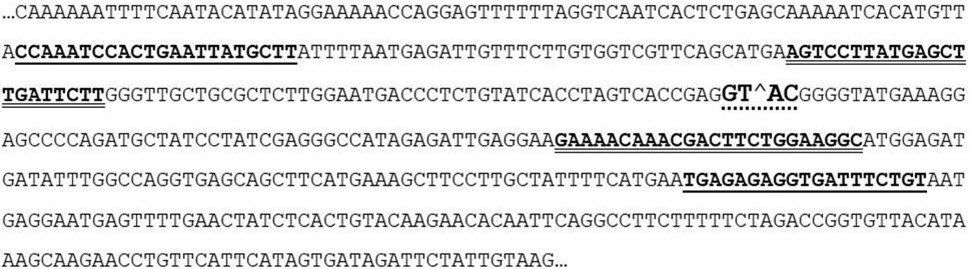
Prl gene exon 4 nucleotide sequences, studied both primer pairs and digested site by the RsaI enzyme (for DNA sequence, GenBank: AF426315.1; note that single underlined primer pairs produce 294 bp fragment, and doubled underlined primer pairs produce 156 bp fragment. GTˆAC: RsaI restriction enzyme digestion site).
References
- Akyuz, B., Arslan, K., Bayram, D. and Iscan, K.M., 2013. Kafkas Univ. Vet. Fak., 9: 439-444.
- Akyuz, B. and Cinar, M.U., 2014. Annls. Anim. Sci., 14: 799-806. https://doi.org/10.2478/aoas-2014-0036[CrossRef]
- Akyuz, B., Agaoglu, K.O. and Ertugrul, O., 2012. Int. J. Dairy Technol., 65: 38-44. https://doi.org/10.1111/j.1471-0307.2011.00732.x[CrossRef]
- Alfonso, E., Rojas, R., Herrera, J.G., Ortega, M.E., Lemus, C., Ruiz, J., Pinto, R. and Gomez, H., 2012. Afri. J. Biotechnol., 11: 7338-7343.
- Alipanah, M., Kalashnikova, L. and Rodionov, G., 2007. Iran. J. Biotechnol., 5: 158-161.
- Alipanah, M., Kalashnikova, L. and Rodionov, G., 2008. J. Anim. Vet. Adv., 6: 813-815.
- Biradar, S.M., Unaune, K.P., Dodamani, S., Mhatre, P.S., Londhe, S.P., Pawar, V.D., Sawane, M.P. and Umrikar, U.D., 2014. J. Cell Tissue Res., 14: 4065-4068.
- Boleckova, J., Matejickova, J., Stipkova, M., Kyselova, J. and Barton, L., 2012. Czech J. Anim. Sci., 57: 45-53. https://doi.org/10.17221/5131-CJAS[CrossRef]
- Brym, P., Kaminski, S. and Wojcik, E., 2005. J. appl. Genet., 45: 179-185.
- Bukhari, S., Khan, N.N., Gupta, P., Das, A.K., Raher, G.A., Chakraborty, D. and Pandey, A., 2013. Int. J. mol. Zool., 3: 10-13.
- Chung, E.R. and Kim, W.T., 1997. Korean J. Diary Sci., 19: 105-112.
- Dayal Das, N., Hatkar, D.N., Hari, V.G.S., Srinivas, B.V., Kaliaperumal, R., Reddy, O.A. and Krishnamurthy, L., 2012. Int. J. Livest. Res., 2: 120-126.
- Dybus, A., 2002. Anim. Sci., 20: 203-212.
- Dybus, A., Grzesiak, W., Kamieniecki, H., Szatkowsk, I., Sobek, Z., Blaszczyk, P., Czerniawska, P.E., Zych, S. and Muszynska, M., 2005. Arch. Anim. Breed, 48: 149-156. https://doi.org/10.5194/aab-48-149-2005[CrossRef]
- Ghasemi, N., Zadehrahmani, M., Rahimi, G. and Hafezian, S.H., 2009. Int. J. Genet. mol. Biol., 1: 48-51.
- Halabian, R., Nasab, M.P.E., Nassiry, M.R., Mossavi, A.R.H., Hosseini, S.A. and Oanbari, S., 2008. Biotechnology, 7: 118-123. https://doi.org/10.3923/biotech.2008.118.123[CrossRef]
- Hallerman, E.M., Theilmann, J.L., Beckmann, J.S., Soller, M. and Womack, J.E., 1988. Anim. Genet., 19: 123-131. https://doi.org/10.1111/j.1365-2052.1988.tb00798.x[CrossRef]
- Ishaq, R., Suleman, M., Riaz, N.M., Yousaf, M., Shah, A. and Ghafoor, A., 2012. Int. J. Dairy Technol., 66: 20-24. https://doi.org/10.1111/j.1471-0307.2012.00875.x[CrossRef]
- Khaizaran, Z.A. and Al-Razem, F., 2014. J. Cell Anim. Biol., 8: 74-85. https://doi.org/10.5897/JCAB2014.0409[CrossRef]
- Kaplan, S. and Boztepe, S., 2010. The determination of prolactin gene polymorphism using PCR-RFLP method within indigenous Anatolian water buffalo and brown Swiss. 2nd International Symposium on Sustainable Development, Sarajevo, pp. 168-173.
- Kepenek, E.S., 2007. Polymorphism of prolactin (Prl), diacylglycerol acyltransferase (DGAT-1) and bovine solute carrier family 35 member 3 (SLC35A3) genes in native cattle breeds and its implication for Turkish cattle breeding. Masters’ thesis, Biological Science Department, Middle East Technical University, Ankara.
- Khatami, S.R., Lazebny, O.E., Maksimenko, V.F. and Sulimova, G.E., 2005. Russian J. Genet., 41: 167-173. https://doi.org/10.1007/s11177-005-0040-x[CrossRef]
- Kumari, A.R., Singh, K.M., Soni, K.J., Patel, R.K., Chauhan, J.B. and Sambasiva, R.K., 2008. Arch. Tierz Dummerstorf, 51: 298-299.
- Lazebnaya, I.V., Lazebny, O.E., Khatami, S.R. and Sulimova, G.E., 2013. Use of the bovine prolactin gene (bPRL) for estimating genetic variation and milk production in aboriginal Russian breeds of Bos taurus L. In: Prolactin (eds. G.M. Nagy and B.E. Toth). InTech, Rijeka, Croatia, pp. 35-52. https://doi.org/10.5772/54756[CrossRef]
- Lewin, H.A., Schmitt, K., Hubert, R., Van Eijk, M.J.T. and Arnheim, N., 1992. Genomics, 13: 44-48. https://doi.org/10.1016/0888-7543(92)90200-C[CrossRef]
- Mahajan, V., Parmar, S.N.S., Thakur, M.S., Sharma, G., Vaishali, V. and Pate, M., 2012. Indian J. Anim. Sci., 82: 46-51.
- Mehmannavaz, Y., Amirinia, C., Bonyadi, M. and Torshizi, R.V., 2009. Afri. J. Biotechnol., 8: 4797-4801.
- Miceikiene, I., Peciulaitiene, N., Baltrenaite, I., Skinkyte, R. and Indriulyte, R., 2006. Biologia, 1: 24-29.
- Mitra, A., Schlee, P., Balakrishnan, C.R. and Pirchner, F., 1995. J. Anim. Breed Gen., 112: 71-74. https://doi.org/10.1111/j.1439-0388.1995.tb00543.x[CrossRef]
- Ozkan-Unal, E., Kepenek, E.S., Ozer, H.D.F., Sonmez, G., Togan, I.Z. and Soysal, M.I., 2015. Turk J. Zool., 39: 734-748. https://doi.org/10.3906/zoo-1409-9[CrossRef]
- Oztabak, K., Un, C., Tesfaye, D., Akis, I. and Mengi, A., 2008. Acta Agric. Scand. Sec. A, 58: 109112. https://doi.org/10.1080/09064700802357771[CrossRef]
- Paramitasari, K.A., Sumantri, C. and Jacaria, K., 2015. Media Paternakan, 38: 1-11. https://doi.org/10.5398/medpet.2015.38.1.1[CrossRef]
- Rorie, R.W., Howland, E.M. and Lester, T.D.E., 2009. Arkansas agric. Exp. Station Res. Ser., 574: 32-34.
- Schennink, A., Bovenhuis, H., Kloosterziel, K.M.L., Arendonk, J.A.M. and Visker, W., 2009. Wageningen Univ. Stitcht. Int. Found. Anim. Genet., 40: 909-916.
- Sharifi, S., Roshanfekr, H., Khatami S.R., Mirzadeh, K.H., 2010. J. Anim. Vet. Adv., 9: 281-283. https://doi.org/10.3923/javaa.2010.281.283[CrossRef]
- Sodhi, M., Mukesh, M., Mishra, B.P., Parvesh, K. and Joshi, B.K., 2011. Biochem. Genet., 49: 39-45. https://doi.org/10.1007/s10528-010-9383-7[CrossRef]
- Sonmez, Z. and Ozdemir, M., 2015. Polymorphism of prolactin (PRL) gene in the East Anatolian red raised as genetic resource in Turkey. 7th Balkan Conference on Animal Science, Balnimalcon, Sarajevo, June 3-6, 2015.
- Uddin, R.M., Babar, M.E., Nadeem, A., Hussain, T., Ahmad, S., Munir, S., Mehboob, R. and Ahmad, F.J., 2013. Mol. biol. Rep., 40: 5685-5689. https://doi.org/10.1007/s11033-013-2670-8[CrossRef]
- Udina, I.G., Turkova, S.O., Kostuchenko, M.V., Lebedeva, L.A. and Sulimova, G.E., 2001. Russian J. Genet., 4: 407-411. https://doi.org/10.1023/A:1016654410191[CrossRef]
- Verma, A., Gupta, I.D. and Gandhi, R.S., 2012. Wayamba J. Anim. Sci., 2012: 408-412. http://www.wayambajournal.com/documents/1337018272.pdf
- Vikas, M., Parmar, S.N.S, Thakur, M.S. and Gurudutt, S., 2012. J. Anim. Res., 2: 173-177.
- Wojdak, M.K., Kmic, M. and Strzalaka, J., 2008. J. Anim. Vet. Adv., 7: 35-40.
Supplementary material
Services
Article usage statistics
Loading…