Research Article · Volume 13, Issue 3, 16 February 2025 · Open Access
Association of PRL/XbaI Polymorphisms with Reproductive Performances in Vietnamese BT and TB Duck Lines
· · · ·
Affiliations & Notes ⌄
1Department of Animal Science, National Chung Hsing University, Taichung 40227, Taiwan
2Faculty of Biological Sciences, Nong Lam University in Ho Chi Minh City - Linh Trung Ward, Thu Duc City, Ho Chi Minh City, Vietnam
3Vigova Poultry Research and Development Center - 496/101 Duong Quang Ham Street, Ward 6, Go Vap District, Ho Chi Minh City, Vietnam
4The iEGG and Animal Biotechnology Center, National Chung Hsing University, Taichung 40227, Taiwan. *Correspondence | Pin-Chi Tang, Department of Animal Science, National Chung Hsing University, Taichung 40227, Taiwan
5Email: pctang@dragon.nchu.edu.tw, Ngoc Tan Nguyen, Faculty of Biological Sciences, Nong Lam University in Ho Chi Minh City - Linh Trung Ward, Thu Duc City, Ho Chi Minh City, Vietnam
This study identified prolactin gene polymorphisms in intron 1 for the first time across two reciprocal crossbred duck lines, BT and TB, with three genotypes and two alleles (SNP 376 C>A).
Results revealed the impact of the polymorphism at PRL/XbaI locus on egg weight, with the TT/XbaI genotype producing a heavier egg weight.
Selected from the article's own text.
Abstract
The prolactin (PRL) gene polymorphisms in the intron 1 region and their association with reproductive traits in the reciprocal TB and BT duck lines were assessed. The 441 bp segment of the PRL gene was amplified from the genomic DNA samples derived from total of 225 ducks (111 TB and 114 BT), and the PCR-RFLP technique to examine the genetic variations in the PRL gene among individuals. The restriction enzyme, XbaI, was digested to cleave the 441-bp PCR products and revealed the TT, TG, and GG genotypes. The TT genotype was most prevalent, with frequencies of 0.820 in TB and 0.754 in BT lines. Allele frequencies of T and G were 0.906 and 0.094 in TB, and 0.868 and 0.132 in BT, respectively. The effective population size (Ne) was 1.205 in TB and 1.297 in BT, while expected heterozygosity (He) values were 0.170 in TB and 0.229 in BT, with polymorphic information content (PIC) values at 0.203 and 0.229, respectively. Ducks with the TT/XbaI genotype exhibited significantly higher (P<0.05) egg weight compared to those with the TG/XbaI genotype in both lines. In the BT line, eggs from TT genotype ducks weighed 76.4 grams versus 74.3 grams from TG genotype ducks (P<0.05). In the TB line, TT genotype ducks had significantly higher egg weight compared to for TG genotype ducks (72.4 grams v.s 69.9 grams; P < 0.05). Furthermore, the TT/XbaI genotype ducks in the BT line (76.4 grams) showed significantly higher (P<0.01) egg weight than those in the TB line (72.4 grams). Polymorphisms were identified at the PRL/XbaI locus, with the TT genotype dominant in the population. Female ducks with the TT genotype showed higher egg weights, indicating that the polymorphism at PRL/XbaI locus may serve as a potential selection genetic marker to improve egg production. Further study is required to explore the impact of this polymorphism on efficacy of breeding selection and application. In addition, maintaining the T allele and TT genotype can be considered in practical conditions for breeding program selections to enhance the egg yield.
The production of duck meat is expanding globally, while in Vietnam, traditional practices like wet rice cultivation and duck farming hold significant importance in the Agri-economy. The country is ranked second behind China, with over 83.7 million ducks as 7% of the global total . Poultry provide vital human nutrition, with duck meat and egg products offering superior nutritional values compared to chicken ; . Vietnam has successfully created numerous high egg-yield duck lines, notably the TC duck strain, a hybrid between the Chinese super-egg-laying duck (Zhejiang/Triet Giang) and the Vietnamese native duck (Co) breed. The TC duck line has a high egg yield, averaging 280.65 to 282.68 eggs/duck over a 52-week laying period, with egg weight of 68 to 70 grams and a feed conversion ratio of 2.04 to 2.10 kg per 10 eggs . The Bien duck, domesticated by Vietnamese scientists at the National Institute of Animal Science, is the first duck line in Vietnam that can live and lay eggs in the marine environment. These ducks drink seawater and eating many kinds of forages in coastal areas, producing around 240 eggs per year ; . Crossbreeding the Bien salt-tolerant and high egg-yielding TC duck lines by reciprocal crosses shows promise for improving adaptability to face the growing challenges of climate change and salt-water intrusion. These environmental shifts present significant challenges for duck farming in Vietnam’s coastal areas, where developing salt-tolerant, high-yield TB and BT crossbred is essential for maintaining stable egg production and ensuring resilience against these evolving conditions.
Marker-assisted selection (MAS) can significantly decrease the time and cost involved in the selection process by eliminating the need for elaborate large-scale experiments, thereby reducing the risks and enhancing overall efficiency . MAS has numerous advantages compared to the conventional Best Linear Unbiased Prediction (BLUP) method by the targeted selection of specific genetic traits, providing flexibility in integrating diverse genetic data. MAS reduces the time and financial resources required for selection ; as a crucial and efficient tool for enhancing the quality and productivity of crops and livestock .
Prolactin (PRL), a hormone produced by the anterior pituitary gland, plays various biological roles across all vertebrates . In ducks, PRL is composed of 229 amino acids, encoded by the prolactin gene . Studies have shown that polymorphisms in intron 1 of the duck prolactin gene are associated with egg weight ; ; , while polymorphisms in exon 5 are linked to annual egg production ; ; . Haplotype analysis revealed that each mutation correlated with egg production and reproductive traits. Studies on various Chinese local duck breeds have identified a C→A mutation at position 381 in intron 1, detected using the XbaI enzyme . In Mulard ducks, the PRL/XbaI polymorphism significantly influences body weight at 10 and 12 weeks of age . Variation at the PRL/XbaI locus within intron 1 significantly influences egg production in Khaki Campbell ducks, particularly benefiting individuals with the GT genotype, which exhibit the highest egg yield .
This study firstly assessed prolactin gene polymorphism in intron 1 region using the PCR-RFLP technique in two reciprocal crossbred duck lines, known for their high egg yield and salt tolerance (referred to as TC×B or the TB line, and B×TC or the BT line). The impact of gene polymorphism on several egg productivity traits of these crossbred duck lines was analyzed to serve as a molecular database to support future selection for enhancing egg production and shortening the time for breeding selection compared to traditional methods, which are crucial for enhancing egg productivity in hybrid duck lines that are created for adaptability in salt tolerance condition.
MATERIALS AND METHODS
Birds
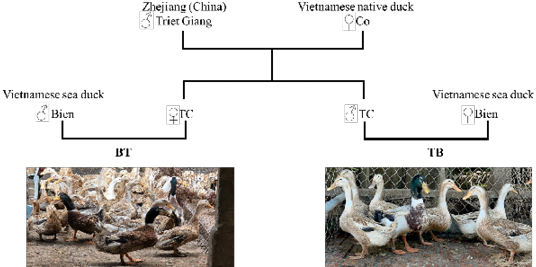
A total of 225 ducks comprised 111 from the TB line and 114 from the BT line (Figure 1) was used. The ducks were raised at the VIGOVA Poultry Research and Development Center. They were kept based on created family units (one male with eight females) with 25 families for one duck line was designed, identified by a wing tag number, and fed according to the standard diet for egg-laying ducks. Commercial feed was provided based on individual family accordingly stages of development: 20-22% crude protein (CP) and 2,850-2,900 kcal metabolizable energy (ME) ad libitum for the starter phase (0 to 8 weeks), 15.5-16.5% CP and 2,700-2,750 kcal ME with restricted feeding for the growing phase (9 to 15 weeks), and 18% CP and 2,700 kcal ME ad libitum for the laying phase (18 to 70 weeks). Clean water was also freely available.
Reproductive parameters recorded included the age at first egg (AFE; in days), the total number of eggs (TNE; eggs) calculated as the number of eggs laid up to 38 weeks of age by the female ducks using individual trap nests, the mean weight of eggs (MEW; in grams) measured by weighing each egg on a digital scale accurate to ±0.01 g, and the total egg weight collected during weeks 37 and 38 ; .
Sample Collection and Genomic DNA Extraction Procedures
Blood samples were collected from the ducks at the age of 8 weeks. The management procedures followed best practices to ensure minimal discomfort for the animals, following the guidelines for the best practice of using animals in research based on EU directive 2010/63. A professional technician drew 1 mL of fresh blood from the wing vein of each duck, then placed in EDTA-treated tubes and stored at 4°C on ice. The samples were transported to the laboratory within 12 hours and stored in a refrigerator at 4°C until extraction, which occurred within one week . Total DNA was extracted using a TopPURE® blood DNA extraction kit (ABT-Vietnam), following the supplier’s guidelines. Total extracted DNA was quantified using two methods: 1% agarose gel electrophoresis and optical density (OD) measurement at wavelengths 260 nm and 280 nm with a NanoBioDrop (BioDrop, UK) spectrophotometer and then preserved at -80°C for further use.
PCR Amplification, PCR-RFLP Assay and Electrophoresis
The PCR amplification of the intron 1 PRL gene region was performed using a Thermo Scientific™ DreamTaq Green PCR Master Mix (2X) (Thermo Scientific, USA), nuclease-free water (Thermo Scientific, USA), agarose (Bioline, UK), a 100-bp ladder (Thermo Scientific, USA), and 0.5X TAE buffer (Vietnam). The PCR reaction was carried out in a total volume of 12.5 µL of chemical components as 0.4 µL of each primer (10 pmol/µL), 3.45 µL of nuclease-free water (Thermo Scientific), 2 µL of DNA template (50 ng/µL) and 6.25 µL of Master Mix (a ready-to-use mixture of Taq DNA polymerase, PCR buffer, MgCl2, and dNTPs). The primer design tool on the NCBI website (https://www.ncbi.nlm.nih.gov/) was used to design a primer based on the sequence identified by accession number AB158611.1. The designed primers had sequences of 5’- ATCGAGGTAAACTCCACGAC -3’ (forward primer) and 5’- TTCAGTGACACTGCTCAGTG-3’ (reverse primer) with a 441 bp fragment length. The thermal cycling program of the PCR reaction included pre-denaturation at 95°C for 3 minutes, followed by 35 cycles of denaturation at 95°C for 30 seconds, annealing at 59°C for 30 seconds, extension at 72°C for 30 seconds and a post-extension at 72°C for 7 minutes . The negative control for PCR involved running a reaction without adding any template DNA. After electrophoresis, the PCR products were visualized using 1% agarose gel stained with GelRed. A 100 bp DNA ladder was run alongside the samples, and the gel was visualized using a GelDoc It2 system (UVP, USA).
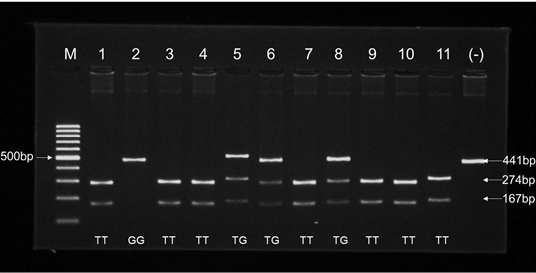
Each digestion reaction had a total volume of 11 µL comprising 5 µL of nuclease-free water, 2 µL of PCR products, 3 µL of 10X CutSmart® Buffer, and 1 µL of XbaI restriction enzyme (25 units/µL). A negative control with all components except the XbaI enzyme was not included. The reaction mixture was incubated at 37°C overnight. The restriction enzyme was then deactivated by adding 4 µL of 2X Gel Loading Dye, Purple (New England Biolabs) to each reaction and incubating at room temperature for 15 minutes following the manufacturer’s instructions. The results were verified by electrophoresis using a 2% agarose gel for 30 minutes. The expected outcomes after the digestion of the three genotypes were TT yield two fragments as 274/167 bp (both alleles are digested), TG yield three fragments of 441/274/167 bp (one allele is digested and other one is undigested), and a GG yield one fragment of 441 bp (none digested by enzyme).
Data Analysis
The restriction enzymes were identified using the NebCutter program version 3.0 (https://nc3.neb.com/NEBcutter/). Allele and genotypic frequencies were calculated following the method described by Abdolhay et al. (2012). Observed heterozygosity (Ho) and expected heterozygosity (He) were determined using the formulas from Cui et al. (2023). A Chi-square (χ2) test was conducted to assess whether the population was in Hardy-Weinberg equilibrium, as described by Rosalinda et al. (2024). The polymorphic information content (PIC) was assessed according to the method described by Serrote et al. (2020). The effective number of alleles (Ne) is a crucial metric for genetic diversity. This value represents the number of effective alleles in a population, equivalent to the number of alleles that, if they had equal frequencies, would produce the same level of genetic diversity observed in the population (Ahmadiet al., 2007). The Ne was calculated using the formula:
Equation 1.
Where; pi is the frequency of the ith allele and k is the total number of alleles in the population .
A one-way analysis of variance (ANOVA) was conducted to evaluate the impact of prolactin gene polymorphism on reproductive traits, followed by Tukey’s test for post-hoc comparisons. A significance level of P<0.05 was used for statistical tests conducted with Minitab software version 22.0.
RESULTS AND DISCUSSION
DNA Amplification and Genotyping of the Prolactin Gene
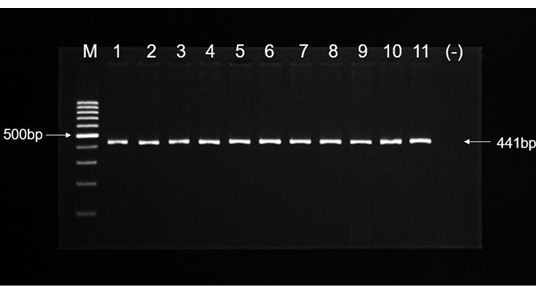
A 441-base pair (bp) fragment from intron 1 of the prolactin gene was successfully amplified across all the duck samples, with the representative electrophoresis image shown in Figure 2. This successful amplification across all the samples demonstrated the consistency and reliability of the procedure. At the negative control position, the absence of a band indicated no contamination during the PCR process.
The next step in the PCR-RFLP technique involved digesting all the PCR products with the restriction enzyme XbaI. The resulting electrophoresis image is presented in Figure 3.
As showed in the Figure 3, the G and T alleles and three genotypic (TT, GT, GG) were detected across all the TB and BT crossbred duck groups. The XbaI restriction enzyme was used to identify three genotypes within the studied duck populations: 441 bp for the GG genotype, 441/274/167 bp for the TG genotype, and 274/167 bp for the TT genotype. This research focused on the SNP 376 C>A (accession number AB158611) to identify genetic polymorphisms in the two studied duck populations following that suggested by several studies ; ; ; .
In TB hybrid ducks, three genotypes TT, TG, and GG were observed with the T allele frequency reaching 0.914 and the G allele frequency 0.086 in females (Table 1). In males, only the TT and TG genotypes were detected, with T and G allele frequencies of 0.875 and 0.125, respectively. For the BT crossbred duck line, the T allele frequency in females was 0.876 and the G allele frequency was 0.124, while the T allele frequency was 0.84 and the G allele frequency was 0.16 in males. Females from the TB line exhibited higher T allele frequency (0.914) than females from the BT line (0.876). Similarly, males from the TB line had a higher T allele frequency (0.875) than those from the BT line (0.84). These data indicated that the T allele was dominant in TB and BT hybrid ducks, aligning with trends reported in various duck breeds in China . By contrast, Chuekwon and Boonlum (2017) reported that the frequency of TT, TG, and GG genotype was 0.07, 0.37, and 0.56, respectively, with a predominance of the G allele at a frequency of 0.74 on Khaki Campbell ducks that showed a markedly different pattern with current study. Whole, monomorphism at the SNP position 376 C>A (accession number AB158611) was observed in certain duck breeds including Muscovy and Perkin . The controversial data among studies could be due to the different of breed sources examined. In current study, the dominant of T allele frequency in TB and BT hybrid ducks could be due to high selection pressure that applied to select the birds in advance for increasing of egg production leading to inbreeding aimed at increasing homozygosity with imbalance allele frequency, it is a necessary step in developing these hybrid lines .
The newly created duck population exhibited an effective number of alleles (Ne) of approximately 1.2 across both lines. Such a low Ne (Ne<5) signifies very limited genetic diversity, primarily resulting from extensive inbreeding carried out over multiple generations to develop specific parental lines for hybridization, leading to reduced allelic diversity ; . The polymorphic information content (PIC) values in the BT and TB duck lines were less than 0.25,
Table 1: Analysis of prolactin gene polymorphism at the PRL/XbaI locus.
indicating low polymorphism levels. A low PIC value reflects the selective breeding process, where individuals were predominantly chosen for high egg production, leading to diminished molecular diversity ; ; . These factors underscore the risks associated with reduced genetic diversity and inbreeding within these newly established lines.
To test whether a population follows Hardy-Weinberg equilibrium (HWE), the chi-square test (χ2) is based on allele frequencies in the population. Since this population has 2 alleles, the degrees of freedom (df) will be 1 . The computed χ² value in Table 1 was less than the critical χ² value at the 0.05 significance level for df = 1, suggesting that the genotype distribution adhered to Hardy-Weinberg equilibrium ; ; . The adherence to HWE may be attributed to factors such as a sufficiently large population size and the process of creating the TB and BT hybrid lines being random mating. This result suggested that the BT and TB populations were in genetic equilibrium and less influenced by selection, mutation, migration, or genetic drift affecting allele frequencies, it could be due to randomly and rotational male used for creating the new line applied, although the imbalance of allele was found as above.
Comparative Analysis of Reproductive Parameters and Association of PRL/XbaI Genotypes with Egg Production in Reciprocal Hybrid Duck Lines (BT and TB)
Comparison of the reproductive parameters of duck lines: The reproductive parameters of the two reciprocal hybrid duck lines (BT and TB) demonstrated statistically significant differences in key egg production (Table 2). The age at first egg (AFE) was earlier in the TB line (148.08 days) compared to the BT line (150.91 days) but no statistical significance was found (P > 0.05). Egg yield (EY) up to 38 weeks of age was significantly higher in the BT line than in the TB line (102.16 vs. 96.63 eggs; P < 0.01). Furthermore, the average egg weight (EW) at 38 weeks was substantially greater in the BT line, averaging 75.95 grams, with the TB line exhibiting a significantly lower average of 72 grams (P < 0.01). These findings highlighted the superior performance of the BT line in terms of egg yield and egg weight, with differences between the lines showing strong statistical significance.
Table 2: Reproductive parameters within the examined duck populations.
Reproductive traits
BT N (Mean ± SE)
TB N (Mean ± SE)
P-value
AFE (days)
88 (150.91b±1.15)
86 (148.08a±1.33)
0.1081*
EY (eggs)
88 (102.16a±1.00)
86 (96.63b±1.25)
0.0007***
EW (grams)
88 (75.95a±0.38)
86 (72,00b±0.39)
0.0001***
Note: AFE: Age at first egg; EY: egg yields up to 38 weeks of age; EW: egg weight at week 38; N: number of individuals; a, b: Values in the same row without common superscripts differ significantly; *: P < 0.05; ***: P < 0.01.
Table 3: Association of PRL/XbaI genotypes on reproductive parameters.
Parameter
Duck line
Genotypes of PRL/XbaI locus
P- value
TT
N (Mean ± SE)
TG
N (Mean ± SE)
AFE (days)
BT
68 (150.7B±1.38)
20 (151.6B±2.03)
0.7497
TB
73 (147.9A±1.51)
13 (149.3A±2.37)
0.6997
P-value
0.1758
0.4846
EY (eggs)
BT
68 (101.9A±1.21)
20 (103.3A±1,76)
0.5877
TB
73 (97.1B±1.37)
13 (94.75B±2.94)
0.3765
P-value
0.0086***
0.0069***
EW (gam)
BT
68 (76.4a, A±0.43)
20 (74.3b, A±0.74)
0.0183*
TB
73 (72.4a, B±0.42)
13 (69.9b, B±0.88)
0.0245*
P-value
0.0001***
0.0007***
Note: AFE: Age at first egg; EY: egg yields up to 38 weeks of age; EW: egg weight at week 38; N: number of individuals; a, b: Values in the same row without common superscripts differ significantly; A, B: Values in the same column of each parameter without common superscripts differ significantly; *: P < 0.05; ***: P < 0.01.
Association of PRL/XbaI genotypes with egg production in reciprocal hybrid duck lines:Statistical data from analyzing the association of PRL/XbaI genotypes with reproductive traits are presented in Table 3. There were no statistically significant differences (P>0.05) between TT/XbaI and TG/XbaI genotypes for age at first egg and egg yield in BT and TB lines (Table 3). In the BT line, the age at first egg was 150.7 days for TT/XbaI and 151.6 days for TG/XbaI, with an egg yield of 101.9 and 103.3 eggs, respectively. In the TB line, the age at first egg was 147.9 days for TT/XbaI and 149.3 days for TG/XbaI, with an egg yield of 97.1 and 94.75 eggs, respectively. Several published studies reported that the PRL/XbaI polymorphism in intron 1 of Khaki Campbell ducks showed a significant impact on egg production. For egg yield, ducks with the GT/XbaI genotype (53.32 eggs) exhibited significantly higher egg production compared to those with GG/XbaI (37.50 eggs) and TT/XbaI (36.67 eggs) genotypes . The controversial results could be come from the different source of duck breeds, previously selection pressure of duck population examined, further study is required.
In the BT line, the average egg weight was 76.4 ± 0.43 grams for the TT genotype and 74.3 ± 0.74 grams for the TG genotype. In the TB line, the average egg weight was 72.4 ± 0.42 grams for the TT genotype and 69.9 ± 0.88 grams for the TG genotype. These differences were statistically significant (P<0.05), suggesting that the PRL/XbaI locus may influence egg weight in both duck lines. These polymorphisms in the PRL gene within intron 1 that affect duck egg weight were consistent with findings from various previous studies ; . Investigation on the Gaoyou duck breed in China revealed that polymorphisms in intron 1 influenced egg weight at the PRL/DraI locus, with the AB/DraI genotype (74.51 g) exhibiting the lowest egg weight compared to the AA/DraI (76.8 g) and BB/DraI (76.72 g) genotypes . Similarly, Bai et al. (2019) reported that polymorphisms in intron 1 of the PRL gene affected egg weight in two Chinese domestic duck lines, Jinding and Youxian, using single-strand conformation polymorphism (PCR-SSCP) analysis. In general, intron 1 does not directly code for proteins but several hypotheses have been proposed to explain its influence, ex: Li et al., (2009) indicated that some introns contain nucleotide sequences that can be translated into novel peptides, which may interact with peptides from the N-terminal exons. Furthermore, the A/C mutation in the non-coding region can also impact gene expression by affecting regulatory elements. Certain intronic SNPs may also activate hidden splice sites, leading to alternative splicing ; . Therefore, while introns are not involved in protein synthesis, variations within intron 1 could potentially affect translation through mechanisms that warrant further investigation. Many studies have shown that gene sequences in intron regions influence the protein expression of these genes ; ; . Intron sequences, once excised during the splicing process, can play a significant role in the formation of microRNAs (miRNAs) . These miRNAs are small RNA molecules, derived from intronic regions of pre-mRNA. The miRNAs are involved in post-transcriptional regulation by binding to complementary sequences in target mRNAs, leading to their degradation or inhibition of translation . This regulatory mechanism allows miRNAs to modulate gene expression and influence protein function . We hypothesized that the influence of the intron 1 region on egg weight differences could be explained by the formation of miRNAs during transcription, where introns are excised. These intron-derived miRNAs are associated with the prolactin gene expression regulation in ducks, thereby affecting egg weight, however, further research is needed to elucidate this hypothesis.
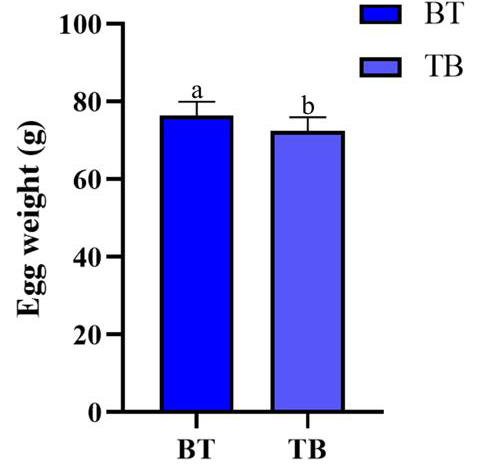
In the same genotype, the BT duck line exhibited higher egg yield and egg weight values compared to the TB duck line (Table 3). Specifically, for the TT genotype, the egg yield in the BT line was 101.9 ± 1.21, whereas in the TB line, it was 97.1 ± 1.37 (P < 0.01). Similarly, for the TG genotype, the BT line demonstrated an egg yield of 103.3 ± 1.76, compared to 94.75 ± 2.94 in the TB line (P < 0.01). When comparing the egg weight of the two duck lines with the same TT/XbaI genotype (Figure 4), the BT duck line showed a significantly higher egg weight compared to the TB duck line (76.4 ± 0.43 grams v.s 72.4 ± 0.42 grams; P<0.01) and this difference was statistically significant at P < 0.01, indicating that the BT duck line produced notably heavier eggs than the TB duck line, resulting in an increase in the total egg yield in terms of quantity. Furthermore, TB line originated from TC male with high egg number in reproductive cycle, meanwhile, BT line originated from Bien breed with less egg number but high egg weight.
Egg weight in ducks is known to influence various aspects of egg quality, including the yolk-to-albumen ratio, shell weight, shell thickness, and hatchability of ducklings ; ; . Heavier duck eggs tend to have a higher yolk proportion compared to lighter eggs ; ; . Consequently, eggs with larger yolks offer greater nutritional value, as yolks are primarily composed of proteins and lipids ; . Pekin ducks in China showed an inverse relationship between egg weight and shell thickness ; , implying that as egg weight increased, the eggshell became thinner, making it harder for the ducklings to hatch . The mortality rate of early stage of embryonic development and hatchability rate are higher in heavier eggs compared to lighter ones (Onbaşılar et al., 2011; . Therefore, depending on the production goals, ducks with the TT/XbaI genotype can be selected from either the BT or TB line. For breeding purposes, the association of PRL/XbaI polymorphism with the yolk egg rate and hatchability rate require further study in both lines.
CONCLUSIONS AND RECOMMENDATIONS
This study identified prolactin gene polymorphisms in intron 1 for the first time across two reciprocal crossbred duck lines, BT and TB, with three genotypes and two alleles (SNP 376 C>A). Results revealed the impact of the polymorphism at PRL/XbaI locus on egg weight, with the TT/XbaI genotype producing a heavier egg weight. Our findings suggested that this marker can be utilized in selective breeding to improve egg yield through egg weight component. Additionally, maintaining the T allele and TT genotype in the practical condition should be considered and further studies are required to explore these associations as clear comprehensively.
ACKNOWLEDGMENTS
We are deeply grateful to all the VIGOVA staffs for collecting of duck blood samples for testing and diligent recording of duck phenotype data during this study.
NOVELTY STATEMENT
This study is the first to investigate the polymorphism of the prolactin gene in intron 1 within reciprocal crosses (BT, TB), demonstrating the positive association of PRL/XbaI in intron 1 on egg production in the new created crossbred ducks with high adaptability to climate change conditions in Vietnam.
AUTHOR’S CONTRIBUTIONS
Tan Loi Le, designed the primers, conducted the genotyping, analyzed the genotype data, and drafted the manuscript. Thi Tuong Vi Trang, analyzed the association of genotype with phenotype data. Tuan Thanh Hoang, handled the collection of phenotypic data. Ngoc Tan Nguyen and Pin-Chi Tang supervised the study, reviewed the manuscript, and ensured that the text was free from plagiarism. All authors have reviewed and approved the final version of the manuscript.
Conflict of Interest
The authors confirm that they have no conflicts of interest.
Figures
Figure 1:.
Breeding scheme illustrating the origins of reciprocal crossing between the TC and B duck lines used in the study. Images of BT (left) and TB (right) ducks at 18 weeks of age.
Figure 2:.
Representative electrophoresis results of PCR products using primer pair L441. M: 100 bp marker. Lanes 1-11: representative samples. (-) negative control.
Figure 3:.
Representative electrophoresis PCR-RFLP pattern of the PRL gene digested with XbaI. M: 100 bp marker. Lanes 1,3,4,7,9,10,11: TT/XbaI genotype. Lanes 5,6,8: TG/XbaI genotype. Lane 2: GG/XbaI. (-) negative control.
Figure 4:.
Chart comparing egg weight of individuals with TT/XbaI genotype in BT and TB lines. a,b: P < 0.001.
References
Abdolhay HA, Khalijah DS, Gilkolahi SR, Pourkazemi M, Shapor SS and Javanmard A (2012). Genetic diversity of Mahisefid (Rutilus frisii kutum Kamensky 1901) in different rivers of the south Caspian Sea using PCR-RFLP.
Abdalhag MA, Zhang T, Fan QC, Zhang XQ, Zhang GX, Wang JY, Wang YJ (2015). Single nucleotide polymorphisms associated with growth traits in Jinghai yellow chickens. Genet. Mol. Res., 14(4): 16169-16177. https://doi.org/10.4238/2015.December.8.6[CrossRef]
Abd El-Hack ME, Hurtado CB, Toro DM, Alagawany M, Abdelfattah EM, Elnesr SS (2019). Fertility and hatchability in duck eggs. World Poult. Sci. J., 75(4): 599-608. https://doi.org/10.1017/S0043933919000060[CrossRef]
Ahn DU, Kim SM, Shu H (1997). Effect of egg size and strain and age of hens on the solids content of chicken eggs. Poult. Sci., 76(6): 914-919. https://doi.org/10.1093/ps/76.6.914[CrossRef]
Ahmadi AK, Rahimi G, Vafaei A, Sayyazadeh H (2007). Microsatellite analysis of genetic diversity in Pekin (Anas platyrhynchos) and Muscovy (Cairina moschata) duck populations. Int. J. Poult. Sci., 6(5): 378-382. https://doi.org/10.3923/ijps.2007.378.382[CrossRef]
Applegate TJ, Harper D, Lilburn MS (1998). Effect of hen production age on egg composition and embryo development in commercial Pekin ducks. Poult. Sci., 77: 1608–1612. https://doi.org/10.1093/ps/77.11.1608[CrossRef]
Bai DP, Hu YQ, Li YB, Huang ZB, Li A (2019). Polymorphisms of the prolactin gene and their association with egg production traits in two Chinese domestic ducks. Br. Poult. Sci., 60(2): 125-129. https://doi.org/10.1080/00071668.2019.1567909[CrossRef]
Bagheri ASS, Niazi A, Zamiri MJ, Dadpasand MT (2013). Polymorphisms of prolactin gene in a native chicken population and its association with egg production. Iran. J. Vet. Res., 14(2): 113-119. https://doi.org/10.22099/IJVR.2013.1584[CrossRef]
Basumatary K, Das B, Borah P, Barkalita L, Bharali K, Tamuly S (2019). Polymorphism of prolactin receptor gene in indigenous ducks of Assam. J. Entomol. Zool. Stud., 7(1): 922-925.
Biswas S, Banerjee R, Bhattacharyya D, Patra G, Das AK, Das SK (2019). Technological investigation into duck meat and its products-a potential alternative to chicken. World Poult. Sci. J., 75(4): 609-620. https://doi.org/10.1017/S004393391900062X[CrossRef]
Chang MT, Cheng YS, Huang MC (2012). Association of prolactin haplotypes with reproductive traits in Tsaiya ducks. Anim. Reprod. Sci., 135(1-4): 91-96. https://doi.org/10.1016/j.anireprosci.2012.08.024[CrossRef]
Cui J, Jiang Z, Wang Z, Shao J, Dong C, Wang L, Zhang M (2023). Eight single nucleotide polymorphisms and their association with food habit domestication traits and growth traits in largemouth bass fry (Micropterus salmoides) based on PCR-RFLP method. PeerJ, 11: e14588. https://doi.org/10.7717/peerj.14588[CrossRef]
Chesnokov YV, Artemyeva AM (2015). Evaluation of the measure of polymorphism information of genetic diversity. Agr. Biol., 5: 571-578. https://doi.org/10.15389/agrobiology.2015.5.571eng[CrossRef]
Chuekwon K, Boolum S. (2017). Association of Prolactin Gene with Egg Production in Khaki Campbell Ducks. Walailak J. Sci. Tech., 14: 849-853.
Debnath J, Debnath S, Sarkar D, Debroy B, Kumar M, Das AK (2023). Genetic characterisation of indigenous duck of Tripura state in India using microsatellite markers. Trop. Anim. Health Prod., 55(3): 198. https://doi.org/10.1007/s11250-023-03629-w[CrossRef]
Dong Y, Yan H, Li J, Bei L, Shi X, Zhu Y, Jiang S (2023). miR-155-1 as a positive factor for novel duck reovirus replication by regulating SOCS5-mediated interferons. Virus Res., 323: 199003. https://doi.org/10.1016/j.virusres.2022.199003[CrossRef]
Galić A, Filipovic D, Pliestic S, Janječić Z, Bedeković D, Kovačev I, Koronc Z (2019). The comparison of quality characteristics of Pekin duck and Cherry Valley duck eggs from free-range raising system. J. Cent. Eur. Agric., 20(4): 1099-1110. https://doi.org/10.5513/JCEA01/20.4.2432[CrossRef]
Gallegos JE, Rose AB (2019). An intron-derived motif strongly increases gene expression from transcribed sequences through a splicing independent mechanism in Arabidopsis thaliana. Sci. Rep., 9(1): 13777. https://doi.org/10.1038/s41598-019-50389-5[CrossRef]
Gutierrez-Reinoso MA, Aponte PM, Garcia-Herreros M (2021). Genomic analysis, progress and future perspectives in dairy cattle selection: a review. Animals, 11(3): 599. https://doi.org/10.3390/ani11030599[CrossRef]
Henning J, Henning KA, Long NT, Ha NT, Vu LT, Meers J (2013). Characteristics of two duck farming systems in the Mekong Delta of Viet Nam: stationary flocks and moving flocks, and their potential relevance to the spread of highly pathogenic avian influenza. Trop. Anim. Health Prod., 45: 837-848. https://doi.org/10.1007/s11250-012-0296-9[CrossRef]
Huang LH, Lin PH, Tsai KW, Wang LJ, Huang YH, Kuo HC, Li SC (2017). The effects of storage temperature and duration of blood samples on DNA and RNA qualities. PloS one, 12(9): e0184692. https://doi.org/10.1371/journal.pone.0184692[CrossRef]
Huang J, Xiong X, Zhang W, Chen X, Wei Y, Li H, Zhou Q (2024). Integrating miRNA and full-length transcriptome profiling to elucidate the mechanism of muscle growth in Muscovy ducks reveals key roles for miR-301a-3p/ANKRD1. BMC Genomics, 25(1): 340. https://doi.org/10.1186/s12864-024-10138-z[CrossRef]
Ibrahim D, Goshu G, Esatu W, Bino G, Abebe T (2018). Comparative study of production and reproductive performance of various strains of chicken parent layers raised in floor pens. Eth. J. Agric. Sci., 28(3), 79-93.
Ipek AYDIN, Sozcu ARDA (2017). Comparison of hatching egg characteristics, embryo development, yolk absorption, hatch window, and hatchability of Pekin Duck eggs of different weights. Poult. Sci., 96(10): 3593-3599. https://doi.org/10.3382/ps/pex181[CrossRef]
Jalaludeen A, Churchil RR (2022). Duck production: An overview. In, Jalaludeen A, Churchil RR, Baéza E (Eds): Duck Production and Management Strategies, 1-55, Springer, Singapore,
Kuru B, Kirmizibayrak T, Cengiz M, Işik S (2023). The effect of egg weight on egg external quality characteristics and hatching performance in Pekin ducks. Kafkas Universitesi Veteriner Fakultesi Dergisi, 29(4). https://doi.org/10.9775/kvfd.2023.29657[CrossRef]
Kokoszyński D, Bernacki Z, Korytkowska H (2007). Eggshell and egg content traits in Pekin duck eggs from the P44 reserve flock raised in Poland. J. Cent. Eur. Agric. 8: 9–16. https://doi.org/10.5513/jcea.v8i1.427[CrossRef]
Kansaku N, Hiyama G, Sasanami T, Zadworny D (2008). Prolactin and growth hormone in birds: protein structure, gene structure and genetic variation. J. Poult. Sci, 45(1): 1-6. https://doi.org/10.2141/jpsa.45.1[CrossRef]
Liu Y, Ma Y, Chi Y, Chi Y (2022). Change in rapid salting kinetics and characteristics of hen egg yolks. J. Food Eng., 329: 111090. https://doi.org/10.1016/j.jfoodeng.2022.111090[CrossRef]
Li HF, Zhu WQ, Chen KW, Zhang TJ, Song WT (2009). Association of polymorphisms in the intron 1 of duck prolactin with egg performance. Turk. J. Vet. Anim. Sci., 33: 193-197. https://doi.org/10.3906/vet-0709-4[CrossRef]
Li R, Song X, Gao S, Peng S (2022). Analysis on the interactions between the first introns and other introns in mitochondrial ribosomal protein genes. Front. Microbiol., 13: 1091698. https://doi.org/10.3389/fmicb.2022.1091698[CrossRef]
Lin L, Liu Y, Liang R, Guo Y, Xu R, Fan R, Li J (2024). Size-dependent enhancement of gene expression by Plasmodium 5’UTR introns. Parasites Vectors, 17(1): 238. https://doi.org/10.1186/s13071-024-06319-0[CrossRef]
Mazurowski A, Frieske A, Wilkanowska A, Kokoszyński D, Mroczkowski S, Bernacki Z, Maiorano G (2016). Polymorphism of prolactin gene and its association with growth and some biometrical traits in ducks. Ital. J. Anim. Sci., 15: 200-206. https://doi.org/10.1080/1828051X.2016.1153405[CrossRef]
MacFarlane LA, Murphy P (2010). MicroRNA: biogenesis, function and role in cancer. Curr. Genomics., 11(7): 537-561. https://doi.org/10.2174/138920210793175895[CrossRef]
Nguyen NT, Le TL, Vo TKN, Do CH, Hoang TT, Duong NK, Luu QM (2023). Effect of a polymorphism in prolactin gene on some reproductive traits in TB crossbred ducks in Southern Vietnam. Adv. Anim. Vet. Sci, 11(6): 886-892. https://dx.doi.org/10.17582/journal.aavs/2023/11.6.886.892[CrossRef]
Nasri H, Brand HVD, Najjar T, Bouzouaia M (2020). Egg storage and breeder age impact on egg quality and embryo development. J. Anim. Physiol. Anim. Nutr., 104(1): 257-268. https://doi.org/10.1111/jpn.13240[CrossRef]
Nei M (1978). Estimation of average heterozygosity and genetic distance from a small number of individuals. Genetics., 89(3): 583-590. https://doi.org/10.1093/genetics/89.3.583[CrossRef]
Nguyen DT, Nguyen VD, Hoang VT, Vuong TLA, Dang TV, Nguyen TTN, Dong TQ, Vu HT, Hoang VT (2011). Performance of four crossbreds between Co duck and Trietgiang duck. J. Anim. Husband. Sci. Tech., 273: 2-12 (Abstract in English).
Onbasilar EE, Erdem E, Poyraz O, Yalsin S (2011). Effects of hen production cycle and egg weight on egg quality and composition, hatchability, duckling quality, and first-week body weight in Pekin ducks. Poult. Sci., 90(11): 2642-2647. https://doi.org/10.3382/ps.2011-01359[CrossRef]
Osman MM, Hemeda SA, Hassanin AA, Husseiny WA (2017). Polymorphism of prolactin gene and its association with egg production trait in four commercial chicken lines. J. Hellenic Vet. Med. Soc., 68(3): 391-404. https://doi.org/10.12681/jhvms.15502[CrossRef]
Qin GL, Fu CM, Tang F, Yin J, Guan DL, Shi CY (2024). Population genomics analysis reveals footprints of selective breeding in a rapid-growth variety of Paulownia fortunei with apical dominance. Genomics, 116(3): 110849. https://doi.org/10.1016/j.ygeno.2024.110849[CrossRef]
Rosalinda E, Sari APZNL, Saraswati YV, Istarisa AF, Sasongko H, Alfiyanto AR, Maharani D (2024). Single Nucleotide Polymorphism and Restriction Enzyme Analysis of Chicken’s Prolactin Gene based on Genbank Sequences. In IOP Conference Series: Earth and Environmental Science (Vol. 1360, No. 1, p. 012024). IOP Publishing. https://doi.org/10.1088/1755-1315/1360/1/012024[CrossRef]
Sabry NM, Mabrouk DM, Abdelhafez MA, El-Komy EM, Mahrous KF (2020). Polymorphism of the prolactin gene in Egyptian duck breeds J. World Poult. Res,. 10(4): 587-598. https://doi.org/10.36380/jwpr.2020.67[CrossRef]
Sari APZNL, Fathoni A, Sasongko H, Hariyono DNH, Kumalawati DS, Maharani D (2022). Genetic Diversity of the Prolactin Gene in Three Indonesian Ducks. In 2nd International Conference on Smart and Innovative Agriculture (ICoSIA 2021) (pp. 350-354). Atlantis Press. https://doi.org/10.2991/absr.k.220305.054[CrossRef]
Sanni MA, Awobajo OK, Osaiyuwu OH (2024). Biochemical analysis of genetic variations in Nigerian mallard and muscovy ducks. Int. J. Agric. Agric. Technol.,
Serrote CML, Reiniger LRS, Silva KB, dos Santos Rabaiolli SM, Stefanel CM (2020). Determining the polymorphism information content of a molecular marker. Gene, 726: 144175. https://doi.org/10.1002/9781118445112.stat05425[CrossRef]
Trakovická A, Moravčíková N, Gábor M, Miluchová M (2014). Genetic polymorphism of Pit-1 gene associated with milk production traits in Holstein cattle. Acta Agraria Kaposváriensis, 18(1): 146-151.
Vuong TLA, Nguyen VD, Mai TH, Nguyen VT, Hoang VT (2019). Productivity of commercial sea ducks 15 - Dai Xuyen reard in fresh and salt water condition. J. Anim. Sci. Technol., 103: 21-34 (Abstract in English).
Wang C, Liang Z, Yu W, Feng Y, Peng X, Gong Y, Li S (2011). Polymorphism of the prolactin gene and its association with egg production traits in native Chinese ducks. S. Afr. J. Anim. Sci., 41(1). https://doi.org/10.4314/SAJAS.V41I1.66044[CrossRef]
Wakchaure R, Ganguly S, Praveen PK, Kumar A, Sharma S, Mahajan T (2015). Marker Assisted Selection (MAS) in Animal Breeding: A Review. J Drug Metab Toxicol 6: e127.
Weng K, Song L, Bao Q, Cao Z, Zhang Y, Zhang Y, Xu Q (2022). Comparative characterization of key volatile compounds in slow-and fast-growing duck raw meat based on widely targeted metabolomics. Foods, 11(24): 3975. https://doi.org/10.3390/foods11243975[CrossRef]
Zhang RF, Xie WM, Zhang T, Lei CZ (2016). High polymorphism at microsatellite loci in the Chinese donkey. Genet. Mol. Res., 15(2): gmr-15028291. https://doi.org/10.4238/gmr.15028291[CrossRef]
Zhang M, Luo H, Xu L, Shi Y, Zhou J, Wang D, Wang Y (2022). Genomic selection for milk production traits in Xinjiang Brown cattle. Animals, 12(2): 136. https://doi.org/10.3390/ani12020136[CrossRef]
Yurnalis A, Kamsa A, Putra DE (2019). Polymorphism of prolactin genes and its association with body weight in Bayang ducks, local duck from West Sumatera, Indonesia. Earth Environ. Sci., 287: 012009. https://doi.org/10.1088/1755-1315/287/1/012009[CrossRef]