Research Article · Volume 14, Issue 4, 7 October 2026 · Open Access
Genetic Analysis of the Prolactin (PRL) Gene in Bushuev Cattle of Uzbekistan
· · · · · ·
Affiliations & Notes ⌄
- 1Animal Genetics Laboratory, Institute of Genetics and Plant Experimental Biology, Academy of Sciences of the Republic of Uzbekistan, Kibray District, Tashkent Region 111226, Uzbekistan. *Correspondence | Bobur Akhmadaliev, Animal Genetics Laboratory, Institute of Genetics and Plant Experimental Biology, Academy of Sciences of the Republic of Uzbekistan, Kibray District, Tashkent Region 111226, Uzbekistan
- 2Email: ahmadaliyev_bobur@mail.ru
Article Info ⌄
- Journal:
- Journal of Animal Health and Production
- Published:
- 7 October 2026

From the article
- The studied population exhibited moderate genetic diversity, conformed to Hardy-Weinberg equilibrium, and showed no evidence of significant inbreeding.
- A significant association was detected between PRL genotypes and milk production traits.
- The AG genotype was associated with higher milk yield, whereas the AA genotype exhibited higher milk fat and protein contents.
- These findings indicate that the g.8398A>G polymorphism of the PRL gene may serve as a useful molecular marker for marker-assisted breeding aimed at improving milk production while maintaining desirable milk quality and genetic diversity in Bushuev cattle.
Selected from the article's own text.
Abstract
INTRODUCTION
Bushuev cattle breed was developed in Uzbekistan and it is considered as an important indigenous genetic resource which is well adapted easily under harsh environmental conditions. This breed has a stable productivity when managed locally with existing production systems . However, with the widespread application of high yielding commercial breeds and implementation of crossbreeding program there are always worries regarding loss of genetic diversity among native cattle population including Bushuev cattle. Therefore, conservation and genetic enhancement of this indigenous breed has got much importance. Lactation is a complex quantitative trait determined by many genetic and environmental factors. Genes associated with lactation process include genes involved in regulation of endocrine functions, which determine milk yield and milk composition of various nutrient components. For instance, PRL gene, encodes a multifunctional polypeptide hormone secreted by anterior pituitary gland is essential for in initiation and maintenance of lactation in mammals ; . In addition to contributes in lactation process itself, this hormone participates in mammary gland development, controls the synthesis of milk proteins, lactose and lipids . In cattle PRL gene is expressed not just within anterior pituitary gland but also some other extrapituitary tissues such as the central nervous system, immune system and mammary gland ; . This gene is located on chromosome 23 spans approximately 10 kb, containing five exons and four introns encoding 199 amino acid polypeptides ; ; . In addition, several polymorphic sites are identified within this locus. The significance of their association with many economically important dairy traits including milk yield, and milk composition have demonstrated by some authors ; . A silent mutation in exon 3 of the PRL gene has been proposed as a potential molecular marker for dairy cattle breeding . Likewise, the PRL-RsaI polymorphism has been associated with variations in milk yield and milk fat percentage in different cattle populations ; . Although PRL gene polymorphisms have been extensively investigated in many cattle breeds, information regarding indigenous Uzbek cattle, particularly the Bushuev breed, remains limited. Bushuev cattle are well adapted to low-input production systems and combine heat tolerance, disease resistance, and satisfactory productive performance under local environmental conditions. Characterizing genetic variation within this breed is therefore important for both conservation and genetic improvement strategies. Therefore, this study aimed to investigate the g.8398A>G polymorphism of the PRL gene in Bushuev cattle using allele-specific real-time PCR and to evaluate its association with milk production traits. The findings of this study may contribute to marker-assisted breeding programs and support the conservation and sustainable genetic improvement of this valuable indigenous cattle breed.
MATERIALS AND METHODS
Sample collection
Blood samples were collected from 96 randomly selected, clinically healthy lactating Bushuev cattle raised on livestock farms in the Tashkent (n= 36) and Syrdarya (n= 60) regions of Uzbekistan. Approximately 5 mL of whole blood was collected from each animal into sterile EDTA-containing vacutainer tubes. The samples were transported to the laboratory and stored at 4°C until genomic DNA extraction.
Phenotypic records
Animals were milked twice per day with a 12-hour interval between sessions. Milk yield for a standard 305-day lactation period was derived from farm records. Milk samples (50 mL) were collected aseptically in sterile Falcon tubes. The fat and protein contents of the milk were measured using a milk analyser (BKMA-MK, Biobase, China).
DNA extraction
The genomic DNA was isolated with GeneJET Genomic DNA Purification Kit (Thermo Fisher Scientific, USA), following the manufacturer’s protocol. Quantification of DNA concentration and purity was carried out on NanoDrop Eight spectrophotometer (Thermo Fisher Scientific, USA). DNA samples were diluted to 100 ng/μL and kept at - 20 °C before use.
SNP genotyping by real-time PCR
The SNP rs211032652 (g.8398A>G) in the PRL gene was genotyped by allele-specific real-time PCR using SNP Pol DNA Polymerase (Genaxxon Bioscience GmbH, Germany), a highly selective DNA polymerase engineered for precise single-nucleotide discrimination. This enzyme efficiently distinguishes primers containing a mismatch at the 3′ end and permits amplification only when there is complete complementarity at this position. Amplification occurs only when the 3′ terminal nucleotide of the primer perfectly matches the target sequence. Each allele-specific primer (Table 1) was designed to specifically recognize one of the two allelic variants through its 3′ terminal nucleotide. Each allele was analyzed in a separate PCR reaction using individual wells, with SYBR Green employed for fluorescence detection. Accordingly, two independent PCR reactions were carried out for every DNA sample. PCR amplification was performed on a QuantStudio™ 5 Real-Time PCR System (Thermo Fisher Scientific, USA) using a final reaction volume of 25 μL. Each 25 μL reaction contained 17.25 μL of sterile distilled water, 2.5 μL of 10× amplification buffer, 0.25 μL of SNP Pol DNA polymerase, 0.5 μL of dNTPs, 0.5 μL of a 10 μM allele-specific forward primer (PRL-A-F or PRL-G-F), 0.5 μL of the reverse primer (PRL-com-R), 0.5 μL of SYBR Green (final concentration 0.2×), and 3 μL of template DNA. For PRL SNP genotyping, the following real-time PCR thermal cycling program was applied. The thermal cycling program began with an initial denaturation step at 95 °C for 2 min, followed by 50 cycles of denaturation at 95 °C for 15 s, annealing at 56 °C for 10 s, and extension at 72 °C for 40 s, during which fluorescence signals were recorded. Amplification specificity was confirmed by melt curve analysis, which included sequential incubation at 95 °C for 15 s, 60 °C for 1 min, and 95 °C for 1 s. Data were analyzed using Quant Studio™ Design and Analysis Software v1.5.2 Real-Time PCR Software.
Statistical analysis
Genetic variation within the Bushuev cattle population at the PRL gene was evaluated using POPGENE v.1.32. Analyses involved determination of the frequency of alleles and genotypes at every locus studied, as well as computation of the observed Na and effective numbers of alleles, Ne respectively. Measures of genetic variability included calculations of both observed Ho and expected He heterozygosities, as well as observed Homo and expected Home homozygosity. In addition, other measures such as Nei’s genetic diversity index H, fixation index FIS and Shannon’s Information Index I were determined. The genotype distribution was tested for conformity with Hardy-Weinberg equilibrium using the chi-square (χ²) test. Effects of genotype on quantitative phenotypic characteristics related to milk production (milk yields, percentages of fat and protein content of milk samples) were analyzed through ANOVA. Analysis of variance was executed using IBM SPSS Statistics package version 29.0 (IBM Corp., Armonk, NY, USA) employing “one way” analysis of variance.
RESULTS
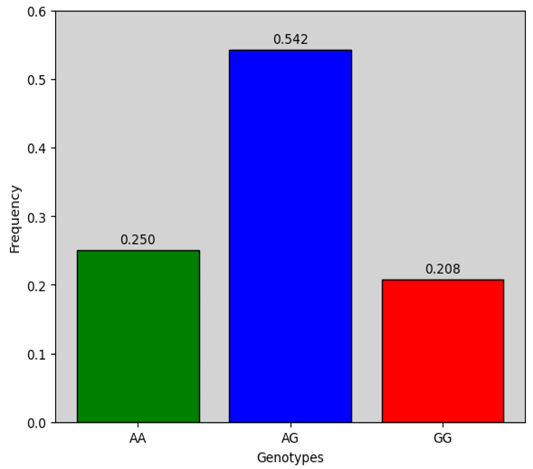
The distribution of PRL genotypes was examined to assess the genetic structure of the Bushuev cattle population. Among the 96 animals analyzed, 24 were identified as AA, 52 as AG, and 20 as GG. The AG genotype was the most prevalent, accounting for 54% of the sampled animals, whereas the AA and GG genotypes represented 25% and 21%, respectively. Allele frequencies were similar, with the A allele occurring at a frequency of 0.521 and the G allele at 0.479 (Table 2).
Table 1: Primers used for SNP genotyping.
|
Primer name |
Sequence |
|
PRL-A-F |
GTATCACCTAGTCACCGAGGTA |
|
PRL-G-F |
GTATCACCTAGTCACCGAGGTG |
|
PRL-com-R |
CATCTCCATGCCTTCCAGAAG |
Table 2: Genotype distribution and allele frequencies of the PRL gene.
|
Category |
Variant |
Count (n) |
Frequency |
|
Genotypes |
AA |
24 |
0.250 |
|
AG |
52 |
0.542 |
|
|
GG |
20 |
0.208 |
|
|
Alleles |
A |
0.521 |
|
|
G |
0.479 |
Assessment of genetic diversity showed a slight predominance of heterozygous individuals. The observed heterozygosity (Ho = 0.542) was marginally higher than the expected heterozygosity (He = 0.500), while the observed homozygosity (0.458) was lower than the expected value (0.500). Nei’s genetic diversity index (H = 0.500) further indicated that the Bushuev cattle population possesses a moderate level of genetic variation (Table 3).
Table 3: Genetic diversity parameters.
|
Parameter |
Value |
|
Observed heterozygosity (Ho) |
0.542 |
|
Expected heterozygosity (He) |
0.500 |
|
Observed homozygosity |
0.458 |
|
Expected homozygosity |
0.500 |
|
Nei’s genetic diversity (H) |
0.500 |
|
Fixation index (FIS) |
-0.084 |
|
Shannon index (I) |
0.692 |
The fixation index was negative (FIS= -0.084), suggesting a modest excess of heterozygotes compared with Hardy-Weinberg expectations. This finding was supported by Shannon’s information index (I= 0.692), which also reflected moderate genetic diversity within the population.
The observed genotype frequencies were consistent with Hardy-Weinberg equilibrium, as no significant deviation was detected (χ²= 0.669, df= 1, p > 0.05) (Table 4). These findings indicate that the studied population maintains a balanced genetic structure and shows no evidence of inbreeding.
Table 4: Hardy-weinberg equilibrium test.
|
Statistic |
Value |
|
χ² |
0.669 |
|
df |
1 |
|
p-value |
>0.05 |
The association analysis revealed that PRL genotypes significantly affected milk production traits (Table 5). Milk yield differed significantly among the three genotypes (F₂,₉₃ = 24.87, p < 0.0001; Table 6). Animals carrying the AG genotype achieved the highest average milk yield (5489.3 ± 30.5 kg). The GG genotype ranked second with an average yield of 5088.7 ± 46.9 kg, whereas cows with the AA genotype produced the lowest yield (4378.6 ± 41.2 kg). Although no significant difference was detected between the AG and GG genotypes, both produced significantly more milk than the AA genotype.
Table 5: Effect of PRL genotypes and breed on milk yield traits.
|
N |
Milk yield |
Fat % |
Protein % |
|
|
AA |
24 |
4378.6 ± 41.2ᵃ |
4.72 ± 0.05ᵇ |
3.97 ± 0.06ᵇ |
|
AG |
52 |
5489.3 ± 30.5ᵇ |
4.18 ± 0.04ᵃ |
3.38 ± 0.04ᵃ |
|
GG |
20 |
5088.7 ± 46.9ᵇ |
4.07 ± 0.05ᵃ |
3.44 ± 0.03ᵃ |
Values are presented as mean ± standard error. Different superscript letters (a, b) within the same column indicate statistically significant differences among genotypes (p < 0.05).
Table 6: Analysis of variance (ANOVA) for milk yield (kg) by genotype.
|
Source |
DF |
SS |
MS |
F-value |
p-value |
|
Genotype |
2 |
18,920,000 |
9,460,000 |
24.87 |
<0.001 |
|
Error |
93 |
35,380,000 |
380,430 |
||
|
Total |
95 |
54,300,000 |
Table 7: Analysis of variance (ANOVA) for milk fat percentage by genotype.
|
Source |
DF |
SS |
MS |
F-value |
p-value |
|
Genotype |
2 |
4.12 |
2.06 |
18.42 |
<0.001 |
|
Error |
93 |
10.40 |
0.112 |
||
|
Total |
95 |
14.52 |
A significant relationship was also observed between genotype and milk fat percentage (F₂,₉₃= 18.42, p < 0.0001; Table 7). The highest fat content was recorded in cows with the AA genotype (4.72±0.05%). In contrast, the AG and GG genotypes showed lower fat percentages of 4.18 ±0.04% and 4.07±0.05%, respectively, with no significant difference between these two groups.
Milk protein content was likewise influenced by PRL genotype (F₂,₉₃= 12.76, p < 0.0001; Table 8). Cows carrying the AA genotype had the highest average protein content (3.97 ± 0.06%), whereas animals with the AG and GG genotypes showed lower values of 3.38 ± 0.04% and 3.44 ± 0.03%, respectively. The difference between the AG and GG genotypes was not statistically significant.
Table 8: Analysis of variance (ANOVA) for milk protein percentage by genotype.
|
Source |
DF |
SS |
MS |
F-value |
p-value |
|
Genotype |
2 |
1.98 |
0.99 |
12.76 |
<0.001 |
|
Error |
93 |
7.21 |
0.077 |
||
|
Total |
95 |
9.19 |
Taken together, these findings demonstrate that variation at the PRL g.8398A>G locus is associated with important milk production characteristics in Bushuev cattle. While the AG genotype was linked to higher milk yield, the AA genotype was associated with increased milk fat and protein contents, indicating a balance between milk quantity and composition among the different genotypes.

DISCUSSION
The observed heterozygosity (Ho= 0.542) was slightly higher than the expected heterozygosity (He= 0.500), suggesting a preservation of the genetic diversity within this breed with no evidence of significant inbreeding within the studied population. In conclusion, our current results demonstrated an average Ho value which was close to the expected value of the same gene pool (Ho/He ratio = 1.08). Our data also showed no significant deviation from Hardy-Weinberg equilibrium (χ²= 0.669). Furthermore, based on the negative fixation index (FIS=-0.084), we could assume the existence of a small number of heterozygous individuals over the general population. Overall, these findings confirm a balanced genetic structure within the studied population, with no evidence of significant inbreeding. These findings indicate that the studied population represents valuable breeding stock for future breeding programs while contributing to the conservation of the breed’s genetic resources. Demir et al. reported similar findings some genetic parameters in the same population and reported comparable results . Öner et al. (2019) reported that the level of heterozygosities ranged between 0.48 and 0.55 in several Turkish cattle breeds . In agreement with our study, they recorded negative or nearly zero values for FIS indices. These findings suggest that the amount of inbreeding events remained quite minimal at different levels of animal production chains in Turkey. Similarly, Solodneva et al. demonstrated that in cattle populations where Ho > He, FIS values tend to be negative, reflecting an excess of heterozygosity . In our population, the condition Ho > He and FIS = -0.084 further supports the maintenance of heterozygosity and overall genetic stability. Recent genomic studies back this up. A large-scale genomic study of West African cattle identified several regions with high genetic diversity that contribute to environmental adaptation. The maintenance of this diversity was attributed to balancing selection and continuous gene flow . This aligns with our observation of Ho > He and suggests that similar evolutionary mechanisms may be operating in the studied population. Likewise, studies on Holstein cattle using high-density SNP data have shown that heterozygosity patterns are closely linked to inbreeding levels and population history, with lower inbreeding corresponding to higher heterozygosity . Our negative FIS value supports this relationship, indicating minimal inbreeding pressure. Genomic inbreeding coefficients for Holstein cattle were recently examined to learn about the effects of recent advances in dairy cattle breeding strategy. It has been shown that these approaches are effective at maintaining genetic diversity while limiting the detrimental effects of inbreeding. Bogatova et al. show this by demonstrating how breeders can maintain levels of homozygosity through carefully planned breeding strategies Bogatova et al. (2024). This is not only true for purebred populations. Crossbred cattle show a similar story. Studies like Yousief et al. report that while observed heterozygosity (Ho) fluctuates, expected heterozygosity (He) remains fairly stable . That pattern points to gene flow and ongoing admixture-real signs that breeders are not closing off genetic lines, but are instead mixing them thoughtfully to guard overall diversity. This trend lines up closely with our own data. The evidence points to a role for gene introgression and strategic outbreeding in bolstering heterozygote excess. In other words, the cattle are not just avoiding inbreeding by accident; structured breeding or deliberate crossbreeding practices inject new genetic material into populations, leading to more heterozygotes than would appear through random mating alone. What really stands out in the recent literature, though, is the practical value of this genetic diversity. Kenny et al. highlight how genomic heterozygosity goes hand in hand with hybrid vigour, or heterosis . When animals are more genetically varied, greater heterozygosity has been associated with improved productive performance. Populations with higher heterozygosity show gains in productivity, greater resilience to disease and shifting environments, and better overall adaptation. This does not seem to wane even when populations look stable on the surface. Taken together, the mounting evidence not only supports the efficacy of modern breeding strategies but also underscores the serious economic and biological importance of preserving heterozygosity for the long-term health and productivity of cattle herds. This provides a biological explanation for why maintaining heterozygosity, as observed in our study, is advantageous for breeding programs. Comparisons with earlier and contemporary studies further reinforce these conclusions. Moderate heterozygosity levels (Ho around 0.50) are common in many cattle populations and usually signal strong genetic health and adaptability. These findings are consistent with effective population management practices, as reported by Leroy . When observed heterozygosity exceeds expected heterozygosity (Ho > He) and FIS values are negative, this may indicate gene flow, balancing selection, or breeding practices that avoid mating among closely related individuals. Hardy-Weinberg equilibrium holds steady here, which means nothing dramatic-like selection, migration, or mutations-is throwing allele frequencies out of line at this gene. High heterozygosity combined with low levels of inbreeding indicates that the studied population has retained sufficient genetic diversity to support future genetic improvement. These findings are particularly important for breeding programmes aimed at improving economically important traits such as fertility, milk production, and disease resistance. The maintenance of genetic diversity is essential for enhancing the adaptability and long-term sustainability of cattle populations under changing environmental and management conditions. Our results are consistent with previous genomic studies reporting that increasing heterozygosity and negative FIS values are characteristic of genetically stable and well-managed cattle populations. The present study also demonstrated a significant association between the g.8398A>G polymorphism of the PRL gene and economically important milk production traits. The significant effect of genotype on milk yield (F₂,₉₃ = 24.87, p < 0.0001) agrees with previous candidate-gene and SNP association studies showing that nucleotide variation within functional or regulatory regions can influence lactation performance by altering gene expression or protein function. In the present study, cows carrying the heterozygous AG genotype produced the highest milk yield (5489.3 ± 30.5 kg), followed by those with the GG genotype (5088.7 ± 46.9 kg), whereas animals with the AA genotype showed the lowest milk yield (4378.6 ± 41.2 kg). Similar heterozygote advantages have been reported for milk-related loci, suggesting possible overdominance or favourable interactions between alleles . In contrast to milk yield, the AA genotype was associated with significantly higher milk fat (4.72 ± 0.05%) and protein (3.97 ± 0.06%) contents than the AG and GG genotypes. This finding is consistent with previous reports indicating that increased milk yield is often accompanied by reduced concentrations of milk constituents because of the physiological trade-off between secretion volume and component synthesis ; . Similar associations have also been reported for polymorphisms in genes involved in milk synthesis, where sequence variation affects transcription factor binding, mRNA stability, and ultimately the efficiency of milk production pathways. The superior milk yield observed in animals carrying the AG genotype, together with the higher milk fat and protein contents recorded in AA animals, suggests that the g.8398A>G polymorphism may exert pleiotropic effects on milk production traits. These findings further support the polygenic nature of dairy performance and demonstrate that individual nucleotide variants can influence both milk yield and milk composition. Therefore, both production and quality traits should be considered when applying marker-assisted selection. Incorporating information on the g.8398A>G polymorphism into breeding programmes may facilitate the development of selection strategies that achieve an appropriate balance between milk yield and milk quality.
CONCLUSION
The present study investigated the genetic diversity and the association of the g.8398A>G polymorphism in the PRL gene with milk production traits in Bushuev cattle. The studied population exhibited moderate genetic diversity, conformed to Hardy-Weinberg equilibrium, and showed no evidence of significant inbreeding. A significant association was detected between PRL genotypes and milk production traits. The AG genotype was associated with higher milk yield, whereas the AA genotype exhibited higher milk fat and protein contents. These findings indicate that the g.8398A>G polymorphism of the PRL gene may serve as a useful molecular marker for marker-assisted breeding aimed at improving milk production while maintaining desirable milk quality and genetic diversity in Bushuev cattle. Further studies involving larger populations are recommended to validate these findings.
ACKNOWLEDGEMENTS
The research was supported within the framework of the state budget program Genotyping of genes responsible for milk productivity and quality in cattle breeds.
NOVELTY STATEMENT
Bushuev cattle population found to exhibit genotype diversity for the g.8398A>G polymorphism of the PRL gene, with a balanced allelic distribution and a slight excess of heterozygosity, indicating maintained genetic variability and absence of inbreeding.
AUTHOR’S CONTRIBUTION
All authors contributed equally to the manuscript.
Ethical statement
Ethical approval for the study was obtained from the Institutional Animal Ethics Committee (IAEC) of the Institute of Genetics and Plant Experimental Biology before the initiation of the experiment (reference number 15/TAS/0581). All experimental procedures were conducted in accordance with the IAEC’s guidelines.
Funding
Support was provided by the Academy of Sciences of the Republic of Uzbekistan in the program of “Genotyping of genes responsible for milk productivity and quality in cattle breeds”.
Generative AI and AI assisted technology statement
The authors declare that no generative AI and AI assisted technology was used in the creation of this manuscript.
Conflict of interest
The authors have declared no conflict of interest.
Figures

Genotype frequency distribution in Bushuev cattle population.
References
- Adilov B, Sherimbetov AG, Akhmadaliev BJ, Abdikarimov BQ, Ruzmetov DR, Abduvaliev BA (2025). Prevalence of A1 and A2 beta casein variants in Bushuev cattle of Uzbekistan. Adv. Anim. Vet. Sci., 13(12): 2659-2668. https://doi.org/10.17582/journal.aavs/2025/13.12.2659.2668[Full text][CrossRef]
- Alipanah M, Kalashnikova L, Rodionov G (2007). Association of genetic variants of the prolactin gene with milk production traits in Russian Red Pied cattle. Proc. Br. Soc. Anim. Sci., 2007(3): 158-161. https://doi.org/10.1017/S1752756200020597[CrossRef]
- Arias, K. D., Fernández, I., Traoré, A. T., & Goyache, F. (2024). West African cattle share non-random heterozygosity-rich region islands enriched on adaptation-related genes despite their different origins. Frontiers in Animal Science, 5, 1468575. https://doi.org/10.3389/fanim.2024.1468575[CrossRef]
- Bayraktar M, Cebeci Z, Gökçe G (2024). Analysing the genetic diversity and population structure of five native Turkish cattle breeds using SNP data. Reprod. Domest. Anim., 59(3): e14545. https://doi.org/10.1111/rda.14545[CrossRef]
- Behailu S, Dadi H, Dejene G, Kang M, Park C, Dinka H (2023). Single nucleotide polymorphisms within exon four of the prolactin gene and their effect on milk traits in cattle populations of Ethiopia. Anim. Biotech., 34(9), 4634–4644. https://doi.org/10.1080/10495398.2023.2176867[CrossRef]
- Ben-Jonathan N, Mershon JL, Allen DI, Steinmetz RW (1996). Extrapituitary prolactin: Distribution, regulation, functions, and clinical aspects. Endocrine Rev., 17: 639-669. https://doi.org/10.1210/edrv-17-6-639[CrossRef]
- Brym P, Kamiński S, Wójcik E (2005). Nucleotide sequence polymorphism within exon 4 of the bovine prolactin gene and its associations with milk performance traits. J. Appl. Genet., 46(2): 179-185.
- Bogatova, P.S., Likhodeevskiy, G.A., Likhodeevskaya, O.E. (2024). The relationship between genomic and estimated inbreeding in the population of Holstein cattle in Sverdlovsk region. Agrarian Bulletin of the Urals, 24(9), 1158–1171. https://doi.org/10.32417/1997-4868-2024-24-09-1158-1171[CrossRef]
- Cao X, Wang Q, Yan JB, Yang FK, Huang SZ, Zeng YT (2002). Molecular cloning and analysis of bovine prolactin full-length genomic and cDNA sequences. Acta Genet. Sin., 29: 768-773.
- Chrenek P, Vasiček D, Bauerová M, Bulla J (1998). Simultaneous analysis of bovine growth hormone and prolactin alleles by multiplex PCR and RFLP. Czech J. Anim. Sci., 43(2): 53-55.
- Chung ER, Rhim TJ, Han SK (1996). Association between PCR-RFLP markers of growth hormone and prolactin genes and production traits in dairy cattle. Korean J. Anim. Sci., 38: 321-336.
- Demir E, Moravčíková N, Kaya S, Kasarda R, Doğru H, Bilginer Ü, Balcıoğlu MS, Karslı T (2023). Genome-wide genetic variation and population structure of native and cosmopolitan cattle breeds reared in Türkiye. Anim. Biotechnol., 34(8): 3877-3886. https://doi.org/10.1080/10495398.2023.2235600[CrossRef]
- Kenny D, Carthy TR, Murphy CP, Sleator RD, Evans RD, Berry DP (2022). The association between genomic heterozygosity and carcass merit in cattle. Front. Genet., 13: 789270. https://doi.org/10.3389/fgene.2022.789270[CrossRef]
- Le Provost F, Leroux C, Martin P, Gaye P, Djiane J (1994). Prolactin gene expression in ovine and caprine mammary gland. Neuroendocrinology, 60(3): 305-313. https://doi.org/10.1159/000126763[CrossRef]
- Leroy G (2016). Genomic measures of inbreeding and their relationship with livestock performance. Anim. Genet., 47(6): 655-667.
- Mulim HA, Brito LF, Pinto LFB, Ferraz JBS, Grigoletto L, Silva MR, Pedrosa VB (2022). Characterization of runs of homozygosity, heterozygosity-enriched regions, and population structure in cattle populations selected for different breeding goals. BMC Genom., 23(1): 209. https://doi.org/10.1186/s12864-022-08384-0[CrossRef]
- Öner Y, Yılmaz O, Eriş C, Ata N, Ünal C, Koncagül S (2019). Genetic diversity and population structure of Turkish native cattle breeds. South Afr. J. Anim. Sci., 49(4): 628-635. https://doi.org/10.4314/sajas.v49i4.4[CrossRef]
- Patel G, Surati U, Singh A (2024). Genomic insights into Sahiwal cattle: Genome-wide SNP analysis using ddRAD sequencing. Int. J. Adv. Biochem. Res., 8(1S): 482-504. https://doi.org/10.33545/26174693.2024.v8.i1Sg.382[CrossRef]
- Rauw WM, Kanis E, Noordhuizen-Stassen EN, Grommers FJ (1998). Undesirable side effects of selection for high production efficiency in farm animals: A review. Livest. Prod. Sci., 56(1): 15-33. https://doi.org/10.1016/S0301-6226(98)00147-X[CrossRef]
- Sacravarty G, Vadodaria VP, Brahmkshtri BP, Shah RR, Solanki JV (2008). Prolactin gene polymorphism and its association with economic traits in Kankrej cattle. Indian J. Dairy Sci., 61(4): 273-276.
- Sinha YN (1995). Structural variants of prolactin: Occurrence and physiological significance. Endocr. Rev., 16: 354-369. https://doi.org/10.1210/er.16.3.354[CrossRef]
- Solodneva E, Svishcheva G, Smolnikov R, Bazhenov S, Konorov E, Mukhina V, Stolpovsky Y (2023). Genetic structure analysis of cattle populations based on STR markers.
- Yousief MY, Al-Galbi HA, Al-Bataat HA (2024). The relationship of DGAT1 polymorphisms and milk fatty acids production of cows bred in Iraq (Local, gross and Holstein-Friesen). Iraqi J. Vet. Sci., 38: 7-14. https://doi.org/10.33899/ijvs.2023.139337.2929[CrossRef]
Services
Article usage statistics
Loading…