Research Article · Volume 12, Issue 5, 13 March 2024 · Open Access
A 24 BP Indel Prolactin Gene Polymorphism and Its Association with Some Reproductive Traits in Color Dual-Purpose VLV Hens in Southern Vietnam
· · · ·
Affiliations & Notes ⌄
1Faculty of Biological Sciences, Nong Lam University in Ho Chi Minh City - Linh Trung Ward, Thu Duc City, Ho Chi Minh City, Vietnam
2Vigova Poultry Research and Development Center - 496/101 Duong Quang Ham Street, Ward 6, Go Vap District, Ho Chi Minh City, Vietnam *Correspondence | Ngoc Tan Nguyen, Faculty of Biological Sciences, Nong Lam University in Ho Chi Minh City - Linh Trung Ward, Thu Duc City, Ho Chi Minh City, Vietnam
We, for the first time, determined the polymorphism at the 24 bp PRL/indel locus in the promoter region in the VLV color dual-purpose chicken breed.
The dominant of D allele and DD genotypes were found and hens bearing the DD genotype produced higher egg numbers up to 38 weeks of age than hens with the ID and II genotypes.
Polymorphism at the 24 bp PRL/indel site can be used for molecular-aided selection to improve egg production in native chickens, requiring more in-depth study.
Selected from the article's own text.
Abstract
Polymorphism of the chicken prolactin gene at the 24 bp indel locus in the promoter region was studied, together with its association with the reproductive traits of color dual-purpose VLV hens. Egg production parameters were recorded as age at first egg (AFE; days), body weight at first egg (BWFE; gram/bird), mean egg weight (MEW; gram), and accumulated number of eggs (ANE) up to 38 weeks of age. DNA collected from the wing vein at 38 weeks of age was extracted from whole blood samples of 393 VLV chickens. The 24 bp indel/PRL target gene was amplified by PCR and the product was separated by electrophoresis on 2% agarose gel for genotyping. Polymorphism was observed at the 24 bp PRL/indel locus, showing two alleles I and D with frequencies 0.57 and 0.43, respectively and three genotypes (II, ID, and DD) with frequencies 18.3, 49.4, and 32.3%, respectively. Hens with the DD genotype had a significantly (P<0.05) higher ANE than hens with the ID or II genotypes. The regression equation, Y = 1.5437X + 58.386 (R2=0.0185) showed a positive correlation with the correlation coefficient (R) at 0.136. Polymorphism at the 24 bp PRL/indel with DD genotype and the correlation coefficient can be used for molecular-aided selection to improve egg production in native chickens, requiring more in-depth study.
Population expansion, is expected to grow from 7.9 billion in 2022 to 8.6 billion in 2032 (OECD/FAO, 2023), has increased global public demand for eggs, meat, and milk. The poultry industry has two principal economic traits as egg and meat production which contribute to both local and world markets. Commercial layer breeds play a pivotal role in egg production, however, native layer hens under intensive or semi-intensive farming systems also provide efficient and profitable egg production in many countries, with high adaptation of breeds, quality of eggs, reduced diseases, and investment cost, especially in rural areas. Traditional techniques for genetic improvement followed quantitative selection but with recent advances in technology, genetic improvement of an animal population can be supported through a molecular biological approach ; ; . Reproductive traits with low to moderate (0.13 to 0.20) estimated heritability make conventional breeding methods ineffective ; , marker assisted (molecular-aided) selection is considerable as a capable tool for improving egg yield-related traits and enhancing economic benefits. In poultry, several candidate genes have been identified showing polymorphism associated with egg production. The prolactin (PRL) gene has important functions in birds, specifically in egg production in chicken ; ; ; ; ; ; , duck ; ; ; ; ; , goose ; , and quail ; ; . In chicken, the size of the prolactin gene is 9.536 bp and comprises three parts as (i) three promoters , (ii) five exons ; ; , and (iii) four introns ; . Several studies have reported that the presence of a 24 bp insertion in the promoter region of the avian prolactin gene corresponded with egg-laying activity and broody behavior in birds ; ; . In chicken, the 24-bp indel (insertion/deletion) polymorphism in the promoter region of the prolactin gene can be identified by the PCR technique; however, the association between the 24 bp indel polymorphism and egg production is still not clearly understood. Several studies have reported a significantly positive association between the 24 bp indel polymorphism and egg production ; ; ; ; ; , while other studies showed no positive association ; . In Vietnam, several reports have been done on the PRL/24 indel polymorphism in Lien Minh, Ri, Mia and Silke chickens ; ; but have no data on VLV chicken breed, upto date. Therefore, this research aimed to investigate the polymorphism of the 24 bp in/del of the PRL gene in the promoter region, as well as to determine the effect of polymorphism on some reproductive traits of VLV dual-purpose color chickens.
MATERIALS AND METHODS
Chickens
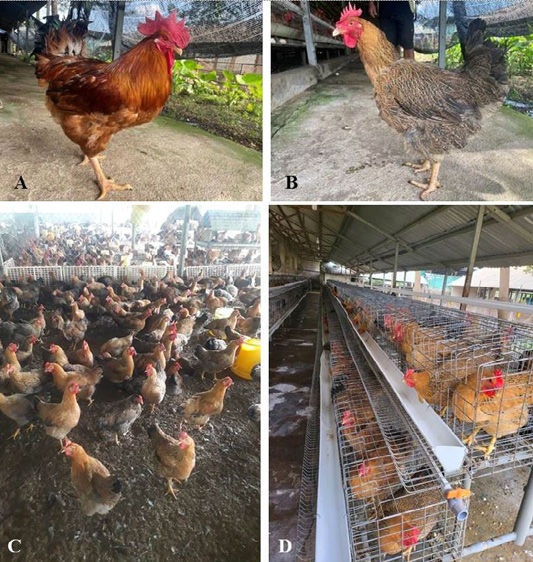
A total of 393 VLV chickens (64 males and 329 females, Figure 1), reared at the VIGOVA Poultry Research and Development Center were used in this study. The VLV is an improved dual-purpose chicken line, with body weight at 38 wks of age was 3.2 kg/male and 2.8 kg/female and egg yield was 170 egg/hen at 68 wks of age developed from chicken breed imported into Vietnam more than 30 years ago.
The birds were individually identified by a wing band, housed in a confined large cage area from one day chick to 04 weeks of age and in the confined ground area from 5 to 20 weeks of age, and then reared in individual cages from 21 weeks. Trade feeds were supplied according to age as 0 to 8 weeks (20% crude protein - CP and 2,900 kcal of metabolizable energy - ME) ad libitum, 9 to 19 weeks (15% CP and 2,700 kcal of ME) under a restricted feeding regime, and for the laying stage from 20 weeks (17.5% CP and 2,750 kcal of ME) ad libitum. Clean fresh water was supplied daily.
The chickens were weighed (BW) at the end of 8 and 20 weeks of age before they were fed in the morning to monitor the feeding regime and control BW before maturity (data not shown). Reproductive traits related to egg production were recorded as age at first egg (AFE; in days), body weight at first egg (BWFE, g/bird), accumulated number of eggs (ANE; egg) calculated as the number of eggs laid until 38 weeks of age, and mean egg weight (MEW; in grams) as the average daily egg weight collected during 37 and 38th week of age.
Collection of samples and DNA extraction
Blood samples were collected at 38 weeks of age from 393 individual healthy and free diseases chickens. A fresh blood sample (1 mL per bird) was taken via the wing vein, following the method of Nguyen et al. (2023). Genomic DNA was extracted using a TopPURE® kit for total blood DNA extraction (ABT-Vietnam) to obtain the OD value using a Bio-drop Machine (UK), qualified by electrophoresis on 1% agarose gel, and then stored at -80 oC until used .
Primer information, amplification and electrophoresis
One set of primers (5’-3’) was used as Forward-TTTAATATTGGTGGGTGAAGAGACA and Reverse-ATGCCACTGATCCTCGAAAACTC with 130/154 bp fragment length .
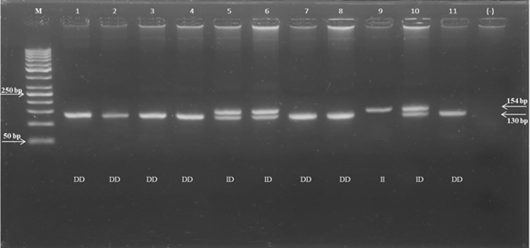
A polymerase chain reaction (PCR) was performed for genotypic analysis of the extracted DNA (12.5 µL) from 393 individual samples using a BIOER Machine (China), according to Nguyen et al. (2023), comprising 6.25 µL (2X) My TaqTM Mix (Bioline, UK), 1 µL primers (10 pM each; Phu Sa-VIE), 1 µL DNA template (50 ng/μL), and 4.25 µL ddH2O. The PCR procedure involved cycling conditions as initial denaturation at 95 ºC for 4 min followed by repeated 35 cycles at (1) 95 ºC for 30 s for denaturation, (2) 59 ºC for 30 s for annealing, (3) 72 ºC for 30 s for extension, and (4) 72 ºC for 5 min for the final extension. The genotypic was identified as 154 bp (Insertion/Insertion; II), 154/130 bp (Insertion/Deletion; ID), and 130 bp (Deletion/Deletion; DD) by 2% agarose gel electrophoresis (60 min, 50V) with a 50 bp DNA ladder under UV light (GelDoc It2-UVP, USA).
Data analysis
Observations of the amplicons and genetic constitutions were made following the procedures of Darabi et al. (2010) and Nguyen et al. (2023). Allele and genotype frequency, and expected heterozygosity (He) were performed according to Nei and Kumar’s Formula (2000), with the value of observed heterozygosity (Ho) based on Weir’s Formula (1996). The polymorphism information content (PIC) was appraised according to Botstein et al. (1980). ANOVA analysis was applied to test the effect of the 24 bp PRL/indel polymorphism in the promoter region of the prolactin gene on reproductive traits together with Tukey’s test, and significant difference was set at P<0.05. A regression analysis was conducted to predict the association of reproductive traits with genotypes, with the values coded as 1 for II, 2 for ID, and 3 for DD genotypes before analysis. The obtained coefficient correlation (R) was then compared to the standard explanation by Schober et al. (2018) based on the value of R as negligible (0.00-0.10), weak (0.10-0.39), moderate (0.40-0.59), strong (0.60-0.79), and very strong (0.80-1.0).
RESULTS AND DISCUSSION
Target gene amplification by PCR assay and identification of polymorphism
A fragment of the 24 bp (130/154 bp) PRL gene in the promoter region was amplified in all the chicken samples, with the representative electrophoresis images 154/130 bp in length, as shown in Figure 2. The mutation form of insertion/deletion (I/D) was identified in the promoter region of the prolactin gene of the sampled chicken population. Two alleles (D and I) and three genotypes were observed as II (insertion of segment of 24 bp), DD (deletion of segment of 24 bp), and ID (insertion/deletion of segment of 24 bp). Several previous studies also successfully amplified the target gene in the promoter region of the prolactin gene in chicken ; ; ; ; ; and in quail or geese ; ; concurring with our results.
Table 1: Genotypic and allelic frequency in VLV chicken population at the 24 bp PRL/indel polymorphic site.
Population
Parameter
Genotypic frequency
Allelic frequency
He
PIC
II
ID
DD
I
D
Female
N
63
146
120
0.413
0.587
0.485
0.367
Observed frequency
0.191
0.444
0.365
Expected frequency
0.170
0.485
0.345
Male
N
9
48
7
0.516
0.484
0.499
0.374
Observed frequency
0.141
0.750
0.109
Expected frequency
0.266
0.499
0.234
Total
N
72
194
127
0.43
0.57
0.49
0.37
Observed frequency
0.183
0.494
0.323
Expected frequency
0.185
0.490
0.325
He: expected heterozygosity; PIC: Polymorphism Information Content.
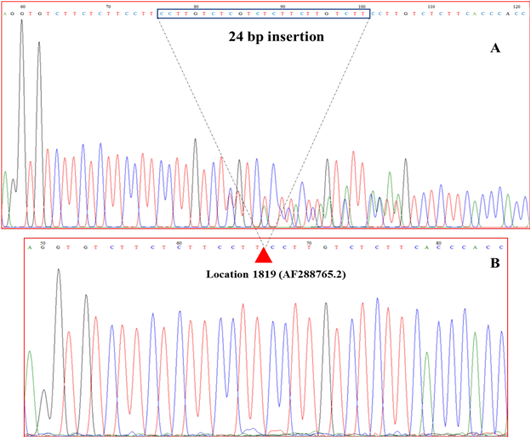
The sequence analysis results are shown in Figure 3, indicating that mutation at this locus formed two alleles (D and I). The I allele (insertion of 24 bp; Figure 3A) and D allele (deletion of 24 bp at site 1819 of AF288765.2; Figure 3B) were identified and three genotypes were observed as illustrated in Figure 2. A similar pattern was also reported by Tu et al. (2023).
The allele and genotype frequencies of the 24 bp indel/PRL were analyzed, with results presented in Table 1. According to sex, the frequencies of the D and I alleles in a group of hens were 0.587 and 0.413, while frequencies in roosters were 0.484 and 0.516, respectively. Frequencies of the II, ID, and DD genotypes were 19.1, 44.4, and 36.5% in hens and 14.1, 75.0, and 10.9% in roosters, respectively. In the total population, the frequency of the I allele (0.43) was lower than the D allele (0.57), while the genotypic frequencies of the three genotypes (DD, ID, and II) were 0.323, 0.494, and 0.183, respectively (Table 1).
The frequencies of the I and D alleles were different and varied among the chicken populations and breeds. The frequency of the I allele varied from low to medium in non-commercial breeds and was commonly dominant in layer commercial breeds. Cui et al. (2006) noted that the frequency of the I allele varied from 0.02 to 0.20 in Taihe Silkies breed for the F0 and F1 generations, 0.05 in Yangshan breed, 0.17 in Nongdahe breed, 0.22 in White Rock, and 1.0 in White Leghorn chickens. The frequency of the I allele also varied among different populations and breeds of chicken such as 0.72 in local Iranian , 0.59 in Mazandaran , “0” in Poltava Clay , 0.31 in Papua chicken (Lumatawn and Mu’in, 2016), while for Vietnamese native chicken breeds the I allele frequency was 0.13 in Lien Minh , 0.12 and 0.19 in Ri and Mia, respectively , and 0.19 in Silkie . In this study, the I allele frequency was 0.43, considered as medium level.
As shown in Table 1, the value of He (expected heterozygosity) was 0.49, indicating that the investigated population was divergent. Wang et al. (2011) suggested that the heterozygosity parameter could be used to estimate the level of genetic diversity within or among populations, with a value of heterozygosity greater than 0.5 considered high genetic diversity .
The PIC value was 0.37 (Table 1) with 0.25<PIC<0.5 indicating moderate polymorphism at the 24 bp PRL/indel locus ; .
Association of polymorphism at the 24 bp PRL/indel site and some reproductive traits in VLV hens
The associations between the 24 bp PRL/indel polymorphism and some reproductive traits are shown in Table 2. Results revealed that grouped hens with the DD genotype had significantly higher accumulated egg numbers up to 38 weeks of age compared to the ID and II genotypes (57.0, 55.0, and 54.1 eggs/bird, P<0.05). No effect of 24 bp PRL/indel genotypic polymorphism on average egg weight was found among the genotypes (DD, ID, and II: 54.3, 54.3, and 55.1 gram/egg, respectively; P>0.05). No significant difference in age at first egg was found among groups of hens with different genotypes (DD, ID, and II) (171.5, 170.9, and 170.6 days, respectively; P>0.05) or body weight at first egg among the three genotypes (2,330.5, 2,362.4, and 2,314.4 g/bird), as shown in Table 2.
Table 2: Effects of a 24 bp PRL/indel genotype on some reproductive traits of VLV chicken breed.
Genotype
N
Age at first egg (days)
Body weight at first egg (g/bird)
Egg yield up to 38 weeks of age (egg)
Mean egg weight (g)
DD
120
171.5±1.5
2,330.5±19.2
57.0a±0.7
54.3±0.4
ID
146
170.9±1.1
2,362.4±19.7
55.0b±0.7
54.3±0.4
II
63
170.6±1.7
2,314.4±44.4
54.1b±1.1
55.1±0.7
Data are presented as mean ± SEM. Within the column, number with different superscripts are significantly different (P<0.05).
The prolactin hormone is a polypeptide that plays a key role in egg production, and enhancement of PRL secretion causes the onset of nesting behavior, which results in lower egg production . In birds, the PRL gene is recognized as an applicant marker for egg productive traits because it performs a pivotal function in broodiness behavior that specifically controls egg yield variability by reducing egg biosynthesis during the nesting period ; . Previous research reported that insertion of the 24 bp PRL/indel in the promoter region was positively correlated with laying rate in hens and negatively correlated with incubation behavior ; ; ; , 2011; . Using the 24 bp PRL/indel as a candidate marker gene in the selection program of Silkie chicken showed no significant associations between genetic variation and productive traits , while Begli et al. (2010) reported no significant association between the 24 bp PRL/indel site polymorphism and growth traits in local fowls of Yazd Province. The II and ID genotypes were significantly associated with an increase in egg number in an Iranian fowl population from Yazd Province. By contrast, several researchers reported that the deletion allele (D) was associated with an increasing number of eggs as well as egg weights ; , concurring with our results and not supporting some of the earlier findings.
For maturity age, Xu et al. (2011) also noted that hens with the ID genotype had an average age at first egg slightly lower than the DD genotype, in agreement with our results (Table 2).
The onset of broodiness triggers an increase in the prolactin hormone in the plasma of tropical chicken breeds, resulting in the regression of ovarian follicles and lower egg production ; . Jiang et al. (2005) mentioned that insertion of the 24 bp fragment in the promoter region of the PRL gene may suppress a transcriptional factor binding site, resulting in decreased PRL expression and contributing to broodiness behavior, especially in hens. Cui et al. (2006) reported that the heterozygous genotype for insertion and deletion (In/Del) had the highest expression level of PRL mRNA in several lines of Chinese chickens.
Several intrinsic and extrinsic factors affect broodiness in birds. Intrinsic factors include genetic divergences due to mutation and other mechanisms related to epigenetic conditions, for example, DNA methyl/demethylation or histone acetyl/deacetylation. Extrinsic factors include photoperiodism, THI (temperature-humidity index), and feed constitutions which change bird behavior toward broodiness which is associated with egg production capacity , 2002; ; . Beside this, changing the feeding style from small-holders scale to industrial system is also considerable the factor that affecting the broody behavior and/or laying rate of hens.
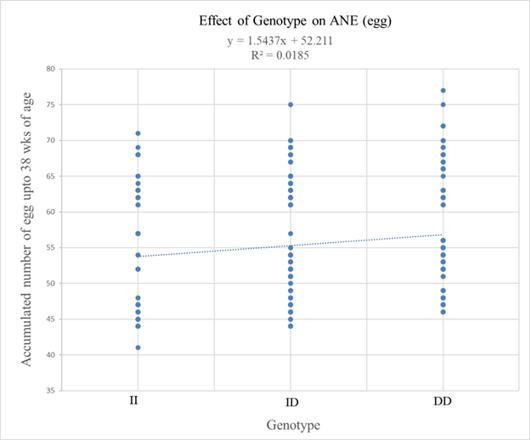
A regression analysis was performed between the 24 bp PRL indel genotypes and egg yield for up to 38 weeks of age, as shown in Figure 4. Results indicated that the PRL gene affected 1.85% of the variation in ANE up to 38 weeks of age, with a similar result also reported by Purwantini et al. (2020). In this study, the correlation coefficient between genotypes with ANE was small (0.136), suggesting a relatively small effect of genotype on egg yield. According to Schober et al. (2018), the weak correlation coefficient (0.136) suggested that many other elements affected the ANE trait as both environmental (extrinsic) and genetic (intrinsic) factors. Reproductive traits are generally controlled by polygenes and some genetic factors affect reproduction. The PRL and other marker genes require more in-depth study. The correlation coefficient in this study was relatively small but could still be used as a basic database for a selection program.
CONCLUSIONS AND RECOMMENDATIONS
We, for the first time, determined the polymorphism at the 24 bp PRL/indel locus in the promoter region in the VLV color dual-purpose chicken breed. The dominant of D allele and DD genotypes were found and hens bearing the DD genotype produced higher egg numbers up to 38 weeks of age than hens with the ID and II genotypes. In case of the breeding program, handling the D allele in the population should be considered. Polymorphism at the 24 bp PRL/indel site can be used for molecular-aided selection to improve egg production in native chickens, requiring more in-depth study.
ACKNOWLEDGMENT
Our deepest thanks go to all the VIGOVA staff for collecting and providing the phenotypic chicken study data.
NOVELTY STATEMENT
This is the first study in Southern Vietnam on the Prolactin gene polymorphism in the promoter regions of dual-purpose VLV chickens carrying the 24 bp PRL/indel. The D allele had a higher frequency and positive effect on the total number of eggs up to 38 weeks of age. A positive association and correlation between egg production and DD genotype implies that carefully managing breeding programs to employ the frequency of the D allele due to it is considerable marker gene to improve egg production.
AUTHOR’s CONTRIBUTION
All authors discussed the experimental design, read and approved the manuscript at each step. NTN managed all the research activities including writing the manuscript. TTVT and TTTN contributed equally to DNA extraction, amplification of the target gene and sequence analysis. TTH and DTN, contributed equally to collect the blood samples, productivity data and performed the statistical analyses.
Conflict of interest
The authors have declared no conflict of interest.
Figures
Figure 1:.
Representative VLV chicken breed. (A and B) adult VLV rooster and hen at the time of sample collection (38 weeks of age); (C) VLV in a confined ground area at the growing stage, and (D) caged hens at the laying stage.
Figure 2:.
Representative electrophoresis of the PCR products of 24 bp indel in the promoter region of the prolactin gene on 2% agarose gel. M: DNA ladder (50 bp). No. 1-4; 7-8 and 11: individual samples with DD genotype; Nos. 5-6 and 10: ID genotype; No. 9: II genotype; (-): Negative control.
Figure 3:.
Representative two sequences of the 24 bp PRL/indel in the promoter region. A: insertion of 24 bp (I allele) and B: deletion of 24 bp (D allele) at site 1819 (AF288765.2).
Figure 4:.
Genotype effects of the 24 bp indel prolactin gene on the accumulated number of eggs laid by VLV hens up to 38 weeks of age. ANE: accumulated number of eggs.
References
Ahmadi S, Takeda M, Ohkubo T (2019). Determination of polymorphisms in pituitary genes of the native Afghani Naked Neck chicken. J. Poult. Sci., 56: 253-261. https://doi.org/10.2141/jpsa.0180087[CrossRef]
Alipanah M, Shojaian K, Khani BH (2011). The polymorphism of prolactin gene in native chicken Zabol region. J. Anim. Vet. Adv., 10: 619-621. https://doi.org/10.3923/javaa.2011.619.621[CrossRef]
Astuti D (2019). The characters and diversity of prolactin and growth hormone genes in the local Turi ducks of Indonesia. AIP Conf. Proc., 2155: 020045. https://doi.org/10.1063/1.5125549[CrossRef]
Au WL, Leung FCC (2002). Rapid communication: Complete nucleotide sequence of the chicken prolactin gene. J. Anim. Sci., 80: 1381. https://doi.org/10.2527/2002.8051381x[CrossRef]
Banu N, Rashid MB, Hasan MM, Aziz FB, Islam MR, and Haque MA (2017). Effect of anti-prolactin drug and peppermint on broodiness, laying performance and egg quality in indigenous hens. Asian J. Med. Biol. Res., 2: 547-557. https://doi.org/10.3329/ajmbr.v2i4.30995[CrossRef]
Begli HE, Zerehdaran S, Hassani S, Abbasi MA, Khan AA (2010). Polymorphism in prolactin and PEPCK-C genes and its association with economic traits in native fowl of Yazd province. Iran. J. Biotech., 8: 172-177.
Botstein D, White RL, Skolnick M, Davis RW (1980). Construction of a genetic linkage map in man using restriction fragment length polymorphisms. Am. J. Hum. Genet., 32: 314-331.
Brijendra MY, Maurya SK, Akansha Y, Shivendra MY (2018). Polymorphism at prolactin promoter region and its relation with production performance in Aseel birds. Int. J. Curr. Microbiol. Appl. Sci., 7: 1367-1370.
Chaovapasee K, Tumwasorn S, Loongyai W, Sopannarath P (2020). Prolactin haplotypes and their effect on body weight and egg production in the KU line of Betong chicken. Agric. Nat. Resour., 54: 479–484.
Chen CF, Shiue YL, Yen CJ, Tang PC, Chang HC, Lee YP (2007). Laying traits and underlying transcripts, expressed in the hypothalamus and pituitary gland that were associated with egg production variability in chickens. Theriogenology, 68: 1305-1315. https://doi.org/10.1016/j.theriogenology.2007.08.032[CrossRef]
Chesnokov YV, Artemyeva AM (2015). Evaluation of the measure of polymorphism information of genetic diversity. Agric. Biol., 50(5): 571–578. https://doi.org/10.15389/agrobiology.2015.5.571eng[CrossRef]
Chuekwon K, Boonlum S (2017). Association of prolactin gene with egg production in khaki Campbell ducks. Walailak J Sci. Tech., 14(11): 849-853.
Cui JX, Du H, Zhang XQ (2005). Polymorphisms and bioinformatics analysis of chicken prolactin gene. Heredit (Beijing), 27: 208-214.
Cui JX, Du H, Liang Y, Deng X, Li N, Zhang X (2006). Association of polymorphisms in the promoter region of chicken prolactin with egg production. Poult. Sci., 85: 26-31. https://doi.org/10.1093/ps/85.1.26[CrossRef]
Cui JX, Du HL, Liang Y, Zhang XQ (2004). Polymorphism of chicken prolactin gene. Departement of Animal Genetics, Breeding and Reproduction, College of Animal Science. South China Agricultural University, Wushan Street, Guangzhou, Guangdong, China. www.ncbi.nlm.nih.gov [24 Maret 2014].
Darabi F, Shahabadi N, Maghsudi M, Kashanian S (2010). DNA binding and gel electrophoresis studies of copper (II) complex containing mixed aliphatic and aromatic dinitrogen ligands. DNA Cell Biol., 29: 329–336. https://doi.org/10.1089/dna.2009.1001[CrossRef]
Dementieva NV, Fedorova ES, Krutikova AA, Mitrofanova OV, Stanishevkaya OI, Pleshanov NV, Smaragdov MG, Kudinov AA, Terletsky VP, Romano MN (2020). Genetic variability of indels in the prolactin and dopamine receptor D2 genes and their association with the yield of Allanto-Amniotic fluid in Russian white laying hens. J. Agric. Sci., 26: 373-379. https://doi.org/10.15832/ankutbd.483561[CrossRef]
Dhara SK, Soller M (1999). Intragenic haplotypes in chicken prolactin in four diversed breeds. Hebrew Univ. Jerusalem, Israel. www.ncbi.nlm.nih.gov [18 March 2014].
Eichie FO, Salako AE, Osaiyuwu OH, Aggrey SE (2016). Genetic diversity of prolactin gene in Japanese Quail (Coturnix coturnix japonica) as affected by location in Nigeria. J. Exp. Agric. Int, 12(6): 1-9. https://doi.org/10.9734/AJEA/2016/25575[CrossRef]
Geng AL, Xu SF, Zhang Y, Zhang J, Chu Q, Liu HG (2014). Effects of photoperiod on broodiness, egg-laying and endocrine responses in native laying hens. Br. Poult. Sci., 55(2): 264-269. https://doi.org/10.1080/00071668.2013.878782[CrossRef]
Ghanem HM, Ateya AI, Saleh RM, Hussein MS (2017). Artificial insemination vs natural mating and genetic PRL/PstI locus polymorphism and their effect on different productive and reproductive aspects in duck. Adv. Anim. Vet. Sci., 5(4): 179-184.
Goraga ZS, Nassar MK, Brockmann GA (2012). Quantitative trait loci segregating in crosses between New Hampshire and white leghorn chicken lines: I. egg production traits. Anim. Genet., 43(2): 183-189. https://doi.org/10.1111/j.1365-2052.2011.02233.x[CrossRef]
Hoang TT, Duong XT, Nguyen DT (2017). Selection and enhancement of egg production of LV5 chicken line. J. Anim. Sci. Tech., 77: 8-18.
Izutsu K, Kurokawa M, Imai Y, Maki K, Mitani K, Hirai H (2001). The corepressor CtBP interacts with Evi-1 to repress transforming growth factor beta signaling. Blood, 97: 2815-2822. https://doi.org/10.1182/blood.V97.9.2815[CrossRef]
Izutsu K, Kurokawa M, Imai Y, Ichikawa M, Asai T, Maki K, Mitani K, Hirai H (2002). The t (3;21) fusion product, AML1/Evi-1 blocks AML1-induced transactivation by recruiting CtBP. Oncogene, 21: 2695-2703. https://doi.org/10.1038/sj.onc.1205356[CrossRef]
Jiang RS, Xu G, Zhang XQ, Yang N (2005). Association of polymorphisms for prolactin and prolactin receptor genes with broody traits in chickens. Poult. Sci., 84: 839-845. https://doi.org/10.1093/ps/84.6.839[CrossRef]
Jiang RS, Zhang LL, Geng ZY, Yang T, Zhang SS (2009). Single nucleotide polymorphisms in the 5’-flanking region of the prolactin gene and the association with reproduction traits in geese. Iran. J. Biotech., 39: 83-87. https://doi.org/10.4314/sajas.v39i1.43550[CrossRef]
Kansaku N (2000). Genetic variation of chicken prolactin promoter. Database 2000. www.ncbi.nlm.nih.gov/ entrez/viewr.fcgi?dbnucleotide& dopt-Genbank& val [19 March 2014].
Karabag K, Balcıoglu MS, Karlı T, Alkan S (2016). Determination of genetic diversity using 15 simple sequence repeats markers in long term selected Japanese quail lines. Asian-Australasian J. Anim. Sci., 29: 1696-1701. https://doi.org/10.5713/ajas.15.0940[CrossRef]
Kulibaba RA (2015). Polymorphism of growth hormone, growth hormone receptor, prolactin and prolactin receptor genes in connection with egg production in Poltava clay chicken. Agric. Biol., 50(2): 198-207. https://doi.org/10.15389/agrobiology.2015.2.198eng[CrossRef]
Kulibaba RA, Podstreshnyi AP (2012). Prolactin and growth hormone gene polymorphisms in chicken lines of Ukrainian selection. Cytol. Genet., 46(6): 390-395. https://doi.org/10.3103/S0095452712060060[CrossRef]
Li HF, Zhu WQ, Chen KW, Zhang TJ, Song WT (2009). Association of polymorphisms in the intron 1 of Duck prolactin with egg performance. Turk. J. Vet. Anim. Sci., 33: 1-5. https://doi.org/10.3906/vet-0709-4[CrossRef]
Li HF, Shu JT, Du YF, Shan YJ, Chen KW, Zhang XY, Han W, Xu WJ (2013). Analysis of the genetic effects of prolactin gene polymorphisms on chicken egg production. Mol. Biol. Rep., 40: 289-294. https://doi.org/10.1007/s11033-012-2060-7[CrossRef]
Lin RL, Chen HP, Rouvier R, and Marie-Etancelin C (2016). Genetic parameters of body weight, egg production, and shell quality traits in the Shan Ma laying duck (Anas platyrhynchos). J. Poult. Sci., 95(11): 2514-2519. https://doi.org/10.3382/ps/pew222[CrossRef]
Lotfi E, Zerehdaran S, Ahani Azari M, Dehnavi E (2013). Genetic polymorphism in prolactin gene and its association with reproductive traits in Japanese quail (Coturnix japonica). J. Poult. Sci., 1(2): 79-85.
Lumatauw S, Mu’in MA (2016). A 24-bp Indel (Insertion-Deletion) polymorphism in promoter prolactin gene of Papua local chickens. Anim. Prod., 18(1): 1-7. https://doi.org/10.20884/1.anprod.2016.18.1.526[CrossRef]
Ma R, Jiang DM, Chen Z, Kang B (2015). Evidence of a role for prolactin as regulators of ovarian follicular development in goose. Electron. J. Biotechnol., 18: 389–392. https://doi.org/10.1016/j.ejbt.2015.08.003[CrossRef]
Manoharan A, Sankaralingam S, Anitha P, Chacko B, Aravindakshan TV (2021). PCR-RFLP analysis of single nucleotide polymorphism (SNP) C-2402T at the promoter region of prolactin gene and its association with positively correlated production traits in White Leghorn Chicken. Indian J. Anim. Res., 56(8): 917-920. https://doi.org/10.18805/IJAR.B-4391[CrossRef]
Miao Y, Burt DW, Paton IR, Sharp PJ, Dunn IC (1999). Mapping of the prolactin gene to chicken chromosome 2. Anim. Genet., 30: 473. https://doi.org/10.1046/j.1365-2052.1999.00498-12.x[CrossRef]
Nei M, Kumar S (2000). Molecular evolution and phylogenetics, Oxford Univ. Press, New York, ISBN: 9780195135848. https://doi.org/10.1093/oso/9780195135848.001.0001[CrossRef]
Nguyen NT, Le TL, Vo TKN, Do CH, Hoang TT, Duong NK, Luu QM (2023). Effect of a polymorphism in prolactin gene on some reproductive traits in TB crossbred ducks in Southern Vietnam. Adv. Anim. Vet. Sci., 11(6): 886-892. https://doi.org/10.17582/journal.aavs/2023/11.6.886.892[Full text][CrossRef]
Nguyen TTB, Duc NH, Thuy NTD (2018). Association of prolactin gene polymorphism with egg production trait in Lien Minh chicken. Vietnam J. Biotech., 16(2): 259-266. https://doi.org/10.15625/1811-4989/16/2/13435[CrossRef]
Ohkubo T, Tanaka M, Nakashima K (1998). Cloning and characterization of chicken prolactin gene. Kagawa University, Departement of Agriculture 2393 Ikenobe, Miki, Kita, Kagawa, Japan. www.ncbi.nlm.nih.gov [25 Maret 2014].
Perdamaian ABI, Daryono BS (2020). Polymorphism of prolactin and prolactin promoter genes and its association with broodiness and body weight in Indonesian chicken lines. Iran. J. Appl. Anim. Sci., 10(2): 311-316.
Poivey JP (2004). Heritabilities and genetic correlations of laying performance in Muscovy ducks selected in Taiwan. Br. Poult. Sci., 45(2): 180-185. https://doi.org/10.1080/00071660410001715777[CrossRef]
Purwantini D, Santosa RSS, Santosa SA, Susanto A, Candrasari DP, Ismoyowati SAS (2020). Prolactin gene polymorphisms and associations with reproductive traits in Indonesian local ducks. Vet. World, 13(11): 2301-2311. https://doi.org/10.14202/vetworld.2020.2301-2311[CrossRef]
Rashidi H, Rahimi-Mianji G, Farhadi A, Gholizadeh M (2012). Association of prolactin and prolactin receptor gene polymorphisms with economic traits in breeder hens of indigenous chickens of Mazandaran province. Iran. J. Biotechnol., 10: 129–135.
Reddy IJ, David CG, Sarma PV, Singh K (2002). The possible role of prolactin in laying performance and steroid hormone secretion in domestic hen. Gener. Comparat. Endocrinol., 127(3): 249-255. https://doi.org/10.1016/S0016-6480(02)00034-5[CrossRef]
Reddy IJ, Ravi Kiran G, Mondal SK, Anandan S (2007). Prolactin, luteinizing hormone and steroid hormone concentration in Punjab Brown (PB3) birds immunized against vasoactive intestinal peptide during the early stages of egg production. Int. J. Poult. Sci., 6(9): 637-641. https://doi.org/10.3923/ijps.2007.637.641[CrossRef]
Rohmah L, Darwati S, Ulupi N, Khaerunnisa I, Sumantri C (2022). Polymorphism of prolactin (PRL) gene exon 5 and its association with egg production in IPB-D1 chickens. Arch. Anim. Breed., 65: 449-455. https://doi.org/10.5194/aab-65-449-2022[CrossRef]
Rowshan J, Matsuda T, Matsuda R, Sunagawa C, Rahman M M, Kohara E, Anann K, Wada Y (2012). Relationship between the production traits and the candidate genes on chromosome 2 in the 5th generation of selection program of silky fowl. Nihon Danchi Chikusan Gakkaihou, 55(2): 115-120.
Roy BG, Saxena VK, Roy U, Kataria MC (2020). PCR-RFLP study of candidate genes for egg production in layer chicken. Arch. Anim. Poult. Sci., 1(3): 52-59. https://doi.org/10.19080/AAPS.2020.01.555563[CrossRef]
Sabry NM, Mabrouk DM, Abdelhafez MA, El-Komy EM, Mahrous KF (2020). Polymorphism of the prolactin gene in Egyptian duck breeds. J. World Poult. Res., 10(4): 587-598. https://doi.org/10.36380/jwpr.2020.67[CrossRef]
Sarvestani AS, Niazi A, Zamiri J, Taromsari M (2013). Polymorphisms of prolactin gene in a native chicken population and its association with egg production. Iran. J. Vet. Res., 14(2): 113-119.
Schober P, Boer C, Schwarte LA (2018). Correlation coefficients: Appropriate use and interpretation. Anesth. Analg., 126(5): 1763-1768. https://doi.org/10.1213/ANE.0000000000002864[CrossRef]
Sharp PJ, Dawson A, Lea RW (1998). Control of Leutinizing hormone and prolactin secretion in birds. Comp. Biochem. Physiol. C, 119: 275–282. https://doi.org/10.1016/S0742-8413(98)00016-4[CrossRef]
Tang J, Guo M, Fu J, Ouyang HJ, Tian YB, Shen X, Huang YM (2021). Polymorphism analysis and expression patterns of the IGF1 gene in the Shitou goose. Arch. Anim. Breed, 64: 315-323. https://doi.org/10.5194/aab-64-315-2021[CrossRef]
Tu TT, Phuong LT, Ngu NT (2023). Associations of polymorphisms in prolactin and dopamine receptor D2 genes with reproductive traits on Silkie chicken. Online J. Anim. Feed Res., 13(5): 321-327. https://doi.org/10.51227/ojafr.2023.47[CrossRef]
Vinh NT, Giang NTP, Linh NV, Dang PK, Cahn NX, Giang NTC, Doan BH, Anh NT, Thinh NH (2021). Single nucleotide polymorphisms of candidate gens related to egg production traits in Vietnamese indigenous chickens. Br. J. Poult. Sci., 23(2): 1-6. https://doi.org/10.1590/1806-9061-2020-1298[CrossRef]
Wada Y, Nakamuta Y, Jiang Y, Matsuda R, Abe S, Anan K (2008). Relationship between 24-bp insertion of prolactin promoter region and performance traits in the selected population of Silkie chicken. Jpn. J. Poult. Sci., 45(2): 82-86.
Wang C, Liang Z, Yu W, Feng Y, Peng X, Gong Y, Li S (2011). Polymorphism of the prolactin gene and its association with egg production traits in native Chinese ducks. South Afr. J. Anim. Sci., 41(1): 64-69. https://doi.org/10.4314/sajas.v41i1.66044[CrossRef]
Wang J, Hou SS, Huang W, Yang XG, Zhu XY, Liu XL (2009). Molecular cloning of prolactin receptor of the Peking duck. J. Poult. Sci., 88(5): 1016-1022. https://doi.org/10.3382/ps.2008-00192[CrossRef]
Weir BS (1996). Genetic data analysis II: Methods for discrete population genetic data. Sinauer Associates, Inc., Sunderland.
Wilkanowska A, Mazurowski A, Mroczkowski S, Kokoszynski D (2014). Prolactin (PRL) and prolactin receptor (PRLR) genes and their role in poultry production traits. Folia. Biol., 62: 1–8. https://doi.org/10.3409/fb62_1.1[CrossRef]
Xu H, Zeng H, Luo C, Zhang D, Wang Q, Sun L, Yang L, Zhou M, Nie Q, Zhang X (2011). Genetic effects of polymorphisms in candidate genes and the QTL region on chicken age at first egg. BMC Genet., 12: 33-42. https://doi.org/10.1186/1471-2156-12-33[CrossRef]
Yadav SK, Maurya SK, Yadav AK, Yadav K, Singh KD (2018). Polymorphism of prolactin gene in relation to egg production performance in Kadaknath hens. Indian J. Anim. Res., 52: 208-211.
Yousefi S, Raoufi Z, Rasouli Z, Zerehdaran S (2012). Investigation of prolactin gene polymorphism in Japanese Quail. Anim. Sci. Biotech., 45(1): 289-292.