Special Issue: Emerging and Re-Emerging Animal Health Challenges in Low and Middle-Income Countries · Volume 13, Issue 1, 16 January 2026 · Open Access
Prolactin Gene Polymorphisms Associated with Productive and Physiological Traits of Local Chickens
· · · · · · ·
Affiliations & Notes ⌄
- 1Department of Public Health, Faculty of Veterinary Medicine, University of Baghdad, Iraq. *Correspondence | Bassam G.M. Al khatib, Department Animal Production, Faculty of Agriculture Engineering Science, University of Baghdad, Iraq
- 2Email: bassam.ghazi@coagri.uobaghdad.edu.iq
Article Info ⌄
- Journal:
- Journal of Animal Health and Production
- Published:
- 16 January 2026

Abstract
INTRODUCTION
Poultry processes had developed during last decades that raised the genetic improvement by using modern requirements to detect the genetic sites on poultry . The researchers’ initiation into developing the poultry industry through selection and genetic improvement had a positive impact on the mass of eggs produced by laying hens and other productive and qualitative traits ; . The rapid scientific movement in applying molecular genetics programs has led to the development of selection programs based on external appearance, thus achieving the desired goal in the selection process . In order to achieve a high level of production in poultry, it is possible to improve performance instead of the old methods used in breeding and genetic improvement programs . Prolactin (PRL) gene contains 229 amino acids located on chromosome 2 and consists of 5 exons and 4 introns with a total length of 9536 bp: Genbank accession no.AF288765.2 ; . Prolactin is a steroid hormone that induces broodiness in chickens. In addition to the prolactin hormone, the incubating nature of chickens is also influenced by genes . Prolactin is one of the hormone family that includes growth hormone (GH) and somatostatin . Its polypeptide hormone which synthesized and secreted by the animal’s anterior pituitary gland . PRL is not only a pituitary hormone that plays a key role in reproduction but also acts as a cytokine in the immune response, also in poultry, PRL plays mainly roles in nesting, hatching, and reproduction . PRL can influence the local environment of immune organs and contribute to the maturation and function of immune cells in birds PRL affects a wide variety of physiological functions, as well as PRL gene plays an important role in egg production traits and broodiness which regression of the ovary . Modern poultry production is generally aimed at elevation of egg production and inhibition of incubation behavior . The genes are now being considered as candidate markers of these traits . There have been several attempts to pinpoint the genes that are responsible for variance in egg production; therefore, PRL is associated with the hen’s egg production . According to previous studies, the aves class prolactin hormone has a significant role in the physiological processes, the stimulation and maintenance in incubation, egg production and osmoregulation . PRL plays an essential role in regulating metabolism, growth, development and production, as well as directly or in directly affect individual various systems, including digestive, reproductive, endocrine glands and immune system . The aimed of this study to determine the impacts of prolactin gene polymorphisms and its relationship with some productive and physiological performance by used DNA sequencing techniques on local chickens.
MATERIALS AND METHODS
This study was conducted at poultry farm of the department of Animal Production College of Agricultural Engineering Sciences, University of Baghdad 100 birds of Iraqi local chickens were used and blood samples were collected from brachial vein into tube containing EDTA stored in -20°C. The birds were reared in individual cages. DNA extraction from genomic DNA was performed using commercial kit (Geneaid company), and was amplified using a pairs primer for prolactin gene (Forward: AGAGGCAGCCCAGGCATTTTAC) (Reverse: CCTGGGTCTGGTTTGGAAATTG) (5). PCR product size was 439bp performed in volume 25 Ml, 12.5 µl of master mix, 1µl of primers, DNA 3 µl and 7.5 µl distilled water with 1.5% agarose gel. PCR programming were initial denaturation 94°C for 5 minute, denaturation 94 °C for 30 sec. annealing temperature 62 °C for 30 sec. extension 72 °C for 30 sec. and final extension 72 °C for 5 min. with 35 cycle. 100-1000bp ladder was used in gel electrophoresis. The concentration and purity of DNA according to (Smbrook and Russell, 2001). The sequence of nucleotide bases in a DNA molecule using the Sanger sequencing technique .
Statistical analysis
Data were statistically analyzed using statistical analysis system program (SAS, 2012) to study the effect of PRL gene polymorphisms and DNA sequencing in various traits (productive and physiological) to compare the significant differences using Duncan test polynomial. The relationship of genotype of the PRL gene (C >224T and T>437C) SNPs to the studied traits were:
Yij= µ+Pi+eij
Where; Yij: the observations value j of the genotype i; µ: the overall means of the trait. Pi: influence of genotype of PRL gene; eij: the random error is normally distributed with a mean of zero and a variance of ϭ2e the chi-square test was also performed to examine the percentage of genotype distribution for PRL gene in the analyzed sample.
RESULTS AND DISCUSSION
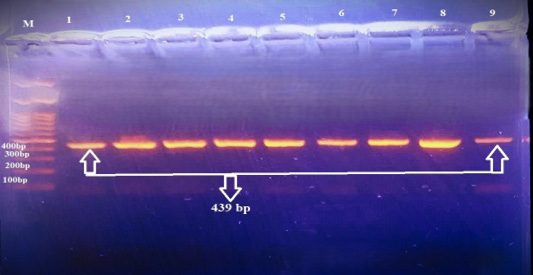
The PCR product with a molecular weight 439 bp was observed as shown in Figure 1.
DNA sequencing
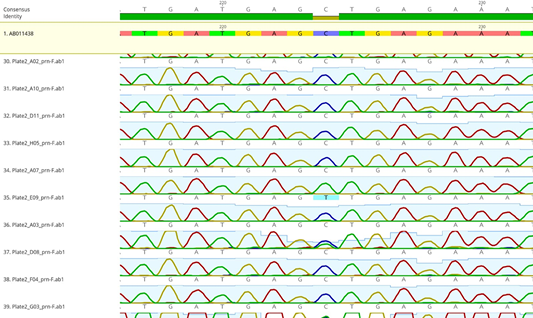
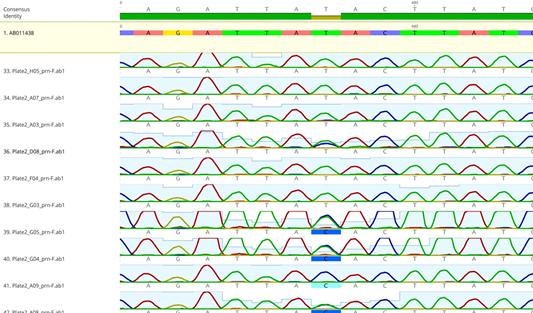
The sequencing results are presented as electropherograms with different peak colors, where adenine (A), guanine (G), cytosine(C) and thymine (T) are represented by green, black, blue and red, respectively.
A SNP was observed in 224 loci as a transition mutation represented in substitution the wild nucleotide C with mutant nucleotide T leading to three genotypes, the wild CC, heterozygous CT and the mutant TT for prolactin gene in local chickens (Figure 2).
Figure 3 indicates that a SNP was observed in 437 loci as a transition mutation represented in substitution the wild nucleotide T with mutant nucleotide C leading to three genotypes, the wild TT, heterozygous TC and the mutant CC for prolactin gene in local chickens.
Distribution percentage of C> 224 T SNPs
The results in Table 1 show no significant differences between the various genotypes of C> 224 T SNPs, as well; no significant effects between C and T alleles on C> 224 T SNPs. While in other studied (Roye et al., 2020) revealed that the allelic frequency and genotype frequency at the promoter sites were 1%, which indicated a reduction in the broodiness in the experimental animals . Have mentioned that the percentage distribution of CT genotype was higher (56.6%) than TT and CC genotypes in PRL gene on Brown strain for (C>2402T) SNPs.
Distribution percentage of T> 437 C SNPs
Data presented in Table 2 revealed that there were a significant differences (P≤0.05) between the various genotypes on T>437C SNPs. The hetero genotype TC had the highest percentage amounted with 37% followed by the mutant and wild genotypes 34% and 29% respectively. The C allele had a significant effects (P≤0.05) compared with T allele.
Table 1: Genotype distribution and allele frequency of PRL gene (C>224 T SNPs)
| Percentage % | Number | Genotype |
| 29.00 | 29 | CC |
| 44.00 | 44 | CT |
| 27.00 | 27 | TT |
| 100 % | 100 | Total |
| N.S١.٥٢٠ | ---- | Chi square (χ2) |
| Frequency | Allele | |
| 0.51 | C | |
| 0.49 | T | |
| N.S: Non-significant | ||
Table 2: Genotype distribution and allele frequency of PRL gene (T>437 C SNPs).
| Percentage % | Number | Genotype |
| 29.00 | 29 | TT |
| 37.00 | 37 | TC |
| 34.00 | 34 | CC |
| 100 % | 100 | Total |
| 7.260 * | ---- | Chi square (χ2) |
| Frequency | Allele | |
| 0.48 | T | |
| 0.52 | C | |
| (P≤0. 05) * | ||
Effect of C >224 T and T >437 C SNPs on feed intake trait
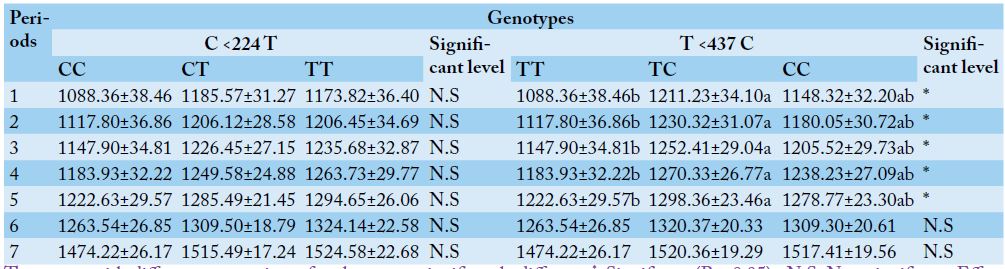
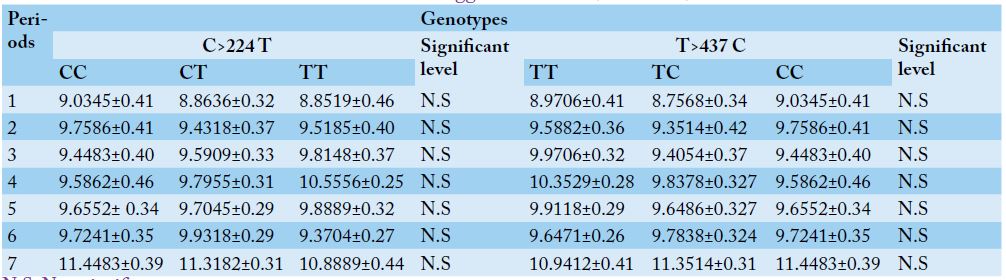
Data in Table 3 shows a significant effect (P<0.05) for the different genotypes in all experiment periods except the 6th and 7th periods of mutation T>437C on feed-intake. Whereas, there were no significant differences observed between the various genotypes of mutation C>224 T in all periods.
The reason may be due to the environmental condition and age or there were harmonic balance changes because of decrease in thyroxin hormone, therefore due to decreasing in metabolism . It’s possible to using in selection program.
Data shown in Table 4 reveal no significant effects between all genotypes of T>437C and C>224T SNPs on weight and age at sexual maturity in all periods, that detecting in prolactin gene genotypes had no effects on these traits. They concluded that a significant effects (P≤ 0.05) on age at sexual maturity in CC and TC genotypes, while there were no significant effects in weight at sexual maturity between TT, TC and CC genotypes in Leptin gene.
Effect of C >224 T and T >437 C SNPs on egg number trait
As sown in Table 5, there were no significant differences in all genotypes of C>224T and T>437C SNPs at all experiment. Periods on egg number trait, because of environmental conditions (temperature and humidity) on egg number trait, or may be these differences due to differentiation on egg number and egg weight for different generations.
Effect of C >224 T and T >437 C SNPs on egg weight trait
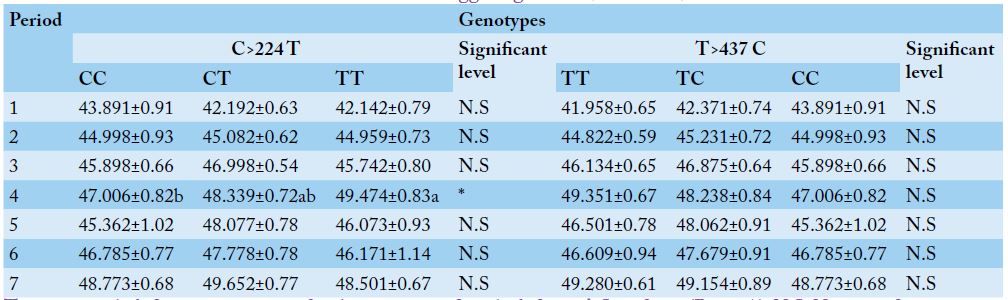
The results in Table 6 reveled to significant effects (P< 0.05) on egg weight in C>224T SNPs in the 4th period and TT genotype had the superiority followed by CC and TT genotypes. While there were no significant differences were observed in the various genotypes of T>437C SNPs in all periods. TT genotype superiority compared with other genotypes was a positive linkage between egg weight and age maturity or due to selection for egg production trait. revealed the positive relationship between BW and EW, as well as there were no significant effects on BW in C>8187T SNPs on local chickens, but stated that PRL gene on exon 5 with mutation T> 8052C had associated with egg production on IPB-D1 chickens.
Effect of C >224 T and T >437 C SNPs on feed conversion ratio
In Table 7 no significant differences were observe between the various genotypes of C>224T and T>4347C SNPs in feed conversion ratio at all periods, the reason is due to genetic diversity between breeds. Smiley (2019) mentioned that the prolactin gene, through its product, the prolactin hormone, specifically controls the variation in the number of eggs produced by reducing egg biosynthesis during the incubation period.
Table 7: Effect of C >224 T and T >437 C SNPs on feed conversion ratio (Mean±SE).
| Trait | Genotypes | |||||||
| C>224 T | Significant level | T>437 C | Significant level | |||||
| CC | CT | TT | TT | TC | CC | |||
| 14 | 3.003± 0.21 | 3.505± 0.25 | 3.442± 0.23 | N.S | 3.328± 0.20 | 3.622± 0.29 | 3.003± 0.21 | N.S |
| 28 | 2.775± 0.21 | 3.593± 0.66 | 3.070± 0.22 | N.S | 2.969± 0.19 | 3.784± 0.78 | 2.775± 0.21 | N.S |
| 42 | 2.858± 0.20 | 2.990± 0.19 | 2.916± 0.18 | N.S | 2.769± 0.15 | 3.139± 0.22 | 2.858± 0.20 | N.S |
| 56 | 3.117± 0.44 | 2.899± 0.19 | 2.471± 0.08 | N.S | 2.537± 0.13 | 2.920± 0.20 | 3.117± 0.44 | N.S |
| 70 | 2.925± 0.13 | 2.969± 0.16 | 2.961± 0.14 | N.S | 2.889± 0.12 | 3.037± 0.19 | 2.925± 0.13 | N.S |
| 84 | 2.926± 0.15 | 2.955± 0.14 | 3.174± 0.12 | N.S | 3.030± 0.11 | 3.046± 0.16 | 2.926± 0.15 | N.S |
| 98 | 3.540± 0.30 | 3.765± 0.17 | 4.031± 0.26 | N.S | 3.937± 0.22 | 3.801± 0.19 | 3.540± 0.30 | N.S |
| Total | 3.020± 0.17 | 3.240± 0.18 | 3.152± 0.14 | N.S | 3.066± 0.12 | 3.336± 0.20 | 3.020± 0.17 | N.S |
N.S: Non-significant.
Effect of C >224 T and T >437 C SNPs on egg mass trait
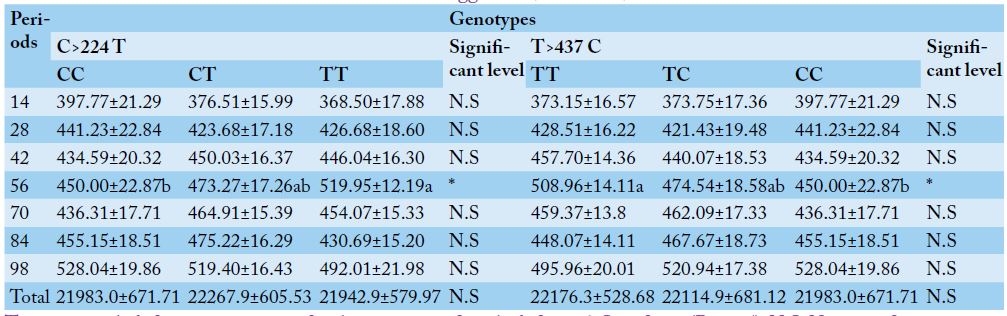
Table 8 shows significant effect (P< 0.05) of the TT genotype over CC genotype of C>224T SNPs and no significant differences were observed between CC and CT, CT and TT genotypes in the 4th period of C>224T SNPs on egg mass, on the other hand the CC genotype of T>437C SNPs had significant effect (P<0.05) on egg mass at the 4th period over TT genotype. The reason was that Large eggs have a large air sac, therefore the internal contents provide more space for the embryo to grow, which leads to a high hatching rate .
Effect of C>224T and T>437C SNPs on blood serum parameters
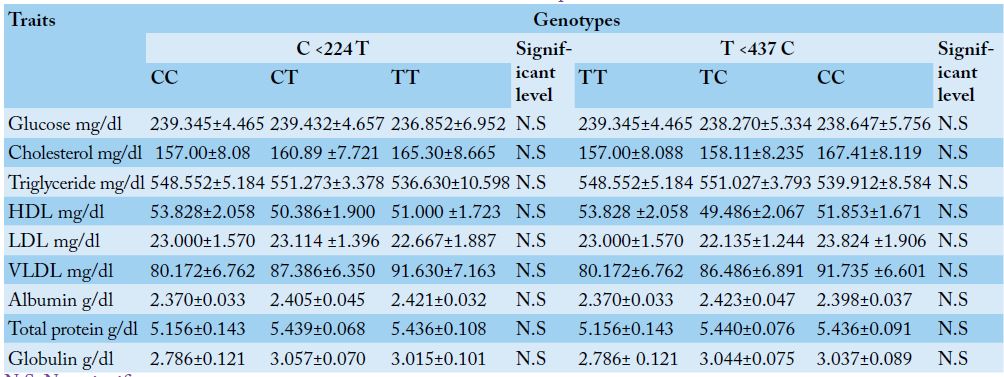
In Table 9 there were no significant effects between all genotypes of T>437C and C>224T SNPs on blood serum parameters in all periods. These genotypes recorded a
Table 10: Effect of C >224 T and T >437 C SNPs on egg qualitative traits (Mean±SE).
| Periods | Genotypes | |||||||
| C <224 T | Significant level | T <437 C | Significant level | |||||
| CC | CT | TT | TT | TC | CC | |||
| Shell weight (gm) | 6.93± 0.10 | 6.98± 0.12 | 6.99± 0.16 | N.S | 6.93± 0.10 | 6.93± 0.12 | 7.04± 0.15 | N.S |
| Shell thickness (mm) | 0.385±0.007 | 0.380± 0.005 | 0.385± 0.006 | N.S | 0.38± 0.007 | 0.37± 0.006 | 0.38± 0.005 | N.S |
| Yolk weight (gm) | 16.06± 0.32 | 15.94± 0.21 | 15.81± 0.36 | N.S | 16.06± 0.32 | 15.79 ± 0.22 | 16.00± 0.31 | N.S |
| Yolk height (mm) | 19.29± 0.22 | 18.79± 0.21 | 18.71± 0.26 | N.S | 19.29± 0.22 | 18.91± 0.22 | 18.60± 0.25 | N.S |
| Yolk diameter (mm) | 38.64± 0.30 | 39.37± 0.30 | 38.72± 0.27 | N.S | 38.64± 0.30 | 39.35± 0.34 | 38.88± 0.25 | N.S |
| Albumin weight (gm) | 26.62± 0.54 | 26.30± 0.56 | 26.34± 0.68 | N.S | 26.62± 0.54 | 26.43± 0.63 | 26.19± 0.59 | N.S |
| Albumin diameter (mm) | 75.19± 1.11 | 74.43± 0.87 | 76.49± 1.05 | N.S | 75.19± 1.11 | 74.15± 0.93 | 76.37± 0.97 | N.S |
| Albumin height (mm) | 7.08 ± 0.19 | 7.43± 0.19 | 7.04± 0.23 | N.S | 7.08± 0.19 | 7.40± 0.22 | 7.16± 0.20 | N.S |
N.S: Non-significant.
highly percentage made a marker for genetic variation into species that can be used in selection program, therefore, the researcher confirmed that the prolactin has an effect on brooding and incubation behavior and thus on egg production.
Effect of C >224 T and T >437 C SNPs on egg qualitative traits
As shown in Table 10, there were no significant differences were show in all genotypes of C>224T and T>437C SNPs at all experiment periods on egg qualitative traits, That may be due to followed a nutrition that could be used in local flocks for genetic improvement and selection.
Conclusion
This research led us to conclude that certain genotypes of the prolactin gene have a significant effect on egg mass and feed-intake, making this gene a potential candidate for use in developing selection programs to improve the productive traits of local chickens in Iraq.
ACKNOWLEDGEMENTS
We want to dedicate thanks for Animal Production Department, College of Agricultural Engineering Sciences, University of Baghdad, Iraq.
NOVELTY STATEMENT
This study provides a new approach that enables us to use modern molecular techniques in early production prediction by identifying superior genetic makeup of candidate genes at early ages in local chicken flocks, thus reducing the financial costs of local chicken development projects in Iraq.
AUTHOR’S CONTRIBUTION
BGMA-K: Conceived the research idea and conducted and supervised on the molecular tests. AAN: Performed the statistical analysis of the study and laboratory work assistant. IQA: Healthcare of experimental birds with blood collection processing.
Generative AI and AI-assisted technology statement
The authors declare that no Genrative AI was used in the creation of this manuscript.
Conflict of interest
The authors have declared no conflict of interest.
Figures

Electrophoresis for PCR product of PRL gene on 1.5% agarose gel and 5 volts/cm2 for 1.5 hr: M (ladder: 100-1000) bp, samples (1-9) with a molecular weight 439 bp.

Alignment DNA sequencing for C>224T SNP of PRL gene with a wild genotype.

Effect of C >224 T and T >437 C SNPs on feed-intake (Mean±SE).
The means with different superscripts of each row are significantly different. *: Significant (P ≤ 0.05) . N.S: Non-significant. Effect of C >224 T and T >437 C SNPs on age and weight at sexual maturity.

Alignment DNA sequencing for T>437C SNP of PRL gene with a wild genotype.

Effect of C >224 T and T >437 C SNPs on age and weight at sexual maturity (Mean±SE).

Effect of C >224 T and T >437 C SNPs on egg number trait (Mean±SE).

Effect of C >224 T and T >437 C SNPs on egg weight trait (Mean±SE).

Effect of C >224 T and T >437 C SNPs on egg mass (Mean±SE).

Effect of C >224 T and T >437 C SNPs on blood serum parameters (Mean±SE).
References
- Abuja PM, and Albertin R (2001). Methods for monitoring oxidative stress, lipid peroxidation and oxidation resistance of lipoproteins. Clin. Chim. Acta, 306: 1-17. https://doi.org/10.1016/S0009-8981(01)00393-X[CrossRef]
- Al-Ani MAK, Al-Khatib BGM (2025). Leptin receptor gene polymorphisms and its effect on some productive and physiological traits in local Iraqi chicken. I. J. Agri. Sci., 56(2): 736-743. https://doi.org/10.36103/kb89xk27[CrossRef]
- Alfiyanto AR, Kunarni A, Sari APZNL, Saraswati YV, Sasongko H, Wibowo MH and Maharani D (2023). Egg production performance of crossbred merawang X KUB chicken. In: Proceedings of the 3rd international conference on smart and innovative agriculture. 29. Atlantis Press, pp. 505–511. https://doi.org/10.2991/978-94-6463-122-7_48[CrossRef]
- Al-Sheikh AA, Ismail IH (2017). Effect of prolactin gene polymorphisms on egg weight of white leghorn and hy-line brown laying hen strains. I. J. Biotech., 16(2): 1-9.
- Bahadoran Z, Parvin M, Azizi F, Ghasemi A (2019). A brief history of modern endocrinology and definitions of a true hormone. Endocr. Metab. Immune., 19: 1116–1121. https://doi.org/10.2174/1871530319666190326142908[CrossRef]
- Bana JJ, Barlian A, Ridwan A (2021). Prolactin hormone profile, patterns and expression level of prolactin, Pit-1, VIP and PREB gene in Kampung chicken (Gallus gallus domesticus) induced by anti-prolactin. Int. J. Poult. Sci., 20: 249-255. https://doi.org/10.3923/ijps.2021.249.255[CrossRef]
- Cui JX, Du HL, Liang Y, Deng XM, Li N, Zhang NXQ (2006). Association of polymorphism in the promoter region of chicken prolactin with egg production. Poult. Sci., 85: 26-31. https://doi.org/10.1093/ps/85.1.26[CrossRef]
- Dobolyi A, Oláh S., Keller D, Kumari R, Fazekas E, Csikós A, Renner VÉ, Cservenák M (2020). Secretion and function of pituitary prolactin in evolutionary perspective. Front. Neuro. Sci., 14: 621. https://doi.org/10.3389/fnins.2020.00621[CrossRef]
- Duncan DB (1955). Multiple range and multiple F-test. Biometrics, 11: 4-42. https://doi.org/10.2307/3001478[CrossRef]
- Haley C, Koning DJ (2006). Genetical genomics in livestock: Potential and pitfalls. Anim. Genet., 37(Suppl): 10-12. https://doi.org/10.1111/j.1365-2052.2006.01470.x[CrossRef]
- Hartman JL, Garvik B, Hartwell L (2001). Principles for the buffering of genetic variation. Scince, 291: 1001-1004. https://doi.org/10.1126/science.1056072[CrossRef]
- Jiang RS, Zhang LL, Geng ZY, Yang T, Zhang SS (2009). Single nucleotide polymorphisms in the 5’-flanking region of the prolactin gene and the association with reproduction traits in geese. S. Afr. J. Anim. Sci., 39: 83-87. https://doi.org/10.4314/sajas.v39i1.43550[CrossRef]
- Knight JA (2000). Review: Free radicals, antioxidants, and the immune system. Ann. Clin. Lab. Sci., 30 (2): 145-158.
- Li HF, Shu JT, Du YF, Shan YJ, Chen KW, Zhang XY, Han W, Xu WJ (2013). Analysis of the genetic effects of prolactin gene polymorphisms on chicken egg production. Mol. Biol. Rep., 40: 289–294. https://doi.org/10.1007/s11033-012-2060-7[CrossRef]
- Manoharan A, Sankaralingam S, Anitha P, Chacko B, Aravindakshan TV (2022). PCR-RFLP analysis of single nucleotide polymorphism (SNP) C-2402T at the promoter region of prolactin gene and its association with positively correlated production traits in white leghorn chicken. Ind. J. Anim. Res., 56(8): 917-920. https://doi.org/10.18805/IJAR.B-4391[CrossRef]
- Mo G, Hu B, Wei P, Luo Q, Zhang X (2022). The role of chicken prolactin, growth hormone and their receptors in the immune system. Front. Microbiol., 13: 1-12. https://doi.org/10.3389/fmicb.2022.900041[CrossRef]
- Power DM (2005). Developmental ontogeny of prolactin and its receptor in fish. Gen. Comp. Endocrinol., 142(1-2): 25-33. https://doi.org/10.1016/j.ygcen.2004.10.003[CrossRef]
- Rohmah L, Darwati S, Ulupi N, Khaerunnisa I, Sumantri C (2022). Polymorphism of prolactin (PRL) gene exon 5 and its association with egg production in IPB-D1 chickens. Arch. Anim. Breed., 65: 449–455.
- Rosalinda E, Sasongko H, Maharani D (2025). Polymorphism of the prolactin gene and its association with reproductive traits in F2 local crossed chickens. Vet. World, 18(1): 29–39. https://doi.org/10.5194/aab-65-449-2022[CrossRef]
- Roy BG, Saxena VK, Roy U, Mahendra CK (2020). PCR-RFLP study of candidate genes for egg production in layer chicken. arch. anim. Poult. Sci., 1(3): 52-59. https://doi.org/10.19080/AAPS.2019.01.555563[CrossRef]
- Sambrook J, Russell B (2001). Molecular cloning: Laboratory manual, 3rd Ed. Old spring harbor laboratory Press, Old Spring Harbor laboratory. New York, USA.
- Sanger F, Niclen S, Coulson AR (1977). DNA sequencing with chain terminating inhibitors. Proc. Natl. Acad. Sci. USA, 74(12): 5463-5467. https://doi.org/10.1073/pnas.74.12.5463[CrossRef]
- SAS (2012). Statistical analysis system, user’s guide. Statistical. Version 9.1th ed. SAS. Inst. Inc. Cary. N.C. USA.
- Sharp PJ, MacNamee MC, Talbot RT, Sterling RJ, Hall TR (1984). Aspects of the neuroendocrine control of ovulation and broodiness in the domestic hen. J. Exp. Zool., 232: 475-483. https://doi.org/10.1002/jez.1402320314[CrossRef]
- Smiley KO (2019). Prolactin and avian parental care: New insights and unanswered questions. Horm. Behav., 111: 114-130. https://doi.org/10.1016/j.yhbeh.2019.02.012[CrossRef]
- Sturkie PD (1986). Avian physiology. 4th ed. New York. Springer-Verlage, Heidellberg, Berlin. https://doi.org/10.1007/978-1-4612-4862-0[CrossRef]
- Uberu NP, Oleforuh-Okoleh VU, Ndofor-Foleng HM, Agaviezor BO, Ohagenyi JI, Udeh FU, Ani AO, Nwosu CC, Akuru EA (2022). Molecular evolution of prolactin gene single nucleotide polymorphisms in Nigerian Chicken Ecotypes, and their association with light ecotype chickens’ egg traits. Int. J. Vet. Sci., 11(1): 91-97. https://doi.org/10.47278/journal.ijvs/2021.079[CrossRef]
- Wilkanowska A, Mazurowski A, Mroczkowski S, Kokoszynski D (2014). Prolactin (PRL) and prolactin receptor (PRLR) genes and their role in poultry production traits. Folia Biologica (Kraków). 62: 1-8. https://doi.org/10.3409/fb62_1.1[CrossRef]
- Xu H, Shen X, Zhou M, Fang M, Zeng H, Nie Q, Zhang X (2010). The genetic effects of the dopamine D1 receptor gene on chicken egg production and broodiness traits. BMC Genet., 11: 10.1186/1471-2156-11-17. https://doi.org/10.1186/1471-2156-11-17[CrossRef]
- Yousefi S, Raoufi Z, Rasouli Z, Zerehdaran S (2012). Investigation of prolactin gene polymorphism in Japanese quail. Anim. Sci. Biotechnol., 45: 289-292.
Services
Article usage statistics
Loading…