
Prolactin gene is involved in mammary gland development and milk production. This gene is not characterized molecularly in Pakistani goat breed. It was thus aimed to characterize genetic variations in prolactin gene in beetal goat, one of the famous breeds. A total of 20 goats at milking stage with 3-5 years’ age were selected. DNA was extracted by salting-out method and amplification of exon 2, 3 and 4 of prolactin gene was done using specific primers. Amplified products were bidirectionally sequenced through Sanger method. BioEdit was used to edit and align sequenced data for detection of single nucleotide polymorphism while Codon Code aligner and MEGA6 softwares were used for molecular analysis and aligned sequence analysis respectively. Exon 2 and 4 were monomorphic with respect to reference sequence but a deletion of a single nucleotide was found in exon 3. This deletion at EX3174delA in coding region of Exon 3 resulted in change in the sequence of amino acids and converted Met to stop codon. This may alter protein structure, expression of the gene and may affect protein’s stability. This premature creation of stop codon may lead to truncated protein, low yield of milk or reduction in nutritional value of milk.
Short Communication · Volume 57, Issue 5, 29 August 2025 · Open Access
Sequence Analysis of Coding Region of Prolactin Gene in Milking Beetal Goats
· · · · · · · · ·
Affiliations & Notes ⌄
- 1Department of Biological Sciences, Virtual University of Pakistan 2Institute of Biological Sciences, Gomal University, D.I. Khan, KP, Pakistan 3Faculty of Veterinary and Animal Sciences, Gomal University, Dera Ismail Khan 29050, Khyber Pakhtunkhwa, Pakistan. 4Gomal Centre of Biochemistry and Biotechnology, Gomal University, D.I. Khan, KP, Pakistan * Corresponding author: masrooruad1@gmail.com
Article Info ⌄
- Journal:
- Pakistan Journal of Zoology
- Published:
- 29 August 2025

From the article
- Sequences of Exon 2, 3 and 4 were analyzed using nucleotide blast and it was found that there was no polymorphism in Exon 2 and 4 (Fig. 1) with respect to reference sequence while a deletion was found in the Exon 3 of prolactin gene of Beetal Goat.
- The deletion “A” in the Exon 3 did not cause any alteration in the genetic code but it did cause alteration in next codon that changed from Met > Stop codon, thus led to varied sequence of amino acids and hence its effect on production of milk in the Beetal goat.
- During this study, exon 2, 3 and 4 of prolactin gene in Beetal goat were characterized for detection of polymorphism and their impact on the production of milk.
- From the result it has been concluded that the prolactin gene is one of the major contributor in determining the fate of quality of milk and its production.
Selected from the article's own text.
Abstract
Materials and methods
The blood samples of Beetal goat breed were collected from Directorate of Livestock Farm, Tehsil Jahania District Khanewal, Punjab, Pakistan. A total of 20 healthy, adult milking goats were selected randomly for blood sampling from the stock. These animals were selected on the basis of age (3–5 years), with a history of multiple births to investigate the nucleotide sequences of prolactin gene.
Five mL blood sample was collected from jugular vein of each selected goat in15 mL falcon tube containing EDTA. For DNA extraction standard salting-out method was used as described earlier . To know about the quality and quantitative measurement of DNA, 1.5% agarose gel and NanoDrop spectrophotometer were used, respectively.
The primers for Exon 2 (384 bp), exon 3 (418 bp) and exon 4 (438 bp) of goat-prolactin were designed using primer3 software. The goat PRL gene was amplified using these primers (Table I). The reaction was carried out through 35 cycle that consisted of denaturation at 95 ºC for 45 sec, annealing at respective temperature specified for each exon for 45 sec and extension at 72ºC for 45 sec. Initial denaturation was made at 95ºC for 5 min while final extension was done at 72ºC for 10 min. The reaction volume of 25.0µL was prepared that contained 100-150 ng of extracted DNA, 5pmol of each primer, 245 µL of each dNTP, 1 unit of Taq polymerase and 1x Taq reaction buffer. Gel electrophoresis of the PCR products was done on 2.5% agarose gel possessing ethidium bromide for visualization. The amplified products were processed through ethanol precipitation method and bidirectional sequenced using direct Sanger method .
The Sequencing results were edited and aligned by BioEdit software for the detection of SNPs in the DNA sequence of goat PRL gene. The edited and aligned sequences were analyzed by Codon Code aligner and MEGA6 software for Molecular analysis.
Results and discussion
Sequences of Exon 2, 3 and 4 were analyzed using nucleotide blast and it was found that there was no polymorphism in Exon 2 and 4 (Fig. 1) with respect to reference sequence while a deletion was found in the Exon 3 of prolactin gene of Beetal Goat. The deletion “A” in the Exon 3 did not cause any alteration in the genetic code but it did cause alteration in next codon that changed from Met > Stop codon, thus led to varied sequence of amino acids and hence its effect on production of milk in the Beetal goat.
Goat is an important livestock species of family Bovidae which plays an important role in milk, meat, hides and fibre ; Shrestha, 2005). Among all the breeds, Beetal goat is regarded as best for the production of meat and milk ; Saeedabadi et al., 2018). The important role of molecular genetics in finding out candidate genes with considerable economic significance, phenotypic variation, physiological, biochemical characteristics and polymorphism in genes
Table I. The primers used for amplification of exon 2, 3 and 4 of prolactin (PRL) gene of goat, with sequences both forward (F) and reverse (R) primers, annealing temperature and product size.
| PRL exon | Primer sequence 5`→3` | Tm temperature | Product size |
| Exon-2 | F: AAATCCTGCTCAGGGCAAC R: GCTGATGCAGCCTTCTTGTT | 60.3ºC | 384 bp |
| Exon-3 | F: GACAAGCAACTGTTTTCAGAGA R: CTTCACCTTTCTCTGCATGTC | 57ºC | 418 bp |
| Exon-4 | F: ATATAGGGGAAACCTGGAGT R: CTTGCTTTGTGTAATACCAGTC | 54 ºC | 438 bp |
PRL, prolactin
was recognized which can be helpful for identifying reproductive trait and improvement in milk content in goat as well. Prolactin is a polypeptide hormone secreted and synthesized by anterior pituitary gland and this is the one of most versatile hormones of the pituitary gland in terms of biological activities . Primarily it is responsible for synthesis of lipids, lactose and other main components of milk ; . So, the gene encoding prolactin is recommended as one of the most significant key links in the gene network. These features make prolactin gene a strong individual gene for milk trait. It was investigated that prolactin gene is a potential genetic marker that supports the performance of cashmere in selection . A relationship between polymorphism in the prolactin gene of Raini cashmere goats and fibre properties have also been reported. Based on RsaI polymorphism, two allelic variants (B and b) in the coding region of exon 3 have previously been described . These variants were proposed to be associated with milk production. Such markers can hence be used to find out the possible relationship between prolactin gene variants and milk performance characteristics. The polymorphisms in translation and coding regions of bovine prolactin gene of the Chios sheep were also observed . Coupling analysis revealed that SNPs have significant effect on milk’s fat content and total lactation . PRL and growth hormone receptors are homologous to receptors of cytokine superfamily. Polymorphisms of intron 1 and intron 2 of prolactin receptor gene were detected in goats with high growth (Jining Gray) and low growth characteristics respectively (Goat Boer, Wendeng Dairy, Liaoning Cashmere and Beijing) . However, the genetic variation of intron 1 had no significant effect on the size of the offspring, but intron 2 had a significant effect on the size of the offspring in goat. During this study, exon 2, 3 and 4 of prolactin gene in Beetal goat were characterized for detection of polymorphism and their impact on the production of milk. The exon 2 and 4 were found monomorphic with respect to the reference sequence while a deletion of a single nucleotide was found in Exon 3. This deletion in the coding region of Exon 3 caused the change in the codon sequence of amino acids and resulted in the conversion of Methionine to stop codon. This change in the coding region may alter the protein structure or may alter the process of gene expression, may modify the proteins activity or may affect the stability of protein. This premature creation of stop codon may lead to the truncated protein product leading to low yield of milk or reduction in the nutritional value of milk. Thus, for better understanding, studies with increased number of breeds are suggested.
Conclusion
From the result it has been concluded that the prolactin gene is one of the major contributor in determining the fate of quality of milk and its production.
IRB approval and ethical approval
Current study was approved by Ethical committee of Virtual University ERB (vide letter no. 215/mb/vu dated 09/02/2021).
Statement of conflict of interest
The authors have declared no conflict of interest.
Figures
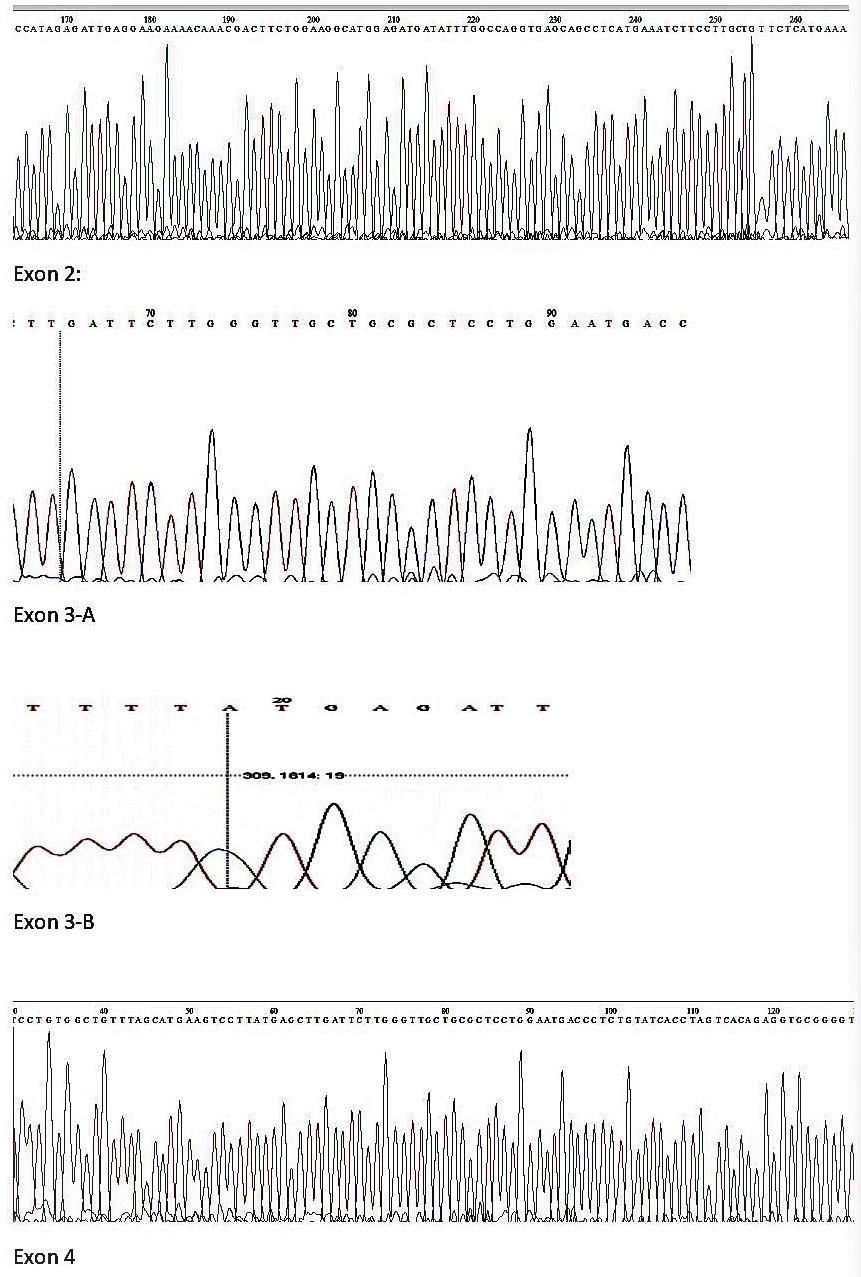
Nucleotide blast results of Exon 2, 3 and 4 of prolactin gene, a deletion of nucleotide A in Exon.
References
- Anonymous, 2011. Pakistan economic survey 2011. Govt. of Pakistan. Ministry of Finance, Economic Advisors Wing, Islamabad.
- Kon, E., Filardo, G., Robinson, D., Eisman, J.A., Levy, A., Zaslav, K., Shani, J. and Altschuler, N., 2013. Knee Surgery. Sport Traumatol. Arthrol., 22: 1452-1464. https://doi.org/10.1007/s00167-013-2467-2[CrossRef]
- Faisal, S.M., Yan, F., Chen, T.T., Useh, N.M., Guo, S., Yan, W., Wang, S., Glaser, A.L., McDonough, S.P., Singh, B. and Chang, Y., 2013. PLoS One, 8: e70171. https://doi.org/10.1371/journal.pone.0070171[CrossRef]
- Saeedabadi, S., Abazari-Kia, A.H., Rajabi, H., Parivar, K. and Salehi, M. 2018. Int. J. Fertil. Steril., 12: 157-163.
- Ahlawat, S., Sharma, R., Maitra, A. and Tantia, M.S. 2015. Small Rumin. Res., 125: 34-42. https://doi.org/10.1016/j.smallrumres.2015.01.027[CrossRef]
- Sodhi, M., Mukesh, M., Prakash, B., Mishra, B.P. and Sobti, R.C., 2007. Biochem. Genet., 45: 145-153. https://doi.org/10.1007/s10528-006-9068-4[CrossRef]
- Rose, J., Kennedy, M., Johnston, B. and Foster, W., 1998. Comp. Biochem. Physiol., A Mol. Integ. Physiol., 121: 263-271. https://doi.org/10.1016/S1095-6433(98)10127-7[CrossRef]
- Lincoln, G.A., 1990. J. Rep. Fertil., 90: 285-296. https://doi.org/10.1530/jrf.0.0900285[CrossRef]
- Moreno, N. and González, A., 2004. J. Comp. Neurol., 479: 130-148. https://doi.org/10.1002/cne.20298[CrossRef]
- Brym, P., Kamiński, S. and Wójcik, E., 2005. J. appl. Genet., 46: 179-185.
- Alipanah, M., Kalashnikova, L. and Rodionov, G., 2007. Iran. J. Biotechnol., 5: 158-161. https://doi.org/10.1017/S1752756200020597[CrossRef]
- Dong, Y., Xie, M., Jiang, Y., Xiao, N., Du, X. and Zhang, W., 2013. Nat. Biotechnol., 31: 135-141. https://doi.org/10.1038/nbt.2478[CrossRef]
- Horseman, N.D., Zhao, W., Montecino-Rodriguez, E., Tanaka, M., Nakashima, K. and Engle, S.J., 1997. Embryol. J., 16: 6926-6935. https://doi.org/10.1093/emboj/16.23.6926[CrossRef]
- Patel, J.B. and Chauhan, J.B., 2017. J. Natl. Sci. Biol. Med., 8: 167. https://doi.org/10.4103/jnsbm.JNSBM_303_16[CrossRef]
- Lewin, H.A., Schmitt, K., Hubert, R., van Eijk, M.J. and Arnheim, N., 1992. Genomics, 13: 44-48. https://doi.org/10.1016/0888-7543(92)90200-C[CrossRef]
- Sodhi, M., Mukesh, M., Mishra, B.P., Parvesh, K. and Joshi, B.K., 2011. Biochem. Genet., 49: 39-45. https://doi.org/10.1007/s10528-010-9383-7[CrossRef]
- Kumari, R., Singh, K., Soni, K.J., Patel, R.K., Chauhan, J. and Rao, S., 2008. Arch. Anim. Breed., 51: 298-299. https://doi.org/10.5194/aab-51-298-2008[CrossRef]
- Sacravarty, G., Vadodaria, V., Joshi, C., Brahmkhtri, B., Shah, R. and Solanki, J., 2008. Ind. J. Dairy Sci., 61: 273-276.
- Miller, S.A., Dykes, D.D. and Polesky, H.F., 1988. Nucl. Acid Res., 16: 1215. https://doi.org/10.1093/nar/16.3.1215[CrossRef]
- Sanger, F., Nicklen, S. and Coulson, A.R., 1977. Proc. Natl. Acad. Sci., 74: 5463–5467. https://doi.org/10.1073/pnas.74.12.5463[CrossRef]
- Lebbie, S.H., 2004. Small Rumin. Res., 51: 131-136. https://doi.org/10.1016/j.smallrumres.2003.08.015[CrossRef]
- Shrestha, J.N., 2005. Small Rumin. Res., 56: 3-20. https://doi.org/10.1016/j.smallrumres.2004.06.014[CrossRef]
- Hallerman, E.M., Theilmann, J.L., Beckmann, J.S., Soller, M. and Womack, J.E., 1988. Anim. Genet., 19: 123-131. https://doi.org/10.1111/j.1365-2052.1988.tb00798.x[CrossRef]
- Shamsalddini, S., Mohammadabadi, M.R. and Esmailizadeh, A.K., 2016. Rus. J. Genet., 52: 405-408. https://doi.org/10.1134/S1022795416040098[CrossRef]
- Di, R., Yin, J., Chu, M.X., Cao, G.L., Feng, T., Fang, L. and Zhou, Z.X., 2011. Anim. Sci. Pap. Rep., 29: 343-350.
Services
Article usage statistics
Loading…