
Over two million women worldwide affected by breast cancer in the recent years. Pakistan has the highest rate of breast cancer among the Asian countries. Pathogenic variations of the BRCA1 and BRCA2 genes are a major cause of hereditary ovarian and breast cancer. The current study includes three hundred ninety-one subjects which were registered and interviewed for a variety of demographic and clinical features and for selection to perform BRCA variant analysis. Data set was comprised 160 female subjects as a control group, rest were 231female patients with breast or ovarian cancer who visited different hospitals in Punjab, Pakistan during July 2015 to October 2018. For the demographic and clinical aspects, case control methodology was employed, while for BRCA1/2 variant analysis samples were used obtained on convenience. The average age of the subjects under study was 44.24±9.67 years. All observations were recorded and analysed on SPSS version 23. Selection of exons 2, 5, 11B and 11D of BRCA1 gene, and exons19 and 22 of BRCA2 gene were made for amplification. Successfully amplified PCR products were sent to Eurofins Genomics for sequencing. Sequences were submitted to GenBank to obtain accession numbers. Bioinformatics tools were used to examine the sequences. The overall frequency of variants of BRCA1/2 in sequenced samples was 4.2%; moreover, among breast cancer, ovarian cancer patients and the control group, the corresponding percentages of variants were valued as 5.2%, 4.2%, and 1.4%. Following the established process for the nomenclature of variations in the human genome, a total of twelve variants, consisting of eight distinct categories, were annotated. The BRCA1 gene revealed total six types of variants out of which, four were “Novel” mutations: annotated as c.67 sub. G>C; IVS5-51 dup T; c.2219 ins.A and c.2009 A>T. Rest of two BRCA1 variants, c.68-69 Del AG and c.2081 C>T, have already been described. Both of the two explored BRCA2 variants c.8675 G>A and c.9079G>A, were categorized as Novel missense variants. In conclusion, seventy five percent of “Novel” kind of variants explored during this study depicts that diverse range of BRCA mutations are present in the Pakistani population.
Research Article · 8 September 2026 · Open Access
Mutational Spectrum at Some Specific Exons of BRCA1/2 Genes in Female Population of Punjab, Pakistan
· ·
Affiliations & Notes ⌄
- 1Abdus Salam School of Sciences, Nusrat Jahan College, Chenab Nager, District Chinot, Punjab, Pakistan 2Institute of Animal and Dairy Sciences, University of Agriculture, Faisalabad, Pakistan. 3Centre of Agriculture Biochemistry and Biotechnology, University of Agriculture, Faisalabad, Pakistan. * Corresponding author: dr.durresamintahir@gmail.com
Article Info ⌄
- Journal:
- South Asian Journal of Zoology
- Published:
- 8 September 2026
From the article
- However, the present study revealed 12% BRCA1 variant among the breast cancer patients while BRCA 2 frequency was found to be 8.3% among the ovarian cancer patients.
- The researchers discovered that 5.3% of females had BRCA2 mutations and 2.3% carried the BRCA1 variant.
- In conclusion, seventy five percent of the “Novel” variant types analysed in this study demonstrate the diversity of BRCA mutations present in the Pakistani population.
- The BRCA1/2 gene are well characterized tumour suppressor genes and germline mutations in BRCA1/2 are powerfully associated with the onset, prognosis and treatment of breast cancer ovarian and certain other cancers.
Selected from the article's own text.
Abstract
Introduction
In the majority of countries, breast cancer has long been the leading cause of cancer related disease and mortality among women. According to estimates, female breast cancers caused 2.3 million new cases and 685,000 deaths globally in 2020, accounting for one in four cancer diagnoses and one in six female cancer deaths (Sung et al., 2020). Most important contributing factor for such an upsurge is positive family history for breast and /or ovarian cancer (Brewer et al., 2017). Along with this number of other factors, especially low financial status and lack of awareness further increase the morbidity and mortality rates related to breast cancer in developing countries (Gulzar et al., 2019). The risk of hereditary breast cancer is increased by the presence of genetic mutations in the genes that cause breast cancer. Accordingly, BRCA1 and BRCA2 are typically the most prevalent genes that are susceptible to breast cancer (Angeli et al.; 2020). Therefore, screening for BRCA1 and BRCA2 mutations may have significant health benefits (Jara et al., 2017). Mutations in any of the 24 exons of BRCA1 and 26 coding exons of BRCA2 gene cause the majority of hereditary breast cancers (Godet et al., 2017). Many significant motifs found in BRCA1 translation products interact strongly with other proteins involved in the processes, such as ubiquitination, apoptosis, responses to DNA damage, cell cycle progression, and genomic integrity maintenance (Deng, 2006). The transcriptional regulators that are produced by the BRCA1 gene are essential for repairing double-strand DNA breaks caused by homologous recombination (Venkitaraman, 2002). In addition to female breast and ovarian cancers, germline mutations in BRCA1 are linked to malignancies of the pancreas, uterus, cervix, prostate and male breast cancer (Thompson and Easton, 2002). According to estimates, a woman’s cumulative frequency of mutations in BRCA1 gene increases her likelihood of developing 50% ovarian cancer and 87% breast cancer (Barnes and Antaniou, 2012; Weitzel, 2013). Approximately 1800 of the nearly 6000 variations found in the BRCA databases have been categorized as either pathogenic or possibly pathogenic (Béroud et al., 2016). Similarly, BRCA2 gene product produces a massive protein with 3418 amino acids and estimated molecular weight of 384 kDa (Spain et al., 1999).
It has been predicted that the BRCA2 protein plays a part in both transcription regulation and DNA reparation processing by functioning within the homologous recombination mechanism of DNA double-strand break repair (Fradet et al., 2016). BRCA2 has been identified to be associated in the maintaining of the length of telomeres in cells through homologous recombination pathway (Thorvaldsdottir et al., 2017; Pompili et al., 2019).
Since BRCA1/2 are large genes containing 24 and 26 exons respectively, thus several authors who investigated mutations in these genes in Pakistani patients, reported variants on specific exons. Moatter et al. (2011) observed mutations in the BRCA1 exons 2, 5, 6, 11, 16, 20, and 22, three mutations were discovered during this investigation, demonstrated founder effect in Pakistani families of Pushtun and Mohajir ethnicity. Nevertheless, the most important topic facing clinical scientists is how to identify high-risk individuals, which is crucial for creating preventative plans for them, to reduce morbidity and mortality associated with breast ovarian and other related cancer.
The objectives of the present study were exploring frequencies of demographic and clinical features associated with breast and ovarian cancer and to investigate variations in the BRCA1 and BRCA2 genes at specific exons by using PCR and direct sequencing approach.
Materials and Methods
A total of 391 subjects including 231 breast /ovarian cancer patients and 160 non-cancerous participants. Subjects were recruited from different hospitals including, PINUM and Allied from Faisalabad, Shifa and PIMS from Islamabad, Fazle Omar, Chenab Nagar Punjab, Pakistan. Sampling and analysis were done during July 2015 to October 2018. Participants were interviewed to collect information about the general health and reproductive characteristics, including age at menarche, menopause, and first childbirth; total number of children; parental consanguinity; and ethnicity. In addition, data were gathered on family history of breast, ovarian, or other cancers. For this study, a positive family history was defined as having at least one first-degree or two second-degree relatives with such cancers. Demographic details were recorded using SPSS version 23.
Participants were included if they were aged 20 years or older at the time of data and /or blood sample collection, had not undergone BRCA testing prior to the study, and provided informed consent to participate. Participation was entirely voluntary, and no subject was compelled to disclose any information.
Blood samples of the subjects were selected on the basis convenience, consent, early age onset of cancer and family history. Regarding family history, 80% of non-cancerous participants and 50% of cancer patients met the study’s definition of having a positive family history. For the sequence analysis of BRCA, exons 2, 5,11 and for BRCA2 exons 19, 22 were selected on the basis of crucial significance of each portion.
Peripheral blood samples were collected into EDTA-containing vials by qualified medical personnel under aseptic conditions to minimize discomfort and prevent contamination. Genomic DNA was extracted using the Thermo Scientific DNA extraction kit (K0781) according to the manufacturer’s protocol. Primer sequences used for BRCA1 and BRCA2 and amplification conditions used have been shown in Table I, respectively. Polymerase chain reaction (PCR) was performed in a 25 µL reaction mixture. Amplification products, along with a 100-2000 base pair molecular weight ladder (Cat#3427A) were resolved on 2.00% agarose gel.
The PCR amplicons were submitted to Eurofins Genomics for bidirectional Sanger sequencing. Resulting FASTA files were analysed using BLASTn and BLASTp tools and sequences were aligned against the Homo sapiens reference genome (Txid9606) available in the NCBI database. Chromatograms, were examined with BioEdit software, verified sequences were deposited in GenBank via the BankIt submission portal.
Table I. Primer sequences and conditions for BRCA1 Exon-2, 5, 11-B and 11-D, BRCA2.
|
Primer name |
Primer sequences (5`→3`) |
TM ºC |
TA ºC |
Fragment size (bp) |
Extension time (sec) |
|
BRCA1 Exon -2 |
F GAAGTTGTCATTTTATAAACCTTT R GTCTTTTCTTCCCTAGTATGT |
54.3 56.7 |
51 |
258 |
20 |
|
BRCA1 Exon-5 |
F CTCTTAAGGGCAGTTGTGAG R ATGGTTTTATAGGAACGCTATG |
60.4 57.1 |
53 |
278 |
21 |
|
BRCA1 Exon-11B |
F CACTAAAGACGAATGAATCTA R GAAGAAGCAGAATATTCATCTA |
55.2 55.2 |
52 |
400 |
27 |
|
BRCA1 Exon-11D |
F TCCACAATTCAAAAGCACCT R GATCTTTGGGGTCTTCAGCA |
56.3 60.4 |
51 |
450 |
30 |
|
BRCA2 Exon-19 |
F TAAGGCAGTTCTAGAAGAATGA R CGAAACTCCATCTCAAACAAAC |
57.4 58.9 |
53 |
296 |
21 |
|
BRCA2 Exon-22 |
F AACCACACCCTTAAGATGAGC R GGGGCATTAGTAGTGGATT |
60.6 55.3 |
51 |
455 |
31 |
Results and Discussion
Demographics and clinicopathology
The average age of the subjects under study was 44.24±9.67, median 43.0, mode 50 and range was 23-74 years. For the data set obtained during present study, Chi square test for age at menarche, first child birth, breast feeding, age at menopause did not reveal any significant difference among cancer patients and control group. Among the breast cancer patients, the most prevalent age category at diagnosis was found to be 41-50 year. Moreover, data set of breast cancer patients revealed that 90% of females presented at second and third stage at diagnosis while 10% recorded to present at fourth and none at first stage. Most common stage at presentation was the third stage as 65.4% patients diagnosed while they were at this stage of breast cancer. The data showed that three molecular classes were prevalent in descending order as Luminal A> Luminal B> triple negative. Among 246 respondents (NCS=140; CP=106), 122 (49.6%) reported that their parents were not relative before marriage. The remaining cases who reported parental consanguinity were classified as first cousins, second cousins, or distant relatives. Comparison of breast cancer incidence between daughters of consanguineous and non-consanguineous parents showed significant associations: Likelihood ratio = 10.026 (P = 0.018), Pearson Chi-square = 9.656 (P = 0.022), and linear-by-linear association = 7.122 (P = .008), particularly a strong association was observed for daughters of at the first cousins. A group of breast cancer patients and control group was compared for Vit- D deficiency level. Data set used in the present study was combined with another study of same author, asymptotic 2-sided significance (P>0.004) for all age groups revealed highly significant association of vitamin-D deficiency with the incidence of breast cancer (Tahir et al., 2022).
BRCA 1/2 variations
For the BRCA1/2 sequence analysis the exon specific approach was utilized along with the consideration of family history, access and availability of blood groups from family members. From whole data set four groups were formulated viz: breast cancer patients (BC), ovarian cancer patients (OC), familial group (FG), probands (P) and non-cancer subjects (NCS). For each group different number of samples were analysed.
The overall frequency of variants of BRCA1/2 in analysed samples was found to be 4.2%. The corresponding percentages of variants among breast cancer, ovarian cancer patients and the control group valued as 5.2%, 4.2%, and 1.4%, respectively. Detailed results for frequency distribution of all included groups have been shown in Table II. Total of twelve variants in BRCA1/2 including 10 in BRCA1 and two in BRCA2 genes were explored and fully described as shown in Table III.
The following accession numbers were obtained upon submission of few selected sequences in GenBank by using BankIt browser.
BRCA1: MH046834, MH046835, MH046836, and MH046837 (published)
BRCA 2: MZ029095; MZ029096; MZ029097; MZ029098; MZ029099; MZ029100; MZ029101; MZ029102; MZ029103; MZ029104; MZ029105; MZ029106; MZ029107; MZ029108; MZ02910
Sequence variation in BRCA1- Exon -2
Amplification of BRCA1 Exon 2 revealed fragment of 258 base pairs, including whole exon 2 and flanking sequence on both 5’and 3’. Two types of variants had been explored, including one of well-known previously
Table II. Frequencies of sequence variations in BRCA1 and BRCA2.
|
Gene |
Exon |
N |
BC |
OC |
NCS |
No. of variants |
Exon-wise frequency |
Cumulative frequency BRCA1/BRCA2 |
|
BRCA1 |
2 |
70 |
56 |
0 |
14 |
3 (BC) |
4.28% (In BC-5.35%) |
- |
|
5 |
16 |
5(P) |
0 |
11 |
1 (BC) |
(In FG: 6.25%) (In P: 20%) |
- |
|
|
11 |
80 |
50 |
0 |
30 |
6 (BC) |
7.5% (In BC: 12%) |
6.0% (BRCA1) |
|
|
BRCA2 |
19 |
49 |
30 |
12 |
7 |
1 (OC) |
2.04% (In OC: 8.3%) |
- |
|
22 |
69 |
50 |
12 |
7 |
1 (NCS) |
1.4% (In NCS: 2.04%) |
1.7% (BRCA2) |
|
|
- |
284 (4.2%) |
191 (5.2%) |
24 (4.16%) |
69 (1.4%) |
12(Total) |
- |
4.2% (BRCA1/2) |
N, total number; BC, breast cancer patients; FG, familial group; NCS, non-cancer subjects- control group; OC, ovarian cancer patients; P, Proband.
Table III. Summary of BRCA1-BRCA2 variations.
|
Gene |
Annotation |
Amino-acid change |
BIC entries and designation |
Type of mutation |
Age (Years) |
Family history |
N |
No. of variants |
|
BRCA1 Exon-2 #1 |
c.68_69delAG |
Stop Codon @39 |
Reported c.68_69delAG |
Frame shift. Truncation. |
33 |
Negative |
N= 70 BC=56 C=14 |
(1) |
|
BRCA1 Exon-2 # 2 |
c.67 sub.G>C |
p.23 E>Q Glu>Gln |
Novel |
Missense |
43 29 |
Negative Positive |
N=70 BC= 56 C=14 |
(2) |
|
BRCA1 Exon-11 # 3 |
c.2082 C>T |
p: 694 S>S Ser>Ser |
Reported c.2082C>T |
Silent Common SNP |
26 43 45 50 |
Positive Positive Negative Positive |
(4) |
|
|
BRCA1 Exon-11 # 4 |
c. 2009 A>T |
p.667 Q>L- Gln>leu |
Novel |
Missense |
45-BC |
Positive |
N=80 BC=70 C=10 |
|
|
BRCA1 Exon-11 #5 |
c.2218-2219 ins.A |
p.737 S>R* |
Novel |
Nonsense. Truncated Stop codon |
48-BC |
Positive |
N=80 BC=70 C=10 |
(1) |
|
BRCA1 Interon-4/exon5 #6 |
IVS 5 -51 dupT |
Novel |
Splice site |
43-BC |
Strong positive |
N= 16 P= 5 C=11 |
(1) |
|
|
BRCA2 Exon 19 #7 |
c.8675 G>A |
p.2816G>D Gly> Asp |
Novel |
Missense |
34Y OC |
Positive |
N= 49 BC=30 OC=12 C= 7 |
(1) |
|
BRCA2 Exon-22 # 8 |
c.9079 G>A |
P.2951 A>T Ala to Thr. |
Novel |
Missense |
50Y NCS |
Single first degree Sister, aunt and a cousin BC >50 |
N=50 BC=31 OC= 12 C=7 |
(1) |
reported pathogenic variant BRCA1 c.68_69 Del AG while other comprised of missense novel variant, annotated as c.67 sub. G>C; p.23E>Q (Glu >Gln). This substitution was observed in two breast patients with ages 43 and 29 years at the time of diagnosis (Fig. 1A, B).
Sequence variation in BRCA1- Exon /Intron-5
Considering familial group, 16 samples including 5 probands 11 closely related family members were analysed for BRCA1-Exon-5. This exon consist of 78 base pairs, thus produces 26 amino acids, includes sequences
for producing ring type zinc figure present on N-terminus of BRCA protein. The PCR amplified product produced fragment of 278 base pairs including whole exon 5 sequence and flanking intron on both 3’ and 5’ sides. This region BRCA-1 displayed variant in intervening flanking region with duplication, annotated as IVS5-51dupT (Fig. 1C). This variant is thus classified as splice- site mutation.
Sequence variation in BRCA1- Exon 11
Exon 11 is largest exon divided into A to L parts. The sequences at region of exon 11part D and E were successfully amplified, out of which total six samples revealed variations comprised of three different kinds of variations. BRCA1 Exon11c. 2082C>T recurrently found in four samples, this variant has already been reported in many other nations but has been found first time in Pakistani populace. The rest of two variants at this exon viz. c. 2009 A>T, c.2219 ins. A were classified as ‘Novel’ since never being reported previously (Fig. 1D-F).
Sequence variations in BRCA2-Exon 19
The amplification of BRCA2 exon 19 produced fragment of 296 base pairs in which 156 bp are exonic region and rest flanking sequences of intron on both 3’ and 5’ side. Coding sequence expression results in production of peptide consist of 52 amino acids.
BRCA2 exon 19c.8675 G>A, missense mutation (Fig. 1G) was explored in a patients aged 34 years at the time of diagnosis of ovarian cancer. Lady reported that she has positive family history of Breast and/or ovarian cancer with multiple cases of these types of cancer in first degree relatives of maternal side. The substitution of wild type guanine to adenine lead to change in the triplet codon at 2816 position of BRCA2 gene; resulted in replacement of amino acid glycine( Gly- G) to Aspartic acid ( Asp-D).
BRCA-2, exon-22 c. 9079G>A
Amplification of samples produced fragment of 455 bp in which coding sequences variation 199 bp of BRCA2 exon 22 and rest of intronic region on both 3’ and 5’ side. One variant named c. 9079G>A (Fig. 1H) was explored, resulted substitution of Guanine with adenine. This substitution lead to change of amino acid alanine to threonine (P.2951 A>T).
This variant was found in a woman in the age of 50 year; she was one of the members of control group not found to have any kind of cancer. The lady reported strong positive family history of cancer. Her sister has presented with breast cancer at age less than 50 years. One of her maternal aunts and a cousin also has been diagnosed with breast cancer.
Discussion
Pakistan has the highest incidence of breast cancer among Asian nations, with BRCA1/2 mutations accounting for 12% of cases (Karami and Mehdipour, 2013). Numerous distinct mutations specific to the Pakistani population were found in the groundbreaking study conducted by Liede et al (2002). BRCA2 was screened along with BRCA1 exons 11, 12, 15, and 20. Five distinct BRCA1 founder mutations with IVS-14-1 A>G, 4284delAG, 3889del AG, and 2080ins.A, were discovered in several individuals. The samples were provided to Sunnybrook Molecular Laboratories and Women’s College of Health Sciences Centre in Toronto, Canada, for analysis of these variants. Using the same concept exon specific analysis was performed during the present study including BRCA1 exon 2,5,11 and BRCA2 exon 19 and 22. In accordance to these findings present study also explored six unique mutations specific to Pakistani women from Punjab Pakistan.
Rashid et al. (2006) conducted another study on the BRCA mutational analysis of Pakistani patients with breast and ovarian cancer. The mutation ratio was 3:1 in BRCA1 and BRCA2, respectively. Similarly current study also revealed that BRCA1 showed three times more mutations as compared to BRCA2. The present study revealed one splice site mutation and four missense mutations along with two nonsense and a silent mutation in BRCA1/2. However, Malik et al. (2008) also found one unique splice site mutation and five missense mutations in BRCA1 gene.
The types and frequency of BRCA1 and BRCA2 mutations in Pakistani women with familial breast cancer were identified by Alkhayyat et al. (2022). The data set was comprised of 300 women from different parts of Pakistan, most of whom were under 50 years of age, and many of whom had a family history of breast cancer. They discovered 18 harmful variants in BRCA1 and BRCA2, including the duplication c.5266dupC and the highly prevalent frameshift mutation c.68_69delAG. Farooq et al. (2011) concluded that BRCA1 mutations were 9% and BRCA2 variations were discovered only 2% of the cancer cases included in the investigation. However, the present study revealed 12% BRCA1 variant among the breast cancer patients while BRCA 2 frequency was found to be 8.3% among the ovarian cancer patients. Aziz et al. (2016) carried-out analysis by using allele specific polymerization approach to detect BRCA1 185delAG at exon 2 and 4627C<A at exon 15. These authors reported mutation BRCA1 185delAG in one patient in heterozygous condition. BRCA1 exon 2 was also investigated by Tahir et al. (2018) with the concept of exon specific analysis on the selected subjects from Punjab, Pakistan. By using direct sequencing approach, authors found BRCA1 185delAG in one of early age onset breast cancer patient without any positive family history for breast cancer. In 2020 and afterwards more modern and better research work was performed to investigate BRCA1/2 mutations for ovarian and breast cancer patients, with inclusion of male breast cancer patients and subjects with strong positive family history of such cancers. The technique of including targeted gene panel sequences made these efforts more reliable and cost effective. The distinct mutational landscape in the members having strongly positive family history of breast, ovarian cancer and male breast cancer could be captured by Whole Exome Sequencing (WES). The Asian Risk Calculator (ARiCa) was used to predict BRCA1/2 in 627 high-risk breast cancer female Pakistani patients in the most recent study. This test was successful in 43% of patients with a sensitivity of 73% and a specificity of 68% (Arif et al., 2025). Another recent study comprised 171 mother-daughter pairings with a breast cancer diagnosis. Breast cancer was discovered in daughters 14.3 years earlier than in mothers (P > 0.0001); for BRCA1 carriers and 11.5 years prior (P > 0.0001) for BRCA2 carriers 12.6 years prior for non-carriers (P >0.0001). However, the lengths of survival were similar between generations (Muhammad et al., 2025). In 2022, 168 female breast cancer patients were recruited and their BRCA1 and BRCA2 gene variants were identified using a case-control research approach. Tetra ARMS-PCR allele-specific method was applied. The researchers discovered that 5.3% of females had BRCA2 mutations and 2.3% carried the BRCA1 variant. According to the authors, PCR-based testing is among the most cost-effective ways to detect BRCA1/2 mutations (Ghulam et al., 2025). The current study revealed overall frequencies of 6.0% and 1.7% for BRCA1 and BRCA2, respectively.
Conclusion
In conclusion, seventy five percent of the “Novel” variant types analysed in this study demonstrate the diversity of BRCA mutations present in the Pakistani population. The BRCA1/2 gene are well characterized tumour suppressor genes and germline mutations in BRCA1/2 are powerfully associated with the onset, prognosis and treatment of breast cancer ovarian and certain other cancers. With the rapid development and widespread embracing of gene sequencing technologies, BRCA testing has become an irrefutable tool in investigative and clinical practice. For patients with germline BRCA1/2 mutations, achieving better outcomes requires a comprehensive approach that integrates multiple therapeutic options, guided by a multidisciplinary team to develop an individualized management plan.
Recommendation
For people at high risk, BRCA1/2 testing is advised, especially if there is a significant family history of breast, ovarian, pancreatic, or prostate cancer, particularly if several family members had bilateral or multiple primary malignancies or were afflicted at an early age. Patients having a personal history of triple-negative breast cancer before the age of 60, ovarian cancer at any age, male breast cancer, or breast cancer detected before the age of 45 should also be given consideration. Testing is also an option for those with a relevant personal or family history of cancer. Genetic counselling should always be conducted before and after a test to address the consequences, advantages, and limits. Testing is most useful when the results potentially affect decisions about prevention, surveillance, or treatment. At-risk relatives should be provided cascade testing if a pathogenic variation is found.
Declarations
Acknowledgments
Author is also extremely grateful to all cancer patients, members of control group and medical professionals who have always remained helpful during the course of study. Author is also highly obliged of Ms. Faiqa Qamar, Ms. Amtul Khabeer and Ms. Mahnoor khan who have helped in converting thesis contents into this manuscript.
Disclaimer
The Authors declare that research was conducted in the Centre of Agriculture Biochemistry and Biotechnology, at University of Agriculture, Faisalabad, as PhD project of DST. This study was conducted without any commercial or financial relationship with any funding agency or person. There is no any conflict of interest among the authors or any other person.
Funding
This study was conducted without any commercial or financial relationship with any funding agency.
IRB approval
The study was approved by IBC, ORIC, UAF (Institutional Bioethical Committee through the Office of Research, Innovation and Commercialization UAF, Pakistan) with reference number 1493/ORIC.
Ethical statement
The study followed all the guidelines of National Biosafety Committee and Punjab Biosafety Rules 2014. Prior permission from the hospital authorities and the concerned patients (in writing) were solicited while confidentiality was maintained at all levels. The trained staff were involved in the collection of blood samples from the patients.
Limitations
There aren’t many sophisticated genetic testing facilities in Pakistan. For most patients, access is limited by the high expense of testing and the absence of insurance coverage. Additionally, the general population and healthcare professionals are not well-informed about hereditary breast and ovarian cancer, which results in underutilization of tests even when it is clinically necessary. Furthermore, it is difficult to provide appropriate pre- and post-test counselling due to the lack of qualified genetic counsellors. Concerns over confidentiality, fear of discrimination, and cultural stigma may also deter people and families from getting tested., the clinical value of test results may be limited due to variants of unknown importance caused by the lack of population-specific mutation panels and local data.
Generative AI and AI-assisted technology statement
The authors declare that no generative AI and AI assisted technology was used in the creation of this manuscript.
Statement of conflict of interest
The authors have declared no conflict of interest.
REFRENCES
Alkhayyat, S., Khan, M., Ahmad, T., Tariq, H. and Baig, M., 2022. A bibliometric analysis of the top 100 most cited papers and research trends in breast cancer related BRCA1 and BRCA2 genes. Medicine, 101: e30576. https://doi.org/10.1097/MD.0000000000030576
Angeli, D., Salvi, S. and Tedaldi, G., 2020. Genetic predisposition to breast and ovarian cancers: How many and which genes to test? Int. J. mol. Sci., 21: 1128. https://doi.org/10.3390/ijms21031128
Arif, S., Muhammad, N., Ang, B.H., Naeemi, H., Sami, W., Ho, W.K. and Rashid, M.U., 2025. Predicting the likelihood of carrying BRCA1 or BRCA2 pathogenic variants in high-risk Pakistani breast cancer patients. Breast Cancer Res. Treat., pp. 1-8. https://link.springer.com/article/10.1007/s10549-025-07724-4
Aziz, F., Fatima, W., Mahmood, S. and Khokher, S., 2016. Screening for del 185 AG and 4627C> A BRCA1 mutations in breast cancer patients from Lahore, Pakistan. Asian Pac. J. Cancer Prevent., 17: 1725-1727. https://doi.org/10.7314/APJCP.2016.17.4.1725
Barnes, D.R. and Antoniou, A.C., 2012. Unravelling modifiers of breast and ovarian cancer risk for BRCA1 and BRCA2 mutation carriers: Update on genetic modifiers. J. Intern. Med., 271: 331-343. https://doi.org/10.1111/j.1365-2796.2011.02502.x
Béroud, C., Letovsky, S.I., Braastad, C.D., Caputo, S.M., Beaudoux, O., Bignon, Y.J. and Strom, C.M., 2016. BRCA share: A collection of clinical BRCA gene variants. Hum. Mutat., 37: 1318-1328. https://doi.org/10.1002/humu.23113
Brewer, H.R., Jones, M.E., Schoemaker, M.J., Ashworth, A. and Swerdlow, A.J., 2017. Family history and risk of breast cancer: An analysis accounting for family structure. Breast Cancer Res. Treat., 165: 193-200. https://doi.org/10.1007/s10549-017-4325-2
Deng, C.X., 2006. BRCA1: Cell cycle checkpoint, genetic instability, DNA damage response and cancer evolution. Nucl. Acids Res., 34: 1416-1426. https://doi.org/10.1093/nar/gkl010
Farooq, A., Naveed, A.K., Azeem, Z. and Ahmad, T., 2011. Breast and ovarian cancer risk due to prevalence of BRCA1 and BRCA2 variants in Pakistani population: A Pakistani database report. J. Oncol., 2011: 632870. https://doi.org/10.1155/2011/632870
Fradet-Turcotte, A., Sitz, J., Grapton, D. and Orthwein, A., 2016. BRCA2 functions: from DNA repair to replication fork stabilization. Endocr. Relat. Cancer, 23: T1-T17. https://doi.org/10.1530/ERC-16-0297
Ghulam, B., Afzal, M., Rahim, A., Bashir, Z., Zakria, N. and Abubakr, A., 2025. Molecular profiling of BRCA1/BRCA2 gene variants in Pakistani breast cancer patients. J. Pak. med. Assoc., 75: 37-40. https://doi.org/10.47391/JPMA.11098
Godet, I. and Gilkes, D.M., 2017. BRCA1 and BRCA2 mutations and treatment strategies for breast cancer. Integr. Cancer Sci. Therapeut., 4: 10-15761. https://doi.org/10.15761/ICST.1000228
Gulzar, F., Akhtar, M.S., Sadiq, R., Bashir, S., Jamil, S. and Baig, S.M., 2019. Identifying the reasons for delayed presentation of Pakistani breast cancer patients at a tertiary care hospital. Cancer Manage. Res., pp. 1087-1096. https://doi.org/10.2147/CMAR.S180388
Jara, L., Morales, S., Mayo, T.D., Gonzalez–Hormazabal, P., Carrasco, V. and Godoy, R., 2017. Mutations in BRCA1, BRCA2 and other breast and ovarian cancer susceptibility genes in Central and South American populations. Biol. Res., 50. https://doi.org/10.1186/s40659-017-0139-2
Karami, F. and Mehdipour, P., 2013. A comprehensive focus on global spectrum of BRCA1 and BRCA2 mutations in breast cancer. BioMed. Res. Int., 2013: 928562. https://doi.org/10.1155/2013/928562
Liede, A., Malik, I.A., Aziz, Z., De los Rios, P., Kwan, E. and Narod, S.A., 2002. Contribution of BRCA1 and BRCA2 mutations to breast and ovarian cancer in Pakistan. Am. J. Hum. Genet., 71: 595-606. https://doi.org/10.1086/342506
Malik, F.A., Ashraf, S., Kayani, M.A., Jiang, W.G., Mir, A., Ansar, M. and Sadiq, R., 2008. Contribution of BRCA1 germline mutation in patients with sporadic breast cancer. Int. Semin. Surg. Oncol., Lond. BioMed. Central, 5: 21. https://doi.org/10.1186/1477-7800-5-21
Moatter, T., Aban, M., Khan, S., Azam, I. and Pervez, S., 2011. BRCA1 status in Pakistani breast cancer patients with moderate family history. J. Coll. Phys. Surg. Pak., 21: 680.
Muhammad, N., Naeemi, H., Arif, S., Hamann, U. and Rashid, M.U., 2025. Anticipation effect in Pakistani breast cancer families with or without BRCA1/2 pathogenic variants. Cancer Epidemiol., 96: 102782. https://doi.org/10.1016/j.canep.2025.102782
Pompili, L., Maresca, C., Dello Stritto, A., Biroccio, A. and Salvati, E., 2019. BRCA2 deletion induces alternative lengthening of telomeres in telomerase positive colon cancer cells. Genes, 10: 697. https://doi.org/10.3390/genes10090697
Rashid, M.U., Zaidi, A., Torres, D., Sultan, F., Benner, A., Naqvi, B. and Hamann, U., 2006. Prevalence of BRCA1 and BRCA2 mutations in Pakistani breast and ovarian cancer patients. Int. J. Cancer, 119: 2832-2839. https://doi.org/10.1002/ijc.22269
Spain, B.H., Larson, C.J., Shihabuddin, L.S., Gage, F.H. and Verma, I.M., 1999. Truncated BRCA2 is cytoplasmic: Implications for cancer-linked mutations. Proc. Natl. Acad. Sci., 96: 13920-13925. https://doi.org/10.1073/pnas.96.24.13920
Sung, H., Ferlay, J., Siegel, R.L., Laversanne, M., Soerjomataram, I., Jemal, A. and Bray, F., 2021. Global cancer statistics 2020: GLOBOCAN estimates of incidence and mortality worldwide for 36 cancers in 185 countries. CA Cancer J. Clin., 71: 209-249. https://doi.org/10.3322/caac.21660
Tahir, D.E.S., Saif-ur-Rehman, M., Shahnawaz-ul-Rehman, M. and Khan, M.S., 2018. Association of BRCA1 185 del AG with early age onset of breast cancer patients in selected cohort from Pakistani population. Pak. J. med. Sci., 34: 1158. https://doi.org/10.12669/pjms.345.15764
Tahir, D.E.S., Madiha, B. and Zia, M.A., 2022. An ignored contributing factor of vitamin-D deficiency, despite the strong association with breast carcinoma among women in Punjab, Pakistan. Nutr. Cancer, 74: 1766-1769. https://doi.org/10.1080/01635581.2021.1974499
Thompson, D. and Easton, D.F., 2002. Cancer incidence in BRCA1 mutation carriers. J. Natl. Cancer Inst., 94: 1358-1365. https://doi.org/10.1093/jnci/94.18.1358
Thorvaldsdottir, B., Aradottir, M., Stefansson, O.A., Bodvarsdottir, S.K. and Eyfjörd, J.E., 2017. Telomere length is predictive of breast cancer risk in BRCA2 mutation carriers. Cancer Epidemiol. Biomark. Prevent., 26: 1248-1254. https://doi.org/10.1158/1055-9965.EPI-16-0946
Venkitaraman, A.R., 2002. Cancer susceptibility and the functions of BRCA1 and BRCA2. Cell, 108: 171-182. https://doi.org/10.1016/S0092-8674(02)00615-3
Weitzel, J.N., Clague, J., Martir-Negron, A., Ogaz, R., Herzog, J., Ricker, C. and Larson, G.P., 2013. Prevalence and type of BRCA mutations in Hispanics undergoing genetic cancer risk assessment in the southwestern United States: A report from the clinical cancer genetics community research network. J. Clin. Oncol., 31: 210-216. https://doi.org/10.1200/JCO.2011.41.0027
Figures
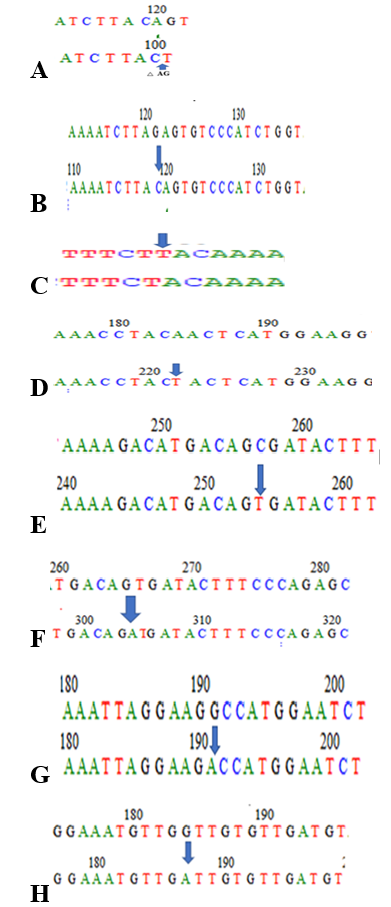
Sequence variantion. A, BRCA1 Exon-2 c.68-69 Del AG; B, BRCA1-Exon2 c.67 sub.G>C; C, BRCA1 Exon- 5 IVS5 -51 dupT; D, BRCA1-Exon 11 c. 2009 A>T; E, BRCA1-Exon -11- c.2082 C>T; F, BRCA1 Exon-11 - c.2218-2219Ins.A; G, BRCA2 Exon-19 c.8675 G>A; and H, BRCA2 EXON- 22 c. 9079G>A.
Services
Article usage statistics
Loading…