
BRCA1/2 genes are highly susceptible genes for both breast and ovarian cancer and account for 15-20% of all the hereditary breast cancer cases. Present study was aimed at identifying mutation in BRCA1/2 in breast cancer patients in Balochistan. Blood samples of 100 subjects including 50 breast cancer cases and 50 normal subjects were used to determine genetic variants in BRCA1 and BRCA2. Nine variants were identified in BRCA1 and four were identified in BRCA2. In case of BRCA1, six missense substitutions (p.Asp343Tyr, p.Gly393Asp, p.Ser561Phe, p.Ser616Phe, p.Pro871Leu and p.Ser1613Gly) two frameshift (p.Ser423fs and p.Gly1770fs) and nonsense mutation (p.Glu1250X) was identified. In case of gene BRCA2, all the four variants were missense substitutions (p.Glu58Lys, p.Asp99Asn, p.Asp104Asn and p.Pro999Gln). The data reported here will be valuable addition for the future genetic screening of the breast cancer patients of Balochistan.
Short Communication · Volume 51, Issue 4, 3 June 2019 · Open Access
Identification of Mutations in Gene BRCA1/2 in Breast Cancer Cases from Balochistan, Pakistan
· · · · · · · · · · · · ·
Affiliations & Notes ⌄
- 1Department of Biotechnology, Balochistan University of Information Technology, Engineering and Management Sciences, Quetta 2Department of Environmental Sciences, Faculty of Bio-Sciences, UVAS, Lahore 3Department of Biotechnology, Sardar Bahadur Khan Women University, Quetta 4Department of Animal Breeding and Genetics, Lasbela University of Agriculture, Water and Marine Sciences, Uthal 5Center for Nuclear Medicine and Radiotherapy, Quetta 6Department of Biotechnology, Virtual University of Pakist
Article Info ⌄
- Journal:
- Pakistan Journal of Zoology
- Published:
- 3 June 2019

From the article
- In the case of BRCA1, six missense substitutions (p.Asp343Tyr, p.Gly393Asp, p.Ser561Phe, p.Ser616Phe, p.Pro871Leu and p.Ser1613Gly) two frameshift (p.Ser423fs and p.Gly1770fs) and one nonsense mutation (p.Glu1250X) was identified (Table I).
- In the case of gene BRCA2, all the four variants were missense substitutions (p.Glu58Lys, p.Asp99Asn, p.Asp104Asn and p.Pro999Gln) (Table II).
- Current study revealed 13 different genetic variants including missense, nonsense and frameshift mutations in gene BRCA1/2 in breast cancer cases from Balochistan.
Selected from the article's own text.
Abstract
Materials and methods
Breast cancer cases (n=50) and normal subjects (n=50), all females, belonging to different ethnic groups, were enrolled in current study. Informed consent forms were signed from the volunteers of both breast cancer patients and normal subjects. History of the disease including the family history of breast or other cancers, onset and date of diagnosis was enquired from the patients. Clinical history including histopathology was obtained from the patient files enrolled for chemotherapy and/or radiotherapy in CENAR (Center for Nuclear Medicine and Radiotherapy). Venous blood (5 ml) was collected in 15 ml tubes containing EDTA as an anticoagulant agent.
DNA was extracted from the blood samples through an inorganic method. Primers were designed for all the coding exons of BRCA1/2 genes using the Prime3 software. BRCA1/2 exons were amplified through PCR by using the primers designed for BRCA1/2 and visualized through gel documentation system after gel electrophoresis. All the amplified products were sequenced on 3100 ABI prism DNA sequencer using the Big Dye Terminator Cycle Sequencing Kit. The results of DNA sequences were analyzed for the genetic variants by comparing the sequences of the exons with the normal sequences of BRCA1/2 genes (ENST00000357654.7) through ENSEMBLE genome browser.
Results and discussion
All the coding exons and intron-exon boundaries of BRCA1/2 gene were analyzed. From among 50 breast cancer patients, nine genetic variants in BRCA1 and four in BRCA2 were recorded. In the case of BRCA1, six missense substitutions (p.Asp343Tyr, p.Gly393Asp, p.Ser561Phe, p.Ser616Phe, p.Pro871Leu and p.Ser1613Gly) two frameshift (p.Ser423fs and p.Gly1770fs) and one nonsense mutation (p.Glu1250X) was identified (Table I). In the case of gene BRCA2, all the four variants were missense substitutions (p.Glu58Lys, p.Asp99Asn, p.Asp104Asn and p.Pro999Gln) (Table II). Sequence data of all exons of BRCA1/2 were compared with normal sequences of BRCA1/2 cDNA sequences and genomic data from public databases.
Table I.- List of genetic variants identified in gene BRCA1.
| Region | Variant | Mutation type | Effect on protein |
| Exon 11 | c.1033G>T | Missense substitution | p.Asp343Tyr |
| Exon 11 | c.1181G>A | Missense substitution | p.Gly393Asp |
| Exon 11 | c.1267insAT | Frameshift | p.Ser423fs |
| Exon 11 | c.1682C>T | Missense substitution | p.Ser561Phe |
| Exon 11 | c.1847C>T | Missense substitution | p.Ser616Phe |
| Exon 11 | c.2612C>T | Missense substitution | p.Pro871Leu |
| Exon 11 | c.3748G>T | Nonsense/Stop codon | p.Glu1250X |
| Exon 16 | c.4837A>G | Missense substitution | p.Ser1613Gly |
| Exon 21 | c.5308insG | Frameshift | p.Gly1770fs |
Table II.- List of genetic variants identified in gene BRCA2.
| Region | Variant | Mutation type | Effect on protein |
| Exon 3 | c.172G>A | Missense substitution | p.Glu58Lys |
| Exon 3 | c.295G>A | Missense substitution | p.Asp99Asn |
| Exon 3 | c.310G>A | Missense substitution | p.Asp104Asn |
| Exon 11 | c.2996C>T | Missense substitution | p.Pro999Gln |
Among the Asian states, Pakistan is considered to have the highest incidences of breast cancer . BRCA1 and BRCA2 are the most susceptible breast cancer genes. Proteins encoded by both genes play an important role to protect the genome. BRCA1 encodes a pleiotropic protein in response to DNA damage that functions to activate cell cycle checkpoint and DNA repair ; ; .
The identified missense mutations was studied by bioinformatics software Polyphen-2 that showed that most of the missense mutations were benign (Fig. 1); while the other nonsense mutation and frameshift mutations may have been the case of breast cancer in the patients (Fig. 2). Studies suggest that BRCA1 and BRCA2 are most predisposing genes to hereditary breast and ovarian cancers. Germline mutations in both BRCA1 and BRCA2 genes may increase the risk of developing breast cancer up to about 80% throughout the life time of an individual ; . In Pakistan, consanguineous marriages are very common. In current study, parents of 7 patients were reported with consanguinity. Hashmi (1997) and Hussain and Bittles (1998) reported in their study that Pakistan has the highest rate of consanguinity globally with 60-70% consanguineous marriages, which may play major role in spreading the hereditary cancers. Liede et al. (2002) reported five BRCA1 mutations (2080insA, 3889delAG, 4184del4, 4284delAG, and IVS14-1A→G) and one BRCA2 mutation (3337C→T) in multiple case subjects in Pakistani population. Rashid et al. (2006) identified thirty deleterious germ-line mutations in the 176 families (17.0%), including 23 in BRCA1 and 7 in BRCA2. Four mutations, 185delAG, 185insA, S1503X and R1835X, were recurrent; these accounted for 52% of all identified BRCA1 mutations.
The data reported here will be valuable addition for the future genetic screening of the breast cancer patients either with a family history or not and for the other family members of the patients who are at risk.
Conclusion
Current study revealed 13 different genetic variants including missense, nonsense and frameshift mutations in gene BRCA1/2 in breast cancer cases from Balochistan.
Statement of conflict of interest
The authors declare no conflict of interest.
Figures
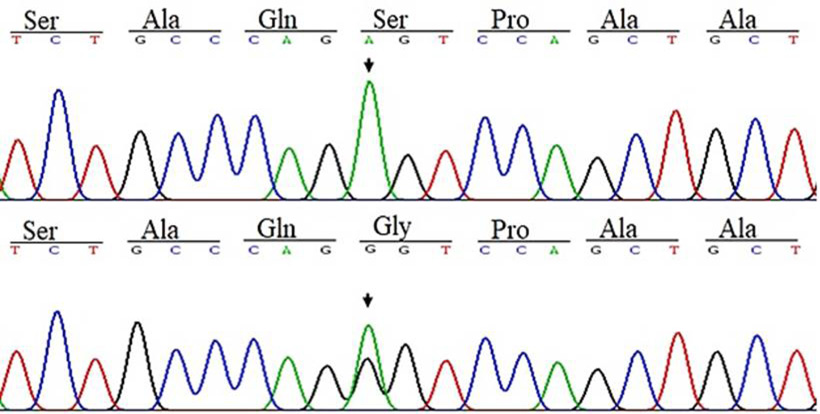
Missense substitution in Exon 16 of gene BRCA1.
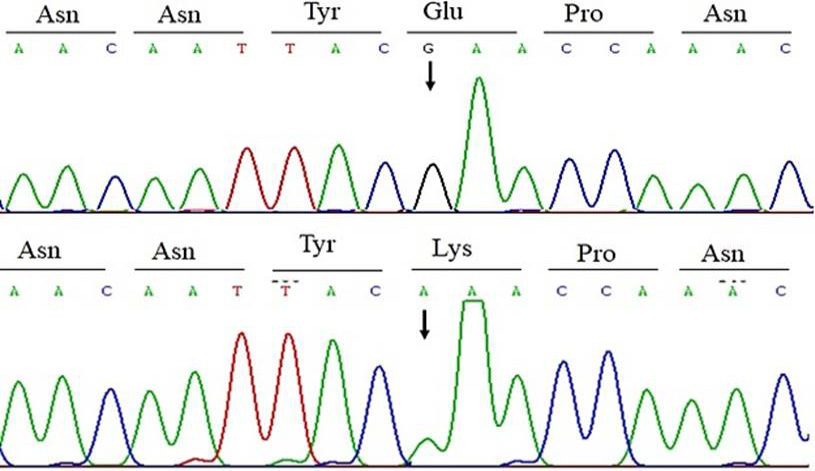
Missense substitution in Exon 3 of gene BRCA2.
References
- Ahmad, J., Le Calvez-Kelm, F., Daud, S., Voegele, C., Vallee, M., Ahmad, A., Kakar, N., McKay, J.D., Gaborieau, V., Leone, M. and Sinilnikova, O., 2012. Clin. Genet, 82: 594-598. https://doi.org/10.1111/j.1399-0004.2012.01869.x[CrossRef]
- Almeer, R., Alqarni, A., Alqattan, S., Abdi, S., Alarifi, S., Hassan, Z. and Semlali, A., 2018. Pakistan J. Zool., 50: 1999-2007. http://dx.doi.org/10.17582/journal.pjz/2018.50.6.1999.2007[Full text][CrossRef]
- Baloch, A.H., Daud, S., Raheem, N., Luqman, M., Ahmad, A., Rehman, A., Shuja, J., Rasheed, S., Ali, A., Kakar, N. and Naseeb, H.K., 2014. Mol. Biol. Rep., 41: 1103-1107. https://doi.org/10.1007/s11033-013-2956-x[CrossRef]
- Borg, A., Haile, R.W., Malone, K.E., Capanu, M., Diep, A., Törngren, T., Teraoka, S., Begg, C.B., Thomas, D.C., Concannon, P. and Mellemkjaer, L., 2010. Hum. Mutat., 31: E1200-E1240. https://doi.org/10.1002/humu.21202[CrossRef]
- Buckley, N.E. and Mullan, P.B., 2012. Stem Cell Rev. Rep., 8: 982-993. https://doi.org/10.1007/s12015-012-9354-y[CrossRef]
- Cao, L., Li, W., Kim, S., Brodie, S.G. and Deng, C.X., 2003. Genes Dev., 17: 201-213. https://doi.org/10.1101/gad.1050003[CrossRef]
- Deng, C.X., 2006. Nucl. Acids Res., 34: 1416-1426. https://doi.org/10.1093/nar/gkl010[CrossRef]
- Dine, J. and Deng, C.X., 2013. Cancer Metast. Rev., 32: 25-37. https://doi.org/10.1007/s10555-012-9403-7[CrossRef]
- Dodova, R.I., Mitkova, A.V., Dacheva, D.R., Hadjo, L.B., Vlahova, A.I., Hadjieva, M.S.T., Valev, S.S., Caulevska, M.M., Popova, S.D., Popov, I.E. and Dikov, T.I., 2015. BMC Cancer, 15: 523. https://doi.org/10.1186/s12885-015-1516-2[CrossRef]
- Esposito, M.V., Nunziato, M., Starnone, F., Telese, A., Calabrese, A., D’Aiuto, G., Pucci, P., D’Aiuto, M., Baralle, F., D’Argenio, V. and Salvatore, F., 2016. Int. J. mol. Sci., 17: 2145. https://doi.org/10.3390/ijms17122145[CrossRef]
- Ford, D., Easton, D., Stratton, M., Narod, S., Goldgar, D., Devilee, P., Bishop, D., Weber, B., Lenoir, G. and Chang-Claude, J., 1998. Am. J. Hum. Genet., 62: 676-689. https://doi.org/10.1086/301749[CrossRef]
- Ferlay, J., Soerjomataram, I., Ervik, M., Dikshit, R., Eser, S., Mathers, C., Rebelo, M., Parkin, D.M., Forman, D., Bray, F. (eds.), 2012. GLOBOCAN, 2012: Estimated cancer incidence, mortality and prevalence worldwide in 2012. Available at: http://publications.iarc.fr/Databases/Iarc-Cancerbases/GLOBOCAN-2012-Estimated-Cancer-Incidence-Mortality-And-Prevalence-Worldwide-In-2012-V1.0-2012 (Accessed on 07 March, 2019).
- Friedman, L.S., Ostermeyer, E.A., Szabo, C.I., Dowd, P., Lynch, E.D., Rowell, S.E. and King, M.C., 1994. Nat. Genet., 8: 399-404. https://doi.org/10.1038/ng1294-399[CrossRef]
- Gudmundsdottir, K. and Ashworth, A., 2006. Oncogene, 25: 5864-5874. https://doi.org/10.1038/sj.onc.1209874[CrossRef]
- Hashmi, M.A., 1997. J. Pak. med. Assoc., 47: 75-77.
- Hussain, R. and Bittles, A.H., 1998. J. Biosoc. Sci., 30: 261-275. https://doi.org/10.1017/S0021932098002612[CrossRef]
- Liede, A., Malik, I.A., Aziz, Z., de los Rios, P., Kwan, E. and Narod, S.A., 2002. Am. J. Hum. Genet., 71: 595-606. https://doi.org/10.1086/342506[CrossRef]
- Moatter, T., Aban, M., Khan, S., Azam, I. and Pervez, S., 2011. J. Coll. Physic. Surg. Pak., 21: 680-684.
- Narod, S.A., 2012. Nat. Rev. clin. Oncol., 9: 460-470. https://doi.org/10.1038/nrclinonc.2012.102[CrossRef]
- Rashid, M.U., Zaidi, A., Torres, D., Sultan, F., Benner, A., Naqvi, B., Shakoori, A.R., Seidel-Renkert, A., Farooq, H., Narod, S., Amin, A. and Hamann, U., 2006. Int. J. Cancer, 119: 2832-2839. https://doi.org/10.1002/ijc.22269[CrossRef]
- Roy, R., Chun, J. and Powell, S.N., 2012. Nat. Rev. Cancer, 12: 68-78. https://doi.org/10.1038/nrc3181[CrossRef]
Services
Article usage statistics
Loading…