
Diabetes mellitus is getting an epidemic worldwide and Pakistan stands at position 3rd with the 17% prevalence of diabetic adults. Diabetes develops several clinical complications and dyslipidemia is one among these complications. Dyslipidemia is marked as derangements in lipid metabolism and is one of the risk factors to develop cardiovascular diseases. The genetic predisposition in association with environmental and lifestyle modifications can play a central role in the progression of diabetic dyslipidemia. A cross-sectional study was designed to detect pathogenic genetic variants in APOA1 and ABCG1 genes associated with dyslipidemia in type 2 diabetic patients. A total of ninety subjects of both genders, aged between 30-70 years were randomly selected and further divided into a diabetic dyslipidemia group, a diabetic group and a healthy group. Genomic DNA was extracted from peripheral blood and subjected to the polymerase chain reaction using primers of the APOA1 gene and ABCG1 gene. The amplicons were subjected to Sanger sequencing on Automated DNA Genetic Analyzer. The sequence data was analyzed on BioEdit7.2 biological software and Basic Local Alignment Search Tool against the human genome database to find any genetic variation. It has been found that ABCG1 gene and APOA1 gene exhibited a pattern of the normal nucleotide sequence in all subjects of three groups with no pathogenic genetic variation. Thus, exon 3 of the ABCG1 gene and exons 2 and 3 of the APOA1 gene do not contribute to the onset of dyslipidemia in type 2 diabetes patients.
Short Communication · Volume 55, Issue 5, 17 September 2023 · Open Access
Screening for Pathogenic Genetic Variants of APOA1 and ABCG1 Genes Associated with Dyslipidemia in Type 2 Diabetic Patients
· · · · ·
Affiliations & Notes ⌄
- 1Department of Biochemistry and Molecular Biology, Army Medical College, National University of Medical Sciences, Rawalpindi, Pakistan * Corresponding author: asifamajeed@amc.numspak.edu.pk
Article Info ⌄
- Journal:
- Pakistan Journal of Zoology
- Published:
- 17 September 2023

From the article
- The Sanger sequencing detected the normal pattern of exons 3 and 2 of the APOA1 gene without any genetic variation (Fig. 2b and 2d).
- Several genes contribute to the development of diabetic dyslipidemia.
- Exon 3 of the ABCG1 and exons 2 and 3 of the APOA1 gene do not contribute to the onset of diabetic dyslipidemia.
- Thus, genetic mutations can be present in other exons of the APOA1 and ABCG1 genes.
Selected from the article's own text.
Abstract
Materials and methods
The study design was a cross-sectional study and carried out at the Biochemistry and Molecular Biology Department, Army Medical College, National University of Medical Sciences in collaboration with the Chemical Pathology Laboratory of Army Medical College, Pak Emirates Military Hospital Rawalpindi. The Ethical Review Committee, Army Medical College approved the study and study followed the Declaration of Helsinki . The sampling technique was non-probability purposive and ninety subjects between the age of 30 to 70 years were included after informed consent. Subjects were randomly selected, both sexes, and subdivided into three groups on the basis of medical examination. Group I was comprised of thirty diabetic dyslipidemia patients, group II comprised thirty type 2 diabetic patients, and group III comprised of healthy individuals. The diagnosis was based on laboratory investigations of fasting blood sugar, HbA1c, and lipid profile. The inclusion criterion followed was newly diagnosed type 2 diabetic patients with dyslipidemia and newly diagnosed type 2 diabetic patients without dyslipidemia. A newly diagnosis is defined as the first visit of patients to the hospital. Patients with type 1 diabetes, T2DM patients with other chronic complications, patients with malignancies, chronic thyroid, renal or hepatic diseases, pregnant females, and patients on lipid-lowering drugs were excluded.
Genomic DNA was extracted from blood samples as described previously . The qualitative DNA analysis was performed on 1% agarose gel electrophoresis. The sequence of exon 3 of the ABCG1 gene and exons 2 and 3 of the APOA1 gene was downloaded from National Centre for Biotechnology Information (https://www.ncbi.nlm.nih.gov) and ENSEMBLE genome databases (https://www.ensembl.org). The primers were designed on primer 3 software (https://primer3.ut.ee/). The sequence of the primer of ABCG1 was 5’-GGTCTTGTTGCTTCCTCTGG-3’ (forward) and 5’-TCC TCCCAGCTTGATACACA-3’ (reverse). The primers of the APOA1 gene were designed from intronic flanking region and the sequence of exon 2 was 5ʹCTCTGTGCCCTTCTCCTCAC3ʹ (forward) and TGAGAAACCTGCTGCCTCTG (reverse), exon-3 was 5ʹGAGGCAGCAGGTTTCTCACT3ʹ (forward) and 5ʹGGCTTCAACATCCCACA3ʹ (reverse). DNA samples of three groups were amplified on Thermocycler (Corbett USA). A 25μl PCR reaction mixture was containing 1X Taq buffer, 0.2μM dNTPs, 1.5mM MgCl2, 1pmol/μl of each primer, 0.5 units Taq DNA polymerase, 20ng/μl template DNA, and 17μl nuclease-free water. The conditions used for amplification of ABCG1 and APOA1 were the same except for annealing temperature. The PCR program was as followed: cycle 1: hot start at 95°C for 4 min, cycle 2: 35 cycles of denaturation at 95°C for 30 sec, annealing for 30 sec at 60.5°C (exon 3 of ABCG1), 61°C (exon 2 of APOA1), 59.6°C (exon 3 of APOA1). DNA sequencing of ABCG1 and APOA1 genes was done on an Automated DNA Sequencer (Beckman Coulter) using DTCS kit (Beckman and Coulter GenomeLab™ Dye Terminator Cycle Sequencing kit). The sequencing PCR followed denaturation at 96°C for 20sec, annealing at optimized temperatures for 20 sec and extension at 60°C for 4 min with 30 cycles. The data was analyzed through BioEdit 7.2 biological software and pairwise alignment was performed on basic local alignment search tool (BLAST) against the human genome database to detect the genetic mutations.
Results and discussion
Type 2 diabetes mellitus is a prevailing health issue. Diabetes leads to several complications that arise mainly due to prolonged hyperglycemia and independent components of metabolic syndrome like insulin resistance . Several genetic and epigenetic factors are considered to be involved in the progression of complications associated with T2DM.
In the present study, genomic DNA was extracted with a concentration of 300ng/μl to 1μg/μl from blood (Fig. 1a). In PCR, 311bp fragment of exon 3 of ABCG1 was obtained and Sanger sequencing revealed no presence of the genetic mutation (Fig. 1b and 1c). The 334bp and 258bp PCR fragments of exons 3 and 2 of the APOA1 gene were obtained (Fig. 2a and 2c). The Sanger sequencing detected the normal pattern of exons 3 and 2 of the APOA1 gene without any genetic variation (Fig. 2b and 2d).
One of the major cardiovascular complications that occur due to prolonged type 2 diabetes is associated with dyslipidemia. Hyperglycemia, advanced glycation end products, and oxidative stress play a significant part in causing diabetic dyslipidemia . Several genes contribute to the development of diabetic dyslipidemia. APOA1 gene provides information for the synthesis of apolipoprotein A-1 that is present in the liver and intestines, thus resulting in the translation of apoA-1 receptor proteins. A study reported no association of polymorphism rs670, rs5069, and rs2070665 in the APOA1 gene with dyslipidemia in the Kazakhs of Xinjiang and found equal distribution in cases and control .
In the population of North-East China, a functional polymorphism in APOA1/C3/A4/A5-ZPR1-BUD13 gene cluster was assessed including males and females. It has been found that rs5072 showed a different spectrum in females and males. It provides a new insight to study the molecular mechanisms of dyslipidemia on a gender basis .
It was hypothesized that mutations in the APOA1 and ABCG1 genes are one of the factors involved in the disruption of cholesterol clearance and diabetic dyslipidemia. These results signify the contribution that studied exons do not involve in diabetic dyslipidemia and open a research gate to study other exons, genes and proteins that take part in the lipid metabolism, especially RCT.
Conclusion
Exon 3 of the ABCG1 and exons 2 and 3 of the APOA1 gene do not contribute to the onset of diabetic dyslipidemia. Thus, genetic mutations can be present in other exons of the APOA1 and ABCG1 genes.
Limitations
Small sample size was due to limited financial resources.
Statement of conflict of interest
The authors have declared no conflict of interest.
Figures
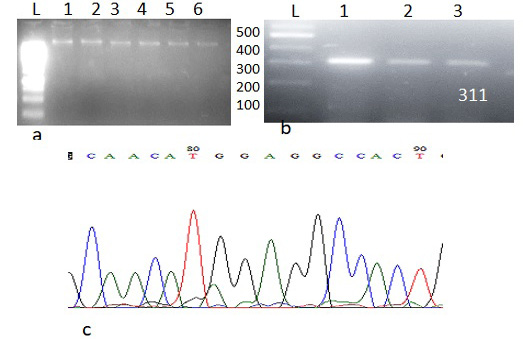
Molecular analysis of ABCG1 gene: (a) L: DNA ladder; Lane 1-7 DNA samples. (b) L: DNA ladder; Lane 1-3 PCR amplification in samples. (c) Sanger sequencing electro-chromatogram of diabetic dyslipidemia sample.
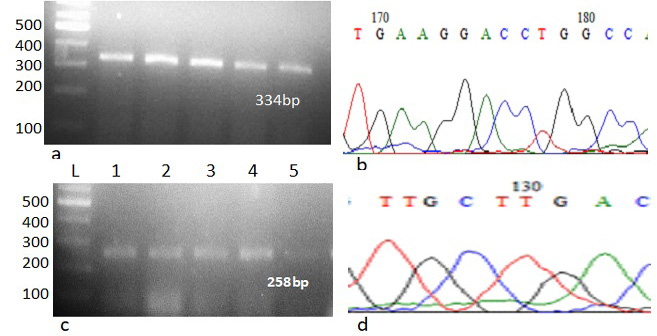
Molecular analysis of APOA1 gene: (a) L: DNA Ladder; Lane 1-5 PCR amplification of exon 3. (b) Sanger sequencing electro-chromatogram of exon 3 in diabetic dyslipidemia samples. (c) L: DNA ladder; Lane 1-5 PCR amplification of exon 2. (d) Sanger sequencing electro-chromatogram of exon 2 in diabetic dyslipidemia samples.
References
- Aamir, A.H., Ul-Haq, Z., Mahar, S.A., Qureshi, F.M., Ahmad, I., Jawa, A., Sheikh, A., Raza, A., Fazid, S., and Jadoon, Z., 2019. Br. Med. J. Open, 9: e025300. https://doi.org/10.1136/bmjopen-2018-025300[CrossRef]
- Abdel-Razek, O., Sadananda, S.N., Li, X., Cermakova, L., Frohlich, J., and Brunham, L.R., 2018. J. Clin. Lipidol., 12: 116-121. https://doi.org/10.1016/j.jacl.2017.10.010[CrossRef]
- Bai, W., Kou, C., Zhang, L., You, Y., Yu, W., Hua, W., Li, Y., Yu, Y., Zhao, T., and Wu, Y., 2019. PeerJ, 6: e6175. https://doi.org/10.7717/peerj.6175[CrossRef]
- Chand, R.P., Kumar, A.S., Anuj, K., Vishnupriya, S., and Reddy, B.M., 2016. PLoS One, 11: e0153720. https://doi.org/10.1371/journal.pone.0153720[CrossRef]
- Chawla, A., Chawla, R., and Jaggi, S., 2016. Indian J. Endocrinol. Metab., 20: 546. https://doi.org/10.4103/2230-8210.183480[CrossRef]
- Daffu, G., Shen, X., Senatus, L., Thiagarajan, D., Abedini, A., Hurtado Del Pozo, C., Rosario, R., Song, F., Friedman, R.A., Ramasamy, R., and Schmidt, A.M., 2015. Diabetes, 64: 4046-4060. https://doi.org/10.2337/db15-0575[CrossRef]
- de Luis Roman, D.A., Izaola, J.O., Primo, D., and Aller, R., 2019. Nutr. Hosp., 36: 1288-1295. https://doi.org/10.20960/nh.02390[CrossRef]
- DeFronzo, R.A., Ferrannini, E., Groop, L., Henry, R.R., Herman, W.H., Holst, J.J., Hu, F.B., Kahn, C.R., Raz, I., Shulman, G.I., Simonson, D.C., Testa, M.A., and Weiss, R., 2015. Nat. Rev. Dis. Primers, 1: 15019. https://doi.org/10.1038/nrdp.2015.19[CrossRef]
- Feng, D., Ma, R., Guo, H., He, J., Yan, Y., Niu, Q., Li, S., Rui, D., Sun, F., and Zhang, M., 2016. Genet. Mol. Res., 15: https://doi.org/10.4238/gmr.15028094[CrossRef]
- Lau, L.H., Lew, J., Borschmann, K., Thijs, V., and Ekinci, E.I., 2019. J. Diab. Investig., 10: 780-792. https://doi.org/10.1111/jdi.12932[CrossRef]
- Mogilenko, D.A., Shavva, V.S., Dizhe, E.B., and Orlov, S.V., 2019. Mol. Biol., 53: 427-437. https://doi.org/10.1134/S0026893319030129[CrossRef]
- Organization, W.H., 2019. Classification of diabetes mellitus.
- Parhofer, K.G., 2015. Diab. Metab. J., 39: 353-362. https://doi.org/10.4093/dmj.2015.39.5.353[CrossRef]
- Sag, D., Cekic, C., Wu, R., Linden, J., and Hedrick, C.C., 2015. Nat. Commun., 6: 6354. https://doi.org/10.1038/ncomms7354[CrossRef]
- Sambrook, J., and Russell, D.W., 2006. Isolation of high molecular weight DNA from mammalian cells using proteinase K and Phenol. CSH Protocols. https://doi.org/10.1101/pdb.prot4036[CrossRef]
- Sarfraz, M., Sajid, S., and Ashraf, M.A., 2016. Saudi J. biol. Sci., 23: 761-766. https://doi.org/10.1016/j.sjbs.2016.03.001[CrossRef]
- World Medical, A., 2013. J. Am. med. Assoc., 310: 2191-2194. https://doi.org/10.1001/jama.2013.281053[CrossRef]
Services
Article usage statistics
Loading…