ResearchersLinks

Review · Volume 10, Issue 9, 1 September 2022 · Open Access

Leverage of Moringa oleifera Supplementation on Performances, Biochemical, and Milk Profiles in Mammals

· · · · ·

Affiliations & Notes ⌄
  1. 1Department of Public Health and Animal Care, College of Veterinary Medicine, King Faisal University, P.O. Box 400, Al-Hassa, Kingdom of Saudi Arabia
  2. 2Department of Clinical Studies, College of Veterinary Medicine, King Faisal University, P.O. Box 400, Al-Hassa, Kingdom of Saudi Arabia
  3. 3Department of Animal and Fish Production, College of Agriculture and Food Sciences, King Faisal University, P.O. Box 400, Al-Hassa, Kingdom of Saudi Arabia
  4. 4Branch of the Ministry of Environment, Water and Agriculture in Jazan Region, KSA
  5. 5Faculty of Human Medicine, Assiut University, Egypt, 71526. *Correspondence | Al-Hassan Mohammed, Faculty of Human Medicine, Assiut University, Egypt, 71526
  6. 6Email: aamohammed@kfu.edu.sa
Article Info ⌄
Journal:
Advances in Animal and Veterinary Sciences
Published:
1 September 2022

From the article

  • The potential properties of M. oleifera as a source of protein and bioactive compounds for animals and humans have been reported in several studies.
  • The biomass-derived macromolecules of M. oleifera have been shown in ruminant species to enhance nutrient digestibility, rumen fermentation, growth performance, antioxidant, and tissue protection.
  • The bioactive compounds of M. oleifera as promising protectors of inflammation and oxidative stress processes have been reported in several studies.
  • Moreover, in-vivo and in-vitro studies should be carried out on M. oleifera bioactive compounds to authenticate their possible applications over a wide range of growth, productivity, and reproductive performances, as well as therapeutic approaches in biopharmaceutical industries as potent drugs.

Selected from the article's own text.

Abstract

Nutritional supplements of Moringa oleifera to animals are considered one of the aids for improving health and production. M. oleifera leaves, seeds, and extracts are administered to animals for therapeutic and nutritional purposes. The effects of using M. oleifera and its extracts on animals’ production and health have shown beneficial effects in several studies. The roles of M. oleifera and its extracts on nutrient digestibility, rumen fermentation and enzyme activities, growth and reproductive performances, antioxidants, and milk production and composition have been well documented. M. oleifera contains valuable chemical constituents such as proteins, essential fatty acids, vitamins, and beta-carotene. The M. oleifera composition varies depending on nutrient availability for production, species, and lifespan of trees. Extracts of leaves and seeds were used for the production of invaluable compounds. Knowledge of M. oleifera impacts on productive, reproductive, and therapeutic performances is more fragmentary and the present review is compiled and discussed owing to the importance of M. oleifera and its purified compounds.

Keywords | Moringa oleifera, Growth, Reproduction, Milk, Blood 

INTRODUCTION

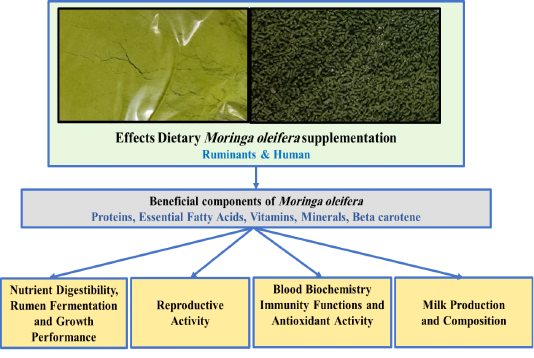
Moringa oleifera (M. oleifera) is a tree plant generally referred to as a miracle plant. M. oleifera is a nutritious and medicinal tree species-rich in protein, minerals, and vitamins. M. oleifera is a native plant in Pakistan, India, Bangladesh, and Afghanistan . Supplementation of M. oleifera to animals and humans has received increased attention for its high contents of certain micro and macro-nutrients, which are important in medicine and nutrition for both humans and animals ; . Leaves of M. oleifera are reported to contain substantial amounts of vitamins such as A, C, and E (Saini et al., 2014a,b; , minerals such as potassium, calcium, magnesium, iron, copper, and manganese , nutrients such as protein, fiber, carotenoids, and tocopherols ; ; Saini et al., 2014a,b). Some of the Moringa components are known to scavenge free radicals . Substantial variations in the contents of M. oleifera have been shown such as protein (19-29%), fiber (16-24%), minerals, vitamins, and others according to cultivar and sources ; ; ; ; . M. oleifera leaves are known to contain calcium (4X) and protein (2X) compared to milk, vitamin C (7X) compared to oranges, potassium and iron (3X) compared to banana and spinach respectively, and vitamin A (4X) compared to carrots ; . The leaves of M. oleifera contain beta-carotene and other phytochemicals known for their antioxidant ability (rutin, quercetin, kaempferol, and caffeoylquinic acids); antioxidant vitamins (A, C, and E) and antioxidant micronutrients (zinc and selenium), which play important roles in fertility performance ; ; as well as contributing to an improvement in growth performance ; , blood metabolites ; , and milk production and composition , 2019; . Due to the several aforementioned nutritional benefits of M. oleifera, this review is compiled and discussed such effects on mammals (Figure 1).


Nutrient Digestibility, Rumen Fermentation, And Growth Performance

Ruminant animals were supplemented with M. oleifera in different doses for enhancement of feed efficiency, rumen fermentation, and growth performances ; ; , 2016, 2017; ; . Fadiyimu et al., (2010, 2016; 2017) conducted studies in Nigeria for investigating the effects of the inclusion of 25, 50, 75, and 100% M. oleifera on nutrient digestibility and nitrogen balance of African ewes with an average body weight of 16.1 kg. The inclusion of Moringa in the diet improved the nutrient digestibility and growth characteristics, while the feed intake decreased by increasing the proportion of Moringa in the diet. Supplementing Rhodes hay in Ethiopia with graded levels of dried Moringa leaves improved dry matter intake, increased body weight, and nitrogen retention and reported that Moringa leaves can serve as a protein supplement for low-quality feeds. EL-Hedainy et al. (2020) conducted a study in Egypt for investigating the effects of 4 g M. oleifera seeds /head for 45 days on the productive performance and body measurements of male Barki five months old. They recorded the ability of M. oleifera seeds to improve the final body weights and daily gains of lambs, while body measurements did not differ significantly between groups. Bhokre et al. (2020) investigated the effects of Moringa leaf meal based diets for 90 days on the biometry and body condition score of Deccani lambs. Their results based on biweekly body measurements indicated that the mean body length, face length, and hip width of the developing Deccani lambs increased linearly throughout the experiment, and body length had a significant difference (P < 0.01) between the treatment groups. They also recorded significantly higher body conditions (BCS) (P < 0.05) in the 25% treated group from the third to sixth week. Warastomo et al. (2021) investigated the effects of moringa leaf flour on the physical properties of lambs with a body weight of 20 kg and aged 7-8 months for 75 days. They recorded that Moringa was not able to improve the physical properties of meat (pH, tenderness, and water holding capacity). Warastomo et al. (2021) investigated the effects of feeding M. oleifera meal (0, 25, and 50) on growth performance of Surti kids aged 6-8 months under intensive system of management for 14 weeks. The lambs showed best results at the supplement level of 25% concerning body weights and biometrics (body length and chest circumference).

The negative effects of replacing soybean meal with M. oleifera leaf meal on ruminal fermentation characteristics were investigated in goats and steers . They observed significant decreases in CH4, ruminal ammonia-N, total protozoal number, and organic matter degradability, as well as increases in CO2 production, fermentation pH, and total bacterial count. Conversely, Abdel-Raheem and Hassan (2021) carried out a study on growing buffalo calves about the effects of M. oleifera dietary inclusion on nutrient digestibility, rumen fermentation, and growth performance. They recorded an improvement in rumen fermentation, growth performance, blood metabolites, and mitigated ammonia and methane values. They attributed the differences between the results to the difference in the environmental conditions, the species, and the age of the animals, as well as the composition and levels of supplementing M. oleifera.

Reproductive Activity

Gonadal dysfunctions and reproductive hormonal imbalances were widely modulated through nutritional ingredients (Nagasawa et al., 1989; Downing et al., 1995; Mohammed and Attaai 2011; Gifre et al., 2017; Senosy et al., 2017, 2018; Mohammed and Farghaly 2018; Mohammed 2018; Mohammed 2019; Mohammed et al., 2012, 2020; 2021, Mohammed and Al-Hozab 2020; Ali et al., 2021), hormonal supplementation (Zarazaga et al., 1996; Mohammed et al., 2011), and both hormonal and nutritional supplementation (Mohammed and Attaai, 2011). Based on the negative influences of increased energy and protein in the diets of humans and animals on health and fertility (McEvoy et al., 1997; Dawuda et al., 2002; Mohammed et al., 2012), and because of the high cost of diet; M. oleifera and their purified extracts were given in small quantity as replacers instead of hormonal stimulation (Odeyinka et al., 2008). In addition, M. oleifera and its purified extracts might be used for treating reproductive dysfunctions.

Barakat et al. (2015) investigated the effect of M. oleifera leaf extract at the level of 20, 50, and 100 μg/ml on the expression of genes related to fertility and the increase of calcium ions in ovine oocytes. They indicated that genes related to oocyte maturation and meiotic progression were affected by M. oleifera extract. Furthermore, M. oleifera along with hormones improved the rate of ovine oocyte maturation and could act to induce mRNA expression and synthesis of the basic maturation-stimulating protein essential for maturation processes. Ajuogu et al. (2019) investigated the effect of M. oleifera leaf powder in levels of 5, 10, and 15 g/kg feed on the concentration of reproductive hormones and semen quality of New Zealand white rabbits. They revealed a significant dose-dependent reduction in the concentration of serum follicle-stimulating (FSH), luteinizing (LH), and estrogen hormones in females.

Sonbarse et al. (2020); Giuberti et al. (2021) recorded that the highest level of M. oleifera significantly increased the progesterone levels whereas the prolactin concentrations were not affected. In males, the concentrations of FSH and LH increased significantly in the M. oleifera treated groups. Semen volume, sperm count, and motility rate were significantly improved in dose-dependent M. oleifera. They added that M. oleifera might be used as an alternative to hormonal treatment to enhance reproductive performance for its high level of beta-carotene, protein, and other fine chemicals. Further studies are still required on the effects of M. oleifera on ovarian follicle development, oocyte quality, oocyte maturation and fertilization, and the viability of the embryos.

Blood Biochemistry

Blood indices and plasma metabolites are indicative of the body’s health in both animals and humans. M. oleifera is widely cultivated as an important vegetable for human consumption . Therefore, blood indices and plasma metabolites were recorded in different studies on M. oleifera supplementation in both animals and humans ; ; . Fadiyimu et al. (2010, 2016; 2017) carried out an investigation in Nigeria on the effects of 25, 50, 75, and 100% M. oleifera on blood indices and plasma metabolites of African ewes with an average body weight of 16.1 kg. They showed that the packed cell volume (PCV), hemoglobin (Hb), red blood cells (RBCs), and white blood cells (WBCs) of the animals treated with M. oleifera were within the normal physiological range in contrast to the ewes of the control group, whose values were less than normal. Moyo et al. (2012) examined the antioxidant activity of M. oleifera leaf extract on the enzymatic activity of the liver in goats of South Africa. They showed that M. oleifera extract could be a potential source of compounds with powerful antioxidant potential. Meel et al. (2018) investigated the effect of M. oleifera leaves at levels of 25, 50, 75, and 100% on blood and plasma components of Sirohi goat kids in India. They showed that the red blood cells, hemoglobin, total protein, and albumin increased significantly while the white blood cells and glucose decreased in the 100% treatment. EL-Hedainy et al. (2020) investigated the effect of M. oleifera seeds (4 g/head) for 45 days on growth performance and body parameters of males aged five months in Egypt. They showed the ability of M. oleifera seeds to improve the concentrations of total protein , as well as maintained all blood serum components within the normal range.

The effect of M. oleifera extract (50 mg/kg DM) on blood and plasma measurements of lambs has been investigated by Akanmu et al. (2020). The results revealed that most of the blood treatments were not affected by M. extract treatment as an anti-methanogenetic additive and all the biochemical parameters except for the decreased alkaline phosphatase; did not differ between treatments, as well as reduce intestinal methane emission. They revealed that the extract was not toxic to sheep as an anti-methane additive at a rate of 50 mg/kg DM.

Yasoob et al. (2022) reported that M. oleifera leaf powder when was supplemented to rabbits during heat stress resulted in reduced glucose, total cholesterol, low-density lipoprotein cholesterol, and triglycerides contributing to reduced intestinal methane emissions, alleviate heat stress, and increased meat yield. M. oleifera leaves may improve physiological parameters, and blood and plasma components. M. oleifera contains high lipid contents, thus might be considered as key constituents of the plasma membrane and they are essential for the functionality of all cellular membranes, as well as lipids form membrane vesicles or lipid droplets (LDs) that are involved in the transport of proteins, hormones, or fat-soluble vitamins (A, D, E, and K) in cells and extracellularly, for example in the bloodstream . 

Immunity Functions And Antioxidant Activity

Immunity functions and antioxidant activity of animals and humans could be improved through the use of feed additives (Kassab and Mohammed 2013, 2014 a,b; ; Ali et al., 2021; , 2022; . Bioactive compounds in M. oleifera have been shown to enhance immunity functions, antioxidant activities, and tissue protection in mammals ; . Wen et al. (2022) examined M. oleifera polysaccharide effects on immune indices of serum and organs in addition to colonic microflora of mice. They indicated that M. oleifera polysaccharide gave a positive effect on immune performance and intestinal health. Kekana et al. (2020) investigated the effect of M. oleifera meal to transition Holstein cows on antioxidant enzymes. The effects of Moringa and its extract on immunity functions and antioxidant activities are attributed to Moringa polyphenols extract, which might have immunomodulatory properties . M. oleifera leaves contain beta-carotene and other phytochemicals such as rutin, quercetin, kaempferol, and caffeoylquinic acids; antioxidant vitamins such as A, C, and E, and essential micronutrients such as zinc and selenium and all known for their antioxidant abilities. Hassan et al. (2021) reported the great protective effects of M. oleifera leaves extract against diseases and the widely persistent environmental toxins which disrupted cellular metabolic function. Up-regulation of genes for thermo-tolerance, antioxidation, and immunity over supplementing rabbits with oral M. oleifera leaf powder under heat stress was recorded indicating beneficial influences on liver functions in heat-stressed rabbits .

Up-regulation of the antiapoptotic BCL2A1 gene by M. oleifera leaves extract may suggest a protective effect against apoptosis induced due to heat stress. Therefore, further studies are still required to investigate phenolic compounds of M. oleifera for the treatment of various immune diseases.

Milk Production And Composition

Sustainable livestock development of milk and meat production requires appropriate strategies to be applied worldwide for covering the shortage of milk and meat requirements for humans. Because of the increasing demands for meat and milk in the world, specialists continue to explore new approaches to improve meat and milk yield through different nutritional strategies ; Alshaheen 2016; ; ; . M. oleifera inclusion for ruminants has changed milk yield and improved milk fatty acid profile (Kholif et al., 2016; 2019; . Kholif et al. (2016) found that M. oleifera supplementation in lactating Anglo-Nubian goats increased milk production by 24.0%. The contents of saturated fatty acids decrease by 9.0% whereas conjugated linoleic acids (CLAs) increased by 57.0%. Choudhary et al. (2018) found that replacing mixed concentrate ration with 50.0% M. oleifera leaves in lactating Bengal goats contributed to a positive effect on milk yield and composition and increased milk production by 6.0%, milk fatty acid profiles of Nubian goats were enhanced with M. oleifera leaves treatments (10, 20, 40 ml/day) . The percentage of saturated fatty acids decreased whereas the of unsaturated fatty acids, conjugated linoleic acid, and the arteriosclerosis index increased. They recommended the use of 20 ml for a practical approach. Olvera-Aguirre et al. (2020) studied the influence of feeding lactating ewes with M. oleifera leaf extracts on milk yield and milk composition. They showed that milk yield and composition were not significantly changed. Effects of M. oleifera essential oils (0.3 and 0.6 ml/day) supplementation on milk quality and fatty acid profile in dairy sheep were investigated by Selmi et al. (2020) and revealed increased milk fat, unchanged protein, decease urea nitrogen, decreased saturated, and decreased unsaturated fatty acid profiles.

Mendoza-Taco et al. (2022) investigated the impacts of M. oleifera leaf extracts (20 ml) on the physicochemical characteristics of yogurt prepared from sheep milk. M. oleifera leaf extracts positively affected the physical and chemical composition of milk and yogurt during storage. Milk production and composition were improved in the previous studies over M. oleifera supplementation due to the nutritional benefits of M. oleifera on nutrient digestibility, rumen fermentation, and growth

CONCLUSIONS AND RECOMMENDATION

The potential properties of M. oleifera as a source of protein and bioactive compounds for animals and humans have been reported in several studies. M. oleifera biomass-derived macromolecules and micromolecules differed according to culture conditions. The biomass-derived macromolecules of M. oleifera have been shown in ruminant species to enhance nutrient digestibility, rumen fermentation, growth performance, antioxidant, and tissue protection. Studies are still required on M. oleifera effects on female and male fertility concerning oocyte, semen quality, and embryo development. Bioactive compounds; carotenoids, could be efficiently transferred to the body and improve body growth and health. The bioactive compounds of M. oleifera as promising protectors of inflammation and oxidative stress processes have been reported in several studies. Moreover, in-vivo and in-vitro studies should be carried out on M. oleifera bioactive compounds to authenticate their possible applications over a wide range of growth, productivity, and reproductive performances, as well as therapeutic approaches in biopharmaceutical industries as potent drugs.

ACKNOWLEDGEMENTS

This work was supported through the Annual Funding track by the Deanship of Scientific Research, Vice Presidency for Graduate Studies and Scientific Research, King Faisal University, Saudi Arabia [GRANT1019].

NOVELTY STATEMENT

The present review article expressed a continuation of a novel dietary supplement of Moringa oleifera based on the previous studies on performances, biochemical, and milk profiles in mammals

CONFLICT OF INTEREST

No conflict of interest for the authors to declare.

AUTHORS contribution

Mohammed participated in experimental design, wrote and submit the review article, and prepared figures. Rashid Al Zeidi, Haitham Al Masruri, Aiman Al Mufarji, Ahmed Al-Madani, and Al-Hassan Mohammed collected references and prepared figures.

Figures

Figure 1.
Figure 1
Figure 1.

Effects of dietary Moringa oleifera supplementation on ruminants and humans 

References

  1. Abdel-Raheem S.M., Hassan E.H. (2021). Effects of dietary inclusion of Moringa oleifera leaf meal on nutrient digestibility, rumen fermentation, ruminal enzyme activities and growth performance of buffalo calves. Saudi J. Biol. Sci. 28: 4430-436. https://doi.org/10.1016/j.sjbs.2021.04.037[CrossRef]
  2. Ademosun A.O., Oboh G., Olufunke Florence Ajeigbe O.F. (2022). Influence of Moringa (Moringa oleifera) enriched ice creams on rats’ brain: Exploring the redox and cholinergic systems. Curr. Res. Food Sci. 5: 366-373. https://doi.org/10.1016/j.crfs.2022.01.021[CrossRef]
  3. Ademosun S., Ekwemalor K., Asiamah E., Worku M. (2019). Moringa oleifera polyphenols modulate galectin expression in LPS-induced bovine peripheral blood mononuclear cells. J. Dairy Sci. 102: 1.
  4. Adjei-Fremah S., Ekwemalor K., Asiamah E., Worku M. (2019). Moringa oleifera polyphenols modulate galectin expression in LPS-induced bovine peripheral blood mononuclear cells. J. Dairy Sci. 102: 3-4.
  5. Afzal S., Nawaz M.F., Qadir I., Gul S., Yasin G., Ahmad I. (2020). Variability in leaf mineral composition of Moringa oleifera in irrigated plains of Pakistan. South Afr. J. Botany. 129: 442-447. https://doi.org/10.1016/j.sajb.2019.11.025[CrossRef]
  6. Afzal A., Hussain T., Hameed A. (2021). Moringa oleifera Supplementation Improves Antioxidant Status and Biochemical Indices by Attenuating Early Pregnancy Stress in Beetal Goats. Front. Nutri., 8. https://doi.org/10.3389/fnut.2021.700957[CrossRef]
  7. Ajuogu P. K., Mgbere O. O., Bila D. S., McFarlane J. R. (2019). Hormonal changes, semen quality and variance in reproductive activity outcomes of post pubertal rabbits fed Moringa oleifera Lam. leaf powder. J. Ethnopharmacol. 233: 80–86. https://doi.org/10.1016/j.jep.2018.12.036[CrossRef]
  8. Akanmu A.M., Hassen A., Adejoro F.A. (2020). Haematology and serum biochemical indices of lambs supplemented with Moringa oleifera, Jatropha curcas and Aloe vera leaf extract as anti-methanogenic additives. Antibiotics. 9(9): 1–7. https://doi.org/10.3390/antibiotics9090601[CrossRef]
  9. Al Masruri H., Al Zeidi, R., Al Mufarji, A., Mohammed A.A. (2022). Moringa oleifera leaves supplementation to anaesthetized mice associated with changes of thermo-tolerance parameters, blood and plasma indices. Fresen. Environ. Bull. 31: 8.
  10. Al Mufarji A., Mohammed A.A. (2022). Organic Moringa oleifera Leaves Chemical Composition and Fatty Acid Profiles and its Effect on Modulation of Blood and Plasma Parameters of Ewes in Subtropics. Adv. Anim. Vet. Sci. 10(6): 1227-1232. https://doi.org/10.17582/journal.aavs/2022/10.6.1227.1232[CrossRef]
  11. Al Mufarji A., Mohammed A.A., Al Masruri H., Al Zeidi R. (2022). Modulation Impacts of Moringa oleifera on Thermo-Tolerance Parameters and Blood indices in Subtropical Ewes under Heat Stress (Accepted). https://doi.org/10.17582/journal.aavs/2022/10.7.1641.1648[Full text][CrossRef]
  12. Ali M.A., Alshaheen T., Senosy W., Kassab A., Mohammed A.A. (2021). Effects of feeding green microalgae and Nigella sativa on productive performance and metabolic profile of Boer goats during peripartum period in subtropics. Fresen. Environ. Bull. 30(07): 8203-8212.
  13. Alshaheen T.A. (2016). Effect of dietary source of omega-3 fatty acid on milk production, some reproductive and blood biochemical parameters of dairy cows during hot summer conditions. Ph.D. College of Food and Agricultural Sciences. King Saud University, KSA.
  14. Barakat I. A. H., Khalil W. K. B., Al-Himaidi A.R. (2015). Moringa oleifera extract modulates the expression of fertility related genes and elevation of calcium ions in sheep oocytes. Small Rumin. Res. 130: 67–75. https://doi.org/10.1016/j.smallrumres.2015.06.011[CrossRef]
  15. Bhokre S.M., Rajanna N., Ramana D. B. v, Nagalakshmi D., Kumar M. K., Kumar M.S. (2020). Effect of feeding of Moringa (Moringa oleifera) leaf meal based diets on the biometry and body condition score of Deccani lambs. Int. J. Curr. Microbiol. Appl. Sci. 9(4): 1089–1096. https://doi.org/10.20546/ijcmas.2020.904.129[CrossRef]
  16. Brady E.L., Pierce K.M., Lynch M.B., Fahey A.G., Mulligan F.J. (2021). The effect of nutritional management in early lactation and dairy cow genotype on milk production, metabolic status, and uterine recovery in a pasture-based system. J. Dairy Sci. 104(5): 5522-5538. https://doi.org/10.3168/jds.2020-19329[CrossRef]
  17. Choudhary R. K., Roy A., Roy P. S., Singh K. M., Kumar P. (2018). Effect of Replacing Concentrate Mixture with Moringa Leaves (Moringa oleifera) on Performance of Lactating Bengal Goats in Kishanganj District of Bihar, India. Int. J. Curr. Microbiol. Appl. Sci. 7: 2895–2900.
  18. Danmalam H.U., Abubakar Z., Katsayal U.A. (2001). Pharmacognostic studies on the leaves of Moringa oleifera, Niger. J. Nat. Prod. Med. 5(1). https://doi.org/10.4314/njnpm.v5i1.11723[CrossRef]
  19. Dawuda P.M., Scaramuzzi R.J., Leese H.J., Hall C.J., Peters A.R., Drew S.B., Wathes D.C. (2002). Effect of timing of urea on the yield and quality of embryos in lactating dairy cows. Theriogenol. 58: 1443–1455. https://doi.org/10.1016/S0093-691X(02)00973-1[CrossRef]
  20. Downing J.A., Joss J., Scaramuzzi R.J. (1995). Ovulation rate and the concentrations of gonadotrophins and metabolic hormones in ewes infused with glucose during the late luteal phase of the oestrous cycle. J. Endocrinol. 146: 403–410. https://doi.org/10.1677/joe.0.1460403[CrossRef]
  21. Elghandour M.M.Y., L.H. Vallejo, A.Z.M. Salem, M. Mellado, L.M. Camacho M. Cipriano, O.A. Olafadehan, J. Olivares, S. Rojas (2017). Moringa oleifera leaf meal as an environmental friendly protein source for ruminants: Biomethane and carbon dioxide production, and fermentation characteristics. J. Cleaner Prod. 165: 1229-1238. https://doi.org/10.1016/j.jclepro.2017.07.151[CrossRef]
  22. EL-Hedainy D. K. A., El-Wakeel E., Rashad A.M.A. (2020). Effect of Moringa seed meal as a feed additive on performance of fattening male Barki sheep. Int. J. Vet. Sci. Res. 6(2): 184–187. https://doi.org/10.17352/ijvsr.000072[CrossRef]
  23. Fadiyimu A. A., Alokan J. A., Fajemisin A.N. (2010). Digestibility, nitrogen balance and haematological profile of West African dwarf sheep fed dietary levels of Moringa oleifera as supplement to Panicum maximum. J. Am. Sci. 6(10): 634–643.
  24. Fadiyimu A. A., Alokan J. A., Fajemisin A. N., Onibi G.E. (2016). Feed intake, growth performance and carcass characteristics of West African dwarf sheep fed Moringa oleifera, Gliricidia sepium or cassava fodder as supplements to Panicum maximum. J. Exp. Agric. Int. 1–10. https://doi.org/10.9734/JEAI/2016/25167[CrossRef]
  25. Fadiyimu A., Alokan J., Fajemisin A., Onibi G. (2017). Feed Intake, Growth Performance and Carcass Characteristics of West African Dwarf Sheep Fed Moringa oleifera, Gliricidia sepium or Cassava Fodder as Supplements to Panicum maximum. J. Exp. Agric. Int. 14(4): 1–10. https://doi.org/10.9734/JEAI/2016/25167[CrossRef]
  26. Fahey J.W. (2005). Moringa oleifera: a review of the medical evidence for its nutritional, therapeutic, and prophylactic properties. Part 1. Trees Life J. 1: 1–15.
  27. Gebregiorgis F., Negesse T., Nurfeta A. (2012). Feed intake and utilization in sheep fed graded levels of dried moringa (Moringa stenopetala) leaf as a supplement to Rhodes grass hay. Trop. Anim. Health Prod. 44(3): 511–517. https://doi.org/10.1007/s11250-011-9927-9[CrossRef]
  28. Gifre L., Arís A, Bach À., Garcia-Fruitós E. (2017). Trends in recombinant protein use in animal production. Microb. Cell Fact. 16: 40. https://doi.org/10.1186/s12934-017-0654-4[CrossRef]
  29. Giuberti G., Rocchetti G., Montesano D., Lucini L. (2021). The potential of Moringa oleifera in food formulation: a promising source of functional compounds with health-promoting properties, Curr. Opin. Food Sci. 42: 257-269. https://doi.org/10.1016/j.cofs.2021.09.001[CrossRef]
  30. Gupta S., Jain R., Kachhwaha S., Kothari S.L. (2018). Nutritional and medicinal applications of Moringa oleifera Lam.—Review of current status and future possibilities. J. Herbal Med. 11: 1–11. https://doi.org/10.1016/j.hermed.2017.07.003[CrossRef]
  31. Hassan M.A., Xu T., Tian Y., Zhong Y., Ali F., Yang X., Lu B. (2021). Health benefits and phenolic compounds of Moringa oleifera leaves: A comprehensive review, Phytomed. 93: 2021 https://doi.org/10.1016/j.phymed.2021.153771.[CrossRef]
  32. Hekmat S., Morgan K., Soltani M., Gough R. (2015). Sensory evaluation of locally-grown fruit purees and inulin fibre on probiotic yogurt in mwanza, Tanzania and the microbial analysis of probiotic yogurt fortified with Moringa oleifera. J. Health Popul. Nutr. 33, 60–67.
  33. Hifzulrahman M., Abdullah M.U., Akhtar T.N., Pasha J.A., Bhatti Z., Ali M., Saadullah M., Haque M.N. (2019). Comparison of oil and fat supplementation on lactation performance of Nili Ravi buffaloes. J. Dairy Sci. 102(4): 3000-3009. https://doi.org/10.3168/jds.2018-15452[CrossRef]
  34. Jaiswal D., Kumar Rai P., Kumar A., Mehta S., Watal G. (2009). Effect of Moringa oleifera lam. leaves aqueous extract therapy on hyperglycemic rats. J. Ethnopharmacol. 123 (3): 392–396. https://doi.org/10.1016/j.jep.2009.03.036[CrossRef]
  35. Jongrungruangchok S., Bunrathep S., Songsak T. (2010). Nutrients and minerals content of eleven different samples of Moringa oleifera cultivated in Thailand. J. Health Res. 24: 123–127.
  36. Kassab A.Y., Mohammed A.A. (2013). Effects of dietary live dried yeast on some physiological responses and productive performances in sohagi ewes. Egypt. J. Nutr. Feeds, 16 (2): 215-225
  37. Kassab A.Y., Mohammed A.A. (2014a). Ascorbic acid administration as anti-stress before transportation of sheep. Egypt. J. Anim. Prod. 51 (1): 13-19. https://doi.org/10.21608/ejap.2014.93664[CrossRef]
  38. Kassab A.Y., Mohammed A.A. (2014b). Effect of vitamin E and selenium on some physiological and reproductive characteristics of sohagi ewes. Egypt. J. Nutr. Feeds. 17 (1): 9-18.
  39. Kekana T.W., U. Marume M.C. Muya, Nherera-Chokuda F.V. (2020). Periparturient antioxidant enzymes, haematological profile and milk production of dairy cows supplemented with Moringa oleifera leaf meal. Anim. Feed Sci. Tech. 268: 114606. https://doi.org/10.1016/j.anifeedsci.2020.114606[CrossRef]
  40. Kholif A.E., Morsy T.A., Goudaa G.A., Anele U.Y., Galyean M.L. (2016). Effect of feeding diets with processed Moringa oleifera meal as protein source in lactating Anglo-Nubian goats. Anim. Feed Sci. Tech. 217: 45-55. https://doi.org/10.1016/j.anifeedsci.2016.04.012[CrossRef]
  41. Kholif A. E., Gouda G. A., Galyean M. L., Anele U. Y., Morsy T.A. (2019). Extract of Moringa oleifera leaves increases milk production and enhances milk fatty acid profile of Nubian goats. Agrofor. Syst. 93(5): 1877–1886. https://doi.org/10.1007/s10457-018-0292-9[CrossRef]
  42. Li M., Yan J., Zhi X., Wang Y., Hang J., Qiao J. (2019). Chapter 13: Gene Expression during oogenesis and oocyte development. The Ovary (Third Edition), Pages 205-216. https://doi.org/10.1016/B978-0-12-813209-8.00013-3[CrossRef]
  43. Lin M., Zhang J., Chen X. (2018). Bioactive flavonoids in Moringa oleifera and their health-promoting properties, J. Functional Foods. 47: 469-479. https://doi.org/10.1016/j.jff.2018.06.011[CrossRef]
  44. McEvoy T.G., Robinson J.J., Aitken R.P., Findlay P.A., Robertson I.S. (1997). Dietary excesses of urea influence the viability and metabolism of preimplantation sheep embryos and may affect fetal growth among survivors. Anim. Reprod. Sci. 47(1-2): 71-90. https://doi.org/10.1016/S0378-4320(96)01627-2[CrossRef]
  45. Meel P., Gurjar M. L., Nagda R. K., Sharma M. C., Gautam L., (2018). Effect of Moringa oleifera leaves feeding on hemato-biochemical profile of Sirohi goat kids. J. Entomol. Zool. Studies. J. Entomol. Zool. Stud. 6: 41–48.
  46. Mendoza-Taco M. M., Cruz-Hernández A., Ochoa-Flores A.A., Hernández-Becerra J.A., Gómez-Vázquez A., Moo-Huchin V. M., Piñeiro-Vázquez Á., Chay-Canul A. J., Vargas-Bello-Pérez E. (2022). Physicochemical Characteristics of Yogurt from Sheep Fed with Moringa oleifera Leaf Extracts. Animals. 12(1): 110. https://doi.org/10.3390/ani12010110[CrossRef]
  47. Mohammed A.A. (2018). Development of oocytes and preimplantation embryos of mice fed diet supplemented with dunaliella salina. Adv. Anim. Vet. Sci. 6: 33-39. https://doi.org/10.17582/journal.aavs/2018/6.1.33.39[CrossRef]
  48. Mohammed A.A. (2019). Nigella Sativa oil improves physiological parameters, oocyte quality after ovarian transplantation, and reproductive performance of female mice. Pak. J. Zool. 51 (6): 2225-2231. https://doi.org/10.17582/journal.pjz/2019.51.6.2225.2231[CrossRef]
  49. Mohammed A.A., Abd El-Hafiz G.A., Ziyadah H.M.S. (2012). Effect of dietary urea on ovarian structures in Saidi ewes during follicular and luteal phases. Egypt. J. Anim. Prod. 49: 29-35. https://doi.org/10.21608/ejap.2012.94345[CrossRef]
  50. Mohammed A.A., Al-Hozab A.A. (2020). +(-)catechin raises body temperature, changes blood parameters, improves oocyte quality and reproductive performance of female mice. Indian J. Anim. Res. 54(5): 543-548. https://doi.org/10.18805/ijar.B-981[CrossRef]
  51. Mohammed A.A., Attaai A.H. (2011). Effects of Dietary Urea on timing of embryo cleavages and blood components in Mice. Vet. World. 4(8): 360-363. https://doi.org/10.5455/vetworld.2011.360-363[CrossRef]
  52. Mohammed A.A., Farghaly M.M. (2018). Effect of Nigella sativa seeds dietary supplementation on oocyte maturation and embryo development in mice. Egypt. J. Anim. Prod. 55 (3): 195-201. https://doi.org/10.21608/ejap.2018.93241[CrossRef]
  53. Mohammed A.A., Al-Hizab F., Al-Suwaiegh S., Alshaheen T., Kassab A., Hamdon H., Senosy W. (2021). Effects of propylene glycol on ovarian Restoration, reproductive performance, Metabolic status and milk production of Farafra ewes in subtropics. Fresen. Environ. Bull. 30(7): 8192-8202.
  54. Mohammed A.A., Ziyad H.M., Abd El-Hafiz G.A. (2011). Changes of follicular fluid composition in relation to dietary urea level and follicle size during follicular and luteal phases in Saidi Ewes. Theriogenol. Insight. 1(1): 31-42.
  55. Moyo B., Masika P., Hugo A., Muchenje V. (2011). Nutritional characterization of Moringa (Moringa oleifera Lam.) leaves. Afr. J. Biotechnol. 10: 12925–12933. https://doi.org/10.5897/AJB10.1599[CrossRef]
  56. Moyo B., Oyedemi S., Masika P., Muchenje V. (2012). Polyphenolic content and antioxidant properties of Moringa oleifera leaf extracts and enzymatic activity of liver from goats supplemented with Moringa oleifera leaves/sunflower seed cake. Meat Sci. 91:, 441–447. https://doi.org/10.1016/j.meatsci.2012.02.029[CrossRef]
  57. Nagasawa H., Konishi R., Yamamoto K., Ben-Amotz A. (1989). Effects of beta-carotene-rich algae Dunaliella on reproduction and body growth in mice. In Vivo. 3(2):79-81.
  58. Odeyinka S.M., Oyedele O.J., Adeleke T.O., Odedire J.A. (2008). Reproductive performance of rabbits fed Moringa Oleifera as a replacement for centrosema pubescens. In: 9th World Rabbit Congress, Verona, Italy, June 10–13, pp. 411–415.
  59. Olvera-Aguirre G., Mendoza-Taco M.M., Arcos-Álvarez D. N., Piñeiro-Vázquez A.T., Moo-Huchin V. M., Canul-Solís J. R., Castillo-Sánchez L., Ramírez-Bautista M. A., Vargas-Bello-Pérez E., Chay-Canul A.J. (2020). Effect of feeding lactating ewes with Moringa oleifera leaf extract on milk yield, milk composition and preweaning performance of ewe/lamb pair. Anim. 10(7): 1–14. https://doi.org/10.3390/ani10071117[CrossRef]
  60. Oyeyinka A.T., Oyeyinka S.A., (2018). Moringa oleifera as a food fortificant: Recent trends and prospects. J. Saudi Soc. Agric. Sci. 17: 127–136. https://doi.org/10.1016/j.jssas.2016.02.002[CrossRef]
  61. Pandey A., Modi R. J., Lunagariya P. M., Islam M. (2022). Effect of Feeding Moringa oleifera Meal on Growth Performance of Growing Surti Kids under Intensive System of Management. Ind. J. Vet. Sci. Biotech. https://doi.org/10.21887/ijvsbt.18.1.14[CrossRef]
  62. Paul L.T., Fowler L.A., Barry R.J., Watts S.A., (2013). Evaluation of Moringa oleifera as a dietary supplement on growth and reproductive performance in zebrafish. J. Nutr. Ecol. Food. Res. 1(4):322-328. https://doi.org/10.1166/jnef.2013.1050[CrossRef]
  63. Razis A.F.A., Ibrahim M.D., Kntayya S.B. (2014). Health benefits of Moringa oleifera. Asian Pac. J. Can. Prev. 15: 8571–8576 https://doi.org/10.7314/APJCP.2014.15.20.8571.[CrossRef]
  64. Saini R., Prashanth K.H., Shetty N., Giridhar P. (2014a). Elicitors, SA and MJ enhance carotenoids and tocopherol biosynthesis and expression of antioxidant related genes in Moringa oleifera Lam. leaves. Acta Physiol. Plant. 36: 2695–2704. https://doi.org/10.1007/s11738-014-1640-7[CrossRef]
  65. Saini R., Shetty N., Prakash M., Giridhar P. (2014b). Effect of dehydration methods on retention of carotenoids, tocopherols, ascorbic acid and antioxidant activity in Moringa oleifera leaves and preparation of a RTE product. J. Food Sci. Technol. 51: 2176 – 2182. https://doi.org/10.1007/s13197-014-1264-3[CrossRef]
  66. Selmi H., Bahri A., Ferchichi A., Rouissi H. (2020). Effect of supplementing Moringa oleifera essential oils on milk quality and fatty acid profile in dairy sheep. Ind. J. Anim. Res. 54(7): 879–882. https://doi.org/10.18805/ijar.B-1085[CrossRef]
  67. Senosy W., Kassab A.Y., Mohammed A.A. (2017). Effects of feeding green microalgae on ovarian activity, reproductive hormones and metabolic parameters of Boer goats in arid subtropics. Theriogenol. 96: 16-22. https://doi.org/10.1016/j.theriogenology.2017.03.019[CrossRef]
  68. Senosy W., Kassab A.Y., Hamdon H.A., Mohammed A.A. (2018). Influence of organic phosphorus on reproductive performance and metabolic profiles of anoestrous Farafra ewes in subtropics at the end of breeding season. Reprod. Domest. Anim. 53(4): 904-913. https://doi.org/10.1111/rda.13183[CrossRef]
  69. Singh S., Kate B.N., Banerjee U.C. (2005). Bioactive compounds from cyanobacteria and microalgae: an overview. Crit. Rev. Biotechnol. 25(3): 73-95. https://doi.org/10.1080/07388550500248498[CrossRef]
  70. Sonbarse P.P., Kiran K., Sharma P., Parvatam G. (2020). Biochemical and molecular insights of PGPR application for the augmentation of carotenoids, tocopherols, and folate in the foliage of Moringa oleifera, Phytochem. Volume 179: 112506. https://doi.org/10.1016/j.phytochem.2020.112506[CrossRef]
  71. Stamey J.A., Shepherd D.M., de Veth M.J., Corl B.A. (2012). Use of algae or algal oil rich in n-3 fatty acids as a feed supplement for dairy cattle. J. Dairy Sci. 95: 5269–5275. https://doi.org/10.3168/jds.2012-5412[CrossRef]
  72. Teixeira E., Carvalho M., Neves V., Silva M., Arantes-Pereira L. (2014). Chemical characteristics and fractionation of proteins from Moringa oleifera Lam. leaves. Food Chem. 147: 51–54. https://doi.org/10.1016/j.foodchem.2013.09.135[CrossRef]
  73. Thurber M.D., Fahey J.W. (2009). Adoption of Moringa oleifera to combat under-nutrition viewed through the lens of the Diffusion of Innovations theory. Ecol. Food Nutr. 48, 212–225. https://doi.org/10.1080/03670240902794598[CrossRef]
  74. Vachier I., Chanez P., Bonnans C., Godard P., Bousquet J., Chavis C. (2002). Endogenous Anti-inflammatory Mediators from Arachidonate in Human Neutrophils. Biochem. Biophys. Res. Commun. 290 (1): 219-224. https://doi.org/10.1006/bbrc.2001.6155[CrossRef]
  75. Vongsak B., Sithisarn P., Gritsanapan W. (2014). Simultaneous HPLC quantitative analysis of active compounds in leaves of Moringa oleifera Lam. J. Chromatogr. Sci. 52 (7): 641–645 https://doi.org/10.1093/chromsci/bmt093.[CrossRef]
  76. Wang C., Liu Q., Guo G., Huo W.J., Zhang Y.L., Pei C.X., Zhang S.L. (2019). Effects of rumen-protected folic acid and branched-chain volatile fatty acids supplementation on lactation performance, ruminal fermentation, nutrient digestion and blood metabolites in dairy cows. Anim. Feed Sci. Technol. 247: 157-165. https://doi.org/10.1016/j.anifeedsci.2018.11.015[CrossRef]
  77. Warastomo M. T., Suryapratama W., Rahardjo A.H.D. (2021). The effect of additional moringa leaf flour (Moringa oleifera) and palm oil in feed on the physical properties of sheep. angon: J. Anim. Sci. Tech. 3(2): 156–165.
  78. Wen Z., Tian H., Liang Y., Guo Y., Deng M., Liu G., Li Y., Liu D., Sun B. (2022). Moringa oleifera polysaccharide regulates colonic microbiota and immune repertoire in C57BL/6 mice, Int. J. Biol. Macromol. 198: 135-146. https://doi.org/10.1016/j.ijbiomac.2021.12.085[CrossRef]
  79. Yasoob T.B., Khalid A.R., Zhang Z., Zhu X., Hang S. (2022). Liver transcriptome of rabbits supplemented with oral Moringa oleifera leaf powder under heat stress is associated with modulation of lipid metabolism and up-regulation of genes for thermo-tolerance, antioxidation, and immunity, Nut. Res. 99: 25-39. https://doi.org/10.1016/j.nutres.2021.09.006[CrossRef]
  80. Zarazaga L.A., Malpaux B., Chemineau P. (1996). Characteristics of the plasma melatonin rhythm are not modified by steroids during the estrous cycle in lle-de-France ewes. J. Pineal Res. 21: 114-120. https://doi.org/10.1111/j.1600-079X.1996.tb00278.x[CrossRef]

Cited by 5 articles

In journals published by ResearchersLinks.

  1. Cytoplasmic and Nuclear Maturation of Intact and Reconstructed Oocytes Controlling the Developmental Competence of EmbryosPakistan Journal of Zoology · 2025
  2. Effects of Dietary Omega-3 Fatty Acids on Reproductive Performance and Biochemical Parameters of Lactating Cows in Arid SubtropicsPakistan Journal of Zoology · 2024
  3. Effect of Moringa oleifera Leaf Extract on Growth Performance, Blood Indices, Diarrheal Rate, and Fecal Microbial Shedding in Weaned PigsJournal of Animal Health and Production · 2024
  4. Influence of Organic Moringa oleifera Leaves Supplemented during Gestation and Lactation Periods: Modulation of Production Efficiency, Blood and Metabolic Parameters of Ewes and Lambs in SubtropicsAdvances in Animal and Veterinary Sciences · 2023
  5. Effects of Feeding Azolla pinnata on Growth Performance, Nutrient Digestibility and Blood Metabolites of Growing Ardi Goats in SubtropicsAdvances in Animal and Veterinary Sciences · 2023

Services

Article usage statistics

Loading…

Leverage of Moringa oleifera Supplementation on Performances, Biochemical, and Milk Profiles in Mammals · ResearchersLinks