Research Article · Volume 10, Issue 8, 14 July 2022 · Open Access
Effects of Dietary Microalgae Supplementation on Mammals’ Production and Health
· · ·
Affiliations & Notes ⌄
1Department of Animal and Fish Production, College of Agriculture and Food Sciences, King Faisal University, P.O. Box 400, Al-Hassa, Kingdom of Saudi Arabia
2Department of Public Health and Animal Care, College of Veterinary Medicine, King Faisal University, P.O. Box 400, Al-Hassa, Kingdom of Saudi Arabia
3Department of Diseases, College of Veterinary Medicine, King Faisal University, P.O. Box 400, Al-Hassa, Kingdom of Saudi Arabia. *Correspondence | Abd El-Nasser Ahmed Mohammed, Department of Animal and Fish Production, College of Agriculture and Food Sciences, King Faisal University, P.O. Box 400, Al-Hassa, Kingdom of Saudi Arabia
Microalgae biomass-derived macromolecules were differed according to culture conditions.
The biomass-derived macromolecules of microalgae have been shown in various animal and fish species to enhance body growth performances and health status, enhance antioxidant and tissue protection.
The phytochemical compounds obtained from the different sources of microalgae and its action mechanism as anticancer has been reported in several studies.
The microalgae desirable characteristics could be obtained through genetic engineering.
Selected from the article's own text.
Abstract
Nutritional supplements of microalgae in small amounts to humans and animals are considered one of the sources for improving nutritional values throughout the world. The microalgae are classified into four groups: green (Chlorophyceae), blue-green (Cyanophyceae), golden (Chrysophyceae), and diatoms (Bacillariophyceae) algae. Microalgae were given to humans and animals for nutritional and therapeutic purposes. Microalgae and their purified constituents have been shown beneficial effects in several studies on mammals’ production and health. The roles of microalgae and their purified compound as antibacterial, antiviral, antioxidant and anti-tumour have been well established. The valuable chemical constituents of microalgae include “proteins, polysaccharides, lipids, PUFAs, vitamins, pigments and other bioactive compounds”. The microalgae composition varies depending on species and nutrient availability for production. Genetic engineering might be used for production invaluable microalgae compounds. Microalgae consider a promising source of omega-3 fatty acids (n-3 FAs), which have beneficial effects for humans and animals. Knowledge for microalgae effects on productive, reproductive and therapeutic performances is more fragmentary. Therefore, the present standard review article is compiled and discussed seventy-one articles concerning the effects of microalgae and their purified compounds on growth and reproductive performances and body health collected of scienceDirect and Elsevier search engine, of which 49.0% were published in the last five years.
The microalgae are classified into four groups: green (Chlorophyceae), blue-green (Cyanophyceae), golden (Chrysophyceae), and diatoms (Bacillariophyceae) algae. The biomass-derived macronutrients and micronutrients of microalgae include proteins (50%–60% of dry mass), carbohydrates (10-12.0 %), lipids (5%–10% of dry mass; polyunsaturated omega-3 and omega-6 fatty acids; ω-3- and ω-6-PUFA), vitamins (A, E, B and C), minerals (4.0-6.5%), and other bioactive secondary compounds, such as carotenoids ; ; ; ; . The microalgae have a variable nutrient composition, depending on several factors as species and culture conditions ; ; . It has been reported that microalgae biomass include 40% oil, 30% protein, 20% CHO and 10% residual and consider promising source for biofuel and biological active products.
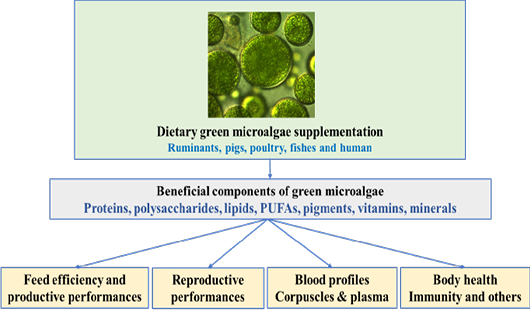
Green microalgae are photosynthetic prokaryotes used as nutritional supplements by animals, fish and humans as well ; ; ; ; ; ; Glover et al., 2021; because of the excellent sources of protein, vitamins and bioactive metabolites, which are found important for health throughout the world (Figure 1). They are also reported to be a source of fine chemicals, renewable fuel and bioactive compounds such as carotenoids . Studies have also indicated that the blue-green type has antiviral, antitumor, antioxidant, anti-inflammatory, antiallergic, antidiabetic and antibacterial properties . Therefore, the present article compiled and discussed the effects of microalgae and their purified compounds on productive, reproductive and therapeutic performances on mammals.
Feed efficiency and growth performance
Sustainable livestock development of meat and milk requires appropriate strategies to be attained worldwide for covering the shortage of meat and milk requirements to humans. Because of the increasing demand for milk and meat in the world, specialists continue to explore new approaches to improve meat and milk yield through different strategies ; . Microalgae supplementation in small amounts as nutritional supplements were given to dairy and different species for improvement of feed efficiency and growth performances ; Al-Madany, 2016; ; ; , 2020; . Enhancement of growth and health status conditions of Artemia nauplii upon carotenoid-rich microalgae supplementation has been indicated . The significant increase of litter size and birth weight has been obtained in mice upon D. salina supplementation . Such improvement might be attributed also to the beneficial effects of microalgae on body health and body weight gain found during the study . Studies has shown improvement of growth and meat quality in pig, poultry and rabbit . In addition, dietary microalgae inclusion of ruminant has improved meat fatty acid profiles. The important applications of microalgae as growth promoter were due to their high contents of lipid and carotenoids . Moreover, Azolla pinnata (a macro algae) supplementation at 0, 10 and 20% (DM basis) levels to lambs for 90 days on growth performance, carcass and meat traits were explored (Vahedi et al., 2021). The results indicated that feed intake tended to be insignificantly lower in Azolla supplemented lambs. Body weight was not affected by dietary Azolla supplementation whereas hot and cold carcass weights were higher for 10 % Azolla group than control one. In addition, chemical composition and sensory properties of longissimus muscle was not differed by Azolla supplementation.
Reproductive activity
Stimulation of ovarian activity or treatment of dysfunctions was widely investigated through nutritional levels and ingredients ; ; ; ; ; , 2018; ; , 2020, 2021; ; ; , hormonal supplementation ; , both hormonal and nutritional supplementation . Because of the negative effects of increased energy and protein in the diet for humans and animals on health and fertility ; ; and the high cost of diet, microalgae and their purified extracts were given in small quantity as replacers of hormonal stimulation. In addition, microalgae and their purified extracts might be used against reproductive dysfunctions. This was confirmed through the alleviative role of Spirulina platensis and Chlorella vulgaris extracts against ovarian dysfunctions in mice induced by monosodium glutamate .
Dietary D. salina supplementation (1.0% kg) has given beneficial effects on ovarian follicles’ development and corpora lutea in goats and the resulting oocytes and embryos in mice . The numbers and diameters of ovarian follicles in addition to ovulation rate, diameters of corpora lutea, estrogen and progesterone concentrations were significantly increased due to supplementation D. salina to Boer goat . Although D. salina supplementation to mice improved quality of cumulus-enclosed germinal vesicle oocytes and embryos, germinal vesicle breakdown (GVBD), maturation rate and timing of embryo cleavage were not differed . In addition, values of follicle stimulating hormone (FSH), luteinizing hormone (LH), estrogen and progesterone were significantly improved upon D. salina supplementation. Such improvement might be attributed to the increase in number and size of preovulatory follicle and copora lutea . Moreover, D. salina supplementation to growing Red Tilapia was found to accelerate fecundity (Al-Madani; personal communication). Hence, D. salina nutritional supplementation might be used as an alternative to hormonal treatment to enhance reproductive performance because of its high level of beta-carotene, glycerol, protein and other fine chemicals ; ; . Further studies are still required of other microalgae species for exploring their effects on ovarian follicle development, viability of the resulting oocytes and embryos.
The ovarian antral follicular fluid (FF) is a transudate from blood plasma and follicular synthesized components. The follicular fluid aspirated from antral ovarian follicles was added to maturation medium during in vitro embryo production for improvement embryo cleavage and developmental competence of the obtained embryos ; . Therefore, it is expected transudate of microalgae bioactive compounds and molecules from blood plasma to follicular fluid if it is collected from animal given dietary microalgae.
Milk production and composition
Milk production and composition were affected through nutritional strategy ; ; . Dietary microalgae inclusion for ruminant has changed milk yield and improved milk fatty acid profile ; ; ; . Kholif et al. (2017) found that dietary C. vulgaris supplementation to Damascus goats improved milk production and composition. The content of conjugated linoleic acids (CLAs) in milk were increased due to C. vulgaris treatment. Angulo et al. (2012) investigated the effects of dietary saturated or unprotected PUFAs extracted from plant oils and algae to lactating dairy cows for 10-weeks on milk fat composition. They found that milk fat yield depressed and de novo secretion of fatty acids in milk reduced, whereas the secretion of trans-10, cis-12-conjugated linoleic acid (CLA) and docosahexaenoic acid (DHA) increased. Glover et al. (2012) studies the effect of fresh forage and marine algae feeding on milk yield and fatty acid composition and oxidation of milk and butter in Holstein dairy cows. Milk yield was not significantly changed due to microalgae supplementation. Although milk fat content depressed upon microalgae treatment, polyunsaturated FAs, docosahexaenoic acid and conjugated linoleic acid were elevated. However, changes in milk fatty acids composition upon microalgae supplementation were observed in different species, which indicates that mammary lipid metabolism require further investigation .
Blood biochemistry
Values of blood and plasma metabolites are an indicative of body’s health in different species. Our work indicated improvement of reproductive hormones and metabolic parameters upon supplementation of 10g/kg diet of D. salina to Boer goats in subtropics. It is indicated that D. salina is rich in selenium, an antioxidant element, which helps in detoxification and immune health. Lupette and Benning (2020) reported human health benefits of very long chain polyunsaturated fatty acids (VLC-PUFAs) from microalgae. Studies ; confirmed improvement of hemato-biochemical indices of Nile Tilapia fry and Heros severus fed with marine microalgae and they suggested production of healthy and disease-free fish due to powerful and reproducible of marine microalgae for different antioxidants and phenolics in addition to vitamins, lipids and proteins. Because of the high content of lipids in microalgae, they might have considered key constituents of the plasma membrane and they are essential for the functionality of all cellular membranes. In addition, lipids form membrane vesicles or lipid droplets (LDs) that are involved in the transport of proteins, hormones or fat-soluble vitamins (A, D, E and K) in cells and extracellularly, for example in the blood stream . Furthermore, Azolla pinnata (a macro algae) supplementation at 10 and 20 % (DM basis) levels to lambs for 90 days lowered creatinine and urea concentrations than control ones .
Immunity functions and antioxidant activity
Bioactive compounds in microalgae have been shown to enhance immune activity and health status in various animal species, enhance antioxidant and tissue protection ; ; ; . Small amounts microalgae supplementation to mammals improved immune functions of the body ; . Messina et al. (2019) investigated the effects of replacing dietary fish meal by two marine microalgae (Tisochrysis lutea and Tetraselmis suecica) over 105 days and they found enhancement of immune responses of European sea bass, suggesting effective roles of microalgae ingredients as immune stimulants. Moreover, Tiong et al. (2020) explored effects of five microalgae species on antioxidant capacity of the brine shrimp Artemia and they found microalgae possess various antioxidant properties.
Anti-cancerous activity
Cancer is the second reason causing death in the world and it occurs due to the cell cycle malfunction or uncontrolled cellular proliferation. Cancer requires appropriate treatment strategies including chemotherapy and radiation treatments, which cause severe side effects as immune system depression, baldness, loss of appetite and infertility. Therefore, the researchers should explore new anticancer agents for the treatments of tumors. Natural resources including medicinal plants and microalgae are considered of the sources of the targeted studies. It has been indicated in several studies the anti-tumor activity of microalgae extracts due to their inhibitor roles against cell cycle and proliferation . The phytochemical compounds (2-Pentadecanone 6, Apratoxin-A, Carotenoids) obtained from the different sources of microalgae (Chlorella vulgaris, Lyngbya majuscule, Chlorella ellipsoidea) and its action mechanism as anticancer has been reported in several studies ; ; ; . Anti-tumor capacity of the microalgae bio-products including carotenoids, PUFAs, polysaccharides, peptides has been confirmed in several studies ; ; .
Antimicrobial, antiviral and antiparasitic activities
Bioactive compounds in microalgae have been shown to provide an innovative role to enhance antimicrobial, antiviral and antiparasitic activities ; ; ; . Ghania et al. (2019) confirmed the antimicrobial and antiparasitic activities of three Algerian algae from the northwest coast. Furthermore, the antimicrobial activity of D. salina extract has been confirmed (Al-Madany, personal communication). Therefore, such microalgae extracts might be used in pharmaceutical industries as potent drugs.
CONCLUSIONS AND RECOMMENDATION
The microalgae desirable characteristics as feed or food ingredients for animals, fish and humans as well have been reported. Microalgae biomass-derived macromolecules were differed according to culture conditions. The biomass-derived macromolecules of microalgae have been shown in various animal and fish species to enhance body growth performances and health status, enhance antioxidant and tissue protection. The phytochemical compounds obtained from the different sources of microalgae and its action mechanism as anticancer has been reported in several studies. The microalgae desirable characteristics could be obtained through genetic engineering. Moreover, in vitro and in vivo extensive studies should be carried out on microalgae bioactive compounds to evaluate their possible applications over a wide range of growth, productive and reproductive performances in addition to therapeutic approaches in pharmaceutical industries as potent drugs.
ACKNOWLEDGEMENTS
This work was supported through the Annual Funding track by the Deanship of Scientific Research, Vice Presidency for Graduate Studies and Scientific Research, King Faisal University, Saudi Arabia (GRANT1019).
NOVELTY STATEMENT
The article presented the effects of dietary microalgae supplementation on mammals’ production and health
AUTHOR’S CONTRIBUTION
Aiman Al-Mufarji, Rashid Al-Zeidi and Haitham Al-Masruri collected references and shared in writing manuscript. Abd El-Nasser Ahmed Mohammed wrote the manuscript and revised it for publication.
Conflict of interest
The authors have declared no conflict of interest.
Figures
Figure 1:.
Effects of dietary microalgae on growth and reproductive performances and body health.
References
Abd El-Hack ME, Abdelnour S, Alagawany M, Abdo M, Sakr MA, Khafaga AF, Mahgoub SA, Elnesr SS, Gebriel MG (2018). Microalgae in modern cancer therapy: Current knowledge. Biomed. Pharmacother., 111: 42-50. https://doi.org/10.1016/j.biopha.2018.12.069[CrossRef]
Abdel-Aziem SH, Abd El-Kader HAM, Ibrahim FM, Sharaf HA, El makawy AI (2018). Evaluation of the alleviative role of Chlorella vulgaris and Spirulina platensis extract against ovarian dysfunctions induced by monosodium glutamate in mice. J. Genet. Eng. Biotechnol., 16(2): 653-660. https://doi.org/10.1016/j.jgeb.2018.05.001[CrossRef]
Abdel-Daim MM, Farouk SM, Madkour FF, Azab SS (2015). Anti-inflammatory and immunomodulatory effects of Spirulina platensis in comparison to Dunaliella salina in acetic acid-induced rat experimental colitis. Immunopharmacol. Immunotoxicol., 37(2): 126-139. https://doi.org/10.3109/08923973.2014.998368[CrossRef]
Abdel-Wahab AM, Al-Madani A, Ibrahim Al-Mehsen I (2020). Growth performances, morphological and chemical characteristics of red tilapia fed diets supplemented with Dunaliella salina. Adv. Anim. Vet. Sci., 8(5): 536-542. https://doi.org/10.17582/journal.aavs/2020/8.5.536.542[Full text][CrossRef]
Abd El-Hack ME, Abdelnour S, Alagawany M, Abdo M, Sakr MA, Khafaga AF, Mahgoub SA, Elnesr SS, Gebriel MG (2019). Microalgae in modern cancer therapy: Current knowledge. Biomed. Pharmacother. 111(2019): 42-50.
Ahmed J, Vinod K (2022). Effect of high-pressure treatment on oscillatory rheology, particle size distribution and microstructure of microalgae Chlorella vulgaris and Arthrospira platensis. Algal Res., 62: 2211-9264. https://doi.org/10.1016/j.algal.2021.102617[CrossRef]
Ali MA, Alshaheen T, Senosy W, Kassab A, Mohammed AA (2021). Effects of feeding green microalgae and Nigella sativa on productive performance and metabolic profile of Boer goats during peripartum period in subtropics. Fresen. Environ. Bull., 30(07): 8203-8212.
Alishahi M, Karamifar M, Mesbah M, Zarei M (2014). Hemato-immunological responses of Heros severus fed diets supplemented with different levels of Dunaliella salina. Fish Physiol. Biochem., 40: 57–65. https://doi.org/10.1007/s10695-013-9823-5[CrossRef]
Alshaheen TA (2016). Effect of dietary source of omega-3 fatty acid on milk production, some reproductive and blood biochemical parameters of dairy cows during hot summer conditions. Ph. D. College of Food and Agricultural Sciences. King Saud University, KSA.
Al-Madani A (2016). Studying the effect of adding Dunaliella salina and biofloc and their mixture to red tilapia fish diets on their production performance. Ph.D. thesis. King Faisal University, KSA.
Amira KI, Rahman MR, Sikder S, Khatoon H, Afruj J, Haque ME, Minhaz TM (2021). Data on growth, survivability, water quality and hemato-biochemical indices of Nile Tilapia (Oreochromis niloticus) fry fed with selected marine microalgae. Data Brief, 38: 2021. https://doi.org/10.1016/j.dib.2021.107422[CrossRef]
Angulo J, Mahecha L, Nuernberg K, Nuernberg G, Dannenberger D, Olivera M, Boutinaud M, Leroux C, Albrecht E, Bernard L (2012). Effects of polyunsaturated fatty acids from plant oils and algae on milk fat yield and composition are associated with mammary lipogenic and SREBF1 gene expression. Anim. 6(12): 1961-1972. https://doi.org/10.1017/S1751731112000845[CrossRef]
Becker EW (2007). Micro-algae as a source of protein. Biotechnol. Adv., 25: 207-210. https://doi.org/10.1016/j.biotechadv.2006.11.002[CrossRef]
Benemann J (2013). Microalgae for biofuels and animal feeds. Rev. Energies, 6(2013): 5869-5886. https://doi.org/10.3390/en6115869[CrossRef]
Bernaerts TMM, Gheysen L, Kyomugasho C, Kermani ZJ, Vandionant S, Foubert I, Hendrickx ME, Van Loey AM (2018). Comparison of microalgal biomasses as functional food ingredients: Focus on the composition of cell wall related polysaccharides. Algal Res., 32: 150-161. https://doi.org/10.1016/j.algal.2018.03.017[CrossRef]
Brady EL, Pierce KM, Lynch MB, Fahey AG, Mulligan FJ (2021). The effect of nutritional management in early lactation and dairy cow genotype on milk production, metabolic status, and uterine recovery in a pasture-based system. J. Dairy Sci., 104(5): 5522-5538. https://doi.org/10.3168/jds.2020-19329[CrossRef]
Brown MR (1991). The amino-acid and sugar composition of 16 species of microalgae used in mariculture. J. Exp. Mar. Biol. Ecol., 145(1): 79-99. https://doi.org/10.1016/0022-0981(91)90007-J[CrossRef]
Camacho F, Macedo A, Malcata F (2019). Potential industrial applications and commercialization of microalgae in the functional food and feed industries: A short review. Mar. Drugs, 17: 1–25.
Chavarro JE, Schlaff WD (2018). Introduction: Impact of nutrition on reproduction: An overview. Fertil. Steril. 110(4): 557-559.
Carbone DA, Pellone P, Lubritto C, Ciniglia C (2021). Evaluation of Microalgae Antiviral Activity and Their Bioactive Compounds. Antibiotics, 10(6): 746. https://doi.org/10.3390/antibiotics10060746[CrossRef]
Chen YH, Chang GK, Kuo SM, Huang S-Y, Hu I-C, Lo Y-L, Shih SR (2016). Well-tolerated Spirulina extract inhibits influenza virus replication and reduces virus-induced mortality. Sci. Rep., 6(2016): 24253. https://doi.org/10.1038/srep24253[CrossRef]
Choochote W, Suklampoo L, Ochaikul D (2014). Evaluation of antioxidant capacities of green microalgae. J. Appl. Phycol., 26(1): 43–48. https://doi.org/10.1007/s10811-013-0084-6[CrossRef]
Cragg GM, Newman DJ (2005). Plants as a source of anticancer agents. J. Ethnopharmacol., 100(1-2): 72-79. https://doi.org/10.1016/j.jep.2005.05.011[CrossRef]
Cuellar-Bermudez SP, Aguilar-Hernandez I, CardenasChavez DL, Ornelas-Soto N, Romero-Ogawa MA, ParraSaldivar R (2015). Extraction and purification of high value metabolites from microalgae: Essential lipids, astaxanthin and phycobiliproteins. Microb. Biotechnol., 8: 190–209. https://doi.org/10.1111/1751-7915.12167[CrossRef]
Dawuda PM, Scaramuzzi RJ, Leese HJ, Hall CJ, Peters AR, Drew SB, Wathes DC (2002). Effect of timing of urea on the yield and quality of embryos in lactating dairy cows. Theriogenology, 58: 1443–1455. https://doi.org/10.1016/S0093-691X(02)00973-1[CrossRef]
Downing JA, Joss J, Scaramuzzi RJ (1995). Ovulation rate and the concentrations of gonadotrophins and metabolic hormones in ewes infused with glucose during the late luteal phase of the oestrous cycle. J. Endocrinol., 146: 403–410. https://doi.org/10.1677/joe.0.1460403[CrossRef]
Fougère H, Bernard L (2019). Effect of diets supplemented with starch and corn oil, marine algae, or hydrogenated palm oil on mammary lipogenic gene expression in cows and goats: A comparative study. J. Dairy Sci., 102(1): 768-779. https://doi.org/10.3168/jds.2018-15288[CrossRef]
Ghania A, Nabila B-B, Larbi B, Elisabeth M, Philippe G, Mariem B, Khadidja K-K, Wacila B-R, Fawzia A-B (2019). Antimicrobial and antiparasitic activities of three algae from the northwest coast of Algeria. Nat. Prod. Res., 33(5): 742-745. https://doi.org/10.1080/14786419.2017.1405403[CrossRef]
Gifre L, Arís A, Bach À, Garcia-Fruitós E (2017). Trends in recombinant protein use in animal production. Microb. Cell Fact., 16: 40. https://doi.org/10.1186/s12934-017-0654-4[CrossRef]
Glover, KE, Budge S, Rose M, Rupasinghe HPV, MacLaren L, Green-Johnson J, Fredeen AH (2012). Effect of feeding fresh forage and marine algae on the fatty acid composition and oxidation of milk and butter. J. Dairy Sci., 95(6): 2797-2809. https://doi.org/10.3168/jds.2011-4736[CrossRef]
Gong M, Bassi A (2016). Carotenoids from microalgae: A review of recent developments. Biotech. Adv., 34: 1396-1412. https://doi.org/10.1016/j.biotechadv.2016.10.005[CrossRef]
Gouveia L, Batista AP, Sousa I, Raymundo A, Bandarra NM (2008). Microalgae in novel food products. In: K. Papadoupoulos, Food Chemistry Research Developments, New York: Nova Science Publishers. pp. 75-112.
Guedes AC, Gião MS, Seabra R, Ferreira ACS, Tamagnini P, Moradas-Ferreira P, Malcata FX (2013). Evaluation of the antioxidant activity of cell extracts from microalgae. Mar. Drugs, 11(4): 1256–1270. https://doi.org/10.3390/md11041256[CrossRef]
Gui, L, Xu L, Liu Z-y, Zhou Z-g, Sun Z (2021). Carotenoid-rich microalgae promote growth and health conditions of Artemia nauplii. Aquaculture, 546: 737289. https://doi.org/10.1016/j.aquaculture.2021.737289[CrossRef]
Gutierrez-Salmean G, Fabila-Castillo L and Chamorro-Cevallos G (2015). Nutritional and toxicological aspects of spirulina (Arthrospira). Nutr. Hosp., 32: 34-40.
Hifzulrahman M, Abdullah MU, Akhtar TN, Pasha, JA, Bhatti Z, Ali M, Saadullah M, Haque MN (2019). Comparison of oil and fat supplementation on lactation performance of Nili Ravi buffaloes. J. Dairy Sci., 102(4): 3000-3009. https://doi.org/10.3168/jds.2018-15452[CrossRef]
Kholif AE, Morsy TA, Matloup OH, Anele UY, Mohamed AG, and El-Sayed AB (2017). Dietary Chlorella vulgaris microalgae improves feed utilization, milk production and concentrations of conjugated linoleic acids in the milk of Damascus goats. J. Agric. Sci., 155: 508–518. https://doi.org/10.1017/S0021859616000824[CrossRef]
Kholif AE, Hamdon HE, Kassab AY, Farahat ESA, Azzaz HH, Matloup OH, Mohamed AG, Anele UY (2020). Chlorella vulgaris microalgae and/or copper supplementation enhanced feed intake, nutrient digestibility, ruminal fermentation, blood metabolites and lactational performance of Boer goat. J. Anim. Physiol. Anim. Nutr., 00: 1–11. https://doi.org/10.1111/jpn.13378[CrossRef]
Kwang HC, Song YIK and Lee DU (2008). Antiproliferative effects of carotenoids extracted from Chlorella ellipsoidea and Chlorella vulgaris on human colon cancer cells. J. Agric. Food Chem., 56: 10521-10526. https://doi.org/10.1021/jf802111x[CrossRef]
Lavy A, Naveh Y, Coleman R, Mokady S, Werman MJ (2003). Dietary Dunaliella bardawil, a beta-carotenerich alga, protects against acetic acid-induced small bowel inflammation in rats. Inflamm. Bowel. Dis., 9(6): 372-379. https://doi.org/10.1097/00054725-200311000-00005[CrossRef]
Luesch H, Yoshida WY, Moore RE, Paul VJ, Corbett TH (2001). Total structure determination of apratoxin A, a potent novel cytotoxin from the marine cyanobacterium Lyngbya majuscule. J. Am. Chem. Soc., 123(2001): 5418-5423. https://doi.org/10.1021/ja010453j[CrossRef]
Lupette J, Benning C (2020). Human health benefits of very-long-chain polyunsaturated fatty acids from microalgae. Biochimie, 178: 15-25. https://doi.org/10.1016/j.biochi.2020.04.022[CrossRef]
McEvoy TG, Robinson JJ, Aitken RP, Findlay PA, Robertson IS (1997). Dietary excesses of urea influence the viability and metabolism of preimplantation sheep embryos and may affect fetal growth among survivors. Anim. Reprod. Sci., 47(1-2): 71-90. https://doi.org/10.1016/S0378-4320(96)01627-2[CrossRef]
Messina M, Bulfon C, Beraldo P, Tibaldi E, Cardinaletti G (2019). Intestinal morpho-physiology and innate immune status of European sea bass (Dicentrarchus labrax) in response to diets including a blend of two marine microalgae, Tisochrysis lutea and Tetraselmis suecica. Aquaculture, 500: 660-669. https://doi.org/10.1016/j.aquaculture.2018.09.054[CrossRef]
Mohammed AA, Karasiewicz J, Modlinski JA, Papis K (2005). Oocyte maturation in the presence of randomly pooled follicular fluid increases bovine blastocyst yield in vitro. J. Anim. Feed Sci., 14: 501-512. https://doi.org/10.22358/jafs/67048/2005[CrossRef]
Mohammed AA (2018). Development of oocytes and preimplantation embryos of mice fed diet supplemented with dunaliella salina. Adv. Anim. Vet. Sci., 6: 33-39. https://doi.org/10.17582/journal.aavs/2018/6.1.33.39[Full text][CrossRef]
Mohammed AA (2019). Nigella Sativa oil improves physiological parameters, oocyte quality after ovarian transplantation, and reproductive performance of female mice. Pak. J. Zool. 51(6): 2225-2231. https://doi.org/10.17582/journal.pjz/2019.51.6.2225.2231[Full text][CrossRef]
Mohammed AA, Al-Hozab AA (2020). + (-) catechin raises body temperature, changes blood parameters, improves oocyte quality and reproductive performance of female mice. Indian J. Anim. Res., 54(5): 543-548. https://doi.org/10.18805/ijar.B-981[CrossRef]
Mohammed AA, Attaai AH (2011). Effects of dietary urea on timing of embryo cleavages and blood components in Mice. Vet. World, 4(8): 360-363. https://doi.org/10.5455/vetworld.2011.360-363[CrossRef]
Mohammed AA, Kassab AY (2014). Biochemical changes of blood and ovarian follicular fluid after time storage in goats. Egypt. J. Anim. Prod., 52(1): 47-54. https://doi.org/10.21608/ejap.2015.93638[CrossRef]
Mohammed AA, Abd El-Hafiz GA, Ziyadah HMS (2012). Effect of dietary urea on ovarian structures in Saidi ewes during follicular and luteal phases. Egypt. J. Anim. Prod., 49(1): 29-35. https://doi.org/10.21608/ejap.2012.94345[CrossRef]
Mohammed AA, Al-Hizab F, Al-Suwaiegh S, Alshaheen T, Kassab A, Hamdon H, Waleed Senosy W (2021). Effects of propylene glycol on ovarian Restoration, reproductive performance, Metabolic status and milk production of Farafra ewes in subtropics. Fresen. Environ. Bull. 30(7): 8192-8202.
Mohammed AA, Al-Suwaiegh S, Al-Shaheen T (2020). Changes of follicular fluid composition during estrous cycle, the effects on oocyte maturation and embryo development in vitro. Indian J. Anim. Res., 54(7): 797-804. https://doi.org/10.18805/ijar.B-1030[CrossRef]
Mohammed AA, Farghaly MM (2018). Effect of Nigella sativa seeds dietary supplementation on oocyte maturation and embryo development in mice. Egypt. J. Anim. Prod., 55(3): 195-201. https://doi.org/10.21608/ejap.2018.93241[CrossRef]
Mohammed AA, Ziyad HM, Abd El-Hafiz GA (2011). Changes of follicular fluid composition in relation to dietary urea level and follicle size during follicular and luteal phases in Saidi Ewes. Theriogenol. Insight, 1(1): 31-42.
Nagarajan D, Varjani S, Lee DJ, Jo-Shu, Chang JS (2021). Sustainable aquaculture and animal feed from microalgae– Nutritive value and techno-functional components. Renewable and Sustainable Energy Reviews. 150: 111549. https://doi.org/10.1016/j.rser.2021.111549[CrossRef]
Nagasawa H, Konishi R, Yamamoto K, Ben-Amotz A (1989). Effects of beta-carotene-rich algae Dunaliella on reproduction and body growth in mice. In Vivo, 3(2): 79-81.
Perdana BA, Chaidir Z, Kusnanda AJ, Dharma A, Zakaria IJ, Syafrizayanti, Bayu A, Putra MY (2021). Omega-3 fatty acids of microalgae as a food supplement: A review of exogenous factors for production enhancement. Algal Res., 60: https://doi.org/10.1016/j.algal.2021.102542[CrossRef]
Santos-Sanchez NF, Valadez-Blanco R, Hernández-Carlos B, Torres-Ariño A, Guadarrama-Mendoza PC, Salas-Coronado R (2016). Lipids rich in omega-3 polyunsaturated fatty acids from microalgae. Appl. Microbiol. Biotechnol., 100: 8667-8684. https://doi.org/10.1007/s00253-016-7818-8[CrossRef]
Senosy W, AY Kassab, AA Mohammed (2017). Effects of feeding green microalgae on ovarian activity, reproductive hormones and metabolic parameters of Boer goats in arid subtropics. Theriogenology, 96: 16-22. https://doi.org/10.1016/j.theriogenology.2017.03.019[CrossRef]
Senosy W, Kassab AY, Hamdon HA, Mohammed AA, 2018. Influence of organic phosphorus on reproductive performance and metabolic profiles of anoestrous Farafra ewes in subtropics at the end of breeding season. Reprod. Domest. Anim., 53(4): 904-913. https://doi.org/10.1111/rda.13183[CrossRef]
Singh S, Kate BN, Banerjee UC (2005). Bioactive compounds from cyanobacteria and microalgae: An overview. Crit. Rev. Biotechnol., 25(3): 73-95. https://doi.org/10.1080/07388550500248498[CrossRef]
Sonkamble V, Wagh N (2022). Chapter 15- An innovative role of bioactive compounds from microalgae, Editor(s): Maulin Shah, Susana Rodriguez-Couto, Celia Bertha Vargas De La Cruz, Jayanta Biswas, An Integration of Phycoremediation Processes in Wastewater Treatment, Elsevier, 2022: 313-336. https://doi.org/10.1016/B978-0-12-823499-0.00023-7[CrossRef]
Stamey JA, Shepherd DM, de Veth MJ, Corl BA (2012). Use of algae or algal oil rich in n-3 fatty acids as a feed supplement for dairy cattle. J. Dairy Sci., 95: 5269–5275. https://doi.org/10.3168/jds.2012-5412[CrossRef]
Tiong IKR, Nagappan T, Abdul Wahid ME, Muhammad TST, Tatsuki T, Satyantini WH, Mahasri G, Sorgeloos P, Sung YY (2020). Antioxidant capacity of five microalgae species and their effect on heat shock protein 70 expression in the brine shrimp Artemia. Aquac. Rep., 18: 100433. https://doi.org/10.1016/j.aqrep.2020.100433[CrossRef]
Vachier I, Chanez P, Bonnans C, Godard P, Bousquet J, Chavis C (2002). Endogenous Anti-inflammatory Mediators from Arachidonate in Human Neutrophils. Biochem. Biophys. Res. Commun., 290(1): 219-224. https://doi.org/10.1006/bbrc.2001.6155[CrossRef]
Vahedi V, Hedayat-Evrigh N, Holman BWB, Ponnampalam EN (2021). Supplementation of macro algae (Azolla pinnata) in a finishing ration alters feed efficiency, blood parameters, carcass traits and meat sensory properties in lambs. Small Rumin. Res., 203: 106498. https://doi.org/10.1016/j.smallrumres.2021.106498[CrossRef]
Valente LMP, Cabrita ARJ, Maia MRG, Valente IM, Engrola S, Fonseca AJM, Ribeiro DM, Lordelo M, Martins CF, Cunha LF, de Almeida AM, Freire JPB (2021). Chapter 9 - Microalgae as feed ingredients for livestock production and aquaculture, Editor(s): Charis M. Galanakis, Microalgae, Academic Press, 2021: 239-312. https://doi.org/10.1016/B978-0-12-821218-9.00009-8[CrossRef]
Wang C, Liu Q, Guo G, Huo WJ, Zhang YL, Pei CX, Zhang SL (2019). Effects of rumen-protected folic acid and branched-chain volatile fatty acids supplementation on lactation performance, ruminal fermentation, nutrient digestion and blood metabolites in dairy cows. Anim. Feed Sci. Technol., 247: 157-165. https://doi.org/10.1016/j.anifeedsci.2018.11.015[CrossRef]
Wichuk K, Brynjólfsson S, Fu W (2014). Biotechnological production of value-added carotenoids from microalgae. Bioengineered, 95(9): 5269–5275. https://doi.org/10.4161/bioe.28720[CrossRef]
Yaakob Z, Ali E, Zainal A, Mohamad M, Takriff MS (1996). An overview: biomolecules from microalgae for animal feed and aquaculture. J. Biol. Res. (Thessalon), 21(1): 6. https://doi.org/10.1186/2241-5793-21-6[CrossRef]
Yi Z, Su Y, Brynjolfsson S, Olafsdóttir K, Fu W (2021). Chapter 3-Bioactive polysaccharides and their derivatives from microalgae: Biosynthesis, applications, and challenges, Editor(s): Atta-ur-Rahman, Studies in Natural Products Chemistry, Elsevier, 71: 67-85. https://doi.org/10.1016/B978-0-323-91095-8.00007-6[CrossRef]
Zarazaga LA, Malpaux B, Chemineau P (1996). Characteristics of the plasma melatonin rhythm are not modified by steroids during the estrous cycle in lle-de-France ewes. J. Pineal Res., 21: 114-120. https://doi.org/10.1111/j.1600-079X.1996.tb00278.x[CrossRef]
Zeng X, Danquah MK, Chen XD, Lu Y (2011). Microalgae bioengineering from CO2 fixation to biofuel production. Renew. Sustain. Energy Rev. 15: 3252-3260. https://doi.org/10.1016/j.rser.2011.04.014[CrossRef]