Research Article · Volume 10, Issue 8, 14 July 2022 · Open Access
Effects of Moringa oleifera on Follicular Development, Blood and Metabolic Profiles of Subtropical Ewes during Peripartum
· · · ·
Affiliations & Notes ⌄
- 1Department of Animal and Fish Production, College of Agriculture and Food Sciences, King Faisal University, P.O. Box 400, Al-Hassa, Kingdom of Saudi Arabia
- 2Department of Clinical Studies, College of Veterinary Medicine, King Faisal University, P.O. Box 400, Al-Hassa, Kingdom of Saudi Arabia
- 3Department of Public Health and Animal Care, College of Veterinary Medicine, King Faisal University, P.O. Box 400, Al-Hassa, Kingdom of Saudi Arabia
- 4Faculty of Human Medicine, Assiut University, Egypt, 71526. *Correspondence | Abd El-Nasser Ahmed Mohammed, Department of Animal and Fish Production, College of Agriculture and Food Sciences, King Faisal University, P.O. Box 400, Al-Hassa, Kingdom of Saudi Arabia
- 5Email: aamohammed@kfu.edu.sa
Article Info ⌄
- Journal:
- Advances in Animal and Veterinary Sciences
- Published:
- 14 July 2022

Abstract
INTRODUCTION
The peripartum stage which is known as the transition period is the most critical for the immediate and long-term performance of pregnant animals and their deliveries. This period in small ruminant species extends from three weeks pre-partum to three weeks post-partum . The decrease and disruptions of ovarian follicles growth and development and the quality of their containing oocytes, growth performance, and feed digestibility, metabolites, and hormones’ profiles were observed during this period ; . In addition, the decrease in feed intake during the pre-partum period can be reached up to 30-35%. Hence, restoration of such disruptions during the transition period would positively improve the productive and reproductive performances of small ruminant species.
Several strategies were suggested to alleviate the negative impacts of the transition period in small ruminant animals including diet formulation and additives ; ; ; . Because of the negative influences of increased protein and urea in the diets on animals’ fertility and health ; ; ; , 2012) and the high cost of diets, it is important to search for useful supplements for productive and reproductive purposes , 2018; ; . It has been observed that there is an increasing interest in the use of M. oleifera as feed supplements for ruminant animals ; .
Several studies have been carried out to investigate the impact of M. oleifera on nutrient digestibility, blood and metabolic profiles, growth, and reproductive performances , 2019; ; . M. oleifera supplementation in animals resulted in an improvement in growth performance ; ; , 2016, 2017; ; , changes in milk production and composition ; 2019), blood profiles (RBCs, PCV, Hb, WBCs), plasma metabolites (total protein, albumin, blood urea nitrogen) , 2016, 2017; , and reproductive performance ; . Little information was available on the effects of M. oleifera on blood and metabolic profiles, ovarian follicles, and CL development of Naimi ewes during the transition period in subtropics. Hence, we hypothesize that supplementation of M. oleifera would positively alter the blood, metabolic and biochemical status of Naimi ewes during the transition period and therefore improve productive and reproductive performances in subtropics.
MATERIALS AND METHODS
The experimental procedures were approved by the Ethical Clearance of the deanship of scientific research, the vice presidency for graduate studies and scientific research, King Faisal University, Saudi Arabia (Ref. No. KFU-REC-2022-JUN-EA1016). This experiment was carried out in the Research and Training Station of King Faisal University for 16 weeks.
Experimental design and animal management
Fifteen healthy pregnant Naimi ewes of 49.50 ± 1.85 kg and 2.5-3.0 years were randomly allocated into three equal groups (five animals per group) as control and two M. oleifera treated groups (50.0 and 100.0 g M. oleifera/ kg diet). The ewes were bred in semi housed system in a standard pen at a stocking rate of 1.75 m2/ewe. The ewes were kept free inside the pen and given the routine vaccination of farm station. The ewes were daily fed one kg basal concentrate diet for the control group and a basal concentrate diet supplemented with 50.0 and 100.0g M. oleifera per head, as well as ad-libitum berseem hay. The given supplemented levels of M. oleifera were chosen according to a preliminary study for three weeks and a previous study ; ; . The concentrate diet was offered twice at 08:00 am and 4:00 pm. Ewes were given access to drinking water ad-libitum. Body weights (kg) of ewes were recorded at 8 and 4 weeks pre-parturition and 4 and 8 weeks post-parturition whereas body weights (kg) of lambs were at lambing, 2, 4, 6, and 8 weeks of the study.
Collection and chemical analyses of milk samples
Three milk samples (50 mL) of control and M. oleifera treated ewes were collected biweekly in 100ml flasks for determination of protein, lactose, solids not-fat, fat, and ash (%) (MilkoScan™ Mars - Analyzer for milk). Milk energy was calculated using the equation as follows:
Calorific value (MJ/kg) = 1.94 + 0.43 x (where: x = fat %)
Blood collection and analysis
Five blood samples were collected of each ewe from control and M. oleifera treated groups every four weeks (8 and 4 weeks pre-parturition and 4 and 8 weeks post-parturition). The obtained blood samples were collected from jugular venipuncture and analyzed for hematological and chemical parameters through hematology analyzers (Abaxis Vetscan HM5) and chemistry analyzers (Skyla VB1; http://www.skyla.com/page/about/index.aspx?kind=103). The measured hematological parameters included red blood cells (RBCs, 1012/L) and white blood cells (WBCs, 109/L). The presented plasma parameters included total protein (TP, g/dl) and blood urea nitrogen (BUN, mg/dl).
Ovarian and corpus luteum development
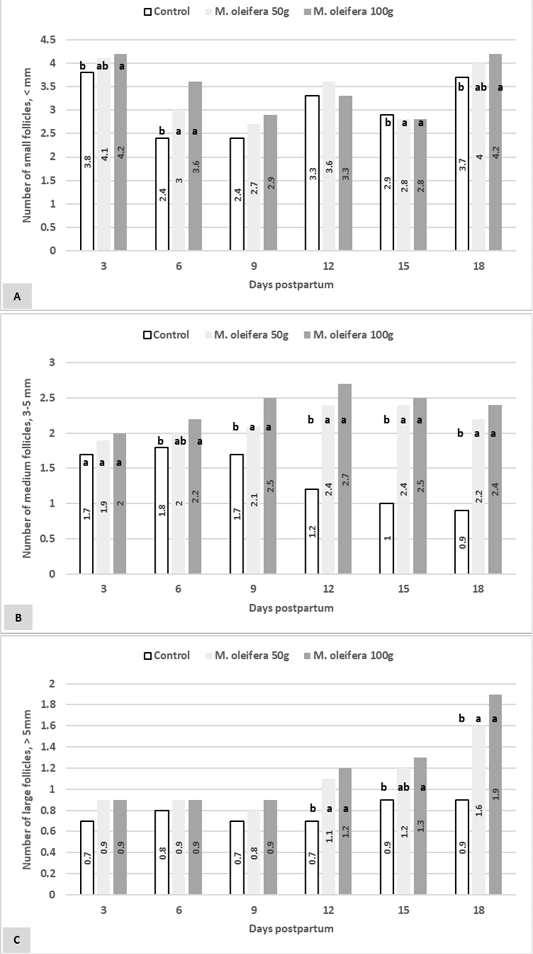
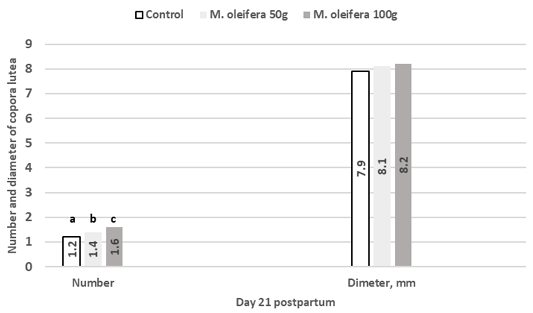
Ewes were investigated post-partum on days 3, 6, 9, 12, 15, and 18 days using an ultrasound scanner (Pie Medical, 100 LC, Holland). The ovaries of control and M. oleifera treated ewes were investigated for the ovarian follicular and corpora lutea waves and development. The numbers and sizes of follicles and corpora lutea were recorded. The ovarian follicles were categorized into small (2–2.9 mm), medium (3–4.9 mm), and large-sized follicles (≥ 5 mm). The numbers of CL were counted and the diameters were measured , 2018).
Statistical analysis
Values of ovarian follicles and corpora lutea, body weights, milk chemical composition, red and white blood cells, total protein, and blood urea nitrogen of control and M. oleifera treated ewes (50.0 and 100.0 g M. oleifera/kg diet) are presented as mean. The values of M. oleifera treated and control groups were statistically analyzed using the General Linear Model (GLM) procedure of SAS (SAS, 2008) according to the following model:
Yij = μ + Ti+ eij
Where: μ = Mean, Ti = Effects of M. oleifera and eij= Standard error.
Duncan’s Multiple Range Test (1955) was used to compare the means of the control and the two M. oleifera treated groups (50.0 and 100.0 g M. oleifera /kg diet).
RESULTS AND DISCUSSION
The effects of M. oleifera supplementation (50 and 100 g/kg diet) from 8 weeks pre-partum to 8 weeks postpartum period on body weights, milk composition, red and white blood cells, total protein and blood urea nitrogen, ovarian follicle dynamics, and CL development are presented in (Tables 1, 4 and Figures 1, 2). The results indicated the restoration of the negative effects of the peripartum period on body weights, metabolites, earlier ovarian follicle development reproduction, and through M. oleifera supplementation.
The solid not-fat and lactose values (%) were decreased significantly (P < 0.05) whereas fat (%) and energy (MJ/kg) values were increased in M. oleifera treated groups compared to the control group as recorded by Kholif et al. (2016, 2019); Choudhary et al. (2018). Furthermore, the recorded body weights of ewes (8 and 4 weeks pre-parturition and 4 and 8 weeks post-parturition) and lambs (2, 4, 6, and 8 weeks post-parturition post-parturition) were significantly higher (P < 0.05) in M. oleifera treated groups compared to control group. The potential properties of M. oleifera as a source of protein and fatty acids profiles have been confirmed according to Al-Mufarji and Mohammed (2022); Al-Masruri et al. (2022). We found that M. oleifera leaves contained carbohydrate (47.82%), fiber (28.35%), protein (28.28%), and fat (7.57) as indicated by ; , 2012; , b). In addition, fatty acid profiles revealed saturated (3.76%), unsaturated (3.79), monounsaturated (2.39%), polyunsaturated (0.76%), and trans-fatty acids (0.64%).
Table 1: Effects of Moringa oleifera (50.0 and 100 g/kg diet) supplementation on milk constituents of Naimi ewes in subtropics.
| Parameters | Treatments | ||
| Control | M. oleifera 50g | M. oleifera 100g | |
| Solids not fat, % | 7.33a ± 0.730 | 7.06ab ± 0.70 | 6.89b ± 0.85 |
| Fat, , % | 3.31c ± 0.60 | 4.00b ± 0.56 | 5.54a ± 0.57 |
| Protein, % | 2.82 ± 0.48 | 2.70 ± 0.56 | 2.76 ± 0.34 |
| Lactose, % | 3.74a ± 0.50 | 3.19b ± 0.42 | 2.82c ± 0.46 |
| Milk energy content, MJ/kg | 3.36c ± 0.26 | 3.66b ± 0.24 | 3.89a ± 0.25 |
a, b, c Values with different superscripts between groups significantly differ at P < 0.05.
Table 2: Effects of Moringa oleifera (50.0 and 100 g/kg diet) supplementation on body weight gain of ewes and lambs in subtropics.
| Parameters | Treatments | ||
| Control | M. oleifera 50g | M. oleifera 100g | |
| Ewes' body weight, kg | 5 | 5 | 5 |
| 8-weeks pre-partum, kg | 49.0 ± 1.40 | 48.50 ± 1.70 | 50.50 ± 2.47 |
| 4-weeks pre-partum, kg | 51.0b ± 1.38 | 50.60b ± 1.33 | 53.3a ± 2.17 |
| Parturition, kg | 45.80b ± 1.56 | 44.0b ± 1.54 | 48.8a ± 1.24 |
| 4-weeks postpartum, kg | 47.10b ± 1.21 | 46.20b ± 1.47 | 51.20a ± 1.37 |
| 8-weeks postpartum, kg | 48.80b ± 1.72 | 48.00b ± 1.14 | 53.20a ± 1.54 |
| Lambs' body weight, kg | 6 | 7 | 6 |
| Lambing | 3.56b ± 0.23 | 3.86ab ± 0.23 | 4.08a ± 0.24 |
| 2-weeks | 5.50b ± 0.45 | 5.74b ± 0.26 | 6.38a ± 0.52 |
| 4-weeks | 7.40b ± 0.50 | 7.70b ± 0.42 | 8.56a ± 0.41 |
| 6-weeks | 10.20 ± 0.54 | 10.64 ± 0.65 | 10.80 ± 0.25 |
| 8-weeks | 12.40 ± 0.62 | 12.80 ± 0.67 | 12.90 ± 0.64 |
a, b Values with different superscripts between groups significantly differ at P < 0.05.
Table 3: Effects of Moringa oleifera (50.0 and 100 g/kg diet) supplementation on blood cells and hemoglobin values of ewes and lambs in subtropics.
| Parameters | Treatments | ||
| Control | M. oleifera 50g | M. oleifera 100g | |
| Red blood cells, 1012/L | |||
| 8-weeks pre-partum, kg | 11.70 ± 0.37 | 12.12 ± 0.37 | 12.14 ± 0.27 |
| 4-weeks pre-partum, kg | 12.10b ± 1.38 | 12.86a ± 0.34 | 12.90a ± 0.64 |
| Parturition, kg | 10.70b ± 0.30 | 11.94a ± 0.56 | 12.08a ± 0.70 |
| 4-weeks postpartum, kg | 10.94b ± 0.25 | 12.52a ± 0.60 | 12.68a ± 0.57 |
| 8-weeks postpartum, kg | 10.50b ± 0.25 | 12.92a ± 0.64 | 12.98a ± 0.46 |
| White blood cells, 109/L | |||
| 8-weeks pre-partum, kg | 8.80 ± 0.51 | 9.00 ± 0.55 | 9.10 ± 0.46 |
| 4-weeks pre-partum, kg | 9.04b ± 0.69 | 9.40ab ± 0.26 | 9.46a ± 0.40 |
| Parturition, kg | 8.28b ± 0.55 | 9.12a ± 0.57 | 9.22a ± 0.57 |
| 4-weeks postpartum, kg | 8.60b ± 0.68 | 10.04a ± 0.56 | 10.30a ± 0.34 |
| 8-weeks postpartum, kg | 9.00b ± 0.63 | 10.54a ± 0.63 | 10.90a ± 0.46 |
a, b Values with different superscripts between groups significantly differ at P < 0.05.
Supplementation of M. oleifera in small or large amounts contributed to improved feed efficiency, rumen fermentation, and growth performances ; ; , 2016, 2017; ; . El-Hedainy et al. (2020) investigated the effects of 4 g M. oleifera seeds/ head for 45 days on the growth performance and body measurements of male Barki aged five months. They recorded the ability of M. oleifera seeds to improve the final body weights and daily gains of lambs compared to the control diet. Elghandour et al. (2017) observed significant decreases in methane (CH4), ruminal ammonia-N, total protozoal number, and organic matter degradability with increases in CO2 production, pH, and total bacterial number due to M. oleifera inclusion. the recorded modifications might explain the beneficial effects of M. oleifera treatment on milk composition and body weight gains.
Table 4: Effects of Moringa oleifera (50.0 and 100 g/kg diet) supplementation on total protein (g/dl) and blood urea nitrogen of ewes in subtropics.
| Parameters | Treatments | ||
| Control | M. oleifera 50g | M. oleifera 100g | |
| Total protein, g/dl | |||
| 8-weeks pre-partum, kg | 7.76 ± 0.22 | 7.80 ± 0.19 | 7.74 ± 0.19 |
| 4-weeks pre-partum, kg | 7.78b ± 0.27 | 8.36a ± 0.17 | 8.54a ± 0.20 |
| Parturition, kg | 7.04b ± 0.30 | 8.26a ± 0.21 | 8.46a ± 0.17 |
| 4-weeks postpartum, kg | 7.42b ± 0.24 | 8.46a ± 0.15 | 8.64a ± 0.27 |
| 8-weeks postpartum, kg | 7.48b ± 0.26 | 8.54a ± 0.19 | 8.72a ± 0.18 |
| Blood urea nitrogen, mg/dl | |||
| 8-weeks pre-partum, kg | 12.98 ± 0.84 | 13.46 ± 0.63 | 12.71 ± 0.45 |
| 4-weeks pre-partum, kg | 13.49a ± 0.94 | 12.15b ± 0.57 | 12.06b ± 0.70 |
| Parturition, kg | 14.11a ± 0.83 | 12.64b ± 0.55 | 12.62b ± 0.64 |
| 4-weeks postpartum, kg | 15.07a ± 0.45 | 12.27b ± 0.56 | 11.78b ± 0.71 |
| 8-weeks postpartum, kg | 15.45a ± 0.64 | 11.71b ± 0.64 | 11.59b ± 0.50 |
a, b Values with different superscripts between groups significantly differ at P < 0.05.
The presented hematological parameters red blood cells (1012/L), white blood cells (109/L), total protein (g/dl), and blood urea nitrogen (mg/dl) were improved in M. oleifera treated animals compared to control one (Tables 3, 4). The recorded values lie within the normal range for clinically-healthy small ruminants ; , 2014a, b; ; . The positive effects of M. oleifera on red blood cells, white blood cells, total protein, and blood urea nitrogen might be attributed to several factors including antioxidative properties, nutrient digestibility, rumen fermentation, and regulating pathways involved in the metabolism ; ; ; ; . Al-Mufarji and Mohammed (2022) and Al-Masruri et al. (2022) indicated that 25.0 and 50.0g organic M. oleifera daily supplementation to ewes resulted in improvement of body status through modulating blood and metabolites, liver, and kidney functions.
Ovarian wave follicular dynamics and CL development due to M. oleifera supplementation were presented in (Figures 1 and 2). M. oleifera contributed to accelerated and significantly increased (P < 0.05) follicular development and numbers and corpora lutea as well. The positive effects of M. oleifera treatment on oocyte quality and reproductive performance have been reported by ; . This could be attributed to the high level of beta-carotene, protein, and other fine chemicals ; ; , which improved the ovarian follicular dynamics and numbers and sizes of corpora lutea. The significant positive changes in body health due to M. oleiferai supplementation collectively resulted in a significant increase in ovarian folliculogenesis and corpora lutea .
CONCLUSIONS AND RECOMMENDATION
The potential properties of M. oleifera as sources of protein and bioactive compounds restore the negative effects of the peripartum period in ewes of the subtropicsal areas. M. oleifera leaves supplementation (50 and 100 g/kg diet) from 8 weeks pre-partum to 8 weeks post-partum of Naimi ewes improved milk composition, improved body weights, blood cells (RBCs and WBCs), and metabolites (total protein and blood urea nitrogen), as well as earlier restoration of ovarian follicle development. Therefore, in-vivo and in-vitro studies are recommended to investigate the quality and viability of aspirated oocytes postpartum upon M. oleifera supplementation.
ACKNOWLEDGEMENTS
This work was supported through the Annual Funding track by the Deanship of Scientific Research, Vice Presidency for Graduate Studies and Scientific Research, King Faisal University, Saudi Arabia (GRANT 1016).
NOVELTY STATEMENT
M. oleifera supplementation to pregnant ewes overcomes the negative effects of transition period.
AUTHOR’S Contribution
Mohammed shared experimental design, wrote, and submit MS, and prepared Figures. Aiman Al Mufarji, Rashid Al-Zeidi, and Haitham Al-Masruri carried out the experiment and statistical analysis. Al-Hassan Mohammed prepared Figures and Tables and collected the references.
Conflict of interest
None of the authors has any conflict of interest to declare.
Figures

Effects of Moringa oleifera (50.0 and 100 g/kg diet) on ovarian follicle development postpartum of Naimi ewes.

Effects of Moringa oleifera (50.0 and 100 g/kg diet) on number and diameter of corpora lutea postpartum of Naimi ewes.
References
- Abdel-Raheem SM, Hassan EH (2021). Effects of dietary inclusion of Moringa oleifera leaf meal on nutrient digestibility, rumen fermentation, ruminal enzyme activities and growth performance of buffalo calves. Saudi J. Biol. Sci., 28: 4430-436. https://doi.org/10.1016/j.sjbs.2021.04.037[CrossRef]
- Afzal A, Hussain T, Hameed A (2021). Moringa oleifera supplementation improves antioxidant status and biochemical indices by attenuating early pregnancy stress in Beetal goats. Front. Nutr., 8: https://doi.org/10.3389/fnut.2021.700957[CrossRef]
- Ajuogu PK, Mgbere OO, Bila DS, McFarlane JR (2019). Hormonal changes, semen quality and variance in reproductive activity outcomes of post pubertal rabbits fed Moringa oleifera Lam. leaf powder. J. Ethnopharmacol., 233: 80–86. https://doi.org/10.1016/j.jep.2018.12.036[CrossRef]
- Al-Masruri H, Al-Zeidi R, Al-Mufarji A, Mohammed AA (2022). Moringa oleifera leaves supplementation to anaesthetized mice associated with changes of thermo-tolerance parameters, blood and plasma indices. Fresen. Environ. Bull., 31: 8.
- Al-Mufarji A, Mohammed AA (2022). Organic Moringa oleifera leaves chemical composition and fatty acid profiles and its effect on modulation of blood and plasma parameters of ewes in subtropics. Adv. Anim. Vet. Sci., 10(6): 1227-1232. https://doi.org/10.17582/journal.aavs/2022/10.6.1227.1232[Full text][CrossRef]
- Ali MA, Alshaheen T, Senosy W, Kassab A, Mohammed AA (2021). Effects of feeding green microalgae and Nigella sativa on productive performance and metabolic profile of Boer goats during peripartum period in subtropics. Fresen. Environ. Bull., 30(07): 8203-8212.
- Barakat IAH, Khalil WKB, Al-Himaidi AR (2015). Moringa oleifera extract modulates the expression of fertility related genes and elevation of calcium ions in sheep oocytes. Small Rumin. Res., 130: 67–75. https://doi.org/10.1016/j.smallrumres.2015.06.011[CrossRef]
- Bragança GM, Souza-Fabjan JMG, Ribeiro LS, Brair VL, Brandão FZ (2020). Exogenous progestogen does not affect first-wave follicle populations and oocyte quality during ovarian stimulation with FSH in sheep. Domest. Anim. Endocrinol., 72: 106369. https://doi.org/10.1016/j.domaniend.2019.06.001[CrossRef]
- Cherif M, Ben Salem H, Abidi S (2018). Effect of the addition of Nigella sativa seeds to low or high concentrate diets on intake, digestion, blood metabolites, growth and carcass. traits of Barbarine lamb. Small Rum. Res. 158: 1-8.
- Choudhary RK, Roy A, Roy PS, Singh KM, Kumar P (2018). Effect of replacing concentrate mixture with moringa leaves (Moringa oleifera) on performance of lactating Bengal goats in Kishanganj district of Bihar, India. Int. J. Curr. Microbiol. Appl. Sci., 7: 2895–2900.
- Dawuda PM, Scaramuzzi RJ, Leese HJ, Hall CJ, Peters AR, Drew SB, Wathes DC (2002). Effect of timing of urea on the yield and quality of embryos in lactating dairy cows. Theriogenology, 58: 1443–1455. https://doi.org/10.1016/S0093-691X(02)00973-1[CrossRef]
- Duncan DB (1955). Multiple range and multiple Ftest. Biometrics, 11: 1. https://doi.org/10.2307/3001478[CrossRef]
- Economides S (1986). Comparative studies of sheep and goats milk yield and composition and growth rate of lambs and kids. J. Agric. Sci., 106: 477–484. https://doi.org/10.1017/S0021859600063358[CrossRef]
- Elghandour MMY, Vallejo LH, Salem AZM, Mellado M, Camacho LM, Cipriano M, Olafadehan OA, Olivares J, Rojas S (2017). Moringa oleifera leaf meal as an environmental friendly protein source for ruminants: Biomethane and carbon dioxide production, and fermentation characteristics. J. Cleaner Prod., 165: 1229-1238. https://doi.org/10.1016/j.jclepro.2017.07.151[CrossRef]
- El-Hedainy DKA, El-Wakeel E, Rashad AMA (2020). Effect of Moringa seed meal as a feed additive on performance of fattening male Barki sheep. Int. J. Vet. Sci. Res., 6(2): 184–187. https://doi.org/10.17352/ijvsr.000072[CrossRef]
- Fadiyimu AA, Alokan JA, Fajemisin AN (2010). Digestibility, nitrogen balance and haematological profile of West African dwarf sheep fed dietary levels of Moringa oleifera as supplement to Panicum maximum. J. Am. Sci., 6(10): 634–643.
- Fadiyimu AA, Alokan JA, Fajemisin AN, Onibi GE (2016). Feed intake, growth performance and carcass characteristics of West African dwarf sheep fed Moringa oleifera, Gliricidia sepium or cassava fodder as supplements to Panicum maximum. J. Exp. Agric. Int., pp. 1–10. https://doi.org/10.9734/JEAI/2016/25167[CrossRef]
- Fadiyimu A, Alokan J, Fajemisin A, Onibi G (2017). Feed intake, growth performance and carcass characteristics of west African Dwarf sheep fed Moringa oleifera, Gliricidia sepium or cassava fodder as supplements to Panicum maximum. J. Exp. Agric. Int., 14(4): 1–10. https://doi.org/10.9734/JEAI/2016/25167[CrossRef]
- Fahey JW (2005). Moringa oleifera: A review of the medical evidence for its nutritional, therapeutic, and prophylactic properties. Part 1. Trees Life J., 1: 1–15.
- Giuberti G, Rocchetti G, Montesano D, Lucini L (2021). The potential of Moringa oleifera in food formulation: A promising source of functional compounds with health-promoting properties. Curr. Opin. Food Sci., 42: 257-269. https://doi.org/10.1016/j.cofs.2021.09.001[CrossRef]
- Hussein HA, Abdel-Raheem SM, Abd-Allah M, Senosy W (2015). Effects of propylene glycol on the metabolic status and milk production of dairy buffaloes. Tierarztl. Prax. Ausg. G Grosstiere Nutztiere, 43(1): 25-34. https://doi.org/10.15653/TPG-140503[CrossRef]
- Jongrungruangchok S, Bunrathep S, Songsak T (2010). Nutrients and minerals content of eleven different samples of Moringa oleifera cultivated in Thailand. J. Health Res., 24: 123–127.
- Kassab AY, Hamdon HA, Mohammed AA (2017). Impact of probiotics supplementation on some productive performance, digestibility coefficient and physiological responses of beef bulls under heat stress conditions. Egypt. J. Nutr. Feeds, 20(1): 29-39. https://doi.org/10.21608/ejnf.2017.75102[CrossRef]
- Kassab AY, Mohammed AA (2013). Effects of dietary live dried yeast on some physiological responses and productive performances in Sohagi ewes. Egypt. J. Nutr. Feeds, 16(2): 215-225.
- Kassab AY, Mohammed AA (2014a). Ascorbic acid administration as anti-stress before transportation of sheep. Egypt. J. Anim. Prod., 51(1): 13-19. https://doi.org/10.21608/ejap.2014.93664[CrossRef]
- Kassab AY, Mohammed AA (2014b). Effect of vitamin E and selenium on some physiological and reproductive characteristics of Sohagi ewes. Egypt. J. Nutr. Feeds, 17(1): 9-18.
- Kholif AE, Morsy TA, Goudaa GA, Anele UY, Galyean ML (2016). Effect of feeding diets with processed Moringa oleifera meal as protein source in lactating Anglo-Nubian goats. Anim. Feed Sci. Technol., 217: 45-55. https://doi.org/10.1016/j.anifeedsci.2016.04.012[CrossRef]
- Kholif AE, Gouda GA, Galyean ML, Anele UY, Morsy TA (2019). Extract of Moringa oleifera leaves increases milk production and enhances milk fatty acid profile of Nubian goats. Agrofor. Syst., 93(5): 1877–1886. https://doi.org/10.1007/s10457-018-0292-9[CrossRef]
- McEvoy TG, Robinson JJ, Aitken RP, Findlay PA, Robertson IS (1997). Dietary excesses of urea influence the viability and metabolism of preimplantation sheep embryos and may affect fetal growth among survivors. Anim. Reprod. Sci., 47(1- 2): 71-90. https://doi.org/10.1016/S0378-4320(96)01627-2[CrossRef]
- Meel P, Gurjar ML, Nagda RK, Sharma MC, Gautam L (2018). Effect of Moringa oleifera leaves feeding on hemato-biochemical profile of Sirohi goat kids. J. Entomol. Zool. Stud., 6: 41–48.
- Mohammed AA, Al-Hizab F, Al-Suwaiegh S, Alshaheen T, Kassab A, Hamdon H, Senosy W (2021). Effects of propylene glycol on ovarian Restoration, reproductive performance, Metabolic status and milk production of Farafra ewes in subtropics. Fresen. Environ. Bull., 30(7): 8192-8202.
- Mohammed AA, Kassab A (2015). Metabolic changes in blood and ovarian follicular fluid in Baladi goats as affected by storage time duration. Egypt. J. Anim. Prod., 52(1): 47-54. https://doi.org/10.21608/ejap.2015.93638[CrossRef]
- Mohammed AA, Abd El-Hafiz GA, Ziyadah HMS (2012). Effect of dietary urea on ovarian structures in Saidi ewes during follicular and luteal phases. Egypt. J. Anim. Prod., 49(1): 29-35. https://doi.org/10.21608/ejap.2012.94345[CrossRef]
- Mohammed AA, Al-Hozab AA (2020). + (-) catechin raises body temperature, changes blood parameters, improves oocyte quality and reproductive performance of female mice. Indian J. Anim. Res., 54(5): 543-548. https://doi.org/10.18805/ijar.B-981[CrossRef]
- Mohammed AA, Attaai AH (2011). Effects of dietary urea on timing of embryo cleavages and blood components in mice. Vet. World, 4(8): 360-363. https://doi.org/10.5455/vetworld.2011.360-363[CrossRef]
- Mohammed AA, Al-Suwaiegh S, Al-Shaheen T (2020). Changes of follicular fluid composition during estrous cycle, the effects on oocyte maturation and embryo development in vitro. Indian J. Anim. Res., 54(7): 797-804. https://doi.org/10.18805/ijar.B-1030[CrossRef]
- Mohammed AA, Ziyad HM, Abd El-Hafiz GA (2011). Changes of follicular fluid composition in relation to dietary urea level and follicle size during follicular and luteal phases in Saidi ewes. Theriogenol. Insight, 1(1): 31-42.
- Mohammed AA (2022). Effects of copper and green algae supplementation on ovarian function, blood and metabolic profiles of boer goats grazing copper-deficient alfalfa in arid subtropics. Fresen. Environ. Bull., 31(06):
- Mohammed AA, Abd El-Hafiz GA, Ziyadah HMS (2012). Effect of dietary urea on ovarian structures in Saidi ewes during follicular and luteal phases. Egypt. J. Anim. Prod., 49(1): 29-35. https://doi.org/10.21608/ejap.2012.94345[CrossRef]
- Moyo B., Masika P., Hugo A., Muchenje V (2011). Nutritional characterization of Moringa (Moringa oleifera Lam.) leaves. Afr. J. Biotechnol., 10: 12925–12933. https://doi.org/10.5897/AJB10.1599[CrossRef]
- Moyo B, Oyedemi S, Masika P, Muchenje V (2012). Polyphenolic content and antioxidant properties of Moringa oleifera leaf extracts and enzymatic activity of liver from goats supplemented with Moringa oleifera leaves/sunflower seed cake. Meat Sci., 91: 441–447. https://doi.org/10.1016/j.meatsci.2012.02.029[CrossRef]
- Pandey A, Modi RJ, Lunagariya PM, Islam M (2022). Effect of feeding Moringa oleifera meal on growth performance of growing Surti kids under intensive system of management. Ind. J. Vet. Sci. Biotech.,
- Paul LT, Fowler LA, Barry RJ, Watts SA (2013). Evaluation of Moringa oleifera as a dietary supplement on growth and reproductive performance in zebrafish. J. Nutr. Ecol. Food Res.,1(4): 322-328. https://doi.org/10.1166/jnef.2013.1050[CrossRef]
- Saini R, Prashanth KH, Shetty N, Giridhar P (2014a). Elicitors, SA and MJ enhance carotenoids and tocopherol biosynthesis and expression of antioxidant related genes in Moringa oleifera Lam. leaves. Acta Physiol. Plant, 36: 2695–2704. https://doi.org/10.1007/s11738-014-1640-7[CrossRef]
- Saini R, Shetty N, Prakash M, Giridhar P (2014b). Effect of dehydration methods on retention of carotenoids, tocopherols, ascorbic acid and antioxidant activity in Moringa oleifera leaves and preparation of a RTE product. J. Food Sci. Technol., 51: 2176–2182. https://doi.org/10.1007/s13197-014-1264-3[CrossRef]
- SAS (2008). SAS user’s guide: Basics. Statistical Analysis System Institute, Inc., Cary, NC, USA.
- Senosy W, Kassab AY, Mohammed AA (2017). Effects of feeding green microalgae on ovarian activity, reproductive hormones and metabolic parameters of Boer goats in arid subtropics. Theriogenology, 96: 16-22. https://doi.org/10.1016/j.theriogenology.2017.03.019[CrossRef]
- Senosy W, Kassab AY, Hamdon HA, Mohammed AA (2018). Influence of organic phosphorus on reproductive performance and metabolic profiles of anoestrous Farafra ewes in subtropics at the end of breeding season. Reprod. Domest. Anim., 53: 904-913. https://doi.org/10.1111/rda.13183[CrossRef]
- Sonbarse PP, Kiran K, Sharma R, Parvatam G (2020). Biochemical and molecular insights of PGPR application for the augmentation of carotenoids, tocopherols, and folate in the foliage of Moringa oleifera. Phytochem., 179: 0031-9422. https://doi.org/10.1016/j.phytochem.2020.112506[CrossRef]
- Tharwat M, Ali A, Al-Sobayil F (2013). Hematological and biochemical profiles in goats during the transition period. Comp. Clin. Path., 24: 1–7. https://doi.org/10.1007/s00580-013-1842-1[CrossRef]
- Warastomo MT, Suryapratama W, Rahardjo AHD (2021). The effect of additional moringa leaf flour (Moringa oleifera) and palm oil in feed on the physical properties of sheep. Angon J. Anim. Sci. Technol., 3(2): 156–165.
Cited by 5 articles
In journals published by ResearchersLinks.
- Colostrum Quality in Saudi Ewes: Breed, Parity, and Seasonal Effects on Immunoglobulins and Glucose Secretion Dynamics PostpartumAdvances in Animal and Veterinary Sciences · 2026
- Cytoplasmic and Nuclear Maturation of Intact and Reconstructed Oocytes Controlling the Developmental Competence of EmbryosPakistan Journal of Zoology · 2025
- Effects of Dietary Omega-3 Fatty Acids on Reproductive Performance and Biochemical Parameters of Lactating Cows in Arid SubtropicsPakistan Journal of Zoology · 2024
- Influence of Organic Moringa oleifera Leaves Supplemented during Gestation and Lactation Periods: Modulation of Production Efficiency, Blood and Metabolic Parameters of Ewes and Lambs in SubtropicsAdvances in Animal and Veterinary Sciences · 2023
- Effects of Feeding Azolla pinnata on Growth Performance, Nutrient Digestibility and Blood Metabolites of Growing Ardi Goats in SubtropicsAdvances in Animal and Veterinary Sciences · 2023
Services
Article usage statistics
Loading…