
Ovine theileriosis, a protozoal disease prevalent among small ruminants in tropical and subtropical regions, is a significant concern worldwide. To discern the distribution patterns and prevalence of this disease within the sheep population, a molecular survey was undertaken in Azad Kashmir, Pakistan. A total of 300 blood samples were collected from six tehsils spanning the districts of Kotli and Bagh. DNA samples were subjected to PCR targeting the 18S rRNA gene of ovine Theileria (T) species. Subsequent nucleotide sequencing of PCR products demonstrated complete alignment with T. luwenshuni sequences documented in GenBank originating from sheep in China. The overall prevalence of Theileria within the sheep population was 29.66% (n=89). District wise analysis indicated a greater infection rate among sheep in District Kotli (42%) than among those in District Bagh (17.33%). Phylogenetic analysis revealed shared homology between the isolated T. luwenshuni strain and other strains from Asia.
Short Communication · Volume 58, Issue 2, 27 February 2026 · Open Access
Prevalence and Molecular Characterization of Theileria luwenshuni in Sheep from Azad Kashmir, Pakistan
· · · · · · · · ·
Affiliations & Notes ⌄
- 1¹Faculty of Veterinary and Animal Sciences, University of Poonch, Rawalakot, Azad Kashmir, Pakistan. ²Institute of Microbiology, Faculty of Veterinary and Animal Sciences, University of Agriculture, Faisalabad, Pakistan. 3Department of Parasitology, Faculty of Veterinary and Animal Sciences, The Islamia University of Bahawalpur, Bahawalpur, Pakistan 4Faculty of Veterinary and Animal Sciences, Azad Jammu and Kashmir University of Bhimber, Bhimber, Azad Kashmir, Pakistan. 5Department of Zoology, F
Article Info ⌄
- Journal:
- Pakistan Journal of Zoology
- Published:
- 27 February 2026

From the article
- Microscopic examination revealed pear-shaped and rod-shaped organisms within red blood cells of infected sheep, consistent with Theileria spp. Among the initial pool of 300 samples, 89 were identified as positive for piroplasms through PCR amplification.
- In addition, a strong correlation was found between tick infestation and higher infection rates, with heavily infested sheep showing a prevalence of 71.91%.
- In this study, we conducted an epidemiological investigation of Theileria spp. infections in sheep population of Azad Kashmir.
- This study provides the molecular identification of Theileria luwenshuni in sheep of Azad Kashmir, with a prevalence of 29.66%, highlighting the need for enhanced surveillance, control measures, and future research on vaccine development and epidemiology.
Selected from the article's own text.
Abstract
Materials and methods
A cross sectional study was conducted between April and September, 2023, across six (Birpani, Dhirkot, Harigil, Khuirata, Charhoi, Fatehpur) tehsils in Bagh and Kotli districts of Azad Kashmir, to examine prevalence of Theileria in sheep populations (Fig. 1). A total of 300 blood samples were collected and the data regarding sex, age (young: 6 months to 1 year, and adult: >1 year), breed and tick infestation was recorded. DNA was extracted using a DNA purification kit (GeneJet Genomic DNA Purification Kit, Thermo Scientific). After DNA extraction, a set of primers (F: 5’-ACCGTGCTAATTGTAGGGCTAATAC-3’) (R: 5’-GAACCCAAAGACTTTGATTTCTCTC-3’) was used to target 18S rRNA gene of Theileria species using PCR (LABTRON Thermal Cycler, LATG-A10) following the protocol described by Ahmed et al. (2024). Positive samples were subjected to DNA sequencing conducted by Macrogen (Seoul, Korea). CLUSTAL Omega (ver. 1.2.1) and BioEdit (ver. 7.2.5) programmes were used to align and analyze positive samples, while phylogenetic tree was constructed with MEGA version 11 using the Neighbor-Joining method and the Tamura 3-parameter model. The sheep population under investigation was assessed for prevalence rate of Theileria spp., in term of percentages in different sub categories and their mean percentage values were calculated. The graphical visualization of prevalence of results were carried out through matplotlib script language model.
Results
Microscopic examination revealed pear-shaped and rod-shaped organisms within red blood cells of infected sheep, consistent with Theileria spp. Among the initial pool of 300 samples, 89 were identified as positive for piroplasms through PCR amplification. Detection of 837-bp fragment under ultraviolet light was considered positive for Theileria spp. Prevalence of T. luwenshuni varied across sites, as Fateh pur and Charhoi showed elevated prevalence rates (60 and 40%), while Dhirkot, Birpani and Khuirata exhibited moderate prevalence rates, respectively (Table I). Similarly, gender-stratified analysis indicated greater susceptibility to Theileria infection among females (32.72%) than males (21.25%). The Parahi breed showed higher prevalence (36.66%), followed by desi (31.11%) and Poonci breeds (10%) (Fig. 1). In addition, a strong correlation was found between tick infestation and higher infection rates, with heavily infested sheep showing a prevalence of 71.91%.
Table I. Prevalence of theileriosis detailed in blood samples of sheep from different localities of Azad Kashmir.
| Districts/Tehsils | Positive samples/ Total samples | % |
| Khuirata | 13/50 | 26% |
| Charhoi | 20/50 | 40% |
| Fateh Pur (Nakyal) | 30/50 | 60% |
| Bir Pani | 09/50 | 18% |
| Dhirkot | 17/50 | 34% |
| Hari Gil | 00/50 | 00 |
| Cumulative total | 89/300 | 29.66% |
Subsequent DNA sequencing of the positive samples revealed a striking 100% nucleotide sequence identity to sequences of T. luwenshuni archived in the NCBI GenBank, as confirmed by BLASTn analysis. Likewise, our analysis revealed an exceptionally high degree of similarity (99.88% identity and 100% query coverage) to T. luwenshuni isolates from China and Myanmar (Fig. 2).
Discussion
In this study, we conducted an epidemiological investigation of Theileria spp. infections in sheep population of Azad Kashmir. Microscopic examination of blood smears revealed the presence of Theileria spp. parasites, the morphological characteristics of which are consistent with the findings of previous reports ; . Subsequent PCR analysis of 300 blood samples confirmed the presence of Theileria luwenshuni isolates, with sequencing results demonstrating 100% similarity to known isolates. Phylogenetic analysis further revealed genetic similarities between isolates from Azad Kashmir and those from China and Myanmar, suggesting potential vector-mediated transmission across borders. Variability in infection rates was observed across different tehsils, with Fatehpur exhibiting the highest prevalence (60%) and Harigel recording zero infections. Notably, Charhoi Tehsil of the Kotli district had the second highest infection rate (40%), highlighting regional disparities in prevalence (Table I). The average incidence of ovine piroplasmosis in the study area was 29.66%.
A non-significant association was observed among sheep breeds in the study areas. Parahi sheep were more susceptible to Theileria infection than desi sheep. However, the Poonchi breed was the least infected sheep in the studied areas. In addition, young sheep aged 6 months to 1 year had a higher incidence than did adult sheep (1 to 2 years or older). The sex of the inspected animals was also checked for associations with the prevalence of ovine theileriosis in two districts of Azad Kashmir. It was observed that female animals were infected more often with T. luwenshuni infection (32.72%; 72/220) than male animals were (21.25%; 17/80). Additionally, our study underscored the significant association between Theileriosis incidence and tick infestation, with tick-infested animals exhibiting markedly greater infection rates. This finding aligns with the established role of ticks as primary vectors for Theileria parasites.
Conclusion
This study provides the molecular identification of Theileria luwenshuni in sheep of Azad Kashmir, with a prevalence of 29.66%, highlighting the need for enhanced surveillance, control measures, and future research on vaccine development and epidemiology.
Funding
This study was funded by the Higher Education Commission of Pakistan (Project ID: HEC-NRPU: 20-16981).
Ethical approval
The study design and experimental protocols were approved by the Human and Animals Ethics Committee of the University of Poonch, Rawalakot with approval number UPR-HAEC-19-03-23.
Statement of conflict of interest
The authors have declared no conflict of interest.
Figures
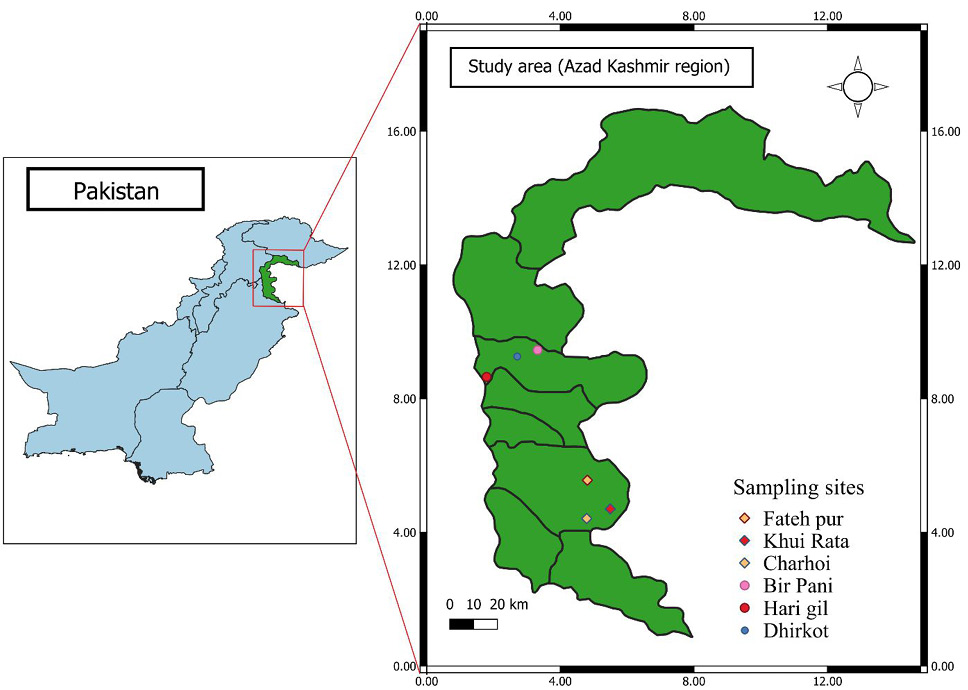
Map of Pakistan highlighting sampling areas in region of Azad Kashmir.
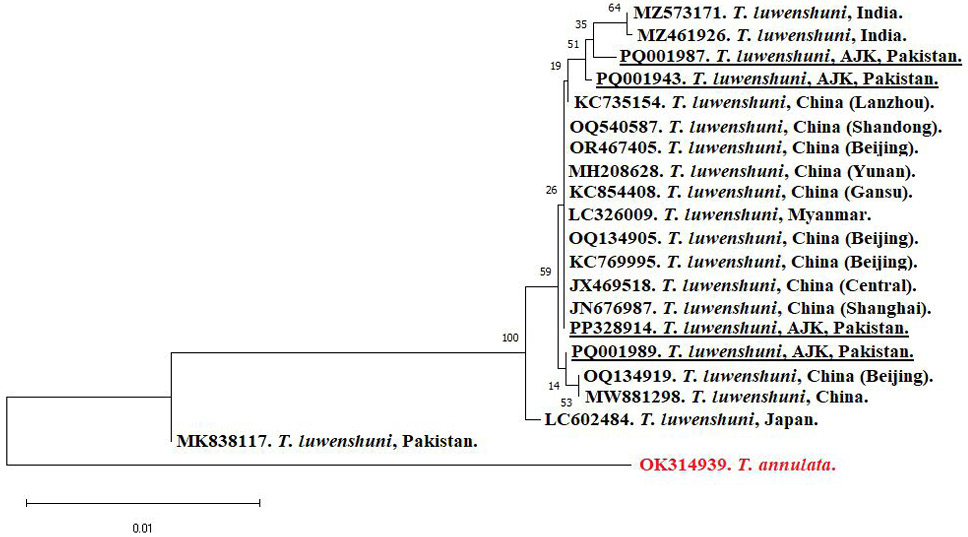
Phylogenetic tree of 18S rRNA of T. luwenshuni in sheep isolated from Azad Kashmir, Pakistan.
References
- Ahmed, Z., Ali, A., Waqas, M., Ahmed, I., Anwar, M.N., Malik, M.I., Jabbar, A., Hussain, A. and Nawaz, M., 2024. Pak. Vet. J., 44: 611-618. http://dx.doi.org/10.29261/pakvetj/2024.112[CrossRef]
- Altay, K., Aktaş, M. and Dumanli, N., 2004. Blood, 2005.
- Idrees, M., Mahmood, Z., Shafi, M. and Sidique, U., 2007. Sarhad J. Agric., 23: 519.
- Li, Y., Chen, Z., Liu, Z., Liu, J., Yang, J., Li, Q., Li, Y., Cen, S., Guan, G. and Ren, Q., 2014. Parasit. Vectors, 7: 1-7. https://doi.org/10.1186/s13071-014-0614-3[CrossRef]
- Schnittger, L., Ganzinelli, S., Bhoora, R., Omondi, D., Nijhof, A.M. and Florin-Christensen, M., 2022. Parasitol. Res., 121: 1207-1245. https://doi.org/10.1007/s00436-022-07424-8[CrossRef]
- Wang, B.H., Du, L.F., Zhang, M.Z., Xia, L.Y., Li, C., Lin, Z.T., Wang, N., Gao, W.Y., Ye, R.Z. andLiu, J.Y., 2023. Microbiol. Spect., 11: e00301-00323. https://doi.org/10.1128/spectrum.00301-23[CrossRef]
Services
Article usage statistics
Loading…