
The long-tailed duck (Clangula hyemalis) is a migratory bird and enduring rapid population declines, as extreme climatic alteration, and other reasons.It is also rare passage migrant into China. The mitochondrial genome (mitogenome) can provide information for phylogenetic analyses and evolutionary biology. In the present investigation, we generated complete mitogenome of the long-tailed duck using sanger sequencing. The mtDNA comprised 16,639 base pairs (bp), and contained 13 protein coding genes, 22 transfer RNAs and 2 ribosomal RNAs. Remarkably, this is the second and most complete published mitogenome for the Clangula hyemalis species. Our findings revealed that control region and ND4L would be expected to be as diversity fragments for identifying population-specific marker in Clangula hyemalis.
Short Communication · Volume 58, Issue 2, 27 February 2026 · Open Access
Characterization and Phylogenetic Analysis of the Mitochondrial Genome of Clangula hyemalis (Linaeus, 1758)
· · · · · · · ·
Affiliations & Notes ⌄
- 1Beijing Wildlife Rescue and Rehabilitation Center, Beijing, 100029, China 2Beijing Key Laboratory of Captive Wildlife Technologies, Beijing Zoo, Beijing, 100044, China 3Academy of Inventory and Planning, National Forestry and Grassland Administration, Beijing, 100714, China 4Beijing Songshan National Nature Reserve, Beijing, 102115, China 5Beijing Milu Ecological Research Center, Beijing, 100076, China 6Department of Freshwater Biology and Fisheries, University of Sindh Jamshoro 76080-Pakistan 7
Article Info ⌄
- Journal:
- Pakistan Journal of Zoology
- Published:
- 27 February 2026

From the article
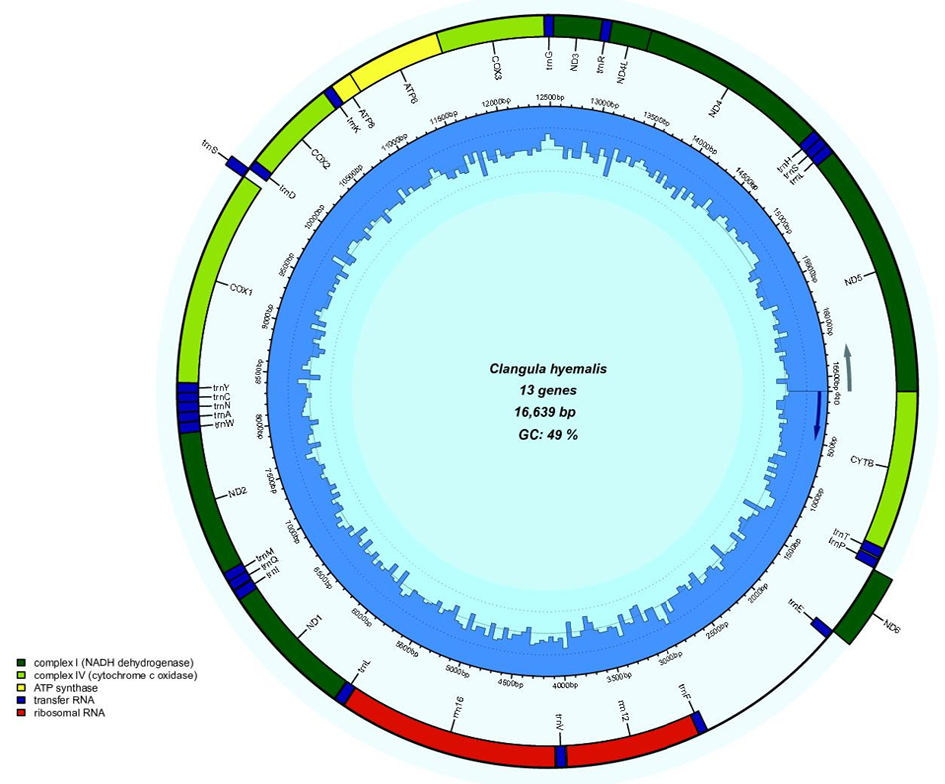
- The complete mitogenome of Clangula hyemalis resulted 16,639 bp in length, including 13 protein-coding genes (PCGs), 22 transfer RNAs, 2 ribosomal RNAs, and a putative control region (D-loop region), shown in Figure 1.
- Primers used for amplification of Clangula hyemalis mitogeno.
- Compared with mitogenome of Clangula hyemalisfrom North American, we found 99.95% identify to the one from Beijing of China.
- In a conclusion,the genetic diversity of Clangula hyemalis was lowest, and control region and ND4L would be expected to be as diversity fragments for identifying population-specific marker in Clangula hyemalis.
Selected from the article's own text.
Abstract
Material and methods
In 2020, we collected a wild migrating long-tailed duck from Beijing, China, (116°18′12″N and 40°10′11″E). A specimen was deposited at Beijing Wildlife Rescue and Rehabilitation Central Lab (contact person: Hengjiu Tian, hengjiutian@126.com, Beijing, China) under the voucher number BWRR-Ch-2020-001.The genomic DNA of each sample was extracted from the feature with TIANamp Genomic DNA Kit.
To get the complete mitochondrial genome, we selected custom-developed primers and minor gaps were resolving by overlapping primer-based PCR for DNA sequence walking (Table 1). All the purified PCR products were sequenced with sanger sequencing mode on an ABI 3730 XL machine. The mitochondrial genome was assembled following Xue et al. (2013), and then annotated using MitoAnnotator . The map of mitochondrial genome was drawing in https://irscope.shinyapps.io/Chloroplot/.
Results and discussion
The complete mitogenome of Clangula hyemalis resulted 16,639 bp in length, including 13 protein-coding genes (PCGs), 22 transfer RNAs, 2 ribosomal RNAs, and a putative control region (D-loop region), shown in Figure 1. Rearrangement and of duplication mitochondrial genome were not observed in this species. The nucleotide composition of mitogenome of Clangula hyemalisis 29.1% for A, 33.2% for C, 15.8% for G, and 21.9% for T, with a slightly higher A+T content (51%). Only ND6 gene is encoded on the light strand, while other genes are distributed in the heavy strand. Among the 13 PCGs, only COX1, COX2, and ND5 uses GTG as the start codon and the rest genes initiate with the start codon of ATG.
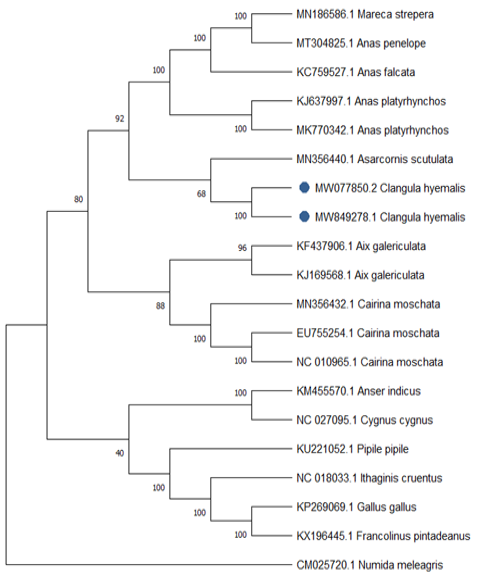
A maximum likelihood analysis was carried out using MEGA X package (Kumar et al., 2016) with GTR+G model and 1,000 bootstrap replicates. We took two Clangula hyemalis mtgenomes (one is published with NCBI accession number MW077850.2 and MW849278.1) and the other eighteen birds from GenBank. The phylogenetic analysis confirms that the beijing’s long-tailed duck close phylogenetic position to North American’s one (Fig. 2).
Table 1. Primers used for amplification of Clangula hyemalis mitogeno
| Primers name | Sequence |
| co1 | F= AATGTAATCGTCACCGCCCA |
| R= TACAGGATTGGGTCTCCCCC | |
| cytb | F= ATCCTGACAGGTCTCCTGCT |
| R= TACGAGGAGGTTGGCCACTA | |
| dloop | F= GCTCCTACTCATACTACCCTGC |
| R= CAGTGTCAAGGTGATTCCCCA | |
| nd2 | F= CGCATTGGGCACAACAATCA |
| R= ATAGTGAGGCGAGGATTGCG | |
| nd3-nd4 | F= CCCCCGTACGAATGTGGATT |
| R= GGAGGCAGATTGAGCTGGTT | |
| nd1-3 | F= AATCTGTGAAAGGAACTCGGC |
| R= ATCATAGGATTGAGTAGACGGC | |
| 16S | F= GTGATAGCTGGTT(A/G)CC(C/T)G |
| R= AAG(C/T)TCCACAGGGTCTTCTCG | |
| CO3 | F= ATGGCCCACCAAGCACACTC |
| R= CAATATCAGGCTGCTGCTTC | |
| ND3 | F= AAACT(A/C/G)TCCCC(A/G/C/T)TACGAATG |
| R= ATTCTGCTCATTCTAGGC | |
| ND4 | F= TAGCAAGCCAAAACCACCT |
| R= GATCAGTGGGTTTGGATTAT | |
| 1 | F= CAAAGTGGCATCTGTGGAAT |
| R= CTGGCACAAGATTTACCGAC | |
| 2 | F= AAAGAGCCCATTCGACC(C/T)TC |
| R= GTTGGGTGGTTGAGCTGTGT | |
| 3 | F= GACTCATCATCCAAGAGCTA |
| R= GGATATACGGTTCAGCCTGT | |
| 4 | F= AAACCTCCCGCACTCTCACA |
| R= GACAACATCCCGTCATCATT | |
| 5 | F= GATTCCACGGACTCCACGTA |
| R= GGTTCAGGCGAGGGTTAGTA | |
| 6 | F= AGA(A/G)CCAAACCCCCTCATTC |
| R= AAAATAGCGCTAGTTCTGTG | |
| 7 | F= CGCTCAATCCCAAACAAACT |
| R= ATGGTATGTCCGCTTGTTAT |
Compared with mitogenome of Clangula hyemalisfrom North American, we found 99.95% identify to the one from Beijing of China. In further, we found 14 SNPs sites and two indels sites between these two mitogenomes (Table II). In a conclusion,the genetic diversity of Clangula hyemalis was lowest, and control region and ND4L would be expected to be as diversity fragments for identifying population-specific marker in Clangula hyemalis.
Table II. Genetic diversity of Clangula hyemalis mitogenome from China and American.
| SNP/ InDel | No. | Gene name | Type |
| INDEL | 1 | Control region | 34bp |
| SNP | 4 | Control region | C/T, C/T, G/A, T/C |
| SNP | 2 | Control region | A/G |
| SNP | 1 | ND1 | G/A |
| SNP | 1 | tRNA-Cys | T/A |
| SNP | 1 | COX1 | A/G |
| INDEL | 1 | COX1 | C |
| SNP | 1 | tRNA-Arg | A/R |
| SNP | 3 | ND4L | T/C, T/C, A/G |
| SNP | 1 | ND6 | A/G |
Declarations
Acknowledgement
We thank Xiaoping Wang for picture providing throughout our project.
Funding
This work was supported by Beijing Financial Project, grant No. 23CB066.
Disclosure statement
No potential conflict of interest was reported by the author(s). The authors comply with the International Union for Conservation of Nature (IUCN) policies research involving species at risk of extinction, the Convention on Biological Diversity and the Convention on the Trade in Endangered Species of Wild Fauna and Flora.
Data availability statement
The genome sequence data by Sangon sequencing that support the findings of this study are openly available in GenBank of NCBI at (https://www.ncbi.nlm.nih.gov) (https://www.ncbi.nlm.nih.gov/) under the accession no.MW077850.2.
Statement of conflict of interest
The authors have declared no conflict of interest.
Figures
The complete mitogenome structure of Clangula hyemalis.
References
- Bernt, M, Donath, A. and Jühling F., 2013. Mol Phylogenet Evol., 69:313-319.
- Bird Life International, 2014. The IUCN red list of threatened species. www.iucnredlist.org.
- Day, R.H., Rose, J.R., Prichard, A.K. and Streever, B., 2015. Island Arctic Alaska, 68: 367-379. https://doi.org/10.14430/arctic4507[CrossRef]
- Dickson, D.L. and Smith, P.A., 2013. J. Wildl. Manage., 77: 777-790. https://doi.org/10.1002/jwmg.529[CrossRef]
- Counihan, K.L., Skerratt, L.F., Franson, J.C. and Hollmén, T.E., 2015. Virology, 485: 393-401. https://doi.org/10.1016/j.virol.2015.07.026[CrossRef]
- Kumar, S., Stecher, G., Li, M., Knyaz, C. and Tamura, K., 2018. Mol. Biol. Evol., 35: 1547-1549.
- Mackenzie, C.L., Kent-Flora, E.A., Baxter, J.M., Gormley, K.S.G., Cassidy, A.J., Sanderson, W.G. and Porter, J.S., 2022. Front. Mar. Sci., 9. https://doi.org/10.3389/fmars.2022.772259[CrossRef]
- Robertson, G.J. and Savard, J.PL., 2002. Long-tailed duck (Clangula hyemalis). In: The birds of North America Online A. Poole, Ed. http://bna.birds.cornell.edu/bna/species/651 https://doi.org/10.2173/bna.651[CrossRef]
- Wu, J. and Shi, Y., 2016. Ecol. Inf., 31: 147-155. https://doi.org/10.13001/1081-3810.3202[CrossRef]
- Xue W., Hou, G., Li, C., Kong, X., Zheng, X., Li, J. and Sun, X., 2013. Mitochondrial DNA, 24: 339-341. https://doi.org/10.3109/19401736.2012.760081[CrossRef]
Supplementary material
Services
Article usage statistics
Loading…