
Hyphessobrycon rosaceus is an important oviparous ornamental fish distributed in the Essequibo and Suriname River basins in South America. To understand the mitochondrial genome characteristics and phylogenetic status of H. rosaceus, Illumina HiSeq high-throughput sequencing technology was used to analyze its entire mitochondrial genome, and the mitochondrial genome sequences of related species were downloaded for a phylogenetic analysis. The results showed that the length of all mitochondrial genes of H. rosaceus comprised 16,870 bp, including 13 protein-coding genes, 22 tRNA genes, two rRNA genes, and one D-loop control region. A phylogenetic tree was constructed based on 13 protein-coding gene sequences. Here, the target species H. rosaceus and Hyphessobrycon socolofi clustered well into one branch, supporting the classification of H. rosaceus as belonging to Hyphessobrycon. However, the mixed distribution of Hyphessobrycon genera throughout the phylogenetic tree suggests that further research is needed to classify this genus. These results provide an important basis for further clarifying the classification status of H. rosaceus, which could help with associated resource protection.
Short Communication · Volume 58, Issue 2, 27 February 2026 · Open Access
Analysis of the Complete Mitochondrial Genome Sequences and Gene Organization of Hyphessobrycon rosaceus (Characiformes, Characidae)
· · ·
Affiliations & Notes ⌄
- 1College of Environment and Life Health, Anhui Vocational and Technical College, Hefei 230011, China. * Corresponding author: gzzxl89@163.com
Article Info ⌄
- Journal:
- Pakistan Journal of Zoology
- Published:
- 27 February 2026

From the article
- The total length of the mitochondrial genome of H. rosaceus was 16,870 bp (Fig. 1), with each containing 13 protein-coding genes, 22 tRNA genes, two rRNA genes, and a control region (D-loop).
- The 13 protein-coding gene combinations in the mitochondrial genome of H. rosaceus obtained in this study had a total length of 11,423 bp, with 3806 codons (excluding termination codons).
- The phylogenetic results indicate that further research is required to classify the Hyphessobrycon genus.
- The phylogenetic tree constructed showed that the target species, H. rosaceus and H. socolofi, clustered together well, supporting the classification of H. rosaceus as belonging to Hyphessobrycon.
Selected from the article's own text.
Abstract
Materials and methods
H. rosaceus was collected from Yufeng Flower, Bird, Insect and Fish Market in Hefei City, Anhui Province (31.853174° N, 117.305852° E). After morphological analysis, a small amount of muscle tissue was taken from the sample and used for extraction of genomic DNA using the high-salt method . DNA quality was determined via 10 g/L agarose gel electrophoresis, and the DNA purity and concentration were determined using a NanoDrop ND-2000 ultra-micro spectrophotometer. To ensure sample accuracy, DNA barcodes were identified using the mitochondrial COI gene sequence (accession number KU568886).
Using a Covaris ultrasound to break the genomic DNA of the sample into approximately 350 bp fragments, repair the end of the DNA fragment, and add an A base and sequencing adapter to the 3 end. PCR amplification was performed on the connected products, which were then recovered and purified using magnetic beads to construct a library. After quality inspection of the DNA library, the Illumina HiSeq high-throughput sequencing platform was used for paired-end sequencing , with a sequencing data volume of no less than 6 Gb. Sequencing was performed by Shenggong Biotechnology Co. Ltd. (Shanghai, China). Low-quality reads and splice sequences were filtered out from the sequencing data, and NOVOPlasty was used for de novo assembly , referring to the published mitochondrial genome sequence of Hyphessobrycon amandae (accession number MT484069, . BioEdit v7.2.5 Software was used to proofread the spliced sequences , and MITOS2 (http://mitos.bioinf.unileipzig.de/index.py) online software was used for gene annotation. The complete mitochondrial genome sequence of H. rosaceus has been submitted to the NCBI (National Center for Biotechnology Information) database (accession number: OP595700).
For phylogenetic analysis Blast alignment was performed based on the NCBI database using the mitochondrial gene sequence of H. rosaceus. The mitochondrial genome sequences of the 41 fish species showed high homology with the mitochondrial gene sequence of H. rosaceus. Corydoras aeneus (accession number MZ571336, Sun et al., 2022b) was used as an outlier for the phylogenetic analysis. Using BioEdit v7.2.5, 13 protein-coding genes sequences were extracted from the mitochondrial genome of the sample and spliced into one sequence. A Bayesian inference phylogenetic tree was constructed using MrBayes v3.2.6 , with four independent Markov chains and 5,000,000 generations run, sampling once every 1000 generations; then, the top 25% were discarded. When the average standard deviation of the column frequency was less than 0.001, it was believed that the analysis tended to be stable, and the posterior support rates for each branch were calculated. A maximum likelihood phylogenetic tree using IQ-TREE v1.6.8 , and the confidence of each branch was tested using bootstrapping (5000 repetitions).
Results and discussion
The total length of the mitochondrial genome of H. rosaceus was 16,870 bp (Fig. 1), with each containing 13 protein-coding genes, 22 tRNA genes, two rRNA genes, and a control region (D-loop). The base composition of the mitochondrial genome sequence was similar, with A, T, C, and G contents of 29.5, 28.8, 26, and 15.6%, respectively. The A+T content (58.3%) was higher than the C+G content (41.6%).
The 13 protein-coding gene combinations in the mitochondrial genome of H. rosaceus obtained in this study had a total length of 11,423 bp, with 3806 codons (excluding termination codons). Twelve genes (ND1, ND2, COX1, COX2, ATP8, ATP6, COX3, ND3, ND4L, ND4, ND5, and Cytb) were encoded in the H chain, whereas only ND6 was encoded in the L chain. All 13 protein-coding genes had ATG as the starting codon. The termination codons included TAG, TAA, AGG, and an incomplete termination codon, T.
An analysis of the frequency of codon usage in protein-coding genes and the frequency of synonymous codon usage (Table I) showed that, among the 13 protein-coding genes, there were 36 preferred codons (RSCU codons), with the third codon C or T having a high usage frequency, whereas the codon ending in G had the lowest usage frequency. In codons ending in A or T at the third base, the RSCUs of AAU (N), AGU (S), CAU (H), CGU (R), GAU (D), GGU (G), UAU (Y), and UGU (C) codons were less than 1, whereas those of the other codons were greater than 1.
Figure 2 shows a phylogenetic tree of 43 mitochondrial genomes, including 39 from the Characidae family, two from Bryconidae, one from Callichthyidae (outer group), and one from Serrasalmidae. It shows that Paracheirodon and Astyanax genera are well supported. Among the three species of the Psalidodon genus, Hyphessobrycon anisitsi was mixed. Other genera were mixed and not clustered according to the classification standards. The target species, H. rosaceus and Hyphessobrycon socolofi, clustered together well and were also clustered with Hyphessobrycon megalopterus and Hyphessobrycon pulchripinnis. However, 11 species of this genus did not form a single branch, resulting in a mixed distribution of species throughout the phylogenetic tree. The phylogenetic results indicate that further research is required to classify the Hyphessobrycon genus.
Table I. Frequency of codon usage in the 13 protein-coding genes.
| Codon | Count | RSCU |
| UUU(F) | 141 | 1.12 |
| UUC(F) | 111 | 0.88 |
| UUA(L) | 159 | 1.51 |
| UUG(L) | 28 | 0.27 |
| CUU(L) | 140 | 1.33 |
| CUC(L) | 107 | 1.02 |
| CUA(L) | 157 | 1.5 |
| CUG(L) | 39 | 0.37 |
| AUU(I) | 201 | 1.37 |
| AUC(I) | 92 | 0.63 |
| AUA(M) | 131 | 1.51 |
| AUG(M) | 43 | 0.49 |
| Table continued on next column...... | ||
| Codon | Count | RSCU |
| GUU(V) | 66 | 1.28 |
| GUC(V) | 57 | 1.11 |
| GUA(V) | 63 | 1.22 |
| GUG(V) | 20 | 0.39 |
| UCU(S) | 64 | 1.54 |
| UCC(S) | 52 | 1.25 |
| UCA(S) | 79 | 1.9 |
| UCG(S) | 8 | 0.19 |
| CCU(P) | 61 | 1.24 |
| CCC(P) | 53 | 1.08 |
| CCA(P) | 68 | 1.38 |
| CCG(P) | 15 | 0.3 |
| ACU(T) | 77 | 1.08 |
| ACC(T) | 96 | 1.35 |
| ACA(T) | 96 | 1.35 |
| ACG(T) | 15 | 0.21 |
| GCU(A) | 85 | 1.02 |
| GCC(A) | 126 | 1.52 |
| GCA(A) | 103 | 1.24 |
| GCG(A) | 18 | 0.22 |
| UAU(Y) | 61 | 0.99 |
| UAC(Y) | 62 | 1.01 |
| UAA(*) | 5 | 2.5 |
| UAG(*) | 2 | 1 |
| CAU(H) | 42 | 0.82 |
| CAC(H) | 60 | 1.18 |
| CAA(Q) | 80 | 1.55 |
| CAG(Q) | 23 | 0.45 |
| AAU(N) | 55 | 0.84 |
| AAC(N) | 76 | 1.16 |
| AAA(K) | 82 | 1.8 |
| AAG(K) | 9 | 0.2 |
| GAU(D) | 32 | 0.82 |
| GAC(D) | 46 | 1.18 |
| GAA(E) | 80 | 1.67 |
| GAG(E) | 16 | 0.33 |
| UGU(C) | 14 | 0.9 |
| UGC(C) | 17 | 1.1 |
| UGA(W) | 99 | 1.74 |
| UGG(W) | 15 | 0.26 |
| CGU(R) | 16 | 0.89 |
| CGC(R) | 10 | 0.56 |
| CGA(R) | 39 | 2.17 |
| CGG(R) | 7 | 0.39 |
| AGU(S) | 17 | 0.41 |
| AGC(S) | 29 | 0.7 |
| AGA(*) | 0 | 0 |
| AGG(*) | 1 | 0.5 |
| GGU(G) | 42 | 0.7 |
| GGC(G) | 76 | 1.27 |
| GGA(G) | 87 | 1.45 |
| GGG(G) | 35 | 0.58 |
Note: bold represents preferred codons.
In this study, the mitochondrial whole genome structure of H. rosaceus was similar to that of other bony fish ; and showed a significant A+T preference in the base composition. The D-loop is the region with the most complex changes in mitochondrial DNA , and its evolutionary rate is 5–10 times that of other mtDNA segments. There were significant differences in the control regions between related species and even between different individuals of the same species. The size of the repeat sequences in the control region of teleost fish varies greatly, and the length of the control region used in this study was 1186 bp. However, the role of D-loop repeat sequences in evolution needs further exploration .
In the mitochondrial genome of H. rosaceus, protein-coding genes were determined to be present in both the H and L chains. Brown et al. (1982) reported that protein-coding genes on the H-chain are not easily transformed into protected double chains because most H-chains are hydrolyzed single chains. Most protein-coding genes in the mitochondrial genome of H. rosaceus were found to be located in the H chain and are prone to hydrolysis and oxidation. The ND6 gene located in the L chain is much more stable, reflecting the differences in and importance of these genes.
Conclusions
The phylogenetic tree constructed showed that the target species, H. rosaceus and H. socolofi, clustered together well, supporting the classification of H. rosaceus as belonging to Hyphessobrycon.
Funding
Funded by Engineering Research Center for Tropical and Subtropical Aquatic Ecological Engineering, Ministry of Education, Jinan University, P.R. China (No. 2022A0201).
Statement of conflict of interest
The authors have declared no conflict of interest.
Figures
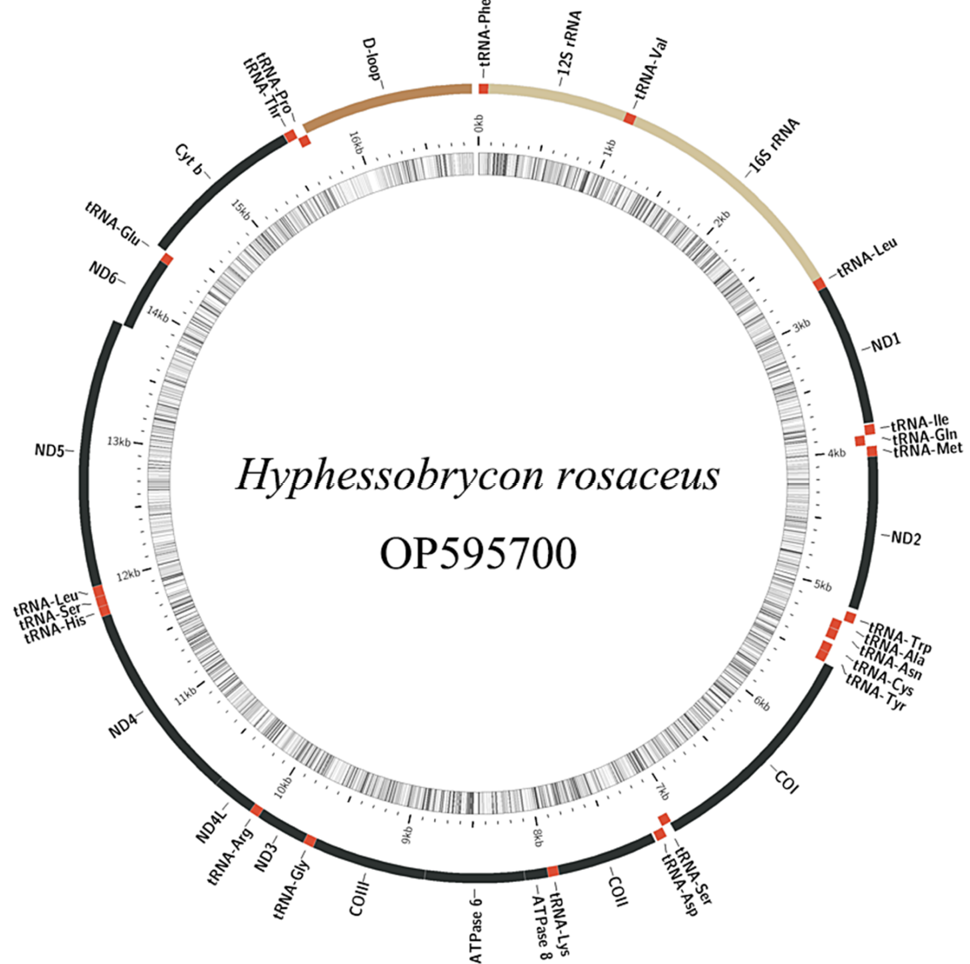
Gene map of the mitochondrial genome of Hyphessobrycon rosaceus.
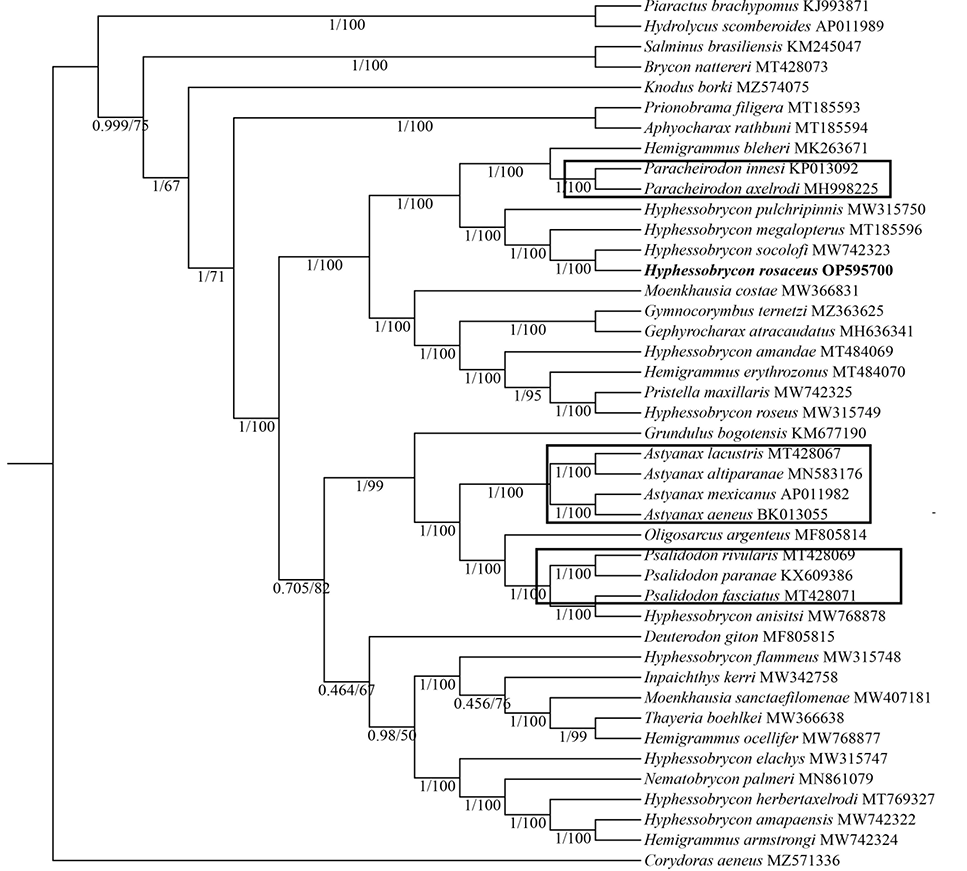
Phylogenetic relationships among Characidae species based on concatenated nucleotide sequences of 13 mitochondrial protein-coding genes. Numbers at the nodes represent the posterior probability for the Bayesian analysis and bootstrap values for the maximum likelihood analysis.
References
- Aljanabi, S.M. and Martinez, I., 1997. Nucl. Acids Res., 25: 4692-4693. https://doi.org/10.1093/nar/25.22.4692[CrossRef]
- Barik, M., Bhattacharjee, I., Ghosh, A. and Chandra, G., 2018. BMC Res. Notes, 11: 1-5. https://doi.org/10.1186/s13104-018-3902-8[CrossRef]
- Boore, J.L., 1999. Nucl. Acids Res., 27: 1767-1780. https://doi.org/10.1093/nar/27.8.1767[CrossRef]
- Brown, G.G., Gadaleta, G., Pepe, G., Saccone, C. and Sbisà, E., 1986. J. mol. Biol., 192: 503-511. https://doi.org/10.1016/0022-2836(86)90272-X[CrossRef]
- Brown, W.M., Prager, E.M., Wang, A. and Wilson, A.C., 1982. J. mol. Evol., 18: 225-239. https://doi.org/10.1007/BF01734101[CrossRef]
- Caporaso, J.G., Lauber, C.L., Walters, W.A., Berg-Lyons, D., Huntley, J., Fierer, N., Owens, S.M., Betley, J., Fraser, L., Bauer, M., Gormley, N., Gilbert, J.A. and Knight, R., 2012. ISME J., 6: 1621-1624.https://doi.org/10.1038/ismej.2012.8[CrossRef]
- Castro-Paz, F.P., Batista, J.D.S. and Porto, J.I.R., 2014. PLoS One, 9: e98603. https://doi.org/10.1371/journal.pone.0098603[CrossRef]
- Dierckxsens, N., Mardulyn, P. and Smits, G., 2017. Nucl. Acids Res., 45: e18-e18. https://doi.org/10.1093/nar/gkw1314[CrossRef]
- Gray, M.W., Burger, G. and Lang, B.F., 1999. Science, 283: 1476-1481. https://doi.org/10.1126/science.283.5407.1476[CrossRef]
- Gutiérrez, V., Rego, N., Naya, H. and García, G., 2015. BMC Genomics, 16: 1-15. https://doi.org/10.1186/s12864-015-2090-3[CrossRef]
- Gvozdanović, K., Margeta, V., Margeta, P., Djurkin Kušec, I., Galović, D., Dovč, P. and Kušec, G., 2019. Anim. Biotechnol., 30: 242-251. https://doi.org/10.1080/10495398.2018.1478847[CrossRef]
- Hall, T., Biosciences, I. and Carlsbad, C.J.G.B.B., 2011. GERF Bull. Biosci., 2: 60-61.
- Johnson, M., Zaretskaya, I., Raytselis, Y., Merezhuk, Y., McGinnis, S. and Madden, T.L., 2008. Nucl. Acids Res., 36: W5-W9. https://doi.org/10.1093/nar/gkn201[CrossRef]
- Nguyen, L.T., Schmidt, H.A., Von Haeseler, A. and Minh, B.Q., 2015. Mol. Biol. Evol., 32: 268-274. https://doi.org/10.1093/molbev/msu300[CrossRef]
- Ronquist, F. and Huelsenbeck, J.P., 2003. Bioinformatics, 19: 1572-1574. https://doi.org/10.1093/bioinformatics/btg180[CrossRef]
- Satoh, T.P., Miya, M., Mabuchi, K. and Nishida, M., 2016. BMC Genomics, 17: 1-20. https://doi.org/10.1186/s12864-016-3054-y[CrossRef]
- Sun, C.H., Zhang, Y.N., Zeng, X.S., Liu, D.W., Huang, Q., Zhang, X.L. and Zhang, Q., 2022a. Mol. Biol. Rep., 49: 1741-1748.
- Sun, C.H., Huang, Q., Zeng, X.S., Li, S., Zhang, X.L., Zhang, Y.N., Liao, J., Lu, C.H., Han, B.P. and Zhang, Q., 2022b. Zookeys, 1083: 89. https://doi.org/10.3897/zookeys.1083.76887[CrossRef]
- Sun, C.H., Liu, H.Y., Xu, N., Zhang, X.L., Zhang, Q. and Han, B.P., 2021. Front. Genet., 12: 627402. https://doi.org/10.3389/fgene.2021.627402[CrossRef]
Services
Article usage statistics
Loading…