
This study aimed to analysis the effect of immunisation of somatostatin (SS) DNA vaccine in maternal animals on serum related hormones in offspring. In this study, ten ewes with two newborn lambs were randomly divided into SS DNA vaccine group (Group T) and empty vector group (Group C), and these vaccines were given orally into the ewes at weeks 0, 3 and 6 of the research. Blood samples of ewes or offspring lambs were collected at week 6 or 9 of lactation, respectively. Serum SS, prolactin (PRL), growth hormone (GH) and insulin-like growth factor 1 (IGF-1) concentrations were detected by radioimmunoassay. The offspring lambs in T group showed significantly lower serum SS and higher PRL concentrations than those in the control group, and there were no difference between T group and the control group in terms of serum GH and IGF-1 concentrations. There was a significant negative correlation between offspring lambs serum SS and GH, IGF-1, PRL concentration, and there was a significant positive correlation between offspring lambs serum PRL and GH, IGF-1 concentration. There was a significant positive correlation between ewes serum SS concentration and offspring lambs serum SS concentration, ewes serum PRL concentration and offspring lambs serum PRL concentration. The findings indicate that the immunisation with oral somatostatin DNA vaccine in ewes may affect serum SS and PRL levels in offspring lambs through maternal related hormones.
Short Communication · Volume 52, Issue 2, 15 February 2020 · Open Access
Immunisation of Somatostatin DNA Vaccine in Ewes Can Affect Serum Somatostatin and Prolactin Levels in Offspring Lambs Through Maternal Related Hormones
· · · · · · · ·
Affiliations & Notes ⌄
- 1College of Animal Science and Technology, Southwest University, Chongqing Key Laboratory of Forage and Herbivore, Chongqing Engineering Research Centre for Herbivores Resource Protection and Utilization, Chongqing, China , * Corresponding author: H67738337@swu.edu.cn
Article Info ⌄
- Journal:
- Pakistan Journal of Zoology
- Published:
- 15 February 2020

From the article
- However, no significant difference was observed between vaccine and control group in terms of offspring lambs serum GH and IGF-1 concentration at week 9 of lactation (Fig. 1B, C, P > 0.05).
- The immunisation with oral somatostatin DNA vaccine in ewes may affect serum SS and PRL levels in offspring lambs through maternal hormones.
- Further studies will focus on the mechanism of maternal hormones affecting offspring hormonal changes after immunisation of SS DNA vaccine.
Selected from the article's own text.
Abstract
Materials and methods
After parturition, ten healthy female Dazu Black goats with two new born offspring lambs per ewe were purchased and fed in Ruifeng Modern Agriculture Development Co., Ltd of Chongqing Dazu District in China. All goats were fed according to the guidelines of the Committee on the Care and Use of Laboratory Animals of China, and all animal experiments were permited by the Science and Technology Ethics Committee of Southwest University.
Ten healthy Dazu Black goat ewes with two new born offspring lambs per ewe were randomly divided into the SS DNA vaccine group (Group T) and control group (Group C). These ewes were firstly given orally 10 mL of 7.5% sodium bicarbonate solution at 30 min before immunisation, then separately given orally C500 (ptCS/2SS-asd) vaccine (Group T) and C500 (pVAX-asd) empty plasmid (Group C) at a dose of 5 × 10¹¹ CFU dissolved in 5 mL sterile saline solution. These ewes were immunisated total three times with a three-week interval. Ewes serum were collected at week 6 of lactation, and offspring lambs serum were collected at week 9 of lactation by centrifugation 1157 × g for 10 min and stored at −20 °C until use.
Ewes and offspring lambs serum SS, GH, IGF-1 and PRL concentrations were detected by radioimmunoassay kit (Beijing Sino-UK Institute of Biological Technology, Beijing, China). The assay sensitivities for SS, GH, IGF-1, PRL was < 1.0 pg/ml, < 0.1 ng/ml, < 10 ng/ml and < 12.5 uIU/ml, respectively. The intra-assay coefficients of variation for SS, GH, IGF-1, PRL assays were < 9.5%, and the inter-assay coefficients of variation for SS, GH, IGF-1 and PRL assays were < 5%.
Statistically significant differences (P<0.05) between vaccine group and control group in terms of ewes and offspring lambs serum SS, GH, IGF-1 and PRL were analysed by one-way ANOVA of SAS 8.1 (SAS Institute, Inc., Cary, NC, USA). All data were expressed as mean±SD.
Results and discussion
The offspring lambs in vaccine group showed significantly lower serum SS concentration than those in control group at week 9 of lactation (Fig. 1A, P < 0.05), and the offspring lambs in vaccine group showed significantly higher serum PRL concentration than those in control group at week 9 of lactation (Fig. 1D, P < 0.05). However, no significant difference was observed between vaccine and control group in terms of offspring lambs serum GH and IGF-1 concentration at week 9 of lactation (Fig. 1B, C, P > 0.05).
There was a significant negative correlation between offspring lambs serum SS and GH, IGF-1, PRL concentration (Table I, P<0.05). There was a significant positive correlation between offspring lambs serum PRL and GH, IGF-1 concentration, and between offspring lambs serum GH and IGF-1 concentration (Table I, P<0.05).
Table I. Correlation coefficients among serum SS, GH, IGF-1 and PRL in offspring lambs at week 9 after lactation.
| SS | GH | IGF-1 | PRL | |
| SS | 1 |
|
| |
| GH | -.532* | 1 |
| |
| IGF-1 | -.807* | .767* | 1 | |
| PRL | -.850* | .567* | .828* | 1 |
*P < 0.05 indicates significant difference between each other.
There was a significant positive correlation between ewes serum SS concentration and offspring lambs serum SS concentration (Table II, P < 0.05), ewes serum PRL concentration and offspring lambs serum PRL concentration (Table II, P < 0.05). There was a significant negative correlation between offspring lambs serum SS and ewes serum PRL concentration (Table II, P < 0.05).
Table II. Correlation coefficients among serum SS, GH, IGF-1 and PRL in ewes and offspring lambs.
| SS in lamb serum | GH in lamb serum | IGF-1 in lamb serum | PRL in lamb serum | |
| SS in ewes serum | 0.909* | |||
| GH in ewes serum | -0.389 | -0.121 | ||
| IGF-1 in ewes serum | -0.450 | 0.216 | 0.414 | |
| PRL in ewes serum | -0.722* | 0.257 | 0.492 | 0.727* |
*P < 0.05 indicates significant difference between each other.
SS, GH, IGF-1 and PRL play a vital role in the regulation of somatostatin DNA vaccine on animal lactation and the weight gain of offspring during lactation. SS plays an important role in the regulation of animal lactation by the GH-IGF-1 axis an PRL ; ; . Many previous studies found that immunisation of SS DNA vaccine can induce the production of specific SS antibodies in animals ; , which can effectively neutralize endogenous SS, then promote the secretion of GH-IGF-1 axis and PRL, and ultimately promote the weight gain of offspring during lactation ; . In addition, SS also plays a vital role in the regulation of animal growth by the GH-IGF-1 axis and immunisation of SS DNA vaccine can promote the growth of animals ; . In addition to improving milk yield and quality by GH-IGF-1 axis and PRL to promote the growth of offspring ; , immunisation of SS DNA vaccine in mothers may also affect the growth of offspring through maternal related hormones such as SS, GH and IGF-1. Therefore, it will enable us to more fully understand the mechanism of somatostatin gene immunisation in promoting the growth of offspring through studying the affects of immunisation of SS DNA vaccine on serum SS, GH, IGF-1 and PRL in offspring animals, and the affects of maternal-related hormones on growth-related hormones in offspring after immunisation of SS DNA vaccine.
In this study, immunisation of SS DNA vaccine in ewes can affect serum SS and PRL levels in offspring lambs. The offspring lambs in vaccine group showed significantly lower serum SS and higher PRL concentrations than those in the control group, and there were no difference between the vaccine group and control group in terms of serum GH and IGF-1 concentration. Bai et al’s study found that immunisation of SS DNA vaccine in mother mice did not affect serum SS antibody concentration and GH concentration in offspring mice . Our results indicated that immunisation of SS DNA vaccine in mother animals can affect serum SS and PRL levels in offspring, which is not caused by the serum SS antibody in offspring neutralizing the serum endogenous SS. Thyroid hormone can promote the growth and development of animals in infancy and SS can inhibit the secretion of thyroid hormone ; . Therefore, lower serum SS in offspring lambs may promote the growth of lambs through improving the secretion of thyroid hormones. PRL can promote liver growth of animals and therefore higher serum PRL in offspring lambs may promote the growth of lambs through the liver function.
In the research, maternal serum related hormones may affect the serum related hormones levels of offspring after immunisation of SS DNA vaccine in ewes. There was a significant positive correlation between ewes serum SS concentration and offspring lambs serum SS, ewes serum PRL concentration and offspring lambs serum PRL concentration, and there was a significant negative correlation between offspring lambs serum SS and ewes serum PRL concentration. In addition, there was a significant negative correlation between offspring lambs serum SS and GH, IGF-1 and PRL concentration, and there was a significant positive correlation between offspring lambs serum PRL and GH, IGF-1 concentration, and there was a significant positive correlation between offspring lambs serum GH and IGF-1 concentration. Previous studies also found that there was a significant negative correlation between maternal serum SS and GH, IGF-1 concentration, and there was a significant positive correlation between maternal serum GH and IGF-1 concentration after immunisation of SS DNA vaccine ; . These results indicated that offspring serum SS and PRL concentrations can be affected by maternal serum SS and PRL after immunisation of SS DNA vaccine in maternal animal. This affects may be caused by sucking milk of the offspring which is due to large amount of SS and PRL in the milk ; .
Conclusion
The immunisation with oral somatostatin DNA vaccine in ewes may affect serum SS and PRL levels in offspring lambs through maternal hormones. Further studies will focus on the mechanism of maternal hormones affecting offspring hormonal changes after immunisation of SS DNA vaccine.
Acknowledgements
This work was supported by the Chongqing Science and Technology Innovation Special Project (No. cstc2019jscx-gksbX0135), the Chongqing Science and Technology Innovation Special Project (No. cstc2017shms-zdyfX0059), the Fundamental Research Funds for the Central Universities (No. XDJK2016C018), the National Key Research and Development Plan of China (No. 2018YFD0502003) and Innovation Team in Chongqing University (No.CXTDG201602004).
Statement of conflict of interest
Authors have no conflict of interest to declare.
Figures
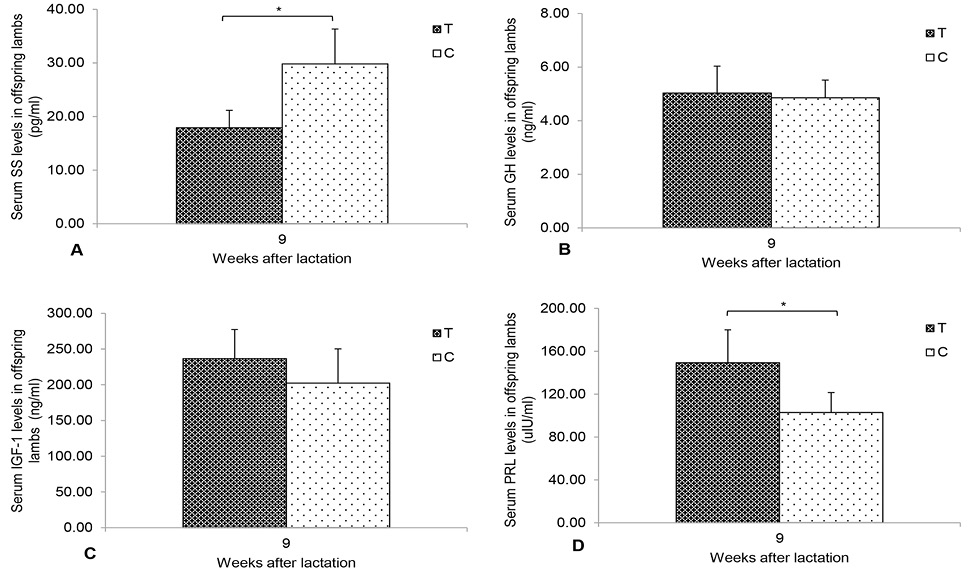
Changes in serum related hormones levels in offspring lambs after immunisation of SS DNA vaccine. A, SS concentration (pg/ml) in T and C groups at week 9 of lactation; B, GH concentration (ng/ml) in T and C groups at week 9 of lactation; C, IGF-1 concentration (ng/ml) in T and C groups at week 9 of lactation; D, PRL concentration (uIU/ml) in T and C groups at week 9 of lactation, Data are shown as means ± SD. *P < 0.05.
References
- Akers, R.M., 2017. J. Dairy Sci., 100: 10332-10352. https://doi.org/10.3168/jds.2017-12983[CrossRef]
- Bai, L.Y., Liang, A.X., Zhang, J., Yang, F.F., Han, L., Huo, L.J. and Yang, L.G., 2011. Theriogenology, 75: 155-163. https://doi.org/10.1016/j.theriogenology.2010.08.001[CrossRef]
- Bao, Z., Lin, J., Ye, L., Zhang, Q., Chen, J., Yang, Q. and Yu, Q., 2016. Front Physiol., 7: 278. https://doi.org/10.3389/fphys.2016.00278[CrossRef]
- Behringer, V., Deimel, C., Hohmann, G., Negrey, J., Schaebs, F.S. and Deschner, T., 2018. Horm. Behav., 105: 66-85. https://doi.org/10.1016/j.yhbeh.2018.07.011[CrossRef]
- Cui, Y., Sun, X., Jin, L., Yu, G., Li, Q., Gao, X., Ao, J. and Wang, C., 2018. BMC. Vet. Res., 13: 350. https://doi.org/10.1186/s12917-017-1267-1[CrossRef]
- de Morais, J.P.G., da S Cruz, A.P., Minami, N.S., Veronese, L.P., Del Valle, T.A. and Aramini, J., 2017. J. Dairy Sci., 100: 5945-5956. https://doi.org/10.3168/jds.2016-11965[CrossRef]
- Dong, F.X., Luo, X., Yuan, D.L., Liang, A.X. and Yang, L.G., 2018. Pakistan J. Zool., 50: 1875-1883.
- Dosouto, C., Calaf, J., Polo, A., Haahr, T. and Humaidan, P., 2019. Front. Endocr. (Lausanne)., 10: 404. https://doi.org/10.3389/fendo.2019.00404[CrossRef]
- Han, Y., Liang, A., Han, L., Guo, A., Jiang, X. and Yang, L., 2014. Scand. J. Immunol., 79: 244-250. https://doi.org/10.1111/sji.12155[CrossRef]
- Han, Y.G., Peng, X.L., Li, Kai., Zhao, Y.H.T., Jiang, X.P., E, G.X., Zhao, Y.J., Ye, J.H., Xu, L., Zhao, Q.T. and Huang, Y.F., 2019. Pakistan J. Zool., 51: 413-419. https://doi.org/10.17582/journal.pjz/2019.51.2.413.419[Full text][CrossRef]
- Healy, D.L., Rattigan, S., Hartmann, P.E., Herington, A.C. and Burger, H.G., 1980. Am. J. Physiol., 238: E83-86. https://doi.org/10.1152/ajpendo.1980.238.1.E83[CrossRef]
- Hoeflich, A. and Meyer, Z., 2017. Best Pract. Res. clin. Endocrinol. Metab., 31: 409-418. https://doi.org/10.1016/j.beem.2017.10.002[CrossRef]
- Holst, N., Jenssen, T.G. and Burhol, P.G., 1990. J. Pediat. Gastroenterol. Nutr., 10: 47-52. https://doi.org/10.1097/00005176-199001000-00010[CrossRef]
- Lacasse, P., Ollier, S., Lollivier, V. and Boutinaud, M., 2016. J. Dairy Sci., 99: 864-874. https://doi.org/10.3168/jds.2015-10035[CrossRef]
- Lacasse, P., Zhao, X., Vanacker, N. and Boutinaud, M., 2019. Animal, 13: s35-s41. https://doi.org/10.1017/S1751731118003312[CrossRef]
- Lékó, A.H., Cservenák, M. and Dobolyi, Á., 2017. Growth Horm. IGF. Res., 37: 7-12. https://doi.org/10.1016/j.ghir.2017.10.003[CrossRef]
- Liang, A., Riaz, H., Dong, F., Luo, X., Yu, X., Han, Y., Chong, Z., Han, L., Guo, A. and Yang, L., 2014. Vaccine, 32: 1368-1374. https://doi.org/10.1016/j.vaccine.2014.01.026[CrossRef]
- Luque, R.M. and Kineman, R.D., 2018. J. Endocr., 237: 217-227. https://doi.org/10.1530/JOE-18-0135[CrossRef]
- Madon, R.J., Ensor, D.M., Knight, C.H. and Flint D.J., 1986. J. Endocr., 111: 117-123. https://doi.org/10.1677/joe.0.1110117[CrossRef]
- Moreno-Carranza, B., Bravo-Manríquez, M., Baez, A., Ledesma-Colunga, M.G., Ruiz-Herrera, X., Reyes-Ortega, P., de Los Ríos, E.A., Macotela, Y., Martínez de la Escalera, G. and Clapp, C., 2018. Am. J. Physiol. Regul. Integr. Comp. Physiol., 314: R902-R908. https://doi.org/10.1152/ajpregu.00003.2018[CrossRef]
- Murray, P.G. and Clayton, P.E., 2013. Am. J. med. Genet. C., 163C: 76-85. https://doi.org/10.1002/ajmg.c.31357[CrossRef]
- Rodríguez-Álvarez, F.J., Jiménez-Mora, E., Caballero, M., Gallego, B., Chiloeches, A. and Toro, M.J., 2015. Mol. cell. Biochem., 411: 253-260.
- Saleem, M., Martin, H. and Coates, P., 2018. Clin. Biochem. Rev., 39: 3-16. https://doi.org/10.1007/s11010-015-2587-8[CrossRef]
- Villa-Osaba, A., Gahete, M.D., Cordoba-Chacon, J., de Lecea, L., Castaño, J.P. and Luque, R.M., 2016. Mol. cell. Endocrinol., 434: 14-24. https://doi.org/10.1016/j.mce.2016.06.014[CrossRef]
- Xue, C.L., Liang, A.X., Mao, D.G., Han, L., Liu, X.B., Zhang, J. and Yang, L.G., 2010. Vaccine, 28: 1541-1546. https://doi.org/10.1016/j.vaccine.2009.11.058[CrossRef]
- Yang, S.Y., Du, F.K. and Pao, X., 2017. Pakistan J. Zool., 49: 257-265. https://doi.org/10.17582/journal.pjz/2017.49.1.243.250[CrossRef]
Services
Article usage statistics
Loading…