
Simple co-injection of CpG adjuvant and somatostatin (SS) DNA vaccine can enhance the effect of the vaccine and promote the growth of animals. This study investigated the enhancing effect of the fusion type of CpG motifs on SS DNA vaccine and growth of ram lambs. In this study, we constructed the ptS/2SS-asd plasmid, pCpG plasmid and the CpG-SS fusion type recombinant plasmid named ptCS/2SS-asd. Twelve ram lambs were randomly divided into three groups, namely, the treatment (Group T1, ptCS/2SS-asd; Group T2, pCpG + ptS/2SS-asd) groups and the control (Group C, pVAX-asd). The vaccine (1 mg/ram) was injected into the rams at weeks 0, 3 and 6 of the study. The rams in Group T1 and T2 showed significantly higher anti-SS antibody, serum growth hormone and IGF-1 concentrations and average body weight than those in the control group (P < 0.05). Immunisation with ptCS/2SS-asd promoted the growth of rams similar to the effect of the simple co-injection of CpG and SS DNA vaccine. Thus, the fusion type of CpG adjuvant is an effective, simple, and low-cost method in enhancing the effect of SS DNA vaccine and the growth of ram lambs.
Research Article · Volume 51, Issue 1, 27 January 2019 · Open Access
Evaluation of the Fusion Type CpG Adjuvant for the Enhancement of Somatostatin DNA Vaccine in Ram Lambs
· · · · · · · · · ·
Affiliations & Notes ⌄
- 1Chongqing Key Laboratory of Forage and Herbivore, Chongqing Engineering Research Centre for Herbivores Resource Protection and Utilization, College of Animal Science and Technology, Southwest University, Chongqing 400715, China 2Key Laboratory of Agricultural Animal Genetics, Breeding and Reproduction of the Ministry of Education, College of Animal Science and Technology, Huazhong Agricultural University, Wuhan 430070, China 3Nanchang Police Canine Base of Ministry of Public Security, Nanchang 3
Article Info ⌄
- Journal:
- Pakistan Journal of Zoology
- Published:
- 27 January 2019

From the article
- In this study, we successfully constructed a novel SS DNA vaccine that fused CpG, tPA and HBsAg-S gene.
- The GH and IGF-1 concentrations in the vaccine fused with CpG group were significantly higher than those in the control group at weeks 6 and 10 after primary vaccination.
- We developed a potent SS DNA vaccine fused with CpG motifs that induced strong humoral immune responses and significantly promoted the growth of ram lambs.
- No significant differences on the immunisation effect were observed between the SS DNA vaccine fused with CpG motifs and the simple co-injection system of CpG and SS DNA vaccine.
Selected from the article's own text.
Abstract
Introduction
Somatostatin (SS)-14 inhibits the secretion of growth hormone (GH) and the growth of animals ; ; . SS DNA vaccines against SS-14 can inhibit the secretion of GH and promote the growth of various animals, such as mice , lambs and swine . Although these SS DNA vaccines are superior over than conventional SS vaccines, the immunogenicity is still weak, and the effect of their growth-promoting of animals is not evident, especially in large animals.
CpG (a hexameric motif) adjuvant can effectively improve the immunogenicity of DNA vaccine ; ; . However, most CpG adjuvants are co-injected with DNA vaccine ; ; this method individually requires the extraction and purification of CpG and DNA vaccine, and thus is inconvenient and increases the cost of vaccine preparation. By contrast, the fusion of CpG motifs and DNA vaccine needs the extraction and purification of the CpG-DNA fusion plasmid only , thereby simplifying the preparation and reducing the cost of DNA vaccine. The simple co-injection with CpG motifs adjuvant (pCpG) significantly improves the immunogenicity of SS DNA vaccine and promotes the growth of Hu lambs . However, the fusion of CpG motifs and SS DNA vaccine has not been developed. Thus, a novel SS DNA vaccine-fused CpG motifs should be constructed, and its effects in promoting the growth of animals should be evaluated to improve the efficiency and reduce the cost of SS DNA vaccine.
In this study, we investigated the enhancing influence of the fusion type CpG-SS on the effect of SS DNA vaccine. The efficiency of the novel SS DNA vaccine-fused CpG motifs in promoting the growth of ram lambs was evaluated by serum anti-SS antibody, GH and IGF-1 concentrations and average body weight.
Materials and methods
Vaccine construction and identification
The sequences of tissue plasminogen activator signal peptide (tPA) gene, three 6 hexameric CpG motifs (5′- TCG TCGTTTTGTCGTTTTGTCGTT -3′), tPA-CpG and hepatitis B surface antigen S (HBsAg-S)-2SS-FLAG gene were chemically synthesised by Sangon Biotechnology Co., Ltd. (Shanghai, China). The recombinant vaccine (ptCS/2SS-asd) was constructed by inserting the sequences of tPA-CpG and HBsAg-S-2SS-FLAG genes into the pVAX-asd vector (Fig. 1A), and the recombinant vaccine (ptS/2SS-asd) was constructed by inserting the sequences of tPA and HBsAg-S-2SS-FLAG genes into the pVAX-asd vector (Fig. 1B). The pVAX-asd vector was kindly provided by associate professor Aixin Liang at College of Animal Science and Technology, Huazhong Agriculture University , which was constructed by using the asd (Aspartate-β-semialdehyde dehydrogenase) gene instead of the kanamycin resistance gene of pVAX1 vector (Invitrogen). The plasmid (pCpG-asd) was constructed by inserting the sequences of CpG motifs into the pVAX-asd vector (Fig. 1C). The insertion sites, direction and sequence of the fusion gene of the recombinant vaccines ptCS/2SS-asd, ptS/2SS-asd and pCpG-asd were identified by polymerase chain reaction (PCR) (primer sequence, T7 forward, 5′-TAATACGAC TCACTATAGGG-3′, BGH reverse, 5′-TAGAAGGCA CAGTCGAGG-3′) and sequencing.
Ram lamb immunisation
Twelve ten-week-old male Dazu Black goats were purchased and raised from Chongqing Dazu District Ruifeng Modern Agriculture Development Co., Ltd. All protocols for the animal experiments conformed to the guidelines of the Committee on the Care and Use of Laboratory Animals of China. All lambs were pretreated with 4 ml of lidocaine hydrochloride (0.25%) for 24 h before immunisation. The lambs were randomly divided into three groups, namely, Groups T1, T2 and C, and were injected intramuscularly with 1 mg of ptCS/2SS-asd, 1 mg of ptS/2SS-asd + 1 mg of pCpG and 1 mg of naked pVAX-asd plasmid, respectively, that were dissolved in 4 ml of saline. The lambs were vaccinated again after 3 and 6 weeks later. Blood samples were harvested from the jugular vein before primary immunisation at weeks 3, 6, 10 and 20 after immunisation, and then blood serum was collected by centrifugation at 3000 rpm for 10 min and stored at −20 °C until use.
Specific SS antibody detection
Specific SS IgG antibodies were detected by an indirect ELISA method. Ninety-six well polystyrene flat-bottom plates were coated with 100 ng /well SS-14 antigen diluted in a bicarbonate buffer and incubated at 4°C overnight. After washing with PBST (0.05% tween-20 in phosphate buffered saline), the plates were blocked with 1% bovine serum albumin in PBST for 1 h at 37°C. Serum samples were serially diluted in PBST (1:25, 1:50, 1:100, 1:200, 1:400, 1:800 and 1:1600). Next, we added 100 µl of diluted serum into each well, and the plates were incubated at 37°C for 1 h. Meanwhile, negative control was also used, with serum samples came from before primary immunisation. Horseradish peroxidase-conjugated rabbit anti-Goat IgG secondary antibody (1:5000) (Abbkine, Inc., Redlands, CA, USA) diluted in PBST was added into each well and incubated for 1 h at 37°C. The enzyme reaction was developed with 150 µl of tetramethylbenzidine substrate/well by incubating the plates at 37°C for 25 min.
The reaction was stopped with 2 M H2SO4, and the absorbance was read at 450 nm wavelength filter. End-point antibody titres were determined as the reciprocal of the highest serum dilution, absorbance of which was greater than the mean plus two standard deviations of negative control samples at the same dilution ; .
Serum GH and IGF-1 assay
Serum GH and IGF-1 concentrations were detected by ELISA using commercial kits (Cusabio Biotech, Wuhan, China). The assay sensitivities of GH and IGF-1 were < 6.25 and 20 ng/ml, respectively. The coefficients of variation of GH and IGF-1 assays were < 15%.
Detection of growth of the lambs
All lambs were fasted for 12 h before weighing and then were weighed at weeks 0, 3, 6, 10 and 20 after primary immunisation.
Statistical analysis
Statistically significant (P<0.05) differences between groups in terms of anti-SS antibody, serum GH concentrations, IGF-1 concentrations and average body weight were analysed by one-way ANOVA using SAS 8.1 (SAS Institute, Inc., Cary, NC, USA). The mean values between groups were compared by Duncan’s multiple-range test. Data were expressed as Mean ± SD.
Results
Vaccine construction
We engineered an antibiotic-free recombinant plasmid ptCS/2SS-asd fused tPA-CpG and HBsAg-S-2SS-FLAG gene (Fig. 1A). Meanwhile, we also constructed a simple co-injection system of ptS/2SS-asd (fused tPA and HBsAg-S-2SS-FLAG gene, Fig. 1B) and pCpG-asd (fused CpG motifs, Fig. 1C). These fusion genes tPA-CpG-HBsAg-S-2SS-FLAG (1002 bp), tPA-HBsAg-S-2SS-FLAG (975 bp) and CpG (178 bp) motifs were identified correctly by PCR and sequencing (Fig. 2).
SS antibody response
SS antibody response was observed in Groups T1 and T2 on weeks 6, 10 and 20 after primary immunisation. The vaccinated lambs (Groups T1 and T2) showed significantly higher anti-SS antibody concentrations than the control group (Group C) (Fig. 3; P < 0.05). Anti-SS antibody concentrations in Group T2 are higher than those in Group T1; however, no significant difference was observed between the two groups.
Serum GH and IGF-1 concentration
Effect on the growth performance
The average body weight of lambs in Groups T1 and T2 was significantly higher than that in the control group on weeks 10 and 20 after primary immunisation (Fig. 6; P < 0.05); however, no significant difference was found between Groups T1 and T2.
At week 10 after primary immunization, significantly positive correlations between anti-SS antibodies concentration and GH, IGF concentration or average body weight were observed (Table I; P < 0.05).
Table I.- Correlation coefficients among SS Ab, GH, IGF-1 and Body Weight from T1, T2 and C groups at week 10 after primary immunisation.
| Ab | GH | IGF-1 | BW | |
| Ab | 1 | |||
| GH | 0.706* | 1 | ||
| IGF-1 | 0.817* | 0.753* | 1 | |
| BW | 0.784* | 0.826* | 0.827* | 1 |
Ab, antibodies; GH, growth hormone; IGF-1, insulin-like growth factor 1; BW, body weight. *P < 0.05 indicates significant difference between each other.
Discussion
CpG motifs are an effective and promising vaccine adjuvant that improves the immunogenicity of DNA vaccines ; ; . Although DNA vaccines can induce the body to produce antigen-specific humoral and cellular immunity, the efficiency of DNA vaccination is weaker in large animals and humans than in rodent models because naked DNA vaccines generally have weak stimulation on the immune system ; ; . The effect of DNA vaccines can be enhanced by the addition of immunostimulatory CpG motifs. The immunogenicity of SS DNA vaccine is significantly improved by the simple co-injection of CpG DNA named pE-CpG plasmid . However, the simple co-injection system of CpG and SS DNA vaccine individually requires the extraction and purification of pE-CpG and pES/2SS plasmid, which is time consuming and expensive. The fusion of CpG motifs and SS DNA vaccine needs the extraction and purification of CpG-SS fusion plasmid only, thereby simplifying the preparation and reducing the cost of the vaccine. Therefore, a novel SS DNA vaccine fused with CpG motifs should be developed.
In this study, we successfully constructed a novel SS DNA vaccine that fused CpG, tPA and HBsAg-S gene. SS is an incomplete antigen because of its small molecular mass that caused its poor immunogenicity . HBsAg-S polypeptide contains 226 residues and is synthesised and secreted as spherical 22 nm virus-like particles . HBsAg-S gene has been applied as a large carrier molecule to improve the immunogenicity of DNA vaccines ; . Although HBsAg-S without signal peptides can secrete the fusion protein (HBsAg-S objective antigen) from DNA vaccines fused with HBsAg-S by its own assembly, the secretion ability is relatively weak . The tPA signal peptide can effectively improve the immunogenicity and the secretion capacity of the expressed antigen of DNA vaccines ; . After immunisation, the plasmid DNA vaccines were absorbed by the muscle cells where the encoded antigens were synthesised. The tPA signal peptide can transfer the encoded antigens of DNA vaccines to extracellular; thus, more encoded antigens were captured by APC . Therefore, the HBsAg-S and tPA genes were applied to construct the novel SS DNA vaccine and improve the immunogenicity of the SS DNA vaccine.
In the present research, the SS DNA vaccine fused with CpG motifs induced strong humoral immune responses and promoted the growth of ram lambs. The SS antibody concentrations in the vaccinated fused with CpG (ptCS/2SS-asd) group were significantly higher than those in the control group at weeks 6, 10 and 20 after primary vaccination. The GH and IGF-1 concentrations in the vaccine fused with CpG group were significantly higher than those in the control group at weeks 6 and 10 after primary vaccination. The average body weight in the vaccinated group with fused CpG was significantly higher than that in the control group at weeks 10 and 20 after primary vaccination. Our data of improved serum GH and IGF-1 concentrations and growth performance are similar to the results of other studies ; . The results indicated that the SS DNA vaccine fused with CpG motifs induced strong humoral immune response, which successfully neutralised many endogenous SS. Thus, the inhibition effect on GH and IGF-1 secretion is counteracted, and the growth of the ram lambs is improved. In addition, the simple co-injection system of CpG and SS DNA vaccine also induced strong humoral immune responses and promoted the growth of ram lambs. The SS antibody, GH and IGF-1 concentrations and average body weight of the lambs were significantly higher in the treatment group than in the control group. Although the SS antibody, GH and IGF-1 concentrations and average body weight of the ram lambs in the simple co-injection system of CpG and SS DNA vaccine are higher than that in the SS DNA vaccine fused with CpG motifs and we did not find significant differences between the two groups. This phenomenon occurred because the fusion gene sequences would affect the efficiency of assembly and the delivery fusion antigen of HBsAg-S in SS DNA vaccine. In this study, we used the co-injected CpG adjuvants and SS DNA vaccine as a positive control group instead of the SS DNA vaccine group only without any additional CpG. On the one hand, it is due to the relatively small number of available Dazu black goats in artificial captive conditions and the same sex and age conditions. On the other hand, it is because that Xue et al’s study has proved that co-injected CpG adjuvants (pE-CpG) and SS DNA vaccine (pES/2SS only) can significantly enhance the growth of animals on 14 weeks after primary immunization compared with the SS DNA vaccine group without any additional CpG (pES/2SS only) and the saline control group , and our study mainly focused on the immune effect of fusion CpG type adjuvants on SS DNA vaccine on promoting growth of goat.
Conclusion
We developed a potent SS DNA vaccine fused with CpG motifs that induced strong humoral immune responses and significantly promoted the growth of ram lambs. No significant differences on the immunisation effect were observed between the SS DNA vaccine fused with CpG motifs and the simple co-injection system of CpG and SS DNA vaccine. These results reveal that the fused CpG motifs adjuvant can enhance the effect of SS DNA vaccine. Further studies will focus on the development of an oral SS DNA vaccine delivered by an attenuated bacterial strain for cost efficiency.
Acknowledgements
This work was supported by the Chongqing Research Program of basic research and frontier technology (CSTC2015JCYJBX0002), the Fundamental Research Funds for the Central Universities of China (XDJK2018C026, SWU115066 and XDJK2017A003), the National Key Research and Development Plan of China (2016YFD0501008; 2018YFD0502003) and the Innovation Team Building Program in Chongqing University of China (No. CXTDG201602004).
Statement of conflict of interest
None of the authors have any conflict of interest to declare.
Figures
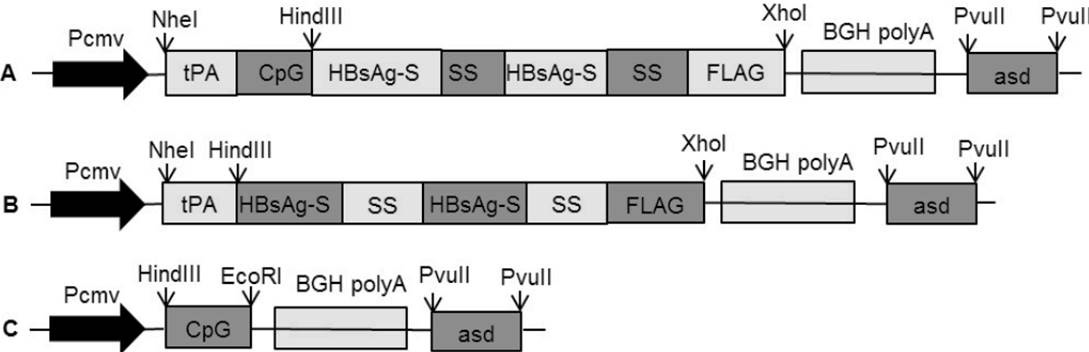
Map of construction of somatostatin (SS) DNA vaccine fused CpG motifs or simple co-injection with CpG: A, map of construction of SS DNA vaccine named ptCS/2SS-asd; B, map of construction of SS DNA vaccine named ptS/2SS-asd; C, map of construction of CpG plasmid adjuvant named pCpG-asd.
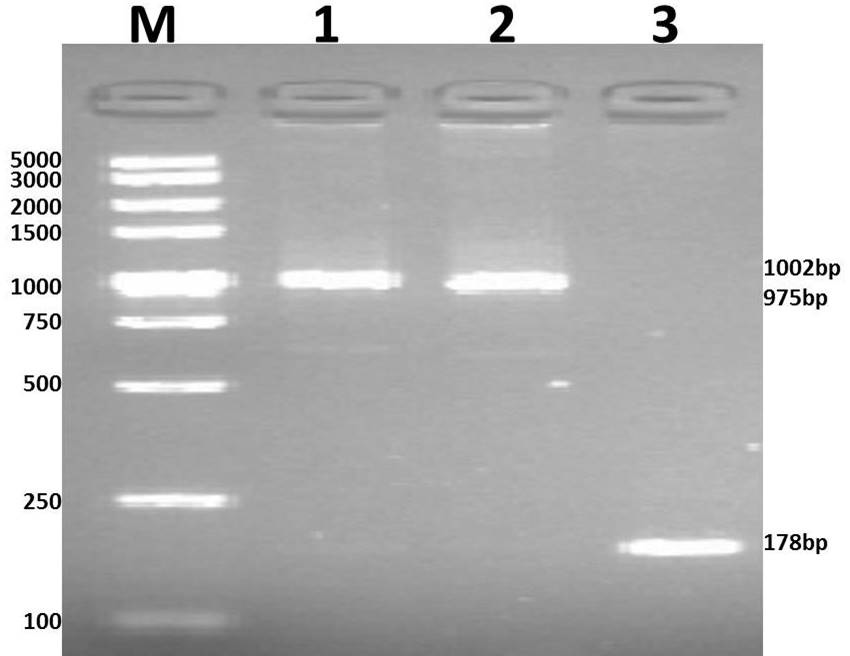
Identification of recombinant plasmids ptCS/2SS-asd, ptS/2SS-asd and pCpG-asd by PCR. Lanes 1, 2 and 3, ptCS/2SS-asd, ptS/2SS-asd and pCpG-asd recombinant plasmids were amplified with T7 and BGH primers; Lane M, DL5000 DNA marker. Three bands shown in Lanes 1, 2 and 3 are tPA-CpG-HBsAg-S-2SS-FLAG (1002 bp), tPA-HBsAg-S-2SS-FLAG (975 bp) and CpG (178 bp) fragment, respectively.
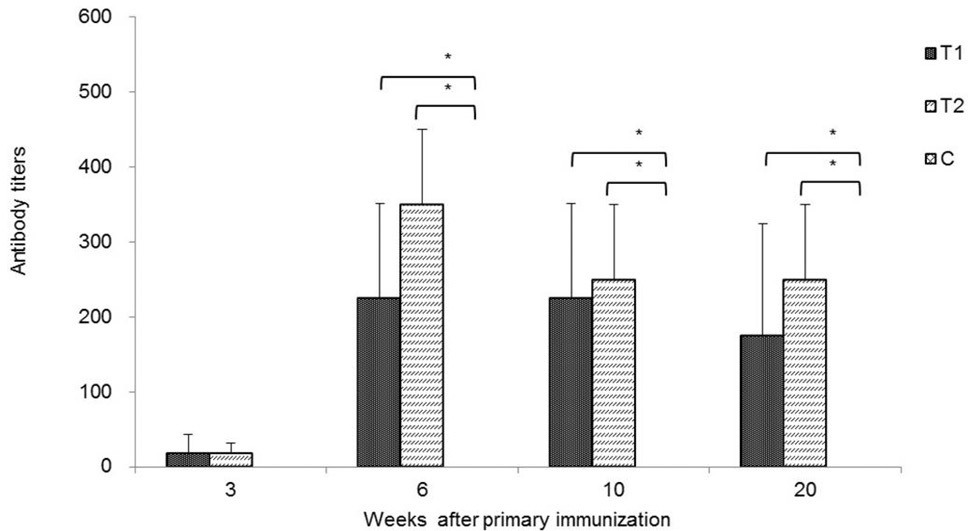
Anti-SS antibody titre in ram lambs. Lamb IgG antibody concentrations against SS were detected at weeks 3, 6, 10 and 20 after primary immunisation in treatment (Groups T1 and T2) and control (Group C) groups. Data are shown as means ± SD; *P < 0.05.
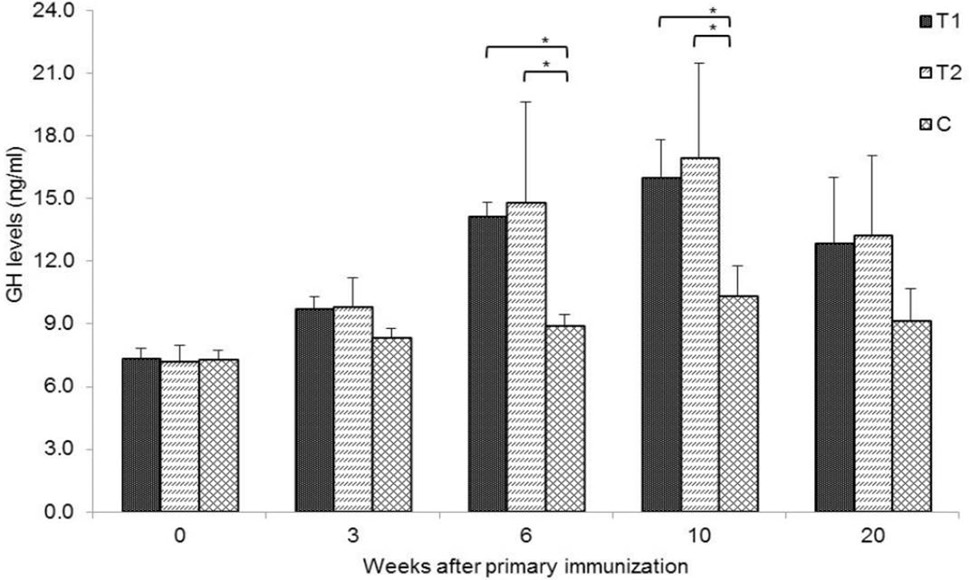
Serum GH concentrations (ng/mL) in Group T1, T2 and C immunised with ptCS/2SS-asd, ptS/2SS-asd + pCpG-asd and naked pVAX-asd, respectively, on weeks 0, 3, 6, 10 and 20 after primary immunisation. Data are shown as means ± SD. *P < 0.05.
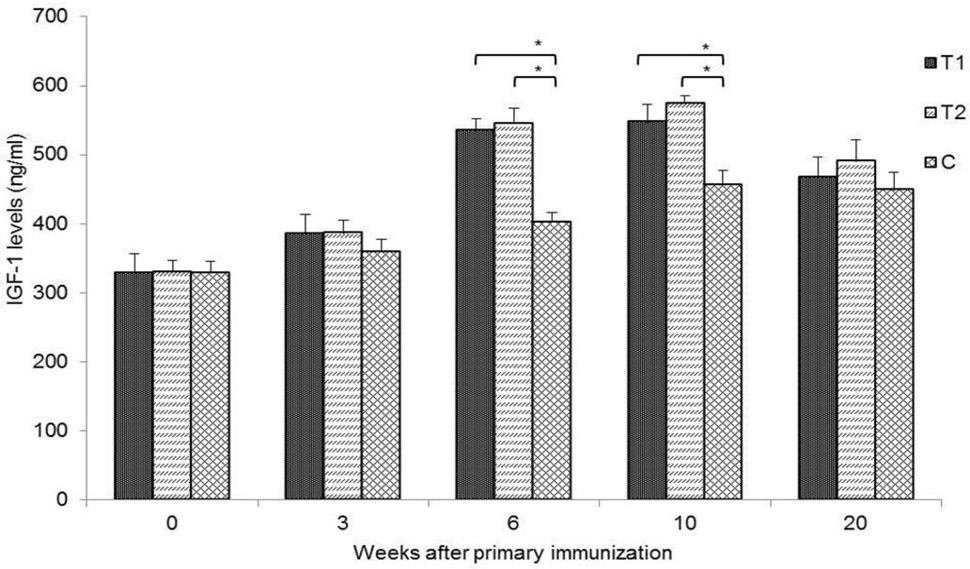
Serum IGF-1 concentrations (ng/mL) in Group T1, T2 and C immunised with ptCS/2SS-asd, ptS/2SS-asd + pCpG-asd and naked pVAX-asd, respectively, on weeks 0, 3, 6, 10 and 20 after primary immunisation. Data are shown as means ± SD; *P < 0.05.
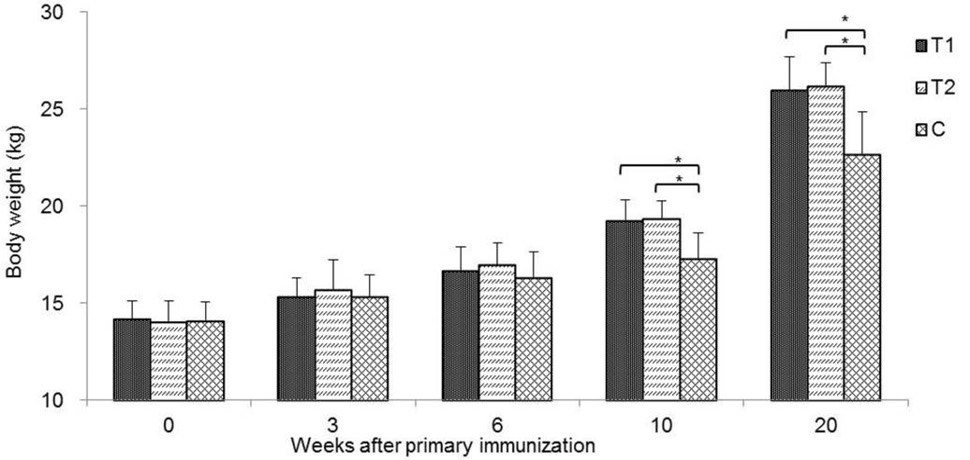
Average body weight (kg) in Group T1, T2 and C immunised with ptCS/2SS-asd, ptS/2SS-asd + pCpG-asd and naked pVAX-asd, respectively, on weeks 0, 3, 6, 10 and 20 after primary immunisation. Data are shown as means ± SD; *P < 0.05.
References
- Adams, J.M., Otero-Corchon, V., Hammond, G.L., Veldhuis, J.D., Qi, N. and Low, M.J., 2015. Somatostatin is essential for the sexual dimorphism of GH secretion, corticosteroid-binding globulin production, and corticosterone levels in mice. Endocrinology, 156: 1052-1065. https://doi.org/10.1210/en.2014-1429[CrossRef]
- Bins, A.D., van den Berg, J.H., Oosterhuis, K. and Haanen, J.B., 2013. Recent advances towards the clinical application of DNA vaccines. Neth. J. Med., 71: 109-117.
- Davis, H.L., Weeratna, R., Waldschmidt, T.J., Tygrett, L., Schorr, J. and Krieg, A.M., 1998. CpG DNA is a potent enhancer of specific immunity in mice immunized with recombinant hepatitis B surface antigen. J. Immunol., 160: 870-876.
- Davis, H.L., Suparto, I.I., Weeratna, R.R., Jumintarto., Iskandriati, D.D., Chamzah, S.S., Ma’ruf, A.A., Nente, C.C., Pawitri, D.D., Krieg, A.M., Heriyanto., Smits, W. and Sajuthi, D.D., 2000. CpG DNA overcomes hyporesponsiveness to hepatitis B vaccine in orangutans. Vaccine, 18: 1920- 1924. https://doi.org/10.1016/S0264-410X(99)00443-0[CrossRef]
- Dong, F., Luo, X., Yuan, D., Liang, A. and Yang, L., 2018. Construction and evaluation of novel plasmid DNA encoding somatostatin fused to a tissue plasminogen activator (tPA) in mice. Pakistan J. Zool., 50: 1875-1883.
- Farshadpour, F., Makvandi, M. and Taherkhani, R., 2015. Design, construction and cloning of truncated ORF2 and tPAsp-PADRE-truncated ORF2 gene cassette from hepatitis E virus in the pVAX1 expression vector. Jundishapur J. Microbiol., 8: e26035. https://doi.org/10.5812/jjm.26035[CrossRef]
- Ghochikyan, A., Davtyan, H., Petrushina, I., Hovakimyan, A., Movsesyan, N., Davtyan, A., Kiyatkin, A., Cribbs, D.H. and Agadjanyan, M.G., 2013. Refinement of a DNA based Alzheimer’s disease epitope vaccine in rabbits. Hum. Vaccine Immunother., 9: 1002-1010. https://doi.org/10.4161/hv.23875[CrossRef]
- Gonzalez, M.C., Kostrzak, A., Guetard, D., Pniewski, T. and Sala, M., 2009. HIV-1 derived peptides fused to HBsAg affect its immunogenicity. Virus Res., 146: 107-114. https://doi.org/10.1016/j.virusres.2009.09.007[CrossRef]
- Han, Y., Liang, A., Han, L., Guo, A., Jiang, X. and Yang, L., 2014. Efficacy and safety of an oral somatostatin DNA vaccine without antibiotic resistance gene in promoting growth of piglets. Scand. J. Immunol., 79: 244-250. https://doi.org/10.1111/sji.12155[CrossRef]
- Han, Y., Liu, G., Jiang, X., Ijaz, N., Tesema, B. and Xie, G., 2015. KISS1 can be used as a novel target for developing a DNA immunocastration vaccine in ram lambs. Vaccine, 33: 777-782. https://doi.org/10.1016/j.vaccine.2014.12.054[CrossRef]
- Han, Y.G., Ye, W.J., Liu, G.Q., Jiang, X.P., Ijaz, N., Zhao, J.Y. and Tesema, B., 2016. Hepatitis B surface antigen S gene is an effective carrier molecule for developing GnRH DNA immunocastration vaccine in mice. Reprod. Domest. Anim., 51: 445-450. https://doi.org/10.1111/rda.12692[CrossRef]
- Hartmann, G., Weeratna, R.D., Ballas, Z.K., Payette, P., Blackwell, S., Suparto, I., Rasmussen, W.L., Waldschmidt, M., Sajuthi, D., Purcell, R.H., Davis, H.L. and Krieg, A.M., 2000. Delineation of a CpG phosphorothioate oligodeoxynucleotide for activating primate immune responses in vitro and in vivo. J. Immunol., 164: 1617-1624. https://doi.org/10.4049/jimmunol.164.3.1617[CrossRef]
- He, Z., Xu, J., Tao, W., Fu, T., He, F., Hu, R., Jia, L. and Hong, Y., 2016. A recombinant plasmid containing CpG motifs as a novel vaccine adjuvant for immune protection against herpes simplex virus 2. Mol. Med. Rep., 14: 1823-1828. https://doi.org/10.3892/mmr.2016.5439[CrossRef]
- Klinman, D.M., Barnhart, K.M. and Conover, J., 1999. CpG motifs as immune adjuvants. Vaccine, 17: 19-25. https://doi.org/10.1016/S0264-410X(98)00151-0[CrossRef]
- Kotiw, M., Johnson, M., Pandey, M., Fry, S., Hazell, S.L., Netter, H.J., Good, M.F. and Olive, C., 2012. Immunological response to parenteral vaccination with recombinant hepatitis B virus surface antigen virus-like particles expressing Helicobacter pylori KatA epitopes in a murine H. pylori challenge model. Clin. Vaccine Immunol., 19: 268-276. https://doi.org/10.1128/CVI.05295-11[CrossRef]
- Li, J., Yu, J., Xu, S., Shi, J., Xu, S., Wu, X., Fu, F., Peng, Z., Zhang, L., Zheng, S., Yuan, X., Cong, X., Sun, W., Cheng, K., Du, Y., Wu, J. and Wang, J., 2016. Immunogenicity of porcine circovirus type 2 nucleic acid vaccine containing CpG motif for mice. Virol. J., 13: 185. https://doi.org/10.1186/s12985-016-0597-0[CrossRef]
- Liang, A.X., Han, L., Hua, G.H., Geng, L.Y., Sang, L., Liu, X.B., Guo, A.Z. and Yang, L.G., 2009. Construction of a fusion protein expression vector pGS/2SS-M4GFP without antibiotic resistance gene and its subcellular localization in different cell lines. Biologicals, 37: 37-43. https://doi.org/10.1016/j.biologicals.2008.09.002[CrossRef]
- Liang, A., Riaz, H., Dong, F., Luo, X., Yu, X., Han, Y., Chong, Z., Han, L., Guo, A. and Yang, L., 2014. Evaluation of efficacy, biodistribution and safety of antibiotic-free plasmid encoding somatostatin genes delivered by attenuated Salmonella enterica serovar Choleraesuis. Vaccine, 32: 1368-1374. https://doi.org/10.1016/j.vaccine.2014.01.026[CrossRef]
- Lipford, G.B., Bauer, M., Blank, C., Reiter, R., Wagner, H. and Heeg, K., 1997. CpG-containing synthetic oligonucleotides promote B and cytotoxic T cell responses to protein antigen: A new class of vaccine adjuvants. Eur. J. Immunol., 27: 2340-2344. https://doi.org/10.1002/eji.1830270931[CrossRef]
- Qiu, Z., Xing, L., Zhang, X., Qiang, X., Xu, Y., Zhang, M., Zhou, Z., Zhang, J., Zhang, F. and Wang, M., 2017. CpG oligodeoxynucleotides augment antitumor efficacy of folate receptor α based DNA vaccine. Oncol. Rep., 37: 3441-3448. https://doi.org/10.3892/or.2017.5633[CrossRef]
- Toussaint, J.F., Coen, L., Letellier, C., Dispas, M., Gillet, L., Vanderplasschen, A. and Kerkhofs, P., 2005. Genetic immunisation of cattle against bovine herpesvirus 1: Glycoprotein gD confers higher protection than glycoprotein gC or tegument protein VP8. Vet. Res., 36: 529-544. https://doi.org/10.1051/vetres:2005015[CrossRef]
- Wang, J.Y., Song, W.T., Li, Y., Chen, W.J., Yang, D., Zhong, G.C., Zhou, H.Z., Ren, C.Y., Yu, H.T. and Ling, H., 2011. Improved expression of secretory and trimeric proteins in mammalian cells via the introduction of a new trimer motif and a mutant of the tPA signal peptide. Appl. Microbiol. Biotechnol., 91: 731-740. https://doi.org/10.1007/s00253-011-3297-0[CrossRef]
- Woo, W.P., Doan, T., Herd, K.A., Netter, H.J. and Tindle, R.W., 2006. Hepatitis B surface antigen vector delivers protective cytotoxic T-lymphocyte responses to diseaserelevant foreign epitopes. J. Virol., 80: 3975-3984. https://doi.org/10.1128/JVI.80.8.3975-3984.2006[CrossRef]
- Xue, C.L., Liang, A.X., Mao, D.G., Han, L., Liu, X.B., Zhang, J. and Yang, L.G., 2010. Effect of genetic adjuvants on immune respondance, growth and hormone levels in somatostatin DNA vaccination-induced Hu lambs. Vaccine, 28: 1541-1546. https://doi.org/10.1016/j.vaccine.2009.11.058[CrossRef]
- Yang, S., Du, F. and Xu, P., 2017. Characterization, tissue-specific and developmental stage expression of somatostatin in Coilia nasus. Pakistan J. Zool., 49: 257-265.
- Zhang, F.H., Fang, F., Chang, H.Y., Peng, B., Wu, J., Chen, J.J., Wang, H.Z. and Chen, Z., 2013. Comparison of protectionagainst H5N1 influenza virus in mouse offspring provided by maternal vaccination with HA DNA and inactivated vaccine. Arch. Virol., 158: 1253-1265. https://doi.org/10.1007/s00705-013-1621-y[CrossRef]
- Zhao, Q., Wang, Y., Freed, D., Fu, T.M., Gimenez, J.A., Sitrin, R.D. and Washabaugh, M.W., 2006. Maturation of recombinant hepatitis B virus surface antigen particles. Hum. Vaccine, 2: 174-180. https://doi.org/10.4161/hv.2.4.3015[CrossRef]
Cited by 2 articles
In journals published by ResearchersLinks.
- Effects of Novel Oral and Plasmid-Injected KISS1 DNA Vaccines on Immunocastration and in Inhibiting Mutton Odour of Male GoatsPakistan Journal of Zoology · 2020
- Immunisation of Somatostatin DNA Vaccine in Ewes Can Affect Serum Somatostatin and Prolactin Levels in Offspring Lambs Through Maternal Related HormonesPakistan Journal of Zoology · 2020
Services
Article usage statistics
Loading…