
The study aimed at comparing the effect of oral somatostatin 14 (SS-14) and somatostatin 28 (SS-28)DNA vaccines in promoting lactation of rats. Fifteen female SD rats were randomly divided into three groups and were orally vaccinated, respectively SS-14 (Group T1) and SS-28 (Group T2) DNA vaccines fused tPA signal peptide and CpG adjuvant and delivered by attenuated Salmonella choleraesuis at weeks 0, 3 and 6 of the study, and rats in control group (Group C) was orally given empty vector vaccine. Blood samples were collected before primary immunization and at weeks 3, 5 and 7 after primary immunization and body weight of offspring were weighed at weeks 0, 2 and 4 after birth. Both SS-14 and SS-28 DNA vaccines induced humoral immune response, however, antibody response in T1 group were significantly stronger than that in T2 and C groups. Serum GH levels in T1 group was significantly higher than those in T2 and C groups, and serum PRL levels in T1 group was significantly higher than that in control group. Body weight of offsping rats in T1 group were significantly higher than that in control group at weeks 2 and 4 after birth, and body weight of offsping in T2 group were significantly higher than that in control group only at week 4. Oral SS-14 DNA vaccine fused tPA signal peptide and CpG adjuvant and delivered by attenuated Salmonella choleraesuis was more effective than that oral SS-28 DNA vaccine in promoting lactation of rats.
Research Article · Volume 51, Issue 5, 19 June 2019 · Open Access
Oral SS-14 DNA Vaccine is More Potent than Oral SS-28 DNA Vaccine in Promoting Rat Lactation
· · · · · ·
Affiliations & Notes ⌄
- 1Nanchang Police Dog Base of Ministry of Public Security, Nanchang 330100, China 2Chongqing Key Laboratory of Forage and Herbivore, Chongqing Engineering Research Centre for Herbivores Resource Protection and Utilization, College of Animal Science and Technology, Southwest University, Chongqing 400715, China , * Corresponding author: xuli7403112018@126.com
Article Info ⌄
- Journal:
- Pakistan Journal of Zoology
- Published:
- 19 June 2019

From the article
- The anti-SS antibody titers in oral SS-14 DNA vaccine group was significantly higher than that in oral SS-28 DNA vaccine group and control group.
- Meanwhile, the PRL concentration in the SS-14 DNA vaccine group was significantly higher than that in control group, however, there was no significant difference in PRL concentration between oral SS-28 DNA vaccine group and control group.
- Immunization of novel SS-14 DNA vaccine improved the weight of offspring rat during lactation more effectively than that SS-28 DNA vaccine.
- The oral SS-14 DNA vaccine fused tPA signal peptide and CpG adjuvant and and delivered by attenuated S. choleraesuis C500 can induce stronger humoral immune response and subsequently promote rat lactation more effectively than that oral SS-28 DNA vaccine.
Selected from the article's own text.
Abstract
Introduction
Immunoneutralization against hormones have been considered as an effective method in improving animal growth and reproductive performance ; ; . The active immunization against somatostatin (SS) has been proven to be very effective in improving animal growth performance ; . However, there have been only a few studies and controversy on the effect of active immunization against somatostatin on milk production. The active immunization against exogenous somatostatin can significantly increase milk production of mice or ewes by promoting the secretion of pituitary GH or PRL ; . However, there are also some studies showing that immunization against somatostatin does not significantly promote animals’ lactation ; .
In mammals, somatostatin is not species-specific and mainly contains two biologically active forms, SS-14 and SS-28 amino acids . SS-28 is an N-terminally extended form of SS-14 . In the peripheral blood, the SS-28, but not SS-14, is the main form of somatostatin and it has a slower metabolic rate compared to SS-14 ; . In addition, some studies showed that SS-28 has a significantly longer acting than that SS-14 in inhibiting spontaneous GH secretion , 1986). The principle of hormone immunoneutralization is that the antibody produced binds to endogenous hormone which results in that the endogenous hormone cannot bind to its receptor ; . In theory, when the amount of antibody is large enough, the immune effect produced by SS-28 vaccine should be greater than that of SS-14 vaccine, because that SS-28 is the main form and has slower metabolic rate in the peripheral blood. Some studies have showed that the immunization against SS-14 can improve animal lactation ; , however, there are very few studies on the immunization effect against SS-28 in enhancing animal lactation . Therefore, to further promote animal lactation performance, it is very necessary to compare the immunization effects of SS-14 and SS-28 on animal lactation.
Attenuated choleraesuis is an effective and low-cost tool for delivering SS DNA vaccines. In addition to being able to induce humoral and cellular immune responses, the DNA vaccine delivered by attenuated choleraesuis can also induce a long-lasting mucosal and systemic immune responses ; ; . In addition, the DNA vaccine delivered by attenuated choleraesuis do not require protein antigen extraction and synthesis which is more convenient and cost effective ; . The oral SS-14 DNA vaccine delivered by attenuated Salmonella typhimurium (CSO22) can significantly improve the lactation by enhancing the body weight of offspring mice at weeks 1 and 2 of lactation . However, the oral SS DNA vaccine contained a kanamycin antibiotic resistance gene which can cause the safety issue of antibiotic residue . In addition, the oral SS DNA vaccine by attenuated Salmonella typhimurium did not significantly enhance the weaning weight of offspring mice (week 3 of lactation) . Salmonella choleraesuis C500 with the asd and crp genes deleted has been widely used to construct non-antibiotic resistance DNA vaccines, in which the antibiotic resistance marker has been replaced by non-antibiotic resistance asd+ balanced-lethal host-vector system which contains a complementing asd+ expression plasmid ; ; . Therefore, to further improve safety and efficiency of oral SS DNA vaccine in enhancing lactation, a non-antibiotic resistance and more effective oral SS DNA vaccines should be developed and applied.
To the best of our knowledge, the non-antibiotic resistance oral SS-14 or SS-28 DNA vaccines has not been applied to improve animals’ lactation. Therefore, the study aims to compare the immunization effect of novel non-antibiotic resistance oral SS-14 and SS-28 DNA vaccines in enhancing lactation of female rats. The immunization effect of oral SS DNA vaccines against somatostatin 14 and 28 was evaluated by serum anti-somatostatin antibody, serum GH, PRL and IGF-1 levels, and offsping rats’ weight of different lactation period.
Materials and methods
Vaccine construction
The tPA (tissue plasminogen activator signal peptide)-CpG (three 6 hexameric CpG motifs, 5′- TCGTCGTTTTGTCGTTTTGTCGTT -3′)-HBsAg-S-2SS-14 (two copies of SS-14 gene inserted into the hepatitis B surface antigen S gene)-FLAG (a protein label), tPA-CpG-HBsAg-S-2SS-28 (two copies of SS-28 gene inserted into HBsAg-S gene)-FLAG fusion genes and single CpG were synthesized chemically (Sangon Biotechnology Co., Ltd, Shanghai, China). The three genes were inserted separately into pVAX-asd plasmid (asd gene coding for aspartate-b-semialdehyde dehydrogenase), and then these recombinant plasmids (pVAX-tPA-CpG-HBsAg-S-2SS-14-asd, pVAX-tPA-CpG-HBsAg-S-2SS-28-asd and pVAX-CpG-asd) were electroporated, respectively into the attenuated S. choleraesuis C500 with the asd and crp genes deleted. These novel recombinant oral SS-14 DNA vaccine C500 (ptCS/2SS-14-asd) and SS-28 DNA vaccine C500 (ptCS/2SS-28-asd) (Fig. 1) were identified by PCR and sequencing.
Animals
Fifteen specific-pathogen-free (SPF) female SD rats aged seven weeks were purchased from Chongqing Academy of Chinese Materia Medica (Chongqing, China) and raised in the Southwest University Experimental Animals House (Chongqing, China) based on the guidelines of the Committee on the Care and Use of Laboratory Animals of China. One week after caging, these female rats were randomly divided into SS-14 (Group T1), SS-28 (Group T2) DNA vaccine groups and control group (Group C) for immunization and mating.
Immunization and sampling
All rats were orally pretreated with 1 mL sodium bicarbonate solution (7.5%) for 30 min before immunization, and then they were separately given orally with SS-14, SS-28 DNA vaccines and empty vector vaccine at a dose of 5 × 10⁹ CFU dissolved in 1 mL of sterile PBS. Subsequently, these rats were mated individually with adult male SD rats for one week. The immunization were boosted for twice at weeks 3 and 6 after primary immunization. Serum samples were obtained from eye socket before primary immunization (before mating) and at weeks 3 (first day after childbirth), 5 (week 2 after childbirth) and 7 (week 4 after childbirth) after primary immunization by centrifugation at 1157 × g for 10 min and stored at -20 °C for further use.
Detection of anti-SS antibodies
Specific anti-somatostatin antibodies were tested by an indirect enzyme-linked immunosorbent assay (ELISA) method . In brief, 96-well ELISA plates were coated with 100 ng/well of SS-14 or SS-28 antigen diluted in a bicarbonate buffer (pH 9.6) at 4°C for overnight. After washing three times with PBST (0.05% Tween-20 in a phosphate buffer saline),
these samples were blocked with 1% bovine serum albumin dissolved PBST at 37 °C for 1 h. Serum samples of tested rat were serially 2-fold diluted in PBST from 1:25 up to 1:3200, and then each well were added to 100 μl for incubating at 37 °C for 1 h. Negative control serum sample from preimmune rats were used. Specific SS bound antibodies were tested by adding horseradish peroxidase-labelled rabbit anti-rat IgG secondary antibodies (Abbkine, Inc., Redlands, CA, USA) diluted in PBST (1:5000) and incubated subsequently at 37 °C for 1 h. Tetramethylbenzidine substrate was used for the enzyme reaction by incubating the samples at 37 °C for 25 min. 2 MH2SO4 was applied to stop the reaction and the absorbance was detected at 450 nm by the Bio-Rad iMark Microplate Absorbance Reader (Bio-Rad, Hercules, CA, USA). End-point titers of these samples were determined as reciprocal of the highest serum dilution in which the absorbance was greater than the mean plus two standard deviations of negative control samples at the same dilution , 1986).
Detection of serum hormone levels
Serum GH, PRL and IGF-1 concentrations in rats were detected by radioimmunoassay (Beijing Sino-UK Institute of Biological Technology, Beijing, China). The intra-assay and inter-assay coefficients of variation were less than or equal to 15%, respectively.
Detection of lactation
One day after primary immunization, adult male rats were put into individually the cage to mate with the vaccinated female rats. Following parturition, the number of offspring rats of per litter was reduced to eight (four females and four males), and weaned after 4 week. Body weight of offspring rats from SS-14, SS-28 DNA vaccine groups and control group was measured at weeks 0 (first day after childbirth), 2 and 4 after birth to compare lactation performance.
Statistical analysis
The differences between groups in terms of anti-SS antibody titers, serum GH, PRL and IGF-1 levels, and body weight of offspring rats were analyzed by one-way ANOVA and Duncan’s test of SAS 8.1 analytical software (SAS Institute, Inc., Cary, NC, USA). p < 0.05 was considered as statistically significant and all the data was expressed as mean ± SD.
Results
Vaccine designing and identification
Oral SS DNA vaccines encoding polypeptides of different lengths somatostatin was engineered which contained two copies of SS-14 or SS-28 gene, tPA signal peptide and CpG motifs (Fig. 1). The recombinant SS-14 and SS-28 DNA vaccines were identified by PCR (Fig. 2) and sequence analysis (data not shown). There was a 1086 bp amplified band in the electrophorogram after amplifying the SS-28 DNA vaccine (Lane 1, Fig. 2), and there was a 1002 bp amplified band after amplifying the SS-14 DNA vaccine (Lane 2, Fig. 2), suggesting that the recombinant oral SS-14 and SS-28 DNA vaccines was successfully developed.
Anti-SS antibody response
SS-specific antibody titers in both SS-14 and SS-28 DNA vaccine groups were significantly higher than that in control group at weeks 3 and 7 after primary immunization (Fig. 3, p < 0.05). However, SS-specific antibody titers in SS-14 DNA vaccine group were significantly higher than that in SS-28 DNA vaccine group at week 7 after primary immunization (Fig. 3, p < 0.05).
Serum GH, PRL and IGF-1 levels
Serum GH concentrations in SS-14 DNA vaccine group were significantly higher than that in SS-28 DNA vaccine group and control group at weeks 5 and 7 after primary immunization (Fig. 4A, p < 0.05). However, no significant difference was observed on serum GH concentrations between SS-28 DNA vaccine group and control group at weeks 0, 5 and 7 after the primary immunization (Fig. 4A, p > 0.05).
Serum PRL concentrations in SS-14 DNA vaccine group were significantly higher than that in control group at week 5 after primary immunization (Fig. 4B, p < 0.05). However, there was no significant difference on serum PRL concentrations between SS-28 DNA vaccine group and control group at weeks 0, 5 and 7 after the primary immunization (Fig. 4B, p > 0.05).
There was no significant difference on serum IGF-1 concentrations between SS-14 DNA vaccine group and SS-28 DNA vaccine group or control group at weeks 0, 5 and 7 after the primary immunization (Fig. 4C, p > 0.05). In addition, there was also no significant difference on serum IGF-1 concentrations between SS-28 DNA vaccine group and control group at weeks 0, 5 and 7 after the primary immunization (Fig. 4C, p > 0.05).
Effect of immunization on lactation
There were no significant difference on birth weight of offspring rats among groups at first day after childbirth. Body weight of offspring in SS-14 DNA vaccine group was significantly higher than that in control group at weeks 2 and 4 after childbirth, and was significantly higher than that in SS-28 DNA vaccine group at week 2 after childbirth (Fig. 5, p < 0.05). However, body weight of offspring rats in SS-28 DNA vaccine group was significantly higher than that in control group only at week 4 after childbirth (Fig. 5, p < 0.05).
Discussion
Long-term active immunoneutralization of somatostatin is a potential method of improving animal lactation performance. GH/IGF-I axis and PRL play a vital role in the development of the mammary gland and animal lactation and they are mainly regulated by GH-releasing hormone and somatostatin ; ; . Somatostatin exerts an inhibitory effect on the secretion of pituitary GH and PRL and consequently animal lactation ; . Somatostatin is mainly consisted of two biologically active components somatostatin-14 and somatostatin-28 . Although somatostatin-14 DNA vaccine delivered by attenuated Salmonella typhimurium improved the mice lactation performance, the oral somatostatin DNA vaccine used a kanamycin antibiotic resistance gene as a selection marker which can cause the safety issue of antibiotic residue , and the humoral response induced by the oral somatostatin DNA vaccine is still weak . Somatostatin-28 has a significantly longer acting than that somatostatin-14 in inhibiting spontaneous GH secretion , 1986), however, there are very few studies on the lactation-promoting effect against SS-28 DNA vaccine. tPA signal peptide and CpG adjuvant and can effectively improve the DNA vaccines’ immunogenicity ; , however, they have not been widely used in the construction of oral somatostatin DNA vaccines. Therefore, to improve the safety and efficacy of somatostatin DNA vaccine in enhancing animal lactation, we developed the novel non-antibiotic resistance SS-14 and SS-28 DNA vaccines fused tPA signal peptide and CpG adjuvant and and delivered by attenuated S. choleraesuis C500 deleted the asd and crp genes.
In this study, the novel oral SS-14 DNA vaccine delivered by attenuated S. choleraesuis C500 induced stronger humoral immune response and subsequently more effective stimulation of GH and PRL secretion than that oral SS-28 DNA vaccine. Both the anti-SS antibody titers in the oral SS-14 and SS-28 DNA vaccines was significantly higher than that in control group. In the study of lactation promotion, previous studies showed that immunization of only SS-14 vaccine can induce humoral immune response in lactation studies ; . However, our results indicated that the immunization of both oral SS-14 DNA vaccine and SS-28 DNA vaccine can induce a strong humoral immune response. The anti-SS antibody titers in oral SS-14 DNA vaccine group was significantly higher than that in oral SS-28 DNA vaccine group and control group. The result indicated that oral SS-14 DNA vaccine induced stronger humoral immune response than oral SS-28 DNA vaccine. The antibody titer in oral SS-14 and SS-28 DNA vaccines delivered by attenuated S. choleraesuis C500 was significantly higher than that in control group from day after childbirth to week 4 after childbirth, however, Bai et al. (2011) study showed that the antibody titer in oral SS-14 DNA vaccine delivered by attenuated Salmonella typhimurium significantly higher than that in control group only from week 2 after the booster immunization to the day after childbirth, and there was no significant difference in antibody titer between oral SS-14 DNA vaccine group and control group at week 3 after childbirth. The result indicated that novle oral SS-14 and SS-28 DNA vaccines fused tPA signal peptide and CpG adjuvant and delivered by attenuated S. choleraesuis C500 can induced stronger immune response than that oral SS-14 DNA vaccine delivered by attenuated Salmonella typhimurium. At weeks 5 and 7 after primary immunization, the GH concentration in the SS-14 DNA vaccine group was significantly higher than that in the SS-28 DNA vaccine group and control group, however, there was no significant difference in GH concentration between oral SS-28 DNA vaccine group and control group. Meanwhile, the PRL concentration in the SS-14 DNA vaccine group was significantly higher than that in control group, however, there was no significant difference in PRL concentration between oral SS-28 DNA vaccine group and control group. Previous studies also showed that immunization of SS-14 DNA vaccine can stimulate the secretion of GH and PRL by the immunoneutralization of anti-SS antibody induced ; ; . These results indicated that immunization of the novel oral SS-14 DNA vaccine may stimulate the secretion of GH and PRL more effectively than that novel oral SS-28 DNA vaccine. Interestingly, there was no significant difference in IGF-1 concentration between oral SS-14 DNA vaccine and control group or between oral SS-28 DNA vaccine and control group, which may be because that the GH levels produced was not high enough or the shoter half-life of plasma IGF-1 ; . However, lower GH levels still can promote the mammary development and lactation by the binding to the GH receptor or PRL receptor ; .
Immunization of novel SS-14 DNA vaccine improved the weight of offspring rat during lactation more effectively than that SS-28 DNA vaccine. The body weight of offspring in SS-14 DNA vaccine was significantly higher than that in SS-28 DNA vaccine group and control group at week 2 after childbirth which was in middle stage of lactation, and the body weight of offspring in SS-14 DNA vaccine was still significantly higher than that in control group at week 4 after childbirth which was at weaning (late stage of lactation). Bai et al. (2011) study showed that oral SS-14 DNA vaccine delivered by attenuated Salmonella typhimurium can significantly improve the weight of offspring mice in the middle stage of lactation, however, our studies showed that oral SS-14 DNA vaccine can significantly improve the weight of offspring rats in the middle and late stage of lactation, which indicated that oral SS-14 DNA vaccine fused tPA signal peptide and CpG adjuvant and delivered by attenuated S. choleraesuis C500 can promote animal lactation more permanently than that oral SS-14 DNA vaccine delivered by attenuated Salmonella typhimurium. Interestingly, the body weight of offspring rats in SS-28 DNA vaccine group was significantly higher than that in control group at weaning, however, there was no significant difference in the GH and PRL levels between the SS-28 DNA vaccine group and control group. In the late stage of lactation, the offspring need to maintain the growth through diet and lactation . Therefore, the significant difference of the body weight of offspring rats between SS-28 DNA vaccine group and control group may be due to the differences of individual feeding and nutrition of the offspring rats at weaning. These results indicated the oral SS-14 DNA vaccine fused tPA signal peptide and CpG adjuvant and delivered by attenuated S. choleraesuis C500 was more effective than that SS-28 DNA vaccine in promoting lactation of rats.
Conclusion
The oral SS-14 DNA vaccine fused tPA signal peptide and CpG adjuvant and and delivered by attenuated S. choleraesuis C500 can induce stronger humoral immune response and subsequently promote rat lactation more effectively than that oral SS-28 DNA vaccine. Further studies should be conducted to study the effect molecular mechanism and of oral SS DNA vaccine on milk composition.
Acknowledgement
This work was financially supported by the National Key Research and Development Plan of China (2016YFD0501008, 2018YFD0502003), the Chongqing Research Program of basic research and frontier technology (CSTC2015JCYJBX0002) and the Fundamental Research Funds for the Central Universities of China (XDJK2018C026).
Statement of conflict of interest
The authors declare no conflict of interest.
Figures
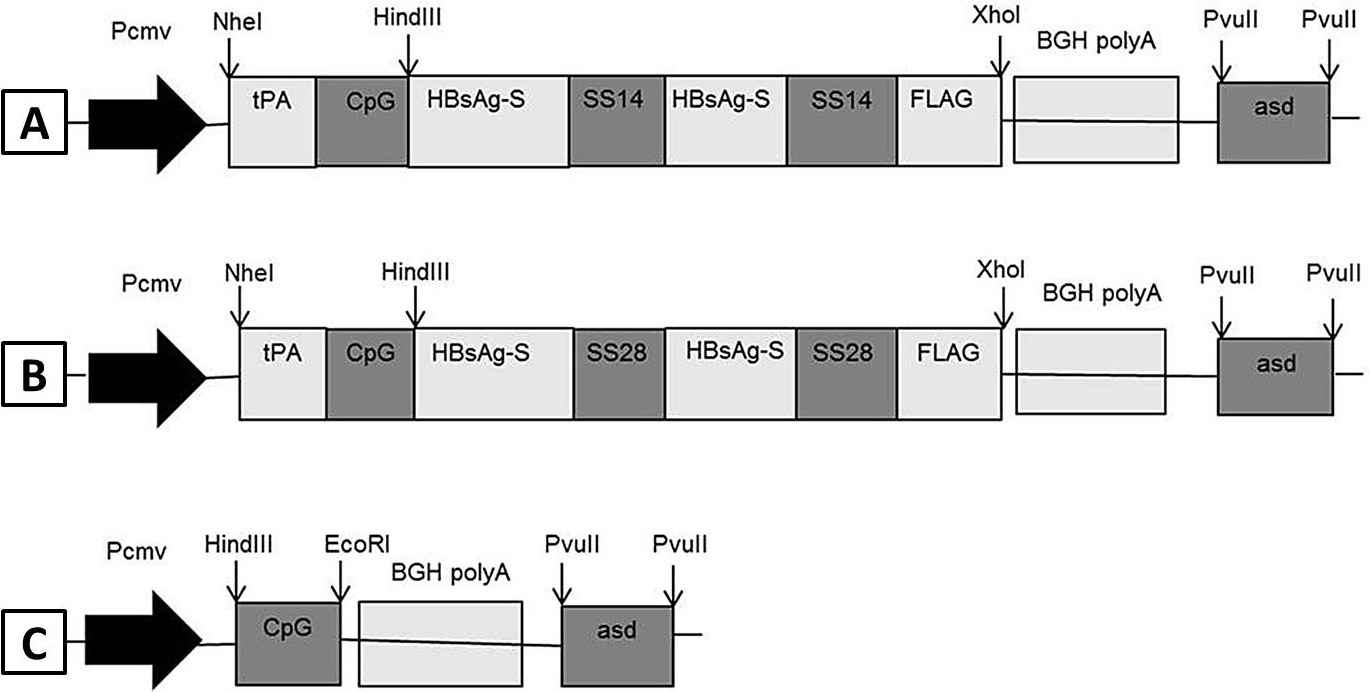
Map of construction of oral somatostatin (SS) DNA vaccines encoding different lengths somatostatin and delivered by attenuated Salmonella choleraesuis C500. A, Map of construction of oral SS-14 DNA vaccine fused tPA signal peptide and CpG adjuvant named C500 (ptCS/2SS-14-asd); B, Map of construction of oral SS-28 DNA vaccine fused tPA signal peptide and CpG adjuvant named C500 (ptCS/2SS-28-asd); C, Map of construction of oral empty vector vaccine fused CpG adjuvant named C500 (pCpG-asd).
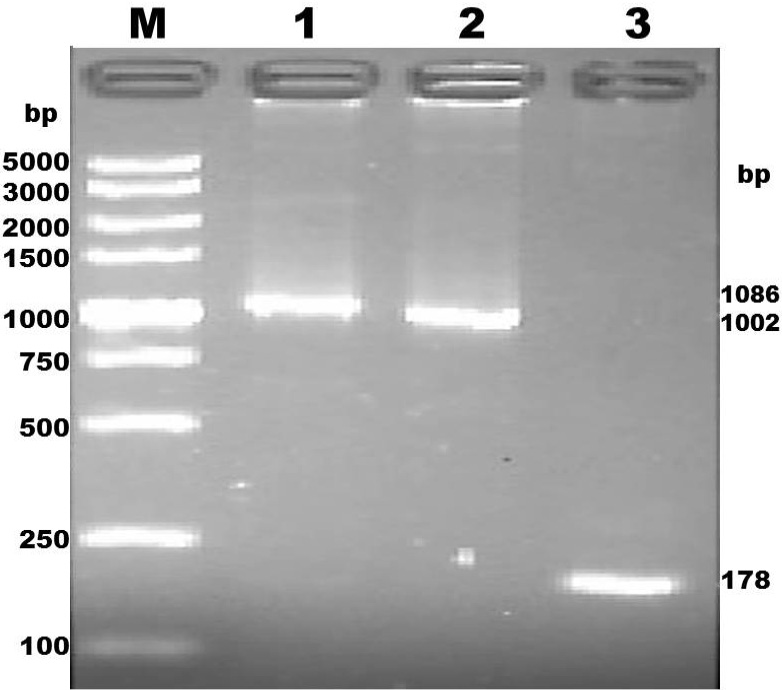
Identification of recombinant SS DNA vaccines encoding different lengths somatostatin and empty vector vaccine by PCR. Lanes 1, 2 and 3, C500 (ptCS/2SS-28-asd), C500 (ptCS/2SS-14-asd) and C500 (pCpG-asd) recombinant DNA vaccines were amplified with T7 and BGH primers; Lane M, DL5000 DNA marker. Three bands shown in Lanes 1, 2 and 3 are tPA-CpG-HBsAg-S-2SS-28-FLAG (1086 bp), tPA-HBsAg-S-2SS-14-FLAG (1002 bp) and CpG (178 bp) fragment, respectively.
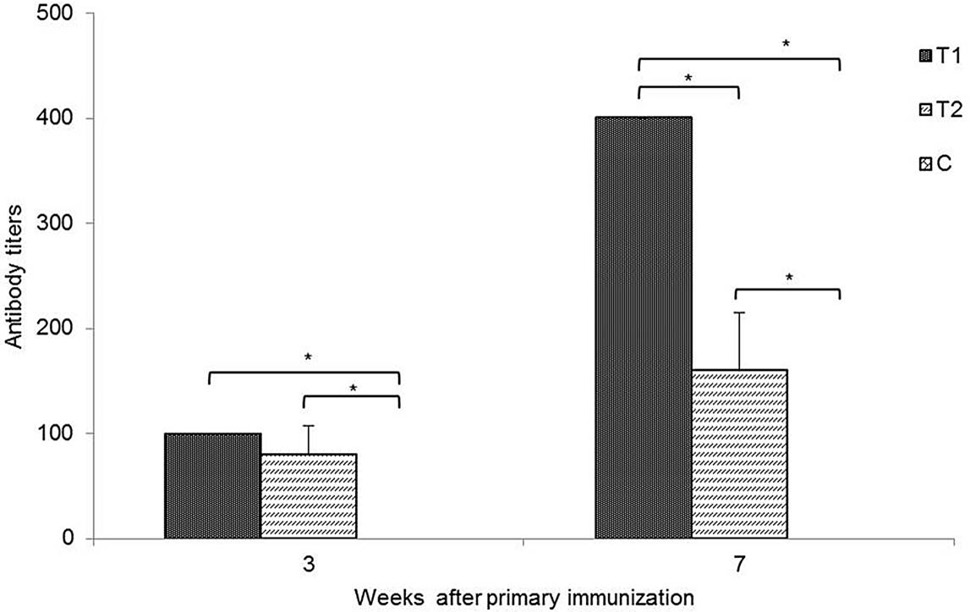
Anti-SS antibodies titers in T1, T2 and C groups immunized with C500 (ptCS/2SS-14-asd), C500 (ptCS/2SS-28-asd) and C500 (pCpG-asd), respectively at weeks 3 (first day after childbirth) and 7 (week 4 after childbirth) after primary immunization. Vaccinations were respectively orally given at weeks 0, 3 and 6 weeks after primary immunization. Data are presented as means ± SD. *p < 0.05.
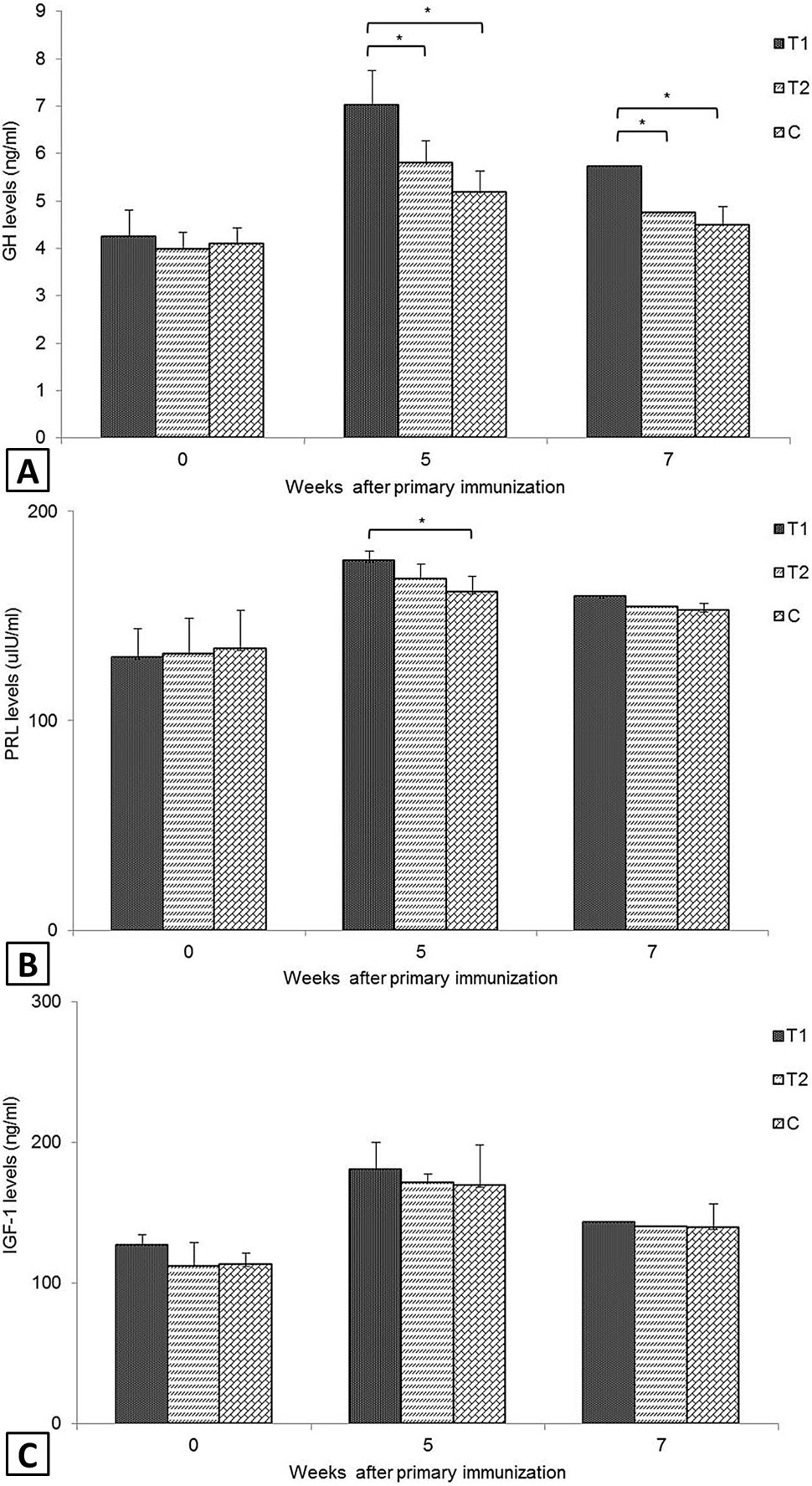
Serum GH (A), PRL (B) and IGF-1 (C) concentrations (ng/mL, uIU/mL and ng/mL, respectively) in T1, T2 and C groups immunized with C500 (ptCS/2SS-14-asd), C500 (ptCS/2SS-28-asd) and C500 (pCpG-asd), respectively at weeks 0 (before mating), 5 (week 2 after childbirth) and 7 (week 4 after childbirth) after primary immunization. Data are presented as means ± SD. *p<0.05.
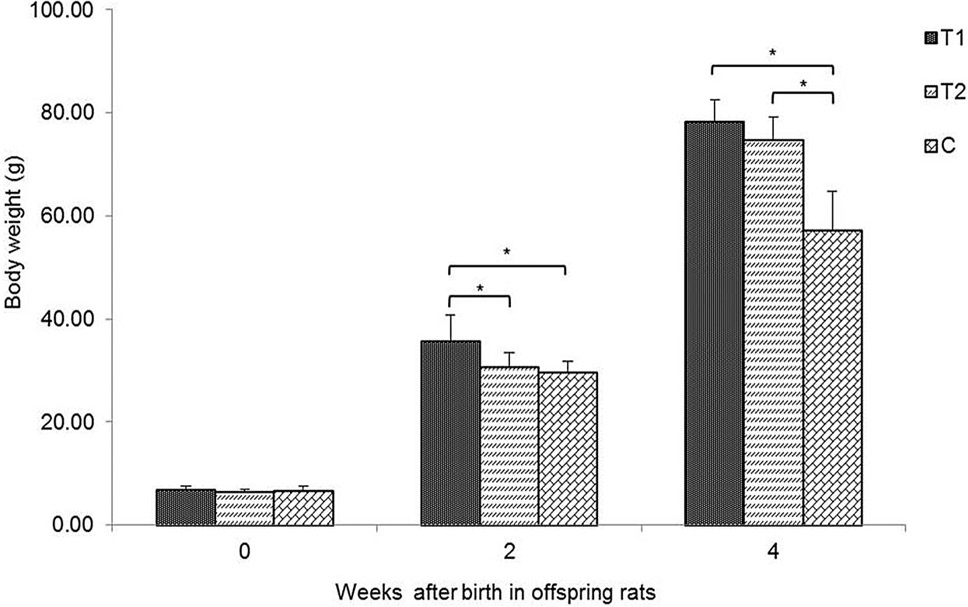
Body weight (g) of offspring rats in T1, T2 and C groups at weeks 0 (first day after childbirth), 2 (week 2 after childbirth) and 4 (week 4 after childbirth) after birth. Data are presented as means ± SD. *p < 0.05.
References
- Bai, L.Y., Liang, A.X., Zhang, J., Yang, F.F., Han, L., Huo, L.J. and Yang, L.G., 2011. Effects of immunization against a DNA vaccine encoding somatostatin gene (pGM-CSF/SS) by attenuated Salmonella typhimurium on growth, reproduction and lactation in female mice. Theriogenology, 75: 155-163. https://doi.org/10.1016/j.theriogenology.2010.08.001[CrossRef]
- Carro, E., Nunez, A., Busiguina, S. and Torres-Aleman, I., 2000. Circulating insulin-like growth factor I mediates effects of exercise on the brain. J. Neurosci., 20: 2926-2933. https://doi.org/10.1523/JNEUROSCI.20-08-02926.2000[CrossRef]
- Chen, W.Z., Li, Y.M., Yu, X., Li, Y., Li, W.K., Wang, Q.L., Liang, A.X., Li, X., Yang, L.G., Han, L., 2018. The efficacy, biodistribution and safety of an inhibin DNA vaccine delivered by attenuated Salmonella choleraesuis. Microb. Biotechnol., 11: 248-256. https://doi.org/10.1111/1751-7915.13029[CrossRef]
- Daneshvar, D., Khorvash, M., Ghasemi, E., Mahdavi, A.H., Moshiri, B., Mirzaei, M., Pezeshki, A. and Ghaffari, M.H., 2015. The effect of restricted milk feeding through conventional or step-down methods with or without forage provision in starter feed on performance of Holstein bull calves. J. Anim. Sci., 93: 3979-3989. https://doi.org/10.2527/jas.2014-8863[CrossRef]
- Dan, X., Han, L., Riaz, H., Luo, X., Liu, X., Chong, Z. and Yang, L., 2016. Construction and evaluation of the novel DNA vaccine harboring the inhibin α (1-32) and the RF-amide related peptide-3 genes for improving fertility in mice. Exp. Anim., 65: 17-25. https://doi.org/10.1538/expanim.15-0044[CrossRef]
- Dan, X., Liu, X., Han, Y., Liu, Q. and Yang, L., 2016. Effect of the novel DNA vaccine fusing inhibin α (1-32) and the RF-amide related peptide-3 genes on immune response, hormone levels and fertility in Tan sheep. Anim. Reprod. Sci., 164: 105-110. https://doi.org/10.1016/j.anireprosci.2015.11.018[CrossRef]
- Ding, Y., Fan, J., Li, W., Peng, Y., Yang, R., Deng, L. and Fu, Q., 2014. The effect of albumin fusion structure on the production and bioactivity of the somatostatin-28 fusion protein in Pichia pastoris. J. Ind. Microbiol. Biotechnol., 41: 997-1006. https://doi.org/10.1007/s10295-014-1440-5[CrossRef]
- García-Tornadú, I., Rubinstein, M., Gaylinn, B.D., Hill, D., Arany, E., Low, M.J., Díaz-Torga, G. and Becu-Villalobos, D., 2006. GH in the dwarf dopaminergic D2 receptor knockout mouse: Somatotrope population, GH release, and responsiveness to GH-releasing factors and somatostatin. J. Endocrinol., 190: 611-619. https://doi.org/10.1677/joe.1.06902[CrossRef]
- Guler, H.P., Zapf, J., Schmid, C. and Froesch, E.R., 1989. Insulin-like growth factors I and II in healthy man. Estimations of half-lives and production rates. Acta Endocrinol., 121: 753-758. https://doi.org/10.1530/acta.0.1210753[CrossRef]
- Han, L., Liang, A., Zhang, J., Fang, M., Hua, G.H., Sang, L., Geng, L.Y., Wang, H.R. and Yang, L.G., 2008. Evaluation of the VP22 gene adjuvant for enhancement of DNA vaccine against somatostatin in mice. Animal, 2: 1569-1574. https://doi.org/10.1017/S175173110800284X[CrossRef]
- Han, L., Zhen, Y.H., Liang, A.X., Zhang, J., Riaz, H., Xiong, J.J., Guo, A.Z. and Yang, L.G., 2014. Oral vaccination with inhibin DNA delivered using attenuated Salmonella choleraesuis for improving reproductive traits in mice. J. Basic Microbiol., 54: 962-968. https://doi.org/10.1002/jobm.201300052[CrossRef]
- Han, Y., Liu, Q., Yi, J., Liang, K., Wei, Y. and Kong, Q., 2017. A biologically conjugated polysaccharide vaccine delivered by attenuated Salmonella Typhimurium provides protection against challenge of avian pathogenic Escherichia coli O1 infection. Pathog. Dis., 75: 1-11. https://doi.org/10.1093/femspd/ftx102[CrossRef]
- Hugues, J.N., Enjalbert, A., Moyse, E., Shu, C., Voirol, M.J., Sebaoun, J. and Epelbaum, J., 1986. Differential effects of passive immunization with somatostatin antiserum on adenohypophysial hormone secretions in starved rats. J. Endocrinol., 109: 169-174. https://doi.org/10.1677/joe.0.1090169[CrossRef]
- Kim, J.Y., Cho, K.K., Chung, M.I., Kim, J.D., Woo, J.H., Yun, C.H. and Choi, Y.J., 2002. Effects of active immunization against somatostatin or its analogues on milk protein synthesis of rat mammary gland cells. Asian-Australas. J. Anim. Sci., 15: 570-575. https://doi.org/10.5713/ajas.2002.570[CrossRef]
- Lei, M., Cai, L., Li, H., Chen, Z. and Shi, Z., 2017. Transcriptome sequencing analysis of porcine granulosa cells treated with an anti-inhibin antibody. Reprod. Biol., 17: 79-88. https://doi.org/10.1016/j.repbio.2017.01.002[CrossRef]
- Lékó, A.H., Cservenák, M. and Dobolyi, Á., 2017. Suckling induced insulin-like growth factor-1 (IGF-1) release in mother rats. Growth Horm. IGF Res., 37: 7-12. https://doi.org/10.1016/j.ghir.2017.10.003[CrossRef]
- Li, J., Yu, J., Xu, S., Shi, J., Xu, S., Wu, X., Fu, F., Peng, Z., Zhang, L., Zheng, S., Yuan, X., Cong, X., Sun, W., Cheng, K., Du, Y., Wu, J. and Wang, J., 2016. Immunogenicity of porcine circovirus type 2 nucleic acid vaccine containing CpG motif for mice. Virol. J., 13: 185. https://doi.org/10.1186/s12985-016-0597-0[CrossRef]
- Luque, R.M., Cordoba-Chacon, J., Pozo-Salas, A.I., Porteiro, B., de Lecea, L., Nogueiras, R., Gahete, M.D. and Castaño, J.P., 2016. Obesity- and gender-dependent role of endogenous somatostatin and cortistatin in the regulation of endocrine and metabolic homeostasis in mice. Scient. Rep., 6: 37992. https://doi.org/10.1038/srep37992[CrossRef]
- Liang, A., Riaz, H., Dong, F., Luo, X., Yu, X., Han, Y., Chong, Z., Han, L., Guo, A. and Yang, L., 2014. Evaluation of efficacy, biodistribution and safety of antibiotic-free plasmid encoding somatostatin genes delivered by attenuated Salmonella enterica serovar Choleraesuis. Vaccine, 32: 1368-1374. https://doi.org/10.1016/j.vaccine.2014.01.026[CrossRef]
- Lin, I.Y., Van, T.T. and Smooker, P.M., 2015. Live-attenuated bacterial vectors: Tools for vaccine and therapeutic agent delivery. Vaccines, 3: 940-972. https://doi.org/10.3390/vaccines3040940[CrossRef]
- Liu, Q., Han, L., Rehman, Z.U., Dan, X., Liu, X., Bhattarai, D. and Yang, L., 2016. The efficacy of an inhibin DNA vaccine delivered by attenuated Salmonella choleraesuis on follicular development and ovulation responses in crossbred buffaloes. Anim. Reprod. Sci., 172: 76-82. https://doi.org/10.1016/j.anireprosci.2016.07.004[CrossRef]
- Liu, X., Liu, Q., Xiao, K., Li, P., Liu, Q., Zhao, X. and Kong, Q., 2016. Attenuated Salmonella Typhimurium delivery of a novel DNA vaccine induces immune responses and provides protection against duck enteritis virus. Vet. Microbiol., 186: 189-198. https://doi.org/10.1016/j.vetmic.2016.03.001[CrossRef]
- Ng, S.T., Zhou, J., Adesanya, O.O., Wang, J., LeRoith, D. and Bondy, C.A., 1997. Growth hormone treatment induces mammary gland hyperplasia in aging primates. Nat. Med., 3: 1141-1144. https://doi.org/10.1038/nm1097-1141[CrossRef]
- Patel, Y.C. and Wheatley, T., 1973. A new technique for the assay of infectivity of human adenovirus 5 DNA. Virology, 52: 456-467. https://doi.org/10.1016/0042-6822(73)90341-3[CrossRef]
- Pradayrol, L., Jörnvall, H., Mutt, V. and Ribet, A., 1980. N-terminally extended somatostatin: The primary structure of somatostatin-28. FEBS Lett., 109: 55-58. https://doi.org/10.1016/0014-5793(80)81310-X[CrossRef]
- Tannenbaum, G.S., Ling, N. and Brazeau, P., 1982. Somatostatin-28 is longer acting and more selective than somatostatin-14 on pituitary and pancreatic hormone release. Endocrinology, 111: 101-107. https://doi.org/10.1210/endo-111-1-101[CrossRef]
- Tannenbaum, G.S. and Patel, Y.C., 1986. On the fate of centrally administered somatostatin in the rat: Massive hypersomatostatinemia resulting from leakage into the peripheral circulation has effects on growth hormone secretion and glucoregulation. Endocrinology, 118: 2137-2143. https://doi.org/10.1210/endo-118-5-2137[CrossRef]
- Toussaint, B., Chauchet, X., Wang, Y., Polack, B. and Le Gouëllec, A., 2013. Live-attenuated bacteria as a cancer vaccine vector. Exp. Rev. Vaccines, 12: 1139-1154. https://doi.org/10.1586/14760584.2013.836914[CrossRef]
- Vale, W., Rivier, C., Brazeau, P. and Guillemin, R., 1974. Effects of somatostatin on the secretion of thyrotropin and prolactin. Endocrinology, 95: 968-977. https://doi.org/10.1210/endo-95-4-968[CrossRef]
- Van Kessel, A.G., Korchinski, R.S., Hampton, C.H. and Laarveld, B., 1990. Effect of immunization against somatostatin in the pregnant ewe on growth and endocrine status of the neonatal lamb. Domest. Anim. Endocrinol., 7: 217-227. https://doi.org/10.1016/0739-7240(90)90028-X[CrossRef]
- Villa-Osaba, A., Gahete, M.D., Cordoba-Chacon, J., de Lecea, L., Castaño, J.P. and Luque, R.M., 2016. Fasting modulates GH/IGF-I axis and its regulatory systems in the mammary gland of female mice: Influence of endogenous cortistatin. Mol. Cell. Endocrinol., 434: 14-24. https://doi.org/10.1016/j.mce.2016.06.014[CrossRef]
- Wang, J.Y., Song, W.T., Li, Y., Chen, W.J., Yang, D., Zhong, G.C., Zhou, H.Z., Ren, C.Y., Yu, H.T. and Ling, H., 2011. Improved expression of secretory and trimeric proteins in mammalian cells via the introduction of a new trimer motif and a mutant of the tPA signal sequence. Appl. Microbiol. Biotechnol., 91: 731-740. https://doi.org/10.1007/s00253-011-3297-0[CrossRef]
- Wu, B., Qi, R., Li, B., Yuan, T., Liu, H., He, J., Lin, Z., Li, W., Fu, Y. and Niu, D., 2012. Effect of active immunization against a recombinant mouse granulocyte-macrophage colony-stimulating factor/somatostatin fusion protein on the growth of mice. Mol. Biol. Rep., 39: 6773-6779. https://doi.org/10.1007/s11033-012-1502-6[CrossRef]
- Xu, J., Sun, D., Jiang, J., Deng, L., Zhang, Y., Yu, H., Bahl, D., Langenheim, J.F., Chen, W.Y., Fuchs, S.Y. and Frank, S.J., 2013. The role of prolactin receptor in GH signaling in breast cancer cells. Mol. Endocrinol., 27: 266-279. https://doi.org/10.1210/me.2012-1297[CrossRef]
- Yi, I., Lim, D., Kim, J., Chung, M., Choi, Y., Kim, Y. and Kim, J., 1999. Effects of active immunization against somatostatin or somatostatin analogues on milk production in rats. Nutr. Res., 19: 1061-1072. https://doi.org/10.1016/S0271-5317(99)00066-4[CrossRef]
Cited by 1 article
In journals published by ResearchersLinks.
Services
Article usage statistics
Loading…