An automated image-based framework for the early detection of Lumpy Skin Disease (LSD) in cattle was proposed by integrating Augmented Local Binary Pattern (ALBP) and Gabor Wavelet (GW) feature extraction method with an ensemble learning-based classification strategy.
The consistently high performance across datasets demonstrated the effectiveness of the proposed feature-fusion and ensemble-learning strategy under the evaluated experimental conditions.
These results indicated that the proposed framework could effectively distinguish LSD-related visual patterns while maintaining stable classification performance across datasets with different image characteristics.
A key strength of the proposed approach is its ability to achieve high classification performance using computationally efficient handcrafted feature descriptors combined with ensemble learning, thereby providing a potentially cost-effective alternative to computationally intensive end-to-end deep learning approaches.
Selected from the article's own text.
Abstract
The increasing incidence of cattle diseases, particularly Lumpy Skin Disease (LSD), posed serious threats to animal health and livestock economies. Conventional diagnostic methods based on visual inspection and laboratory analysis were often time-consuming, costly, and subjective. To address these limitations, this study proposed an automated LSD detection framework that integrated Augmented Local Binary Pattern (ALBP) and Gabor Wavelet (GW) features with ensemble learning techniques. Initially, cattle images were divided into non-overlapping blocks, where ALBP was used to encode local texture information. Each block was further partitioned into overlapping sub-blocks, within which row-wise intensity differences were computed, followed by Local Binary Pattern (LBP) feature extraction and histogram generation. The resulting ALBP histograms from all blocks were concatenated to form a single feature vector. In parallel, the images were divided into non-overlapping patches, and GW features were extracted from each patch to capture directional, frequency-dependent, and structural characteristics, including local skin-texture variations, abnormal spots, nodules, and lesion boundaries on cattle skin. The resulting Gabor features were combined into a feature vector, and the ALBP and GW features were subsequently concatenated to form a unified representation. The combined feature vector was then provided as input to ensemble learning techniques to classify cattle images into healthy and infected categories. Experimental results demonstrated that the proposed framework achieved accuracies of 0.98, 0.97, and 0.98 on the Mendeley, Kaggle, and Veterinary Research datasets, respectively, outperforming existing approaches. Overall, the proposed framework provided a fast, scalable, and cost-effective solution for automated LSD detection, with potential to support early disease screening, timely veterinary intervention, and improved livestock management.
Lumpy Skin Disease (LSD) is a highly contagious viral disease of cattle caused by the Lumpy Skin Disease Virus (Capripoxvirus, family Poxviridae). The disease is characterized by fever, enlarged lymph nodes, and skin nodules, leading to reduced milk production, weight loss, infertility, hide damage, and occasionally mortality. LSD causes substantial economic losses due to decreased productivity, treatment costs, and trade restrictions. Recent outbreaks across Asia, including India, have highlighted the need for effective surveillance and early diagnosis. However, conventional diagnostic methods are often time-consuming and resource-intensive, particularly in remote farming regions. These challenges have motivated the development of computer vision and artificial intelligence-based approaches for rapid and automated LSD detection.
Recent advances in deep learning have significantly improved the automated detection of LSD from cattle images. Senthilkumar et al. (2024) evaluated several pre-trained convolutional neural network (CNN) architectures for LSD classification under varying imaging conditions and highlighted challenges related to illumination variations, complex backgrounds, and lesion diversity. Similarly, Saqib et al. (2024) demonstrated that deeper CNN architectures can effectively learn discriminative lesion features. But the method achieved moderate classification performance. Practical applications have demonstrated the potential of deep learning systems to enhance disease diagnosis and support more efficient veterinary decision-making processes . Their effectiveness is largely attributed to advancements in network design, particularly architectures such as DenseNet, which promote feature reuse through dense connectivity and facilitate efficient information propagation across layers, thereby improving the learning of subtle visual patterns and disease-related features . Other studies have explored transformer-based and morphology-aware learning approaches to improve the recognition of lesion structures and contextual information in LSD images ; Ahmed et al., 2025). Although these methods have reported promising results, most rely primarily on deep feature extraction and focus mainly on comparing network architectures.
Beyond LSD-specific research, deep learning has also been successfully applied to the detection of various livestock diseases. Ensemble learning techniques have been shown to improve classification robustness and generalization by combining the strengths of multiple classifiers . Reviews by Muhindi et al. (2026) further demonstrated the growing adoption of CNNs, transfer learning models, and transformer-based approaches for animal disease diagnosis. While these studies provided valuable insights into veterinary image analysis, their findings are not directly tailored to the unique visual characteristics of LSD lesions and therefore require careful adaptation for LSD-specific applications (Alzubi, 2024; .
In addition to deep learning methods, handcrafted texture descriptors remain effective for capturing disease-related image characteristics. Local Binary Pattern (LBP), introduced by Song et al. (2025), is a widely used texture descriptor known for its computational efficiency and robustness to illumination changes. Its effectiveness has been demonstrated in various medical image classification applications, including disease diagnosis from radiographic and clinical images . Similarly, Gabor Wavelet features have proven effective for representing texture, orientation, and frequency information in image analysis tasks . These properties make Gabor features particularly suitable for characterizing skin lesions and texture irregularities associated with LSD. Despite their success in other image-analysis domains, the combined use of enhanced LBP-based descriptors and Gabor Wavelet features for LSD image classification has received limited attention, as most existing studies focus predominantly on deep learning architectures with relatively little investigation of complementary handcrafted texture representations.
A review of the existing literature reveals several important research gaps. Most LSD detection studied concentrate on comparing deep learning architectures rather than investigating handcrafted texture features that can effectively characterize lesion-specific patterns. Furthermore, limited research has explored the integration of Augmented Local Binary Pattern (ALBP) and multi-scale Gabor Wavelet features to jointly capture local texture variations and directional lesion characteristics. In addition, many existing methods are evaluated using a single dataset, making it difficult to assess their robustness and generalization under diverse imaging conditions.
To address these limitations, this study proposed a hybrid framework that integrated Augmented Local Binary Pattern (ALBP) and patch-wise Gabor Wavelet (GW) features with a Gentle AdaBoost classifier. The block-based ALBP extracted discriminative local texture information while reducing the influence of illumination variations, whereas the Gabor Wavelet features captured multi-scale and multi-orientation texture characteristics, making the framework more robust to variations in lesion size and orientation. The fusion of these complementary descriptors provided a richer representation of LSD lesions and improved classification performance compared with individual feature extraction methods. Specifically, the proposed ALBP descriptor generated a more discriminative representation of local texture patterns than conventional LBP, enabling improved identification of subtle skin lesion characteristics. The block-based feature extraction strategy effectively captured fine-grained texture variations and local structural information in infected skin regions, while the hybrid integration of ALBP and patch-wise Gabor Wavelet features exploited complementary spatial and frequency information to enhance robustness against illumination changes, viewpoint variations, and lesion heterogeneity. Finally, the Gentle AdaBoost ensemble classifier effectively utilized the fused feature representation to achieve superior detection performance across multiple benchmark datasets. Extensive experiments and ablation studies further demonstrated the effectiveness of the proposed feature descriptors, block-based strategy, and feature fusion in improving the accuracy, robustness, and generalization capability of automated Lumpy Skin Disease detection.
MATERIALS AND METHODS
Datasets and image acquisition
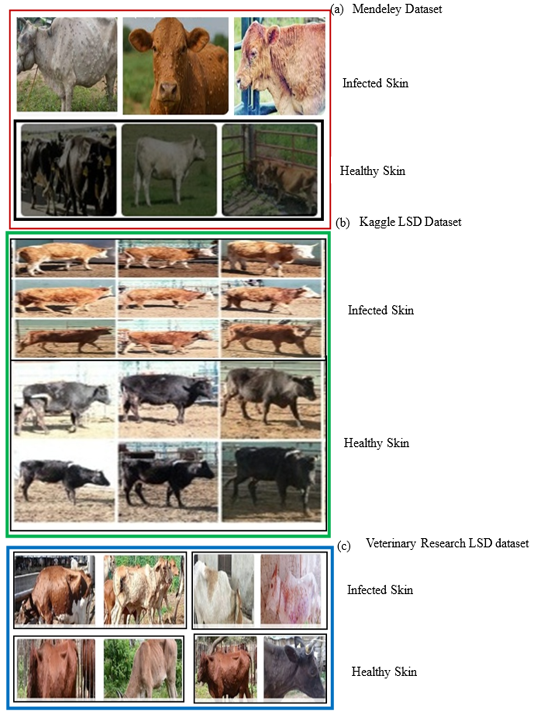
The study was conducted using three publicly available LSD datasets: the Mendeley LSD dataset , the Kaggle Lumpy Skin Disease images dataset, and the Veterinary Research LSD dataset. Sample images from the three datasets were presented in Figure 1, and their characteristics were summarized in Table 1. All images were resized to 240 x 240 pixels before feature extraction to ensure consistency. The healthy images exhibited normal skin conditions, whereas infected images contained visible LSD symptoms, including skin nodules and lesions. Ground-truth labels were adopted from the original dataset annotations. Only high-quality images with clear skin visibility and reliable labels were retained, while duplicate, blurred, corrupted, and ambiguously labelled images were excluded.
Image pre-processing and data preparation
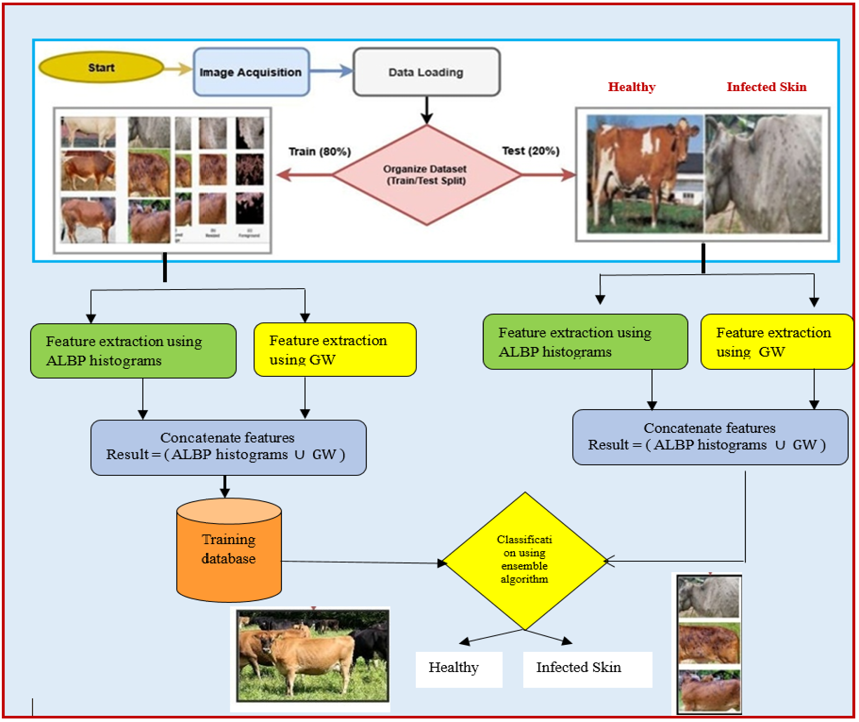
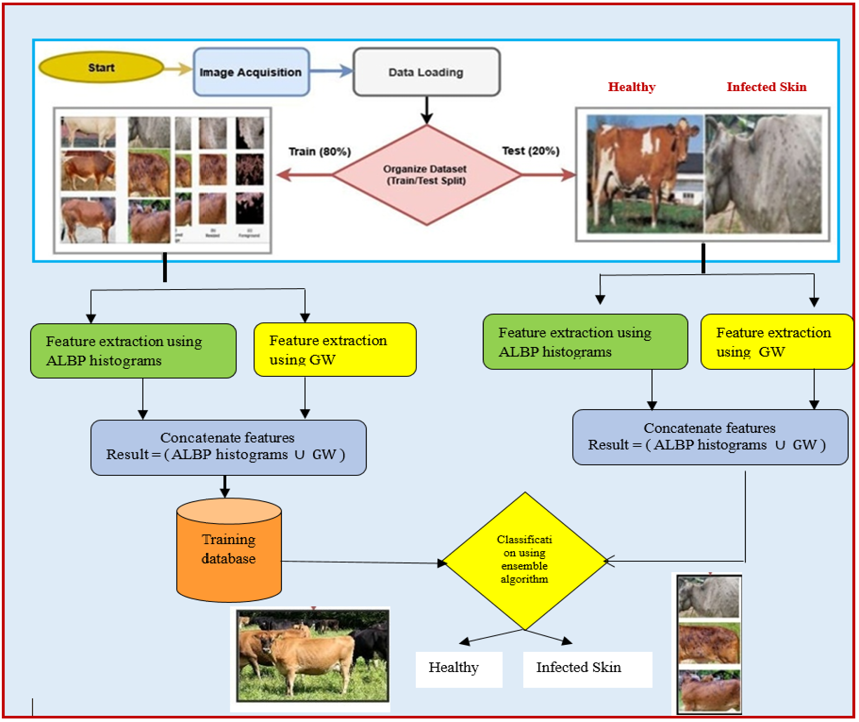
Figure 2 illustrates the proposed framework, which integrated Augmented Local Binary Pattern (ALBP) and Gabor Wavelet (GW) features with an ensemble classifier for automated Lumpy Skin Disease (LSD) detection in cattle. Initially, healthy and infected cattle images were acquired, resized to a uniform resolution, and divided into training (80%) and testing (20%) sets. ALBP histograms were extracted from the training images to represent local texture characteristics, while GW features captured directional patterns, including lesion boundaries and skin irregularities. The extracted ALBP and GW features were concatenated into a unified feature vector to form the training database. During testing, the same feature extraction procedure was applied, and the resulting feature vectors were compared with the trained model to classify images as healthy or LSD infected.
The conventional Local Binary Pattern (LBP) method proposed by Song et al. (2025), shown in Figure 3a, encoded pixel neighbourhoods into binary patterns and generated texture histograms. To improve its discriminative capability, the proposed ALBP approach, illustrated in Figure 3b, partitioned each image into non-overlapping blocks, which were further divided into overlapping (4 × 4) sub-blocks. Row-sum differences from overlapping (2 × 2) windows were computed to produce a (3 × 3) representation, and the average value replaced the centre pixel. Binary encoding was then performed by comparing
Table 1: Overview of lumpy skin disease (LSD) image datasets.
Dataset name
Total images
Healthy
LSD - infected
Image size
Key characteristics
Mendeley LSD dataset
1024
700
324
(256 × 256)
Includes multiple breeds (Santa Gertrudis, Brahman, Guzerat, and Yak); with diverse poses, lighting, and perspectives.
Kaggle LSD dataset
8223
4520
3703
(640 × 640)
Large and diverse LSD image dataset;
Veterinary Research LSD dataset
1023
478
545
(256 × 256)
Real-farm images with variations in cattle breed, age, and disease severity
the centre pixel with its neighbours, followed by histogram generation. Histograms from all blocks were concatenated to produce the final feature vector. This modified descriptor effectively captured fine-grained lesion textures while reducing the influence of noise and illumination changes, thereby improving feature discrimination and higher classification accuracy compared with the conventional LBP method.
Feature extraction using the ALBP method
The gray-level cattle image C was divided equally into 64 (8 rows and 8 columns) non-overlapping blocks. Each block was represented as B(B=1, 2, …., (r1 ×c1)). Each block had a size of (30 × 30) pixels as given below.
Figure 11.
Where r1 and c1 denoted the number of rows and columns in the cattle image (240 × 240 pixels) respectively and b height and b width were the size of the block height and block width respectively. Each block was again divided into overlapping sub-blocks. It was represented as SB. Generally, each sub-block had a size of (4 × 4) pixels. The number of sub-blocks was (m1-sb_height-1) × (n1-sb_width-1) where m1 and n1 were the number of rows and columns in each block respectively and sb _ height and sb_width were the height and width of the sub-block respectively as given below.
Figure 12.
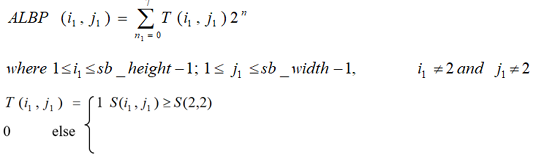
The ALBP was defined by a binary coding function to obtain the difference between the row sums of each overlapping window size (a1, b1) of (2 × 2) pixels within a sub-block (a1, b1) of (4 × 4) pixels as follows:
Let M represent the matrix defined as follows:
Figure 4.
Where; S(k_x, k_y) was the difference between the row sum of overlapping window size of (2 × 2) intensities in a sub-block SB whose size is (4 × 4) at pixel position (k_x, k_y). The resultant value was available as (3 × 3) matrices for each sub-block at pixel position (k_x, k_y). From that result, the center value was replaced of (3 × 3) pixels by calculating the average of sub-blocks expressed as:
Figure 9.
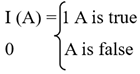
Where; k_x and k_y were the number of rows and columns in the resulting sub-block (3 × 3 pixels) respectively. This center value in the sub-block was compared with eight neighbor values. If the center value was less than the neighboring value then the neighboring pixel value was set to 1; otherwise, zero. An 8-bit code was coined, which represents the value in decimal form at each pixel position (a1, b1) in the block. The representations of these quantities were as follows:
The value by using the proposed method ALBP was obtained as follows:
Figure 5.
After obtaining the value using the ALBP method for each pixel associated with a block in the cattle image, a 59-bin histogram was computed to represent the extract the texture features. The histograms of each block in the cattle image ALBPf was defined as follows:
Figure 6.
Where L is the number of bins for the values produced by the ALBP operator.
Figure 10.
The ALBPf histograms which are extracted from all blocks were concatenated into a single feature. As a result ALBPf = number of blocks × histogram bins ((8 × 8 × L) = 3776) was obtained from each cattle image. The ALBPf histograms contained information about the description of the local micro-patterns such as edges, spots and flat areas over the whole image. Hence, it was used to statistically describe image characteristics. Similarly, the differences between the column sums and diagonal sums were calculated within a sub-block.
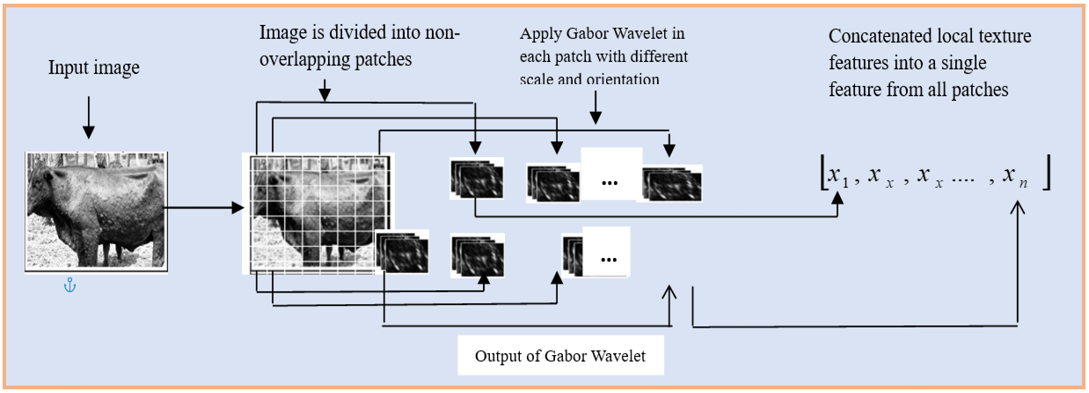
Figure 4 illustrates that each cattle image was divided into non-overlapping patches. Texture features were extracted from each patch using the Gabor wavelet approach for effective texture analysis. Each patch was convolved with a set of Gabor kernels at multiple orientations and scales. This process enhanced directional texture patterns such as wrinkles, spots, and lesion boundaries present on the animal’s skin. The resulting output, commonly referred to as the Gabor magnitude response, emphasized high-frequency components such as edges and irregular patterns while suppressing uniform regions. Finally, the extracted local texture features from all patches were concatenated into a single feature vector for further processing.
Feature extraction using patch-wise Gabor wavelet
Each cattle image I was divided into non-overlapping patches denoted by P (P= 1, 2, ….,(m× n). The m and n denote the numbers of patches arranged in rows and columns respectively. The total number of patches was m×n. Typically, the m1 and n1 denoted the row and column dimensions of each patch size (i.e., pixels) respectively.
Figure 7.
Where r1 and c1 were numbers of rows and columns in the cattle image respectively, m1 and n1 were the row and column of each patch size, respectively.
Figure 1.
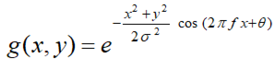
Where; Ip(x, y) represented each patch of the cattle image and g(x, y) denotes the two-dimensional (2D) Gabor Kernel. The symbol * denotes convolution. The magnitude was then computed as follows:
Figure 8.
Where; g(x, y) was the Gabor filter response, σ denotes the scale, f represents the frequency and θ represents the orientation, IG captured texture and directional characteristics of LSD lesions. The features extracted from all patches were concatenated into a single feature vector as GW. This process yielded a feature vector of size expressed as follows:
Figure 2.
This magnitude image provided a clearer representation of texture variations, making it highly effective for identifying abnormal skin patterns in cattle.
Ensemble learning for classification
Features were extracted from each image using both ALBP and Gabor wavelet techniques. These extracted feature vectors were concatenated to form a combined representation, expressed as follows:
Figure 3.
Where; U denoted the concatenation operation. Consequently, the final representation of each image consisted of a high-dimensional feature vector determined by the number of blocks, histogram bins, patches, scales, and orientations. The extracted features were subsequently provided as input to an ensemble learning model for classification.
The boosting algorithm, originally proposed by Khotimah (2026) for object detection, was employed because of its ability to achieve a low false-positive rate. A key advantage of the boosting approach was its ability to combine multiple weak learners to construct a strong classifier while reducing redundancy in high-dimensional feature spaces, thereby improving computational efficiency. However, boosting methods were sensitive to noisy data and outliers. In this study, three AdaBoost variants Real AdaBoost (RA), Gentle AdaBoost (GA), and Modest AdaBoost (MA) were employed to classify cattle skin images into two categories: healthy and infected.
RESULTS
Experimental setup
The experiments were conducted using MATLAB R2017 on a personal computer equipped with an Intel Core i5 processor (3.20 GHz) and 8 GB of RAM. The proposed framework was evaluated using an 80:20 training–testing split. Feature vectors were normalized using min–max normalization before classification. The AdaBoost classifier was configured with 500 weak learners, a learning rate of 0.1, and 100 boosting iterations. To improve robustness and address class imbalance, data augmentation techniques, including rotation, and scaling, together with class weighting, were applied during training. The use of three independent datasets increased data diversity and reduced dataset bias, enabling comprehensive evaluation under varying imaging conditions, class distributions, cattle breeds, and disease stages. This experimental design improved the generalization and practical applicability of the proposed framework in real-world livestock disease detection.
Performance of ALBP features
The ALBP features effectively captured local texture variations and micro-patterns in cattle skin, helping to distinguish the irregular textural characteristics of LSD lesions from healthy skin. The results demonstrated that ALBP provided useful discriminative information for identifying LSD-infected cattle.
Performance analysis on different sizes of block in ALBP
The results presented in Table 2 demonstrate that the number of blocks and block size significantly influenced classification performance. The 36-block configuration (40 × 40 pixels) achieved accuracies ranging from 90% to 92.7%, whereas the 64-block configuration (30 × 30 pixels) improved accuracy to 91–95%, producing the best performance across all three datasets. Increasing the partition to 100 blocks (24 × 24 pixels) resulted in a slight reduction in accuracy, indicating that the 64-block configuration provided the optimal balance between capturing discriminative local texture information and computational efficiency for classifying healthy and LSD-infected cattle skin.
Table 2: Detection accuracy of LSD using different sizes of block.
Number of blocks
Each block size (in Pixels)
Accuracy (%)*
Mendeley dataset
Kaggle dataset
Veterinary research LSD dataset
RA
GA
MA
RA
GA
MA
RA
GA
MA
36 (6 rows, 6 columns)
(40 × 40)
90
92
89
92
94
92
90-93
92
89
64 (8 rows, 8 columns)
(30 × 30)
91
93
91
94
95
93
92
94
91
100 (10 rows, 10 columns)
(24 × 24)
89
90
88
92
94
92
90
93
91
* Real AdaBoost denoted as RA, Gentle AdaBoost denoted as GA, and Modest AdaBoost denoted as MA.
Table 3: Detection of LSD using different sizes of sub-block.
Different sub-block size
Different window size
Recognition rate (%)*
Mendeley dataset
Kaggle dataset
Veterinary research LSD dataset
RA
GA
MA
RA
GA
MA
RA
GA
MA
Raw pixel
---
----
88
89
89
90
90
89
91
92
90
(3 × 3) LBP#
---
-----
90
91
90
91
92
90
90
92
91
(4 × 4)
ALBP
(2 × 2)
Row sums
92
93.5
91
92
95
92
91
94
91
Column sums
91
92
92
90
90
91
91
92
92
Diagonal sums
91
92
91
92
92
91
91
92
92
(5 × 5)
ALBP
(3 × 3)
Row sums
90
91
90
92
91
92
90
92
92
Column sums
92
92
91
91
92
91
92
92
90
Diagonal sums
91
92
89
91
92
92
90
92
91
(6 × 6)
ALBP
(4 × 4)
Row sums
91
92
91
91
92
92
91
92
92
Column sums
91
92
88
90
92
92
91
92
92
Diagonal sums
91
92
90
92
92
90
90
92
92
(7 × 7)
ALBP
(5 × 5)
Row sums
90
91
90
90
92
91
92
92
90
Column sums
89
90
89
91
91
92
90
92
91
Diagonal sums
90
92
91
92
90
91
91
91
90
* Real AdaBoost denoted as RA, Gentle AdaBoost denoted as GA, and Modest AdaBoost denoted as MA. # Song et al. (2025).
Table 4: Detection of LSD using different sizes of Gabor patch.
Number of patches
Each patch size (Pixels)
Accuracy (%)
Mendeley
dataset
Kaggle dataset
Veterinary research LSD dataset
Gabor Wavelet – without patches*
90
91
91
16 (arranged in 4 rows, 4 columns)
(64 × 64)
92.5
92.7
92
64 (arranged in 8 rows, 8 columns)
(32 × 32)
94.5
94
95.8
256 (arranged in 16 rows, 16 columns)
(16 ×16)
94
93
92.3
*Shafer-Skelton et al. (2026).
Performance analysis on different sizes of sub-block in ALBP
The performance of the proposed ALBP descriptor was evaluated using different sub-block sizes. Three ALBP variants based on row-wise, column-wise, and diagonal intensity differences were investigated using sub-block sizes of (3 × 3), (4 × 4), (5 × 5), (6 × 6) and (7 × 7). The (3 x 3) sub-block corresponded to the conventional LBP. Larger sub-blocks were reduced to a (3 x 3) representation by computing intensity differences over overlapping (2 x 2) windows, after which the standard LBP encoding was applied. Histograms generated from all image blocks were concatenated to form a unified feature vector and subsequently classified using ensemble AdaBoost techniques. The proposed method was independently evaluated on the three datasets, and the results are presented in Table 3. Among all configurations, the ALBP descriptor generated from (4 x 4) sub-blocks using row-wise differences with the Gentle AdaBoost classifier consistently achieved the highest classification performance across all datasets.
Performance of gabor wavelet features
Gabor Wavelet (GW) features effectively captured the directional, frequency, and structural variations of cattle skin lesions. The results demonstrated that Gabor Wavelet features provided useful discriminative information for distinguishing LSD-infected cattle from healthy cattle.
Performance analysis on different sizes of Gabor patch
The proposed model was evaluated using different numbers of image patches, with Gabor filters applied to each patch for texture feature extraction. As shown in Table 4, the 64-patch configuration (8 × 8 grid, 32 × 32 pixels) achieved the highest accuracies of 94.5%, 94.0%, and 95.8% on the Mendeley, Kaggle, and Veterinary Research LSD datasets, respectively. It also outperformed the Gabor Wavelet approach without patches reported by Shafer-Skelton et al. (2026), which achieved 90%, 91%, and 91%. Therefore, the 64-patch configuration was selected for subsequent experiments.
Performance analysis of different Gabor scale and Gabor orientations
In these experiments, the orientation and scale parameters of the Gabor filter play a crucial role in determining the effectiveness of texture-based feature extraction. A comparative evaluation was conducted using different orientation sets, including 2 orientations (0°, 90°), 4 orientations (−45°, 0°, 45°, 90°), 6 orientations (−45°, −22.5°, 0°, 22.5°, 45°, 90°), and 8 orientations (−67.5°, −45°, −22.5°, 0°, 22.5°, 45°, 67.5°, 90°), while maintaining a fixed scale value of eight. The experimental results across three datasets were presented in Table 5 using a variant ensemble classifier.
Table 5: Detection of LSD using four sets of orientation.
Number of orientations
Accuracy (%)
Three datasets*
Mendeley dataset
Kaggle dataset
Veterinary research dataset
RA
GA
MA
RA
GA
MA
RA
GA
MA
2
90
93
88
90
91
90
91
92
90
4
92
94.5
93
92
94
93
92
95.8
94
6
93
93
91
90
91
89
92
93
92
8
92
93
90
88
89
97
90
93
92
* Real AdaBoost denoted as RA, Gentle AdaBoost denoted as GA, and Modest AdaBoost denoted as MA.
Table 6: Detection of LSD using four sets of scales.
Number of scale
Accuracy (%)
Three datasets*
Mendeley dataset
Kaggle dataset
Veterinary research dataset
RA
GA
MA
RA
GA
MA
RA
GA
MA
4
90
93
88
86
88
87
89
91
86
6
91
92
90
89
90
87
90
92
89
8
93
94.5
91
91
94
90
93
95
92
10
92
93
90
89
90
88
91
92
91
* Real AdaBoost denoted as RA, Gentle AdaBoost denoted as GA, and Modest AdaBoost denoted as MA.
Table 7: Performance comparison of ALBP, Gabor, and combined ALBP + GW features with Gentle AdaBoost.
Model Name
Accuracy
F1-Score
Recall
Precision
Dataset
ALBP + Gentle AdaBoost
0.94
0.91
0.93
0.89
Mendeley dataset
GW + Gentle AdaBoost
0.95
0.94
0.94
0.94
Mendeley dataset
ALBP + GW + Gentle AdaBoost (Proposed)
0.98
0.96
0.95
0.96
Mendeley dataset
ALBP + Gentle AdaBoost
0.95
0.93
0.94
0.92
Kaggle dataset
GW + Gentle AdaBoost
0.96
0.94
0.94
0.93
Kaggle dataset
ALBP + GW + Gentle AdaBoost (Proposed)
0.97
0.96
0.95
0.96
Kaggle dataset
ALBP + Gentle AdaBoost
0.94
0.92
0.93
0.92
Veterinary Research LSD dataset
GW + Gentle AdaBoost
0.96
0.93
0.93
0.93
Veterinary Research LSD dataset
ALBP + GW + Gentle AdaBoost (Proposed)
0.98
0.98
0.98
0.99
Veterinary Research LSD dataset
Furthermore, the impact of varying scale parameters was analyzed by fixing the number of orientations at four and evaluating scale ranges of (5:2:11), (5:2:15), (5:2:19), and (5:2:23), corresponding to 4, 6, 8, and 10 scales, respectively. The results, shown in Table 6 using the same variant ensemble classifier, indicate that this configuration was effective in distinguishing between healthy and infected skin across all datasets. From Tables 5 and 6, it was observed that the highest classification accuracy was achieved using 4 orientations and 8 scales, with the GA classifier demonstrating superior performance compared to other scale–orientation combinations and AdaBoost classifiers across all three datasets. The Gabor feature extraction process produced a feature vector of size 32, derived from 8 scales and 4 orientations.
Performance comparison of ALBP, Gabor, and combined ALBP + GW features with different Adaboost classifiers
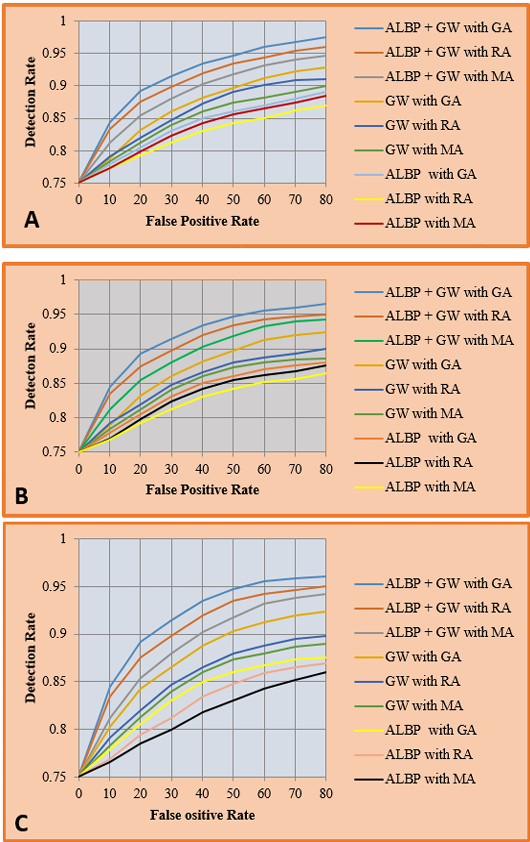
The Receiver Operating Characteristic (ROC) curves were plotted based on the results obtained using the ALBP histograms alone, GW alone, and combined ALBP and GW with Adaboost variants classifier such as Real AdaBoost (RA), Gentle AdaBoost (GA), and Modest AdaBoost (MA), to classify cattle skin images as either healthy or infected. These evaluations were performed on the three datasets and the corresponding results are presented in Figure 5. The analysis of GA yielded higher classification rate than RA and MA. Hence, GA was selected as the classification algorithm for our system.
The ROC curve illustrates the trade-off between the FPR and the TPR (recognition rate). The results indicate that the proposed ALBP + GW with the GA model achieved superior LSD detection performance. This combination demonstrated a high recognition rate while maintaining a low FPR across all datasets.
Evaluation of LSD detection performance
The models were evaluated using accuracy, F1-score, recall, and precision across three LSD datasets, as shown in Table 7. The combined ALBP–GW features with Gentle AdaBoost consistently outperformed the individual ALBP and GW features, achieving accuracies of 0.98, 0.97, and 0.98 on the Mendeley, Kaggle, and Veterinary Research datasets, respectively. These results demonstrate the effectiveness of combining complementary texture and frequency-domain features.
For the Veterinary Research dataset, which contains 1,023 cattle skin images comprising 478 healthy and 545 infected samples, the confusion matrix in Table 8 shows that 536 infected (TP) and 470 healthy (TN) images were correctly classified, while 9 infected (FN) and 8 healthy (FP) images were misclassified. These results demonstrate the effectiveness of the proposed model in distinguishing between healthy and LSD-infected cattle images.
Table 8: Confusion matrix for veterinary research LSD dataset.
Predicted infected
Predicted healthy
Actual infected
536 (TP)
9 (FN)
Actual healthy
8 (FP)
470 (TN)
Comparison with existing LSD detection methods
Table 9 compares the proposed framework with existing LSD detection approaches using the same 80:20 training–testing protocol, datasets, preprocessing steps, and evaluation metrics, providing a consistent basis for comparison. The compared methods include several deep learning approaches, which achieved accuracies ranging from 90% to 95%, whereas the proposed ALBP + GW with Gentle AdaBoost achieved accuracies of 98%, 97%, and 98% on the Mendeley, Kaggle, and Veterinary Research datasets, respectively. The proposed framework also required only 22, 23, and 24 s for the Mendeley, Kaggle, and Veterinary Research datasets, respectively, demonstrating competitive computational efficiency. Overall, the results indicate that the proposed feature-fusion and ensemble-learning strategy provides a favorable balance between classification accuracy and computational cost compared with existing LSD detection methods.
Cross-validation and statistical analysis
The framework was evaluated using 10-fold cross-validation, achieving average accuracies of 98.5%, 97.45%, and 98.7% on the Mendeley, Kaggle, and Veterinary Research LSD datasets, respectively. The 10-fold cross-validation accuracy was higher than the accuracy obtained from the single 80:20 train–test split; this difference reflects the use of different data-partitioning and evaluation protocols rather than the use of the independent test set during model training.
For the 10-fold cross-validation analysis, ten fold-wise accuracy values were obtained for each dataset. These ten values were treated as repeated evaluation units for statistical comparison. The paired t-test was used to compare the fold-wise accuracies of the proposed ALBP–GW framework and the individual-feature approaches using identical folds. One-way ANOVA was used to assess differences among the mean performances of the evaluated methods, while McNemar’s test was applied to paired classification outcomes obtained from the same evaluation samples. Statistical significance was assessed at p < 0.05.
Table 9: Comparison of existing approaches with proposed methodology where A represents accuracy.
Authors
Year
Model / Technique
Classifier
A for accuracy (%) S for seconds
Mendeley
Kaggle
Veterinary research
A
S
A
S
A
S
Saqib et al.
2024
Deep learning
MobileNetV2 + RMSProp
92
24
91
25
92
26
Senthilkumar et al.,
2024
Transfer learning
MobileNetV2
91
24
90
25
93
25
AlZubi et al.,
2024
Deep Learning
Advanced CNN
92
25
91
26
92
24
Sahare
2025
Deep Learning
CNN
91
21
91
23
90
24
Abdullah et al.,
2025
Transfer learning
DenseNet121
92
23
92
22
91
24
Pal et al.,
2025
Deep learning ensemble
ViT + ConvMixer
93
23
93
24
94
24
Gouda et al.,
2025
Ensemble ML + resampling
RF, AdaBoost, GBoost, XGBoost
90
25
91
25
90
26
Meravath et al.,
2025
Hybrid deep learning + attendion
Muti-scale hybrid model
92
24
90
26
90
26
Muhindi et al.,
2026
Swin Transformer Tiny
CNN
92
26
91
27
91
27
Ayon et al.,
2026
Deep learning ensemble
VGG16 + ResNet50 + InceptionV3
96
31
96
29
97
29
Ahmed et al.,
2025
Morphological priors + local texture refinement
YOLO + EfficientNet
95
24
95
25
96
25
Ubaidullah et al.,
2026
Lesion detection + deep features
YOLOv11 + EfficientNet
94
26
96
26
96
27
Ullah et al.,
2026
Deep learning
Vision Transformer (ViT)
94
25
95
24
95
26
Khotimah et al.,
2026
Ensemble deep learning + L2 regularization
Weighted ensemble CNN
95
26
96
26
95
25
Senussi et al.,
2026
Multi-scale deep learning
ConvNeXtLSD
96
27
96
25
97
25
Our Proposed
2026
ALBP + GW
Gentle Adaboost
98
22
97
23
98
24
Statistical analysis further supported the robustness of the proposed framework. Cohen’s kappa coefficient of 0.95 (95% CI: 0.94–0.98) indicated almost perfect agreement between the predicted and reference classifications. The McNemar’s test, paired t-test, and one-way ANOVA indicated statistically significant differences in the observed performance (p < 0.05). Overall, the proposed framework demonstrated improved performance compared with the individual-feature approaches across the three datasets.
DISCUSSION
This study presented an automated LSD detection framework integrating Augmented Local Binary Pattern (ALBP) and Gabor Wavelet (GW) features with Gentle AdaBoost. As shown in Table 9, the proposed framework achieved accuracies of 98%, 97%, and 98% on the Mendeley, Kaggle, and Veterinary Research LSD datasets, respectively. The existing methods achieved accuracies ranging from 90% to 97%. Ayon et al. (2026), using a VGG16 + ResNet50 + InceptionV3 ensemble, and Senussi et al. (2026), using ConvNeXtLSD, achieved the highest performance among the compared methods, with accuracies of 96–97%. However, deep learning and transfer-learning approaches may depend strongly on the quality, diversity, and size of the training data, which may limit their ability to generalize across variations in lesion appearance, illumination, background, and image acquisition conditions. This may explain the comparatively lower performance of MobileNetV2 with RMSProp by Saqib et al. (2024), MobileNetV2 transfer learning by Senthilkumar et al. (2024), advanced CNN by Al-Zubi (2024), CNN by Sahare (2025), and DenseNet121 by Abdullah et al. (2025).
Similarly, ViT + ConvMixer by Pal et al. (2025) and the multi-scale hybrid model by Meravath and Kolluri (2025) combined multiple feature representations, which can increase model complexity and may require more representative training samples to learn robust features. The VGG16 + ResNet50 + InceptionV3 ensemble of Ayon et al. (2026), although achieving strong performance, involves multiple deep networks and therefore has greater architectural complexity. Likewise, YOLO + EfficientNet by Ahmed et al. (2025), YOLOv11 + EfficientNet by Ubaidullah et al. (2026), and the weighted ensemble CNN with L2 regularization by Khotimah (2026) employ multiple learning components, potentially increasing computational requirements and sensitivity to training configurations. The Swin Transformer-Tiny by Muhindi et al. (2026) and Vision Transformer (ViT) by Ullah et al. (2026) rely on attention-based global representations and may require sufficiently diverse training data to capture variations in LSD lesions effectively. The ensemble machine-learning approach of Gouda and Abdallah (2025), using RF, AdaBoost, Gradient Boosting, and XGBoost with resampling, may also be influenced by feature quality and resampling strategies, which can affect generalization across datasets.
In contrast, the proposed ALBP–GW framework combines complementary local texture and directional frequency information. ALBP captures fine-grained local variations in lesion texture, while GW characterizes directional and frequency-dependent patterns. This combination enables the framework to represent irregular LSD lesion characteristics more effectively without relying on multiple deep architectures. Consequently, the proposed method achieved consistently strong performance across all three datasets while maintaining execution times of 22, 23, and 24 s, respectively. These results indicate that the proposed ALBP–GW framework provides a favorable balance between detection accuracy, feature representation, and computational efficiency under the experimental conditions considered.
CONCLUSIONS
An automated image-based framework for the early detection of Lumpy Skin Disease (LSD) in cattle was proposed by integrating Augmented Local Binary Pattern (ALBP) and Gabor Wavelet (GW) feature extraction method with an ensemble learning-based classification strategy. The proposed ALBP–GW framework was designed to exploit complementary visual characteristics of LSD lesions: ALBP effectively characterizes local texture variations and micro-patterns, while GW captures directional, frequency-dependent, and structural information associated with skin lesions, nodules, and surface irregularities. By fusing these complementary descriptors, the proposed method provided a more informative and discriminative representation of affected and healthy cattle images than relying on a single feature descriptor. The integration of the fused ALBP–GW representation with ensemble classifiers further strengthens the classification capability by combining the decision-making characteristics of multiple learners and improving the robustness of the prediction process. Experimental evaluation on three independent LSD datasets Mendeley, Kaggle, and Veterinary Research achieved classification accuracies of 98.0%, 97.0%, and 98.0%, respectively. The consistently high performance across datasets demonstrated the effectiveness of the proposed feature-fusion and ensemble-learning strategy under the evaluated experimental conditions. These results indicated that the proposed framework could effectively distinguish LSD-related visual patterns while maintaining stable classification performance across datasets with different image characteristics.
The execution-time results further demonstrated that the proposed approach maintains competitive computational efficiency. The proposed framework required 22, 23, and 24 seconds for the Mendeley, Kaggle, and Veterinary Research datasets, respectively. These values are comparable to or lower than several deep learning-based approaches that achieved lower classification accuracies. Therefore, the proposed ALBP–GW with Gentle AdaBoost provides a favorable balance between classification accuracy and computational efficiency, making it a promising candidate for computer-assisted LSD screening. A key strength of the proposed approach is its ability to achieve high classification performance using computationally efficient handcrafted feature descriptors combined with ensemble learning, thereby providing a potentially cost-effective alternative to computationally intensive end-to-end deep learning approaches.
Limitations and future work
Despite its promising performance, the framework was evaluated under specific experimental conditions and may be affected by variations in cattle breed, age, skin pigmentation, illumination, occlusion, camera viewpoint, disease severity, and environmental conditions. The availability of diverse real-world farm images was also limited, which may affect the generalizability of the framework across different farms and surveillance environments.
Future work will focus on expanding the framework using larger and more diverse real-world farm datasets and conducting cross-farm and cross-camera validation. Further investigations will include comparisons with state-of-the-art deep-learning and vision-based models, explainable prediction mechanisms, and deployment on mobile, edge, and real-time surveillance platforms. These developments could support the integration of the framework into automated livestock health-monitoring systems, potentially enabling earlier disease screening and facilitating timely veterinary intervention.
Acknowledgments
All authors are thankful to the Koneru Lakshmaiah Education Foundation for supporting this work and providing valuable insights.
NOVELTY STATEMENT
The proposed study introduced a hybrid handcrafted feature framework that integrated Augmented Local Binary Pattern (ALBP) and Gabor Wavelet (GW) descriptors for automated Lumpy Skin Disease detection in cattle. A novel ALBP descriptor based on overlapping sub-blocks with row-wise intensity differences was developed to capture discriminative lesion textures while improving robustness to noise and illumination variations. The fused ALBP–GW features, combined with the Gentle AdaBoost classifier, achieved superior accuracy and computational efficiency compared with existing deep learning and hybrid approaches. The framework was further validated on three independent public datasets, demonstrating strong generalization and suitability for real-world livestock disease monitoring.
AUTHOR’S CONTRIBUTION
IRPS: Conceptualization, experimental design, data analysis, manuscript writing, and corresponding author. YRAR, RC: Conducted the experiment, sample collection, and laboratory analyses. VS, DM and SA: Statistical analysis, interpretation of results, and critical revision of the manuscript. All authors read and approved the final manuscript.
Generative AI and AI assisted technology statement
The authors declare that no generative AI and AI assisted technology was used in the creation of this manuscript.
Conflict of interest
The authors have declared no conflict of interest.
Figures
Figure 1:.
Sample images from (a) Mendeley , (b) Kaggle, and (c) Veterinary Research LSD datasets.
Figure 2:.
Proposed framework for LSD detection using ALBP histograms and GW with ensemble learning.
Figure 3:.
System diagram (a) Local Binary Pattern method (LBP) (b) Amplified Local Binary Pattern method (ALBP).
Figure 4:.
System diagram for Patch-Wise Gabor wavelet feature extraction method.
Figure 5:.
ROC curves comparing the detection performance of ALBP alone, Gabor Wavelet (GW) alone, and the integrated ALBP + GW features using different AdaBoost classifier variants: Real AdaBoost (RA), Gentle AdaBoost (GA), and Modest AdaBoost (MA). Where (a) Mendeley (b) Kaggle (c) Veterinary Research datasets.
References
Abdullah W, Tanwar S, Abouhawwash M (2025). Deep learning-based detection of lumpy skin disease in livestock using CNNs. Sustain. Machine Intell. J., 11: 1–10. https://doi.org/10.61356/SMIJ.2025.11515[CrossRef]
Ahmed MJ, Chalise R, Bhandari P (2025). Lumpy Skin Disease in Cattle and Buffalo in Asian Countries: A Systematic Review and Meta-Analysis. Veterinary Medicine and Science, 11(5): e70607. https://doi.org/10.1002/vms3.70607[CrossRef]
Al-Zubi A (2024). Lumpy skin disease detection in cattle by a robust approach using advanced convolutional neural networks. Indian J. Anim. Res., 58(12): 2146–2153. https://doi.org/10.18805/IJAR.BF-1793[CrossRef]
Ayon NB, Hasib A, Ahmed MF, Rahman MS (2026). Simultaneous detection of LSD and FMD in cattle using ensemble deep learning. arXiv preprint arXiv: 2601.12889.
Gouda HF, Abdallah FDM (2025). Comparative performance of bagging and boosting ensemble models for predicting lumpy skin disease with multiclass-imbalanced data. Sci. Rep., 15(1): 39373. https://doi.org/10.1038/s41598-025-23846-7[CrossRef]
Khotimah BK (2026). A robust ensemble deep learning model for lumpy skin disease identification. Eng. Technol. Appl. Sci. Res., 16(1): 31285–31293. https://doi.org/10.48084/etasr.14823[CrossRef]
Meravath C, Kolluri R (2025). A hybrid deep learning framework with attention and multi-scale features for early detection of lumpy skin disease in cattle. IEEE 9th International Conference on Information and Communication Technology (CICT). DOI: 10.1109/CICT67193.2025.11399184.
Muhindi G, Wambugu MG, Oirere A (2026). A survey of deep learning methods for detection of lumpy skin disease. Int. J. Technol. Emerg. Sci., 6(1): 1–10.
Pal M, Behera S, Mohapatra R (2025). Implementation of a deep learning system for detection and classification of lumpy skin disease in cattle. Vet. Med. Sci., 11(6).
Sahare D (2025). Detection of lumpy skin disease in cattle using convolutional neural networks (CNN): A review. Int. J. Res. Appl. Sci. Eng. Technol., 13(4): 101–106. https://doi.org/10.22214/ijraset.2025.68192[CrossRef]
Saqib SM, Iqbal M, Ben Othman MT, Shahazad T, Ghadi YY (2024). Lumpy skin disease diagnosis in cattle: a deep learning approach optimized with RMSProp and MobileNetV2. PLoS One, 19(8): e0302862. https://doi.org/10.1371/journal.pone.0302862[CrossRef]
Senthilkumar C, Sindhu C, Vadivu G, Neethirajan S (2024). Early detection of lumpy skin disease in cattle using deep learning a comparative analysis of pretrained models. Veterinary Sciences, 11(10): 510. https://doi.org/10.3390/vetsci11100510[CrossRef]
Shafer-Skelton A, Brady TF, Serences JT (2026). A 2D Gabor-wavelet baseline model out-performs a 3D surface model in scene-responsive cortex. PLoS Comput. Biol., 22(2): e1013888. https://doi.org/10.1371/journal.pcbi.1013888[CrossRef]
Song Y, Sa J, Luo Y, Zhang Z (2025). A comprehensively improved local binary pattern framework for texture classification. Multimed. Tools Appl., 84: 22043–22068. https://doi.org/10.1007/s11042-024-19877-3[CrossRef]
Ubaidullah, Hussain MA, Jafri MR, Khan R, Sandhu M (2026). Adaptive hybrid optimizer based framework for lumpy skin disease identification. arXiv:2601.01807. DOI: 10.48550/arXiv.2601.01807
Ullah A, Haider A, Rahulamathavan Y, Khokhar MW (2026). A vision transformer model-integrated mobile application for early and accurate detection of lumpy skin disease in cattle. Sci. Rep., 16: 683. https://doi.org/10.1038/s41598-025-30259-z[CrossRef]