
This study analysed the effect of novel oral and plasmid-injected KISS1 DNA vaccines on immunocastration and in inhibiting mutton odour of male goats. In this study, 20 male goats aged eight weeks were randomly divided into the oral and plasmid-injected KISS1. DNA vaccine groups (groups T1 and T2) and the empty vector groups (groups C1 and C2) for immunisation. Blood samples were collected at 0, 3, 6, 10 and 14 weeks after primary immunisation for the detection of kisspeptin antibodies and testosterone by indirect enzyme-linked immunosorbent assay. Scrotal circumference was detected from week 0 to week 14 after primary immunisation, and the testes were weighed at week 14 after primary immunisation after slaughter. The concentrations of 4-methyloctanoic acid and 4-methylnonanoic acid in waist subcutaneous adipose tissue were detected using gas chromatography. Immunisation of oral and plasmid-injected KISS1 DNA vaccines induced strong antibody response, significantly suppressed testosterone secretion and reduced scrotal circumference and testis weight. It also significantly reduced the concentrations of 4-methyloctanoic acid and 4-methylnonanoic acid in adipose tissue. These findings indicated that immunisation of oral and plasmid-injected KISS1 DNA vaccines can effectively suppress testosterone secretion, testis growth and mutton odour, and the novel oral KISS1 DNA vaccine is more promising in the large-scale preparation of immunocastration vaccines because of simple operations and low cost.
Short Communication · Volume 52, Issue 4, 23 April 2020 · Open Access
Effects of Novel Oral and Plasmid-Injected KISS1 DNA Vaccines on Immunocastration and in Inhibiting Mutton Odour of Male Goats
· · · · · · ·
Affiliations & Notes ⌄
- 1College of Animal Science and Technology, Southwest University, Chongqing Key Laboratory of Forage and Herbivore, Chongqing Engineering Research Centre for Herbivores Resource Protection and Utilization, Chongqing, China * Corresponding author: H67738337@swu.edu.cn
Article Info ⌄
- Journal:
- Pakistan Journal of Zoology
- Published:
- 23 April 2020

From the article
- Scrotal circumference in groups T1 and T2 was significantly lower than that in groups C1 and C2 at weeks 3, 6, 10 and 14 after primary immunisation, respectively (Fig. 3, P < 0.05); however, no significant difference was observed between groups T1 and T2 (Fig. 3, P > 0.05).
- However, the immunisation effect of the KISS1 DNA vaccine in suppressing male animal-associated odours remains unclear.
- Our results showed that the testosterone concentrations in oral and plasmid-injected vaccinated male goats were lower compared with those in control groups.
- Immunisation against oral and plasmid-injected KISS1 DNA vaccine can effectively suppress testosterone secretion, testis growth and mutton odour, and the novel oral KISS1 DNA vaccine is more promising in the large-scale preparation of immunocastration vaccines because of simple operations and low cost.
Selected from the article's own text.
Abstract
Materials and methods
Twenty healthy male Dazu black goats (Ruifeng Modern Agriculture Development Co., Ltd., Chongqing, China) aged eight weeks were used in the study. All animal experiments were approved by the Science and Technology Ethics Committee of Southwest University, China. These ram lambs were randomly divided into four groups, vaccine groups T1 and T2 and control groups C1 and C2 (five lambs each group), on the basis of comparable body weight and scrotal circumference.
Novel oral and plasmid injection types of KISS1 DNA vaccines, C500 (pVAX-tPA-HBsAg-S-2KISS1-54-asd) and pVAX-tPA-HBsAg-S-2KISS1-54-asd, were successfully developed by our laboratory (Han et al. 2018b). Ram lambs in groups T1 and C1 were orally given C500 (pVAX-tPA-HBsAg-S-2KISS1-54-asd) and C500 (pVAX-asd) empty vector bacteria at a dose of 5 × 10¹¹ CFU, respectively. Ram lambs in groups T2 and C2 were intramuscularly injected with 1 mg of pVAX-tPA-HBsAg-S-2KISS1-54-asd and 1 mg of pVAX-asd empty plasmid, respectively. The procedures for oral and plasmid injection types of the KISS1 DNA vaccine were referred to previous studies . These ram lambs were boosted twice at an interval of three weeks. Blood samples were collected at weeks 0 (before primary immunisation), 3, 6, 10 and 14 after immunisation by centrifugation at 1157 × g for 10 min.
The titres of specific anti-kisspeptin IgG antibodies were detected by indirect enzyme-linked immunosorbent assay (ELISA) , 2018b). Horseradish peroxidase-labelled rabbit anti-goat IgG secondary antibody (Abbkine, Inc., Redlands, CA, USA) was used in this study. Serum testosterone concentrations were measured by ELISA using commercial kits (Cusabio Biotech, Wuhan, China). The intra- and inter-assay coefficients of variation were less than or equal to 15%, respectively. Scrotal circumference was measured at weeks 0, 3, 6, 10 and 14 after primary immunisation by using a flexible plastic tape in accordance with previous studies . The ram lambs were slaughtered at 14 weeks after the primary immunisation, and their bilateral testes were then weighed.
After slaughter, the ram lambs’ waist subcutaneous adipose tissues were collected and stored at −18 °C until use. To evaluate the mutton odour, the concentrations of 4-methyloctanoic acid and 4-methylnonanoic acid in the subcutaneous adipose tissue were detected by gas chromatography in accordance with a previous study .
Statistically significant differences (P< 0.05) between groups in terms of anti-kisspeptin antibody, serum testosterone concentrations, scrotal circumference, testis weight and concentrations of 4-methyloctanoic acid and 4-methylnonanoic acid in subcutaneous adipose tissue were analysed with one-way ANOVA using SAS 8.1. The mean values between groups were compared using Duncan’s multiple range test. Data were presented as mean ± standard deviation (SD).
Results
Kisspeptin antibody response was found in vaccine groups (groups T1 and T2) at weeks 3, 6, 10 and 14 after primary immunisation. The anti-kisspeptin antibody titres in groups T1 and T2 were significantly higher than those in groups C1 and C2 at weeks 6, 10 and 14 after primary immunisation, respectively (Fig. 1, P < 0.05); however, no significant difference was observed between groups T1 and T2 (Fig. 1, P > 0.05).
The ram lambs in groups T1 and T2 showed significantly lower serum testosterone concentrations than those in groups C1 and C2 at weeks 6, 10 and 14 after primary immunisation, respectively (Fig. 2, P < 0.05); however, no significant difference was observed between groups T1 and T2 (Fig. 2, P > 0.05).
Scrotal circumference in groups T1 and T2 was significantly lower than that in groups C1 and C2 at weeks 3, 6, 10 and 14 after primary immunisation, respectively (Fig. 3, P < 0.05); however, no significant difference was observed between groups T1 and T2 (Fig. 3, P > 0.05).
The ram lambs in groups T1 and T2 presented significantly lower testis weight than those in groups C1 and C2, respectively (Fig. 4, P < 0.05); however, no significant difference was observed between groups T1 and T2 (Fig. 4, P > 0.05).
The 4-methyloctanoic acid and 4-methylnonanoic acid in the subcutaneous adipose tissue were detected to evaluate the effect of KISS1 gene immunisation on mutton odour. The concentrations of 4-methyloctanoic acid and 4-methylnonanoic acid in groups T1 and T2 were significantly lower than those in groups C1 and C2, respectively (Fig. 5, P < 0.05); however, no significant difference was observed between groups T1 and T2 (Fig. 5, P > 0.05).
Discussion
Immunocastration is an effective measure in suppressing animal reproduction, aggressive behaviour and male-associated odours. Immunisation of the novel oral KISS1 DNA vaccine fused with tPA signal peptide and two copies of KISS1-54 can effectively suppress steroid hormone secretion, gonad growth and fertility in mice (Han et al., 2018b). However, the immunocastration effect of the novel oral KISS1 DNA vaccine in large animals remains unclear. Male animal-associated odours in adipose tissue significantly affect the consumer’s acceptance of the meat . Immunocastration against GnRH vaccine can reduce boar taint and mutton odour ; . However, the immunisation effect of the KISS1 DNA vaccine in suppressing male animal-associated odours remains unclear. Hence, this study evaluated the effects of the novel oral KISS1 DNA vaccine on immunocastration and in inhibiting mutton odour of male goats.
In this study, immunisation of the novel oral and plasmid-injected KISS1 DNA vaccines effectively suppressed testosterone secretion and testis growth of male goats by inducing the anti-KISS1 antibody. The specific KISS1 antibody response in the oral and plasmid-injected vaccinated groups was found from week 3 to week 14 after primary immunisation and reached a peak from week 6 to week 10. Immunisation of oral and plasmid-injected KISS1 DNA vaccines suppressed testosterone secretion in male goats, which could inhibit testis growth, spermatogenesis and sexual behaviour . Scrotal circumferences in oral and plasmid-injected vaccinated male goats were lower compared with those of the control groups from week 3 to week 14 after primary immunisation, and testes weight in oral and plasmid-injected vaccinated male goats was also lower compared with control groups, which indicated that immunisation of oral and plasmid-injected KISS1 DNA vaccines suppressed the testis growth of male goats. These results were similar with the immunisation effect of other KISS1 DNA vaccines in suppressing testis growth , 2018a). Our results showed that the novel oral KISS1 DNA vaccine could achieve the same immunocastration effect as the plasmid-injected KISS1 DNA vaccine. The novel oral KISS1 DNA vaccine does not require plasmid extraction and purification, which is easy to operate and saves cost . Hence, the novel oral KISS1 DNA vaccine is more promising for the large-scale preparation of immunocastration vaccines.
To the best of our knowledge, this study is the first to analyse the immunisation effect of the KISS1 DNA vaccine in suppressing mutton odour. Our results revealed that the immunisation of oral and plasmid-injected KISS1 DNA vaccines effectively reduced the concentrations of 4-methyloctanoic acid and 4-methylnonanoic acid, which are the main compounds responsible for mutton odour in the adipose tissue of male goats . Moreover, mutton odour in goats can also be caused by androstenone in the testes ; . Our results showed that the testosterone concentrations in oral and plasmid-injected vaccinated male goats were lower compared with those in control groups. These results indicated that immunisation against oral and plasmid-injected KISS1 DNA vaccine could effectively suppress mutton odour of male goats.
Conclusion
Immunisation against oral and plasmid-injected KISS1 DNA vaccine can effectively suppress testosterone secretion, testis growth and mutton odour, and the novel oral KISS1 DNA vaccine is more promising in the large-scale preparation of immunocastration vaccines because of simple operations and low cost. Further studies will focus on the mechanism of the novel oral KISS1 DNA vaccine in immunocastration and suppressing mutton odour.
Acknowledgements
This study was funded by the National Key Research and Development Plan of China (No. 2018YFD0502003), the Chongqing Science and Technology Innovation Special Project (No. cstc2019jscx-gksbX0135, No. cstc2017shms-zdyfX0059) and the Innovation Team Building Program in Chongqing University (No. CXTDG201602004).
Statement of conflict of interest
The authors have declared no conflict of interest.
Figures
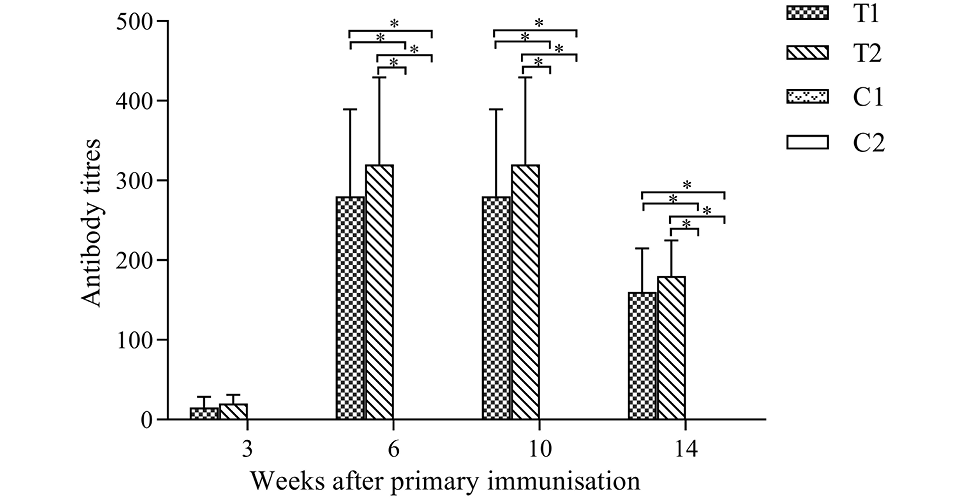
Anti-kisspeptin antibody titre in male goats. Anti-kisspeptin IgG antibody levels in the oral and plasmid-injected KISS1 DNA vaccine groups (groups T1 and T2) and empty vector groups (groups C1 and C2) were detected at weeks 3, 6, 10 and 14 after primary immunisation. Data are presented as mean ± SD; *P < 0.05.
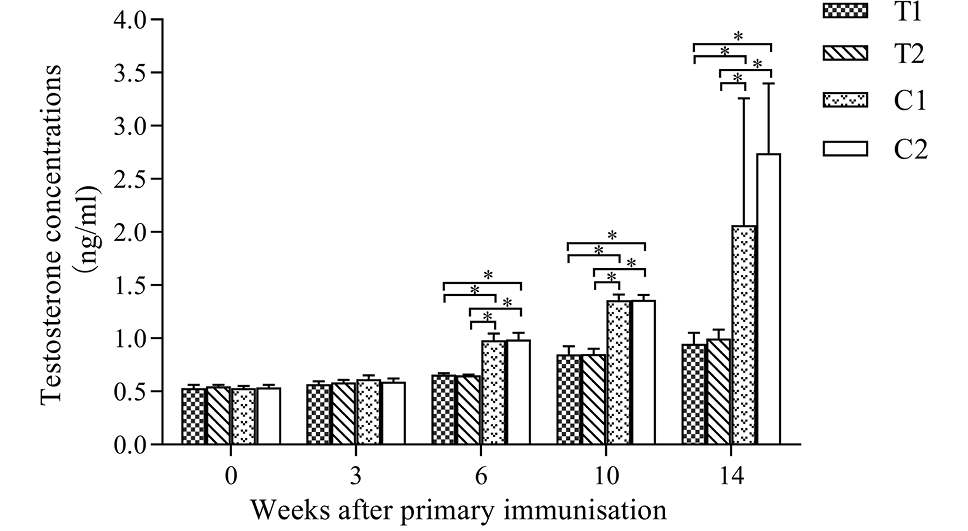
Serum testosterone concentrations (ng/ml) in male goats. Serum testosterone concentrations in oral and plasmid-injected KISS1 DNA vaccine groups (groups T1 and T2) and empty vector groups (groups C1 and C2) were detected at weeks 0, 3, 6, 10 and 14 after primary immunisation. Data are presented as mean ± SD; *P < 0.05.
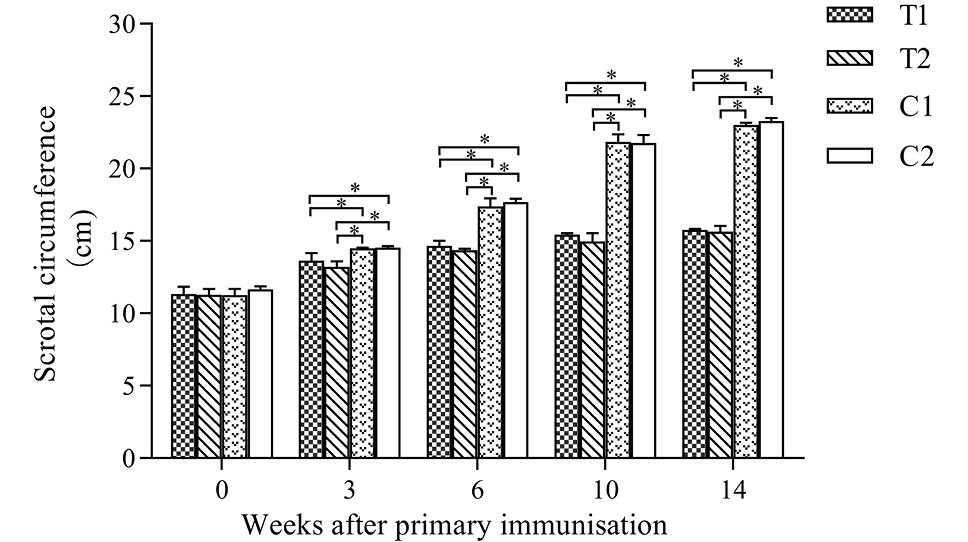
Scrotal circumference (cm) in male goats. Scrotal circumference in oral and plasmid-injected KISS1 DNA vaccine groups (groups T1 and T2) and empty vector groups (groups C1 and C2) were detected at weeks 0, 3, 6, 10 and 14 after primary immunisation. Data are presented as mean ± SD; *P < 0.05.
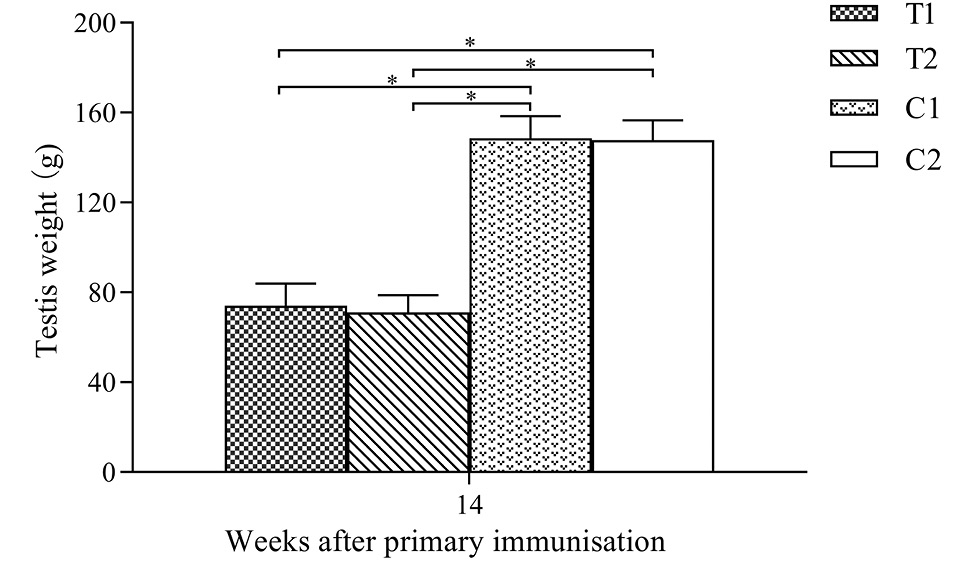
Testis weight (g) in male goats. The testis weights in oral and plasmid-injected KISS1 DNA vaccine groups (groups T1 and T2) and the empty vector groups (groups C1 and C2) were detected at week 14 after primary immunisation after slaughter. Data are presented as mean ± SD; *P < 0.05.
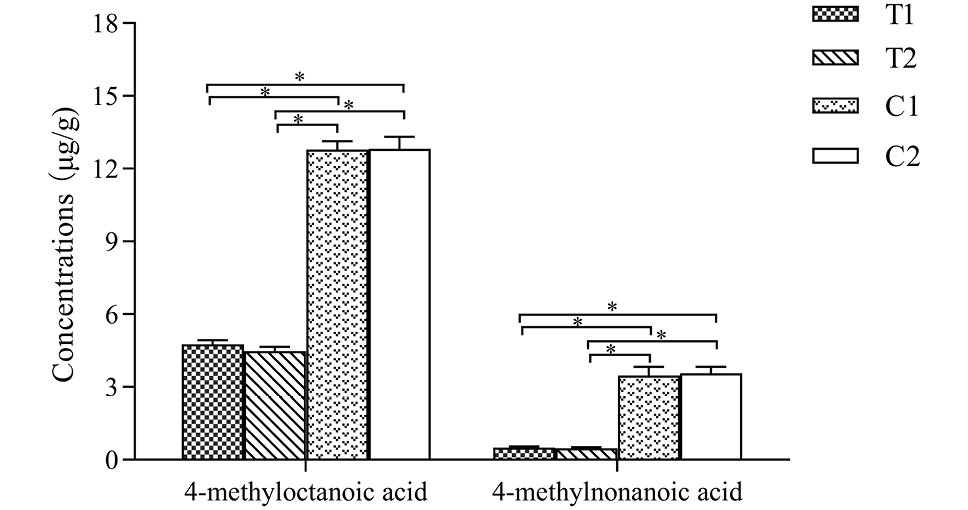
4-methyloctanoic acid and 4-methylnonanoic acid concentrations (μg/g) in waist subcutaneous adipose tissue of male goats. The concentrations of 4-methyloctanoic acid and 4-methylnonanoic acid in oral and plasmid-injected KISS1 DNA vaccine groups (groups T1 and T2) and empty vector groups (groups C1 and C2) were detected at week 14 after primary immunisation after slaughter. Data are presented as mean ± SD.
References
- Cao, Y., Li, Z., Jiang, W., Ling, Y. and Kuang, H., 2019. Reprod. Biol. Endocrinol., 17: 65. https://doi.org/10.1186/s12958-019-0511-x[CrossRef]
- Chen, H., Wang, Y., Jiang, H. and Zhao, G., 2012. Meat. Sci., 92: 715-720.
- Dong, F., Luo, X., Yuan, D., Liang, A. and Yang, L., 2018. Pakistan J. Zool., 50: 1875-1883. https://doi.org/10.17582/journal.pjz/2018.50.5.1875.1883[Full text][CrossRef]
- Gravador, R.S., Harrison, S.M., Monahan, F.J., Gkarane, V. and Brunton, N.P., 2019. J. Fd. Sci., 84: 80-85.
- Han, Y., Liu, G., Jiang, X., Ijaz, N., Tesema, B. and Xie, G., 2015. Vaccine, 33: 777-782. https://doi.org/10.1016/j.vaccine.2014.12.054[CrossRef]
- Han, Y.G., Liu, G.Q., Jiang, X.P., Xiang, X.L., Huang, Y.F., Nie, B., Zhao, J.Y., Nabeel, I. and Tesema, B., 2018a. Asian-Australas. J. Anim. Sci., 31: 835-841.
- Han, Y., Peng, X., Li, K., Jiang, X., Liu, G., Yang, L., Liang, C., Zhao, Y., Huang, Y., E, G., Zhao, Y., Huang. Y., 2018b. Vaccine, 36: 6631-6639.
- Han, Y.G., Peng, X.L., Li, K., Zhao, Y.H.T., Jiang, X.P., E, G.X., Zhao, Y.J., Zhao, Q.T. and Huang, Y.F., 2019a. Pakistan J. Zool., 51: 413-419. https://doi.org/10.17582/journal.pjz/2019.51.2.413.419[Full text][CrossRef]
- Han, Y.G., Ye, J.H., Zhao, Q.T., Huang, Y.J., Li, K., Huang, Y.F. and Xu, Li., 2019b. Pakistan J. Zool., 51: 1711-1719. https://doi.org/10.17582/journal.pjz/2019.51.5.1711.1719[Full text][CrossRef]
- Han, X., Zhou, M., Cao, X., Du, X., Meng, F., Bu, G., Kong, F., Huang, A. and Zeng, X., 2019c. Theriogenology, 131: 32-40.
- Heyrman, E., Kowalski, E., Millet, S., Tuyttens, F.A.M., Ampe, B., Buys, N., Wauters, J., Vanhaecke, L. and Aluwé, M., 2019. Res. Vet. Sci., 124: 293-302. https://doi.org/10.1016/j.rvsc.2019.04.010[CrossRef]
- Wassie, T., Liu, G., Jiang, X., Tesema, B., Han, Y., Zhao, J., Girmay, S. and Ahmad, H.I., 2019. Theriogenology, 125: 193-202. https://doi.org/10.1016/j.theriogenology.2018.10.029[CrossRef]
- Xu, M., Xu, C., Liu, F., Shen, X., Meng, J., Chen, H., Yang, J., Zhou, P., Gao, R. and Gan, S., 2018. Biol. Reprod., 99: 461-472.
Services
Article usage statistics
Loading…