
The study aimed to predict the onset of estrus and insemination timing based on automated recorded behaviors in Buffaloes. A total of 100 estrus events episodes of 60 buffaloes having 2nd to 5th parity were studied either automated monitoring system or visual observation. The rate of true estruses detection was higher when estruses were detected by an automated monitoring system than visual observation (30 vs 17, respectively; P<0.05). However, false estruses prediction was lowered by an automated monitoring system than visual observation (11 vs 19, respectively; P<0.05). Therefore, efficiency (60%) and accuracy (73.1%) of estruses detection by NEDAP were higher than visual observation. The feeding bouts were decreased from day -3 to 0 day (9.56±0.3 vs 6.23±0.3 bouts/d, respectively; P<0.001), and reduction in rumination time was about 3.8 h/d from day -1 to 0 day. The lying bouts (P<0.001) and time (P<0.0001) was first decreased from day -3 to estrus onset then increased. The reduction in lying time was approximately 5.0 h which shows that buffaloes were restless. The standing bouts and time were at the highest level (26.10±1.2 bouts/day, P<0.01 and 11.1±0.7 h/d, P<0.001) at day 0 (estrus onset), which indicated that due to restlessness, buffaloes walking activity increased at estrus. There was a negative correlation between lying and standing variables on the day of estrus, therefore the longest-standing episode was approximately 5 h which was significantly higher in comparison to pre and post estrus days. Estrus is correctly detected by NEDAP than visual observation, which improve the success rate of insemination in Buffalos.
Research Article · Volume 56, Issue 6, 31 October 2024 · Open Access
Estrus Detection in Synchronized Dairy Buffaloes Based on Behavioral Variables for the Assessment of NEDAP Leg and Neck Monitoring Devices
· · · ·
Affiliations & Notes ⌄
- 1Department of Livestock Management, University of Veterinary and Animal Sciences Lahore, 54000, Pakistan 2Department of Animal Nutrition, University of Veterinary and Animal Sciences Lahore, 54000, Pakistan 3Department of Veterinary Medicine, University of Veterinary and Animal Sciences, Lahore, 54000, Pakistan * Corresponding author: nisarahmad@uvas.edu.pk
Article Info ⌄
- Journal:
- Pakistan Journal of Zoology
- Published:
- 31 October 2024

From the article
- The result of the current study showed that standing time was lowered on pre-estrus days and then increased to its highest value (11.1±0.7 h/d) on the day of estrus.
- This is the first study in which an automated monitoring system was used for the detection of the onset of estrus in buffaloes.
- This study found that high variation in rumination and feeding behaviors on the days of estrus, such that rumination and feeding behaviors (bouts and time) decreased from pre-estrus to the onset of estrus indicating that buffaloes were restless.
- The finding of the longest-standing bout on the day of estrus and shorter lying bouts provided important insights into how standing and lying bouts could be used to improve estrus detection in buffaloes and also used for the timing of AI.
Selected from the article's own text.
Abstract
INTRODUCTION
Buffalo (Bubalus bubalis) is the highest milk-producing animal after cattle . Buffalo milk contributes 50% of total milk in the world. In Pakistan, buffaloes are one of the major dairy animals, which produced about a 36.18 million tons of milk . The growing demand for milk can only be fulfilled, when there is high milk production and improved reproduction of dairy animals. Modern technologies (artificial insemination, embryo transfer, etc.) are needed to improve the reproduction of dairy animals. Artificial insemination is a modern technique by which high-genetic sire semen is used in the insemination to produce high genetic potential offspring . The conception of animals depends on the correct timing of insemination and also various other factors i.e., female health, semen quality, insemination technique, etc. . If animals are inseminated too early from ovulation, the chance of fertilization decreases due to sperm aging. On the other hand, if animals are inseminated too late the embryo formation chance is minimum due to the aging of the egg . Therefore, the correct estrus detection in animals is necessary to predict the timing of ovulation and insemination.
Estrus is a sexual phase of the estrous cycle in domestic animals (cattle and buffaloes), at that time animals allow males for mating or are ready for insemination. During estrus, many behavioral and physiological changes take place in dairy animals, i.e., mounting, tail rising, mucus discharge ; . These changes are detected visually in dairy farms and declaration of estrus, and timing of insemination in animals. Many factors affect the efficiency of estrus detection through visual observation. One is the inability of farm staff is that not fully aware of the signs of estrus , and the second is improper timing for visual observation of estrus detection . The achieving of high efficiency of estrus detection through visual observation required experience and diligent attention of farm employees. However, experienced labors availability is a very difficult and costly job in developed countries . Therefore, automated monitoring systems have been developed to monitor behavioral changes during estrus. The pedometer is attached to a leg that detects the changes in walking activity during the estrous cycle and the increased number of steps declared that this animal is in estrus . The neck collar has been used to detect the change in feeding and rumination activity during estrus days . The accelerometers were used by to detect the change in lying, standing, and rumination behavior during estrus in cattle. However, these systems are used in dairy cattle and no single study was performed on buffalos.
Buffaloes exhibit a somewhat poor frequency of reproduction due to low fertility and silent estrus . Therefore, the automated monitoring system for estrus detection is very necessary to improve reproductive performance. Therefore, we design the study to measure the changes in behaviors at pre-estrus, estrus, and post-estrus days through the NEDAP system in buffalos. The objectives of the study were (a) to determine the changes in feeding, rumination, lying, and standing behaviors in buffaloes, (b) to predict the onset of estrus through these automated monitoring behavioral changes, and (c) to suggest the timing of insemination in buffaloes.
MATERIALS AND METHODS
This study was conducted at the Dairy Animals Training and Research Center, B Block, Ravi Campus, UVAS, Pattoki located in Punjab, Pakistan. The ambient temperature of Pattoki-Pakistan was 35-45°C in summer, while 20-25°C in winter, with 55% humidity at the start of summer, and 70%, during the rainy season. The experiment was carried out on sixty (n=60) dairy buffaloes (Nili Ravi) having 2nd to 5th parity, which were subdivided into two groups. All experimental animals were scanned through an ultrasound (Scanner 200, Pie Medical, Maastricht, Netherlands) to evaluate the health status of the reproductive tract. The animals with a healthy reproductive tract, no sign of abnormalities, and corpus luteum (CL) on the ovary were included in the experiment. All experimental animals were fed a mixture of green fodder, grass silage, mineral supplements and concentrates twice daily, and freshwater was provided ad libitum. The buffaloes were milked twice daily. Each animal of the herd had an average of 2700-3200 kg of milk on 305-days of the lactation period. All experimental procedures were approved under the guideline of the Ethical Committee of the University of Veterinary and Animal Sciences, Lahore- Pakistan.
The study design to assess the NEDAP leg and neck logger tag variables are illustrated in Figure 1. Transrectal ultrasonography was performed on the day of-35 (before the first injection of PGF2α) to confirm the presence of CL on ovaries (buffaloes cyclicity). After confirmation of CL on ovaries, animals were included in the study. On the day of -34 first PGF2α injection intramuscular was administered in all animals and 11 days apart, the second PGF2α injection was administered. Regression of a CL and ovulation of the preovulatory follicle were determined through ultrasonography at 12-h intervals to verify the response of estrus synchronization protocol. The presence of new CL and concentration of progesterone (>1.0 ng/ml) at the day of -20 to -17 was the reference standard for ovulation in comparison to automated estrus detection. Then all animals were divided into two groups, in each group n=30 dairy buffaloes were allocated. In one group, the estruses were detected through an automated monitoring system (NEDAP), and in the other group, the estruses were detected through visual observation. The data were reduced to 3 days before (day -3) and 3 days after (day +3) of estrus. A total of 100 estrous cycles were analyzed led to conception in each group. When the estrus was detected either by visual observation or by the NEDAP monitoring system (Parallelweg 2 7141 DC Groenlo the Netherlands), it was set as the day of estrus (day 0). Insemination was done at 24-h after the onset of estrus (AM: AM rule).
NEDAP leg and head collar tags were attached on a hind limb and left side of the neck, respectively in buffalos for the whole study period to observe behavioral variables. The leg tags recorded lying behaviors and standing behaviors on a per-minute basis at -3 to +3 days of estrus. While neck tag recorded feeding behaviors and rumination behaviors on daily basis during the study period. The onset of estrus was confirmed as a true estrus by ovarian ultrasonography.
Visually estrus was observed 4 times daily (6:00 AM, 12:00 PM, 6:00 PM, and 12:00 AM) for 30 min. Estrus was declared on visual observation behaviors (behavioral score as shown in Table I) i.e., mounting with other animals, mucus discharge, minor swelling of vulva, increased walking activity, and sniffing . After detection of estrus insemination was done on AM: AM or PM: PM rule. Conception was determined through ultrasonography at day 45 of insemination.
Table I. Scoring scale for visual observed estrus signs relative to insemination.
| Visual observed estrus signs | Points |
| Swelling of valve | 3 |
| Increased walking | 8 |
| Sniffing | 15 |
| Mounting with other animals | 25 |
| Mucus discharge | 45 |
Insemination was done 24 h after mucus discharge
The experimental data of the automated monitoring system was summarized on daily basis at -3, -2, -1, 0, +1, +2, and +3 days of estrus. The statistical analysis of feeding, rumination, lying, and standing behaviors was performed through SAS version 9.3. The normality of data was assessed by the Kolmogorov Smirnov and Shapiro-Wilk tests. A general linear model (GLM) with repeated measures was used to assess the effect of days of estrus with automated monitoring behaviors (feeding behaviors: feeding bouts, average bouts and feeding time; rumination behaviors: rumination bouts, average bouts and rumination time; lying behaviors: lying bouts, average bouts and time: standing activity: standing bouts, average bouts and time). The Spearman correlation was performed to evaluate the relationship between the start and end of standing and lying variables within hours of day -3 and at the day of estrus onset (day 0). Student paired t-test was used to compare the duration of the longest standing and lying bout on the day of -3 and 0. A mixed model procedure was used to compare the effect of parity on the automated monitor behaviors at days -3 and 0 of estrus. Binary logistic regression was to compare the conception rate, true and false estruses of automated estrus detection, and visual observation.
RESULTS
The results showed that the NEDAP monitoring system detected 30/50 true estruses which were significantly higher (P<0.05) than visual observation (17/50). However, false estrus events detection was significantly higher (P<0.05) in visual observation than NEDAP® system (19 vs 11). Therefore, the estruses detection efficiency and accuracy by NEDAP® monitoring system achieve 60% and 73.1%, which was significantly higher (P<0.05) than visual observation efficiency and accuracy (34 and 47.2%, respectively). The first AI conception rate and overall conception rate were 43% (13/30 1st AI conceptions) and 35% (18/50 overall conceptions) by the automated monitoring system, which was significantly higher (P<0.01) than visual observation, as shown in Table II.
Table II. Comparative statistical results of reproductive performance and estrus detection with NEDAP monitoring system or visual observation in buffaloes.
| Parameters | Methods of estrus detection | |
| NEDAP monitoring system | Visual observation | |
| Total estrus events | 50 | 50 |
| True estrus events detected | 30a | 17b |
| False estrus events detected | 11a | 19b |
| Efficiency (%) | 60a | 34b |
| Accuracy (%) | 73.1a | 47.2b |
| First AI conception rate (%) | 43a | 28.1b |
| Overall conception rate (%) | 35a | 25.4b |
Rumination and feeding behaviors in buffalos were changed during estrus days (Fig. 2A and B). The feeding
bouts were decreased (P<0.001) from 9.56±0.3 bouts/d at day -3 of estrus to 6.23±0.3 bouts/d on the day of estrus (day 0) and after estrus the feeding bouts had increased. The results showed that feeding time was similarly decreased (P<0.0001) from 4.5±0.3 h/d on day -3 to 2.3±0.6 h/d on the day of estrus, which showed feeding behaviors were changed during estrus days. The results revealed that rumination bouts and time were in decreasing (P<0.001) pattern from -3 days of estrus to 0 days of estrus and then an increasing pattern till +3 days of estrus. These results showed that feeding and rumination behaviors were changed during estrus and may be ideal parameters for estrus detection in buffaloes.
The daily standing and lying behaviors were shown in Figure 3. Overall lying time was decreased from day -3 to day 0 and therefore standing time was increased on the day of estrus. There was a negative correlation (-0.91; P<0.001) between lying and standing behavior at estrus duration. The longest-standing episode was present between 8:00 AM to 1:00 PM on the day of estrus. Consequently, the longest-standing bout on the day of estrus (day 0) was about 300 min which was significantly higher (P<0.0001) than the longest-standing bout of day -3 (160 min).
The lying bouts were significantly lowered on the day of estrus (day 0) as compared to pre and post estrus days (5.69±0.8 vs 12.13±0.5 and 9.96±0.7, respectively; P<0.001) and increased from day 0 to day +3, as shown in Figure 2C. The mean lying time was in decreasing pattern from 9.0±0.9 h/d at day -3 to its lowest value at the day of estrus onset (4.0±0.6 h/d, P<0.0001) and then increased to 8.0±0.6 at the day of +3 of estrus, as shown in Figure 2C. The mean lying time was reduced by about 5.0 h from day -3 to 0 day (day of estrus), which shows that lying time was a useful parameter for estrus detection in buffaloes. The standing bouts were lowered at day -3 of estrus (19.13±1.1) and then increased to their highest value on the day of estrus (26.10±1.2), as shown in Figure 2D. The standing time was significantly higher at estrus (day 0)
Table III. Interaction between parity and automated monitoring technology parameters at -3 days before estrus and the day of estrus (0 days).
| Days | Parity | Automated monitoring technology parameters | |||||||||||
| Rumination behaviors | Feeding behaviors | Lying behaviors | Standing behaviors | ||||||||||
| RB | ARB | RT (h) | FB | AFB | FT (h) | LB | ALB | LT (h) | STB | ASTB | STT (h) | ||
| -3 | 2nd | 23.8± 0.7 | 24.1± 1.0 | 8.8± 0.6 | 10.3± 1.2 | 24.8± 1.1 | 3.7± 1.0 | 9.4± 0.3 | 51.2± 1.6 | 7.9± 1.3 | 20.0± 0.7 | 27.3± 1.3 | 8.5± 1.2 |
| 3rd | 23.4± 0.8 | 22.8± 0.6 | 8.6± 0.5 | 8.7± 0.9 | 24.5± 1.1 | 3.4± 0.5 | 9.1± 0.2 | 52.1± 1.8 | 7.8± 1.1 | 19.8± 0.6 | 25.8± 0.9 | 8.8± 1.7 | |
| 4th | 22.9± 0.7 | 24.0± 0.9 | 9.1± 1.1 | 8.9± 0.7 | 24.8± 1.0 | 3.5± 0.9 | 10.1± 0.4 | 50.7± 2.1 | 8.1± 1.1 | 19.3± 0.8 | 26.3± 1.2 | 7.9± 1.3 | |
| 5th | 24.0± 0.6 | 23.4± 0.8 | 9.2± 0.8 | 8.6± 0.8 | 24.0± 1.1 | 3.6± 0.8 | 9.8± 0.4 | 48.9± 2.1 | 7.8± 1.0 | 21.5± 0.8 | 25.2± 1.2 | 8.1± 1.4 | |
| 0 | 2nd | 15.3± 0.9 | 23.3± 1.5 | 5.5± 1.3 | 6.2± 0.3 | 23.1± 1.1 | 2.2± 0.5 | 5.6± 0.2 | 44.9± 3.0 | 3.8± 1.4 | 26.6± 2.4 | 25.8± 4.4 | 11.6± 1.6 |
| 3rd | 16.0± 0.5 | 23.8± 0.9 | 5.6± 1.1 | 6.5± 0.4 | 23.5± 1.3 | 2.5± 0.3 | 6.0± 0.5 | 44.5± 1.9 | 3.9± 1.6 | 26.1± 3.2 | 25.4± 3.9 | 11.4± 1.7 | |
| 4th | 15.8± 0.9 | 24.1± 1.1 | 6.0± 1.3 | 6.0± 0.7 | 22.9± 0.7 | 2.3± 0.4 | 5.9± 0.4 | 43.9± 2.0 | 4.1± 0.7 | 25.9± 2.7 | 26.4± 2.4 | 12.1± 1.8 | |
| 5th | 16.3± 0.8 | 23.5± 0.7 | 5.8± 0.9 | 5.8± 0.8 | 23.7± 1.6 | 2.6± 0.5 | 5.3± 0.9 | 44.7± 1.4 | 4.3± 1.4 | 26.3± 3.2 | 25.2± 5.4 | 12.3± 1.9 | |
The variable was statistically non-significant (P>0.05) therefore no superscripts on values. 2nd, second parity; 3rd, third parity; 4th, fourth parity and 5th, fifth parity; Rumination behaviors (RB, rumination bouts; ARB, average rumination bouts and RT, rumination time in hours); Feeding behaviors (FB, feeding bouts; AFB, average feeding bouts and FT, feeding time in hours); Lying behaviors (LB, lying bouts; ALB, average lying bouts and LT, lying time in hours); Standing behaviors (STB, standing bouts; ASTB, average standing bouts and STT, standing time in hours); h indicate hours, -3 indicate three days before estrus detection and 0 indicated day of estrus in buffalo.
as compared to day -3 and day +3 (11.1±0.7 vs 6.5±0.6 and 8.6±0.7 h/d, respectively; P<0.001), as shown in Figure 2D. There was about a 4.6 h increase from day -3 to day 0 during the study period in buffaloes, that behaviors show animal want to meet with buff or inseminated.
The interaction between parity and behavioral parameter during different days of estrus was shown in Table III. The result showed that there was no significant difference (P>0.05) between parity (2nd, 3rd, 4th, and 5th) in rumination, feeding, lying, and standing behaviors either at pre-estrus (day -3) or on the day of estrus (day 0)
DISCUSSION
The detection of estrus through different automated monitoring systems in dairy animals is helpful for improving conception rate through insemination . The results of the current study supported the previous reports that behavioral changes were observed during the estrous cycle in dairy animals ; . Restlessness is the main and first behavioral change in dairy animals at the time of estrus onset and is mainly used for the detection of estrus events .
The results of the current study showed that the true estruses detection, was were significantly higher in the NEDAP monitoring system, and false estruses detection was lowered than visual observation in dairy buffaloes. Our results were in agreement with previous reports that true estrus events detection was significantly higher in dairy cows by monitoring device and decreases the chance of false estus ; . In the current study the estruses detection efficiency was 50% and accuracy was 65.2% by NEDAP monitoring system which was significantly higher than visual observation in buffaloes. The efficiency (76.9%) and accuracy (99.4%) of estruses detection by AAM® collars were also significantly higher in Holstein cows ; . The difference between results might be due to differences in the method of visual observation, frequency, and duration of observation. The conception rate of our study was higher in the automated monitoring system, which is in agreement with other studies that conception rate was higher in the automated system than visual observation estrus detection . These findings prove the efficiency of the systems. Buffaloes are silent estrus and mostly at night , therefore monitoring device is necessary to improve their reproduction.
The result of the current study showed that feeding and rumination behaviors were changed during estrus days, such that feeding bouts and time were decreased from pre-estrus to estrus. These findings suggested that animals were restless and had changes in their body physiology i.e., hormonal profile . The previous reports showed similar results as our finding that during estrus the chewing of feed staff was disturbed during estrus days in dairy animals . In recent studies, the feeding bouts and time were decreased in Holstein cattle by the automated monitoring system . The finding of the current study showed that reduction in rumination time was about 3.8 h/d from -1 to 0 day. Our results supported the finding of previous scientists that rumination time was significantly affected on the day of estrus onset and found a 247 min decrease in rumination . The possible explanation for decrease in rumination around estrus is due to decreased feed intake and lowered feeding time . During estrus, the estradiol level was high, which increased moment behavior in animals that are negatively correlated with feeding and rumination behaviors .
The lying behaviors were changed during estrus days in this study such that the reduction in lying time was about 5.0 h from -3 days to 0 days of estrus. This is in agreement with that reported, lying bouts and time decrease from -7 day to day of estrus. Other scientists reported that lying time decreased as the day of estrus approached due to increased walking activity and restlessness. An explanation of this decrease in lying might be due to restlessness and increased walking activity. The lying activity on the day of estrus is a useful parameter for the detection of estrus and the time of insemination in cattle and buffaloes .
The standing bouts and lying bouts duration and their association with walking activity are important parameters for automated estrus detection in dairy animals . The result of the current study showed that standing time was lowered on pre-estrus days and then increased to its highest value (11.1±0.7 h/d) on the day of estrus. The standing time high on estrus day indicated that the buffaloes were restless and become standing heat for insemination. Our result supports the finding of previous reports that standing behaviors increased on the day of estrus in dairy cattle . The increased standing time on day 0 due to longest-standing bout duration, which was started at 8 AM and ends at 1 PM. This increased duration of the single bout at the day of estrus (day 0) was approximately 5 h, which was about 43% of the standing time on the day of estrus. A similar finding was reported by two scientists that the longest-standing bout was approximately 4h (39% of the total standing time) and the two longest-standing bouts were about 8 h (55% of the standing time) . The walking activity of buffaloes was high during estrus, which is in agreement with the previous finding that peak walking activity was noticed at the onset of estrus in dairy cows .
In the current study, the automated monitoring behaviors were independent of parity, both on the pre-estrus day (day -3) and at the onset of estrus. Our result is in contrast with previous reports that in heifers standing time had higher than multiparous cattle due to high walking activity in heifers . The difference in the result may be due to species differences or climatic conditions of the study area.
CONCLUSION
This is the first study in which an automated monitoring system was used for the detection of the onset of estrus in buffaloes. This study found that high variation in rumination and feeding behaviors on the days of estrus, such that rumination and feeding behaviors (bouts and time) decreased from pre-estrus to the onset of estrus indicating that buffaloes were restless. The negative relationship between lying and standing behaviors shows that buffaloes in estrus, on the other hand, the walking activity increased for seeking of mating bull. The finding of the longest-standing bout on the day of estrus and shorter lying bouts provided important insights into how standing and lying bouts could be used to improve estrus detection in buffaloes and also used for the timing of AI. The automated monitoring variables had independent of parity at pre-estrus and estrus days in buffaloes.
ACKNOWLEDGMENTs
The authors acknowledge Cloud Agri (Pvt) for providing the Nedap management system for the research. We are thankful to the UVAS Dairy Farm Staff for collecting the calving data used in this study.
Funding
The study received no external funding.
IRB approval
Institutional Review Board of University of Veterinary and Animal Sciences, Lahore, 54000, Pakistan grnated approval of this study (DAS/ 8353, Dated: 08-11-2019).
Ethical statement
Animal handling during experimentation was according to the guidelines of Ethical Review Committee, University of Veterinary and Animal Sciences, Lahore, Pakistan.
Statement of conflict of interest
The authors have declared no conflict of interest.
Figures
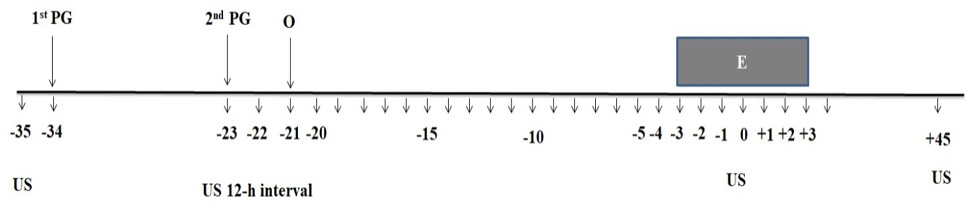
Experimental design to assess the NEDAP leg and neck logger tag variables for the estrus detection in dairy buffaloes. At day -35 transrectal ultrasonography (US) was done to determine the presence of CL on ovaries and verification of cyclicity at the start of experiment. First PGF2α injection was administered at the day -34 and then 11 days apart 2nd PGF2α injection at the day of -23 was administered and after PGF2α injection US was performed at 12-h intervals until ovulation was detected. The NEDAP leg and neck tag was attached at the day of -5 relation to day of estrus (day 0). From the day -3 to estrus onset (day 0) daily US was performed until ovulation and new CL was detected on ovaries. Insemination was done on the basis of AM: AM or PM: PM rule. Conception was determined at the day of +45 through ultrasonography.
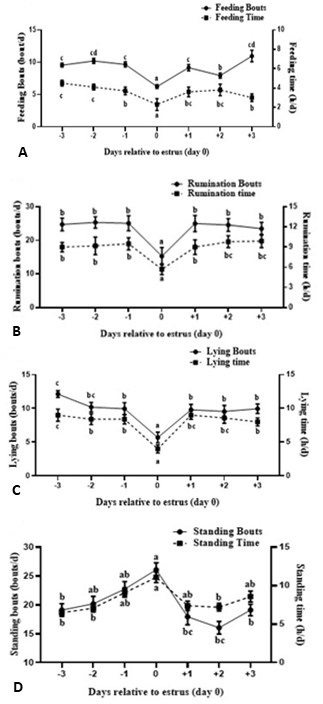
Mean±SE of the automated monitoring system behaviors for Days -3 to +3 relative to estrus (Day 0). (A) mean for feeding behaviors relative estrus; (B) mean for rumination behaviors relative to estrus; (C) mean for lying behaviors relative estrus and (D) mean for standing behaviors relative to estrus, a-c different superscripts letters show significance (P<0.01) between days.
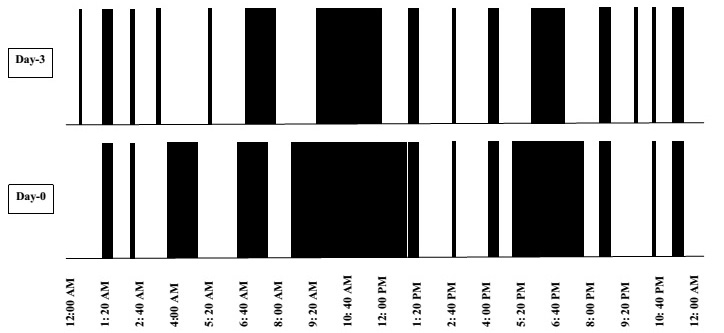
Comparison of standing (full black bar) and lying (empty bar) bouts at 3 days before estrus (Day-3) and day of estrus (Day-0) in buffaloes.
References
- Andriamandroso, A.L.H., Lebeau, F., Beckers, Y., Froidmont, E., Dufrasne, I., Heinesch, B., Dumortier, P., Blanchy, G., Blaise, Y. and Bindelle, J., 2017. Development of an open-source algorithm based on inertial measurement units (IMU) of a smartphone to detect cattle grass intake and ruminating behaviors. Comput. Electron. Agric., 139: 126–137. https://doi.org/10.1016/j.compag.2017.05.020[CrossRef]
- Aungier, S.P.M.J.F., Roche, P., Duffy, S., Scully and Crowe, M.A., 2015. The relationship between activity clusters detected by an automatic activity monitor and endocrine changes during the per estrous period in lactating dairy cows. J. Dairy Sci., 98: 1666–1684. https://doi.org/10.3168/jds.2013-7405[CrossRef]
- Bikker, J.P., Van, L., Rump, P., Doorenbos, J., Meurs, K., Griffioen, G. and Dijkstra, J., 2014. Evaluation of an ear-attached movement sensor to record cow feeding behavior and activity. J. Dairy Sci., 97: 2974–2979. https://doi.org/10.3168/jds.2013-7560[CrossRef]
- Borchers, M.R., Chang, Y.M., Proudfoot, K.L., Wadsworth, B.A., Stone, A.E. and Bewley, J.M., 2017. Machine-learning-based calving prediction from activity, lying, and ruminating behaviors in dairy cattle. J. Dairy Sci., 100: 5664–5674. https://doi.org/10.3168/jds.2016-11526[CrossRef]
- Burnett, T.A., Polsky, L., Kaur, M. and Cerri, R.L.A., 2018. Effect of estrous expression on timing and failure of ovulation of Holstein dairy cows using automated activity monitors. J. Dairy Sci., 101: 11310-11320. https://doi.org/10.3168/jds.2018-15151[CrossRef]
- Devi, I., Singh, P., Dudi, K., Lathwal, S.S., Ruhil, A.P., Singh, Y., Malhotra, R., Baithalu, R.K. and Sinha, R., 2019. Vocal cues based decision support system for estrus detection in water buffaloes (Bubalus bubalis). Comput. Electron. Agric., 162: 183–188.
- Dobson, H., Walker, S.L., Morris, M.J., Routly, J.E. and Smith, R.F., 2008. Why is it getting more difficult to successfully artificially inseminate dairy cows? Animal Europe PMC Funders, pp. 1104–1111. https://doi.org/10.1017/S175173110800236X[CrossRef]
- Dolecheck, K.A., Silvia, W.J., Heersche, G., Chang, Y.M., Ray, D.L., Stone, A.E., Wadsworth, B.A. and Bewley, J.M., 2015. Behavioral and physiological changes around estrus events identified using multiple automated monitoring technologies. J. Dairy Sci., 98: 8723–8731. https://doi.org/10.3168/jds.2015-9645[CrossRef]
- Firk, R., Stamer, E., Junge, W. and Krieter, J., 2003. Improving oestrus detection by a combination of activity measurements with information about previous oestrus cases. Livest. Prod. Sci., 82: 97–103. https://doi.org/10.1016/S0301-6226(02)00306-8[CrossRef]
- Fricke, P.M., Giordano, J.O., Valenza, A., Lopes, G., Amundson, M.C. and Carvalho, P.D., 2014. Reproductive performance of lactating dairy cows managed for first service using timed artificial insemination with or without detection of estrus using an activity-monitoring system. J. Dairy Sci., 97: 2771–2781. https://doi.org/10.3168/jds.2013-7366[CrossRef]
- Friggens, N.C. and Labouriau, R., 2010. Probability of pregnancy as affected by oestrus number and days to the first oestrus in dairy cows of three breeds and parities. Anim. Reprod. Sci., 118: 155–162. https://doi.org/10.1016/j.anireprosci.2009.08.009[CrossRef]
- Gupta, K., Shukla, S., Inwati, P. and Shrivastava, O., 2015. Fertility response in postpartum anoestrus buffaloes (Bubalus bubalis) using modified Ovsynch based timed insemination protocols. Vet. World, 8: 316. https://doi.org/10.14202/vetworld.2015.316-319[CrossRef]
- Jónsson, R., Blanke, M., Poulsen, N.K., Caponetti, F. and Højsgaard, S., 2011. Oestrus detection in dairy cows from the activity and lying data using online individual models. Comput. Electron. Agric., 76: 6-15. https://doi.org/10.1016/j.compag.2010.12.014[CrossRef]
- Kamphuis, C., DelaRue, B., Burke, C.R. and Jago, J., 2012. Field evaluation of 2 collar-mounted activity meters for detecting cows in estrus on a large pasture-grazed dairy farm. J. Dairy Sci., 95: 3045–3056. https://doi.org/10.3168/jds.2011-4934[CrossRef]
- Magsi, S.H., Haque, M.N., Ahmad, N. and Shahid, M.Q., 2018. Short communication: Stall occupancy behavior of Nili Ravi buffaloes (Bubalus bubalis) when first introduced to free-stall housing. J. Dairy Sci., 101: 1505–1510. https://doi.org/10.3168/jds.2017-13601[CrossRef]
- Mayo, L.M., Silvia, W.J., Ray, D.L., Jones, B.W., Stone, A.E., Tsai, I.C., Clark, J.D., Bewley, J.M. and Heersche, G., 2019. Automated estrous detection using multiple commercial precision dairy monitoring technologies in synchronized dairy cows. J. Dairy Sci., 102: 2645–2656. https://doi.org/10.3168/jds.2018-14738[CrossRef]
- Michaelis, I.O., Burfeind and Heuwieser, W., 2014. Evaluation of estrous detection in dairy cattle comparing an automated activity monitoring system to visual observation. Reprod. Domest. Anim., 49: 621–628. https://doi.org/10.1111/rda.12337[CrossRef]
- Reith, S. and Hoy, S., 2018. Review: Behavioral signs of estrus and the potential of fully automated systems for detection of estrus in dairy. Cattle Anim., 12: 398-407. https://doi.org/10.1017/S1751731117001975[CrossRef]
- Roelofs, J.B., Eerdenburg, F.J.C.M., Soede, N.M. and Kemp, B., 2005. Pedometer readings for estrous detection and as a predictor for the time of ovulation. Dairy Cattle Theriogenol., 64: 1690–1703. https://doi.org/10.1016/j.theriogenology.2005.04.004[CrossRef]
- Rutten, C.J.A., Velthuis, W., Steeneveld. and Hogeveen, H., 2013. Invited review: Sensors to support health management on dairy farms. J. Dairy Sci., 96: 1928–1952. https://doi.org/10.3168/jds.2012-6107[CrossRef]
- Saint-Dizier, M. and Chastant-Maillard, S., 2018. Potential of connected devices to optimize cattle reproduction. Theriogenology, 2017: 09.033. https://doi.org/10.1016/j.theriogenology.2017.09.033[CrossRef]
- Schweinzer, V., Gusterer, E., Kanz, P., Krieger, S., Süss, D., Lidauer, L., Berger, A., Kickinger, F., Öhlschuster, M., Auer, W., Drillich, M. and Iwersen, M., 2019. Evaluation of an ear-attached accelerometer for detecting estrus events in indoor housed dairy cows. Theriogenology, 2019: 02.038. https://doi.org/10.1016/j.theriogenology.2019.02.038[CrossRef]
- Senger, P.L., 1994. The estrus detection problem. New concepts, technologies, and possibilities. J. Dairy Sci., 77: 2745–2753. https://doi.org/10.3168/jds.S0022-0302(94)77217-9[CrossRef]
- Shahbaz, P., Boz, I. and Haq, S., 2020. Adaptation options for small livestock farmers having large ruminants (cattle and buffalo) against climate change in central Punjab Pakistan. Environ. Sci. Pollut. Res., 27: 17935–17948. https://doi.org/10.1007/s11356-020-08112-9[CrossRef]
- Silper, B.F., Madureira, L.B., Polsky, S., Soriano, A.F., Sica, J.L.M., Vasconcelos and Cerri, R.L.A., 2017. Daily lying behavior of lactating Holstein cows during an estrus synchronization protocol and its associations with fertility. J. Dairy Sci., 100: 8484–8495. https://doi.org/10.3168/jds.2016-12160[CrossRef]
- Silper, B.F.I., Robles, A.M.L., Madureira, T.A., Burnett, M., Reis, A.M., Passillé, J., Rushen, and Cerri, R.L.A., 2015. Automated and visual measurements of estrous behavior and their sources of variation in Holstein heifers. I: Walking activity and behavior frequency. Theriogenology, 84: 312–320. https://doi.org/10.1016/j.theriogenology.2014.12.029[CrossRef]
Services
Article usage statistics
Loading…