This study compared the reproductive performance of Bali cattle synchronized using two estrus synchronization protocols, Short-Synch and Heat-Synch, by evaluating estrus expression, reproductive tract characteristics, and key reproductive performance indicators.
The lack of marked differences in fertility outcomes suggests that both Short-Synch and Heat-Synch are viable options for estrus synchronization in Bali cattle with normal reproductive status.
This study showed that Short-Synch and Heat-Synch protocols were equally effective in synchronizing estrus in cows, with both achieving 100% estrus response and yielding comparable estrus intensity, reproductive tract measurements, and reproductive performance indicators.
Although Heat-Synch produced a larger corpus luteum and slightly higher estrus intensity, these differences did not result in improved fertility outcomes.
Selected from the article's own text.
Abstract
Reproductive efficiency plays a crucial role in determining productivity in cattle production systems, particularly in indigenous breeds such as Bali cattle. Estrus synchronization protocols are commonly applied to improve reproductive management and enhance the accuracy of artificial insemination (AI). This study compared the effectiveness of two synchronization protocols, Short-Synch and Heat-Synch, in Bali cows by evaluating estrus response, estrus intensity, reproductive tract characteristics, and reproductive performance. Sixteen Bali cows were divided evenly into two groups: Short-Synch (n = 8) and Heat-Synch (n = 8). The Short-Synch protocol consisted of PGF₂α administration on Day 0, GnRH on Day 2, and timed AI (TAI) on Day 3, whereas Heat-Synch involved GnRH on Day 0, PGF₂α on Day 7, estradiol cypionate (ECP) on Day 8, and TAI on Day 9. Observed parameters included estrus expression, cervix, uterus, follicle and corpus luteum diameters, services per conception (S/C), days open, and the calving–first insemination interval. Both protocols resulted in a 100% estrus response, indicating equal effectiveness in inducing estrus. Estrus intensity was slightly higher in the Heat-Synch group, though not significantly different. While most reproductive tract measurements showed no variation between treatments, corpus luteum diameter was significantly larger in cows receiving Heat-Synch (p < 0.05), suggesting improved luteal development. Despite this physiological difference, S/C, days open, and calving–first insemination interval did not differ significantly between groups. Overall, the results demonstrate that Short-Synch and Heat-Synch yield comparable reproductive outcomes in Bali cattle, allowing protocol selection to be guided by practical considerations such as duration, hormone use, and desired estrus expression.
Reproductive efficiency plays a crucial role in the sustainability and productivity of cattle production systems. The ability to manage and optimize reproductive events, particularly estrus expression and conception, is essential for improving calving intervals, enhancing genetic progress, and increasing overall herd productivity. One of the most widely adopted reproductive technologies to support these goals is estrus synchronization, which allows for controlled breeding and improves the precision of artificial insemination (AI) programs ; . Synchronization protocols are designed to manipulate the estrous cycle through exogenous hormonal administration, enabling producers to increase reproductive efficiency while reducing labor and variability associated with natural estrus detection.
GnRH- and prostaglandin-based protocols, such as Ovsynch and its derivatives, have been extensively used to synchronize follicular waves and ensure timely ovulation . However, variations in estrus intensity, ovulatory response, and ultimate fertility outcomes have driven interest in alternative protocols that incorporate estradiol compounds to enhance behavioral estrus expression. The Heat-Synch protocol, which combines GnRH, PGF₂α, and estradiol cypionate (ECP), has demonstrated the ability to improve observable estrus signs and potentially enhance insemination timing accuracy . In contrast, simplified PGF₂α–GnRH combinations, such as the Short-Synch protocol, focus on strategic synchronization of luteolysis and ovulation while maintaining fewer hormonal interventions and shorter treatment duration .
The effectiveness of these protocols can vary depending on breed, physiological status, management conditions, and expression of estrus behavior. This is particularly relevant for Bali cattle (Bos javanicus), an indigenous Indonesian breed known for its adaptability, disease resistance, and importance in smallholder farming systems, but which often exhibits suboptimal reproductive performance under traditional management . Observable estrus signs such as standing heat, mucus discharge, and mounting activity remain critical indicators for optimal insemination timing, especially in systems relying on visual estrus detection . Differences in follicular development, corpus luteum function, and uterine tone between synchronization protocols may also influence fertility outcomes, including services per conception, days open, and the interval from calving to first insemination .
Comparative studies evaluating short-synch and heat-synch protocols remain limited, particularly under field conditions and in indigenous breeds such as Bali cattle with varying reproductive histories. Understanding how these protocols influence estrus expression, reproductive tract characteristics, and fertility indicators in Bali cattle can support more precise recommendations for improving reproductive efficiency in this locally important genetic resource .
Therefore, the objective of this study was to compare the short-synch and heat-synch protocols in Bali cattle by evaluating estrus response, estrus intensity, reproductive tract measurements, and key reproductive performance indicators. The findings from this research are expected to contribute to the selection of effective and practical synchronization strategies that support improved reproductive management in Bali cattle and, more broadly, in tropical cattle production systems .
MATERIALS AND METHODS
Ethical approval and experimental design
This study involved a total of 16 Bali cows were used in this experiment and assigned into two treatment groups: Short-Synch (T1, n = 8) and Heat-Synch (T2, n = 8). All cows were clinically healthy, with normal reproductive status, regular estrus cycles (18–24 days), at least one previous calving, and free from reproductive disorders. Body Condition Score (BCS) ranged from 2.5 to 3.5 (scale 1–5). Reproductive tract status (uterus, cervix, ovaries) was confirmed through rectal palpation. Cows were maintained in a free-stall housing system and were fed chopped forage at 10% of body weight twice daily supplemented with concentrate at 1% of body weight . All experimental procedures complied with ethical standards and were approved by the Ethics Committee of the Faculty of Animal Science, Hasanuddin University, under approval number 11/UN4.12/EC/V/2025.
Synchronization treatments
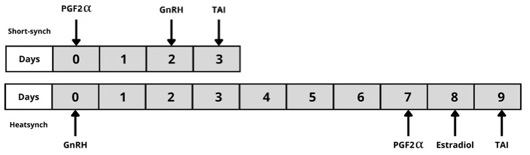
Two estrus synchronization protocols were applied in this study, namely Short-Synch (T1) and Heat-Synch (T2), as illustrated in Figure 1. The Short-Synch protocol was initiated with an intramuscular administration of prostaglandin F₂α (PGF₂α) on Day 0. This was followed by an intramuscular injection of gonadotropin-releasing hormone (GnRH) on Day 2, and timed artificial insemination (TAI) was performed on Day 3. The Heat-Synchprotocol began with an intramuscular injection of GnRH on Day 0. On Day 7, cows received PGF₂α to induce luteolysis, followed by an estradiol cypionate (ECP) injection on Day 8 to enhance estrus expression. Timed artificial insemination was subsequently performed on Day 9 .
Estrus detection for both synchronization methods was conducted twice daily based on behavioral and physical signs, including standing heat, mounting activity, vulvar swelling, and mucus discharge. All hormonal administrations and insemination procedures were carried out by trained and experienced technicians following established reproductive management guidelines .
Estrus observation
Estrus detection was performed twice daily, in the morning and evening, following the completion of each synchronization protocol. Cows were observed for behavioral and physical signs indicative of estrus, including standing heat, mounting and allowing to be mounted, restlessness, vulvar swelling, and the presence of clear cervical mucus, which were used as observational criteria to determine estrus response and estrus intensity rather than being recorded as individual outcome variables. Estrus response was recorded as positive when one or more characteristic signs were present. Estrus intensity was evaluated using a three-point scoring system, where a score of 1 indicated mild estrus, 2 indicated moderate estrus, and 3 represented strong estrus expression. All observations were conducted by trained personnel with experience in estrus detection to ensure consistency and accuracy .
Reproductive tract examination
Reproductive tract examinations were conducted to evaluate uterine and ovarian characteristics associated with the estrus response and reproductive performance of the cows. Examinations were performed through rectal palpation by experienced technicians following standard reproductive assessment procedures. Measurements included the diameter of the cervix, uterus, dominant follicle, and corpus luteum, recorded in centimeters. These measurements were intended to allow comparative evaluation of reproductive tract status between synchronization protocols rather than to assess individual pre- and post-treatment changes. These evaluations were carried out during the peri-estrus period or at the time closest to insemination to ensure accurate assessment of reproductive status .
The cervix and uterus were palpated to determine tone, size, and diameter as indicators of estrus readiness during the peri-estrus period and used for descriptive comparison between treatments. Ovarian structures were examined to identify and measure dominant follicles and corpus luteum formation, which provided information on follicular development and ovulation status based on the presence and size of ovarian structures at the time of examination rather than direct confirmation of ovulation. Although rectal palpation was used, all reproductive tract parameters were quantitatively recorded and expressed as numerical values for subsequent statistical comparison. All measurements were obtained carefully to avoid excessive manipulation of reproductive organs, and each parameter was recorded immediately after examination to ensure data accuracy and traceability .
Reproductive performance evaluation
Reproductive performance was assessed to determine the effectiveness of the Short-Synch and Heat-Synch protocols in improving fertility outcomes. Several performance indicators were recorded, including service per conception (S/C), days open, and the calving–first insemination interval. These parameters were obtained from farm reproductive records and confirmed through direct observation during the study .
Service per conception (S/C) was defined as the number of insemination attempts required for a cow to achieve pregnancy. Days open referred to the interval between calving and the establishment of a successful conception, while the calving–first insemination interval represented the number of days from the last calving to the first artificial insemination performed as part of this study. Pregnancy diagnosis was conducted through rectal palpation between 45 and 60 days post-insemination to confirm conception status .
Statistical analysis
All data obtained from the study were analyzed using SPSS software (Version 26, IBM Corp., Armonk, NY, USA). Prior to statistical comparisons, data were tested for normality using the Shapiro–Wilk test. Variables that met the assumptions of normal distribution were analyzed using an unpaired t-test to compare mean differences between the Short-Synch and Heat-Synch treatment groups. In cases where the data did not follow a normal distribution, comparisons were performed using the Mann–Whitney U test. Categorical variables, such as estrus response (+/–), were analyzed using a Chi-square test to determine differences in estrus expression between treatments. All results were presented as mean ± standard deviation (SD), and statistical significance was established at p < 0.05 .
RESULTS
Estrus response and estrus intensity of Bali cattle
Estrus response following synchronization was 100% in both treatment groups, with all cows in the Short-Synch (T1) and Heat-Synch (T2) protocols exhibiting signs of estrus (Table 1). Mean estrus intensity scores were numerically higher in cows synchronized with the Heat-Synch protocol (3.0 ± 0.00) compared with those in the Short-Synch group (2.8 ± 0.35); however, this difference was not statistically significant (p = 0.317).
Table 1: Estrus response and estrus intensity of Bali cattle synchronized using short-synch and heat-synchprotocols.
Parameter
Treatment
Shortsynch
Heatsynch
Estrus response (+, %)
8 (100%)
8 (100%)
Estrus intensity (score)
2.8 ± 0.35
3.0 ± 0.00
Reproductive tract measurements of Bali cattle
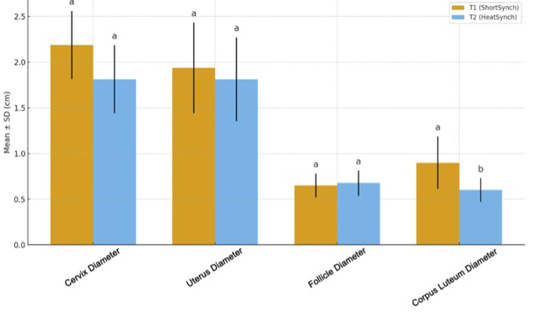
Reproductive tract measurements for Bali cattle synchronized using the Short-Synch and Heat-Synch protocols are presented in Figure 2. Cervix diameter was similar between treatments, with T1 averaging 2.00 ± 0.44 cm and T2 averaging 2.06 ± 0.42 cm. Uterus diameter also showed minimal variation, with mean values of 1.90 ± 0.49 cm in T1 and 1.87 ± 0.44 cm in T2, indicating no appreciable difference between protocols. Follicle diameter tended to be slightly larger in cows treated with Heat-Synch (0.74 ± 0.11 cm) compared with Short-Synch (0.68 ± 0.10 cm), although this difference was not statistically significant (p > 0.05). In contrast, corpus luteum diameter differed significantly between treatments, with T1 showing a mean of 0.86 ± 0.35 cm and T2 showing 1.01 ± 0.29 cm (p < 0.05).
Reproductive performance indicators of bali cows
Reproductive performance indicators for Bali cattle synchronized using the Short-Synch (T1) and Heat-Synch (T2) protocols are shown in Table 2. The number of services per conception (S/C) was slightly lower in T1 (1.50 ± 0.93) than in T2 (1.75 ± 1.04), although this difference was not statistically significant (p = 0.619). Days open also tended to be shorter in cows assigned to the Short-Synch protocol (237.88 ± 103.76 days) compared with those in the Heat-Synchgroup (287.00 ± 97.42 days), but again the difference was not significant (p = 0.346). Similarly, the calving–first insemination interval was numerically lower in T1 (215.38 ± 114.63 days) than in T2 (247.25 ± 109.83 days), with no significant difference between treatments (p = 0.579). These results indicate that, despite minor numerical advantages for Short-Synch, both synchronization protocols yielded comparable reproductive performance under the conditions of this study.
Table 2: Reproductive performance indicators of Bali cattle synchronized using short-synch and heat-synchprotocols.
Parameter
Treatment
p value
Short-synch
Heat-synch
Service per conception (S/C)
1.50 ± 0.93
1.75 ± 1.04
0.619
Interval from calving to conception (d)
237.88 ± 103.76
287.00 ± 97.42
0.346
Interval from calving to AI (d)
215.38 ± 114.63
247.25 ± 109.83
0.579
DISCUSSION
This study compared the reproductive performance of Bali cattle synchronized using two estrus synchronization protocols, Short-Synch and Heat-Synch, by evaluating estrus expression, reproductive tract characteristics, and key reproductive performance indicators. The overall findings indicate that both protocols were effective in inducing estrus and supporting acceptable levels of fertility under field conditions in this indigenous breed.
The 100% estrus response observed in both groups demonstrates that the hormonal regimens applied in this study were highly effective in inducing estrus in cyclic Bali cows. This agrees with previous reports showing that PGF₂α–GnRH–based protocols and estradiol-containing protocols can reliably synchronize estrus when cows have functional corpora lutea and regular ovarian cycles ; . The similar estrus response also suggests that the animals used in the present study had adequate reproductive status and luteal sensitivity to prostaglandin.
Although estrus intensity scores were numerically higher in cows treated with the Heat-Synch protocol, the difference was not statistically significant. Estradiol cypionate, included in the Heat-Synch program, is known to enhance behavioral estrus by stimulating neural pathways associated with standing heat and mounting behavior . The tendency toward stronger estrus expression in the Heat-Synch group is therefore consistent with the known pharmacological effects of estradiol. However, because this difference did not reach statistical significance, it suggests that the luteolytic and ovulatory control achieved by Short-Synch was already sufficient to produce clear estrus signs in most Bali cattle under the present management conditions .
Reproductive tract measurements showed minimal differences between Short-Synch and Heat-Synch, with cervix, uterus, and follicle diameters being comparable between groups. This indicates that both protocols were able to establish similar uterine and ovarian conditions at the time of estrus and insemination in Bali cattle. Interestingly, corpus luteum diameter was significantly greater in cows synchronized with the Heat-Synch protocol compared with those in the Short-Synch group. Larger corpus luteum size is often associated with higher progesterone production and improved uterine receptivity . It is possible that the estradiol component of Heat-Synch contributed to more synchronized ovulation or enhanced luteal development; however, the absence of a corresponding improvement in fertility outcomes suggests that this difference in CL size alone was not sufficient to markedly influence conception rates under the conditions of this study. Overall, these findings indicate that while most reproductive anatomical parameters were comparable between synchronization methods, corpus luteum development was influenced by the protocol applied .
The reproductive performance indicators services per conception, days open, and the calving–first insemination interval did not differ significantly between Short-Synch and Heat-Synch. Although the Short-Synch group showed numerically lower values for all three parameters, these differences were small and not statistically significant. Similar findings have been reported in other studies where modifications to synchronization protocols improved certain physiological or behavioral responses but did not necessarily translate into higher pregnancy rates . Fertility in cattle, including Bali cattle, is inherently multifactorial and can be influenced by oocyte quality, sperm fertility, insemination timing, nutritional status, and postpartum uterine health, which may overshadow modest differences between synchronization schemes.
The lack of marked differences in fertility outcomes suggests that both Short-Synch and Heat-Synch are viable options for estrus synchronization in Bali cattle with normal reproductive status. Short-Synch has the advantage of a shorter treatment interval and fewer hormonal administrations, which may be beneficial from a management and cost perspective, particularly in smallholder systems where Bali cattle are commonly raised. In contrast, Heat-Synch offers the benefit of enhanced estrus expression due to the inclusion of estradiol, which may be particularly useful in systems that rely heavily on visual estrus detection. Nevertheless, regulatory restrictions on estradiol use in some regions must be considered when selecting an appropriate protocol for field application .
This study has several limitations that should be acknowledged. The relatively small sample size limits the statistical power to detect subtle differences between protocols. Furthermore, hormonal profiling (e.g., circulating progesterone and estradiol concentrations) was not conducted, which would have provided deeper insight into the endocrine mechanisms underlying the observed responses in Bali cattle. Future research involving larger herds, detailed hormonal monitoring, and the inclusion of multiple parities and breeds would help to clarify the conditions under which one protocol may be favored over the other and to determine whether the present findings can be generalized beyond Bali cattle (Evan et al., 2022).
Short-Synch and Heat-Synch protocols both proved effective in synchronizing estrus and supporting acceptable reproductive performance in Bali cattle. While Heat-Synch was associated with stronger estrus expression and larger corpus luteum size, these physiological differences did not result in superior fertility outcomes compared with Short-Synch. The choice between these protocols may therefore be guided primarily by practical considerations, including management preferences, drug availability, regulatory constraints, and the need for enhanced estrus expression in specific Bali cattle production systems .
CONCLUSION
This study showed that Short-Synch and Heat-Synch protocols were equally effective in synchronizing estrus in cows, with both achieving 100% estrus response and yielding comparable estrus intensity, reproductive tract measurements, and reproductive performance indicators. Although Heat-Synch produced a larger corpus luteum and slightly higher estrus intensity, these differences did not result in improved fertility outcomes. Both protocols can therefore be considered reliable options for estrus synchronization, and the choice between them may be based primarily on practical factors such as protocol duration, ease of application, and regulatory considerations rather than clear differences in reproductive efficiency.
ACKNOWLEDGEMENTS
The first author is a doctoral student and supported by Beasiswa Pendidikan Indonesia (BPI) No. 202209092736 Ministry of Education, Culture, Research, and Technology and Lembaga Pengelola Dana Pendidikan (LPDP) Ministry of Finance, Republic of Indonesia.
Novelty Statement
This study highlights the practical value of the Short-Synch protocol in Bali cattle by demonstrating that it produces reproductive outcomes comparable to those of Heat-Synch, despite requiring a shorter treatment duration and fewer hormonal administrations. This finding supports Short-Synch as a simpler and more efficient synchronization option for field application, particularly in production systems where treatment time, hormone use, and management practicality are important considerations.
AUTHOR’S CONTRIBUTION
A. Fausiah has contributed in conception and design the study, collecting and data analysis, and drafted the manuscript; A.L Toleng supervised the experiments, and drafted the manuscript; M. Yusuf collecting and data analysis, and drafted the manuscript; L. Rahim have contributed in conception and design the study; A.M. Diansyah have contributed in collecting and data analysis and improvement of the manuscript.
Generative AI and AI assisted technology statement
The authors declare that no generative AI and AI assisted technology was used in the creation of this manuscript.
Statement of conflict of interest
The authors have declared no conflict of interest.
Figures
Figure 1:.
Illustration of the short-synch (upper line) and heat-synch (lower line) estrus synchronization protocols applied in this study, showing the sequence and timing of hormonal treatments and timed artificial insemination (TAI).
Figure 2:.
Reproductive tract measurements in Bali cattle synchronized using the short-synch and heat-synch protocols.
References
Adam AAS, Yusuf M, Sahiruddin S, Diansyah, AM, Alfian AM, Masturi M, Said S (2025). Development Potential of Bali Cattle in South Sulawesi: A Study on Population Structure and Management System. In BIO Web of Conferences, Vol. 189: 01013. EDP Sciences. https://doi.org/10.1051/bioconf/202518901013[CrossRef]
Arya D, Goswami R, Sharma M (2023). Estrous synchronization in cattle, sheep and goat. Multidis. Rev., 6(1): 2023001. https://doi.org/10.31893/multirev.2023001[CrossRef]
Ayantoye JO, Kolachi HA, Zhang X, Shahzad M, Kandil OMT, Wan P, Zhao X (2025). Advances in timed artificial insemination: integrating omics technologies for enhanced reproductive efficiency in dairy cattle. Animals, 15(6): 816. https://doi.org/10.3390/ani15060816[CrossRef]
Bihon A, Assefa A (2021). Prostaglandin based estrus synchronization in cattle: A review. Cogent Food Agric., 7(1): 1932051. https://doi.org/10.1080/23311932.2021.1932051[CrossRef]
Cardoso Consentini CE, Wiltbank MC, Sartori R (2021). Factors that optimize reproductive efficiency in dairy herds with an emphasis on timed artificial insemination programs. Animals, 11(2): 301. https://doi.org/10.3390/ani11020301[CrossRef]
Cox JF, Navarrete F, Bocic A, Saravia F, Dorado J (2025). Effects of phase-specific GnRH administration on ovarian functional markers, ovulation timing, and fertility in estrous-synchronized ewes. Front. Vet. Sci., 12: 1683330. https://doi.org/10.3389/fvets.2025.1683330[CrossRef]
Demont K, Webb EC, Treadwell R, Masenge A (2025). The effects of environmental and management factors on the quality of the corpus luteum and subsequent conception rates of beef and dairy cows in South Africa. Life, 15(11): 1687. https://doi.org/10.3390/life15111687[CrossRef]
Diansyah AM, Yusuf M, Toleng AL, Hasrin H, Rahmat R, Amrullah MF, Alfian AM, Adam AAS (2025). Identification of fertility rates in swamp buffalo heifers through reproductive tract score and cervical mucus analysis. J. Anim. Health Prod., 13(3): 760-767. https://doi.org/10.17582/journal.jahp/2025/13.3.760.767[Full text][CrossRef]
Ermawati D, Panjono BS, Agus A, Widyobroto BP, Yudistyra B, Mustofa R, Hartatik T (2024). Estrus signs and estrogen levels in brahman cross and first-generation (F1) crossbred cattle: implications for pregnancy and repeat mating. Adv. Anim. Vet. Sci., 12(11): 2293-2300. https://doi.org/10.17582/journal.aavs/2024/12.11.2293.2300[Full text][CrossRef]
Gaude I, Kempf A, Strüve KD, Hoedemaker M (2021). Estrus signs in Holstein Friesian dairy cows and their reliability for ovulation detection in the context of visual estrus detection. Livest. Sci., 245: 104449. https://doi.org/10.1016/j.livsci.2021.104449[CrossRef]
Hariyono D, Panjono P, Priyadi D, Rastosari A, Endrawati E, Hartatik T (2025). Reproductive performances of Bali cattle under different management systems for designing their breeding strategies. Thai J. Vet. Med., 55(1): 1-15. https://doi.org/10.56808/2985-1130.3814[CrossRef]
Hassanein EM, Szelényi Z, Szenci O (2024). Gonadotropin-releasing hormone (GnRH) and its agonists in bovine reproduction I: Structure, biosynthesis, physiological effects, and its role in estrous synchronization. Animals, 14(10): 1473. https://doi.org/10.3390/ani14101473[CrossRef]
Liu S, Gao Y, Canela-Xandri O, Wang S, Yu Y, Cai W, Fang L (2022). A multi-tissue atlas of regulatory variants in cattle. Nat. Genet., 54(9): 1438-1447. https://doi.org/10.1038/s41588-022-01153-5[CrossRef]
Mansur M, Diansyah AM, Rahmat R, Amrullah MF, Alfian AM, Adam AAS, Nurlatifah A (2025). Reproductive disorders in Simmental cattle: Enhancing fertility through a hormonal protocol. Open Vet. J., 15(5): 2112–2121. https://doi.org/10.5455/OVJ.2025.v15.i5.29[CrossRef]
Murdzeva E, Nikolovski M, Tokin S, Mickov L, Ilievska K, Dimitrovski Z, Esmerov I, Dovenski T, Atanasov B (2025). Short Synch-a reproductive management tool to increase the reproductive performance in dairy cows. Macedonian Vet. Rev., 48(1): 31-37. https://doi.org/10.2478/macvetrev-2025-0013[CrossRef]
Omar ME, Hassanein EM, Shehabeldin AM, Szenci O, El-Shereif AA (2025). Evaluating the impact of minimized GnRH and PGF2α analogues-loaded chitosan nanoparticles on ovarian activity and fertility of heat-stressed dairy cows. Pharmaceutics, 17(2): 274. https://doi.org/10.3390/pharmaceutics17020274[CrossRef]
Pasha MMH, Moniruzzaman M, Islam MN, Alam MH, Das SK (2021). Estrus synchronization of native buffaloes using PGF2α and GnRH based protocols in Bangladesh. Bangladesh J. Livest. Res., 28(1&2): 50-60. https://doi.org/10.3329/bjlr.v28i1.72057[CrossRef]
Przygrodzka E, Plewes MR, Davis JS (2021). Luteinizing hormone regulation of inter-organelle communication and fate of the corpus luteum. Int. J. Mol. Sci., 22(18): 9972. https://doi.org/10.3390/ijms22189972[CrossRef]
Purba FY, Ayub M, Putra MRT, Sari DK, Nurdin MA, Ariyandy A, Yusuf S (2025). Hematological and serum biochemical profiles at the time of artificial insemination based on pregnancy outcomes in repeat breeder beef cows. Open Vet. J., 15(6): 2602. https://doi.org/10.5455/OVJ.2025.v15.i6.31[CrossRef]
Reineri PS, Bernhard SDR, Principi SA, Gerlero GD, Aller JF (2023). Effects of two protocols of ovulation synchronization on corpus luteum size and blood flow, progesterone concentration, and pregnancy rate in beef heifers. Anim. Reprod. Sci., 251: 107223. https://doi.org/10.1016/j.anireprosci.2023.107223[CrossRef]
Rivero MJ, Lopez-Villalobos N, Evans A, Berndt A, Cartmill A, Neal AL, Lee MR (2021). Key traits for ruminant livestock across diverse production systems in the context of climate change: Perspectives from a global platform of research farms. Reprod. Fertil. Dev., 33(2): 1-19. https://doi.org/10.1071/RD20205[CrossRef]
Sales A, Cappellozza BI, Vilela E, Júnior IC, Sá Filho OG, Vasconcelos JLM (2023). Effects of estradiol cypionate dosage and body condition on reproductive performance of Nellore cattle synchronized for timed-artificial insemination. Theriogenology, 210: 207-213. https://doi.org/10.1016/j.theriogenology.2023.07.032[CrossRef]
Santos BB, Franco FL, Martins IR, Linhares IP, Silva GZ, CM Filho W (2025). D-cloprostenol and dinoprost tormetamine at the time of artificial insemination in Nelore heifers: Luteal dynamics and pregnancy rate. https://doi.org/10.21203/rs.3.rs-6508312/v1[CrossRef]
Sharifuzzaman M, Mun HS, Ampode KMB, Lagua EB, Park HR, Kim YH, Yang CJ (2024). Technological tools and artificial intelligence in estrus detection of sows. A comprehensive review. Animals, 14(3): 471. https://doi.org/10.3390/ani14030471[CrossRef]
Vásquez TRW, Hernández-Guevara JE, Depaz-Hizo BA, Ampuero-Trigoso G, Poclín-Rojas AY, Rojas-Reategui M, Quispe-Ccasa HA (2025). Efficacy of two estrus synchronization protocols in crossbred gyr dairy cows and their relationship with heat stress in the peruvian tropics. Vet. Sci., 12(9): 804. https://doi.org/10.3390/vetsci12090804[CrossRef]
Yu X, Bai Y, Yang J, Zhao X, Zhang L, Wang J (2022). Comparison of five protocols of estrous synchronization on reproductive performance of Hu sheep. Front. Vet. Sci., 9: 843514. https://doi.org/10.3389/fvets.2022.843514[CrossRef]
Yusuf M, Toleng AL, Hasrin H, Baharun A, Diansyah AM, Santoso S, Rahmat R (2024). The reproductive tract score and characteristic of cervical mucus on fertility rate of Bali heifers. Adv. Anim. Vet. Sci., 12(12): 2403-2409. https://doi.org/10.17582/journal.aavs/2024/12.12.2403.2409[Full text][CrossRef]
Zhang L, Guo W, Lv C, Guo M, Yang M, Fu Q, Liu X (2024). Advancements in artificial intelligence technology for improving animal welfare: Current applications and research progress. Anim. Res. One Health, 2(1): 93-109. https://doi.org/10.1002/aro2.44[CrossRef]