Research Article · Volume 12, Issue 5, 16 March 2024 · Open Access
Responses of Ovarian Activity of Dairy Holstein Friesian Heifers after Synchronized Using Heasynch and Select Synch Protocols
· · · · · · ·
Affiliations & Notes ⌄
1Laboratory of Animal Reproduction, Department of Animal Production Faculty of Animal Science Hasanuddin University, Jl. Perintis Kemerdekaan KM. 10 Makassar, Indonesia
2Animal Husbandry Study Program, Faculty of Science and Technology, Muhammadiyah Sidenreng Rappang University, Sidenreng Rappang, 91651, Indonesia
3Livestock and Animal Health Services, West Papua Province, Jl. Abraham Atururi, Manokwari 98315, Indonesia
4Sub-Laboratory of Animal Physiology and Reproduction Faculty of Animal Science Papua University, Kabupaten Manokwari, Papua Barat. 98314, Indonesia. *Correspondence | Muhammad Yusuf, Laboratory of Animal Reproduction, Department of Animal Production Faculty of Animal Science Hasanuddin University, Jl. Perintis Kemerdekaan KM. 10 Makassar, Indonesia
The objective of this study was to determine the ovarian responses of dairy heifers after treated with estrous synchronization using Heasynch and Select Synch protocols. The study was conducted in Maiwa Breeding Centre (MBC) Farm of Hasanuddin University. A total of 18 dairy Holstein Friesian heifers were used in the present study. The heifers were then divided into two groups based on different treatments of estrous synchronization. All heifers were examined for ovarian activities prior to synchronize the estrus then subjected to either Heasynch or Select Synch protocols. The results of this study showed that inactive ovaries of dairy heifers were relatively higher in comparison to both follicular and luteal phases (58% vs. 26% and 16%). After treating the heifers with either Heatsynch or Select-synch protocols for synchronizing the estrus, all animals become estrus as predicted in advance. The mean interval from PGF2α injection to onset of estrus was 42 and 43 h (P>0.05) in Heatsynch and Select-synch protocols, respectively. However, the mean duration of estrus in dairy heifers synchronized using Heatsynch protocol was 25.1 h, significantly higher (P=0.029) than the mean duration of estrus (19.5 h) in Select Synch protocol. It can be concluded that dairy Holstein Friesian heifers synchronized with both the Heatsynch and Select Synch protocols had a good response in synchronizing the estrus regardless of the condition of the ovaries.
In general, many dairy farming businesses in Indonesia have been implemented, although they are still partial and mostly on the island of Java. However, domestic milk production is still below 30% for all the needs, so imports of domestic milk raw materials are needed. One of the reasons for the low milk production is that the dairy cattle population is still low. On the other hand, the existing of dairy cattle population generally still has low reproductive efficiency, resulting in delayed calving which ultimately also delays lactation and milk production. Our previous studies concluded that high incidence of reproductive disorders reduced reproductive performance of the dairy cattle ; . Furthermore, the other problem in the region is delay heifers becoming pregnant in an optimum time.
The reproductive efficiency problems mentioned above include the slow rate at which heifers become pregnant which causes delays in milk production. Heifers generally show their first heat at puberty at the age of 9 to 13 months and should become pregnant at the age of 15 months and calving for the first time at the age of 24 months . However, this is difficult to achieve if there are reproductive disorders in cattle. The problem of reproductive disorders in dairy cattle which causes low reproductive efficiency can be caused by poor management, in terms of feeding, rearing environment, housing sanitation, disease prevention, and late weaning of calves . Especially for heifers, the result can prolong the interval between puberty and pregnancy.
Several objective conditions that have been reported in previous studies mean that it is difficult for heifers to reach the optimal level for the first pregnancy in relation to the time. Therefore, this study is one solution in the dairy farming business. Failure in pregnancy in dairy cattle can occur due to failure to show heat, ovulation, inappropriate ovarian cycle patterns, and death of the embryo/fetus . Even though fertility in heifers is higher than in dairy cows , efforts to maximize the reproductive level of dairy cows can still be increased by using heat induction or ovulation induction technology. Improving reproductive management through the introduction of external reproductive hormones could be a solution in accelerating pregnancy in dairy cattle. The reproductive hormones used in estrus synchronization in this study were prostaglandin hormones (PGF2α), GnRH, and estrogen . Therefore, the aim of this study was to determine the ovarian response of dairy heifers which makes it possible to accelerate pregnancy in these animals. The administration of these hormones was intended to speed up the estrus of heifers which can ultimately be mated. Thus, the specific aim of this study was to accelerate and increase the calving rate in dairy heifers.
MATERIALS AND METHODS
Animals and herd management
The study was conducted in Maiwa Breeding Centre (MBC) in Enrekang Regency of South Sulawesi Province, Indonesia. A total of 18 dairy Holstein Friesian heifers aged >24 months and body weight ranging from 280 to 320 kg was using in the present study. Heifers in the herd were housed in an individual tie-stall barns throughout the year with an exercise area for resting. Feedstuffs consisted of grass and chopped-elephant grass, concentrate and multi-mineral supplements. However, administration of concentrate as well as multi-mineral supplements in the herd were supplied during two months before initiation of estrous synchronization due to low BCS condition of the heifers that suffered from hot season.
Clinical examination of dairy heifers
All dairy heifers were subjected to clinical examinations following the procedures performed by Gautam et al. (2009) and Yusuf et al. (2011). Before clinical examination, all dairy heifers were scored for their body condition individually following the procedure of Edmonson et al. (1989). Clinical examinations in dairy heifers were conducted both vaginoscopy and palpation per rectum. Vaginoscopy examination was intended to observe the condition of reproductive tracts sucs vaginal wall and opening of the cervix. This examination was performed using a silinder glass vaginoscope and lighting to explore the condition of heifers’ reproductive tract until the cervix. First, the condition of the heifers was checked and the presence of fresh mucus on the vulva or tail. The vulva was washed using water then wiped using a clean tissue then sprayed with 2% PVP-Iodine and wiped again using 70% alcohol cotton. Trans-rectal palpation and/or ultrasound examination of the reproductive organs were performed to assess the condition and structure of the ovaries. Ovaries with a corpus luteum (CL) structure greater than 10 mm in diameter with or without follicles were considered as luteal phase. However, if there was no CL structure but with follicles greater than 10 mm, it was considered as the follicular phase. Ovaries with no structures or follicles less than 10 mm in diameter or CL were considered as inactive ovaries. The heifers that did not show any disturbances for these vaginoscopy and palpation per rectum examinations were then subjected to the treatment for estrus synchronization.
Synchronization of estrus and artificial insemination (AI)
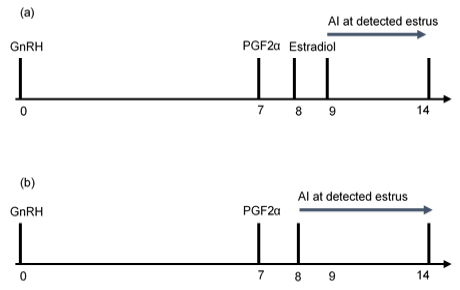
The dairy heifers that were passed both vaginoscopy and palpation per rectum examinations were then randomly treated either heatsynch or select synch protocols to synchronize the estrus. Due to very low BCS, out of 18 heifers examined, 3 heifers were excluded from the treatment. Of 15 heifers, 7 and 8 heifers were subjected to Heatsynch and Select Synch protocols, respectively. The protocols using in the study are shown in Figure 1. At the beginning of treatment, all heifers were injected GnRH; 0.5 mg gonadorelin (FERTAGYL®) followed by PGF2α; 500 µg of cloprostenol (Juramate) injection on day-7 after GnRH injection. On day-8, those heifers were then injected Ethinyl estradiol 100.000 IU (Ovalumon) (Heatsynch protocol). Detection of estrous was conducted starting on day-9 and AI was performed to the heifers detected in estrous. For Select Synch protocol, the treatment were similar to the Heatsynch protocol without estradiol injection (Figure 1). However, detection of estrous was started on day-8 and AI was conducted to the heifers detected in estrous.
Duration of estrus
Duration of estrus was defined as the interval from the onset of estrus until the end of estrus. Estrus of each heifer was observing every 4 h. When the heifers were showing estrus at the time of observation, onset of estrus were considered 2 h before. Likewise, when estrus were not showing estrus at the time of observation, the end of estrus were considered 2h before observation .
Parameters of the study
Parameters measured in the study were:
Ovarian activity of dairy heifers prior to estrus synchronization;
Interval from PGF2α injection to onset of estrus at different estrus synchronization protocols; and
Duration of estrus in dairy heifers at different estrus synchronization protocols.
Data analyses
All data obtained in the present study were tabulated in Excel program for Windows. Percentages of ovarian activities in dairy heifers such as follicular and luteal phases as well as inactive ovary were calculated using Excel program. Interval from PGF2α injection to onset of estrus and duration of estrus in dairy heifers between Heatsynch and Select Synch protocols were compared using t-test: Two-Sample Assuming Equal Variances. Significance level of P≤0.05 was considered different between the two groups of treatments.
RESULTS AND DISCUSSION
Ovarian activity of dairy heifers prior to estrus synchronization
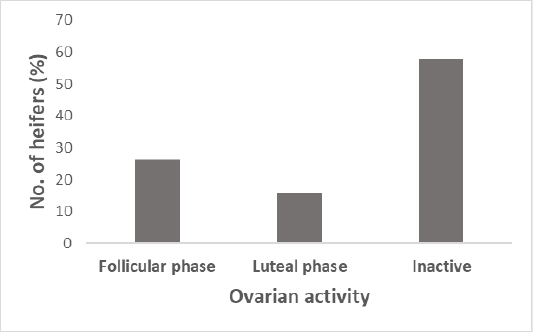
In the present study, estrus synchronization that were carried out in dairy heifers intended to have estrus response simultaneous or almost simultaneous in all animals. Before estrus synchronization, examinations of reproductive physiological status were conducted to determine ovarian activities at the beginning of treatments. Ovarian activities of dairy heifers before estrus synchronization are shown in Figure 2. Ovarian activities are the important aspect to determine prior to estrous synhcronization due to that these activities may have direct effect on estrus rate.
Figure 2 shows that inactive ovaries of dairy heifers were relatively higher in comparison to both follicular and luteal phases (58% vs. 26% and 16%). Although inactive ovary heifers were higher in comparison to both follicular and luteal phases in this study, however, estrous rate was satisfied. In the present study, we were unable to display individually the fate of different ovarian activities of the heifers in the beginning of estrous synchronization on development of follicle(s) on day-7 and day-8 or day-9 of treatments. However, estrous rate of the heifers after synchronization of estrus at different protocols is shown below. The importance of ovarian activities examination prior to estrus synchronization is to predict the effectiveness of treatments given. It was expected that heifers with inactive ovaries would be greater than those cycling heifers. This might be due to that the body condition score (BCS) of those inactive ovaries heifers were mainly less than 2.75. Lower BCS would be able to affect follicle development and ovulation rate . Likewise, study of Vedovatto et al. (2022) stated that the cattle with greater BCS had greater ovarian structure development. This suggests that BCS of the cattle at the beginning of estrous synchronization treatment must be paid attention in order to increase the effectiveness of regime. Anestrus in cattle is a condition where no reproductive activity occurs in the ovaries. In dairy farming, anestrus status can be detrimental to farmers if it occurs in heifers or in cows that have given calved. For this reason, estrous induction is one method that can be used to reduce the occurrence of anestrus conditions in cattle.
Responses of different estrus synchronization protocols on estrus rate in dairy heifers
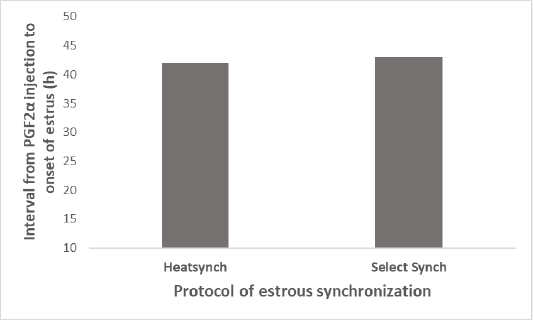
Accumulatively, after treating the heifers either Heatsynch or Select-synch protocols for synchronizing the estrus, all animals become estrus as predicted in advance. The mean interval from PGF2α injection to onset of estrus in dairy heifers at different estrus synchronization protocols was 42 and 43 h in Heatsynch and Select-synch protocols, respectively. There was no significant difference (P>0.05) in the intervals between the two groups (Figure 3). This suggests that either Heatsynch or Select-synch protocols would be able to synhconize the estrus of dairy FH heifers in the region especially in tropical conditions. This finding is in line with the studies of Ahola et al. (2009). They reported that effectively of these protocols the estrus rate achieved 100% in beef cows and dairy cows. Likewise, Yusuf et al. (2010) reported that estrus rate of dairy FH heifers synchronized using Heatsynch was about 94%.
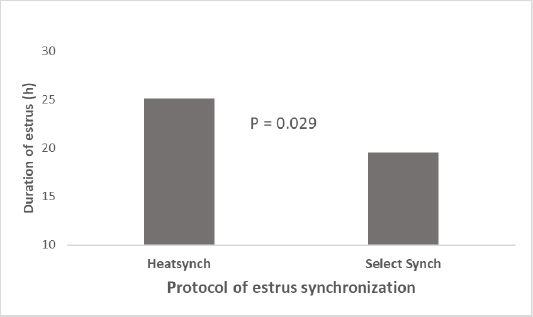
The duration of estrus in dairy heifers at different estrus synchronization protocols is shown in Figure 4. The mean duration of estrus in dairy heifers synchronized using Heatsynch protocol was 25.1 h, significantly higher (P=0.029) than the mean duration of estrus (19.5 h) in select synch protocol.
The duration of estrus is influenced by age, body condition, and also the type of hormone used to synchronize or induce the estrus . Moreover, duration of estrus to the cows that are stimulated with the hormone PGF2α intramuscularly varies between 12 and 36 hours. Colazo et al. (2004), stated that the occurrence of estrus after injection of PGF2α in the select Synch protocol was 36 to 72 hours. According to the study of Lopez et al. (2004) that administration of estradiol as a substitute for GnRH can induce estrus, LH surge, ovulation and normal corpus luteum growth in heifers.
The implementation of estrus synchronization which utilizes reproductive hormone injection is expected to be able to suppress anestrus status in heifers. This study also confirms that there is an ovarian response in heifers that were previously in anestrus into the follicular phase after estrous synchronization. GnRH injection which is carried out as a method of synchronizing estrus will stimulate the anterior pituitary to secrete FSH and LH. Follicular growth and development are stimulated by the combined action of FSH and LH on follicular cells .
On the other hand, successful implementation of estrus synchronization in anestrus cattle with low BCS is intended to activate the estrus cycle, but not for mating. Dairy heifers that will be bred still require ideal BCS so that maximum milk production can be achieved. Generally, in many farms, BCS score for dairy heifers and cows ranges from 2.75–3.50. The BCS value at the beginning of lactation to the third lactation is in the score range of 3.00-3.25, then the ideal BCS value at peak milk production and mid-lactation is 2.75, respectively. After calving, cows experience problems regarding the availability of nutrients to produce milk, because after postpartum feed consumption in dairy cows is limited, so fat reserves under the skin tissue are used to meet milk availability .
CONCLUSIONS and Recommendations
It can be concluded that dairy Holstein Friesian heifers synchronized with both the Heasynch and Select Synch protocols had a good response in synchronizing the estrus regardless of the condition of the ovaries.
ACKNOWLEDGMENT
This study was supported and funded by Institute for Research and Community Service (IRCS) (Lembaga Penelitian dan Pengabdian kepada Masyarakat; LPPM Unhas) Hasanuddin University based on contract No. 00323/UN4.22//PT.01.03/2023, January 25, 2023 for research scheme of Penelitian Fundamental Kolaborasi; PFK 2023 (Collaborative Fundamental Research).
NOVELTY STATEMENT
The study was conducted in dairy heifers with relatively low body condition score (BCS) in tropical condition. Treatment of the dairy heifers using Heasynch and Select Synch protocols to this condition would be able to induce estrous and even to the inactive ovaries heifers.
AUTHOR’S CONTRIBUTION
MY, ALT, SH, and MT have contributed in designing the study, collecting and analyzing the data, and writing the manuscript. HR, MM, HF and JK have contributed in collecting data and improvement of the manuscript.
Conflict of interest
The authors have declared no conflict of interest.
Figures
Figure 1:.
Protocols for estrus synchronization in dairy Holstein Friesian heifers (a) Heatsynch and (b) Select Synch.
Figure 2:.
Ovarian activities of dairy heifers before estrus synchronization.
Figure 3:.
Interval from PGF2α injection to onset of estrus in dairy heifers at different estrus synchronization protocols (Heatsynch n=7 and Select Synch n=8).
Figure 4:.
Duration of estrus in dairy heifers at different estrus synchronization protocols (Heatsynch n=7 and Select Synch n=8).
References
Ahola JK, Seidel Jr GE, Whitteir JC (2009). Use gonadotropin releasing hormone at fixed time artificial insemination at eighty or ninety-seven hours post prostaglandin F2 alfa in beef cows administered the long term melengestrol acerate select synch. Prof. Anim. Scient., 25: 256-261. https://doi.org/10.15232/S1080-7446(15)30715-4[CrossRef]
Caraviello DZ, Weigel KA, Fricke PM, Wiltbank MC, Florent MJ, Cook NB, Nordlund KV, Zwald NR, Rawson CL (2006). Survey of management practices on reproductive performance of dairy cattle on large US commercial farms. J. Dairy Sci., 89: 4723-4735. https://doi.org/10.3168/jds.S0022-0302(06)72522-X[CrossRef]
Centurion-Castro F, Orihuela-Porcayo J, Ake-Lopez RJ, Magana-Monforte JG, Montes-Perez RC and Segura-Correa JC (2013). Effect of body condition score on estrus and ovarian function characteristics of synchronized beef-master cows. Trop. Subtrop. Agroecosyst., 16: 193-199.
Colazo MG, Small JA, Ward DR, Erickson NE, Kastelic JP, Mapletoft RJ (2004). The effect of presynchronization on pregnancy rate to fixed-time AI in beef heifers subjected to a cosynch protocol. Reprod. Fertil. Dev., 16(2): 128-130. https://doi.org/10.1071/RDv16n1Ab11[CrossRef]
Edmonson AJ, Lean IJ, Weaver LD, Farver T, Webster G (1989). A body condition scoring chart for Holstein dairy cows. J. Dairy Sci., 72: 68-78. https://doi.org/10.3168/jds.S0022-0302(89)79081-0[CrossRef]
Gautam G, Nakao T, Yusuf M, Koike K (2009). Prevalence of endometritis during the postpartum period and its impact on subsequent reproductive performance in two Japanese dairy herds. Anim. Reprod. Sci., 116: 175-187. https://doi.org/10.1016/j.anireprosci.2009.02.001[CrossRef]
Hafizuddin, Siregar TN, Akmal (2012). Hormon dan perannya dalam dinamika folikuler pada hewan domestik. JESBIO, 1(1): 21-24.
Hastono (2000). Penyerempakan Berahi pada Domba dan Kambing. Anim. Prod., 2(1 ): 1-8.
Lopez-Gatius F, Yaniz JL, Santolaria P, Murugavel K, Guijarro R, Calvo E, Lopez-Bejar M (2004). Reproductive performance of lactating dairy cows treated with cloprostenol at the time of insemination. Theriogenology, 62: 677-689. https://doi.org/10.1016/j.theriogenology.2003.11.014[CrossRef]
Pryce JE, Royal MD, Garnsworthy PC, Mao IL (2004). Fertility in the high-producing dairy cow. Livest. Prod. Sci., 86: 125-135. https://doi.org/10.1016/S0301-6226(03)00145-3[CrossRef]
Royal MD, Darwash AO, Flint APF, Webb R, Woolliams JA, Lamming GE. (2000). Declining fertility in dairy cattle: changes in traditional and endocrine parameters of fertility. Anim. Sci., 70: 487-501. https://doi.org/10.1017/S1357729800051845[CrossRef]
Sutiyono S, Samsudewa D, Suryawijaya A (2017). Identifikasi gangguan reproduksi sapi betina di peternakan rakyat. J. Vet., 18: 580-588. https://doi.org/10.19087/jveteriner.2017.18.4.580[CrossRef]
Taylor RE, Field TG (2004). Scientific farm animal production. An introduction to animal science. Upper Saddle River, New Jersey (US): Perason Prentice Hall.
Vedovatto M, Lecciolli RB, de Assis Lima E, Rocha RFAT, Coelho RN, Moriel P, da Silva LG, Ferreira LCL, da Silva AF, dos Reis WVA, de Oliveira DM, Franco GL (2022). Impacts of body condition score at beginning of fixed-timed AI protocol and subsequent energy balance on ovarian structures, estrus expression, pregnancy rate and embryo size of Bos indicus beef cows. Livest. Sci., 256: 104823. https://doi.org/10.1016/j.livsci.2022.104823[CrossRef]
Yoshida C, Yusuf M, Nakao T (2009). Duration of estrus induced after GnRH-PGF2α protocol in dairy heifer. Anim. Sci. J., 80: 649-654. https://doi.org/10.1111/j.1740-0929.2009.00694.x[CrossRef]
Yusuf M, Nakao T, Yoshida C, Long ST, Gautam G, Ranasinghe RMSBK, Koike K, Hayashi A (2011). Days in milk at first AI in dairy cows, its effect on subsequent reproductive performance and some factors influencing it. J. Reprod. Dev., 57: 653-659. https://doi.org/10.1262/jrd.10-097T[CrossRef]
Yusuf M, Nakao T, Yoshida C, Long ST, Fujita S, Inayoshi Y, Furuya T (2010). Comparison in effect of Heatsynch with heat detection aids and CIDR-Heatsynch in dairy heifers. Reprod. Dom. Anim., 45: 500-504. https://doi.org/10.1111/j.1439-0531.2008.01277.x[CrossRef]
Yusuf M, Rahim L, Asja MA, Wahyudi A (2012). The Incidence of Repeat Breeding in Dairy Cows under Tropical Condition. Media Peternakan; J. Anim. Sci. and Tech., 35(1): 28-31. https://doi.org/10.5398/medpet.2012.35.1.28[CrossRef]
Wulandari SR, Yusuf M, Ako A (2023). Clinical Treatments Of Reproductive Disorders On Dairy Cows Under Smallholder Rearing System In Enrekang Regency. International Journal of Sciences: Basic and Applied Research (IJSBAR), 68(1): 256-263.