
The reproductive performance of dairy cows in Indonesia still needs to be improved. The method of Double-dose AI can highly improve the success of AI. The materials used were 160 cows divided into 80 cows inseminated by a single dose and 80 cows inseminated with a double dose. There were two treatments in this research; T1 was AI single dose at the 8th hour after estrus onset, while T2 AI double dose at the 2nd and 8th hour after estrus onset. The Non-Return Rate (NRR 1) was observed on the next cycle after AI. If the cows showed the estrus sign, the insemination was repeated with the same treatment and then continued to observe NRR 2 on the next cycle. After two months, the pregnancy and AI failure were observed using ultrasound. A Chi Square was performed using SAS OnDemand for Academics (ODA, Cary, NC, USA). Moreover, probability values were calculated using the least significant different testing. The results showed that NRR-1 was 83.75% and 85%, while NRR-2 was 62.5% and 68.75% on T1 and T2, respectively. Furthermore, the failure of AI was mainly caused by repeat breeders, which were 28.75% on T1 and T2. It consists of 95.65% and 87.5% of normal ovaries, Corpus luteum persistent at 4.35% and 8.34%, and ovarian hypo function at 0% and 4.16% in T1 and T2, respectively. In conclusion, Artificial Insemination using the double doses method did not significantly improve the pregnancy rate of dairy cows.
Research Article · Volume 11, Issue 7, 15 June 2023 · Open Access
The Study of Artificial Insemination with Double Doses at Different Times in Friesian Holstein Crossbred
· · · · · · · · ·
Affiliations & Notes ⌄
- 1Lecturer Faculty of Animal Science, Universitas Brawijaya, Malang, East Java, 65145, Indonesia
- 2Student of Faculty of Animal Science, Universitas Brawijaya, Malang, East Java, 65145, Indonesia. *Correspondence | Trinil Susilawati, Lecturer Faculty of Animal Science, Universitas Brawijaya, Malang, East Java, 65145, Indonesia
- 3Email: tsusilawati@ub.ac.id
Article Info ⌄
- Journal:
- Advances in Animal and Veterinary Sciences
- Published:
- 15 June 2023

From the article
- The BCS indicated the performance, and a cow with a BCS of 2.5 showed normal reproduction.
- The non-return rate value was calculated based on the number of cows that did not show estrus after AI, it’s was assumed the dairy cows were pregnant.
- AI – Artificial Insemination; N – number of acceptors; NRR – non return rate; RMSE – root mean square error; SEM – Standard Error Mean.
- In conclusion, there was no difference in pregnancy success in artificial insemination using single and double doses.
Selected from the article's own text.
Abstract
INTRODUCTION
Friesian Holstein (FH) breeds are the most dairy cattle raised in Indonesia due to the good adapt to subtropical and tropical climatic conditions in Indonesia. Recently, the demand for milk in Indonesia is around 80% still imported (DITJENPKH, 2020). In contrast, subtropical country such as the United Kingdom (UK), FH cows can achieve milk production of approximately 7,609-8,548 kg for each lactation period . Reproduction in dairy cattle is crucial and related to its productivity. Reproductive disorders can reduce milk production, and maintenance costs. A study in India found that reproductive disorders that often occur in dairy cows include AI (repeat breeder) failure, retained placenta, abortion, and vaginal discharge. Early pregnancy to reduce AI failure and abortion . The effects of low-dose AI on pregnancy rates have seldom been studied in lactating dairy cows. Failure of dairy cows to become pregnant after repeated AI is a source of frustration and economic loss to local farmers. A traditional protocol for noticing dairy cows in heat is by direct observation, which is a time consumable and not effective. Unfortunately, may factors caused and shorten the duration of heat and also weaken the behavioral sign regarding to the phenomenon. However, these methods can’t guarantee every detection of signal will be found and inseminated . This due to the appearance of estrus signs on dairy cows has been decreasing, as well as an ovulation disorder related to endocrine function .
The reproductive performance of dairy cows in several regions in Indonesia varies widely and still needs to be improved. Repeat breeding has long been considered one of the critical reproductive disorders in cattle. Repeat breeding is often defined as a syndrome with many possibilities including genetic, acquired defects of the ovary, sperm, or early zygote. Further, Research infections or inflammatory, endocrine dysfunctions, nutritional deficiencies were associated with embryonic loss . Incidences of repeat breeding in lactating dairy cows varied among regions, environments, and management . Dairy cows with high genetic value should usually produce female offspring, while cows with low value should produce male beef-crossbred calves with high meat quality and good growth performance. Several studies on AI using low-dose frozen-thawed and low-dose sexed semen have been undertaken in heifers and beef cows ; ; .
Previously study presented while using single doses AI was service per conception (S/C) was 2.31 ± 0.54 times, days open (DO) 161.95 ± 61.99 days, calving interval (CI) 444.47 ± 61.21 days, respectively. Furthermore, the reproductive performances in were S/C 2.11 ± 0.62 times, DO 138.38 ± 47.18 days, and CI 419.86 ± 46.95 days, respectively after injected low doses AI . In light of previous finding, the increase in the success of AI can be improved by using double doses AI . AI using the double dose method can increasing the success of pregnancy, both single dose and double dose in Ongole crossbreed cattle . The time interval difference of the AI may also influenced the result of pregnancy. Since there is seldom using double doses in the Friesian Holstein dairy cows, this research was conducted on a smallholder farm in the Pujon sub-district, Malang Regency, Indonesia. The aim of this study was to determine the double doses AI at different time of Frisien Holstein Crossbred.
MATERIALS AND METHODS
This research was conducted in the Pujon sub-district, Malang Regency. The material used is FH crossbreed cattle belonging to Koperasi (KOP) SAE Pujon breeders, Malang Regency. With the criteria of having given birth and being normal, Body Condition Score (BCS) > 2.5 (rating range 1-6), aged 3-7 years based on the dental replacement. Samples of cows were 160 heads, T1 was 80 cows, and T2 was 80 cows. The frozen semen was produced from the Artificial insemination center of Singosari. The deposition of semen was position 4 (corpus uteri) with a double dose at the 2nd hour and the 8th hour after estrous onset.
Artificial Insemination Process
The farmer observed the estrous regularly, and if the cows showed estrous signs, the farmer called the Inseminator to inseminate the cows. The estrous condition was observed further based on the onset of estrous, and the vulva condition was swollen and red, with clear mucus. T0 will be inseminated 8 hours after estrous onset, while T1 will be inseminated two times at 2 hours and 8 hours after estrous onset to improve the pregnancy rate. The vitamin of BIO Adenosin Triphosphate (ATP) was injected before inseminating as much as 10 ml intramuscularly. The semen deposition was placed at the corpus uteri (position 4) . Furthermore, Cows that did not pregnant or have repeat breeders are observed for their ovaries using Ultrasonography, namely ovarian hypo function, corpus luteum persistence, and ovarian hyper function,
Non-Return Rate
The non-return rate (NRR) was observed after one cycle (days 19-21). If there was no estrus, it was considered pregnant (NRR-1), whereas if the cows were estrous, AI was carried out according to treatment. The second cycle (NRR-2) was evaluated on days 39-42. After two months, pregnancy and ovarian conditions were evaluated by using Ultrasonography (USG).
Parameters Observed
Non-return rate (NRR) includes NRR1 and NRR2: The NRR value was obtained by observing lust on days 19-21 and days 40-42 after IB. If there are signs of lust, the AI was failed and repeats once again .

Where: NRR is non-return rate, AAI is the number of acceptors AI, and EAI is the number of acceptors that have a sign of estrous.
Conception rate (CR): The CR value can be obtained by calculating the pregnant cows in the first AI. CR is the percentage of pregnant cows in the first AI of the conception rate, with the formula:

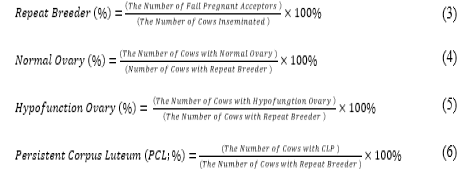
Evaluation of AI failure. Repeat Breeder is a condition where the female cows fail to conceive after being AI several times with fertile males without any observed abnormalities . The parameters for the repeat breeder were:
Data Analysis
The data and coding analysis was conducted using General Linear Model and Chi Square was performed using SAS OnDemand for Academics (ODA, Cary, NC, USA). The results were presented as standard error mean (SEM). Moreover, probability values were calculated using the least significant different testing. The modelling used as follows :

where: 


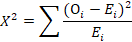
where: Oi = observed value (actual value) and Ei = expected value.
Therefore, the validation test was conducted using the root mean square error (RMSE) and Nakagawa determination coefficient (R2) or or 
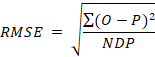
Note: = actual value, = estimated value, = number of data point, is the variant of a fixed factor, is the sum of all variants of the component, is the variant due to the predictor dispersion and is the specific distribution of the variant ; Sholikin et al., 2023).
RESULTS AND DISCUSSION
In this study, the cows had a body condition score (BCS) between 2.5-3 .5, a BCS with an average of 2.86 ± 0.12 with a score between 1-5. The BCS indicated the performance, and a cow with a BCS of 2.5 showed normal reproduction. Regarding this result, it is assumed that the nutrition provided for FH was well-enough . The lack of nutrition and the poor BCS condition can negatively impact cow fertility. Dairy cow reproduction fertility is influenced by the nutrition fed in, which plays an important role in the reproduction cycle . Adequate nutrition will affect hormonal conditions that play a role in pregnancy success. Insufficient progesterone hormone in the early stages of pregnancy can cause mortality. Nutrients, minerals, and vitamins were associated with the female reproduction and must be given in balanced amounts . Indirectly, nutrition affects the hypothalamus gland in the brain to secrete gonadotropin hormone (GnRH), which in turn stimulates the anterior pituitary to produce FSH and LH. Further, associated with the follicular development, which leads to the emergence of estrus and successful pregnancy in cows. Previously, the reproductive cows aged 4.41 ± 0.22 years, and parity 2.53 ± 0.27 times have good physiological conditions . Inseminations in either horn, without ovarian palpation, gave an insignificant pregnancy rates than inseminations in the uterine body with doses of 2 million spermatozoa . Another result presented insignificant difference on the pregnancy rates were achieved after preovulatory follicle palpation and deep corneal insemination into the ipsilateral horn . First, spermatozoa from the contralateral horn moving through the oviduct and abdominal cavity into the ipsilateral oviduct. Second, the spermatozoa was transported within the uterus from the uterine body to the fertilization site in cows . Current knowledge about the function of the reproductive tract and appropriate use of hormonal drugs affords control of the estrus cycle of cows. Use of such protocols in reproductive management allows estrus cycles to be synchronized and cows to be effectively inseminated without oestrous detection, which is time-consuming and difficult in farms with numerous cows.
The data showed that NRR-1 values at T0 and T1 were 83.75% and 65%, respectively (Table 1). The non-return rate value was calculated based on the number of cows that did not show estrus after AI, it’s was assumed the dairy cows were pregnant. Based on the NRR result, injected using single dose presented 16.25%, and double dose,
Table 1: Non-Return Rate of Single and Double Doses of Frisian Holstein.
| The treatment of semen used for AI | N | NRR1 (days 0-21) | RMSE | SEM | NRR2 (Days at 22-42) | RMSE | SEM | ||
| Heads | % | Heads | % | ||||||
| Single dose | 80 | 67 | 83.75 | 0.22 | 3.22 | 52 | 65.00 | 1.31 | 4.33 |
| Double dose | 80 | 68 | 85.00 | 0.34 | 1.22 | 55 | 68.75 | 0.34 | 2.86 |
AI – Artificial Insemination; N – number of acceptors; NRR – non return rate; RMSE – root mean square error; SEM – Standard Error Mean
Table 2: Conception Rate from Artificial Insemination using Single and Double doses of Frisian Holstein.
| Treatments | N | Conception Rate | RMSE | SEM | Pregnancy Rate (2nd AI) | RMSE | SEM | ||
| Heads | % | Heads | % | ||||||
| A single dose (T1) | 80 | 50 | 62.50 | 1.56 | 0.67 | 55.00 | 68.75 | 1.13 | 2.31 |
| Double dose (T2) | 80 | 46 | 57.50 | 1.67 | 0.31 | 55.00 | 68.75 | 1.45 | 1.77 |
AI – Artificial Insemination; N – number of acceptors; NRR – non return rate; RMSE – root mean square error; SEM – Standard Error Mean
Table 3: Conditions of the ovaries or uterus in cows that fail to pregnant after injected by single and double doses of AI
| Treatments | Repeat Breeder n (%) | SEM | Normal Ovarian n (%) | SEM | Follicle cystic n (%) | SEM | Corpus Luteum Persistence n (%) | SEM | Hypo function ovary n (%) | SEM |
| Single doses ( T1) | 23 (28.75) | 2.25 | 22 ( 95.65) | 2.11 | 0 (0) | 1.22 | 1 (4.35) | 1.12 | 0 (0) | 2.32 |
| Double doses (T2) | 24 (28.75) | 1.25 | 21 (87.50) | 1.23 | 0(0) | 1.45 | 2 (8.34) | 1.34 | 1 ( 4.16) | 1.45 |
AI – Artificial Insemination; N – number of acceptors; SEM – Standard Error Mean
35%, respectively . Susilawati et al., (2017) state that the progressive motility of spermatozoa is the most decisive in fertilization. Frozen semen allowed the storage of semen for a longer time. However, it will cause damage to sperm that will decrease its motility of sperm . Hafez and Hafez (2000) has mentioned that frozen semen had fewer spermatozoa functionality than liquid semen when it is evaluated by sperm motility, thermo-resistance test, and hypo-osmotic swelling test. Therefore, inseminated semen using liquid semen can also improve reproduction efficiency.
NRR1 and NRR2 decreased, indicating the occurrence of silent heat, early embryonic death, or when estrus detection is not accurate. According to opinion . Farmers have an essential role in detecting estrus because it will affect the time to do insemination, thus affecting the accuracy of AI by the Inseminator. Cows that experienced repeat breeders or failed to conceive in the first AI with the second treatment at single and double doses were 28.75% and 28.75%, respectively. In cows with repeat breeders, 95.65% and 87.5% of normal ovaries were found. This happens because of several possibilities: failure in fertilization, failure of implantation, or premature embryo death. Fertilization failure is caused by low semen quality, poor oocyte quality, or inappropriate estrus detection and timing of AI. Unfavorable physiological conditions cause implantation failure and embryo death. A repeat Breeder is a cow bred several times or has not been successfully AI, caused by poor management and good ovary condition (Sing et al, 2018). Based on the Table 2, the number of conception rate presented 62.50 (single doses;%), and 57.50 (double doses;%), respectively. Furthermore, the second time after insemination was 68.75% both single and double doses (Table 2). Based on survival analysis from Yusuf et al. (2010) it took 94 d after calving for 50% of normal fertility cows to become pregnant, compared to 155 d for repeat breeders. For repeat breeders, 31.4, 50.0, and 58.1% became pregnant within 210, 300, and 435 d after calving, respectively .
Cows that were AI with single and double doses had a Persistent Corpus Luteum (PCL) incidence of 4.35%, and 8.34% (Table 3) of cattle were categorized as repeated breeders. PCL is a condition in which the corpus luteum does not regress and remains in the ovary for a long time. The size of the corpus luteum is large and has a hard texture . Cows in AI with a single dose and double dose with ovarian hypofunction were 0% and 4.16% (Table 3). Ovaries surface was smooth, and there was no protrusion of follicles or corpus luteum. The supporting diagnosis for ovarian hypofunction is ultrasound (ultrasonography) to see the presence of subordinate follicles with a size of <5 mm . While the case of cystic follicles is absent of Follicular cysts, the diameter of the ovary usually reaches 2.5 in large numbers, and the surface is smooth, the walls are thin, and if pressed, there is a feeling of fluid .
CONCLUSION
In conclusion, there was no difference in pregnancy success in artificial insemination using single and double doses. But, the result of non-return rate on inseminated two times at 2 hours and 8 hours after estrous onset was better.
ACKNOWLEDGMENTS
The author would like to thank LPPM UB through Research Grant “Hibah Penelitian Pengembangan Unggulan (HAPPU)” with contract number 959.2/UN10.C10/PN/2022.
CONFLICT OF INTEREST
The authors declare that there is no conflict of interest regarding the publication of this article.
NOVELTY STATEMENT
A traditional protocol for noticing dairy cows in heat is by direct observation, which is a time consumable and not effective. Since there is seldom using double doses in the Friesian Holstein dairy cows. The double doses of Artificial Insemination were conducted accordingly. These method was increasing the change of pregnancy especially in the tropical condition like Indonesia.
AUTHORS CONTRIBUTION
Trinil Susilawati contributed to the concept and design of the research, supervision of the research, Aulia Puspita Anugra Yekti contributed to the concept and design of the research, writing original manuscript, project administration, data curation, and software, Amir Firdaus contributed to the collecting data, Dinda Ayu Damayanti the collecting data, Rizki Prafitri contributed critical of the manuscript, Nanang Febrianto contributed critical of the manuscript, Kuswati contributed to the supervision and revision of the manuscript, Achadiah Rachmawati contributed to the data validation, Sri Wahjuningsih contributed to the supervised of the manuscript, Nurul Isnaini contributed to the supervised of the manuscript. All authors read and approved the final version of the manuscript in the present journal.
Figures

References
- Adli DN, Sjofjan O, Sholikin MM, Hidayat C, Utama DT, Jayanegara A, Natsir MH, Nuningtyas YF, Pramujo M, Puspita PS (2023). The effects of lactic acid bacteria and yeast as probiotics on the performance, blood parameters, nutrient digestibility, and carcase quality of rabbits: a meta-analysis. Ital. J. Anim. Sci., 22(1): 157-168. https://doi.org/10.1080/1828051X.2023.2172467[CrossRef]
- Albarran-Portillo B, Pollott GE (2008). Genetic parameters derived from using a biological model of lactation on records of commercial dairy cows. J. Dairy Sci., 91(9): 3639-3648. https://doi.org/10.3168/jds.2007-0929[CrossRef]
- Amiridis GS, Tsiligiann, E, Dovolou C, Rekkas D, Vouzaras, Menegatos (2009). Combined administration of gonadotropin-releasing hormone, progesterone, and meloxicam is an effective treatment for the repeat-breeder cow. Theriogen. 72(4):542-48. https://doi.org/10.1016/j.theriogenology.2009.04.010[CrossRef]
- Andersson M, Taponen J, Koskinen E, Dahlbom M (2004). Effect of insemination with doses of 2 or 15 million frozen-thawed spermatozoa and semen deposition site on pregnancy rate in dairy cows. Theriogen. 61(7-8):1583-1588. https://doi.org/10.1016/j.theriogenology.2003.09.006[CrossRef]
- Ardiansyah W, Sjofjan O, Widodo E, Suyadi S, Adli DN (2022). Effects of combinations of α-Lactobacillus sp. and Curcuma longa flour on production, egg quality, and intestinal profile of Mojosari ducks. Adv. Anim. Vet. Sci., 10(8): 1668-1677. https://dx.doi.org/10.17582/journal.aavs/2022/10.8.1668.1677[CrossRef]
- Bearden HJ, Fuquay F, Willard ST (2004). Applied Animal Reproduction. 6th edition. New Jersey. USA. Pearson Prentice Hall.
- Borges-Silva JC, Silva MR, Marinho DB, Nogueira E, Sampaio DC, Oliveira LOF, Abreu UGP, Mourão GB, Sartori R (2015). Cooled semen for fixed-time artificial insemination in beef cattle. Anim. Rep. Sci. 28: 1004-1008. https://doi.org/10.1016/j.anireprosci.2022.106946[CrossRef]
- Crowe, M. A., Hostens, M., and Opsomer, G. 2018. Reproductive management in dairy cows - The future. Ir. Vet. J. 71: 1-13. https://doi.org/10.1186/s13620-017-0112-y[CrossRef]
- Direktorat Jenderal Peternakan dan Kesehatan Hewan Kementerian Pertanian (2020). Livestock and Animal Heath Statistics. Jakarta
- Endo N. (2022). Possible causes and treatment strategies for the estrus and ovulation disorders in dairy cows. The Journal of reproduction and development, 68(2), 85–89. https://doi.org/10.1262/jrd.2021-125[CrossRef]
- Ervandi, Ihsan MN, Wahyuningsih S, Yekti APA, Susilawati T (2009). Reproductive Performance of Brahman Cross Cows on Difference Time Intervals of Artificial Insemination. Asian Jr. of Microbiol. Biotech. Env. Sci. (4):96-100
- Hafez ESE, Hafez B (2000). Reproductive cycles. In. Reproduction in Farm Animals 7 edition Blackwell.
- Hermadi HA, Hariadi M, Susilawati TS (2017). The Ovarian Hypofycction: A Case Cow Management Therapy. Adv. in Health Sci. Res. 311-316.
- Kusmayadi T, Hadiana MH, Tanuwiria UH (2020). Reproductive Performances of Friesian Holstein Dairy Cows in Different Agricultural Ecosystems. Bull. of Anim. Sci. 44(2): 8-14. https://doi.org/10.21059/buletinpeternak.v44i2.39917[CrossRef]
- Martinez F, Kaabi M, Martinez-Pastor F (2004). Effect of the interval between estrus onset and artificial insemination on sex ratio and fertility in cattle: a field study. Theriogen. 62(7): 1264-1270. https://doi.org/10.1016/j.theriogenology.2004.01.002[CrossRef]
- Nowicki A, Barański W, Baryczka A, Janowski T (2017). OvSynch protocol and its modifications in the reproduction management of dairy cattle herds - An update. J. of Vet. Res. 61(3): 329. https://doi.org/10.1515/jvetres-2017-0043[CrossRef]
- Parmar SC, Dhami AJ, Hadiya KK (2016). Early Embryonic Death in Bovines: An Overview. Raksha Tech. Rev. 6(1): 6-12.
- Pradhan R (2008). Reproductive Disorders in Cattle due to Nutritional Status. J. of Int. Dev. and Coop. 14 (1): 45-66
- Sholikin MM, Irawan A, Sofyan A, Jayanegara A, Rumhayati B, Hidayat C, Adli DN, Julendra H, Herdian H, Manzila I, Hudaya MH, Harahap MA, Qomariyah N, Budiarto R, Krisnan R, Asmarasari SA, Hayanti SY, Wahyono T, Priyatno TP, Ujilestari T, Negara W, Wulandari W, Nahrowi N (2022). A meta-analysis of the effects of clay mineral supplementation on alkaline phosphatase, broiler health, and performance. Poult. Sci., 102(3): 102456. https://doi.org/10.1016/j.psj.2022.102456[CrossRef]
- Sing J, Dadarwal D, Honparkhe M, Kumar A (2008). Incidences of Various Etiological Factors Responsible for Repeat Breeding Syndrome in Cattle and Buffaloes. J. Vet. Med. 6(1): 87-91.
- Smith OB, Akinbamijo OO (2000). Micronutrients and reproduction in farm animals. Anim. Rep. Sci. 60(61): 549-560. https://doi.org/10.1016/S0378-4320(00)00114-7[CrossRef]
- Struve K, Herzog K, Magata F, Piechotta M, Shirasuna K, Miyamoto A, Bollwein H (2013). The Effect of Metritis on Luteal Function in Dairy Cows. BMC Vet. Res. 9 (1): 244. https://doi.org/10.1186/1746-6148-9-244[CrossRef]
- Susilawati T, Ratnawati D, Isnaini N, Kuswati, Yekti APA (2018a). Character of Liquid semen motility in various diluents on Balinese cattle during cold storage. Asian Jr. of Microbiol. Biotech. Env. Sc. 20(1): 166-172.
- Susilawati T, Fauzi MR, Suyadi, Kuswati, Yekti APA. (2018b). The Effect of estrous Synchronizations by Using PGF2α on the Conception Rate on Brahman Cross Cow. Asian Jr. of Microbiol. Biotech.Env.Sci. 20(3): 818-820.
- Susilawati T, Kuswati RS, Sudarwati H, Marjuki, Yekti APA, Udrayana S (2017). Quality of Ongole bull sperm after storage in CEP-2 extender containing different extracellular cryoprotectans. Asian J. Microbiol. Biotech. Environ. Sci., 19(7): 268-273.
- Susilawati T, Isnaini N, Kuswati, Satria AT, Huda AN, Yekti APA (2020). The pregnancy Evaluation Evaluation on Ongole Crossbred Cows by using Liquid Semen and Frozen Semen. IOP Conf. Series and Env. Sci., 478(1): 012-015. https://doi.org/10.1088/1755-1315/478/1/012015[CrossRef]
- Yekti APA, Rahayu S, Ciptadi G, Susilawati, T (2023). The Quality and Proportion of Spermatozoa X and Y in Sexed Frozen Semen Separated with Percoll Density Gradient Centrifugation Method on Friesian Holstein Bull. Adv. in Anim. and Vet. Sci. 387(1):012-029. https://doi.org/10.17582/journal.aavs/2023/11.3.371.378[CrossRef]
- Yekti APA, Prafitri R, Kuswati, Huda AN, Kusmartono, Susilawati T (2022). The Succes Rate of double dose Artificial Insemination at different Times in Ongole Crossbred Cattle. American J. of Anim. and Vet. Sci. 17 (1): 26-30. https://doi.org/10.1051/e3sconf/202233500031[CrossRef]
- Yekti APA, Bustari WO, Huda AN, Satria AT, Susilawati, T (2019). Male calf proportion of artificial insemination results by using sexed sperm with double dose on Ongole crosbred cows. In IOP Conf. Ser. Earth and Env. Sci. 387(1):012-029. https://doi.org/10.1088/1755-1315/387/1/012029[CrossRef]
- Yusuf M, Nakao T, Ranasinghe G, Gautamsu ST, Long C, Yoshida K, Koike A, Hayashi (2010). Reproductive Performance of Repeat Breeder in Dairy Herds. Theriogen. Anim. Rep. 73(9): 1220-1229. https://doi.org/10.1016/j.theriogenology.2010.01.016[CrossRef]
Cited by 3 articles
In journals published by ResearchersLinks.
- Effect of Body Condition Score on the Success of Artificial Insemination in Sumba Ongole Cattle under Smallholder FarmsJournal of Animal Health and Production · 2026
- Catalyst Factors for the Effectiveness of the Artificial Insemination Programs Based on Breeders’ Internal Dynamics and External Support in Bone Bolango RegencyAdvances in Animal and Veterinary Sciences · 2025
- Evaluation of Artificial Insemination Success of Crossbred Friesian Holstein Cow After Foot and Mouth Disease OutbreakAdvances in Animal and Veterinary Sciences · 2024
Services
Article usage statistics
Loading…