
Kisspeptin, a product of the KISS1 gene, plays an essential role in the regulation of spermatogenesis acting primarily at the hypothalamic level of the gonadotropic axis. Citric acid is synthesized and secreted by the prostate gland. Its synthesis is regulated by androgens. As, dose dependent degeneration of prostate gland has been described following intraperitoneal kisspeptin treatment. However, effects of kisspeptin administration on the levels of prostatic citric acid remain elusive till date. The present study, therefore, addresses the effects of 12 day administration of kisspeptin on prostatic citric acid levels in male mice. Kisspeptin-10 was administered intraperitoneally in different dosage concentrations (1μg, 1 ng, and 10 ρg) to adult male mice twice daily for 12 days. Prostatic citric acid levels were determined photometrically. The levels decreased significantly at all tested doses. Intermittent administration of Kisspeptin –10 negatively regulates the prostatic citric acid levels in adult male mice.
Short Communication · Volume 49, Issue 1, 21 January 2017 · Open Access
Effect of Variable Kisspeptin Doses on Prostatic Citric Acid Levels in Male Mice
· ·
Affiliations & Notes ⌄
- 1Gomal Centre of Biochemistry and Biotechnology, Gomal University, Dera Ismail Khan, Khyber Pakhtukhwa, Pakistan 2Department of Physiology, Khyber Medical University Institute of Medical Sciences, Kohat, Khyber Pakhtunkhwa, Pakistan * Corresponding author: faiqah_ramzan@yahoo.com p.p1 {margin: 0.0px 0.0px 0.0px 0.0px
- 2text-align: justify
- 3font: 9.0px 'Times New Roman'} p.p1 {margin: 0.0px 0.0px 0.0px 0.0px
- 4font: 10.0px 'Times New Roman'} p.p1 {margin: 0.0px 0.0px 0.0px 0.0px
Article Info ⌄
- Journal:
- Pakistan Journal of Zoology
- Published:
- 21 January 2017

Abstract
Methods and materials
Animals and maintenance
Forty (n=40), adult male albino mice (Mus musculus) of Swiss strain with an average weight of 50±5g were purchased from the National Institute of Health, Islamabad and maintained in the animal house facility of Gomal University. Ten mice were housed per cage (15″ × 11″ × 9″, steel mesh cages) under standard conditions of 12L:12D h photoperiod, 25±2ºC temperature controlled with automatic timers and adjustable controls for heating and cooling. Standard rat diet and water were provided ad libitum.
All animal handling and subsequent sacrifice was carried out according to the guidelines provided by the “Institutional Review Board” of the Gomal Centre of Biochemistry and Biotechnology, Gomal University, Dera Ismail Khan for humane use of animals for scientific research. Animal handling was also in accordance with European Union guidelines for the use of laboratory animals.
Experimental procedures
Kisspeptin (metastin 45-54 or kisspeptin-10; 1mg lyophilized powder) was purchased from Calbiochem (EMD Biosciences, Inc. La Jolla, CA) and was dissolved in 1 ml Dimethylesulphoxide (DMSO) to give a stock solution of 1 mg ml-1 that was diluted further with distilled water (dH2O) and was administered intraperitonealy (i.p.).
Animals were randomly assigned to four groups (n =10 in each). Group I mice constituted control and received 0.9% w/v physiological saline, (DMSO was added to saline at the same concentration as it was added to kisspeptin stock and was further diluted to concentration equivalent to the experimental doses), group-II mice received 10 ρg, group-III received 1 ng and group IV received 1µg kisspeptin as twice daily after every 12 h for 12 days. Kisspeptin doses were selected as previously described . Three h after the last dose of the peptide, animals were anesthetized with sodium pentobarbital (60 mg kg-1 b.w. i.p.). Prostate glands were dissected out, weighed, rinsed in phosphate buffered saline and stored at -50°C until assayed. To determine the concentrations of fructose in prostate glands,1 ml of distilled water was added to the tissue samples, macerated and then centrifuged at 5000 rpm for 10 min. Supernatant was aspirated and levels of citric acid were determined photometrically.
Citric acid estimation
Seminal fructose was estimated photometrically. Citric acid levels were estimated using citric acid test kit (FertiPro N.V.IndustrieparkNoord 32, 8730 Beernem – Belgium). Assays were carried out according to the manufacturer’s instructions. The absorbance was measured at 505 nm.
Results were expressed as mean ± SD. The results obtained, were analyzed and compared by one way ANOVA followed by post hoc Tukey’s adjustment using the Statistical Package for Social Sciences (SPSS, version 16, Inc, Chicago, Illinois, USA). P< 0.05 was considered to be statistically significant.
Results and discussion
Figure 1 shows effect of kisspeptin an total body weight, prostatic weight and citric acid level of prostate gland of male mice. There is no significant difference in the body and prostatic weight, although the concentration of citric acid was significantly reduced (P<0.001) in the treated groups when compared with the control group.
The kisspeptin/GPR54 interaction has finally been identified in recent years as key regulator of the HPG axis ; . Although, the acute effects of central and peripheral administration of kisspeptin in rats, mice ; , 2005) and broiler breeder birds , as well as effects of long term kisspeptin administration on structure and functional aspects of testicular tissue in prepubertal and adult testes , 2009) have been explored in detail. Moreover, the effects of kisspeptin administration on histomorphological and ultrastructure of accessory sex glands, the seminal vesicle and prostate have also been documented , 2013). The seminal fructose levels following kisspeptin challenge in male mice have also been investigated . However, to date there is no report on kisspeptin effects on the functional aspects of prostate gland. The present study shows that the sub chronic 12 days i.p. kisspeptin administration at 1µg, 1ng and 10 ρg dose led to a significant decrease in prostatic citric acid levels in male mice.
Prostatic citrate production is androgen dependent, since castration and hypophysectomy results in rapid loss of prostatic citrate and seminal fructose. The administration of physiologic amounts of androgen restores prostatic citrate and seminal fructose values to normal levels ; . The activity of seminal vesicle and prostate is known to be under the control of testosterone produced by the testis. Lindner and Mann (1960) described a significant correlation between the testosterone content of bull testes and the weight of seminal vesicles, their fructose and citric acid contents. Similar correlations between the action of administered testosterone and the level of acid phosphatase and citric acid in semen have been observed by various workers .
Fawcett (1986) also proved that testosterone is essential for the maintenance of height of the mucosal epithelium required for productions of continuous prostate secretions . The growth and active secretion of accessory reproductive tissues are dependent on the presence of circulating androgens (Higgins et al., 1976a, b; . The prostatic epithelial height is known to be androgen-dependent and secretory activity by the prostate and seminal vesicles therefore is a sensitive, androgen dependent function .
In benign prostatic hypertrophy citrate accumulation is striking while in early and advanced prostatic carcinoma there was a striking straight line reduction in citrate concentration directly related to size and extent of carcinoma. In advanced carcinoma the citrate values were less than 10% of those found in benign hypertrophy .
Conclusion
The study reveals that chronic kisspeptin-10 administration down regulates the citric acid content of the prostate gland in adult male mice.
Acknowledgments
The study was funded by the Startup Research Grant provided to the corresponding author by the Higher Education Commission (HEC), H-9, Islamabad, Pakistan. The authors are indebted to Dr. Muhammad Aslam Khan, Clinical Pathologist, Department of Pathology, District Headquarter Teaching Hospital, Dera Ismail Khan KPK, Pakistan for technical assistance.
Conflict of interest statement
We declare that we have no conflict of interest.
Figures
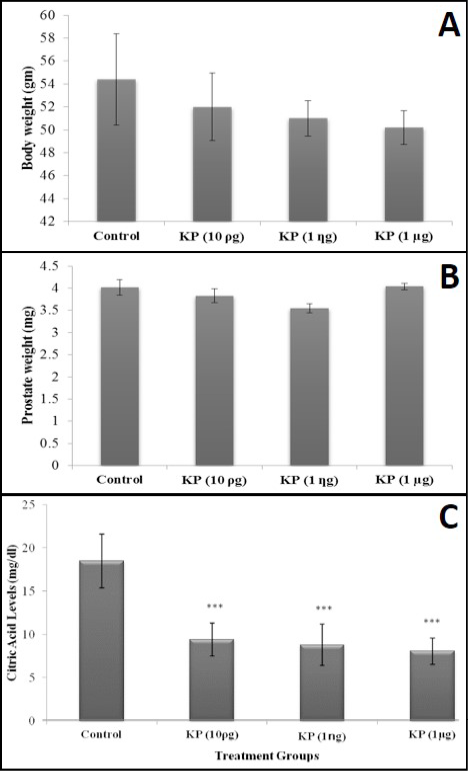
Effect of different concentrations of KP on body weight (A), prostatic weight (B) and prostatic citric acid levels (mg/dl) (C) in male mice. Values are expressed as mean±SD.
References
- Barron, E. S. and Huggins, C., 1946a. Proc. Soc. exp. Biol. Med., 62: 195. http://dx.doi.org/10.3181/00379727-62-15418[CrossRef]
- Barron, E. S. and Huggins, C., 1946b. J. Urol., 55: 385-390.
- Brandes, D., 1974. In: Male accessory sex organs. Structure and function in mammals (ed. D. Brandes), Academic Press, New York.
- Cooper, J. F. and Farid, I., 1963. J. Surg. Res., 3: 112-121. http://dx.doi.org/10.1016/S0022-4804(63)80041-4[CrossRef]
- De Roux, N., Genin, E., Carel, J. C., Matsuda, F., Chaussain, J. L. and Milgrom, E., 2003. Proc. natl. Acad. Sci. U. S. A., 100: 10972-10976. http://dx.doi.org/10.1073/pnas.1834399100[CrossRef]
- Fawcett, D. W., 1986. In: A textbook of histology (eds. W. Bloom and D. W. Fawcett) W.B. Saunders Company, Philadelphia.
- Fink, G., 2000. In: Neuroendocrinology in physiology and medicine (eds. P. M. Conn and M. E. Freeman). Humana Press Inc, New Jersey.
- Gonzales, G. F., 1989. Arch. Androl., 22: 1-13. http://dx.doi.org/10.3109/01485018908986745[CrossRef]
- Gonzales, G. F., Miranda, S., Nieto, J., Fernandez, G., Yucra, S., Rubio, J., Yi, P. and Gasco, M., 2005. Reprod. Biol. Endocrinol., 3: 5. http://dx.doi.org/10.1186/1477-7827-3-5[CrossRef]
- Gottsch, M. L., Cunningham, M. J., Smith, J. T., Popa, S. M., Acohido, B. V., Crowley, W. F., Seminara, S., Clifton, D. K. and Steiner, R. A., 2004. Endocrinology, 145: 4073-4077. http://dx.doi.org/10.1210/en.2004-0431[CrossRef]
- Hart, R. G., 1970. Biol. Reprod., 3, 347-352.
- Higgins, S. J., Burchell, J. M. and Minwaring, W. I., 1976a. Biochem. J., 158: 271-282. http://dx.doi.org/10.1042/bj1580271[CrossRef]
- Higgins, S. J., Burchell, J. M. and Mainwaring, W. I., 1976b. Biochem. J., 160: 43-48. http://dx.doi.org/10.1042/bj1600043[CrossRef]
- Hoskins, D. D. and Patterson, D. L., 1967. J. Reprod. Fertil., 13: 337-340. http://dx.doi.org/10.1530/jrf.0.0130337[CrossRef]
- Huggins, C. and Neal, W., 1942. J. exp. Med., 76: 527-541. http://dx.doi.org/10.1084/jem.76.6.527[CrossRef]
- Humphrey, G. F. and Mann, T., 1949. Biochem. J., 44: 97-105. http://dx.doi.org/10.1042/bj0440097[CrossRef]
- Kotani, M., Detheux, M., Vandenbogaerde, A., Communi, D., Vanderwinden, J. M., Lepoul, E., Brezillon, S., Tyldesly, R., Suarez-Huerta, N., Vandeput, F., Blanpain, C., Schiffmann, S. N., Vassart, G. and Parmentier, M., 2001. J. biol. Chem., 276: 34631-34636. http://dx.doi.org/10.1074/jbc.M104847200[CrossRef]
- Linder, H. R. and Mann, T., 1960. J. Endocrinol., 21: 341-360.
- Mann, T., 1964. The biochemistry of semen and of the male reproductive tract, Wiley, New York.
- Mann, T. and Parsons, U., 1947. Nature, 160: 294. http://dx.doi.org/10.1038/160294a0[CrossRef]
- Marberger, H., Marberger, E., Mann, T. and Lutwak-Mann, C., 1962. Br. med. J., 1: 835-836. http://dx.doi.org/10.1136/bmj.1.5281.835[CrossRef]
- Navarro, V. M., Castellano, J. M., Fernandez-Fernandez, R., Tovar, S., Roa, J., Mayen, A., Nogueiras, R., Vazquez, M. J., Barreiro, M. L., Magni, P., Aguilar, E., Dieguez, C., Pinilla, L. and Tena-Sempere, M., 2005. Endocrinology, 146: 156-163. http://dx.doi.org/10.1210/en.2004-0836[CrossRef]
- Navarro, V. M., Fernandez-Fernandez, R., Castellano, J. M., Roa, J., Mayen, A., Barreiro, M. L., Gaytan, F., Aguilar, E., Pinilla, L., Dieguez, C. and Tena-Sempere, M., 2004. J. Physiol., 561: 379-386. http://dx.doi.org/10.1113/jphysiol.2004.072298[CrossRef]
- Pierantoni, R., Cobellis, G., Meccariello, R. and Fasano, S., 2002. Int. Rev. Cytol., 218: 69-141. http://dx.doi.org/10.1016/S0074-7696(02)18012-0[CrossRef]
- Ramzan, F., Khan, M. A. and Ramzan, M. H., 2014. Endocrine, 45: 144-147. http://dx.doi.org/10.1007/s12020-013-0016-x[CrossRef]
- Ramzan, F. and Qureshi, I. Z., 2011. Life Sci., 88: 246-256. http://dx.doi.org/10.1016/j.lfs.2010.11.019[CrossRef]
- Ramzan, F., Qureshi, I. Z., Ramzan, M. and Ramzan, M. H., 2012. Reprod. Biol. Endocrinol., 10: 18. http://dx.doi.org/10.1186/1477-7827-10-18[CrossRef]
- Ramzan, F., Qureshi, I. Z., Ramzan, M. and Ramzan, M. H., 2013. Prostate, 73: 690-699. http://dx.doi.org/10.1002/pros.22609[CrossRef]
- Schersten, B., 1929. Skand. Arch. Physiol., 58: 90. http://dx.doi.org/10.1111/j.1748-1716.1930.tb00919.x[CrossRef]
- Seminara, S. B., Messager, S., Chatzidaki, E. E., Thresher, R. R., Acierno, J. S., JR., Shagoury, J. K., Bo-Abbas, Y., Kuohung, W., Schwinof, K. M., Hensrick, A. G., Zahn, D., Dixon, J., Kaiser, U. B., Slaugenhaupt, S. A., Gusella, J. F., O’Rahilly, S., Carlton, M. B., Crowley, Jr., W. F., Aparicio, S. A. and Colledge, W. H., 2003. N. Engl. J. Med., 349: 1614-1627. http://dx.doi.org/10.1056/NEJMoa035322[CrossRef]
- Shahab, M., Mastronardi, C., Seminara, S. B., Crowley, W. F., Ojeda, S. R. and Plant, T. M., 2005. Proc. natl. Acad. Sci. U. S. A., 102: 2129-2134. http://dx.doi.org/10.1073/pnas.0409822102[CrossRef]
- Thompson, E. L., Amber, V., Stamp, G. W., Patterson, M., Curtis, A. E., Cooke, J. H., Appleby, G. F., Dhillo, W. S., Ghatei, M. A., Bloom, S. R. and Murphy, K. G., 2009. Br. J. Pharmacol., 156: 609-625. http://dx.doi.org/10.1111/j.1476-5381.2008.00061.x[CrossRef]
- Thompson, E. L., Patterson, M., Murphy, K. G., Smith, K. L., Dhillo, W. S., Todd, J. F., Ghatei, M. A. and Bloom, S. R., 2004. J. Neuroendocrinol., 16: 850-858. http://dx.doi.org/10.1111/j.1365-2826.2004.01240.x[CrossRef]
- Ukena, K. and Tsutsui, K., 2005. Mass Spectrom. Rev., 24: 469-486. http://dx.doi.org/10.1002/mas.20031[CrossRef]
- Veneziale, C. M., Burns, J. M., Lewis, J. C. and Bucchi, K. A., 1977. Biochem. J., 166: 167-173. http://dx.doi.org/10.1042/bj1660167[CrossRef]
- Wahab, F., Riaz, T., Khan, L. A., Leprince, J., Vaudry, H. and Sempere, M.T., 2012. Pakistan J. Zool. 44:7-14.
Services
Article usage statistics
Loading…