
The aim of this study was to report the effects of AlCl3 mediated toxicity on the hematobiochemical profile of male albino mice. Eight week old male albino mice were used as experimental animals and were divided into two groups. First group was treated with 80mg/Kg body weight of AlCl3 for 16 days while control group was treated with saline solution for the same period of time. Complete blood count were determined in both experimental treatments at the end of dose supplementation. Our results revealed that oral supplementation of 80mg/Kg body weight of AlCl3 for 16 days did not affect (P > 0.05) any of the studied parameters of complete blood count. On the other hand, serological parameters like triglycerides (P = 0.0075 ), total proteins (P = 0.042) and creatinine (P = 0.0038)were significantly higher in treated male mice when compared with their untreated control group indicating the hazardous effects of AlCl3 on blood chemistry of adult male albino mice.
Short Communication · Volume 50, Issue 4, 10 July 2018 · Open Access
Effect of AlCl3 Mediated Toxicity on the Hemato-biochemical Profile of Adult Male Albino Mice
· · · ·
Affiliations & Notes ⌄
- 1Department of Life Sciences, Zoology Division, The Islamia University of Bahawalpur, Bahawalpur 63100, Pakistan 2Institute of Pure and Applied Biology, Zoology Division, Bahauddin Zakariya University, Multan 60800, Pakistan , Muhammad Nazar Aftab and Ahmed Ali contributed equally to the manuscript. , * Corresponding author: furhan.iqbal@bzu.edu.pk
Article Info ⌄
- Journal:
- Pakistan Journal of Zoology
- Published:
- 10 July 2018

From the article
- Analysis of studied parameters of serum indicated a significant increase in creatinine concentrations in AlCl3 exposed mice (Fig. 2).
- The difference in results is probably due to the different exposure time of Aluminum in two studies and probably similar results may be observed in albino mice as well as their exposure time to AlCl3 is prolonged.
- AlCl3 administrated orally at 80 mg/ml solvent/Kg body weight did not affect the complete blood count but had drastically affected the serum parameters that are indicator of liver and Kinney functioning indicating disturbed physiology of male albino mice.
Selected from the article's own text.
Abstract
Materials and methods
Eight week old male albino (n=12) mice were orally supplemented with 80 mg AlCl3/Kg body weight, another group (n=12) was orally supplemented with saline solution for 16 days. The blood was analyzed haematologically as well as biochemically.
Complete blood count, mean corpuscular volume (MCV), mean corpuscular hemoglobin (MCH), mean corpuscular hemoglobin concentration (MCHC), packed cell volume (PVC), hemoglobin level (HB), total red (TRBC) and white blood cell count (TWBC), total lymphocytes, monocytes, neutrophil count and total platelets count was determined in treated and untreated albino mice by using hematology analyzer FMI- 6180 (Jiangsu, China) following Aslam et al. (2015). While serum biochemical parameters such as cholesterol, alanine transaminase (ALT), aspartate transaminase (AST),
total protein, creatinine and triglycerides were analyzed in serum samples by using Hitachi 902 automatic analyzer (Japan) following the instructions of diagnostic kit manufacturers.
All the data is expressed as Mean ± SD Statistical package Minitab (version 17, Pennsylvania) was used for the statistical analysis of the results. Two sample t-test was used to compare all studied parameters of complete blood count and serum biochemistry between AlCl3 and saline treated male albino mice.
Results and discussion
Figure 1 shows the effect of AlCl3 on complete blood count, whereas Figure 2 shows serum biochemistry of male albino mice.
Analysis of our results indicates that the hematological profile of male albino mice remained unaffected following 16 days exposure to 80 mg/Kg body weight of AlCl3 These findings are contradictory to those reported by Aziz and Zabut (2011) as they observed significant decrease in hemoglobin red blood cells and hematocrit while significant increase in lymphocytes, white blood cells, mean corpuscular hemoglobin, mean corpuscular volume and platelets in albino rats,each weighing 100-120 gm, treated for eight week with 40mg/L AlCl3 as compared to their untreated control group. In another similar study conducted by Manisha et al. (2013) it was reported that 100 mg Aluminum exposure for 90 days to old male rats resulted in a significant (P < 0.05) decrease in total erythrocyte count, hemoglobin and PVC, while white blood cells were increased significantly as compared to control group.
The differences in the results of compared studies can be attributed to different experimental animals, doses used and their duration of application. Analysis of studied parameters of serum indicated a significant increase in creatinine concentrations in AlCl3 exposed mice (Fig. 2). Increased creatinine concentrations in serum are generally considered as an indicator of abnormal renal function . Our findings are in agreement with the recent report from Majida et al. (2014) who has documented a significant increase (p < 0.0001) in creatinine concentrations in adult male rats upon exposure to 50 mg/kg body weight of AlCl3 for 60 days as compared to the control group confirming that exposure to AlCl3 results in disturbed renal function in rodents. Aluminum exposure is reported to result in altered total protein levels by indirectly or directly effecting protein synthesis . Our results are contrary to the findings of El-Kholy et al. (2010) who had reported that Aluminum toxicity of 100 mg / kg body weight for 90 days causes a significant decrease in total protein concentrations in rats compared to control group. The difference in results is probably due to the different exposure time of Aluminum in two studies and probably similar results may be observed in albino mice as well as their exposure time to AlCl3 is prolonged.
Conclusion
AlCl3 administrated orally at 80 mg/ml solvent/Kg body weight did not affect the complete blood count but had drastically affected the serum parameters that are indicator of liver and Kinney functioning indicating disturbed physiology of male albino mice.
Statement of conflict of interest
Authors have declared no conflict of interest.
Figures
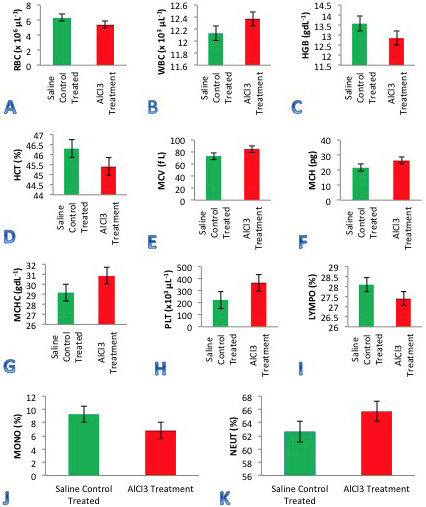
Effect of AlCl3 administrated to male albino mice (n=6) for 16 days on various hematological parameters such as RBC (A), WBC (B), HGB (C), HCT (D), MCV (E), MCH (F), MCHC (G), PLT (H), LYMPHO (I), MONO (J) and NEUT (K) All values are expressed as Mean ± Standard Deviation. P-value presents the results of 2 sample t-test conducted for each parameter between the two treated groups. P > 0.05, non-significant.
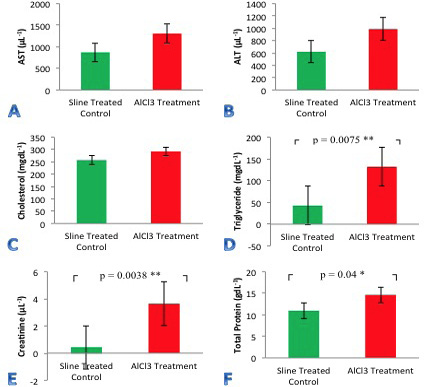
Effect of AlCl3 administrated to male albino mice (n=6) for 16 days on various parameters of serum biochemical profile such as AST (A), ALT (B), Cholesterol (C), triglyceride (D), creatinine (E) and total protein (F). All values are expressed as Mean ± Standard Deviation. P-value presents the results of 2 sample t-test conducted for each parameter between the two treated groups. P > 0.05, non-Significant; *P < 0.05, least-significant; **P < 0.01, significant.
References
- Abdel-Aziz, I.I.S. and Zabut, B.M., 2011. Egypt. J. Biol., 13: 1-7.
- Aslam, S., Gillani, Q.A.U. and Iqbal, F., 2015. Pakistan J. Zool., 47: 1601-1604
- Buraimoh, A.A., Adeniyiojo, S., Olajidehambolu, J. and Adebisi, S.S., 2012. Am. Int. J. Cont. Res., 2: 294-303.
- Domingo, J.L., Gomez, M. and Sanchez, D.J., 1993. Res. Commun. Chem. Pathol. Pharmacol., 79: 377-380.
- El-Kholy, W.M., El-Habibi, E.M. and Mousa, A.T., 2010. J. Am. Sci., 6: 1462-1474.
- Goncalves, P.P. and Silva, S.V., 2007. J. Inorg. Biochem., 10: 1291-1338. https://doi.org/10.1016/j.jinorgbio.2007.06.002[CrossRef]
- Jiang, H.X., Chen, L.S., Zheng, J.G., Han, S., Tang, N. and Smith, B.R., 2008. Tree Physiol., 28: 1863-1871. https://doi.org/10.1093/treephys/28.12.1863[CrossRef]
- Majida, A.J., Al-Qayim Ghali, L.S. and Al-Azwai, T.S., 2014. Appl. Sci. Rep., 5: 26-30.
- Manisha, C., Kumar, J.D., Sandeep, T., Sandeep, K. and Ali, M.A., 2012. Int. J. Res. Pharm. Sci., 2: 131-145.
- Manisha, C., Kumar, J.D., Sandeep, T. and Ali M.A., 2013. Res. J. pharmaceut. Sci., 2: 6-11.
- Nayak, P., 2002. Enviorn. Res., 89: 101-115. https://doi.org/10.1006/enrs.2002.4352[CrossRef]
- Shehla, K.F., Prabhavathi, P.A., Padmavathi, P. and Reddy, P.P., 2001. Mutat. Res., 490: 179-186. https://doi.org/10.1016/S1383-5718(00)00165-0[CrossRef]
- Szilagyi, M., Okori, J.B., Fekete, S., Vetesi, F., Albert, M. and Kadar, I., 1994. Eur. J. clin. Chem. clin. Biochem., 32: 485-486.
Cited by 1 article
In journals published by ResearchersLinks.
Services
Article usage statistics
Loading…