
Tibial dyschondroplasia (TD) is skeletal abnormality in rapidly growing birds causing carcass downgrading and severe welfare problems.Present study was aimed to determine specificity of salvia miltiorrhiza (SM) on growth plate width, liver oxidative stress and toxicity in avian TD. One hundred and fifty broiler chicks were equally distributed into three groups: Control, Thiram (50 mg/kg/d) and SM (10 mg/kg/d) treated. Results showed that thiram caused lameness, decrease in alkaline phosphatase (ALP) activity and increase in alanine aminotransferase (ALT) and aspartate aminotransferase (AST) activities in the serum along with decrease in level of antioxidant enzymes and significantly increase in the MDA contents in TD afflicted chickens compared to control group. The SM administration to TD affected birds significantly ameliorated lameness, stimulated ALP level with a decrease in ALT and AST contents, increase in antioxidant parameter and decrease in MDA contents significantly (P<0.05). SM treatment of TD-afflicted birds prevented lameness and reinstated antioxidant imbalance. SM may be effective for the treatment and control of TD and minimizing the liver damages caused by thiram in broiler chickens.
Short Communication · Volume 50, Issue 4, 10 July 2018 · Open Access
Salvia Miltiorrhiza Reinstates Growth Plate Width, Reduces Liver Oxidative Stress and Toxicity in Avian Tibial Dyschondroplasia
· · · · · ·
Affiliations & Notes ⌄
- 1College of Veterinary Medicine, Huazhong Agricultural University, Wuhan 430070, PR China 2Faculty of Veterinary and Animal Science, Lasbela University of Agriculture, Water and Marine Sciences, Uthal, Balochistan, Pakistan 3University College of Veterinary and Animal Sciences, The Islamia University of Bahawalpur, Pakistan , Fazul Nabi and Hui Zhang have equally contributed to this article. , * Corresponding author: lijk210@sina.com
Article Info ⌄
- Journal:
- Pakistan Journal of Zoology
- Published:
- 10 July 2018

From the article
- However, administration of SM medicine resulted in significant decrease in TD and growth-plate width (Fig. 1B).
- In the current study, treatment with 10 mg/kg of SM significantly attenuated TD, decreased growth plate width and eliminated lameness in broiler chicken.
- Administration of natural antioxidants in case of liver damages or oxidative stress significantly a rational strategy to cure oxidative imbalance and antioxidant capabilities.
- Administration of SM to dyschondroplastic birds abrogates lameness, reduces oxidative stress markers and hepatic injury and appears to have health benefits and therapeutic efficacy against avian TD in broiler chicken.
Selected from the article's own text.
Abstract
Material and methods
One hundred and fifty 1-day-old Arbor Acres broilers (AAC) (46.5 ±0.5 g) were purchased from commercial hatchery (Chia Tai Animal Husbandry Co. Ltd., Wuhan, China) and raised under standard hygienic conditions that included cleaning, disinfecting, free access to clean drinking water and standard feed, constant lighting, optimum humidity and temperature in proper well-ventilated room. The chickens were divided into 3 equal groups, Group 1 (n=50) received control feed and groups 2 and 3 (n=50 each) were fed thiram from day 3 (Shanghai Macklin Biochemical Co. Ltd., China) @ 50 mg/kg of feed to induce TD until end of the experiment day-15. After induction of TD, the group 3 birds received treatment with SM (trade name Danshen) injections prepared from the dried root extract of SM was purchased from Wuhan Dinghui Chemical Co., Ltd. SM was dissolved in dimethyl sulfoxide (DMSO) and diluted to make stock solution. SM (Danshen) group were given i.p. injection @ 10 mg/kg/day of SM through intra-peritoneal route from day 8 until end of the experiment on day 15. All the experiments were conducted after the approval of institutional Animal Welfare and Care, Ethics Committee guideline of Huazhong Agricultural University, Wuhan, China.
Blood samples (n=10 each) were collected by cardiac puncture on day 8 and 15 from each group. Blood samples were centrifuged at 3000×g for 20 min to separate serum which was stored at -70°C, until subsequent use to determine the serum ALT, AST level and ALP activities. All chicks were kept for 15 days then slaughtered by cervical dislocation to collect liver samples from each group. The liver samples were stored at -70°C for subsequent analysis of SOD, GSH-Px activity and MDA content. Briefly, whole liver tissues samples were chopped into small pieces on ice, a homogenate was prepared in 10mM phosphate buffered saline (10 ml PBS/0.1 g of tissue) and centrifuged at 3500 rpm/min for 10 min at 4°C. The supernatant was collected and stored for determination of the SOD, GSH-Px activities and MDA content by commercial reagent kits (Nanjing Institute of Biological Engineering Inc., Jiangsu, China) following manufacturer’s instructions. The SOD and GSH-Px results
presented in Unit per milligram of protein (U/mg protein), while MDA contents were expressed in nanomoles/ gram wet weight of liver tissue (nmoles/g). The values of AST, ALT and ALP activities were presented in unit per liter (U/L). All methods were performed according to our previous studies ; ; , b).
Data were analyzed with one way ANOVA by student t-test to compare the differences between mean values of control and treatment groups. The differences were considered statistically significant if P < 0.05. All statistical analyses were performed using SPSS 19.0 software and results are presented as means±SEM.
Results
The morphological examination revealed the reduced growth rate and lameness in thiram-induced TD group as compared to control. Birds regained their growth rate, ability to stand and walk after the treatment with SM (Fig. 1A). Tibial growth plate morphology indicated that width of the proximal tibial growth plates was markedly enlarged in the TD group as compared to control. However, administration of SM medicine resulted in significant decrease in TD and growth-plate width (Fig. 1B).
A significant (P<0.05) decrease in serum ALP activity along with an increase in serum ALT and AST contents were observed in thiram-fed birds as compared to control group. However, SM administration caused a significant increase in ALP level (P<0.05) with a decrease in serum ALT and AST levels significantly (P<0.05) as compared with thiram only fed group. The antioxidants SOD and GSH-Px were significantly decreased (P<0.05), while the MDA contents was increased in TD-affected chickens as compared to control group. However, the intra peritoneal SM administration restored and increased antioxidant markers (SOD and GSH-Px) with a decrease in MDA contents significantly (P<0.05) (Fig. 2).
Discussion
SM is used as an anti-osteoporotic drug in traditional Chinese medicine. It has been widely used for the microcirculatory disturbance and for the treatment of cardiovascular and cerebrovascular diseases, liver dysfunction, renal deficiency and vascular complications of diabetes . Traditional Chinese Medicine (TCM) approach offers a holistic solution to prevent and eradicate bone disease. SM extract also enhances bone formation through increasing angiogenesis and osteoblastic activity and decreasing osteoclastic activity . In the current study, treatment with 10 mg/kg of SM significantly attenuated TD, decreased growth plate width and eliminated lameness in broiler chicken.
Some authors described that thiram is an oxidant agent, ultimately increased oxidative stress on liver and lead to decreased in antioxidant (SOD and GSH-Px) activities ; . MDA is well-known cell membrane injury marker, lipid peroxidation resulting in release of MDA product in the end ;; . Thiram-induction can lead to TD disease causes liver damages with increasing of liver damages indicators (AST and ALT) in blood and toxicity ; ; ; .
TD is characterized by lack of calcification and causes failure of epiphyseal growth plate chondrocytes hypertrophy. ALP measurement in serum is primary marker of bone formation and TD is associated with significant decreased ALP level . SM treatment significantly restored ALP level in blood serum. ALP level is deficient in TD but its level was restored to normal level both in affected area and in blood after the treatment with SM with concurrent resolution of TD ; ; .
Liver toxicity and oxidative stress is considered to mutual pathological mechanism due to several inflammatory or pathological conditions in animals ; . Diverse factors induce toxicity and oxidative stress and the liver is the principal detoxifying organ that directly impairs the production performance of chicken. Administration of natural antioxidants in case of liver damages or oxidative stress significantly a rational strategy to cure oxidative imbalance and antioxidant capabilities.
Conclusion
Salvia miltiorrhiza appears to act as a natural traditional Chinese medicine with oxidant scavenging capabilities. Administration of SM to dyschondroplastic birds abrogates lameness, reduces oxidative stress markers and hepatic injury and appears to have health benefits and therapeutic efficacy against avian TD in broiler chicken.
Acknowledgment
This study was supported by the National key Research and Development Program of China (Project No 2017YFD0502200) and National Natural Science Foundation of China (No. 31460682).
Statement of conflict of interest
Authors declare that they have no competing interests.
Figures
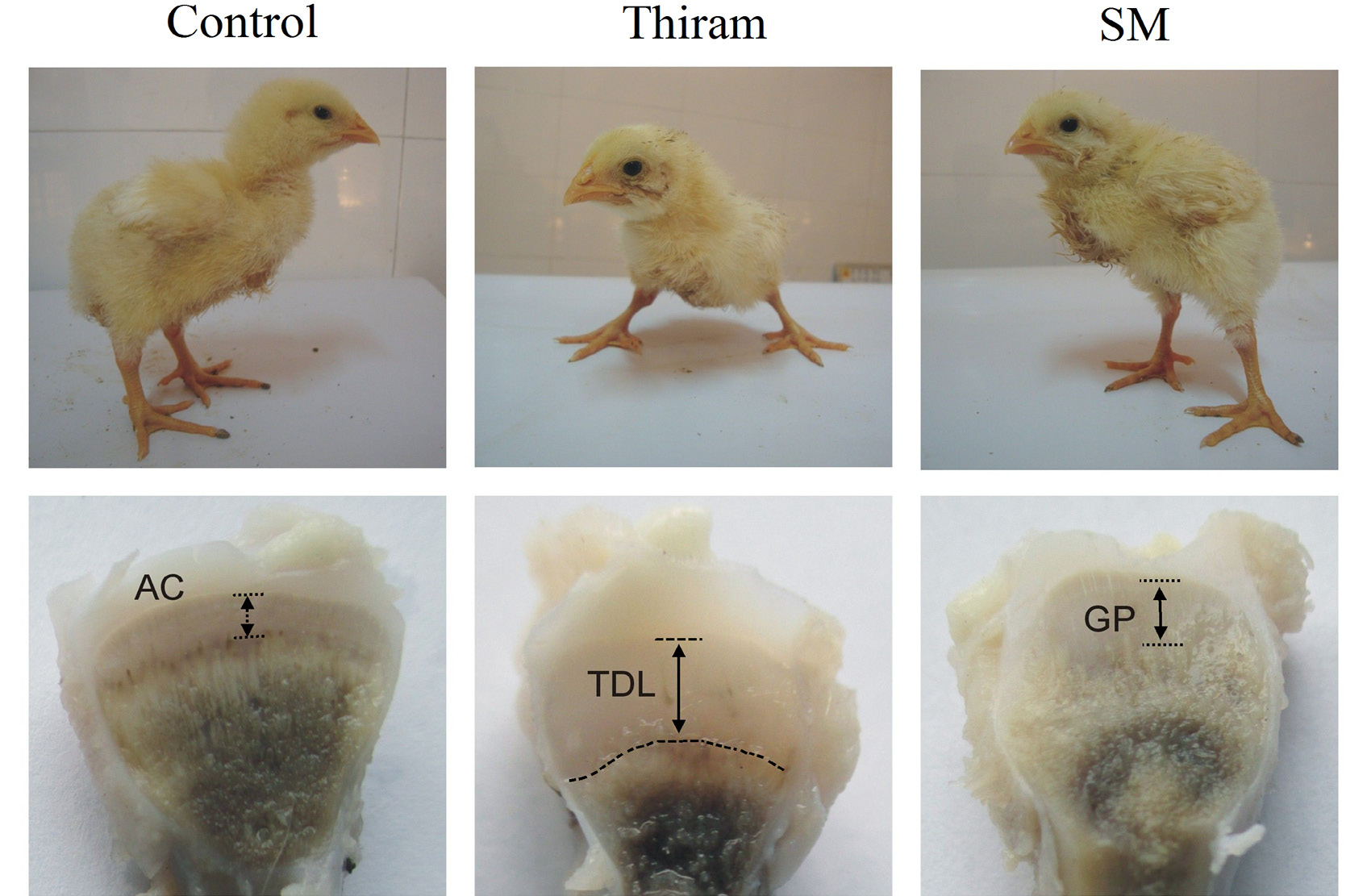
Effects of SM on lameness and growth-plate morphology. Control group of birds showing normal posture with normal growth plate, Thiram fed birds showing lameness and enlarged growth plate width in the chicks with tibial dyschondroplasia (TD). SM group showing restored lameness and growth plate size by Salvia miltiorrhiza (SM) treatment. AC, Articular cartilage; TDL, TD lesion; GP, growth plate.
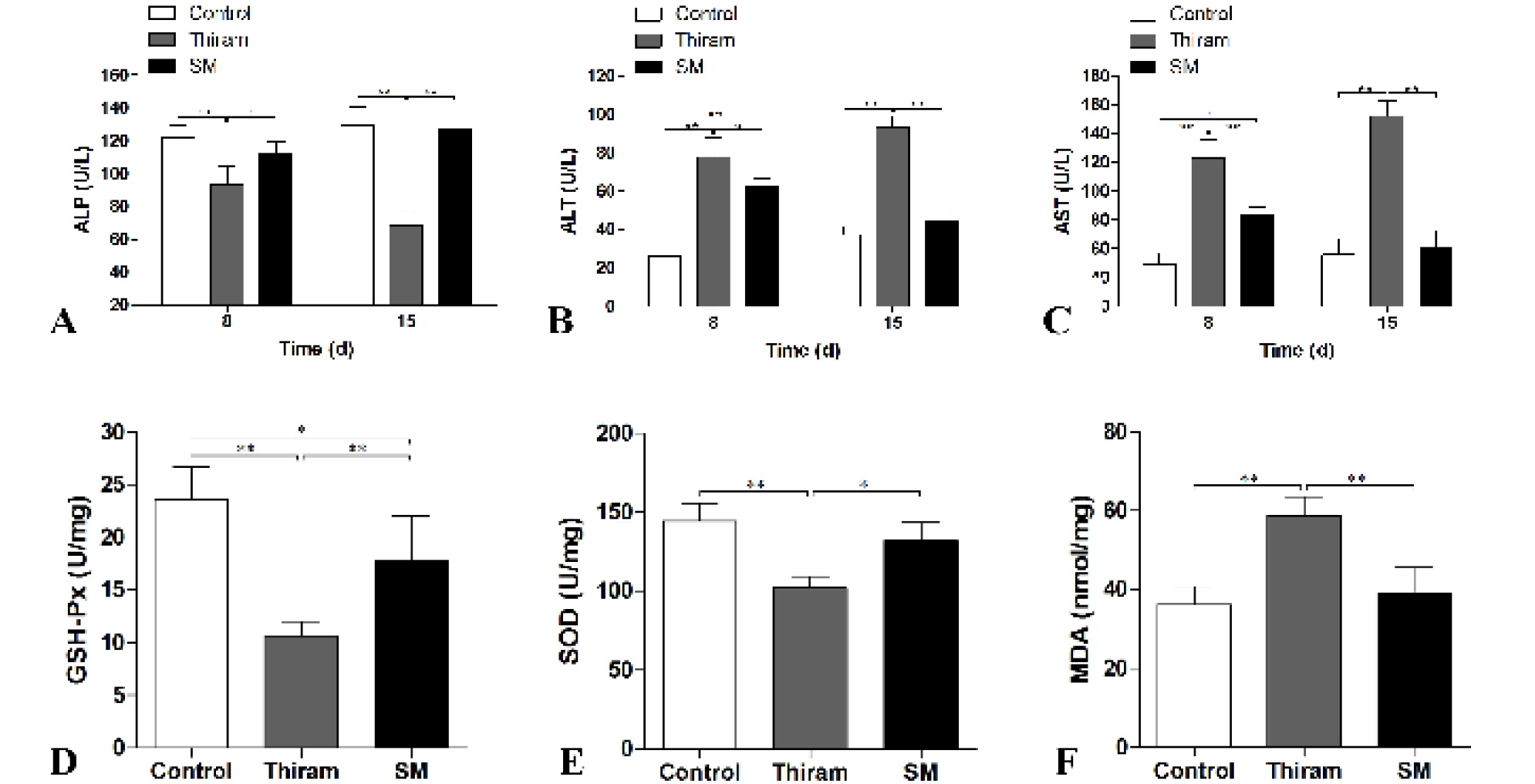
Effect of thiram and Salvia miltiorrhiza (SM) therapy on serum AST, ALT, ALP activity (A-C) and antioxidant biomarkers (SOD, GSH-Px) and MDA content (D-F). Thiram caused decrease in serum ALP activity and increase in ALT and AST contents. SM therapy caused an increase in ALP levels with a decrease in serum ALT and AST levels (A-C). The antioxidants SOD and GSH-Px were decreased while the MDA content was increased in thiram-fed group. SM therapy restored and increased antioxidant markers (SOD and GSH-Px) with a decrease in MDA contents (D-F). The data are expressed as the mean ± SD *P<0.05 among groups (n=10/group).
References
- Cui, L., Liu, Y.Y., Wu, T., Ai, C.M. and Chen. H.Q., 2009. Acta Pharmacol. Sin., 30: 321-332. https://doi.org/10.1111/j.1600-0773.1972.tb00663.x[CrossRef]
- Genin, O., Hasdai, A., Shinder, D. and Pines, M., 2012. Poult. Sci., 91: 1619-1626. https://doi.org/10.3382/ps.2012-02207[CrossRef]
- Guo, Y., Yu, L., Liming, X., Richele, P.S., Gao, S., Niu, J., Qin, L.P., Zhang, D. and Brömme, D., 2014. J. Ethnopharmacol., 155: 1401-1416. https://doi.org/10.1016/j.jep.2014.07.006[CrossRef]
- Gupta, M. and Amma, M.K., 1993. J. appl. Toxicol., 13: 33-37. https://doi.org/10.1002/jat.2550130108[CrossRef]
- Han, J.Y., Fan, J.Y., Horie, Y., Miura, S., Cui, D.H., Ishii, H., Hibi, T., Tsuneki, H. and Kimura, I., 2008. Pharmacol. Ther., 117: 280-295. https://doi.org/10.1016/j.pharmthera.2007.09.008[CrossRef]
- Li, J., Bi, D., Span, S. and Zhang, Y., 2007. Br. Poult. Sci., 48: 724-728. https://doi.org/10.1080/00071660701261310[CrossRef]
- Li, S., Tan, H.Y., Wang, N., Zhang, Z.J., Lao, L., Wong, C.W. and Feng, Y., 2015. Int. J. mol. Sci., 16: 26087-26124. https://doi.org/10.3390/ijms161023994[CrossRef]
- Marikovsky, M., 2002. Br. J. Cancer, 86: 779-787. https://doi.org/10.1038/sj.bjc.6600078[CrossRef]
- Nabi, F., Shahzad, M., Liu, J., Li, K., Han, Z., Zhang, D., Iqbal, M.K. and Li, J., 2016a. Avian Pathol., 45: 187-193. https://doi.org/10.1080/03079457.2016.1141170[CrossRef]
- Nabi, F., Li, K., Shahzad, M., Han, Z., Zhang, D. and Li, J., 2016b. Pak. Vet. J., 36: 224-226.
- Rath, N.C., Richards, M.P., Huff, W.E., Huff, G.R. and Balog, J.M., 2005. J. comp. Pathol., 133: 41-52. https://doi.org/10.1016/j.jcpa.2005.01.005[CrossRef]
- Shahzad, M., Liu, J., Gao, J., Wang, Z., Zhang, D., Nabi, F. and Li, J., 2014. Pak. Vet. J., 34: 545-547.
- Shahzad, M., Liu, J., Gao, J., Wang, Z., Zhang, D., Nabi, F. and Li, J., 2015. Avian Pathol., 44: 13-18. https://doi.org/10.1080/03079457.2014.987210[CrossRef]
- Tian, W., Li, J., Qin, P., Wang, R., Ning, G., Qiao, J., Li, H., Bi, D., Pan, S. and Guo, D., 2013. BMC Genomics, 14: 276. https://doi.org/10.1186/1471-2164-14-276[CrossRef]
- Wong, R.W. and Rabie, A.B., 2008. J. Biomed. Mater. Res. A, 85: 506-512. https://doi.org/10.1002/jbm.a.31577[CrossRef]
- Zhou, L., Zuo, Z. and Chow, M.S., 2005. J. clin. Pharmacol., 45: 1345-1359. https://doi.org/10.1177/0091270005282630[CrossRef]
- Zhu, Y.Z., Huang, S.H., Tan, B.K., Sun, J., Whiteman, M. and Zhu, Y.C., 2004. Nat. Prod. Rep., 21: 478-489. https://doi.org/10.1039/b304821g[CrossRef]
Services
Article usage statistics
Loading…