Animals
A total of 85 adult male albino mice of age one month old were collected from Veterinary Research Institute (VRI) Lahore with the body weight range from 19–27(g). The Animals Ethical Committee of Lahore College for Women University approved the animal studies. The animals were kept at animal house of Lahore College for Women University, Lahore and fed on standard pelleted diet and tap water.
Experimental Design
The animals were acclimatized for a period of one month prior to experiment in animal house of Lahore College for Women University, Lahore. During acclimatizing period 5 mice died. To decrease the effects of circadian rhythm all treatments were given between 9 to 10 a.m. These animals were kept in wire cages in groups of 20 animals per cage. All the animals were kept under similar management and feeding conditions throughout the experiment and 12–h light/12–h dark cycle with ambient temperature of 20–22ºC was maintained. The relative humidity was 60%. After acclimatizing period mice were indiscriminately distributed into two groups, control group (n=40 without nicotine treatment) and experimental group (n=40 nicotine treated (1 mg/ kg of body weight). By giving nicotine injections subcutaneously mortality was not arisen within the 6 weeks of experimental period.
Mode of Treatment
The body weight of each adult male mice was measured before giving them injections on the first day of experiment. An average weight of 26.5g was obtained. First group containing 40 mice was nominated as control in which 0.1ml of normal saline was administered subcutaneously. Second group containing 40 mice was given effective dose of 1 mg/kg of body weight of nicotine hydrogen tartarate subcutaneously injected in the scruff of the neck daily for 6 weeks at 10 a.m. every day. Daily weighed feed was provided early morning and then on next day the remaining feed was weighed again per cage to determine the amount of feed consumed.
Sample Collection
The blood samples were collected by performing cardiac puncture directly from the ventricle of the heart after anesthetizing the animal. To avoid hemolysis, sampling is performed with moderate suction. For hematological analysis blood is collected in EDTA coated tubes and for the assessment of lipid profile and liver enzymes serum was separated by centrifugation at 5000 rpm for 10 minutes and stored in eppendorfs at –20 ºC till analyzed.
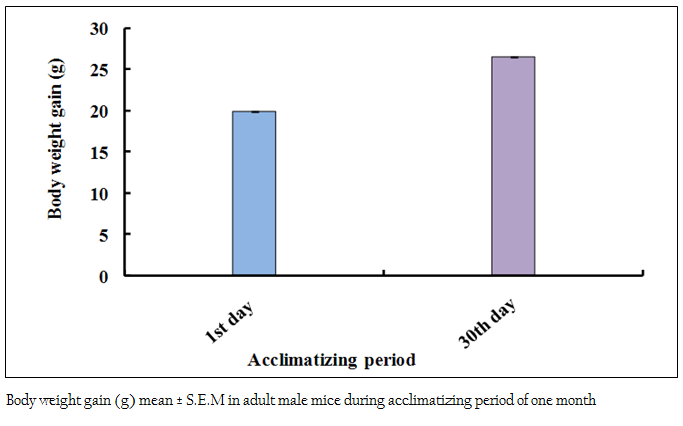
Figure 1: Body weight gain (g) mean ± S.E.M in adult male mice during acclimatizing period of one month
Assessment of Hematological Parameters
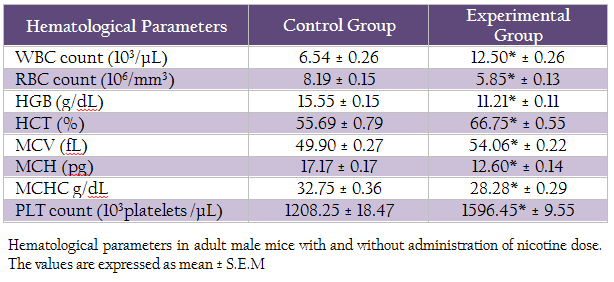
For this purpose the blood was immediately collected in ETDA tubes and the samples were immediately run on hematological analyzer (Model “KX–21 Sysmex”, Germany) to assess various hematological parameters like WBC count, RBC count, Hgb concentration, Hct, MCV, MCH, MCHC and PLT.
Assessment of Biochemical Parameters
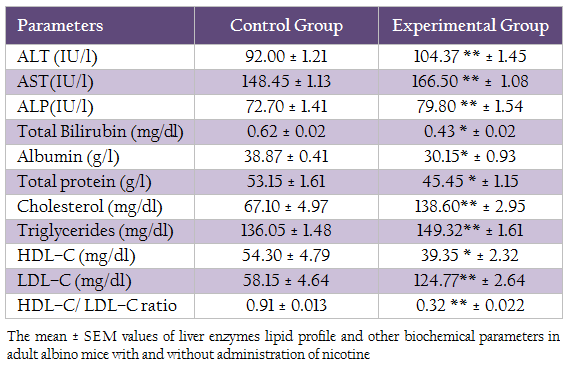
The lipid components such as total cholesterol, LDL–C, HDL–C, triglyceride, the liver enzymes (AST, ALT and ALP) and other biochemical parameters bilirubin, total proteins, and albumin in serum were determined by using chemistry analyzer.
Statistical Analysis
Values of various hematological parameters TC, HDL–C, LDL–C, AST, ALT, ALP, triglycerides, bilirubin, albumin and total protein were given as mean ± Standard Error Mean (S.E.M). The comparisons between the parameters of control group and experimental group were statistically analyzed by using Independent Sample Student “t” Test. All the statements of significance are based on the 0.05 level of probability at 95% confidence interval. All graphs were obtained on Microsoft Excel Starter 2010 and statistical analysis was done on SPSS Version 13.0.
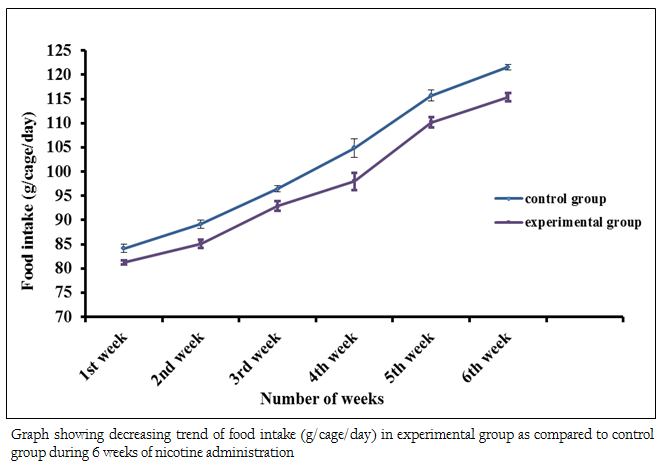
Figure 2: Graph showing decreasing trend of food intake (g/cage/day) in experimental group as compared to control group during 6 weeks of nicotine administration
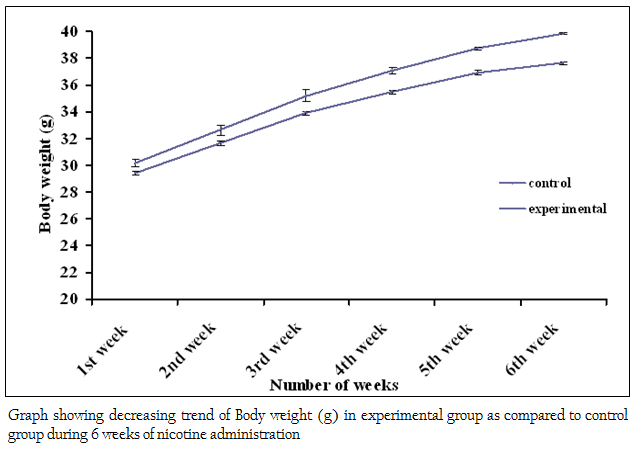
Figure 3: Graph showing decreasing trend of Body weight (g) in experimental group as compared to control group during 6 weeks of nicotine administration