
The sequencing of the complete mitochondrial (mt) genome of the pet bamboo rat Rhizomys pruinosus, which had a problem in standing and walking in a Bamboo farm in Wenzhou, China was carried out, using its tibia. The mt genome (16,579 bp) is composed of 13 protein coding genes, 22 tRNA genes and 2 rRNA genes. The ratio of the bases of the mt genome of R. pruinosus from Wenzhou are A (32.31%), T (31.04%), C (24.77%), G (11.88%), A+T (63.35%), respectively. The multivariable sites in rRNA were 1.98% and 5.53% in 12S rRNA and 16S rRNA, respectively. The multivariable sites in protein coding gene were ranged from 0 to 4.83%, while the multivariable sites in amino acids were ranged from 0 to 5.22%. The current results contributes to the perform prevention of leg problems in the bamboo rat industry.
Short Communication · Volume 50, Issue 4, 10 July 2018 · Open Access
A Report on the Multivariable Sites of the Mitochondrial Genome of a Bamboo Rat, Rhizomys pruinosus from Wenzhou, China
· · · · · · ·
Affiliations & Notes ⌄
- 1College of Animal Science, Wenzhou Vocational College of Science and Technology, Wenzhou 325006, People’s Republic of China 2College of Veterinary Medicine, Huazhong Agricultural University, Wuhan 430070, People’s Republic of China 3University College of Veterinary and Animal Sciences, The Islamia University of Bahawalpur, Bahawalpur 63100, Pakistan 4Barani Livestock Production Research Institute, Kherimurat, Attock, Pakistan 5College of Agriculture, Hubei Three Gorges Polytechnic, Yichang 44300
Article Info ⌄
- Journal:
- Pakistan Journal of Zoology
- Published:
- 10 July 2018

From the article
- The ratio of the bases of the mt genome of R. pruinosus from Wenzhou are A (32.31%), T (31.04%), C (24.77%), G (11.88%), A+T (63.35%), which present a little difference with previous reported in southern China (KC789518) (Fig. 2).
- Interestingly, a lot of multivariable sites of the mitochondrial genome of R. pruinosus from Wenzhou, China were found when compared with KC789518.
- The multivariable sites in rRNA were 1.98% and 5.53% in 12S rRNA and 16S rRNA, respectively (Table I).
- Though the R. pruinosus from Wenzhou shows a homology with previous reported one, low multivariable sites in protein coding gene were found with the leg problem rat, which may contribution to the perform prevention of leg problems in the bamboo rat industry.
Selected from the article's own text.
Abstract
Materials and methods
Samples were collected after permission from the relevant institutions. All procedures were performed under the instructions and approval of Laboratory Animals Research Centre of Zhejiang province in P.R. China.
A 3 months old male, pet R. pruinosus with heavy leg problem (can not stand up) was obtained from the hospital of College of Animal Science, Wenzhou Vocational College of Science and Technology. This rat was fed on fresh bamboos. Under euthanasia tibia of this pet was removed and stored at -70 °C.
For sequencing mt DNA was isolated from an improved extraction method previously reported by Sorensen et al. (2006). After purification of mt DNA, short-insert libraries (insert size 350 bp) were constructed according to the manufacturer’s instructions (Illumina). The short library sequences were sequenced by using a commercial Illumina Hiseq 4000 sequencing system at total genomics solution (TGS) Institute in Shenzhen, China.
For variation analysis the current mt genome was multiple aligned with previously reported 12S rRNA of mt sequences by MEGA (6.0). The reference sequences were Rhizomys pruinosus (AJ250358.1), Rhizomys pruinosus (KC789518.1) and Rhizomys sinensis (NC_026124.1). The phylogenetic analysis was performed to determine Rhizomy species using MEGA version 6 by pilotting methods of the neighbor-joining algorithm, and the distances were computed using the Tajima-Nei method. The stability of branches was assessed after bootstrapping with 1000 replicates . The reference mt genes are as follows: R. pruinosus mt (KC789518.1), Rhizomys sinensis mt (KM434232.1), Eospalax rothschildi mt (JN544420.1), Eospalax baileyi mt (JN540033.1), Myospalax psilurus mt (JX014234.1), Eospalax cansus mt (KC514112.1), Rattus exulans mt (KY814718.1), and Myodes rufocanus mt (KT725595.1).
Results and discussion
The sequence of the present mt genome of R. pruinosus was submitted to NCBI database with the Genebank accession number of MG193909. The mt genome (16,579 bp) is composed of 13 protein coding genes, 22 tRNA genes and 2 rRNA genes, which is in line with previous of KC789518 (Table I, Fig. 1). The ratio of the bases of the mt genome of R. pruinosus from Wenzhou are A (32.31%), T (31.04%), C (24.77%), G (11.88%), A+T (63.35%), which present a little difference with previous reported in southern China (KC789518) (Fig. 2). Interestingly, a lot of multivariable sites of the mitochondrial genome of R. pruinosus from Wenzhou, China were found when compared with KC789518. The multivariable sites in rRNA were 1.98% and 5.53% in 12S rRNA and 16S rRNA, respectively (Table I). The multivariable sites in protein coding gene ranged from 0 to 4.83%, while the multivariable sites in amino acids ranged from 0 to 5.22% (Table I).
Table I.- Comparison of the mt genome of R. pruinosus from Wenzhou (WZ) with previously reported from South China (SC) KC789518.
| Gene | Length (gene / amino acid) | Gene variable sites (bp / %) | Amino acid variable (No. / %) | |
| SC | WZ | |||
| 12S-rRNA | 958 | 938 | 19 (1.98%) | |
| 16S-rRNA | 1556 | 1477 | 86 (5.53%) | |
| NADH1 | 957/318 | 942/314 | 25 (2.61%) | 4 (1.26%) |
| NADH2 | 1050/349 | 1035/345 | 38 (3.62%) | 6 (1.72%) |
| COI | 1545/514 | 1542/514 | 20 (1.29%) | 1 (0.19%) |
| COII | 684/227 | 681/227 | 13 (1.90%) | 1 (0.44%) |
| ATP8 | 207/68 | 201/67 | 10 (4.83%) | 2 (2.94%) |
| ATP6 | 681/226 | 678/226 | 14 (2.06%) | 5 (2.21%) |
| COIII | 784/261 | 783/261 | 13 (1.66%) | 2 (0.77%) |
| NADH3 | 348/115 | 344/115 | 12 (3.45%) | 6 (5.22%) |
| NADH4L | 297/98 | 294/98 | 6 (2.20%) | 0 |
| NADH4 | 1377/459 | 1374/458 | 24 (1.74%) | 4 (0.87%) |
| NADH5 | 1815/604 | 1779/593 | 59 (3.25%) | 17 (2.81%) |
| NADH6 | 531/176 | 525/175 | 11 (2.07%) | 1 (0.57%) |
| CYTB | 1140/379 | 1134/378 | 22 (1.93%) | 3 (0.79%) |
Though, a low multivariable sites in protein coding gene were found, the NCBI blast (https://blast.ncbi.nlm.nih.gov/Blast.cgi?PROGRAM=blastn&PAGE_TYPE=BlastSearch&LINK_LOC=blasthome) and phylogenetic analysis revealed that the mt genome of R. pruinosus from Wenzhou is 99% in homology with KC789518 by pilotting Neighbor Joining method with available mt sequences of R. pruinosus mt (KC789518.1), Rhizomys sinensis mt (KM434232.1), Eospalax rothschildi mt (JN544420.1), Eospalax baileyi mt (JN540033.1), Myospalax psilurus mt (JX014234.1), Eospalax cansus mt (KC514112.1), Rattus exulans mt (KY814718.1 ), and Myodes rufocanus mt (KT725595.1) (Fig. 3).
We also performed the phylogenetic analysis of 12S rRNA by employing Neighbor Joining method with available sequences of R. pruinosus (AJ250358.1), R. pruinosus (KC789518.1) and R. sinensis (NC_026124.1), which also demonstrated the high homology 99.99% and 99.987% of R. pruinosus from Wenzhou with KC789518.1 and AJ250358.1, respectively (Fig. 4).
Conclusion
Though the R. pruinosus from Wenzhou shows a homology with previous reported one, low multivariable sites in protein coding gene were found with the leg problem rat, which may contribution to the perform prevention of leg problems in the bamboo rat industry.
Acknowledgements
This study was supported by the General Project of Education of the Zhejiang province in 2017 (Y201737824), and the Startup Project for Doctoral Scientific Research of Wenzhou Vocational College of Science and Technology in 2016 (No. 201604).
Statement of conflict of interest
The authors state that there are no competing interests.
Figures
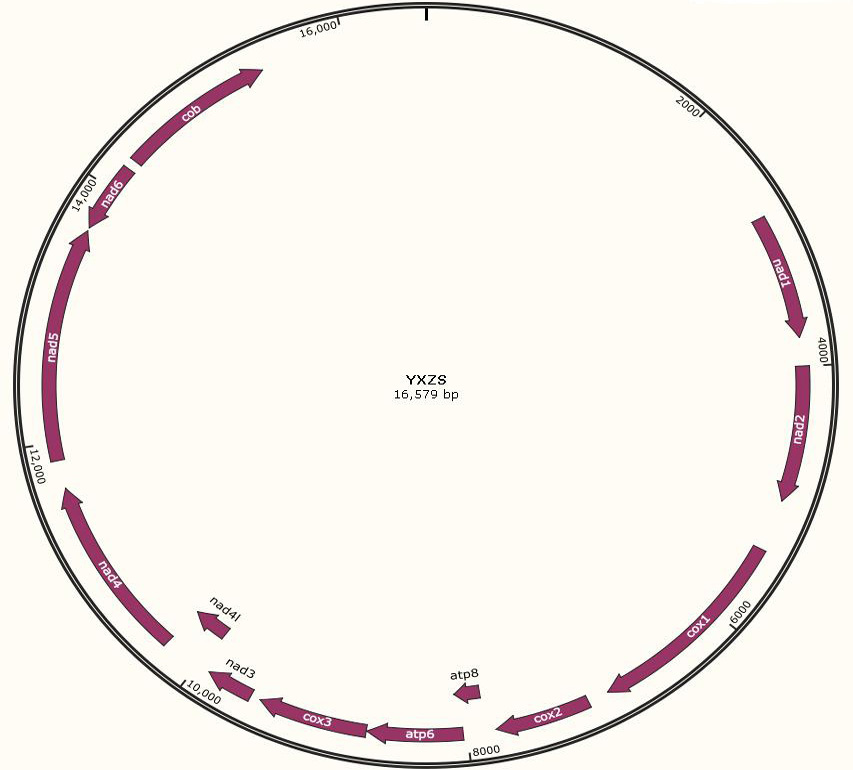
The complete mt genome map of R. pruinosus from Wenzhou.
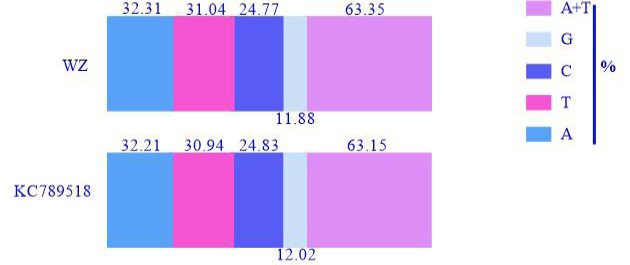
The ratio of the bases of the mt genome of R. pruinosus from Wenzhou.
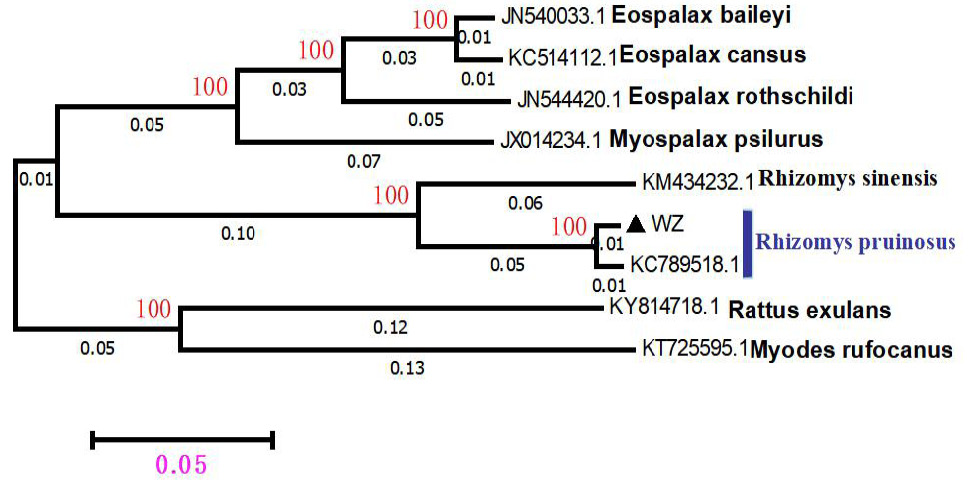
Phylogenetic analysis of the mt genome of R. pruinosus from Wenzhou using Neighbor Joining method. The numbers at clades indicate bootstrap values.
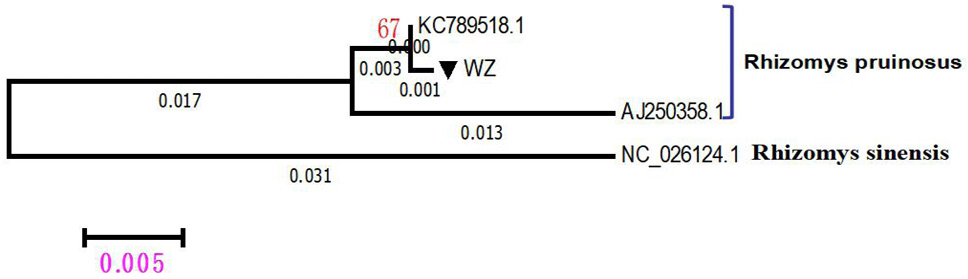
Phylogenetic analysis of the 12S rRNA of mt genome of R. pruinosus from Wenzhou using Neighbor Joining method. The numbers at clades indicate bootstrap values.
References
- Chen, T.B., Xun, Z., Lin, J.P., Fu, Y., Wu, W.N., Fu, X.C., Hu, Y.H., Zeng, Y.B. and Ou, Q.H., 2016. J. med. Virol., 89: 1958-1962. https://doi.org/10.1002/jmv.24886[CrossRef]
- Li, K., Lan, Y.F., Luo, H.Q., Zhang, H., Liu, D.Y., Zhang, L.H., Gui, R., Wang, L., Shahzad, M., Sizhu, S.L., Li, J.K. and Chamba, Y.Z., 2016a. Korean J. Parasitol., 545: 645-652. https://doi.org/10.3347/kjp.2016.54.5.645[CrossRef]
- Li, K., Luo, H.Q., Zhang, H., Lan, Y.F., Han, Z.Q., Shahzad, M., Wang, X.Q., Qiu, Q., Huang, S.C., Jiang, W.T. and Li, J.K., 2016b. Vet. Parasitol., 223: 91-95. https://doi.org/10.1016/j.vetpar.2016.04.036[CrossRef]
- Li, K., Luo, H.Q., Zhang, H., Mehmood, K., Shahzad, M., Zhang, L.H. and Li, J.K., 2017a. Mitochond. DNA Part A, 21: 1-5. https://doi.org/10.1016/j.compositesa.2017.05.002[CrossRef]
- Li, K., Lan, Y.f., Luo, H.q., Shahzad, M., Zhang, H., Wang, L., Zhang, L.h., Liu, D.y., Liu, X.y., Hao, Y.n., Sizhu, S.l. and Li, J.k., 2017b. Acta Parasitol., 62: 90-96. https://doi.org/10.1515/ap-2017-0063[CrossRef]
- Li, M.W., Lin, R.Q., Song, H.Q., Wu, X.Y. and Zhu, X.Q., 2008. BMC Genom., 9: 224. https://doi.org/10.1186/1471-2164-9-224[CrossRef]
- Liu, J.H., Hao, L., Liu, J.H., Liu, S.Z. and Gao, J.R., 2011. Chinese J. Vector Biol. Contr., 25: 259-262.
- Sorensen, M., Sanz, A., Gmez, J., Pamplona, R., Portero-Otín, M., Gredilla, R. and Barja, G., 2006. Free Radic. Res., 40: 339-347. https://doi.org/10.1080/10715760600733129[CrossRef]
- Tang, H.B., Chen, F.L., Rao, G.B., Bai, A.B., Jiang, J.J., Du, Y.C., Ren, P.F., Liu, J.F., Qin, S.M., Yang, L. and Wu, J.M., 2017. Vet. Microbiol., 207: 280-285. https://doi.org/10.1016/j.vetmic.2017.06.018[CrossRef]
- Xu, Y., Liu, X.H. and Tu, F.Y., 2016. Mitochond. DNA, 27: 1773-1774. https://doi.org/10.3109/19401736.2014.908469[CrossRef]
- Yan, Y.J., Lü, Z.M., Wang, T.M., Chen, Y.J., Yang, J.W., Guo, B.Y., Jiang, L.H., Wu, C.G. and Liu, L.Q., 2018. Pakistan J. Zool., 50: 463-472.
- Zhao, F., Zhang, T.Z., Su, J.P., Nevo, E. And Lin, G.H., 2014. Mitochond. DNA, 25: 381-382. https://doi.org/10.3109/19401736.2013.809434[CrossRef]
- Zong, W.X., Rabinowitz, J.D. and White, E., 2016. Mol. Cell, 61: 667-676. https://doi.org/10.1016/j.molcel.2016.02.011[CrossRef]
Services
Article usage statistics
Loading…