
Mollusks a group of macroinvertebrates found in both aquatic and freshwater habitats are the oldest animals. Historically which goes back to Cambrian deposits. They have got a second rank in abundance after the more abundant arthropods taxon and are the most important invertebrates around the world whose importance may be estimated from their roles such as (i) use as a delicious food in many regions of the world (ii) key role in cosmetics and pharmaceutical industries (iii) as a pest causing serious damage to crops and (iv) an active intermediate host in the transmission of infectious agents like genus Schistosoma, Fasciola and Echinostoma etc. in mammals causing serious infections such Schistosomiasis, Fascioliasis etc. Looking to their importance, the current study was conducted in District Swat, Khyber Pakhtunkhwa, Pakistan to explore the freshwater gastropods’ fauna. For this 1135 live snails’ specimen were collected from various localities. Using conchological characteristics freshwater snails were identified up to species level are Physa acuta, Draparnaud, 1805, Indoplanorbis exustus, Deshayes, 1834 and Bellamya bengalensis, Lamark, 1882. Among the species Physa acuta was the more abundant species (54.18%) followed by Indoplanorbis exustus (26.43%) and Bell a bengalensis (19.38%). The Shannon-wiener and Simpsons’ diversity indices shown a significant value of 1.001 and 0.599, respectively for the given region. The current study has revealed the freshwater snails’ fauna for the first time from District Swat, Pakistan and also provided a key feature of the identified species.
Short Communication · Volume 58, Issue 1, 2 January 2026 · Open Access
Diversity of Freshwater Gastropoda Snails Found in District Swat, Khyber Pakhtunkhwa, Pakistan
· · · ·
Affiliations & Notes ⌄
- 1College of Animal Science and Technology, Yangzhou University, Jiangsu Province, China 2Department of Zoology, Abdul Wali Khan University, Mardan, Khyber Pakhtunkhwa, Pakistan. 3Centre for Animal Sciences and Fisheries, University of Swat, Swat, Khyber Pakhtunkhwa, Pakistan. * Corresponding author: shahzebahmad997@gmail.com
Article Info ⌄
- Journal:
- Pakistan Journal of Zoology
- Published:
- 2 January 2026

From the article
- From 1135 collected snail specimens from various localities (Table I), three freshwater snail species were identified belonging to three gastropods’ families i.e. Physidae, Viviparidae and Planorbidae.
- The species are Physa acuta, Draparnaud, 1805, Indoplanorbis exustus, Deshayes, 1834 and Bellamya bengalensis, Lamarck, 1882.
- The species’ abundance calculated during the study were 615(54.18%), 300(26.43%) and 220(19.38%) for P. acuta, I. exustus and B. bengalensis, respectively (Fig. 2) indicating P. acuta as the dominant species.
Selected from the article's own text.
Abstract
Materials and methods
The study was conducted in District Swat, Pakistan (Fig. 1). It is situated in the North of Pakistan (34.30o-35.05oN, 71.45o-72.50oE). Geographical studies revealed the possession of altitudinal variation like plain areas to a high peaks ranging from 600m-6000m above sea level form hilly as well as mountainous extremities. From these high peaks a single drainage basin (River Swat) originates which is a major source of freshwater . The region possesses an unusual weather profile i.e. the average recorded temperature revealed a significant fluctuation monthly wise which is 32.71oC in June falls to 0oC or below in December and January. The high precipitation in July (143.00mm) unlike the month of November and December (only 20mm). Humidity is high in August (82.58%) . Due to their unusual environmental condition the valley also possesses a rich flora and fauna and can be estimated from the presence forests (natural and artificial) and the agroforestry which provide a favorable condition for animal life such as terrestrial and freshwater to the life of birds (resident and migratory) .
Specimen collected from all the seven tehsils except Bahrain due to low water temperature Ghalegay, Guligram, Kabal, Charbagh, Khwaza Khela, Matta and Bahrain. Specimen were collected from different freshwater sources like spring water, river Swat and rice fields through a mesh as well as by handpicking . All the live snail specimen were brought to zoological Laboratory in ¾ filled plastic boxes with constant aeration. The collection and rearing of the live specimen during transect as well as in the Laboratory was done by following the standard protocols provided by the guide entitled Guidelines and Procedures for the Malacology Collection of the Tom Ridge Environment Centre at Presque Isle Gastropoda-Snails Bivalvia-mussels (integrated taxonomic information system) with some modifications.
Using the keys provided by ; ; snails were identified up to species taxon. The identification was based on conchology i.e. shell height and width, no. of whorls, shell coiling (sinistral or dextral). Aperture shape and size, presence or absence of operculum, shape and texture of operculum, spire position, texture of periostracum, presence/absence of aperture lip and umbilical features (open or closed). The shell morphometry was done by Analogue Vernier caliper. Shannon-Wiener and Simpson’s diversity indices were also calculated using MS Excel sheet 2013.
Results and discussion
From 1135 collected snail specimens from various localities (Table I), three freshwater snail species were identified belonging to three gastropods’ families i.e. Physidae, Viviparidae and Planorbidae. The species are Physa acuta, Draparnaud, 1805, Indoplanorbis exustus, Deshayes, 1834 and Bellamya bengalensis, Lamarck, 1882. The species’ abundance calculated during the study were 615(54.18%), 300(26.43%) and 220(19.38%) for P. acuta, I. exustus and B. bengalensis, respectively (Fig. 2) indicating P. acuta as the dominant species.
The environmental factors such as water pH and temperature were also recorded and the average values found were 7.00 and 26.18ºC, respectively.
Family Physidae
Genus Physa Haldeman, 1843
Physa acuta, Draparnaud, 1805
Table I. Number of collected snail samples along with the species’ distribution and richness.
| S. No | Tehsils | Water temperature (oC) | Localities | Physa acuta | Bellamya bengalensis | Indoplanorbis exustus | Total collected samples |
| 1 | Babozai | 27.9 | Marghazar | 40 | 00 | 00 | 240 |
| Guligram | 40 | 00 | 50 | ||||
| Tindodag | 40 | 40 | 30 | ||||
| 2 | Barikot | 28.1 | Ghalegay | 110 | 60 | 60 | 230 |
| 3 | Kabal | 27.5 | Aligrama | 20 | 20 | 00 | 40 |
| 4 | Charbagh | 24.1 | Charbagh | 170 | 00 | 150 | 320 |
| 5 | Khwaza Khela | 30.5 | Khwaza Khela | 150 | 20 | 00 | 170 |
| 6 | Matta | 26.5 | Matta | 45 | 80 | 10 | 135 |
| Total | 615 | 220 | 300 | 1135 | |||
Measurable features of the shell that is shell height and width are 13.31mm and 7.07mm, respectively. The species has wide distribution throughout the district. It is familiar with the name “fruit fly” of the malacology because of their very fast maturation and higher reproduction rate .
Family Planorbidae
Genus Indoplanorbis, Annandale and Prashad, 1921
Indoplanorbis exustus, Deshayes, 1834
Shell’s height and width are 4.01mm and 10.11mm, respectively. This is a native species of Asia and is known for their role as an intermediate host for the transmission of trematode’s infections, especially Asiatic schistosomiasis .
Family Viviparidae
Genus Bellamya, Jousseaume, 1886
Bellamya bengalensis, Lamark, 1882
Shell’s height and width are 32.40mm and 22.47mm, respectively. The presence of color bands (striation) is one of their main diagnostic character among the other members of the same genus. In many countries throughout the world it is used as a food. It is a well-known vector for parasitic nematode of human and other animals like fishes .
Using Shannon-Wiener and Simpson’s diversity indices the diversity of gastropods were calculated for the region, which are 1.001 and 0.599, respectively (Table II) showing the significance value for diversity of gastropods in the study area. These values are less than the calculated indices found in the study of Shahrbabak et al. (2021), but provided a baseline for the future studies regarding the biodiversity of gastropods in the region.
Table II. Shannon-wiener (H) and simpson (D) index values for gastropod’s diversity Swat.
| Name of species | No of individuals of each species (n) | pi | pi2 | In pi | pi (In pi) | n (n-1) | Ʃn (n-1) | N (N-1) |
| P. acuta | 615 | 0.5418502 | 0.2936017 | -0.612766 | -0.332027 | 377610 | 515490 | 1287090 |
| B. bengalensis | 220 | 0.1938326 | 0.0375711 | -1.64076 | -0.318033 | 48180 | ||
| I. exustus | 300 | 0.2643172 | 0.0698636 | -1.330605 | -0.351702 | 89700 | ||
| Total (N) | 1135 | 1 | 0.4010363 | -1.001762 | ||||
| H = 1.0017619 | D = 0.5994919 | |||||||
Among the identified species, the P. acuta Draparnaud, 1805 is the more prevalent and abundant species (54.18%) collected from all the sampling sites strongly supports the idea presented by Kakar et al. (2017) that is the P. acuta has high reproductive and maturation rate as compare to other gastropod species. The abundance of I. exustus recorded was 26.43% nearly similar to the result of Qureshi et al. (2015) which is 23.4%. Looking to the species richness, tehsil Babozai and Barikot are richer because all the three gastropod species were found here might be due to a little bit high water temperature (27.5oC) than the other sampling sites which is in line of the work of McCreesh and Booth (2014) i.e. snails survive well in between the range of 15oC-31oC.
The height to width ratio of the shells has calculated, they were 1.8, 1.44 and 0.39 for P. acuta, B. bengalensis and I. exustus respectively and have confirmed their shell shapes i.e. conical for P. acuta and B. bengalensis and plane shape for I. exustus. Mostly the samples were collected from the agricultural lands as compared to other water bodies supporting the idea that agro-ecosystem is rich in species than the other water bodies .
Conflict of interest
The authors have declared no conflict of interest.
Figures
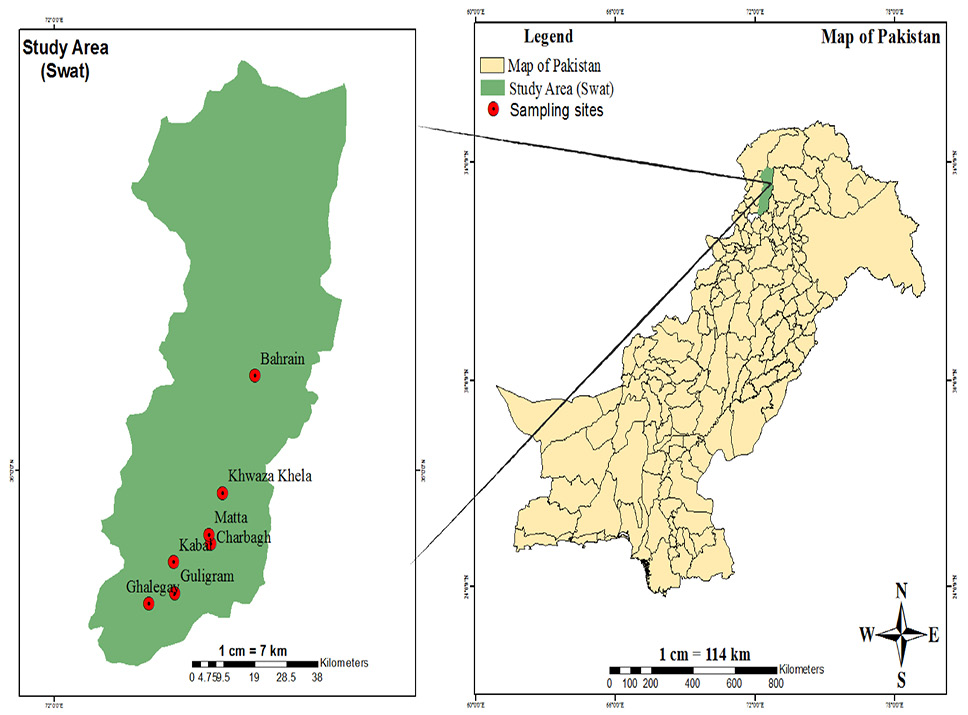
Map of study area showing sampling sites.
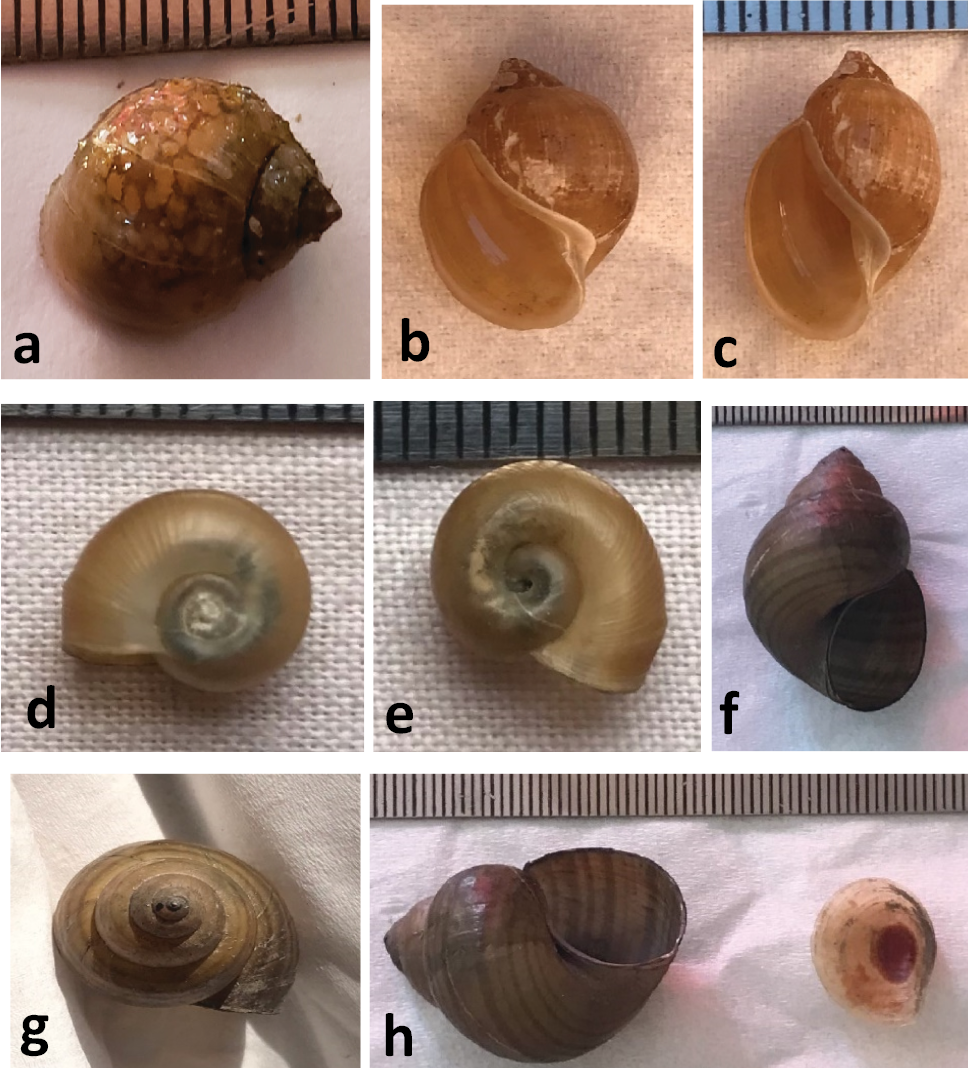
P. acuta: a, Shell height; b, shell texture, shape of aperture and aperture lip (peristome); c, shell width. I. exustus: d, shell width and texture; e, umbilicus. f, shell width and umbilicus size; g, No of whorls and shell texture; h, Aperture shape and texture of operculum.
References
- Abbott, R.T., 1989. Compendium of landshells: A color guide to more than 2,000 of the world’s terrestrial shells (First edition). American Malacologists.
- Ahmad, H., Öztürk, M., Ahmad, W. and Khan, S.M., 2015. In: Climate change impacts on high-altitude ecosystems. Springer, pp. 49-98. https://doi.org/10.1007/978-3-319-12859-7_2[CrossRef]
- Akhtar, S., 1978. Biologia, 24: 437-447.
- Altaf, J., Qureshi, N.A., Raza, S.H. and Iqbal, M.J., 2016. J. Biodiv. environ. Sci., 8: 17-33.
- Altaf, J., Qureshi, N.A. and Siddiqui, M.J.I., 2017. J. Biodiv. environ. Sci., 10: 240-252.
- Begum, F. and Nazneen, S., 1992. Philipp. J. Sci., 121: 53-64.
- Brown, D.S., 2002. Freshwater snails of Africa and their medical importance. CRC press.
- Chapman, A.D., 2009. Numbers of living species in Australia and the world. Report for the Australian Biological Resources Study.
- Dhiman, V. and Pant, D.J.J.I., 2021. Immunochemistry, 42: 211-235. https://doi.org/10.1080/15321819.2020.1844751[CrossRef]
- Farahnak, A. and Ghobadi, H., 2006. Arch. Razi Ins., 61: 49-52.
- Kakar, S., Kashif, K., Essote, S.A., Iqbal, A. and Ali, M., 2017. Int. J. Biosci., 10: 251-259. https://doi.org/10.12692/ijb/10.3.251-259[CrossRef]
- Khan, M.D. and Dastagir, S.G., 1971. Rec. Zool. Surv. Pak., 2: 17-129.
- Khatoon, S., Ali, S.R., 1978. Freshwater mollusks of Pakistan. Bull. Hydrobiol. Res. Ser., 1: 518-525.
- McCreesh, N. and Booth, M., 2014. PLoS One, 9: e101462. https://doi.org/10.1371/journal.pone.0101462[CrossRef]
- Miller, S.A. and Harley, J.P., 2001. Zoology. The McGraw-Hill, United States.
- Mitra, S. and Dey, A., 2005. Ramakrishna, pictorial handbook: Indian land snails. Zoological Survey of India, Kolkata.
- Neubert, E., 1998. Fauna Arabia, 17: 333-462.
- Qureshi, A.W., Tanveer, A., Maqbool, A. and Niaz, S., 2015. Asian J. Agric. Biol., 3: 130-139.
- Roberts, L.S., Jr, J.J. and Nadler, S., 2013. Foundations of parasitology. The McGraw-Hill, United States.
- Shahrbabak, S.M., Erfani, M. and Ardakani, T., 2021. Int. J. environ. Sci. Technol., 18: 989-996. https://doi.org/10.1007/s13762-020-02887-7[CrossRef]
Services
Article usage statistics
Loading…