
The purpose of this study was to investigate the effect of estrogen receptor gene (ESR1) polymorphism on the carcass traits of laying quail. The polymorphism of ESR1 gene exon 4 in three laying quail populations was detected by PCR product sequencing, and the correlation between ESR1 gene and carcass traits of laying quail was analyzed. The results show that, Exon 4 of ESR1 gene among Beijing white quail, the pectora weight and pectoral muscle rate of CC genotype was significantly higher than that of CT and TT genotype(P<0.05). Among Korean quail, the body weight and carcass weight of CC genotype were significantly higher than that of CT and TT genotype(P<0.05). It was found that exon 4 of ESR1 gene was significantly associated with body weight, carcass weight, pectora weight, pectoral muscle rate of egg quail(P<0.05).
Short Communication · Volume 53, Issue 2, 27 February 2021 · Open Access
Correlation Analysis between Exon 4 of ESR1 Gene and Carcass Traits in Egg Quail
· · · ·
Affiliations & Notes ⌄
- 1College of Animal Science and Technology, Henan University of Science and Technology, Luoyang 471003, China , * Corresponding author: junyanbai@163.com
Article Info ⌄
- Journal:
- Pakistan Journal of Zoology
- Published:
- 27 February 2021

From the article
- Three genotypes, CC, CT and TT, were detected in exon 4 of ESR1 gene in three quail populations, the frequency of CC genotype of ESR1 gene exon 4 was 0.273, 0.667, 0.106, and that of CT genotype was 0.318, 0.235, 0.277 and that of TT genotype was 0.409, 0.098, 0.617, respectively.
- The results of correlation between ESR1 exon 4 and carcass traits of quail are shown in Table I. It can be seen that Exon 4 of ESR1 gene had no significant effect on the slaughter traits of China yellow quail (P>0.05).
- Among Beijing white quail, the pectora weight and pectoral muscle rate of CC genotype was significantly higher than that of CT and TT genotype (P0.05).
- Among Korean quail, the body weight and carcass weight of CC genotype were significantly higher than that of CT and TT genotype (P0.05).
Selected from the article's own text.
Abstract
Materials and methods
In this experiment, egg quails were 50 China quails with yellow feathers, 50 Beijing quails with white feathers and 50 Korean quails. All egg quails were females. Blood samples (5ml each) were collected at vein in wings and stored in heparin sodium anticoagulant tubes which were then kept in a refrigerator under -20oC. DNA was extracted by poultry whole blood DNA kit and kept under -20 oC.
Primers at exon 4 of ESR1 gene were designed with references to the design of Pu (2016), The primer sequence is as follows: F:CGGGCGAATGATGAAACA, R: CCCAGTTGATCATGTGCA, Size is 301bp. Primers were synthesized by Beijing Dongguo Changsheng Biotechnology Co., Ltd. Pre-denaturation at 94oC for 4 min, then denaturation at 94oC for 40 s, annealing at 58oC for 1 min, annealing at 72oC for 20 seconds, denaturation, annealing and elongation were carried out for 35 cycles, then elongation at 72oC and finally the reaction was completed and cooled and preserved at 4oC. PCR products are directly sent to Zhengzhou Dingguo biology Co., Ltd. for sequencing.
SPSS 17.0 statistical software was used to analyze the association between different genotypes and body size traits, and Duncan multiple comparison method was used to make multiple comparison. The final results were expressed in the form of mean value ± standard error.
Results and discussion
The results of PCR product detection for exon 4 of ESR1 gene were shown in Figure 1, and it can be seen that the detection results are all single band, and the size of exon 4 of ESR1 gene is consistent with the target fragment, which indicate that the quality of PCR amplification products is well up to standard. The PCR amplification products of all individuals of exon 4 of ESR1 gene were sequenced and the sequencing results were shown in Figure 2, it can be seen that in the Exon 4 of ESR1 gene, one SNP site is C50T, and three genotypes were detected.
Note: m is DL2000 marker, 1 is Chinese Yellow quail, 2 is Beijing white quail, 3 is Korean quail.
Three genotypes, CC, CT and TT, were detected in exon 4 of ESR1 gene in three quail populations, the frequency of CC genotype of ESR1 gene exon 4 was 0.273, 0.667, 0.106, and that of CT genotype was 0.318, 0.235, 0.277 and that of TT genotype was 0.409, 0.098, 0.617, respectively. The frequencies of exon 4 of ESR1 gene of T allele in China yellow quail and Korean quail were the highest (0.568, 0.755, respectively), the frequencies of exon 4 of ESR1 gene of C allele in Beijing white quail was as high as 0.784. This finding was similar to the results of Pu (2016).
The results of correlation between ESR1 exon 4 and carcass traits of quail are shown in Table I. It can be seen that Exon 4 of ESR1 gene had no significant effect on the slaughter traits of China yellow quail (P>0.05). Among Beijing white quail, the pectora weight and pectoral muscle rate of CC genotype was significantly higher than that of CT and TT genotype (P<0.05), and this rate had no significantly effects on other slaughter traits (P>0.05). Among Korean quail, the body weight and carcass weight of CC genotype were significantly higher than that of CT and TT genotype (P<0.05), and this had no significant effect on other slaughter trait (P>0.05). It was found that exon 4 of ESR1 gene was significantly associated with body weight, carcass weight, pectora weight, pectoral muscle rate of egg quail (P<0.05). Liu et al. (2017) indicated in their studies that Large White pigs of AB and BB genotypes of ESR gene produced superior total litter size and total living piglets than pigs of AA genotypes, although the differences were not statistically significant. They found that multiparous sows of BB genotypes had their total litter size and healthy piglets even 0.12 heads and 0.07 heads more respectively than that of AA genotypes, with the differences not statistically significant. Tan (2015) detected 4 SNPs in the first Exon of ESR gene in Jiaxing black pigs, but the HH genotype in A7188G locus was the only one that had litter size and total living piglets of greater than those by JJ genotype, in addition to its produced dead fetus and, in case of living piglet, the birth weight more than that by JJ genotype. As to the rest of the traits, no significant difference was observed among the various genotypes. Liu (2016) suggested that there was notable divergence in the total litter size, number of living piglets and birth weight between Jinhua sows of GG genotype and GA genotype of ESR gene. Wu (2013) carried out researche with female line of Shaobo Chicken and then found some polymorphisms at the 5’ lateral of ESR gene, and the egg yields of 43 weeks by pigs of EE and EF genotypes both were higher than that by FF genotypes. As demonstrated in this study, exon 4 of ESR1 gene went significantly correlated with the body weight, carcass weight, pectora weight, pectoral muscle rate of egg quails.
Acknowledgements
Sincere gratitude goes to the sponsor of National Natural Science Foundation (31201777) and Industry-University-Research Cooperation Project in Henan Province (152107000095.0).
Table I. Correlation analysis between ESR1 gene exon 4 and carcass traits of laying quail.
| Carcass traits | Beijing white quail | Chinese yellow quail | Korean quail | ||||||
| CC | CT | TT | CC | CT | TT | CC | CT | TT | |
| Weight(g) | 139.19 ± 2.347a | 133.16 ± 3.621a | 135.50 ± 2.513a | 136.45 ± 3.412a | 134.52 ± 4.275a | 144.408 ± 2.156a | 160.24 ± 3.562a | 144.40 ± 4.051b | 143.55 ± 3.626b |
| Slaughter weight(g) | 133.45 ± 2.315a | 127.78 ± 3.023a | 129.50 ± 2.672a | 130.92 ± 3.165a | 129.46 ± 4.023a | 139.408 ± 2.512a | 156.86 ± 3.512a | 140.81 ± 4.451b | 139.54 ± 3.497b |
| Eviscerated weight(g) | 84.72 ± 1.324a | 80.35 ± 2.583a | 85.40 ± 2.401a | 87.81 ± 1.634a | 86.59 ± 3.142a | 93.400 ± 1.946a | 99.860 ± 2.832a | 91.000 ± 3.801a | 92.713 ± 3.740a |
| Heart weight(g) | 1.020 ± 0.052a | 0.978 ± 0.063a | 1.200 ± 0.054a | 1.071 ± 0.097a | 1.109 ± 0.068a | 1.125 ± 0.048a | 1.180 ± 0.124a | 1.122 ± 0.046a | 1.006 ± 0.037a |
| Liver weight(g) | 3.930 ± 0.153a | 3.933 ± 0.183a | 4.300 ± 0.152a | 3.700 ± 0.393a | 3.500 ± 0.283a | 3.883 ± 0.214a | 5.380 ± 0.629a | 5.800 ± 1.452a | 4.138 ± 0.137a |
| Pectora weight (total)(g) | 28.860 ± 0.732a | 25.122 ± 0.934b | 26.000 ± 0.823b | 26.886 ± 1.235a | 26.427 ± 1.423a | 29.425 ± 0.965a | 30.340 ± 1.839a | 28.533 ± 1.976a | 29.425 ± 1.216a |
| Leg muscle weight (single)(g) | 7.195 ± 0.148a | 7.178 ± 0.381a | 7.800 ± 0.210a | 7.314 ± 0.371a | 7.445 ± 0.324a | 7.667 ± 0.221a | 8.020 ± 0.174a | 7.578 ± 0.321a | 7.519 ± 0.292a |
| Slaughter rate(%) | 95.863 ± 0.135a | 95.955 ± 0.159a | 95.572 ± 0.145a | 95.966 ± 0.176a | 96.203 ± 0.183a | 96.515 ± 0.214a | 97.884 ± 0.103a | 97.510 ± 0.299a | 97.233 ± 0.140a |
| Eviscerating percentage(%) | 60.933 ± 0.591a | 60.403 ± 1.404a | 63.026 ± 0.743a | 64.502 ± 1.265a | 64.432 ± 1.084a | 64.768 ± 1.217a | 62.369 ± 1.707a | 63.010 ± 1.826a | 64.356 ± 1.177a |
| Heart rate(%) | 1.211 ± 0.063a | 1.217 ± 0.068a | 1.405 ± 0.061a | 1.217 ± 0.100a | 1.285 ± 0.064a | 1.207 ± 0.049a | 1.176 ± 0.100a | 1.243 ± 0.054a | 1.103 ± 0.047a |
| Liver rate(%) | 4.659 ± 0.188a | 4.936 ± 0.269a | 5.035 ± 0.192a | 4.232 ± 0.463a | 4.029 ± 0.262a | 4.172 ± 0.265a | 5.379 ± 0.562a | 6.740 ± 0.324a | 4.575 ± 0.244a |
| Pectoral muscle rate (total)(%) | 34.013 ± 0.550a | 31.276 ± 0.647b | 30.445 ± 0.598b | 30.654 ± 1.382a | 30.429 ± 0.819a | 31.481 ± 0.714a | 30.475 ± 1.998a | 31.080 ± 1.001a | 31.812 ± 0.624a |
| Leg muscle ratio (single)(%) | 16.991 ± 0.251a | 17.858 ± 0.630a | 18.267 ± 0.432a | 16.647 ± 0.709a | 17.179 ± 0.419a | 16.417 ± 0.322a | 16.133 ± 0.699a | 16.682 ± 0.365a | 16.253 ± 0.204a |
Statement of conflict of interest
The authors have declared no conflict of intesest.
Figures
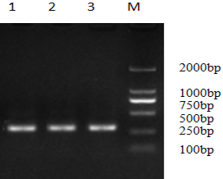
Detection of PCR products of exon 4 of ESR1 gene.
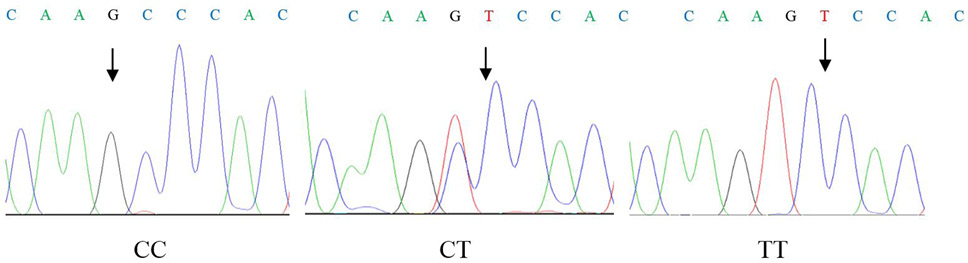
Detection of SNP locus in exon 4 of ESR1 gene.
References
- Bai, J.Y., Pang, Y.Z., Qi, Y.X., Zhang, X.H. and Yun, Y.X., 2017. Indian J. Anim. Res., 51: 851-855.
- Bai, J.Y., Pang, Y.Z., Wu, S.J., Yu, M.Q. and Zhang, X.H., 2016a. Indian J. Anim. Res., 50: 1-7.
- Bai, J.Y., Pang, Y.Z., Zhang, X.H., Yun, Y.X. and Qi, Y.X., 2016b. Brazilian J. Poult. Sci., 18: 519-524. https://doi.org/10.1590/1806-9061-2015-0101[CrossRef]
- Bai, J.Y., Pang, Y.Z., Qi, Y.X., Zhang, X.H. and Yun, X.Y., 2016c. Brazilian J. Poult. Sci., 18: 027-032.
- Bai, J.Y., Pang, Y.Z., Zhang, X.H. and Li, Y.X. 2016d. Brazilian J. Poult. Sci., 18: 91-93. https://doi.org/10.1590/1806-9061-2015-0177.[CrossRef]
- Bai, J.Y., Yang, S., Pang, Y.Z., Wu, X.H. and Li, G.L., 2019. Pakistan J. Zool., 51: 1663-1666. https://doi.org/10.17582/journal.pjz/2019.51.5.1663.1666[Full text][CrossRef]
- Li, Y.X., Zhang, X.H., Pang, Y.Z., Qi, Y.X. and Zhao, S.J., 2019. J. Poult. Sci., 56: 84-90. https://doi.org/10.2141/jpsa.0180058[CrossRef]
- Liu, J., 2016. Polymorphism of MDR1, OPN and ESR genes and correlation analysis of reproductive traits in remaining sows. Zhejiang University, Hangzhou.
- Liu, Y., Hu, J.Y., Zhao, Y.Q.,Wang, D.M., Liu, X.J. and Huang, T., 2017. Chinese J. Anim. Sci., 53: 44-48.
- Pu, Y.J., 2016. Study on cloning, expression and correlation of egg-producing related genes of egg quail with characters. Huazhong Agricultural University, Wuhan.
- Rasul, M., Mehmood, S., Ahmad, S., Javid, A., Mahmud, A., Rehman, A., Usman, M., Hussain, J., Ahmad, M. and Azhar, M., 2019. Brazil. J. Poult. Sci., 21: 1-10. https://doi.org/10.1590/1806-9061-2018-0734[CrossRef]
- Sanches, L.M., Eyng, C., Garcia, R.G., Alves, G.P., Sangalli, G.G. and Nunes, R.V., 2019. Brazil. J. Poult. Sci., 21: 1-6. https://doi.org/10.1590/1806-9061-2018-0823[CrossRef]
- Tan, Z.B., 2015. Study on the polymorphism of ESR, FSH β, PRLR and their correlation analysis of reproductive traits in Jiaxing black pig. Zhejiang agricultural and Forestry University, Hangzhou.
- Wu, Z.Y., 2013. Study on the relationship between ESR and ncoal gene polymorphism and laying performance of Shaobo hen (S2) and its expression pattern. Yangzhou University, Yangzhou.
- Zhang, X.H., Pang, Y.Z., Zhao, S.J., Xu, H.W., Li, Y.L., Xu, Y., Guo, Z. and Wang, D.D., 2013. Br. Poult. Sci., 54: 306-311.
Services
Article usage statistics
Loading…