
In this study, PCR-RFLP was used to analyze the correlation between estrogen receptor (ESR) gene polymorphism and growth traits in two populations of quail. The results showed that three genotypes, CC, CT and TT, were detected in exon 1, exon 4 and exon 8 of ESR gene. The frequencies of CC genotype in expressed exon 1 of ESR gene were the highest in french giant quail and savimit quail (0.531 and 0.778, respectively). The frequencies of TT genotype in expressed exon 4 of ESR gene were the highest in french giant quail and savimit quail (0.338 and 0.581, respectively). The frequencies of TT genotype in expressed exon 8 of ESR gene were the highest in french giant quail and savimit quail (0.544 and 0.838, respectively). The research in this paper demonstrated the significant associations of exon 1 of ESR gene with sternal length and body length (P<0.05), exon 8 with body length (P<0.05), and exon 4 with body weight, chest width, and tibial circumference of meat quails (P<0.05).
Short Communication · Volume 54, Issue 1, 19 December 2021 · Open Access
Correlation Analysis of Estrogen Receptor Gene Polymorphism and Growth Traits in Meat Quail (Coturnix coturnix)
· · · · · ·
Affiliations & Notes ⌄
- 1College of Animal Science and Technology, Henan University of Science and Technology, Luoyang 471003, China 2College of Agriculture, Henan University of Science and Technology, Luoyang 471003, China , * Corresponding author: junyanbai@163.com
Article Info ⌄
- Journal:
- Pakistan Journal of Zoology
- Published:
- 19 December 2021

From the article
- Three genotypes, CC, CT and TT, were detected in expressed exon 4 of ESR gene in french giant quail, and only two genotypes, CT and TT, were detected in savimit quail.
- As with exon 1 of ESR gene in french giant quails, sternal length by TT genotype was significantly greater than that by CC genotype (P0.05), accompanied by hardly any obvious effects on any other growth traits (P>0.05).
- In savimit quails, the body length by CT genotype was larger than that by CC genotype (P0.05).
Selected from the article's own text.
Abstract
Materials and methods
In this experiment, blood samples (5ml each) were collected from vein in wings of 50 french giant quail and 50 savimit quail. The blood samples were stored in heparin sodium anticoagulant tubes which were then kept in a refrigerator under -20 oC. DNA was extracted by poultry whole blood DNA kit and kept under -20 oC.
Primers were designed according to the reference of Pu (2016) (Table I). Primers were synthesized by Beijing Dingguo Changsheng Biotechnology Co., Ltd. The PCR amplification procedure was as follows: pre-denaturation at 94 oC for 4 min, then denaturation at 94 oC for 40 s, annealing at 53-55 oC for 1 min, elongation at 72 oC for 20 seconds, denaturation, annealing and elongation
Table I. The information of primer sequences.
| Name | Primer Sequence (5'-3') | Size (bp) | Annealing temperature (oC) |
| Exon 1 | F: CAAAGCCCTTGGAGTTAC R: AGCAGTTCTCCCTACTCC | 370 | 55.4 |
| Exon 4 | F: CGGGCGAATGATGAAACA R: CCCAGTTGATCATGTGCA | 301 | 58 |
| Exon 8 | F: CAACAAAGGAATGGAGCA R: CCCTTCTTTTGCTGTTAA | 212 | 53.6 |
Table II. Correlation between ESR gene polymorphism and growth traits (3-5 weeks old) in meat quail.
| Name | Varieties | Genotype (Genotype frequency) | Body weight (g) | Tibia length (cm) | Chest width (cm) | Chest depth (cm) | Sternum length (cm) | Body length (cm) | Tibia circum-ference (cm) |
| Exon 1 | French giant quail | CC(0.531) | 122.85 ±4.90a | 3.70 ±0.02a | 2.93 ±0.05a | 3.27 ±0.03a | 3.67 ±0.09b | 8.33 ±0.16a | 1.58 ±0.01a |
| CT(0.306) | 127.91 ±6.01a | 3.69 ±0.03a | 3.02 ±0.05a | 3.33 ±0.04a | 3.83 ±0.11ab | 8.51 ±0.21a | 1.59 ±0.02a | ||
| TT(0.163) | 124.31 ±8.81a | 3.66 ±0.04a | 3.02 ±0.08a | 3.28 ±0.06a | 3.85 ±0.14a | 8.37 ±0.27a | 1.58 ±0.03a | ||
| Savimit quail | CC(0.778) | 112.44 ±5.53a | 3.67 ±0.04a | 2.86 ±0.05a | 3.18 ±0.04a | 3.62 ±0.09a | 8.08 ±0.17b | 1.61 ±0.05a | |
| CT(0.222) | 115.22 ±9.17a | 3.64 ±0.08a | 2.95 ±0.07a | 3.17 ±0.05a | 3.73 ±0.17a | 8.30 ±0.33a | 1.56 ±0.04a | ||
| Exon 4 | French giant quail | CC(0.326) | 119.70 ±5.93b | 3.65 ±0.03a | 2.91 ±0.06b | 3.24 ±0.05a | 3.72 ±0.12a | 8.23 ±0.20a | 1.56 ±0.002b |
| CT(0.286) | 130.93 ±6.33a | 3.73 ±0.03a | 3.10 ±0.05a | 3.36 ±0.03a | 3.83 ±0.10a | 8.60 ±0.19a | 1.62 ±0.02a | ||
| TT(0.388) | 124.29 ±5.77ab | 3.70 ±0.03a | 2.94 ±0.05ab | 3.29 ±0.04a | 3.72 ±0.11a | 8.37 ±0.19a | 1.58 ±0.02ab | ||
| Savimit quail | CT(0.419) | 115.19 ±7.36a | 3.70 ±0.06a | 2.92 ±0.07a | 3.13 ±0.05a | 3.68 ±0.13a | 8.18 ±0.26a | 1.55 ±0.03a | |
| TT(0.581) | 111.85 ±8.18a | 3.64 ±0.04a | 2.86 ±0.06a | 3.20 ±0.04a | 3.63 ±0.10a | 8.10 ±0.19a | 1.63 ±0.07a | ||
| Exon 8 | French giant quail | CC(0.152) | 123.43 ±8.23a | 3.69 ±0.04a | 2.95 ±0.07a | 3.32 ±0.08a | 3.81 ±0.17a | 8.44 ±0.26a | 1.58 ±0.03a |
| CT(0.304) | 124.05 ±6.02a | 3.68 ±0.04a | 2.99 ±0.06a | 3.29 ±0.03a | 3.73 ±0.12a | 8.40 ±0.20a | 1.59 ±0.02a | ||
| TT(0.544) | 125.45 ±4.03a | 3.70 ±0.02a | 2.97 ±0.05a | 3.28 ±0.03a | 3.74 ±0.08a | 8.38 ±0.16a | 1.58 ±0.01a | ||
| Savimit quail | CT(0.162) | 113.33 ±10.68a | 3.65 ±0.10a | 2.83 ±0.11a | 3.22 ±0.11a | 3.59 ±0.20a | 7.79 ±0.35b | 1.78 ±0.23a | |
| TT(0.838) | 112.99 ±5.32a | 3.66 ±0.03a | 2.89 ±0.05a | 3.17 ±0.03a | 3.66 ±0.09a | 8.20 ±0.17a | 1.56 ±0.02a |
If the letters in the same column are different, the difference is significant (P<0.05); if the letters in the same column are the same, the difference is not significant (P>0.05).
were carried out for 35 cycles, finally elongation at 72oC for 10 min, the reaction was completed and preserved at 4oC.
The PCR product amplified by exon 1 primers was digested by restriction endonuclease Pvu II. The reaction system was 15 μL: ddH2O 5 μL, PCR product 8 μL, restriction endonuclease Pvu II (10U / μL) 0.5 μL, 10 × buffer 1.5 μL. The mixture was evenly mixed and digested in a 37 oC water bath for 4 h. The PCR product amplified by exon 8 primers was digested by restriction endonuclease ACC Ι. The reaction system was 10 μL: ddH2O 0.5 μL, PCR product 8 μL, restriction endonuclease ACC Ι (10U / μL) 0.5 μL, 10 × buffer 1.0 μL. The mixture was evenly mixed and incubated at 37oC for 4h. The digested products were detected by 2% agarose gel electrophoresis. Exon 4 was identified by PCR product direct sequencing.
SPSS17.0 statistical software was used to analyze the association between different genotypes and growth traits, the final results were represented in the form of mean value + standard error.
Results and discussion
As can be seen from Figure 1, CC, CT and TT, were detected in expressed exon 1 of ESR gene in french giant quail, and only two genotypes, CT and TT, were detected in savimit quail. The frequencies of CC genotype in expressed exon 1 of ESR gene were the highest in french giant quail and savimit quail (0.531 and 0.778, respectively). Three genotypes, CC, CT and TT, were detected in expressed exon 4 of ESR gene in french giant quail, and only two genotypes, CT and TT, were detected in savimit quail. The frequencies of TT genotype in expressed exon 4 of ESR gene were the highest in french giant quail and savimit quail (0.338 and 0.581, respectively). Three genotypes, CC, CT and TT, were detected in expressed exon 8 of ESR gene in french giant quail, and only two genotypes, CT and TT, were detected in savimit quail. The frequencies of TT genotype in expressed exon 8 of ESR gene were the highest in french giant quail and savimit quail (0.544 and 0.838, respectively).
Table II showed the results of association analysis between ESR gene polymorphism and growth traits of meat quails. As with exon 1 of ESR gene in french giant quails, sternal length by TT genotype was significantly greater than that by CC genotype (P<0.05), while those by CT genotype had no difference with that by CC or TT genotypes (P>0.05), accompanied by hardly any obvious effects on any other growth traits (P>0.05). In savimit quails, the body length by CT genotype was larger than that by CC genotype (P<0.05), without obvious influences imposed on the rest of their growth traits (P>0.05). It therefore suggested a remarkable correlation of exon 1 of ESR gene with the sternal length and body length of meat quails(P<0.05).
Exon 4 of ESR gene had no significant effects on the growth traits of savimit quails (P<0.05). In french giant quails, the body weight, chest width and tibial circumference of CT genotype were greater than those of CC genotype (P<0.05), such indicators by TT genotype were not notably different with that of CT or CC genotype (P>0.05), the rest of the traits were not affected. These results told that exon 4 of ESR gene had been correlated with the body weight, chest width, and tibial circumference of meat quails (P<0.05). Not any growth traits of french giant quails were notably affected by exon 8 of ESR gene (P>0.05), but among savimit quails, the body length of CT genotype was significantly higher than that of TT genotype (P<0.05), indicating the exon 8 and the body length of meat quails in somehow relevance (P<0.05).
By now the studies about association between ESR gene and growth performance in livestock and poultry were few. Wang et al. (2009) and others indicated that individuals with AA genotype of ESR gene produced higher body length, and more significant body height, chest circumference and body weight than that with BB genotype in Su Jiang pigs. Liu (2007) found that ESR gene had obvious influences on the daily gain of Jiangxi and Anhui Large White pigs, but showed little effect on their body height, body length and chest circumference. Li (2005) suggested that there was no significant difference in early growth traits among Suhuai pigs with various genotypes of ESR gene. The results of this research were similar to those findings by Wang et al. (2009) but inconsistent with results by Liu (2007) and Li (2005), the research in this paper demonstrated the significant associations of exon 1 of ESR gene with sternal length and body length (P<0.05), exon 8 with body length (P<0.05), and exon 4 with body weight, chest width, and tibial circumference of meat quails (P<0.05). In the selection of meat quails therefore the sternal length, body length, the body weight, chest width, and tibial circumference et al. shall be considered comprehensively.
Acknowledgements
Sincere gratitude goes to the sponsor of National Natural Science Foundation (31201777) and Industry-University-Research Cooperation Project in Henan Province (152107000095.0).
Statement of conflict of interest
The authors have declared no conflict of interest.
Figures
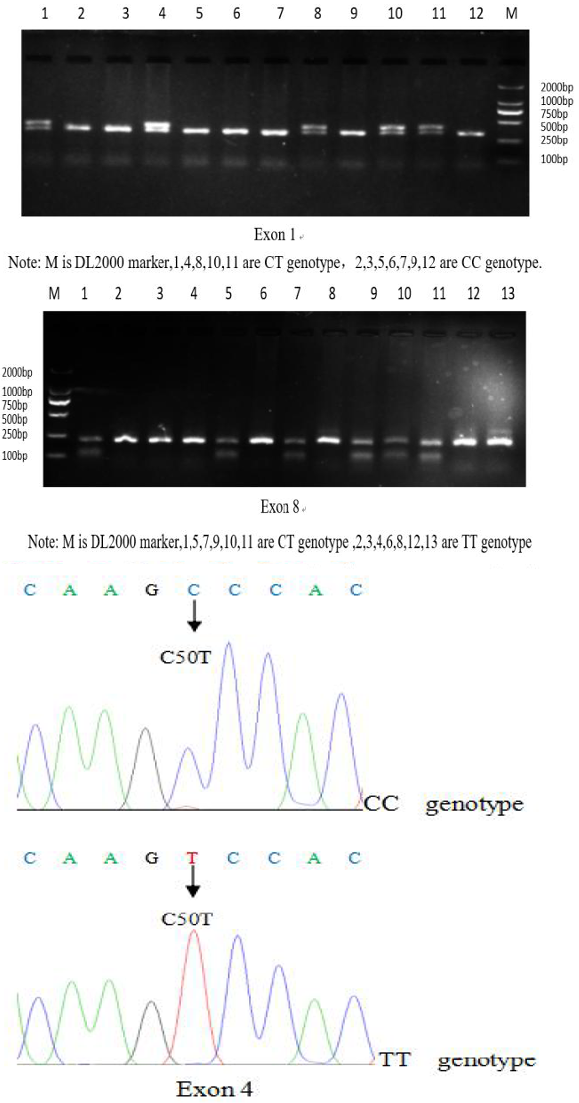
Detection results of ESR gene polymorphism.
References
- Azhar, M., Ahmed, S., Mehmood, S., Naveed, S., Ahmad, S., Usman, M. and Zia, M.W., 2018. Indian J. Anim. Sci., 52: 1797-1802.
- Bai, J., Pang,Y., Wu,S., Yu, M., Zhang, X., Zhao, S. and Xu, H. 2013. J. Anim. Pl. Sci., 23:1072-1076.
- Bai, J.Y., Pang, Y.Z., Qi, Y.X., Zhang, X.H. and Yun, X.Y., 2016a. Brazilian J. Poult. Sci., 18: 27-32. https://doi.org/10.1590/1806-9061-2015-0124[CrossRef]
- Bai, J.Y., Pang, Y.Z., Qi, Y.X., Zhang, X.H. and Yun, Y.X., 2017. Indian J. Anim. Res., 52: 851-855.
- Bai, J.Y., Pang, Y.Z., Wu, S.J., Yu, M.Q. and Zhang, X.H., 2016b. Indian J. Anim. Res., 50: 1-7.
- Bai, J.Y., Pang, Y.Z., Zhang, X.H. and Li, Y.X., 2016c. Brazilian J. Poult. Sci., 18: 91-93. https://doi.org/10.1590/1806-9061-2015-0177[CrossRef]
- Bai, J.Y., Cao, H., Yang, S., Pang, Y.Z., Jiang, M.J., Fan, H.D., Fu, X.Y., Zhang, J.Y. and Shi, H.J., 2020. Indian J. Anim. Res., 54: 392-395.
- Li, Y.X., 2005. Study on polymorphism of seven functional genes and its correlation with production performance in Suhuai pigs. Nanjing Agricultural University, Nanjing.
- Li, Y.X., Zhang, X.H., Pang, Y.Z., Qi, Y.X. and Zhao, S.J., 2019. J. Poult. Sci., 56: 84-90. https://doi. org/10.2141/jpsa.0180058
- Liu, W.D., 2007. Study on the association effect between ESR, FSHβ, HAL genes and some important economic traits in pigs. China Agricultural University, Beijing.
- Pu, Y.J., 2016. Cloning and expression of egg laying related genes in laying quails and their correlation with traits. Huazhong Agricultural University. Wuhan.
- Wang, X.Y., Cao, G.L., Sun, L.Y., Song, C.Y., Hou, Y.J. and Jing, R.B., 2009. China J. Anim. Sci., 45: 1-4.
- Zhang, X.H., Pang, Y.Z., Zhao, S.J., Xu, H.W., Li, Y.L., Xu, Y., Guo, Z. and Wang, D.D., 2013. Br. Poult. Sci., 54: 306-311.
Services
Article usage statistics
Loading…