
Flavin monooxygenase 3 (FMO3) is one member of flavin monooxygenase, FMO3 gene mutation has been proved the main causes of trimethylamine urine of human as well as fishlike smell of milk and eggs. In this study, polymorphism of FMO3 genes in Beijing white quail, China yellow quail and Korean quail was tested by PCR technology and hybrid DNA pool sequencing technology. Results can provide references for further exploring the action mechanism of FMO3 on fishlike smell of quail eggs. Research results show that, One SNPs mutation site (A66G) was detected from the exon 2 of FMO3, the A allele frequencies of A66G in Beijing white quail, China yellow quail and Korean quail were 0.603, 0.500 and 0.574, while G allele frequencies were 0.397, 0.500 and 0.426, respectively. One SNPs mutation site (C219T) was detected from the exon 9, C allele frequencies of C219T in Beijing white quail, China yellow quail and Korean quail were 0.125, 0.250 and 0.000, and the T allele frequencies were 0.875, 0.750 and 1.000, respectively. Two SNPs mutation sites (A39G and A41T) were detected from exon 7, A and G allele frequencies of A39G in Korean quail, Beijing white quail and China yellow quail were 0.811, 0.189, 0.605, 0.395, 0.491 and 0.509, A and T allele frequencies of A41T were 0.000, 1.000, 0.167, 0.833, 0.000 and 1.000, respectively. Two SNPs mutation sites (A139T and C187T) were detected from exon 4, A and T allele frequencies of A139T in Beijing white quail and Korean quail were 0.826, 0.174, 0.351 and 0.649, respectively, C and T allele frequencies of C187T were 0.370, 0.630, 0.283 and 0.717, respectively. According to clustering analysis, Beijing white quail has the closest genetic relationship with Japan quail, partridge, and mallard, which are clustered in one group.
Short Communication · Volume 52, Issue 3, 17 March 2020 · Open Access
Polymorphism Analysis of FMO3 Gene in Egg Quail
· · · · · ·
Affiliations & Notes ⌄
- 1College of Animal Science and Technology, Henan University of Science and Technology, China 2 College of Agriculture, Henan University of Science and Technology, China , * Corresponding author: junyanbai@163.com
Article Info ⌄
- Journal:
- Pakistan Journal of Zoology
- Published:
- 17 March 2020

From the article
- Agarose test results of FMO3 are shown in Figure 1, in all three Egg quail groups, the exon 4 of FMO3 has a clear band at 267bp.
- C allele frequencies of C219T site of exon 9 in Beijing white quail, China yellow quail and Korean quail were 0.125, 0.250 and 0.000, and the T allele frequencies were 0.875, 0.750 and 1.000, respectively.
Selected from the article's own text.
Abstract
Materials and methods
In this experiment, egg quails were 80 China quails with yellow feathers, 80 Beijing quails with white feathers and 80 Korean quails. All egg quails were females. Blood samples (5ml each) were collected at vein in wings and stored in heparin sodium anticoagulant tubes which were then kept in a refrigerator under -20oC. DNA was extracted by poultry whole blood DNA kit and kept under -20oC.
For PCR amplification primers at FMO3 gene were designed with references to the design of Mo et al. (2014), primers were synthesized by Beijing Dongguo Changsheng Biotechnology Co., Ltd, Primer details of FMO3 gene are shown in Table I. Pre-denaturation at 94oC for 4 min, then denaturation at 94oC for 40 s, annealing at 62-64oC for 1 min, annealing at 72oC for 20 seconds, denaturation, annealing and elongation were carried out for 35 cycles, then elongation at 72oCand finally the reaction was completed and cooled and preserved at 4oC.
Gene frequency (Bai et al., 2016e, 2017b) was estimated according to the following formula: F1 = Hi / (H1 +H2) (i=1, 2), Where, F1 is frequency of an allele at SNP site, H1 and H2 are heights of peak 1 and peak 2 of this SNP allele on the sequencing diagram.
Results and discussion
Agarose test results of FMO3 are shown in Figure 1, in all three Egg quail groups, the exon 4 of FMO3 has a clear band at 267bp. Exon 7 has a clear band at 279bp and exon 9 has a clear band at 337bp. In addition, exon 2 has two band s at 137bp and 270bp, the band at 137bp is the target band, with considerations to rubber cutting sequence, the impure band at 270bp may not influence sequencing.
SNP detection results of FMO3 in egg quails are shown in Figure 2. Exon 2 of FMO3 has one SNPs mutation site (A66G). Exon 9 has one SNPs mutation site (C219T). Exon 4 has 2 SNPs mutation sites (A139T and C187T). Exon 7 has 2 SNPs mutation sites (A39G and A41T).
In this study, average contents of 4 basic groups of exon 2 of FMO3 are A=22.86%, T=20%, C=16.19% and G=40.95%. Obviously, FMO3 might be in the region with relatively higher CG content. Whether AT and CG contents in FMO3 can influence functions of gene has to be further proved by studies.
The gene frequencies of the FMO3 gene in the three egg mites population are shown in Table II, as can be seen from Table II, the A allele frequencies of A66G site of exon 2 in Beijing white quail, China yellow quail and Korean quail were 0.603, 0.500 and 0.574, while G allele frequencies were 0.397, 0.500 and 0.426, respectively. C allele frequencies of C219T site of exon 9 in Beijing white quail, China yellow quail and Korean quail were 0.125, 0.250 and 0.000, and the T allele frequencies were 0.875, 0.750 and 1.000, respectively. A and G allele frequencies of A39G site of exon 7 in Korean quail, Beijing white quail and China yellow quail were 0.811, 0.189, 0.605, 0.395, 0.491 and 0.509. A and T allele frequencies of A41T site of
Table I. Primer sequence of FMO3 gene.
| FMO3 gene | Primer sequence (5’→3’) | Annealing temperature | Product length |
| Exon 2 | F:ATGGTGCGACGCGTGGCTGT | 64oC | 137bp |
| R:TTCCGTGTAGCGCCAGAGCC | |||
| Exon 4 | F:GGGATAGAGAAAGTTTAAAGGTTG | 65.4oC | 267bp |
| R:ACACGGCTCATCACCCAGGA | |||
| Exon 7 | F:GTGAAGGAATTCAGAGAAACA | 62.0oC | 279bp |
| R:CTGAAACACCTTGACTGCC | |||
| Exon 9 | F:TGGTTCGGACAAGCAACAC | 64oC | 337bp |
| R:TAGAGCACAGTGAGGAGGAG |
Table II. Gene frequencies of FMO3 gene.
| FMO3 gene | SNPs | China yellow quail | Beijing white quail | Korean quail |
| Exon 2 | A66G | A(0.500) | A(0.603) | A(0.574) |
| G(0.500) | G(0.397) | G(0.426) | ||
| Exon 4 | A139T | - | A(0.826) T(0.174) | A(0.351) T(0.649) |
| C187T | - | C(0.370) T(0.630) | C(0.283) T(0.717) | |
| Exon 7 | A39G | A(0.491) G(0.509) | A(0.605) G(0.395) | A(0.811) G(0.189) |
| A41T | A(0.000) T(1.000) | A(0.167) T(0.833) | A(0.000) T(1.000) | |
| Exon 9 | C219T | C(0.250) | C(0.125) | C(0.000) |
| T(0.750) | T(0.875) | T(1.00) |
exon 7 were 0.000, 1.000, 0.167, 0.833, 0.000 and 1.000, respectively. A and T allele frequencies of A139T site of exon 4 in Beijing white quail and Korean quail were 0.826, 0.174, 0.351 and 0.649, respectively. C and T allele frequencies of C187T site of exon 4 were 0.370, 0.630, 0.283 and 0.717, respectively.
A phylogenetic tree of FMO3 gene sequences of different species was constructed by DNA Star (Fig. 3). According to clustering analysis of egg quail, Beijing white quail had the closest genetic relationship with Japan quail, partridge, and mallard, which were clustered in one group. Jungle fowl, Agelastes meleagrides and turkey were clustered into the second group. Cuckoo was clustered into the fourth group independently, and the rest were clustered the third group.
Polymorphism of FMO3 has been studied a lot. Existing studies involve both people and animals. Polymorphism of FMO3 is discovered not only from animals, but also from human . Zeng et al. (2003) found that mutation frequencies of FMO3 in 4 Dai communities in Yunnan Province were different. In addition, expression level of FMO3 was also related with many production performances. Tian et al. (2017) pointed out that expression level of FMO3 was positively correlated with fat deposition. FMO3 is also related with many diseases. Obstacle of trimethylamine is manifested by “trimethylaminuria” in human bodies. Recently, FMOs have certain functions in human brain. In the Rotenone-induced Parkinson model, activity of FMOs is inhibited by tapazole, which can strengthen activity of caspase 3 and decrease expression of Parkin protein. Hence, it is speculated that dysfunction of FMOs is one cause of dopaminergic apoptosis in the Rotenone-induced Parkinson model and it provides a new clue for studying the pathological model. Zhao et al. (2016) demonstrated that individuals with FMO3 susceptibility genes could be eliminated by molecular assisted marker by investigating distribution of FMO3 sensitive sites in different chicken species. Tian et al. (2017) detected few gene frequencies of FMO3 mutation sites in Lhasa white chicken, but individuals with mutant genes still can be eliminated by molecular assisted marker. According to detection results of duck FMO3 in FATGY highly conservation region, Yang et al. (2016) found no mutation of basic groups. In other words, no gene mutation was detected at the FMO3 sensitive sites.
Zhong et al. (2017) discovered mutation of basic group in quail egg which was closely related with TMA content. This mutation weakened activity of FMO3 enzyme, thus causing fishlike smelling quail eggs. In addition, Mo et al. (2011) discovered a mutation site on exon 7 of FMO3 in quail. The basic group C was mutated to the basic group T, thus inducing transformation of threonine in highly conservation area of FATGY. Therefore, there’s genetic effect of fishlike smelling quail eggs similar with chick eggs. Moreover, Mo et al. (2014). discovered that exon 4 of FMO3 had only one mutation site (A/G) and detected 6 mutation sites in exon 7. Among them, functions of amino acid at two sites were changed. In this study, two mutation sites (A139T and C187T) were found in exon 4 of FMO3, and only two mutation sites (A39G and A41T) were found in exon 7. These mutation sites disagreed with research results of Mo Fengtao. This study also demonstrated that there’s one mutation site on exon 2 (A66G) and exon 9 (C219T) of FMO3, respectively. This conformed to the research conclusion of Mo Fengtao. There are few studies concerning quail. Most studies on FMO3 in animals mainly focused on chicken. Hence, whether gene mutation of FMO3 in quail can cause fishlike smelling quail eggs still has to be further studied.
Acknowledgements
Sincere gratitude goes to the sponsor of National Natural Science Foundation (31201777) and Industry-University-Research Cooperation Project in Henan Province (152107000095.0).
Statement of conflict of interest
The authors declare there is no conflict of interest.
Figures
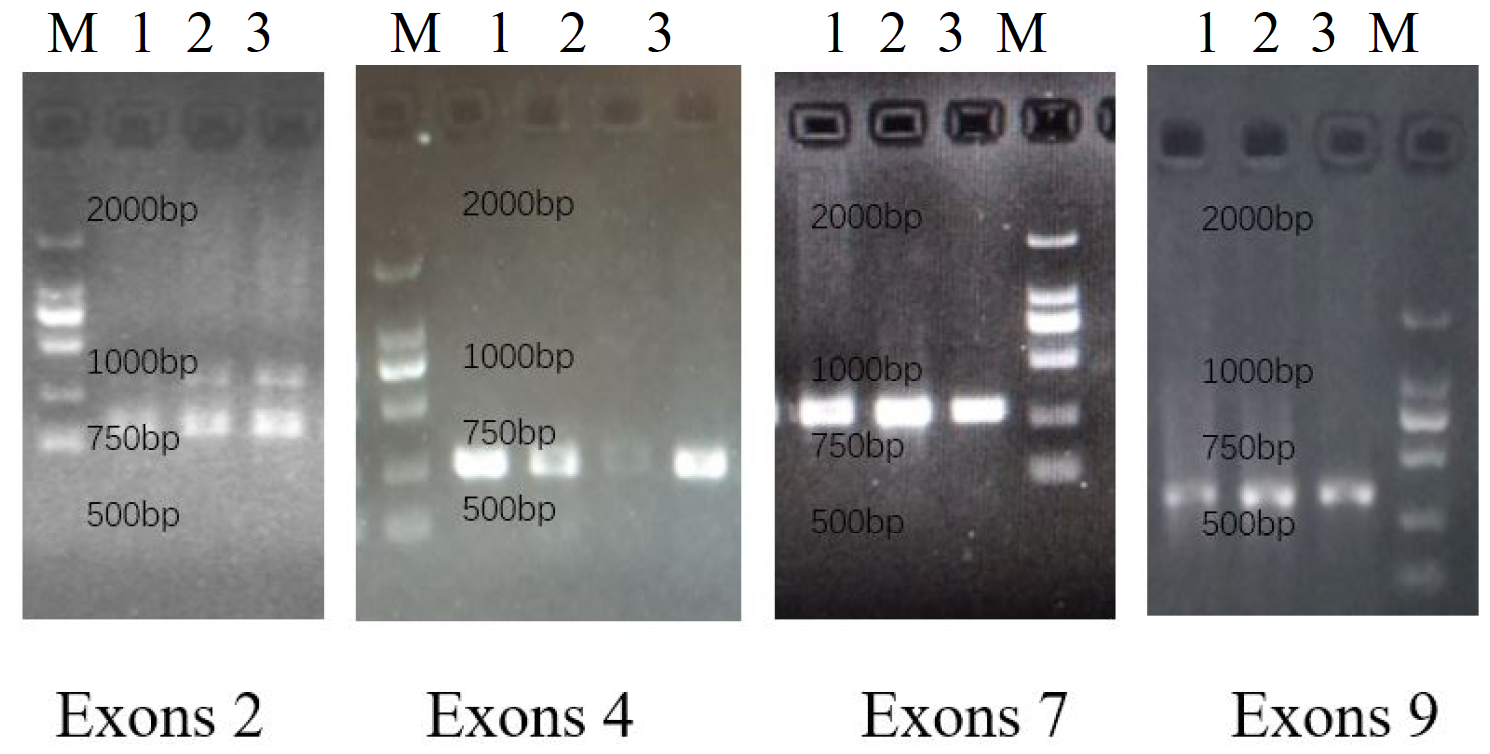
Agarose electrophoresis results of FMO3 gene. M, DL2000 Mark; 1, Chinese yellow quail; 2, Beijing white quail; 3, Korean quail.
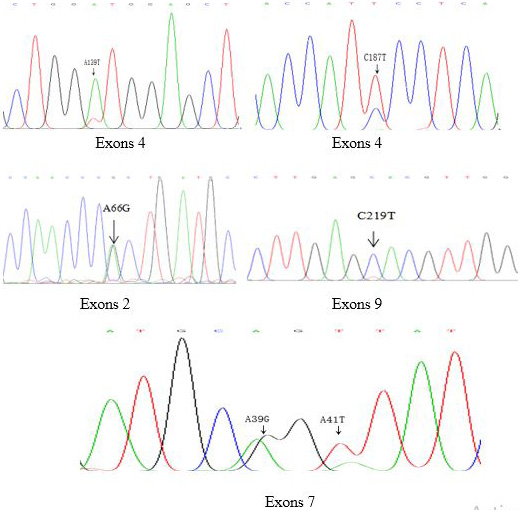
SNP detection of FMO3 gene.
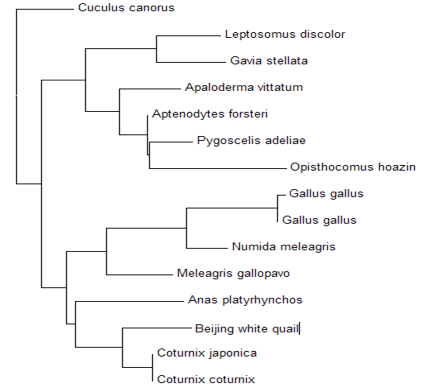
Evolutionary tree of FMO3 gene in different species.
References
- Bai, J.Y., Jia, X.P., Yang, Y.B., Pang, Y.Z. and Wang, Y.Q., 2017b. Indian J. Anim. Res., 51: 856-859. https://doi.org/10.18805/ijar.v0iOF.4551[CrossRef]
- Bai, J.Y., Wang, X., Yang, Y.B., Zhang, X.H., Pang, Y.Z. and Li, H.W., 2016e. R. Bras. Zootech., 45: 604-607. https://doi.org/10.1590/S1806-92902016001000004[CrossRef]
- Bai, J.Y., Pang, Y.Z., Qi, Y.X., Zhang, X.H. and Yun, Y.X., 2017a. Indian J. Anim. Res., 51: 851-855. https://doi.org/10.18805/ijar.v0i0f.3803[CrossRef]
- Bai, J.Y., Pang, Y.Z., Wu, S.J., Yu, M.Q. and Zhang, X.H., 2016a. Indian J. Anim. Res., 50: 1-7. https://doi.org/10.18805/ijar.8429[CrossRef]
- Bai, J.Y., Pang, Y.Z., Zhang, X.H., Yun, Y.X. and Qi, Y.X., 2016b. Brazilian J. Poult. Sci., 18: 519-524. https://doi.org/10.1590/1806-9061-2015-0101[CrossRef]
- Bai, J.Y., Pang, Y.Z., Qi, Y.X., Zhang, X.H. and Yun, X.Y., 2016c. Brazilian J. Poult. Sci., 18(Special Issue): 027-032. https://doi.org/10.1590/1806-9061-2015-0124[CrossRef]
- Bai, J.Y., Pang, Y.Z., Zhang, X.H. and Li, Y.X., 2016d. Brazilian J. Poult. Sci., 18(Special Issue2): 91- 93. https://doi.org/10.1590/1806-9061-2015-0177[CrossRef]
- Bai, J.Y.,Yang, S., Pang, Y.Z., Wu, X.H. and Li,G.L., 2019. Pakistan J. Zool., 51: 1663-1666. http://dx.doi.org/ 10.17582/journal.pjz/2019.51.5.1663.1666
- Lattard, V., Zhang, J., Tran, Q., Furnes, B., Schlenk, D. and Cashman, J.R., 2003. J. Drug Metabol. Dispos., 31: 854-860. https://doi.org/10.1124/dmd.31.7.854[CrossRef]
- Li, X., Yuan, G., Chen, X., Guo, Y., Yang, N., Pi, J., Zhang, H. and Zheng, J., 2018. J. Fd. Sci., 83: 39-45. https://doi.org/10.1111/1750-3841.13977[CrossRef]
- Mo, F.T., Zheng, J.X., Xu, G.Y. and Yang, N., 2011. China Anim. Husband. Vet. Soc. Poult. Soc., 270-275.
- Mo, F.T., 2014. Cloning and polymorphism of quail FMO3 gene associated with trimethylamine content in egg yolk. Ph.D. Dissertation of China Agricultural University.
- Tian, C.Q., Zhou, S.W., Wang, X.F., Tian, C.L., Dai, L.X., Ceng, J., Wang, X.L., Yang, Y.X., Zhang, E.P., Chen, Y.L. and Kou, Q.F., 2017. Acta Agric. Boreali-occidentalis Sin., 26: 805-811.
- Tian, X.L., Ma, X.Y., Zhang, H.L., Feng, J., Liu, H.J., Zhang, H. and Wu, C.X., 2017. China Poult., 39: 49-51.
- Wang, P., Zheng, J., Qu, L., Lian, L., Xu, G. and Yang, N., 2013. Mol. Cell. Biochem., 379: 141-151. https://doi.org/10.1007/s11010-013-1636-4[CrossRef]
- Yang, Y.P., Tao, L.W., Gong, P., Yang, Y., Chen, C., Dai, C.Y. and Ye, S.Q., 2016. Hubei agric. Sci., 55: 4018-4020.
- Zeng, W.M., Yang, J., Dong, Y.L., Yang, Z.L., Gao, L., Lu, J., Hao, Z.J. and Xiao, C.J., 2003. J. Yunnan Univ., 25(S1):232-233.
- Zhao, S.S., Hu, H.Y., Jia, Q., Sun, F.L., Xi. J.Z. and Li, X.M., 2016. J. Henan agric. Sci., 45: 134-137.
- Zhong, H., Luo, Y., Sun, J., Wang, C., Wang, Q.G., Gao, G.L., Zhang, K.S., Li, Q., Wang, H.W., Li, J., Chen, M.J., Wang, Y.M., Zhao, X.Z., 2017. Gene, 632: 25-35. https://doi.org/10.1016/j.gene.2017.08.023[CrossRef]
Services
Article usage statistics
Loading…