
At the 20th week, body weight, carcass weight, liver weight and dressing percentage of Korean quail are significantly higher than those of the rest two quail species (P<0.05). The whole net carcass weight and whole net carcass rate of China yellow quail are far higher compared to those of Beijing white quail (P<0.05). Rate of chest muscles and rate of leg muscles of Beijing white quail are significantly higher compared to those of Korean quail and China yellow quail (P<0.05). At the 38th week, Korean quail and China yellow quail show significantly higher body weight, carcass weight, whole net carcass weight, breast muscle weight, liver weight and rate of liver than Beijing white quail (P<0.05). Moroever, Korean quail has significantly higher dressing percentage than Beijing white quail (P<0.05). The whole net carcass rate of Beijing white quail is greatly higher compared to those of Korean quail and China yellow quail (P<0.05). Carcass weight of China yellow quail presents extremely significant positive correlations with body weight, whole net carcass weight, heart weight, liver weight, breast muscle weight, leg muscle weight and dressing percentage (P<0.01). The correlation coefficients are 0.997, 0.807, 0.378, 0.645, 0.695, 0.352 and 0.362, respectively. Carcass weight of Beijing white quail presents extremely significant positive correlations with body weight, whole net carcass weight, liver weight, breast muscle weight, leg muscle weight and dressing percentage (P<0.01), with correlation coeffiecients of 0.997, 0.799, 0.419, 0.719, 0.554 and 0.498, respectively. Carcass weight of Korean quail also show extremely significant positive correlations with body weight, whole net carcass weight, heart weight, breast muscle weight and leg muscle weight (P<0.01), showing correlation coefficients of 0.997, 0.790, 0.392, 0.641 and 0.406, respectively.
Short Communication · Volume 57, Issue 2, 8 April 2025 · Open Access
Comparative Analysis of Carcass Traits of Three Egg Quail Populations (Coturnix coturnix)
· · · · · · · · ·
Affiliations & Notes ⌄
- 1College of Animl Science and Technology, Henan University of Science and Technology, 263 Kaiyuan Avenue, Luolong District, Luoyang City, Henan Province, China,471023, China. * Corresponding author: junyanbai@163.com
Article Info ⌄
- Journal:
- Pakistan Journal of Zoology
- Published:
- 8 April 2025

Abstract
Materials and methods
There were 50 Chinese white quails, 50 Chinese Yellow quails and 50 Korean quails. At the age of 20 weeks, 30 quails of each breed were slaughtered, and the remaining 20 quails of each breed were slaughtered at 38 weeks old. The comparison of carcass traits of different breeds of quails was analyzed by using the multi factor ANOVA module of SPSS software, and the correlation analysis module was used to analyze the correlation between carcass traits of different breeds of quails.
Results and discussion
Comparative analysis results of carcass traits at 20th week are shown in Figure 1A. Korean quail shows significantly higher body weight, carcass weight and liver weight than the rest two quail species (P<0.05). China yellow quail and Korean quail present significantly higher whole net carcass weight and whole net carcass rate than Beijing white quail (P<0.05). Dressing percentage of Korean quail is ffar higher compared to those of China yellow quail and Beijing white quail and dressing percentage of China yell quail is far higher than that of Beijing white quail (P<0.05). Korean quail achieves significantly higher rate of liver than China yellow quail (P<0.05). Rate of chest muscles and rate of leg muscles of Beijing white quail are considerably higher compared to those of Korean quail and China yellow quail (P<0.05). Comparative analysis resutls of carcass traits at 38th week are shown in Figure 1B. According to comparative analysis of carcass traits at the 38th week, Korean quail and China yellow quail show significantly higher body weight, carcass weight, whole net carcass weight, breast muscle weight, liver weight and rate of liver than Beijing white quail (P<0.05). Korean quail shows significantly higher dressing percentage than Beijing white quail (P<0.05). Whole net carcass rate of Beijing white quail is far higher compared to those of Korean quail and China yellow quail (P<0.05). Moreover, rate of leg muscles of Beijing white quail is significantly higher than that of Korean quail (P<0.05).
Sabow (2019) Showed that brown quails possessed the highest (P < 0.05) slugger weight (237.9g) and carcass yields (160.45g) than others. Abou-Kassem et al. (2019) showed that the carcass percentage and liver ratio of Japanese quails were 71.77-77.08% and 2.24-3.98% at 5-7 weeks of age. It was suggested that Japanese quails (both malees and females) should be smoothed at 5 or 6 wk of age to obtain higher carcass yields and the best meat quality and composition. Nasr et al. (2017) pointed out that slaughter weight, carcass weight and dressing percentage of Japan white quail were significantly higher compared to those of other color of quail species at the 6th week. Gontijo et al. (2017) reported that body weight of Japan quail UFV3 at the 35d was greatly higher than those of other species. Narinc et al. (2014) found that breast muscle weight (24.1-25.7g) and leg muscle weight (15.1-16.8g) of Japan quail decreased gradually from the
4th week to the 8th week. This study demonstrated that leg muscle weights of China yellow quail, Beijing white quail and Korean quail at 38th week decreased compared to those at the 20th week. The breast muscle weight of Beijing white quail also decreased from 20th week to the 38th week. These research results are similar with conclusions of Narinc et al. (2014). Ling et al. (2003) measured that dressing percentage of Korean quail at the 6th week was higher than 80%. Besides, the whole net carcass weights of both male and female quails were 57%-59%. Rate of leg muscles and rate of chest muscles were higher than 19% and 12%, respectively. Li et al. (2015) discovered that dressing percentage, whole net carcass rate, rate of chest muscle and rate of leg muscles of adult Korean quail were 89.64%, 62.65%, 31.10% and 19.70%, respectively. In this study, the whole net carcass rate of Korean quail (61.35-63.62%) is similar with research conclusions of Li et al. (2015).
It can be seen from Supplementary Table I, that carcass weight of China yellow quail has extremely significantly positive correlations with body weight, whole net carcass weight, heart weight, liver weight, breast muscle weight, leg muscle weight and dressing percentage (P<0.01). Correlation coefficients are 0.997, 0.807, 0.378, 0.645, 0.695, 0.352 and 0.362. In addition, carcass weight has extremely significantly negative correlations with whole net carcass rate and rate of leg muscles (P<0.01). Correlation coefficients are -0.366 and -0.367, respectively. Carcass weight presents significantly positive correlations with rate of liver and rate of chest muscles (P<0.01). The correlation coefficients are 0.338 and 0.307, respectively. Breast muscle weight has extremely significantly positive correlations with body weight, whole net carcass weight, leg muscle weight and rate of chest muscles (P<0.01), with correlation coefficients of 0.695, 0.813, 0.373 and 0.792.
Carcass weight of Beijing white quail shows extremely significantly positive correlations with whole net carcass weight, liver weight, breast muscle weight, leg muscle weight and dressing percentage (P<0.01). Correlation coefficients are 0.997, 0.799, 0.419, 0.719, 0.554 and 0.498, respectively. Moreover, extremely significantly positive correlations of breast muscle weight with body weight, whole net carcass weight, leg muscle weight and rate of chest muscles are observed (P<0.01). The corresponding correlation coefficients are 0.716, 0.789, 0.413 and 0.771, respectively.
Carcass weight of Korean quail shows extremely significantly positive correlations with body weight, whole net carcass weight, heart weight, breast muscle weight and leg muscle weight (P<0.01). Correlation coefficients are 0.997, 0.790, 0.392, 0.641 and 0.406. Besides, breast muscle weight shows extremely significantly positive correlations with body weight, whole net carcass weight, leg muscle weight and rate of chest muscles (P<0.01). The corresponding correlation coefficients are 0.640, 0.806, 0.531 and 0.608, respectively. Ling et al. (2003) and Li et al. (2015) proved high-strength correlations among carcass traits (e.g. dressing percentage, whole net carcass rate, rate of leg muscles and rate of chest muscles) of Korean quail. This study also dicovered high correlations among carcass traits in all three egg quail species, which is similar with research conclusions of Ling et al. (2003) and Li et al. (2015).
Acknowledgements
This work was supported by Natural Science Foundation of Henan Province Project (242300420467).
Supplementary material
There is supplementary material associated with this article. Access the material online at: https://dx.doi.org/10.17582/journal.pjz/20200922080900
Statement of conflict of interest
The authors have declared no conflict of interest.
Figures
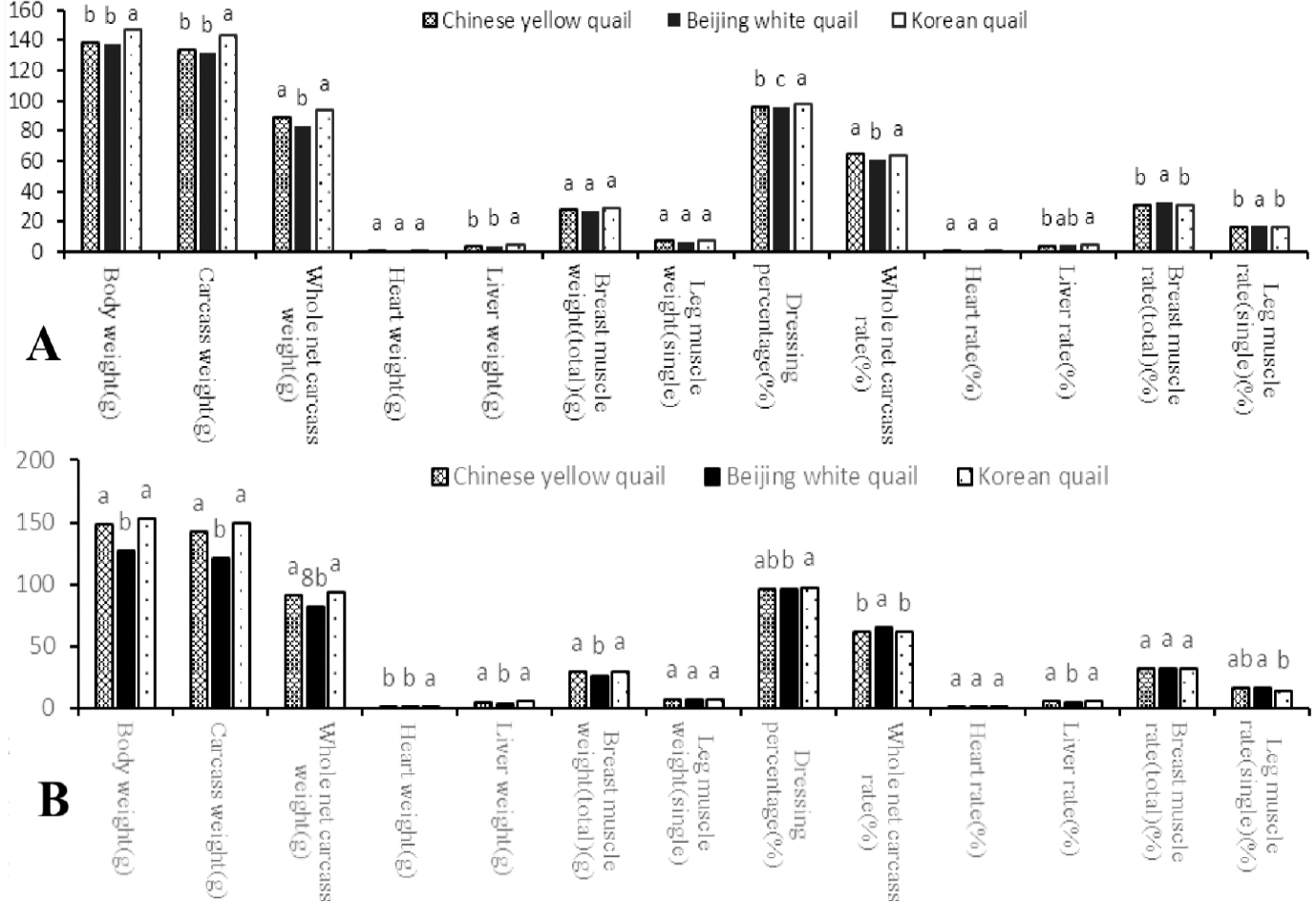
Comparative analysis of carcass traits of 20 weeks (A) and 38 weeks (B) old laying quails.
References
- Bai, J.Y., Cao, H., Yang, S., Pang, Y.Z., Jiang, M.J., Fan, H.D., Fu, X.Y., Zhang, J.Y. and Shi, H.J., 2020. Indian J. Anim. Res., 54: 392-395.
- Bai, J.Y., Pang, Y.Z., Qi, Y.X., Zhang, X.H. and Yun, X.Y., 2016. Braz. J. Poult. Sci., 18: 27-32. https://doi.org/10.1590/1806-9061-2015-0124[CrossRef]
- Bai, J.Y., Pang, Y.Z., Qi, Y.X., Zhang, X.H. and Yun, Y.X., 2017. Indian J. Anim. Res., 51: 851-855.
- Gontijo, R.P., Boari, C.A., Pires, A.V., Silva, M.A., Abreu, L.R.A. and Martins, P.G.M.A., 2017. Anim. Prod. Sci., 57: 2141–2147. https://doi.org/10.1071/AN15854[CrossRef]
- Li, M.L., Gu, Z.B., Lan, G.X., Wang, X.Y. and Wang, X.W., 2015. Chinese Poult., 15: 57–58.
- Ling, H.A., Feng, Y.L., Wang, G.Q., Huang, Y.J. and Du, B.W., 2003. Proc. 11th Natl. Poult. Symp., pp. 269–270.
- Narinc, D., Karaman, E. and Aksoy, T., 2014. Poult. Sci., 93: 762–769. https://doi.org/10.3382/ps.2013-03506[CrossRef]
- Nasr, M.A.F., Ali, E.M.R. and Hussein, M.A., 2017. J. Fd. Sci. Technol., 54: 4189–4196. https://doi.org/10.1007/s13197-017-2881-4[CrossRef]
- Sabow, A.B., 2019. Trop. Anim. Hlth. Prod., 52: 131-140. https://link.springer.com/article/10.1007/s11250-019-01991-2
Supplementary material
Services
Article usage statistics
Loading…