
In this study, the complete mitochondrial genome of Lophius litulon was sequenced and assembled by next-generation sequencing techniques. The complete mitochondrial genome of Lophius litulon contained 13 protein-coding genes (PCGs), two ribosomal RNA (rRNA) genes, and 22 transfer RNA (tRNA) genes. The total length of the mitochondrial genome of L. litulon was 16,430 bp, and the overall base composition of the mitochondrial genome was 26.96% A, 30.13% C, 17.58% G and 25.33% T. Our sequence is consistent with the mitogenome (NCBI accession number AP004413) named Lophiomus setigerus, indicating that the latter might be a misidentification. Phylogenetic analysis based on PCGs suggested that genus Lophius was more closely related to Lophiodes than Antennatus.
Short Communication · Volume 55, Issue 6, 31 October 2023 · Open Access
The Complete Mitogenome of the Lophius litulon (Lophioidei: Lophiidae) and Phylogenetic Implications
· · · ·
Affiliations & Notes ⌄
- 1Naval Architecture and Port Engineering College, Shandong Jiaotong University, Weihai, P.R. China 2Fisheries College, Ocean University of China, Qingdao, P.R. China 3Zhejiang Provincial Key Laboratory of Mariculture and Enhancement, Zhejiang Marine Fisheries Research Institute, Zhoushan, P.R. China * Corresponding author: hellojelly1130@163.com
Article Info ⌄
- Journal:
- Pakistan Journal of Zoology
- Published:
- 31 October 2023

From the article
- The complete mitochondrial genome of L. litulon (GenBank Number: OL627348) was 16,430 bp in length, including 13 protein-coding genes, 22 transfer RNAs and two ribosomal RNA genes.
- A phylogenetic tree was reconstructed using the mitogenome of L. litulon produced in this study and six others available mitogenomes of family Lophiidae with Antennatus coccineus of family Antennariidae as the outgroup (Fig. 1).
- The 13 protein-coding genes of the eight mitogenomes were extracted by PhyloSuite 1.2.2.
- The results suggested that sequences of Lophiomus setigerus (AP004413) and L. litulon (KJ020931) may be identifications.
Selected from the article's own text.
Abstract
Materials and methods
A specimen of L. litulon was collected from the coastal waters of Qingdao, China (35°35′N, 119°30′E) in 2021 and identified morphologically. The fish were stored at –80 °C and the muscle tissues were obtained from the Fishery Ecology and Biodiversity Laboratory (FEBL) of Zhejiang Ocean University (http://www.zjou.edu.cn/, Zhoushan, China). The specimen was kept by Tianyan Yang (hellojelly1130@163.com) under voucher number 20200206005. The complete mitochondrial DNA sequence of L. litulon was determined by the next-generation sequencing platform. MitoFinder was used for mitogenome assembly . The assembled mitogenome was annotated using MITOS2 .
Results and discussion
The complete mitochondrial genome of L. litulon (GenBank Number: OL627348) was 16,430 bp in length, including 13 protein-coding genes, 22 transfer RNAs and two ribosomal RNA genes. The overall base composition was 26.96% for A, 30.13% for C, 17.58% for G and 25.33% for T, with a slight A+T bias of 52.29%. Gene arrangement was in accordance with the usual structure of vertebrate mitogenomes. All protein coding genes were encoded on the H-strand with the exception of ND6, and eight tRNA genes were transcribed from the L-strand.
A phylogenetic tree was reconstructed using the mitogenome of L. litulon produced in this study and six others available mitogenomes of family Lophiidae with Antennatus coccineus of family Antennariidae as the outgroup (Fig. 1). The 13 protein-coding genes of the eight mitogenomes were extracted by PhyloSuite 1.2.2. and aligned by MAFFT . The aligned sequences were concatenated, and a maximum-likelihood analysis was conducted with IQTREE . The results suggested that sequences of Lophiomus setigerus (AP004413) and L. litulon (KJ020931) may be identifications. The four species of genus Lophius formed a monophyletic group first and clustered with genus Lophiodes and next with Sladenis, indicating a closer relationship between genus Lophius and Lophiodes.
The tree was inferred using IQ-TREE under the best-fit model GTR+F+I+G4 chosen according to BIC for 1,000 ultrafast bootstraps , as well as the Shimodaira Hasegawa like approximate likelihood-ratio test .
Acknowledgment
We sincerely thank the reviewers for their constructive comments. We would like to thank Qi Liu for assistance in sample collection and data analysis.
Funding
Data availability statement
The genome sequence data of L. litulon that support the findings of this study are openly available in GenBank of NCBI at [https://www.ncbi.nlm.nih.gov] (https://www.ncbi.nlm.nih.gov/) under the accession number OL627348. The associated BioProject, SRA, and Bio-Sample numbers are PRJNA795006, SRR17477882, and SAMN24669163, respectively.
IRB approval
The fish was collected by trawling by local fishermen for commercial purposes. It was already dead when collected. No of the authors was involved in the collection of the fish. IRB approval was not needed because that no handing of live animals was involved.
Ethics statement
The field studies did not involve any endangered or protected species. L. litulon is not protected by Chinese law. No fishing licence was required for the collection of samples from all locations. It is a commercial harvested species in China. The fish were collected by trawling by local fishermen for commercial purposes and were already dead when collected. None of the authors were involved in the collection of the fish. Animal Ethics Committee approval was not needed because no handing of live animals was involved.
Statement of conflict of interest
The authors have declared no conflict of interest.
Figures
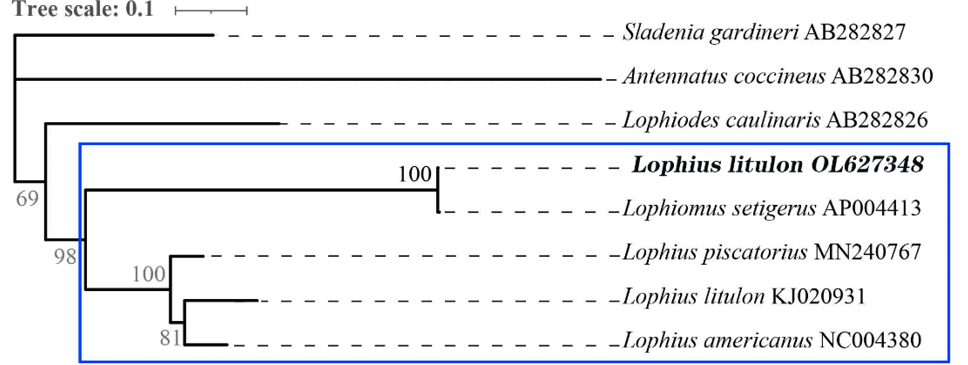
Phylogenetic tree reconstructed by the maximum likelihood method based on concatenated sequences of protein-coding genes from 7 mitogenomes of Family Lophiidae with Antennatus coccineus as the outgroup.
References
- Allio, R., Schomaker-Bastos, A., Romiguier, J., Prosdocimi, F., Nabholz, B., and Delsuc, F., 2020. Mol. Ecol. Resour., 20: 892-905. https://doi.org/10.1111/1755-0998.13160[CrossRef]
- Donath, A., Jühling, F., Al-Arab, M., Bernhart, S.H., Reinhardt, F., Stadler, P.F., Middendorf, M., and Bernt, M., 2019. Nucleic Acids Res., 47: 10543-10552. https://doi.org/10.1093/nar/gkz833[CrossRef]
- Froese, R., and Pauly, D., 2021. FishBase. World wide web electronic publication. www.fishbase.org. version (08/2021).
- Guindon, S., Dufayard, J.F., Lefort, V., Anisimova, M., Hordijk, W., and Gascuel, O., 2010. Syst. Biol., 59: 307-321. https://doi.org/10.1093/sysbio/syq010[CrossRef]
- Jin, X.S., Zhang, B., and Xue, Y., 2010. Deep Sea Res., Pt II. 57: 996-1000. https://doi.org/10.1016/j.dsr2.2010.02.001[CrossRef]
- Katoh, K., and Standley, D.M., 2013. Mol. Biol. Evol., 30: 772-780. https://doi.org/10.1093/molbev/mst010[CrossRef]
- Minh, B.Q., Nguyen, M.A., and Haeseler, A., 2013. Mol. Biol. Evol., 30: 1188-1195. https://doi.org/10.1093/molbev/mst024[CrossRef]
- Nguyen, L.T., Schmidt, H.A., Von-Haeseler, A., and Minh, B.Q., 2015. Mol. Biol. Evol., 32: 268-274. https://doi.org/10.1093/molbev/msu300[CrossRef]
- Wei, Q.S., Li, X.S., Wang, B.D., Fu, M.Z., Ge, R.F., and Yu, Z.G., 2016. J. Sea Res., 112: 1-12. https://doi.org/10.1016/j.seares.2016.02.004[CrossRef]
- Zhang. D., Gao, F., Jakovlić, I., Zou, H., Zhang, J., Li, W.X., and Wang, G.T., 2020. Mol. Ecol. Resour., 20: 348-355. https://doi.org/10.1111/1755-0998.13096[CrossRef]
Services
Article usage statistics
Loading…