
Production performance of rotifer in different systems such as microalgae (MA), heterotrophic biofloc (BF) and autotrophic biofloc system (BA) were analyzed without any supplementation of feed or media during the culture period. Rotifer numbers and egg bearer percentage were noted daily. MA as well as BA showed rotifer survival up to 6 days whereas in the biofloc system it was 4 days. The peak production (nos./ml) was observed on the 4th day in MA (90.00±5.00), BA (33.67±0.88) and BF (29.00±2.31) followed by the peak in percentage egg carriers on the 3rd day. Based on the preliminary study the cultures were repeated to harvest the rotifer in the peak days of production and the biochemical composition was analyzed. There was no significant difference (p>0.05) in the protein, carbohydrate content (%) of the rotifers harvested from the treatments. The results suggest that B. plicatilis can survive in biofloc based systems especially in autotrophic biofloc based systems without compromising the nutritional quality.
Short Communication · Volume 58, Issue 2, 27 February 2026 · Open Access
Comparative Production Performance of Rotifer (Brachionus plicatilis) in Microalgae and Biofloc-Based Systems
·
Affiliations & Notes ⌄
- 1College of Fishery Science, Muthukur- 524344, APFU, Andhra Pradesh, India 2ICAR- Central Institute of Fisheries Education, Mumbai- 400061, Maharashtra, India * Corresponding author: harshahari.2008@gmail.com
Article Info ⌄
- Journal:
- Pakistan Journal of Zoology
- Published:
- 27 February 2026

From the article
- The peak production was observed on the 4th day in MA (90.00±5.00 nos./ml), BA (33.67±0.88 nos./ml) and BF (29.00±2.31nos.
- The study shows that the rotifer can survive in biofloc based systems utilizing the components of biofloc.
- Biochemical compositions of the rotifers reared in biofloc based systems were equal or superior than the rotifers reared in the microalgae-based system.
- Standardization of culture conditions and feeding and maintenance of the biofloc system to optimize the rotifer production would be a further area of research in future.
Selected from the article's own text.
Abstract
Material and methods
The stock solutions of rotifer (Brachionus plicatilis) and algae (Nannochloropsis sp.) for the experiment were obtained from ICAR-Central Marine Fisheries Research Institute, Cochin. The first experiment, to assess the survivability was done in 3 L plastic containers with 2L working volume and the second experiment, to analyze the biochemical composition was done in 65 L fiber reinforced plastic (FRP) tanks with 50 L working volume. The experiment followed completely randomized design (CRD), with three treatments viz. Biofloc (BF), autotrophic biofloc (BA) and microalgae (MA) based culture systems in triplicates. Filtered seawater of salinity 25 ppt was used for the experiments. In MA based culture systems, filtered seawater were inoculated with Nannochloropsis sp. to form an initial algal cell density of 4x10⁷ cells ml-1. Both the biofloc based systems BA and BF were produced following Avnimelech (1999) protocol for the inoculum preparation and calculation of C/N ratio. The laboratory grade sucrose was used as carbon source and C/N were maintained at 15:1. Nannochloropsis sp. was inoculated in BA to bring about initial algal cell density 1x10⁶ cells ml-1 whereas in BF there was no any supplementation of microalgae. To initiate the culture, each treatment tanks were inoculated with rotifer to form an initial stock of 5 individuals ml-1.
Water quality parameters such as dissolved oxygen, temperature and ammonia were monitored daily following .
For determining growth, three samples of 1ml each were collected daily from the different parts of the culture system and were counted using Sedgwick rafter under the microscope (Olympus CH 20i). Average of the samples was taken to find out total number of rotifers and number of egg carriers in each replicate. Percentage egg carriers were calculated using the following formulae.
Total number of rotifer (nos./ml) = Sum of number of rotifer in samples/ number of samples
Percentage egg carriers (%) = (number of egg carriers/ total number of rotifer) x 100
The samples were analyzed to obtain the moisture percentage, crude protein according to Lowry et al. (1951) and carbohydrate contents using phenol-sulphuric acid method . The wet and dry method was followed for analyzing the moisture percentage.
Statistical analysis of growth and biochemical parameters were performed using one-way ANOVA, and significant differences among mean values were compared using Duncan multiple range test (P < 0.05). All statistical analyses were performed using software SPSS 20.0.
Result and discussion
Water quality parameters were in the optimum range for the culture of rotifers (Supplementary Table I). Temperature was 27oC. BA as well as MA showed rotifer survival till 6th day whereas the survivability in BF was till 4th day without any further addition of feed or culture medium. The peak production was observed on the 4th day in MA (90.00±5.00 nos./ml), BA (33.67±0.88 nos./ml) and BF (29.00±2.31nos.) followed by the peak in recruitment curve on the 3rd day 62.57%, 27.05% and 5.73%, respectively (Fig. 1).
Table I. Biochemical composition of rotifers at the end of culture period.
| Treatments | Moisture (%) | Protein (%) | Carbohydrate (%) |
| MA | 79.67±1.29a | 23.33±0.45 a | 36.27±0.94a |
| BA | 85.50±0.46 b | 26.27±1.70 a | 38.57±0.43b |
| BF | 85.83±0.12 b | 24.33±1.03 a | 39.70±0.44b |
Values in the same column with different superscripts differ significantly (P<0.05) for each parameter. Values are presented as Mean±Standard Error. Protein and carbohydrate expressed in percentage dry weight.
The biochemical analysis shows that the composition of rotifer does not vary significantly in the case of crude protein content, but significant difference was observed in the case of carbohydrate and moisture content (Table I). Slightly higher values of crude protein were observed in the BA (26.27±1.70%) and BF (24.33±1.03%) compared to MA (23.33±0.45%). Similarly, carbohydrate content varied significantly among the treatments, MA (36.27±0.94%) being the lowest compared to biofloc based treatment groups. Moisture percentage was less in MA but both BF and BA showed significantly higher levels of moisture content.
BFT is proven to be an eco-friendly and sustainable solution to adopt intensive aquaculture practices with minimal or zero exchange of water helps to maintain the water quality in desired range for rotifer production also. Every system of production becomes successful when the culture organism grows and survives efficiently using the minimum inputs. So, to assess the utility, growth of rotifer was accounted based on the number of survivors and occurrence of egg carriers in the samples collected on daily basis from all the units. The results show that rotifer in biofloc based system were able to utilize the biofloc components as feed and survived for 4 days. This may be because of the fact that rotifers can feed on protozoa, bacteria and dead organic materials ; which is abundant in the biofloc . There are study reports showing that the bacterial inputs influence growth performance of rotifer culture . Similarly, Hosain et al. (2024) also reported that BFT can be used for the rotifer culture. However, compared to BF, the BA system was found more suitable for the rotifer rearing as they showed better growth and survivability. The presence of preferred microalgae, Nannochloropsis in the BA along with other beneficial biofloc components such as bacteria and protozoans which intern act as feed for rotifer may have resulted in the better survival compared to BF where they lack the microalgae component in sufficient quantity.
Further, the survival and growth depend on the recruitment of young ones into the system. The life cycle of rotifer has two phases based on the mode of reproduction, i.e., sexual and asexual . Daily growth and recruitment assessment showed that there was no increase in number of rotifers in the first two days in any of the treatments which may be the lag phase in production cycle. After which an exponential growth was observed in all the treatments to form a sigmoid growth curve.
There are studies which mention Brachionus response during starvation, i.e., during the unfavourable condition when there is unavailabilty of food material, rotifer stop reproduction and lower the metabolism to preserve the mother’s body ; ; . However, the occurrence of egg-bearing females in BF shows that the production cycle was happening and they survived for 3-4 days by utilizing biofloc as feed. Virro (2001) suggested intraspecific variability of life cycle patterns in rotifers and concluded in his study that the occurrence of mixes is an anticipatory event, and not a response to environmental deterioration, or an ending of a rotifer population cycle. By analyzing the number of survivors in the treatments, the preferred culture condition of rotifer B. plicatilis is MA followed by BA and then BF. Optimizing the culture conditions to provide required nutrition in terms of supplementation of feed may enhance the production performance of biofloc based systems. Crab et al. (2010) has reported that BFT can be used for culture of commercially important zooplankton, Artemia with enhanced immunity against the pathogens. Thus, study supports the finding that the BFT can be utilized for zooplankton, especially rotifer production.
However, the survival of zooplankton with a depreciated nutrient content may not serve the purpose of the production. The feed organism used for culture influences the nutritional quality of rotifer ; ; . The biochemical analysis shows that the composition of rotifer does not vary significantly in the case of crude protein content, but significant difference was observed in the case of carbohydrate content. Biofloc based system utilized carbon source (sucrose) for biofloc production and produce a floc with a higher percentage of carbohydrate. This may be the reason behind the accumulation of carbohydrate in the rotifer body. Biofloc has a higher amount of moisture. The presence of micro biofloc along with the rotifer harvested from biofloc based system might be a reason behind the higher moisture content in BA and BF. However, the biofloc had synergic effect on the biochemical composition compared to the normal microalgae-based technology. Thus, the rotifer produced in the biofloc based system especially autotrophic biofloc system can help in increasing the nutrient availability to the fish under culture.
Conclusion
The study shows that the rotifer can survive in biofloc based systems utilizing the components of biofloc. Biochemical compositions of the rotifers reared in biofloc based systems were equal or superior than the rotifers reared in the microalgae-based system. Utilization of autotrophic BFT can help to reduce the dependence on microalgae for live feed production. Standardization of culture conditions and feeding and maintenance of the biofloc system to optimize the rotifer production would be a further area of research in future. Larval rearing in autotrophic live feed production system can be standardized to produce good quality and quantity of young ones for aquaculture production.
Declarations
Acknowledgments
The authors are thankful to Directors of ICAR-Central Island Agricultural Research Institute and ICAR-Central Marine Fisheries Research Institute for giving permission and support for conducting the experiments.
Funding
This work was supported by the Indian Council of Agricultural Research.
Supplementary material
There is supplementary material associated with this article. Access the material online at: https://dx.doi.org/10.17582/journal.pjz/202404151
Statement of conflict of interest
The authors have declared no conflict of interest.
Figures
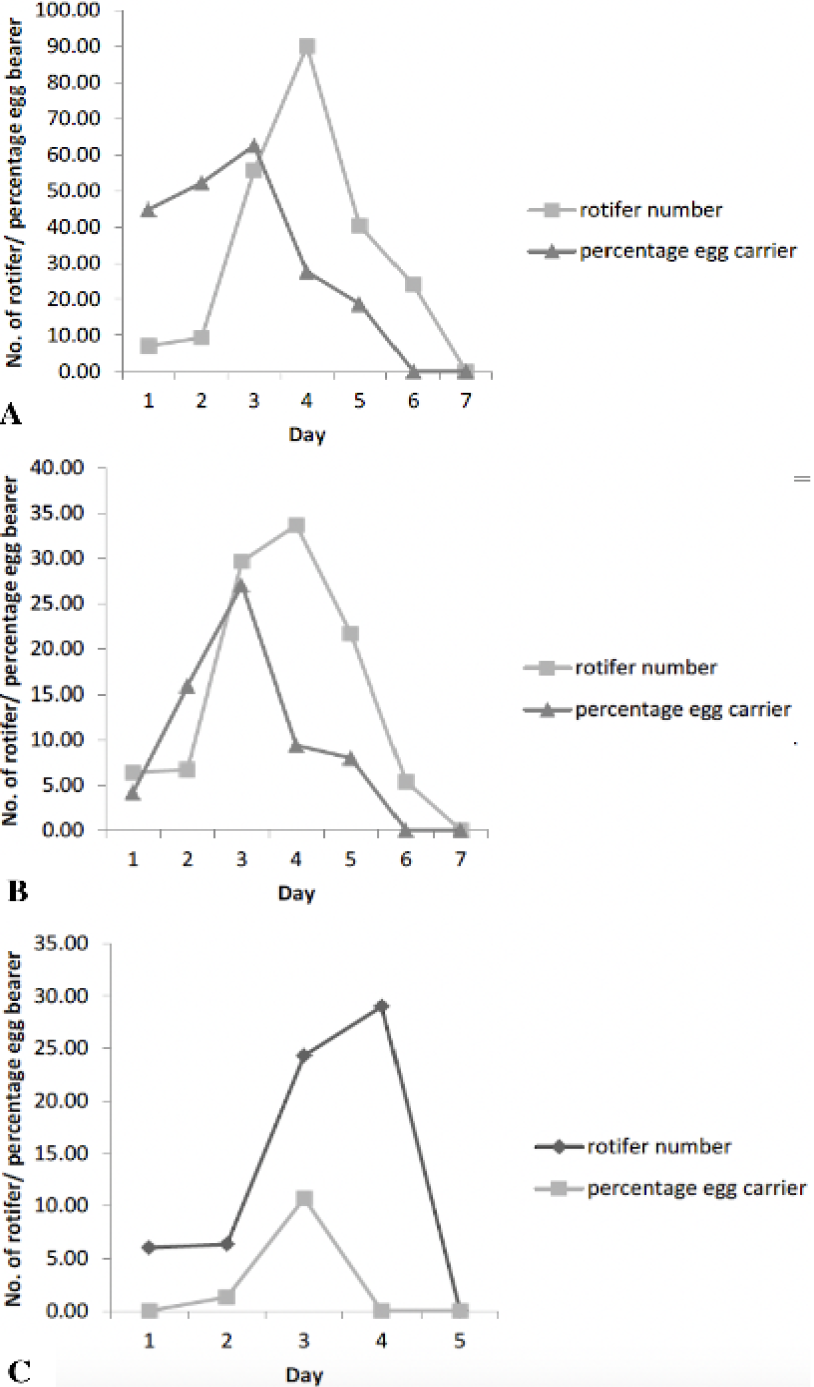
Number of rotifer (ml-1 day-1) and egg carrier percentage (%) in MA (A), BA (B) and BF (C) during the culture period.
References
- APHA, 1998. Standard methods for examination of water and wastewater, American Public Health Association, Washington, DC, USA.
- Avnimelech, Y., 1999. Aquaculture, 176: 227-235. https://doi.org/10.1016/S0044-8486(99)00085-X[CrossRef]
- Barros, M.M., Falcon, D.R., De Oliveira, O.R., Pezzato, L.E., Fernandes, Jr A.C., Guimarães, I.G., Fernandes, Jr A., Padovani, C.R. and Sartori, M.M.P., 2014. Fish Shellfish Immunol., 39: 188-195. https://doi.org/10.1016/j.fsi.2014.05.004[CrossRef]
- Burford, M.A., Thompson, P.J., Mcintosh, R.P., Bauman, R.H. and Pearson, D.C., 2003. Aquaculture, 219: 393-411. https://doi.org/10.1016/S0044-8486(02)00575-6[CrossRef]
- Cheng, S.H., Aoki, S., Maeda, M. and Hino, A., 2004. Aquaculture, 241: 331-343. https://doi.org/10.1016/j.aquaculture.2004.08.006[CrossRef]
- Crab, R., Lambert, A., Defoirdt, T., Bossier, P. and Verstraete, W., 2010. J. appl. Microbiol., 109: 1643-1649.
- Dhert, P., Rombaut, G., Suantika, G. and Sorgeloos, P., 2001. Aquaculture, 200: 129-146. https://doi.org/10.1016/S0044-8486(01)00697-4[CrossRef]
- Douillet, P., 2000. Aquaculture, 182: 249-260. https://doi.org/10.1016/S0044-8486(99)00271-9[CrossRef]
- Dubois, M., Gilles, K.A., Hamilton, J.K., Rebers, P.T. and Smith, F., 1956. Anal. Chem., 28: 350-356. https://doi.org/10.1021/ac60111a017[CrossRef]
- Ekasari, J. and Maryam, S., 2012. Hayati J. Biosci., 19: 73-80. https://doi.org/10.4308/hjb.19.2.73[CrossRef]
- Fielder, D., Purser, G. and Battaglene, S., 2000. Aquaculture, 189: 85-99. https://doi.org/10.1016/S0044-8486(00)00369-0[CrossRef]
- Hassanin, M., Hakim, Y. and Badawi, M., 2014. Abbassa Int. J. Aquacult., 7: 35-52.
- Hosain, M.E., Amin, S.N., Kamarudin, M.S., Arshad, A., Karim, M., Naser, M.N. and Fotedar, R., 2024. Aquacult. Res., 2024: 8837330. https://doi.org/10.1155/2024/8837330[CrossRef]
- Jatobá, A., Da Silva, B.C., Da Silva, J.S., Do Nascimento, V.F., Mouriño, J.L.P., Seiffert, W.Q., Toledo, T.M., 2014. Aquaculture, 432: 365-371. https://doi.org/10.1016/j.aquaculture.2014.05.005[CrossRef]
- Jeeja, P., Imelda, J. and Paulraj, R., 2011. Indian J. Fish, 58: 59-65.
- Jung, J.Y., Damusaru, J.H., Park, Y., Kim, K., Seong, M., Je, H.W., Kim, S. and Bai, S.C., 2017. Algal Res., 27: 259-264. https://doi.org/10.1016/j.algal.2017.09.021[CrossRef]
- Kirk, K.L., Ellis, J. and Taylor, J., 1999. Freshw. Biol., 42: 637-644. https://doi.org/10.1046/j.1365-2427.1999.00502.x[CrossRef]
- Kirk, K.L., 1997. Ecology, 78: 434-441. https://doi.org/10.1890/0012-9658(1997)078[0434:LHRTVE]2.0.CO;2[CrossRef]
- Lavens, P. and Sorgeloos, P., 1996. Manual on the production and use of live food for aquaculture, Food and Agriculture Organization (FAO).
- Lim, L.C., Dhert, P. and Sorgeloos, P., 2003. Aquaculture, 227: 319-331. https://doi.org/10.1016/S0044-8486(03)00512-X[CrossRef]
- Lowry, O.H., Rosebrough, N.J., Farr, A.L. and Randall, R.J., 1951. J. biol. Chem., 193: 265-275.
- Øie, G. and Olsen, Y., 1997. In: Live Food in Aquaculture. Springer. https://doi.org/10.1007/978-94-017-2097-7_39[CrossRef]
- Rezeq, T. and James, C., 1987. In: Rotifer symposium IV, 1987. Springer, pp. 257-261. https://doi.org/10.1007/978-94-009-4059-8_34[CrossRef]
- Scott, A.P. and Baynes, S.M., 1978. Aquaculture, 14: 247-260. https://doi.org/10.1016/0044-8486(78)90098-4[CrossRef]
- Silva, D.A., de Lima, P.C.M., da Silva, A.E.M., de Oliveira, F.P.R.C., da Silva, S.M.B.C., Olivera, G.A. and Brito, L.O. 2021. Aquacult. Res., 52: 4380-4393.
- Snell, T.W., Childress, M.J., Boyer, E.M. and Hoff, F.H., 1987. J. World Aquacult. Soc., 18: 270-277. https://doi.org/10.1111/j.1749-7345.1987.tb01038.x[CrossRef]
- Stelzer, C.P., 2005. Hydrobiol. J., 546: 335-346.
- Virro, T., 2001. Life cycle patterns of rotifers in Lake Peipsi. In: Rotifera IX. Springer. https://doi.org/10.1007/978-94-010-0756-6_13[CrossRef]
- Watanabe, T., Kitajima, C. and Fujita, S., 1983. Aquaculture, 34: 115-143. https://doi.org/10.1016/0044-8486(83)90296-X[CrossRef]
- Whyte, J.N. and Nagata, W.D., 1990. Aquaculture, 89: 263-272. https://doi.org/10.1016/0044-8486(90)90131-6[CrossRef]
- Yoshinaga, T., Hagiwara, A. and Tsukamoto, K., 2003. J. exp. Mar. Biol. Ecol., 287: 261-271. https://doi.org/10.1016/S0022-0981(02)00574-9[CrossRef]
Supplementary material
Services
Article usage statistics
Loading…