
Bardet-Biedl syndrome (BBS) is a rare autosomal recessive ciliopathic genetic disorder in humans. It is a multisystem disorder and is principally described by visual abnormalities, con-rod dystrophy, eyes exotropia, obesity, polydactyly, hypogonadism, and renal abnormalities. Few additional features of BBS also include delayed motor development, clumsiness, anosomia, ataxia, hypodontia, hearing impairment, hirschsprung disease, cardiovascular and liver disorders. So far 21 genes are reported that cause BBS (BBS1-BBS21). A consanguineous family having clinical symptoms of BBS9 is described in current study. Mutation was detected in BBS9 on chromosome 7p14.3 using whole exome sequencing (WES). A splice acceptor site mutation (c.1131G>A) in exon 3 was revealed by Sanger sequencing.
Short Communication · Volume 51, Issue 4, 3 June 2019 · Open Access
A Homozygous c.1131G>A Missense Mutation in BBS9 Gene Manifesting Autosomal Recessive Bardet-Biedl Syndrome in Consanguineous Kashmiri Family
· · · ·
Affiliations & Notes ⌄
- 1Department of Biotechnology, University of Azad Jammu and Kashmir, P.O. Box 13100, Muzaffarabad, Pakistan 2Institute for Neurobiology, Charite University of Berlin, Campus Mittle, P.O. Box 10117, Germany 3Department of Pediatric Neurology, Charité-Universitätsmedizin Berlin, Berlin, Germany 4Center for Chronically Sick Children (Sozialpädiatrisches Zentrum, SPZ), Charité-Universitätsmedizin Berlin, Berlin, Germany , Ghazanfar Ali and Angela M. Kaindl contributed equally in this study. , * Corres
Article Info ⌄
- Journal:
- Pakistan Journal of Zoology
- Published:
- 3 June 2019

From the article
- The observed clinical features in the studied family were alike to those reported before.
- WES analysis followed by Sanger sequencing revealed a variant in BBS9 gene.
- The present study reported a splice acceptor site mutation (c.1131G>A, p.38) predicting a missense mutation gly-to-arg in exon 3 in the Kashmiri family from Pakistani origin Figure 1.
- Up till now eight mutations are reported in BBS9 gene including one of each splice site, stop, frame shift, missense, substitution and three deletion mutations.
Selected from the article's own text.
Abstract
Materials and methods
Permission to conduct the present research was obtained from the Director Advance Studies and Research (DASR) of University of Azad Jammu and Kashmir, Muzaffarabad and Charite University, Berlin. An informed written consent was obtained from the guardians of the affected individuals.
In the present study, a consanguineous family was investigated, from district Bagh, Azad Kashmir. Pedigree was constructed as per information provided by the family’s elders. Generation pattern of pedigree indicates autosomal recessive inheritance (Fig. 1). Venous blood samples of four members of this family were collected in vacutainers (BD Biosciences, Franklin Lakes, NJ, USA) containing EDTA.
Genomic DNA was extracted from the collected blood samples using phenol-chloroform and GeneJET Genomic DNA Purification kit (Lithuania).
In order to identify the causative genes its direct exome sequencing was performed. DNA from a single proband (IV-1) in the family was subjected to WES. Exomes enrichment was accomplished using Agilent SureSelect Human All Exome 50 Mb kit and the sequencing was done on illuminaHiSeq 2000 systems. All the reads were aligned against the human assembly hg19 (GRCh38).
Results
Clinical phenotype of both effected individuals show mild type of intellectual disability along with vision
Table I.- Clinical manifestations observed in affected members.
| Patient | Sex | Age (years) | RP | Polydactyly (PAP) | Obesity | Hypogonadism | Eyes exotropia | CI | RI |
| IV-1 | M | 20 | + | + | + | + | + | + | + |
| IV-2 | M | 24 | + | + | + | + | + | + | + |
| III-2 | F | 40 | - | - | - | - | - | - | - |
| IV-3 | F | 18 | - | - | - | - | - | - | - |
+, presence of feature; -, absence; RP, retinitis pigmentosa; PAP, postaxial polydactyly; ND, no data available; CI, cognitive impairment; RI, renal impairment.
loss, obesity, speech problems and learning disability. Hypogonadism was also found in both of the affected males. However, only one affected male (IV-2) have polydactyly. The age of the affected individuals was 20 (IV-1) and 24 (IV-2) years at the time of study (Table I).
Direct WES was performed in affected individual (IV-1) of the family under study, at the Department of Pediatric Neurology, Charite-Universit at smediz in Berlin, Germany.
Sanger sequencing of BBS9 gene exposed a homozygous G to A transition (c.1131G>A, p.38) resulting in splice acceptor site mutation at exon 3 in all affected individuals of this family. Unaffected members were either heterozygous for a mutant allele or had wild type alleles. Therefore, Sanger sequencing showed co-segregation of the variants with the disease phenotype.
Discussion
Bardet-Biedl syndrome is an autosomal recessive pleiotropic ailment . However, tri-allelic nature of BBS is reported to occur in less than 5% of cases having three mutated alleles in two genes ; M’hamdi et al., 2013). In the recent study we have identified disease-causing allele in a consanguineous family of Azad Kashmir origin. The inheritance of disease has an autosomal recessive pattern hence, excluding tri-allelism in the present case. The observed clinical features in the studied family were alike to those reported before. WES analysis followed by Sanger sequencing revealed a variant in BBS9 gene. The BBS9 gene, mapped on chromosome 7p14.3, having 24 exons, which spans more than 700 kb genomic region . BBSome is a group of seven BBS proteins (BBS1-BBS7) which promotes ciliogenesis. However, BBS7 and BBS8 are structurally different from others and work as intra flagellar transport (IFT) cohesion factors ; . Any change in the sequences of the BBSome results in defective ciliogenesis and its functions. The present study reported a splice acceptor site mutation (c.1131G>A, p.38) predicting a missense mutation gly-to-arg in exon 3 in the Kashmiri family from Pakistani origin Figure 1. Up till now eight mutations are reported in BBS9 gene including one of each splice site, stop, frame shift, missense, substitution and three deletion mutations.
Acknowledgements
We highly appreciate cooperation and participation of the family members in this study. Syeda Ain-ul-Batool was supported by an Indigenous Indigenous Ph.D. from HEC, Islamabad, Pakistan and German Research Foundation and the Berlin Institute of Health.
Statement of conflict of interest
The authors declare that they have no competing interests.
Figures
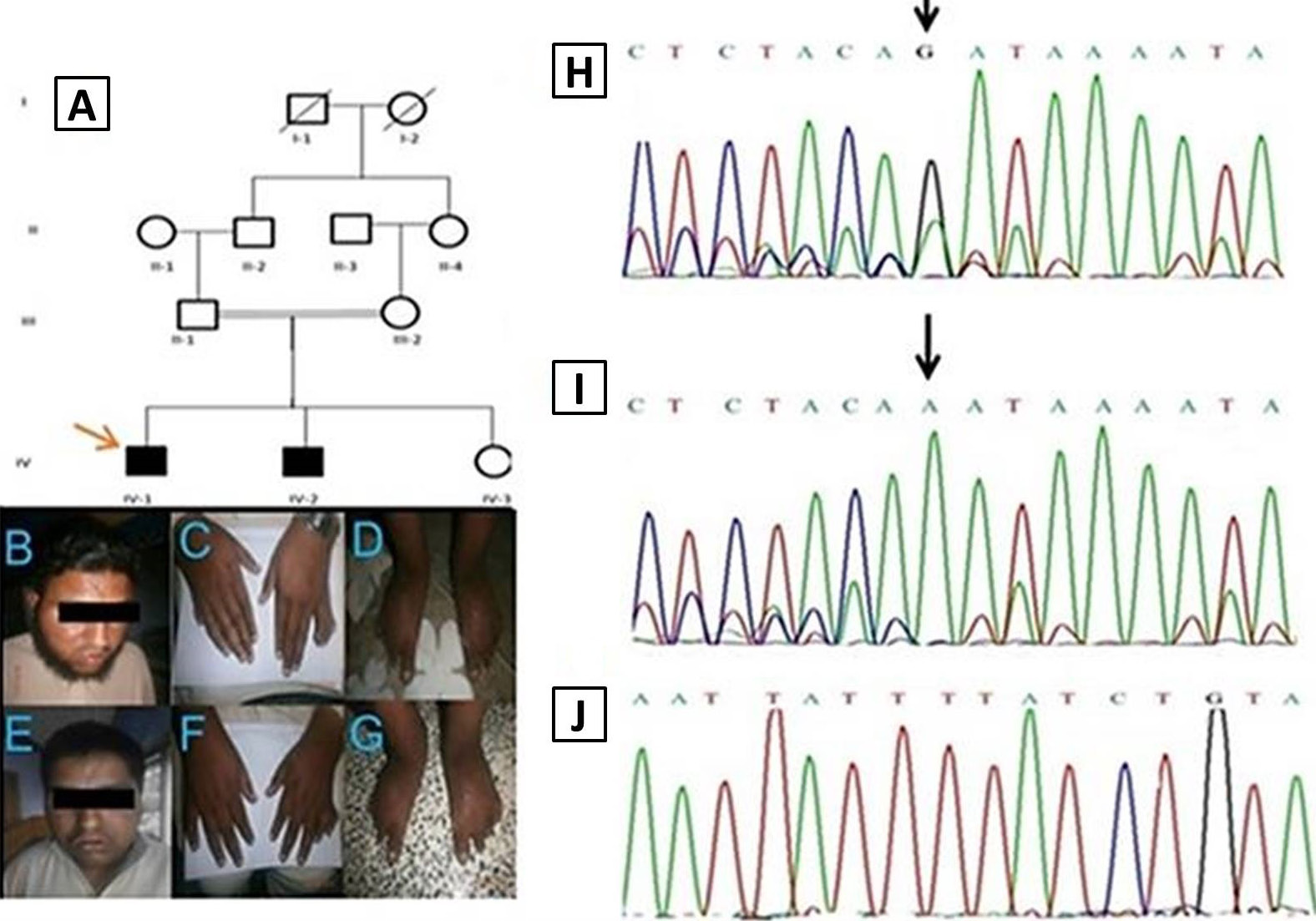
A, pedigree of family (MR20) showing autosomal recessive inheritance, while red arrow indicates the affected individual for whom WES was done. B, affected individual IV-1, having typical features of BBS syndrome including hypertelorism, eyes exotropia and a flat nasal bridge. C, dorsal view of hands showing polydactyly in right hand while polydactyly and syndactyly is clearly visible in left hand. D, dorsal view of feet having polydactyly in both. E, typical BBS facial features shown by affected individual IV-2, having flat nasal bridge, poor eye sight, intellectual disability and small mouth. F, dorsal and palmar view of hands, and having post axial polydactyly in left hand. G, feet of affected individual IV-4, showing obesity and polydactyly in left foot. H, homozygous mutation in the patient IV-1 showing splice acceptor site change G>A on position 167. I, heterozygygous carrier and J, homozygous Normal.
References
- Aldahmesh, M.A., Li, Y., Alhashem, A., Anazi, S., Alkuraya, H., Hashem, M., Awaji, A.A., Sogaty, S., Alkharashi, A. and Alzahrani, S., 2014. Hum. Mol. Genet., 23: 3307-3315. https://doi.org/10.1093/hmg/ddu044[CrossRef]
- Ansley, S.J., Badano, J.L., Blacque, O.E., Hill, J., Hoskins, B.E., Leitch, C.C., Kim, J.C., Ross, A.J., Eichers, E.R. and Teslovich, T.M., 2003. Nature, 425: 628-633. https://doi.org/10.1038/nature02030[CrossRef]
- Badano, J.L., Ansley, S.J., Leitch, C.C., Lewis, R.A., Lupski, J.R. and Katsanis, N., 2003. Am. J. Hum. Genet., 72: 650-658. https://doi.org/10.1086/368204[CrossRef]
- Chiang, A.P., Beck, J.S., Yen, H.J., Tayeh, M.K., Scheetz, T.E., Swiderski, R.E., Nishimura, D.Y., Braun, T.A., Kim, K.Y.A. and Huang, J., 2006. . Proc. natl. Acad. Sci. U.S.A., 103: 6287-6292.
- Fan, Y., Esmail, M.A., Ansley, S.J., Blacque, O.E., Boroevich, K., Ross, A.J., Moore, S.J., Badano, J.L., May-Simera, H. and Compton, D.S., 2004. Nat. Genet., 36: 989-993. https://doi.org/10.1038/ng1414[CrossRef]
- Forsythe, E. and Beales, P.L., 2013. Eur. J. Hum. Genet., 21: 8-13. https://doi.org/10.1038/ejhg.2012.115[CrossRef]
- Heon, E., Kim, G., Qin, S., Garrison, J.E., Tavares. E., Vincent, A., Nuangchamnong, N., Scott, C.A., Slusarski, D.C. and Sheffield, V.C., 2016. . Hum. Mol. Genet., 25: 2283-2294. https://doi.org/10.1093/hmg/ddw096[CrossRef]
- Iannaccone, A., Mykytyn, K., Persico, A.M., Searby, C.C., Baldi, A., Jablonski, M.M. and Sheffield, V.C., 2005. Am. J. med. Genet., 132: 343-346. https://doi.org/10.1002/ajmg.a.30512[CrossRef]
- Katsanis, N., Ansley, S.J., Badano, J.L., Eichers, E.R., Lewis, R.A., Hoskins, B.E., Scambler, P.J., Davidson, W.S., Beales, P.L. and Lupski, J.R., 2001. Science, 293: 2256-2259. https://doi.org/10.1126/science.1063525[CrossRef]
- Kim, S.K., Shindo, A., Park,T.J., Oh, E.C., Ghosh, S., Gray, R.S., Lewis, R.A., Johnson, C.A., Attie-Bittach, T. and Katsanis, N., 2010. Science, 329: 1337-1340. https://doi.org/10.1126/science.1191184[CrossRef]
- Kulaga, H.M., Leitch, C.C., Eichers, E.R., Badano, J.L., Lesemann, A., Hoskins, B.E., Lupski, J.R., Beales, P.L., Reed, R.R. and Katsanis, N., 2004. Nat. Genet., 36: 994-998. https://doi.org/10.1038/ng1418[CrossRef]
- Leitch, C.C., Zaghloul, N.A., Davis, E.E., Stoetzel, C., Diaz-Font, A., Rix, S., Alfadhel, M., Lewis, R.A., Eyaid, W. and Banin, E., 2008. Nat. Genet., 40: 443-448. https://doi.org/10.1038/ng0708-927b[CrossRef]
- M’hamdil, O., Ouertani, I. and Chaabouni-Bouhamed, H., 2013. Mol. Syndromol., 5: 51-56. https://doi.org/10.1159/000357054[CrossRef]
- Moore, S.J., Green, J.S., Fan, Y., Bhogal, A.K., Dicks, E., Fernandez, B.A., Stefanelli, M., Murphy, C., Cramer, B.C. and Dean, J., 2005. Am. J. med. Genet., 132: 352-360. https://doi.org/10.1002/ajmg.a.30406[CrossRef]
- Muller, J., Stoetzel, C., Vincent, M.C., Leitch, C.C., Laurier, V., Danse, J.M., Helle, S., Marion, V., Bennouna-Greene, V. and Vicaire, S., 2010. Hum. Genet.,127: 583-593. https://doi.org/10.1007/s00439-010-0804-9[CrossRef]
- Mykytyn, K., Braun, T., Carmi, R., Haider, N.B., Searby, C.C., Shastri, M., Beck, G., Wright, A.F., Iannaccone, A. and Elbedour, K., 2001. Nat. Genet., 28: 188-191. https://doi.org/10.1038/88925[CrossRef]
- Mykytyn, K., Nishimura, D.Y., Searby, C.C., Beck, G., Bugge, K., Haines, H.L., Cornier, A.S., Cox, G.F., Fulton, A.B. and Carmi, R., 2003. Am. J. Hum Genet., 72: 429-437. https://doi.org/10.1086/346172[CrossRef]
- Nachury, M.V., Loktev, A.V., Zhang, Q., Westlake, C.J., Peränen, J., Merdes, A., Slusarski, D.C., Scheller, R.H., Bazan, J.F. and Sheffield, V.C., 2007. Cell, 129: 1201-1213.
- Nishimura, D.Y., Searby, C.C., Carmi, R., Elbedour, K., Maldergem, L.V., Fulton, A.B., Lam, B.L., Powell, B.R., Swiderski, R.E. and Bugge, K.E., 2001. Hum. mol. Genet., 70: 865-874. https://doi.org/10.1093/hmg/10.8.865[CrossRef]
- Nishimura, D.Y., Swiderski, R.E., Searby, C.C., Berg, E.M., Ferguson, A.L., Hennekam, R., Merin, S., Weleber, R.G., Biesecker, L.G. and Stone, E.M., 2005. Am. J. Hum. Genet., 77: 1021-1033. https://doi.org/10.1086/498323[CrossRef]
- Otto, E.A., Hurd, T.W., Airik, R., Chaki, M., Zhou, W., Stoetzel, C., Patil, S.B., Levy, S., Ghosh, A.K. and Murga-Zamalloa, C.A., 2010. Nat. Genet., 42: 840-850. https://doi.org/10.1038/ng.662[CrossRef]
- Pontual, L.D., Zaghloul, N.A., Thomas, S., Davis, E.E., Mcgaughey, D.M., Dollfus, H., Baumann, C., Bessling, S.L., Babarit, C. and Pelet, A., 2009. Proc. natl. Acad. Sci. U.S.A., 106: 13921-13926. https://doi.org/10.1073/pnas.0901219106[CrossRef]
- Sahin, C., Huddam, B., Akbaba, G., Tunca, H., Koca, E. and Levent, M., 2015. Case Rep. Nephrol., 2015: Article ID 764973. https://doi.org/10.1155/2015/764973[CrossRef]
- Schaefer, E., Stoetzel, C., Scheidecker, S., Geoffroy, V., Prasad, M.K., Redin, C., Missotte, I., Lacombe, D., Mandel, J.L. and Muller, J., 2016. J. Hum. Genet., 61: 447-450. https://doi.org/10.1038/jhg.2015.162[CrossRef]
- Scheidecker, S., Etard, C., Pierce, N.W., Geoffroy, V., Schaefer, E., Muller, J., Chennen, K., Flori, E., Pelletier, V. and Poch, O., 2014. J. med. Genet., 51: 132-136. https://doi.org/10.1136/jmedgenet-2013-101785[CrossRef]
- Slavotinek, A.M., Stone, E.M., Mykytyn, K., Heckenlively, J.R., Green, J.S., Heon, E., Musarella, M.A., Parfrey, P.S., Sheffield, V.C. and Biesecker, L.G., 2000. Nat. Genet., 26: 67-70. https://doi.org/10.1038/79116[CrossRef]
- Stoetzel, C., Laurier, V., Davis, E.E., Muller, J., Rix, S., Badano, J.L., Leitch, C.C., Salem, N., Chouery, E. and Corbani, S., 2006. Nat. Genet., 38: 521-524.
- Stoetzel, C., Muller, J., Laurier, V., Davis, E.E., Zaghloul, N.A., Vicaire, S., Jacquelin, C., Plewniak, F., Leitch, C.C. and Sarda, P., 2007. Am. J. Hum. Genet., 80: 521-524. https://doi.org/10.1086/510256[CrossRef]
- Vernon, E.G., Malik, K., Reynolds, P., Powlesland, R., Dallosso, A.R., Jackson, S., Henthorn, K., Green, E.D. and Brown, K.W., 2003. Oncogene, 22: 1371-1380. https://doi.org/10.1038/sj.onc.1206332[CrossRef]
- White, D.R., Ganesh, A., Nishimura, D., Rattenberry, E., Ahmed, S., Smith, U.M., Pasha, S., Raeburn, S., Trembath, R.C. and Rajab, A., 2007. Eur. J. Hum. Genet., 15: 173-178. https://doi.org/10.1038/sj.ejhg.5201736[CrossRef]
- Young, T.L., Penney, L., Woods, M.O., Parfrey, P.S., Green, J.S., Hefferton, D. and Davidson, W.S., 1999. Am. J. Hum. Genet., 64: 900. https://doi.org/10.1086/302301[CrossRef]
Cited by 1 article
In journals published by ResearchersLinks.
Services
Article usage statistics
Loading…