
Pycnodysostosis is a rare genetic bone disorder (OMIM 265800) with an autosomal recessive mode of inheritance. More than 50 mutations have been reported in CTSK (Cathepsin k) responsible for this disease. Mutations in CTSK result in impaired bone resorption consequently leading to short stature, increased bone density, recurrent fractures, stubby hands and feet with dystrophic nails, unossified fontanels, and an obtuse mandibular. The present study was conducted to determine the underlying genetic cause of Pycnodysostosis in a family from Azad Kashmir, Pakistan presenting with symptoms of multiple recurrent fractures, short stature, increased bone density and stubby hands. We performed direct sequencing of CTSK for five members of the family to find out the causative mutation. All coding exons of CTSK gene were amplified and sequenced in the affected and unaffected individuals of a consanguineous Pakistani family consisting of five members, three affected brothers, one unaffected sister and the unaffected mother. We identified a known missense mutation c.136 C>T in the third exon of CTSK changing arginine to tryptophan (p.Arg46Trp) which segregated with the disorder. The clinical findingsimplicated CTSK and the use of direct sequencing provided a precise molecular diagnosis. Theidentification of the same variant in CTSK as identified in other families from Pakistan suggests that it is common due to a founder effect.
Research Article · Volume 49, Issue 5, 11 September 2017 · Open Access
A Recurrent Mutation in CTSK Gene is Responsible for Autosomal Recessive Pycnodysostosis in Consanguineous Pakistani Families
· · · · ·
Affiliations & Notes ⌄
- 1Institute of Biomedical and Genetic Engineering (IBGE), Islamabad, Pakistan 2Department of Biochemistry, Faculty of Biological Sciences, Quaid-i-Azam University, Islamabad, Pakistan 3Department of Paediatrics, Federal Government Polyclinic Hospital, Islamabad, Pakistan 4Department of Radiology, Federal Government Polyclinic Hospital, Islamabad, Pakistan , * Corresponding author: saimasiddiqi2@gmail.com
Article Info ⌄
- Journal:
- Pakistan Journal of Zoology
- Published:
- 11 September 2017

From the article
- Sanger sequencing of all coding exons of CTSK revealed a mutation in c.136 C>T in third exon of.
- The study presented here revealed the identification of a known missense mutation in CTSK in a consanguineous Pakistani family belonging to Kashmir.
- Earlier, same mutation was identified in a Kashmiri (Pakistan) family living in Germany.
- Family described here also belongs to Kashmir (Pakistan), so this recurrent mutation is reflecting the founder effect in Kashmiri (Pakistan) consanguineous families affected by pycnodysostosis.
Selected from the article's own text.
Abstract
Introduction
The cathepsins belong to the lysosomal cysteine proteinase family which play an essential role in the different cellular processes in bone remodeling and resorption . Cathepsins are synthesized in an inactive form; they carry an N-terminal pro-region (activation peptide) that is removed to synthesize active cathepsin. Cathepsins are also responsible for inhibition of the proteolytic function until the proenzyme reaches the lysosome . Previous studies in animal models show that Cathepsin K (CTSK) is involved in autoimmune and inflammatory diseases by regulating the Toll-like receptor 9 (TLR9) signalling .
Cathepsin K is encoded by CTSK that has role in the late osteoclast differentiation as well as in the degradation of bone organic matrix . The CTSK gene located on 1q21 contains 8 exons (GenBank acc. no., NM_000396.2) and is approximately 12 kb long (GenBank acc. no., NC_000001.10). Mutations in CTSK lead to a rare genetic bone disorder “pycnodysostosis” (OMIM 265800) that follows an autosomal recessive mode of inheritance, resulting in osteoclast dysfunction ; ; Fleming et al., 2007; . The first case of Pycnodysostosis was reported by Montanari in 1923 and the core features of pycnodysostosis (Greek: pycnos = dense; dys = defective; osteon = bone) were described later by Marteaux and Lamy in 1962. Thus, it is also known as Maroteaux-Lamy syndrome. Since then, nearly 200 cases have been reported . The prevalence of this disease is 1 to 1.7 per million ; ; ; .
Features typical to pycnodysostosis are short stature, increased bone density of long bones, pathological recurrent fractures with poor healing, stubby hands and feet with dystrophic nails, unossified fontanels, and an obtuse mandibular angle ; ; ; .
To date 34 mutations in CTSK have been reported in 59 families with pycnodysostosis ; ; ; . Six of these mutations are reported from Pakistan (Supplementary Table I). The mutational hot spots are Arg241 in exon 6 and Ala277 located in exon 7. Nearly 70 percent of the total mutations are related to the mature domain of CTSK. The present study was undertaken to identify CTSK mutation in a consanguineous family suffering from pycnodysostosis in Pakistan.
Methods
Ascertainment of study subjects
The study was approved by Ethical committee of the Institute of Biomedical and Genetic Engineering (IBGE), Islamabad, Pakistan. Informed consent was taken from all family members who agreed to participate in the study. A Pakistani consanguineous family of Kashmiri origin with three affected individuals was studied (Fig. 1). Medical and family history and information on the pedigree was obtained from mother of affected children. Family pedigree provided convincing evidence of autosomal recessive mode of inheritance. Clinical features include short stature; frontal and parietal bossing of the facial bone, hypoplasia and irregular jaw, grooved palate, short and stubby hand with coarse skin, prominent eyes with mild bluish sclera, dysplastic nails and beaked nose (Fig. 2).
Radiological findings
X-Rays of the affected individuals revealed some notable findings. The clavarium, base of skull and orbital rims were dense, widened sutures with intra sutural wormian bones, small facial bones with hypoplastic maxillae and obtuse angle of mandible (Fig. 3A). X-Ray of hands showed, acro-osteolysis with irregular distal fragments of the distal phalanges (Fig. 3B). X-Ray of T/L spine indicated anterior defects between thoracolumbar vertebrae. Ribs showed dense cortices with adequate contour (Fig. 3C). Dense and thickened cortices were noted in the visualized bones of lower limb (Fig. 3D).
Sequencing
The candidate gene for pycnodysostosis CTSK, was amplified by designing specific primers (Supplementary Table II) with “Exon primer” (Human Genome Browser (UCSC)) for all coding exons of CTSK (NM_000396.2). All exons were amplified in 50μl of reaction volume in a 0.5 ml PCR tube containing 250 ng of the extracted DNA, 10x Buffer 5μl, dNTP 2.5 μl (2.5mM), MgCl2 2μl (2.5mM), 2 μl (10μM) sense and antisense primers, 1μl of 5U/μl Taq DNA Polymerase. PCR products were purified and sequenced using Big dye terminator v.3.1 Sequencing was carried out by using 3130 Genetic Analyzer (ABI part no. 4363785, Applied Biosystems, Foster city, CA, USA).
ABI Sequencing Analysis Software v5.2 was used for data collection and analysis. Sequences were aligned by Human Genome Browser (UCSC) to identify mutation.
Results
Three individuals of a family of Pakistani Kashmiri origin (Fig. 1) were admitted in the Polyclinic Hospital Islamabad with complaint of frequent fractures and bone problems. The disorder was reported to be present by birth among the affected individuals. Height of the elder affected individual (10 years old) was 115.5 cm, middle affected individual (6 years old) was 101.2 cm and younger affected individual (3 years old) was 87.2 cm, all were below than age and sex matched controls. Frontal and parietal bossing was apparent. Hands were stubby with coarse skin. Grooved palate, dysplastic nails and beaked nose were observed (Fig. 1). No neurological problems were seen. A rare bone disorder pycnodysostosis was diagnosed by the Paediatrician and Radiologist At the hospital.
The gene responsible for pycnodysostosis CTSK was analyzed further. Sanger sequencing of all coding exons of CTSK revealed a mutation in c.136 C>T in third exon of
CTSK gene changing arginine to tryptophan (p.Arg46Trp) which segregated in the family (Fig. 4). Schematic structures of the original and the mutant amino acids and t
he resultant protein are shown in (Fig. 5).
The mutation is located within the signal peptide domain (protease inhibitor I29). This sequence of the peptide is important because it is recognized by other proteins and is cleaved off to generate the mature protein. The new residue that is introduced in the signal peptide differs in its properties from the original one. It is possible that this mutation disturbs recognition of the signal peptide. The wild type residue (Arg46) is evolutionarily conserved up to fruitfly and forms salt bridge with Glu70. The mutation disrupts the bridging thus exposing the hydrophobic pro-peptide and consequently lead to premature inactivation of protein. (http://www.interactive-biosoftware.com/alamut-visual/) .
Discussion
The study presented here revealed the identification of a known missense mutation in CTSK in a consanguineous Pakistani family belonging to Kashmir. This homozygous mutation was previously reported in 2007 by Schilling et al. (2007) in a family with multiple fractures. This mutation affects the pro-region of the protein. The same mutation was also reported with a clinical diagnosis of autosomal recessive osteopetrosis (ARO) in a patient from Azad Kashmir . ARO and pycnodysostosis share some clinical features, such as generalized increase in bone density, frontal bossing, short stature, delayed abnormal tooth eruption and fragile fractures. The p.Arg46Trp variant in different Pakistani patients suffering from either pycnodysostosis or Osteopetrosis suggests pleiotropic effect for this mutation . The identification of p.Arg46Trp mutation in multiple unrelated families indicates a founder effect for the origin of the variant in the Kashmir region of Pakistan. Haplotype analyses remains to be conducted to verify this hypothesis.
Conclusion
This report highlights the significance of suspicion of pycnodysostosis by performing careful clinical evaluation along with a keen focus on radiological examination and proper investigations for such cases. Earlier, same mutation was identified in a Kashmiri (Pakistan) family living in Germany. Family described here also belongs to Kashmir (Pakistan), so this recurrent mutation is reflecting the founder effect in Kashmiri (Pakistan) consanguineous families affected by pycnodysostosis.
Supplementary material
There is supplementary material associated with this article. Access the material online at: http://dx.doi.org/10.17582/journal.pjz/2017.49.5.1797.1802
Conflict of interest statement
The authors declare that there is no conflict of interest with any one about this manuscript.
Figures
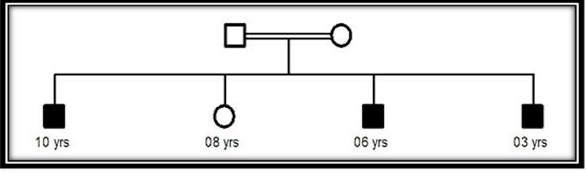
Pedigree of the affected family showing 3 affected male members and a normal female.
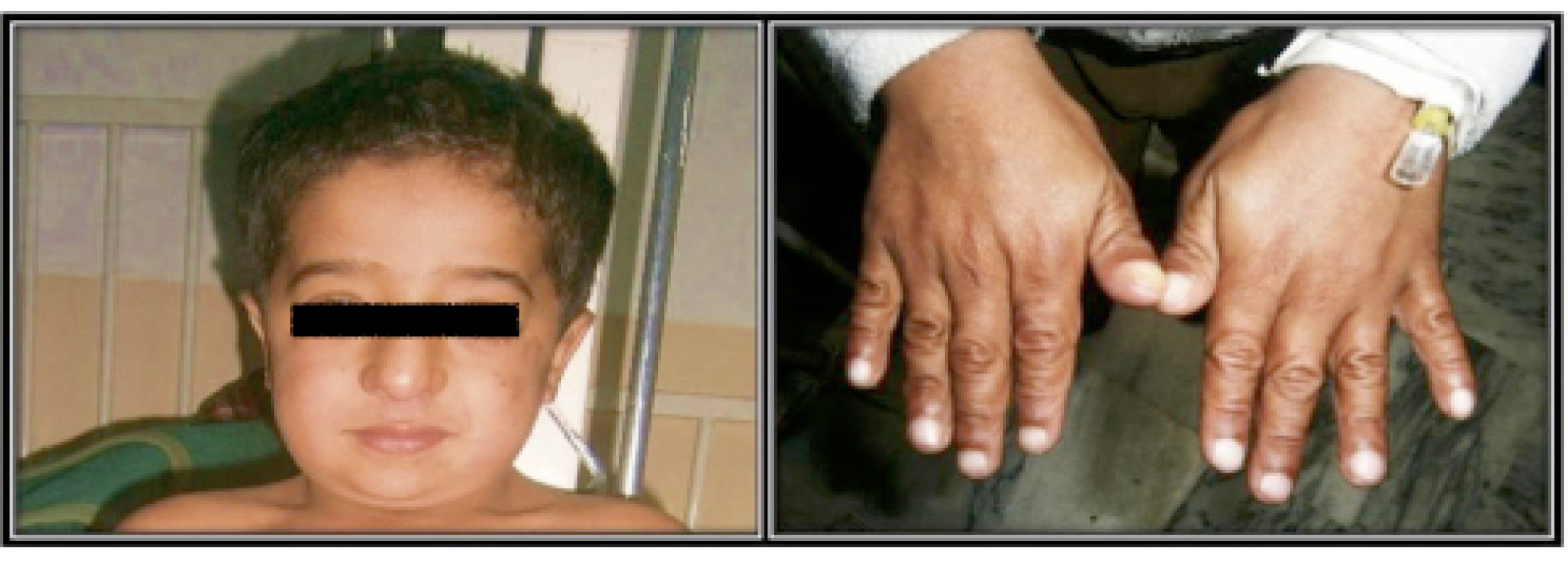
Clinical presentation of affected individuals A, beaked nose and mild bluish sclerae/prominent eyes (masked)e; B, stubby hands with coarse skin and grooved/flattend nails.
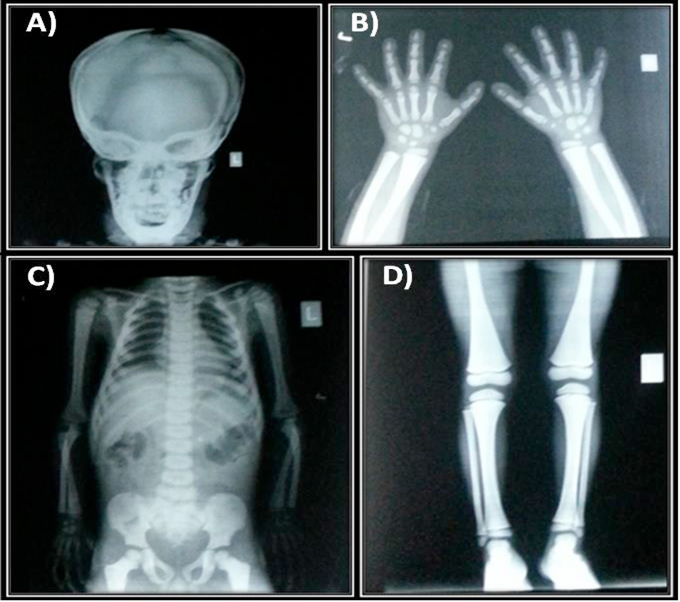
Radiological presentation of affected individuals: A, dense orbital rims; B, acro-osteolysis of distal phalanges; C, defects between thoracolumbar vertebrae; D, dense and thickened cortices of lower limbs.
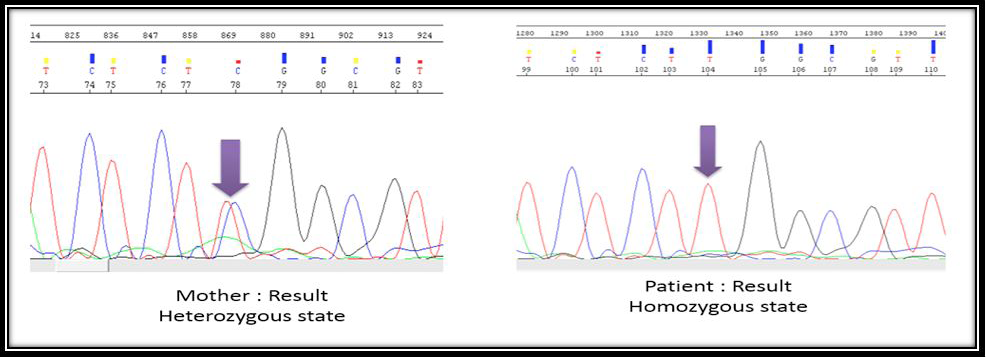
Sequencing result, arrow on left panel indicates the heterozygous and arrow on right panel indicates the homozygous mutation.
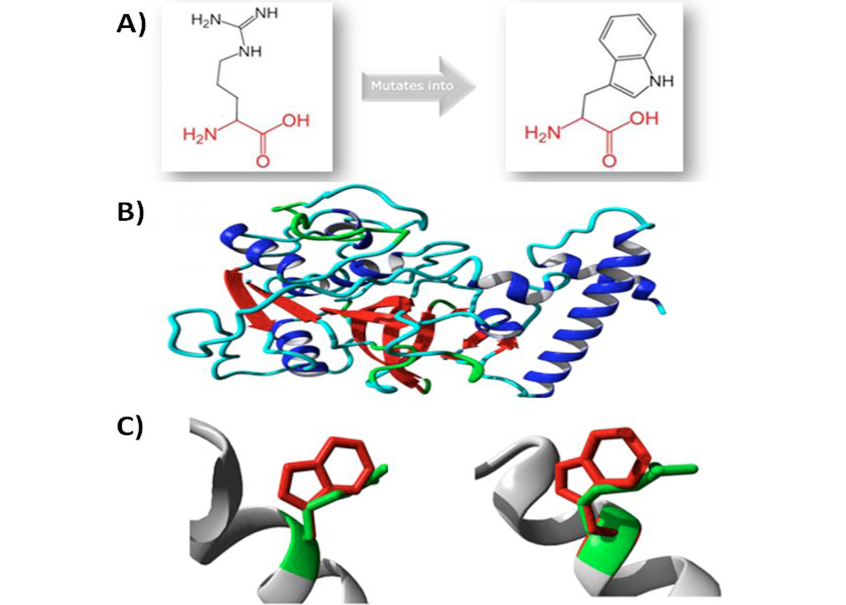
In silico examination of mutation and resultant protein: A, schematic structure of the original (left) and the mutant (right) amino acid; B, overview of the protein in ribbon-presentation. The protein is coloured by element; alpha helix, blue; beta strand, red; turn, green; 3/10 Helix, Yellow; random coil, cyan; C, Close up of mutation from two slightly different angles. The protein is coloured grey, the side chains of both the wild type and the mutant residue are shown and coloured green and red, respectively.
References
- Asagiri, M., Hirai, T., Kunigami, T., Kamano, S., Gober, H.J. and Okamoto, K., 2008. Cathepsin K-dependent toll-like receptor 9 signalling revealed in experimental arthritis. Science, 319: 624-627. https://doi.org/10.1126/science.1150110[CrossRef]
- Cygler, M. and Mort, J.S., 1997. Pro-region structure of members of the papain superfamily. Mode of inhibition of enzymatic activity. Biochimie, 79: 645-652. https://doi.org/10.1016/S0300-9084(97)83497-9[CrossRef]
- Fleming, K.W., Barest, G. and Sakai, O., 2007. Dental and facial bone abnormalities in pycnodysostosis: CT findings. Am. J. Neuroradiol., 28: 132-134.
- Fonteles, C.S., Chaves, C.M., Silveira, A.D., Soares, E.C., Couto, J.L. and Azevedo, M.D., 2007. Cephalometric characteristics and dento-facial abnormalities of pycnodysostosis: report of four cases from Brazil. Oral Surg. Oral Med. Oral Pathol. Oral Radiol. Endod., 104: 83-90. https://doi.org/10.1016/j.tripleo.2007.05.011[CrossRef]
- Inui, T., Ishibashi, O., Inaoka, T., Origane, Y., Kumegawa, M. and Kokubo, T., 1997. Cathepsin K antisense oligodeoxynucleotide inhibits osteoclastic bone resorption. J. biol. Chem., 272: 8109-8112. https://doi.org/10.1074/jbc.272.13.8109[CrossRef]
- Karakurt, L., Yilmaz, E., Belhan, O. and Serin, E., 2003. Pycnodysostosis associated with bilateral congenital pseudarthrosis of the clavicle. Arch. Orthop. Trauma Surg., 123: 125-127.
- Li, H.Y., Ma, H.W., Wang, H.Q. and Ma, W.H., 2009. Molecular analysis of a novel cathepsin K gene mutation in a Chinese child with pycnodysostosis. J. Int. Med. Res., 37: 264-269. https://doi.org/10.1177/147323000903700133[CrossRef]
- Mujawar, Q., Naganoor, R., Patil, H., Thobbi A.N., Ukkali, S. and Malagi, N., 2009. Pycnodysostosis with unusual findings: a case report. Cases J., 2: 6544-6547. https://doi.org/10.4076/1757-1626-2-6544[CrossRef]
- Naeem, M., Sheikh, S. and Ahmad, W., 2009. A mutation in CTSK gene in an autosomal recessive pycnodysostosis family of Pakistani origin. BMC med. Genet., 10: 76-80. https://doi.org/10.1186/1471-2350-10-76[CrossRef]
- Osimani, S., Husson, I., Passemard, S., Elmaleh M., Perrin, L. and Quelin, C., 2010. A rare complication of pycnodysostosis. Eur. J. med. Genet., 53: 89-92. https://doi.org/10.1016/j.ejmg.2009.12.001[CrossRef]
- Pangrazio, A., Puddu, A., Oppo, M., Valentini, M., Zammataro, L. and Vellodi, 2014. Exome sequencing identifies CTSK mutations in patients originally diagnosed as intermediate osteopetrosis. Bone, 59: 122-126. https://doi.org/10.1016/j.bone.2013.11.014[CrossRef]
- Schilling, A. F., Mulhausen, C., Lehmann, W., Santer, R., Schinke, T. and Rueger, J. M., 2007. High bone mineral density in pycnodysostotic patients with a novel mutation in the propeptide of cathepsin K. Osteopor. Int., 18: 659-669. https://doi.org/10.1007/s00198-006-0311-y[CrossRef]
- Soliman, A.T., Ramadan, M.A., Sherif, A., Aziz E.S.B. and Rizk, M.M., 2001. Pycnodysostosis: clinical, radiologic and endocrine evaluation and linear growth after growth hormone therapy. Metabolism, 50: 905-911. https://doi.org/10.1053/meta.2001.24924[CrossRef]
- Teissier, N., Jacquemont, M.L., Blancal J.P., Elmaleh-Bergès, M., Abbeele, T.V. and Bennaceur, S. 2009. Severe snoring in a child with pycnodysostosis treated with a bilateral rib graft. Cleft Palate Craniofac. J., 46: 93-96. https://doi.org/10.1597/06-199.1[CrossRef]
- Turk, V., Turk, B. and Turk, D., 2001. Lysosomal cysteine proteases: facts and opportunities. EMBO J., 20: 4629-4633. https://doi.org/10.1093/emboj/20.17.4629[CrossRef]
- Vu, V., Verster, A. J., Schertzberg, M., Chuluunbaatar, T., Spensley, M., Pajkic, D. and Hart, G.T., 2015. Natural variation in gene expression modulates the severity of mutant phenotypes. Cell, 162: 1-12. https://doi.org/10.1016/j.cell.2015.06.037[CrossRef]
Supplementary material
Services
Article usage statistics
Loading…