
The THOC6 protein is a component of the THO complex, which plays a role in transcription, mRNA processing, and export from the nucleus. Homozygous loss-of-function variants in the THOC6 gene have been first identified in patients with Beaulieu-Boycott-Innes syndrome (BBIS). To date, 24 cases of THOC6-related BBIS from 18 families have been reported in 15 studies across various populations. In this study, we aimed to investigate the genetic basis of intellectual disability in a consanguineous family from Pakistan. The family had three siblings with intellectual disability, and whole exome sequencing was performed to identify pathogenic variants which were later validated through Sanger sequencing. This study was conducted at the Centre of Excellence in Molecular Biology, University of the Punjab, Lahore. We identified a novel homozygous missense mutation (c.508T>C; p.Tyr170His) in the THOC6 gene in all three affected siblings of PKMR427. The mutation was found to segregate in the family along with the phenotype, and clinical assessment confirmed the typical features of BBIS. This is the first report of a THOC6 gene mutation from Pakistan, and it substantiates the candidacy of THOC6 as a gene involved in BBIS. It also expands the study spectrum of this syndrome.
Short Communication · Volume 57, Issue 3, 12 May 2025 · Open Access
First Report of THOC6 Mutation in a Pakistani Family with Beaulieu-Boycott-Innes Syndrome
· ·
Affiliations & Notes ⌄
- 1Department of Biotechnology, Institute of Biochemistry, Biotechnology and Bioinformatics, The Islamia University of Bahawalpur, Bahawalpur, Pakistan 2Centre of Excellence in Molecular Biology, University of the Punjab, Lahore, Pakistan 3Allama Iqbal Medical College, Jinnah Hospital, Lahore, Pakistan * Corresponding author: m.rashidmukhtar@yahoo.com
Article Info ⌄
- Journal:
- Pakistan Journal of Zoology
- Published:
- 12 May 2025

From the article
- Physical and clinical evaluations of Pakistani family PKMR427 revealed three affected siblings (one male and two females) with characteristic features of BBI syndrome (Fig. 2).
- She had dental caries and dental malocclusion, and dysmorphic facial features including upslanted palpebral fissures, deep set eyes, hypertelorism, epicanthal fold, a bulbous nose, a thick vermillion of the lower lip and a low hanging columella.
- One homozygous missense variant Chr16:3076704T>C (c.508T>C, (p.Tyr170His)) in 8th exon of THOC6 gene (NM_024339.3) was finally confirmed as co-segregating with ID phenotype in the family (Fig. 1A).
- Sanger sequencing was performed on six members of the family, and the resulting chromatograms (Fig. 1B) indicate that affected individuals carried a homozygous mutant variant, while the mother was a carrier of the mutation.
Selected from the article's own text.
Abstract
Materials and methods
A consanguineous Punjabi family having one male and two female affected siblings in a single loop was recruited from Faisalabad, Pakistan (Fig. 1A). The diagnosis was made through neurological, morphological, behavioural, ophthalmological, auditory, skeletal and dermatological assessments by a physician and a neurologist. There were no healthy siblings in the nuclear family. Blood samples (10 mL) were collected from all affected individuals, and their normal mother and two uncles. Written informed consent was obtained from each participant.
Standardized organic protocol was used to isolate genomic DNA from blood samples of six family members . One affected individual (VI:1) was selected for whole exome sequencing on Illumina HiSeq2000 systems producing 100bp paired-end reads. These reads were mapped to human genome GRCh37/hg19 reference assembly. A filtration scheme was followed to prioritize the variants on the basis of allele frequency, pathogenicity and brain expressions. The variants most likely to be of our interest were filtered out during exome data analysis. Orthologous protein sequences were checked for evolutionary conservation on UCSC genome browser. HOPE web-server (V 1.1.1) was employed for homology modelling to predict mutation effect using Human Protein THOC6 sequence (NM_024339.3, UniProt ID: Q86W42) .
The prioritized pathogenic variants were confirmed by Sanger sequencing, for their occurrence in patients and co-segregation with the disease phenotype in family. Following the PCR amplification (GeneAmp® PCR system 2700, Applied Biosystems), sequencing was carried out on ABI Prism 3100 Genetic analyzer (Applied Biosystems) present at CEMB, using BigDye (Applied Biosystems TM Big dye® Terminator v3.1 Cycle Sequencing Kit) and bidirectional primers (forward primer, 5’-GCCTATCCTGATTTGACATTGAC-3’; reverse primer, 3’-CTCACCTCGTGCTTATAGACCTC-5’). Sequencing results were analyzed by SeqMan TM II (version 5.00.2221.0, DNASTAR Inc.) software. Primers were designed using Primer3 .
Results
Physical and clinical evaluations of Pakistani family PKMR427 revealed three affected siblings (one male and two females) with characteristic features of BBI syndrome (Fig. 2). All three patients suffered from moderate ID, diagnosed since early childhood, and exhibited facial dysmorphism and global developmental delays. Individual IV:1 was 17 years old at the time of evaluation. He was born through vaginal delivery after a full-term pregnancy of 38 weeks, and had a normal head size and shape. He had speech delay as well as delays in other developmental milestones such as sitting at 3 years and walking at 4 years. He could chew and eat soft food at the age of 1 year. He had dental caries, and dysmorphic facial features including upslanted palpebral fissures, hypertelorism, synophrys, a low hanging columella, a bulbous nose, a tall forehead and a thick vermillion of the upper lip. He also expressed slightly aggressive behaviour.
Individual IV:2 was 21 years old at the time of evaluation, and had normal head shape and size. She was born through vaginal delivery after full-term pregnancy of 37 weeks. She demonstrated delayed childhood milestones such as sitting at 2 years and walking at 3.5 years. She had not yet started speaking. She could eat soft foods at the age of 1 year. She started spoon-feeding and playing very late, around the age of 5 years. She had dental caries and dental malocclusion, and dysmorphic facial features including upslanted palpebral fissures, deep set eyes, hypertelorism, epicanthal fold, a bulbous nose, a thick vermillion of the lower lip and a low hanging columella. Additionally, she exhibited violent behaviour, including a hair-pulling disorder (Trichotillomania) in which she pulls her own hair from her head and even bites people who try to stop her. She was diagnosed with tonic-clonic epilepsy at the age of 11 and continues to suffer from it. Her epilepsy was being treated by Sodium Valproate which also reduced her hair-pulling problem.
Individual IV:3 was 19 years old at the time of evaluation. She was born through vaginal delivery after a full-term pregnancy of 38 weeks with a normal head size and shape. Despite reaching the age of four, she had only spoken a few words and had not yet developed proper speech. She began sitting at the age of 2.5 years and started walking at 3.5 years. Additionally, she displayed dysmorphic facial features such as upslanted palpebral fissures and a bulbous nose tip.
Exome sequencing identified 79,567 variants which were processed through our filtration scheme. There were 11 variants each from a different gene, prioritized at the end. Ten were missense and one was splice site variant. Out of these, five variants were predicted as disease causing by one or more in-silico prediction tools and were further tested through Sanger sequencing for co-segregation with disease phenotype across the entire family. One homozygous missense variant Chr16:3076704T>C (c.508T>C, (p.Tyr170His)) in 8th exon of THOC6 gene (NM_024339.3) was finally confirmed as co-segregating with ID phenotype in the family (Fig. 1A). Sanger sequencing was performed on six members of the family, and the resulting chromatograms (Fig. 1B) indicate that affected individuals carried a homozygous mutant variant, while the mother was a carrier of the mutation. Additionally, one uncle was identified as homozygous wild type and the other as carrier of the variant. The variant was not detected in either dbSNP or the 1000G and ExAC databases. In-silico pathogenicity predicting tools predict it as having deleterious effect on protein structure and function. Mutation Taster predicted disease causing (Probability 0.9) as well as Polyphen2 probably damaging (score 0.9). PhyloP showed the thymine as highly conserved wild type nucleotide (score 4.085). The evolutionary conservation analysis of amino acids revealed that the tyrosine amino acid is highly conserved up to zebrafish (Fig. 1C). The physicochemical distance was determined to be 83, indicating moderate differences between tyrosine and histidine amino acids. The calculated CADD score was found to be 27.0. Furthermore, the expression profile of the THOC6 gene in the brain tissue of Drosophila, as determined by NCBI Unigene EST profile, was 11 TPM.
Protein homology modelling by HOPE depicted that the mutant residue (Fig. 1D) is less hydrophobic and smaller in size than the wild type residue, therefore, this mutation may lead to loss of (hydrophobic) interaction either on the surface or in the core of protein. In view of more explanation, the wild type amino acid and other surrounding residues are highly conserved and present in WD4 region of protein which is very much repetitive. Variation of this wild type residue into another might affect this repeating stretch leading to overall effect on protein functions.
Discussion
ID is a heterogeneous group of disorders with complex phenotype, and is mostly caused by genetic variations (60%) . THOC6 is a causal gene for BBIS and the first-ever case with pathogenic missense mutation (p.Gly46Arg) in THOC6 was reported by Beaulieu et al. (2013). To date, 24 BBIS patients from 18 families have been documented in 15 different studies from various populations (Hutterite, Saudi, Irish, French, Italian, Indian, Iranian, American, European and Turkish) ; ; ; . In our study, the identified THOC6 gene mutation (c.508T>C; (p.Tyr170His)) highlights the importance of genetic testing in the Pakistani population for intellectual disability cases.
Various clinical features were observed and reported in association with BBIS. Our patients displayed the characteristic phenotype of BBI syndrome but no cardiac or genitourinary anomalies were observed. However, the hair-pulling disorder was observed in our female patient (IV:2) who exhibited violent behaviour by pulling her own hair and biting other people who tried to stop her. She was also diagnosed with tonic-clonic epilepsy at the age of 11 years. Previously, epileptic seizures have been observed in two research studies ; but type and severity of the seizures was not specified.
THOC6 is translated into a protein of 341 amino acid residues, which contains WD (Tryptophan-Aspartic Acid) repeats . In-silico analyses predicted that the identified mutation (p.Tyr170His) is located in the WD4 repeat region of the protein which is crucial for the structural and functional stability of the encoded protein. Wild type nucleotide and amino acid of this variant was found highly conserved as well as this variant was not recognized in different genome databases.
Consclusion
In conclusion, this study reports the first-ever cases of BBIS in Pakistan and identifies a novel homozygous missense mutation (c.508T>C; p.Tyr170His) in THOC6 as the genetic cause of the disorder in our family. The identified mutation highlights the critical role of the THOC6 gene in normal intellectual development and suggests that genetic testing along with genetic counselling should be considered in families with intellectual disability in Pakistan.
Acknowledgement
We are grateful to the patients and their family for their enthusiastic participation in this study.
Funding
Funding was provided by Higher Education Commission, Islamabad, Pakistan through Indigenous 5000 PhD Fellowship program, Phase-II, Batch-I, 2012 (PIN: 112-34325-2Bm1-370).
Ethical statement and IRB approval
This research study followed guidelines of the Helsinki Declaration and was approved by the IRB of Centre of Excellence in Molecular Biology (CEMB), University of The Punjab, Lahore, Pakistan.
Statement of conflict of interest
The authors have declared no conflict of interest.
Figures
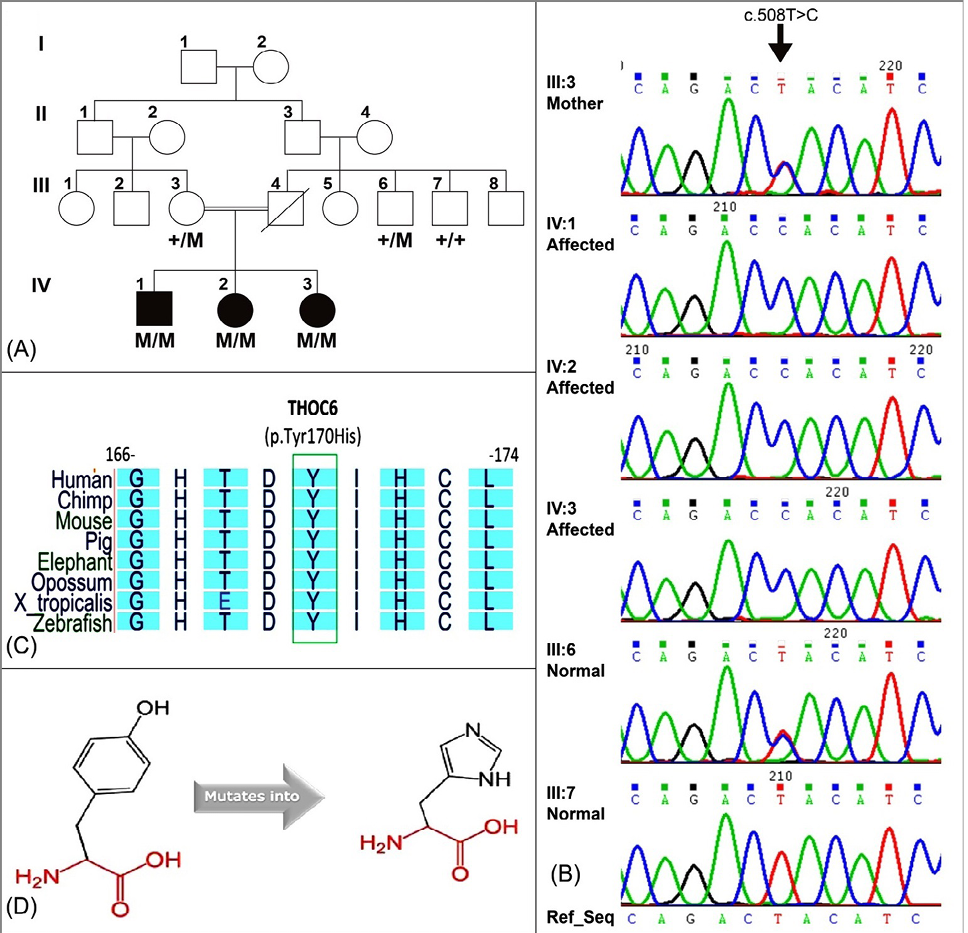
(A) Pedigree of PKMR427 showing segregation of THOC6 gene mutation, (B) sequencing chromatograms confirming the variant (c.508T>C), (C) highly conserved wild-type Tyrosine amino acid (p.Tyr170His) in various species, (D) graphical representation of amino acid change from tyrosine to histidine.
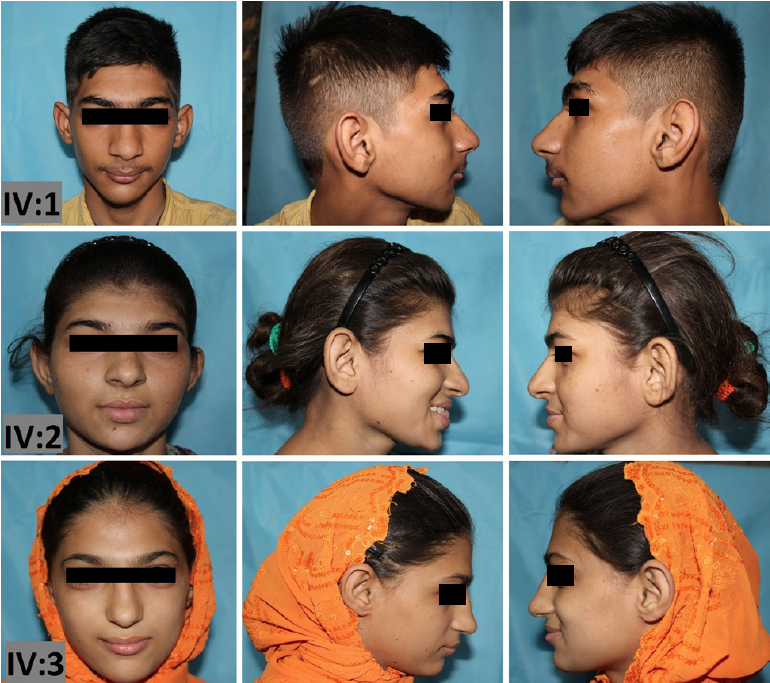
Dysmorphic facial features of three patients of PKMR427 having BBIS phenotype.
References
- Amouzadeh, M.H., Sepahi, M.A. and Abasi, E., 2020. Iran. J. Kidney Dis., 14: 312.
- Association, A.P., 2013. Diagnostic and statistical manual of intellectual disability, Fifth edition (DSM-5).
- Beaulieu, C.L., Huang, L., Innes, A.M., Akimenko, M.A., Puffenberger, E.G., Schwartz, C., Jerry, P., Ober, C., Hegele, R., McLeod, D.R. Schwartzentruber, J. Consortium, F.C., Majewski, J., Bulman, D.E., Parboosingh, J.S. and Boycott, K.M., 2013. Orphanet. J. Rare Dis., 8: 62. https://doi.org/10.1186/1750-1172-8-62[CrossRef]
- Elmas, M., Yıldız, H., Erdoğan, M., Gogus, B., Avcı, K. and Solak, M., 2019. Mol. Biol. Rep., 46: 287-299. https://doi.org/10.1007/s11033-018-4470-7[CrossRef]
- Gupta, N., Yadav, S., Gurramkonda, V.B., Vl, R., Sg, T. and Kabra, M., 2019. Eur. J. med. Genet., 63: 103742. https://doi.org/10.1016/j.ejmg.2019.103742[CrossRef]
- Kiraz, A., Tubaş, F. and Seber, T., 2022. Am. J. med. Genet. A, 188: 1568-1571. https://doi.org/10.1002/ajmg.a.62667[CrossRef]
- Koressaar, T. and Remm, M., 2007. Bioinformation, 23: 1289-1291. https://doi.org/10.1093/bioinformatics/btm091[CrossRef]
- Lemire, G., Innes, A.M. and Boycott, K.M., 2020. In: GeneReviews (eds. M.P. Adam, J. Feldman, G.M. Mirzaa, R.A. Pagon, S.E. Wallace, L.J.H. Bean, K.W. Gripp and A. Amemiya). University of Washington, Seattle. pp. 1993–2024.
- Mattioli, F., Isidor, B., Abdul-Rahman, O., Gunter, A., Huang, L., Kumar, R., Beaulieu, C., Gecz, J., Innes, M. and Mandel, J.L., 2019. Hum. mol. Genet., 28: 952-960. https://doi.org/10.1093/hmg/ddy391[CrossRef]
- Riazuddin, S., Hussain, M., Razzaq, A., Iqbal, Z., Shahzad, M., Polla, D.L., Song, Y., van Beusekom, E., Khan, A.A., Tomas-Roca, L., Rashid, M., Zahoor, M.Y., Wissink-Lindhout, W.M., Basra, M.A.R., Ansar, M., Agha, Z., van Heeswijk, K., Rasheed, F., Van de Vorst, M., Veltman, J.A., Gilissen, C., Akram, J., Kleefstra, T., Assir, M.Z., Grozeva, D., Carss, K., Raymond, F.L., O’Connor, T.D., Riazuddin, S.A., Khan, S.N., Ahmed, Z.M., de Brouwer, A.P.M. and van Bokhoven, H., 2017. Mol. Psychiat., 22: 1604-1614. https://doi.org/10.1038/mp.2016.109[CrossRef]
- Ruaud, L., Roux, N., Boutaud, L., Bessières, B., Ageorges, F., Achaiaa, A., Bole, C., Nitschke, P., Masson, C. and Vekemans, M., 2022. Birth Defects Res., 114: 499-504. https://doi.org/10.1002/bdr2.2011[CrossRef]
- Sambrook, J., Fritsch, E.G. and Maniatis, T., 1989. Molecular cloning: A laboratory manual. 2nd edn Cold Spring Harbor, New York.
- Venselaar, H., Te Beek, T.A., Kuipers, R.K., Hekkelman, M.L. and Vriend, G., 2010. BMC Bioinf., 11: 548. https://doi.org/10.1186/1471-2105-11-548[CrossRef]
Services
Article usage statistics
Loading…