
Morphological characters such as wing length and body mass often correlate with life history parameters in avian biology, affect the probability of acquiring a mate, timing of reproduction, success in obtaining extra-pair copulation or survival. We measured biometrics in common rosefinch Carpodacus erythrinus among three age groups (Juveniles about 3-month old, yearlings, adults > 2 y) during autumn migration in central China. We found that body measurements changed with age, yearling males have shoretest wing length in three groups and similar to adult female, express female-like wing length and plumage coloration. Juveniles have relative longer wing to support their first migration; yearlings have female-like body traits (wing length and plumage coloration) to avoid attacks from adult males in breeding season and increase maneuverability to escape predation risks. Adults have the longest wing, which could support their early arrival at wintering ground in migration. Our studies suggest that body size in juveniles is fully developed and the yearling males display female mimicry in wing length which is an adaptive strategy to sexual selection.
Short Communication · Volume 55, Issue 3, 20 April 2023 · Open Access
Yearling Males have Female-Like Body Size in Common Rosefinch
·
Affiliations & Notes ⌄
- 1School of Life Sciences and Technology, Longdong University, Qingyang 745000, P.R. China * Corresponding author: pfliu0120@126.com
Article Info ⌄
- Journal:
- Pakistan Journal of Zoology
- Published:
- 20 April 2023

From the article
- The results of generalized linear model showed that the wing length, tail length and tarsus length were significantly different in different age groups of male rosefinches (Table II).
- Covariate analysis showed that beak length and wing length are suitable predictor of body size (body mass) in our bird (beak length: Beta = 0.346, t = 3.851, P < 0.001, wing length: Beta = 0.220, t = 2.452, P = 0.016).
- Wing length and tail length of juvenile males is relative longer than yearlings, and similar to adults which suggests that wing length is important for first migration of juveniles.
- These results suggest that the female mimicry in body size of sub-adult males in birds showed delayed plumage maturation may be a commonly strategy.
Selected from the article's own text.
Abstract
Materials and methods
Our study site was located at Shuiluo village (35°12′58″N, 106°01′12″E, 1600 m above sea level) at western of Liupan Mountain, a breeding habitat of common rosefinch of Zhuanglang County, Gansu province, central China.
For morphological traits measurement and sex determination, we captured individuals using mist-nets combined with playback methods, at the breeding grounds from the end of July to early August of the year 2018 and 2019. In this period, the breeding season is nearly over and rosefinches get ready to depart. This assured that captured birds belong to local population. We categorized these captured males into three age groups by plumage coloration and pattern: juveniles, yearlings (second calendar year of life) and adults (older than 2 years). Females were divided as juvenile and adult as the plumage coloration and pattern of females in second year were similar to even elders. We took blood samples from venipuncture of the brachial veins of yearling males with the female-like plumage and used for genetic sexing. We extracted DNA using a TIANamp Gemonic DNA kit (TianGen Biotech, Co., Ltd., Beijing, China). The sexes of the birds were determined using the genetic primer pair sex1/sex2 . We measured 6 morphological parameters: beak length measured from the transition between skull and maxilla and the tip of the beak, beak width measured as the largest latero-lateral width of the mandible, beak height measured between the transition between skull and maxilla and the lowest/most caudo-ventral point of the mandible. Tarsus length, wing length, and tail length were determined with digital calipers (to 0.01 mm) following the methods of Wagner (1999) and body mass with an electrical balance (to 0.01 g) following the methods of Merom et al. (1999). We banded each bird with a unique combination of colored leg rings and released them after measurements. We captured and measured 266 individuals (48 juvenile males, 39 juvenile females, 80 adult females, 40 yearling/subadult males, 59 adult males), we believe all captured individuals belong to local breeding population, as our fieldworks were conducted at the end of the breeding season, before migration. All procedures in the field work have been done with the permission of Animal Ethics Committee of the Longdong Unniversity.
For statistical analysis we used generalized linear model to test the variations of body measurements among different age groups of males, it will give a more comprehensive look at the biometric variability observed in this species. Covariance analysis were used to distinguish the suitable linear predictors of body size, one-way ANOVA was used to investigate differences in all body measurements among all age groups, independent sample T-test to compare the differences between any different age males and mature females. All statistical tests were performed with SPSS software package for Windows 22.0, and all probabilities were 2-tailed with a significance level of alpha = 0.05.
Results
Table I shows average values of all body measurements of all males classified by age. The data belongs to 147 males (48 juvenile, 40 yearlings and 59 adults) and 119 females (39 juveniles and 80 mature individuals) captured in two years. Because age of females cannot be determined by plumage after second year, we combined them together as mature females.
The results of generalized linear model showed that the wing length, tail length and tarsus length were significantly different in different age groups of male rosefinches (Table II). Covariate analysis showed that beak length and wing length are suitable predictor of body size (body mass) in our bird (beak length: Beta = 0.346, t = 3.851, P < 0.001, wing length: Beta = 0.220, t = 2.452, P = 0.016). Based on these results, therefore, we select wing length as the strongest predictor of body size in this work.
Table I.- Morphological measurements (Mean ± SD) of male common rosefinch Carpodacus erythrinus of different age groups.
| Age | Sample (n) | Beak length (mm) | Beak width (mm) | Beak depth (mm) | Wing length (mm) | Tail length (mm) | Tarsus length (mm) | Body mass (g) |
| Juvenile males | 48 | 8.33 ± 0.33 | 8.23 ± 0.33 | 8.26 ± 0.34 | 79.54 ± 2.79 | 60.04 ± 4.68 | 18.56 ± 0.79 | 13.92 ± 1.10 |
| Yearling males | 40 | 8.61 ± 0.51 | 8.10 ± 0.55 | 8.42 ± 0.31 | 77.86 ± 2.49 | 56.98 ± 3.78 | 18.29 ± 0.90 | 14.15 ± 1.16 |
| Adult males | 59 | 8.81 ± 0.93 | 8.17 ± 0.40 | 8.37 ± 0.40 | 80.26 ± 3.25 | 58.05 ± 4.52 | 18.19 ± 1.00 | 14.34 ± 0.84 |
| Females | 80 | 8.51 ± 0.24 | 8.14 ± 0.25 | 8.32 ± 0.21 | 77.36 ± 0.36 | 58.98 ± 1.71 | 18.31 ± 0.61 | 14.05 ± 0.56 |
Table II.- The results of generalized linear model to analyze the biometrics among age groups of male common rosefinch Carpodacus erythrinus. The significant parameters marked in bold.
| Explanatory variables | Coefficients | Wald Chi-Square | P |
| Beak length | 0.060 | 0.085 | 0.770 |
| Beak width | -0.183 | 0.977 | 0.323 |
| Beak depth | 0.186 | 0.736 | 0.391 |
| Wing length | 0.129 | 14.647 | < 0.001 |
| Tail length | -0.047 | 7.147 | 0.008 |
| Tarsus length | -0.126 | 1.865 | 0.172 |
| Body mass | 0.120 | 2.181 | 0.140 |
Independent sample T-test showed that wing length of yearling males is close to those mature females (average value: 77.36 ± 0.36 mm, n = 80; t = -0.555, P = 0.581; Fig. 1), but different from adult and juvenile males (Table I). The results suggest that sub-adult males grew female-like wing length in their first potential breeding season.
Discussion
Our results indicated that yearling male of common rosefinch differed from adults not only in plumage coloration and song characteristic , but also in body size. Although some studies believed full body size is attained before fledging in altricial birds .Several studies have suggested that body measurements grow for a long time and change with age in many songbirds ; ; ; ; ; . Our results suggest that the beak size is fully-grown in juvenile common rosefinch. The beak morphology and size are closely related with foraging behavior and diet in birds, beak size increased with age in Darwin,s medium ground-finches Geospiza fortis and song sparrow Melospiza melodia . Individuals with bigger bill could have better foraging ability and therefore have heavier body mass. In autumn migration, yearlings and adults leave breeding ground earlier and hence accumulate fat stores earlier than juveniles . Body mass increased significantly with age in male rosefinches, heavier body mass are also related to foraging experiences in birds ; . Age-related increases of body mass with age were also reported in other passerine birds, such as reed warbler Acrocephalus scirpaceus and clamorous reed warbler A. stentoreus .
Wing length and tail length of juvenile males is relative longer than yearlings, and similar to adults which suggests that wing length is important for first migration of juveniles. Shorter wings may increase maneuverability, while longer wings could fly faster ; . Wing length is the best predictor of body size in our bird, which is consistent with some other passerine birds ; . Wing length and shape in juveniles of migratory passerines may results from a greater importance of predation avoidance, which relates to migration performance in the first year of life . In our birds, juveniles begin autumn migration where they are about three months old. This leads to poorer flight performance. Longer wings could possible compensate for these negative effects. Adult males have longest wing could support they arrived breeding grounds earlier , and longer wings is also important for birds departing from breeding grounds. Unlike wings, tails have often been selected for additional functions other than flight, such as balancing aid in other types of locomotion .
Yearling male common rosefinch derived shorter wing after their first molt at wintering ground . The wing length is similar to that of females but shorter than the length of the same sex juveniles. Similar to the delayed plumage maturation, this may be an important life history strategy that could help avoid attacks from adult males in the first potential breeding season. Interestingly, adult males sing to attract mates when arrive at breeding sites. Yearling males follow the adult male until the latter paired (personal observations). This is different from reed warbler Acrocephalus scirpaceus and clamorous reed warbler A. stentoreus , while consistent with the orange-flanked bush-robin Tarsiger cyanurus, a passerine bird with delayed plumage maturation. First-year males showed female-like plumage and male-like wing length . These results suggest that the female mimicry in body size of sub-adult males in birds showed delayed plumage maturation may be a commonly strategy.
Tarsus length decreased slightly with age but not significant when taking body mass into considerations, this skeletal trait may be related with ontogeny as avian bones coalesced significantly. In song sparrow Melospiza melodia, tarsus length was also found decreased with age . Our results suggest that tarsus is probably fully developed before plumage maturation in this species. Another explanation is that tarsus length is decreased with age because of loss of bone materials, or/and shrinkage of the scutes on the anterior of the tarsus .
Studies of avian morphology are often correlated with life history strategy . Our results enhanced our understanding for life history in this species. The full development of body size in juveniles assured their first migration, while yearlings with female-like morphology include both wing length and plumage coloration in first breeding season may reduce repulsion from adult males and get mating chance. This adaptive strategy may evolve under the pressure of sexual selection.
Acknowledgements
We are grateful to the helps from Jingbo Shao, Baozhuo Li and Xiaoping Li in the field works. Funding support of this work is from Doctoral Programs of Longdong University (XYBY1914).
Statement of conflicts of interest
The authors have declared no conflicts of interest.
Figures
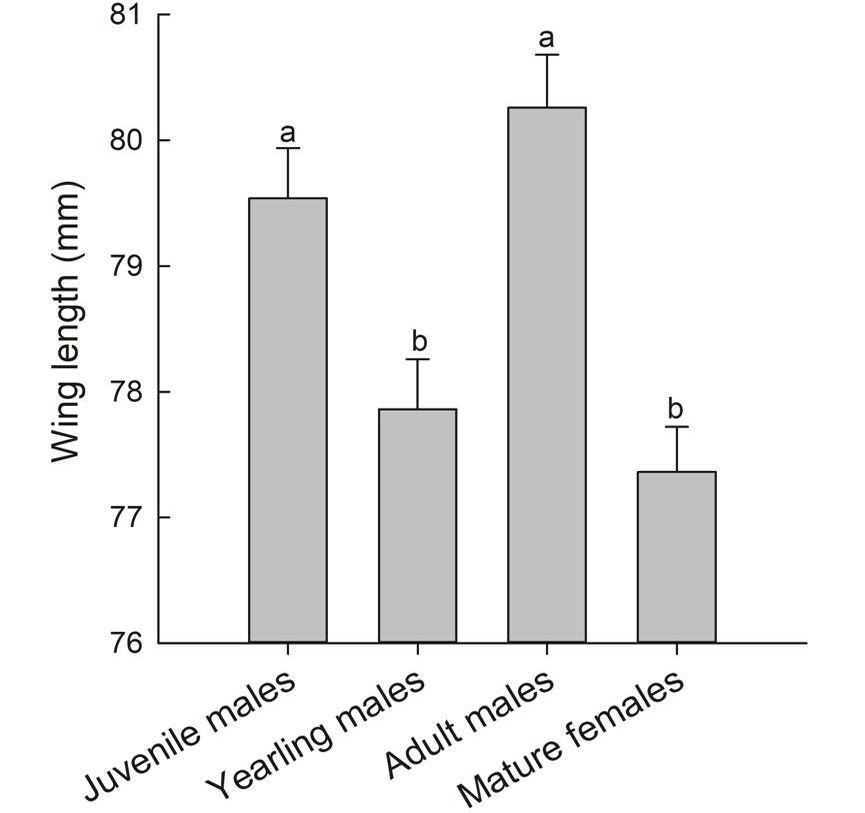
Comparisons of wing length across different age groups of males and mature females in Common Rosefinch Carpodacus erythrinus. The individual effects were removed by covariance analysis with bode mass as covariate. The same letter above the bars showed no significant difference, conversely, differences were significantly.
References
- Alatalo, R.V., Gustafsson, L. and Lundberg, A., 1984. Ibis, 126: 410-415. https://doi.org/10.1111/j.1474-919X.1984.tb00264.x[CrossRef]
- Björklund, M., 1990. Auk, 107: 35-44.
- Bryant, D.M. and Jones, G., 1995. Bird Study, 42: 57-65. https://doi.org/10.1080/00063659509477149[CrossRef]
- Cucco, M. and Malacarne, G., 2000. Ethol. Ecol. Evol., 12: 291–308. https://doi.org/10.1080/08927014.2000.9522802[CrossRef]
- Enoksson, B., 1988. Anim. Behav., 36: 231-238. https://doi.org/10.1016/S0003-3472(88)80266-5[CrossRef]
- Gardner, J.L., Heinsohn, R. and Joseph, L., 2009. Proc. R. Soc. B: Biol. Sci., 276: 3845-3852. https://doi.org/10.1098/rspb.2009.1011[CrossRef]
- Gosler, A.G., 1987. Ibis, 129: 451-476. https://doi.org/10.1111/j.1474-919X.1987.tb08234.x[CrossRef]
- Gosler, A.G., Greenwood, J.D., Baker, J.K. and Davidson, N.C., 1998. Bird Study, 45: 92-103. https://doi.org/10.1080/00063659809461082[CrossRef]
- Hogstad, O., 1985. Cinclus, 8: 116-118.
- Leisler, B. and Winkler, H., 2003. In: Avian migration. Springer, Berlin, Heidelberg, pp. 175-186. https://doi.org/10.1007/978-3-662-05957-9_11[CrossRef]
- Li, J., Zhang, Z., Wang, Y., Gao, C., Xu, J., Xi, B. and Du, Z., 2016. J. nat. Hist., 50: 1283-1289. https://doi.org/10.1080/00222933.2015.1105318[CrossRef]
- Martin, K., 1995. Am. Zool., 35: 340–348. https://doi.org/10.1093/icb/35.4.340[CrossRef]
- Merom, K., McCleery, R. and Yom-Tov, Y., 1999. Bird Stud., 46: 249-255. https://doi.org/10.1080/00063659909461137[CrossRef]
- Mitrus, J., Mitrus, C., Rutkowski, R. and Sikora, M., 2014. Avian Biol. Res., 7: 111–116. https://doi.org/10.3184/175815514X13948188185179[CrossRef]
- Nowicki, S. and Searcy, W.A., 2004. Annls. N.Y. Acad. Sci., 1016: 704–723. https://doi.org/10.1196/annals.1298.012[CrossRef]
- Parapura, A., Mitrus, C. and Golawski, A., 2018. Acta Zool. Bull., 70: 535-538.
- Pérez-Tris, J. and Tellería, J.L., 2001. J. Avian Biol., 32: 207-213. https://doi.org/10.1111/j.0908-8857.2001.320301.x[CrossRef]
- Price, T.D. and Grant, P.R., 1984. Evolution, 38: 483-494. https://doi.org/10.1111/j.1558-5646.1984.tb00314.x[CrossRef]
- Rising, J.D. and Somers, K.M., 1980. Auk, 106: 666-674.
- Smith, J.N.M., Arcese, P. and Schluter, D., 1986. Auk, 103: 210-212.
- Stewart, I.F., 1963. Bird Stud., 10: 1-9. https://doi.org/10.1080/00063656309476036[CrossRef]
- Stolt, B.O. and Fransson, T., 1995. Ornis Fennica, 72: 14-18.
- Van Balen, J.H., 1987. Ardea, 55: 1-59. https://doi.org/10.5253/arde.v55.p1[CrossRef]
- Wang, N., Li, J., Liu, Y. and Zhang, Z., 2010. Chinese Birds, 1: 65–69. https://doi.org/10.5122/cbirds.2009.0009[CrossRef]
- Wagner, R., 1999. Auk, 116: 542–544. https://doi.org/10.2307/4089388[CrossRef]
Services
Article usage statistics
Loading…