
The plain laughingthrush Garrulax davidi concolor (PL) and Elliot,s laughingthrush Trochalopteron elliotii (EL), are two members of family Leiothrichidae, who are both assumed sexually monomorphic. We employed reflectance spectrometry to determine the plumage coloration in these two species in the hand. PL with dull plumage, the males had brighter head plumage than females, there was no significant difference in coloration of wing and breast plumage between two sexes. EL appeared relatively bright and polychrome plumages, and the males had extremely significantly higher carotenoid chroma than female in grayish-white tail end, however, there was no difference in orange wing patch and yellowish-brown hip plumage between sexes. Both male PL and EL had higher reflectance than female in wavelength ranges 300-700 nm. We argued that the patterns of sexual plumage dimorphism in these two babblers might be selective advantage in reducing nest depredation risk and brood parasitism, and it could be viewed as an indicator to assess the pressure of sexual selection between two sexes.
Short Communication · Volume 53, Issue 2, 28 February 2021 · Open Access
Sexual Plumage Dichromatism in Two Laughingthrush Species
· ·
Affiliations & Notes ⌄
- 1School of Life Science and Technology, Longdong University. Qingyang 745000, China 2Education Administration Office, Bozhou Branch of Anhui Open University, Bozhou 236800, China , * Corresponding author: pfliu0120@126.com
Article Info ⌄
- Journal:
- Pakistan Journal of Zoology
- Published:
- 28 February 2021

From the article
- In PL, the male head plumage brightness was significantly higher than females (t = 5.781, P < 0.001; Table I).
- In male EL, the caroteniod chroma of white patch in tail was extremely significantly higher than that in female (t = 6.847, P < 0.001; Table I).
- The results indicated sexual dichromatism in tail white plumage.
- The orange wing patch and yellowish-brown hip feathers indicate carotenoid-based coloration in EL, but we found no significant differences of brightness and saturation in these plumage parts.
Selected from the article's own text.
Abstract
Materials and methods
We carried out the investigation at Badu village of Lianhuashan National Natural Reserve (34°40′67″N, 103°30′84″E, at 2100 m above sea level), in Gansu Province, central China during the breeding season of the year 2018 and 2019 (April to July). We used mist-net to capture the adults inside their territories after birds paired and colonized, the sex was determined by sexual size dimorphism , 2018).
For measurement of plumage coloration we used AvaSpec-ULS2048L ultra low straylight fiber optic spectrometer with AvaLight-DHc compact halogen light source and WS-2 white reference title (Avantes BV, Eerbeek, Netherlands) for reflectance measurements in the hand within wavelength ranged 300-700 nm. The probe was used to provide light and sample reflected light stream, and used to measure body plumage parts which were closed to a black cloth to prevent ambient lights. As the plumage pattern of two species is distinctly different, we selected different body points in the two species to measure the size of head, breast, wing plumage of PL and wing orange patch, hip yellowish-brown patch and tail white end of EL. Each measurement was taken for five times and averaged for each bird. No stretching was done when measuring natural arrangement of feathers. Eighteen males and 15 females of PL and 23 males and 15 females of EL were measured. We obtained reflectance (in %) within the wavelength range 300-700nm by 1-nm increments, calculated total brightness and saturation following the method used by Shawkey et al. (2003). We measured carotenoid chroma as (R450-R700)/R700 (Peter et al., 2004; , where R450 is the percent reflectance at 450 nm and R700 the percent reflectance at 700 nm. Black was used as control. After each bird was banded with a combination of coloured rings and a unique numbered metal ring on the right leg, the bird was immediately released. To further confirm sex of banded birds, more information on courtship display, sexual dimorphism in singing and copulation behaviour was collected by focal visual observations. All animal procedures were approved by the Institutional Animal Care and Use Committee of the Institute of Zoology, Chinese Academy of Sciences.
All data were normally distributed. One-way ANOVA were used to detect if there were individual reflectance variations across the breeding season in all measured body plumage parts. The independent sample t-tests were used to investigate sex differences in measurements. The result values were presented as Mean ± SD. All statistical tests were performed with SPSS 16.0 software for windows and all probabilities were two-tailed with alpha levels for statistical significance was set as P < 0.05.
Results and discussion
In both of these laughingthrush species, males have relative higher reflectance than females (Fig. 1A). In PL, the male head plumage brightness was significantly higher than females (t = 5.781, P < 0.001; Table I). We found no other variables significantly different. At wavelength > 400 nm, the males had higher reflectance than females (Fig. 1A). The results indicate sexual dichromatism in head plumage. In male EL, the caroteniod chroma of white patch in tail was extremely significantly higher than that in female (t = 6.847, P < 0.001; Table I). No significant differences were found in wing orange patch and hip
yellowish-brown feathers. Males had higher reflectance than females at all wavelengths (300-700 nm, Fig. 1B). The results indicated sexual dichromatism in tail white plumage.
The pattern of sexual difference in the coloration of feathers in which male PL hadwith brighter head feathers than female may be correlated with its life history . In this species, only females incubate the eggs. When female is sitting in the nest darker head reduces the predation risk. For the babbler species in which the female incubate the eggs, the duller plumage of females may have adaptive values for favoring incubation and reducing clutch depredation risk , both PL and EL are open-nesting. Previous studies suggest females in open-nesting species had more cryptic coloration than females nesting in cavities ; . This implied that natural selection may strongly affect female coloration and drive the evolution of sexual dichromatism (Wallace, 1868; ; Ekanayake et al., 2015). In EL, the males tend to have brighter white tail end than females, but in this species, both the male and female incubate the eggs . In red-capped plover Charadrius ruficapillus, a ground-nesting and biparental incubation shorebird, the male has brighter and redder head plumage which incurred higher clutch depredation than females and attending nest more at night to reduce nest predation . If both male and female EL are involed in EL parental care during incubation in turn reduces nest predation risk (Wallace, 1868; ; . We need further investigations on the rhythm and duty switching of incubation between sexes. The orange wing patch and yellowish-brown hip feathers indicate carotenoid-based coloration in EL, but we found no significant differences of brightness and saturation in these plumage parts. No individual variations were found in EL, because carotenoid do not appear to influence brightness ; . This is similar to Steere’s Liocichla steerii, in which the female has bright yellow breast plumage than in males. This was because of difference in the underlying feather microstructure between sexes , which was supported by previous studies ; .
In both laughingthrushes, males have relative higher reflectance than females. In local breeding community, the large hawk cuckoo Hierococcyx sparverioides and Eurasian cuckoo Cuculus canorus are mainly nest parasites. The brood parasitism rate in these two babblers is higher than 10% (our unpubl. data). The duller female coloration might be an anti-parasitisim adaptive strategy. This hypothesis needs further experimental studies.
Table I. Average reflectance properties (Mean ± SD) of body feathers in 18 males and 15 females plain laughingthrushing Garrulax davidi concolor and 23 males and 15 females Elliot,s laughingthrushing Trochalopteron elliotii. The significant difference (P < 0.05) is in bold.
| Plumage patch | Male | Female | t | P | |
| Garrulax davidi concolor | |||||
| Head | Brightness | 3.11 ± 0.41 | 2.58 ± 0.29 | 2.429 | 0.029 |
| Saturation | 0.17 ± 0.008 | 0.17 ± 0.01 | 0.096 | 0.925 | |
| Carotenoid chroma | -0.47 ± 0.03 | -0.48 ± 0.05 | 0.729 | 0.479 | |
| Wing | Brightness | 0.85 ± 0.01 | 0.85 ± 0.01 | -0.701 | 0.495 |
| Saturation | 0.22 ± 0.05 | 0.22 ± 0.02 | -0.252 | 0.804 | |
| Carotenoid chroma | -0.33 ± 0.06 | -0.37 ± 0.02 | 1.787 | 0.096 | |
| Breast | Brightness | 0.85 ± 0.01 | 0.85 ± 0.01 | -0.684 | 0.504 |
| Saturation | 0.20 ± 0.04 | 0.21 ± 0.03 | -0.399 | 0.695 | |
| Carotenoid chroma | -0.40 ± 0.07 | -0.39 ± 0.09 | -0.127 | 0.901 | |
| Trochalopteron elliotii | |||||
| Wing orange patch | Brightness | 0.87 ± 0.013 | 0.86 ± 0.012 | 1.867 | 0.07 |
| Saturation | 0.12 ± 0.036 | 0.13± 0.035 | -0.914 | 0.367 | |
| Carotenoid chroma | -0.77 ± 0.102 | -0.70 ± 0.136 | -1.769 | 0.085 | |
| Hip yellowish- brown plumage | Brightness | 0.84 ± 0.009 | 0.85 ± 0.037 | -1.225 | 0.228 |
| Saturation | 0.12 ± 0.029 | 0.10 ± 0.060 | 0.965 | 0.341 | |
| Carotenoid chroma | -0.70 ± 0.112 | -0.72 ± 0.142 | 0.520 | 0.606 | |
| Tail white end | Brightness | 0.84 ± 0.006 | 0.84 ± 0.007 | 2.011 | 0.056 |
| Saturation | 0.20 ± 0.013 | 0.20 ± 0.016 | 1.975 | 0.061 | |
| Carotenoid chroma | -0.12 ± 0.050 | -0.17 ± 0.057 | 3.043 | 0.004 | |
Sexual plumage dichromatism is also considered to be correlated with sexual selection (Darwin, 1871; , which acted on sexual differences, whereas, the natural selection acted on both sexes for the type of colour . The difference of plumage coloration between sexes are strongly correlated with morphology, breeding system and life history, such as sexual size dimorphism, parental care, geographical distribution and migration . Both babblers are socially monogamous, and similar to each other in life history traits, but they express different patterns in plumage and coloration. This may be related to phylogenetic relationship. The two species are evolving in two separate clades . In addition, we know little about their behaviours and variations of reproductive success. It also needs to be investigated if the plumage coloration is fluctuating with age. There is a lot of work to be done on life to get better understanding of how the natural and sexual selection drives the evolution of plumage coloration in babblers.
Acknowledgements
This work was supported by the Doctoral Program of Longdong University (No. XYBY1914). We are grateful to the permission of field work of Authority of Lianhuashan National Natural Reserve, at Gansu. We thank the help of postgraduate students of Avian Ecology Research group, Institute of Zoology, Chinese Academy of Science in field work. We are grateful to the anonymous reviewers and the editor of the journal for their valuable comments.
Statement of conflict of interest
The authors have declared no conflict of interest.
Figures
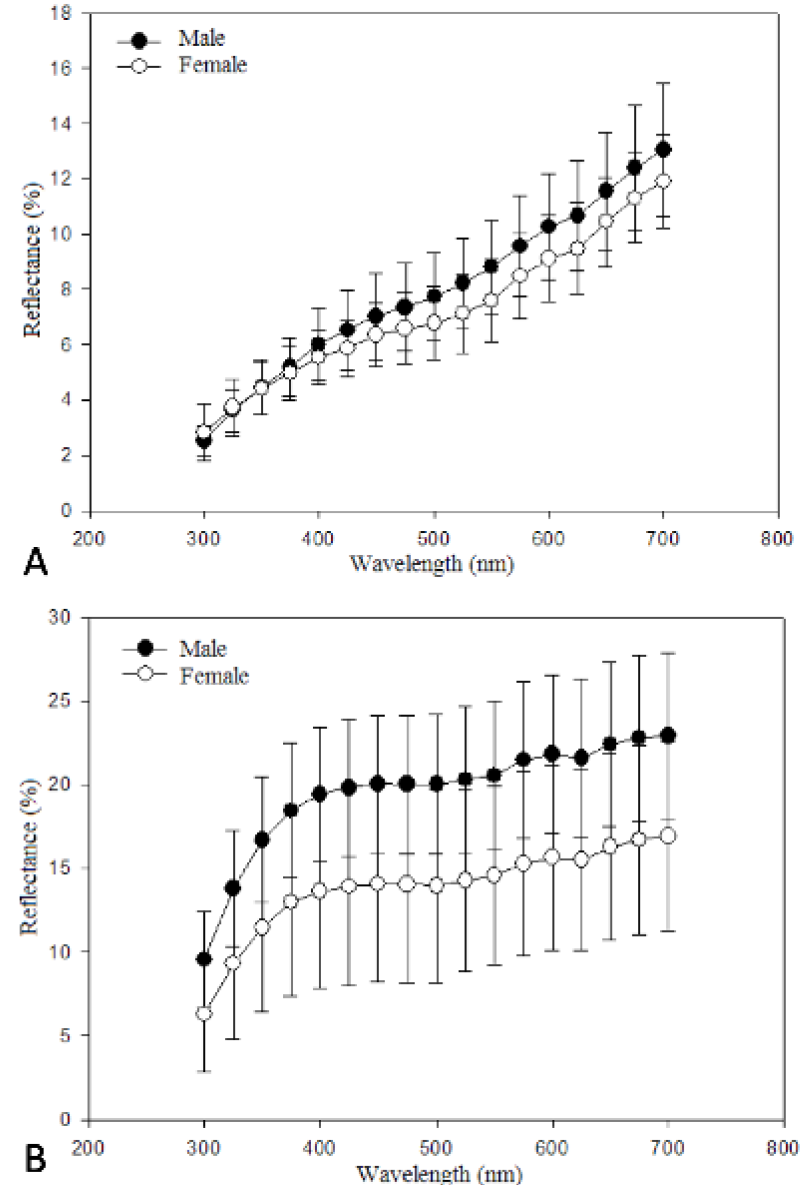
Mean ± SD percent reflectance for: A, plain laughingthrush G. d. concolor, male (n = 18) and female (n = 15). B, Elliot,s laughingthrush Trochalopteron elliotii, male (n = 23) and female (n = 15).
References
- Badyaev, A.V. and Hill, G.E., 2003. . Annu. Rev. Ecol. Evol. Sys., 34: 27 –49. https://doi.org/10.1146/annurev.ecolsys.34.011802.132441[CrossRef]
- Dale, J., Dey, J., Delhey, K., Kempenaers, B. and Valcu, M., 2015. Nature, 527: 367-370. https://doi.org/10.1038/nature15509[CrossRef]
- Darwin, C.R., 1871. The descent of man and selection in relation to sex. John Murray, London. https://doi.org/10.5962/bhl.title.24784[CrossRef]
- Dickinson, E.C., 2003. The Howard and Moore complete checklist of the birds of the world. 3rd edn. Princeton University Press, Princeton, NJ.
- Dunn, P.O., Armenta, J.K., and Whittingham, L.A., 2015. Sci. Adv., 1: e1400155. https://doi.org/10.1126/sciadv.1400155[CrossRef]
- Ekanayake, K.B., Weston, M.A., Nimmo, D.G., Maguire, G.S., Endler, J.A. and Küpper, C., 2015. Proc. R. Soc. Lond. B: Biol. Sci., 282: 20143026. https://doi.org/10.1098/rspb.2014.3026[CrossRef]
- Hill, G.E. and McGraw, K.J., 2006. Bird coloration. Harvard University Press, Cambridge, London.
- Hubbard, J.K., Uy, C., Hauber, M.E., Hoekstra, H.E. and Safran, R.J., 2010. Trends Genet., 26: 231–239. https://doi.org/10.1016/j.tig.2010.02.002[CrossRef]
- Ismar, S.M., Daniel, C., Igic, B., Morrison-Whittle, P.K., Ballard, G., Millar, C.D. and Cassey, P., 2014. Wilson J. Ornithol., 126: 417–428. https://doi.org/10.1676/13-203.1[CrossRef]
- Jiang, Y.X., Zhu, Y.Z. and Sun, Y.H., 2007. Sichuan J. Zool., 26: 555–556.
- Lei, F.M. and Lu, T. C., 2006. China endemic birds. Science Press, Beijing, China.
- Liu, P.F. and Sun, Y.H., 2016. Ardea, 104: 177-181. https://doi.org/10.5253/arde.v104i2.a2[CrossRef]
- Liu, P.F. and Sun, Y.H., 2018. Wilson J. Ornithol., 130: 510–512. https://doi.org/10.1676/16-031.1[CrossRef]
- Luo, X., Qu, Y.H., Han, L.X., Li, Sh.H. and Lei, F.M., 2009. Zool. Scrip., 38: 9–22. https://doi.org/10.1111/j.1463-6409.2008.00355.[CrossRef]
- Matysiokova, B. and Remeš, V., 2010. Ethology, 116: 596–607. https://doi.org/10.1111/j.1439-0310.2010.01776.x[CrossRef]
- Mays, H.L., McGraw, K.J., Ritchison, G., Cooper, S., Rush, V. and Parker, R.S., 2004. J. Avian Biol., 35: 125–134. https://doi.org/10.1111/j.0908-8857.2004.03101.x[CrossRef]
- Mays, H.L., Doucet, S.M., Yao, C.T. and Yuan, H.W., 2006. J. Field Ornithol., 77: 437–443.
- McGraw, K.J., Safran, R.J. and Wakamatsu, K., 2005. Funct. Ecol., 19: 816–821. https://doi.org/10.1111/j.1365-2435.2005.01032.x[CrossRef]
- McGraw, K.J., 2006. In: Bird coloration. I. Mechanisms and measurements. Harvard University Press, Cam-bridge, Massachusetts, USA. pp. 243–294
- Peters, A., Denk, A.G., Delhey, K. and Kempenaers, B., 2004. J. Evol. Biol., 17: 1111–1120. https://doi.org/10.1111/j.1420-9101.2004.00743.x[CrossRef]
- Saks, L., McGraw, K. and Horak., P., 2003. Funct. Ecol., 17: 555–561. https://doi.org/10.1046/j.1365-2435.2003.00765.x[CrossRef]
- Shawkey, M.D., Estes, A.M. Siefferman, L.M. and Hill. G.E., 2003. Proc. R. Soc. Lond. B: Biol. Sci., 270: 1455–1460. https://doi.org/10.1098/rspb.2003.2390[CrossRef]
- Shawkey, M.D. and Hill., G.E., 2005. Biol. Lett., 1: 121–124. https://doi.org/10.1098/rsbl.2004.0289[CrossRef]
- Soler, J.J. and Moreno, J., 2012. J. Evol. Biol., 25: 1614–1622. https://doi.org/10.1111/j.1420-9101.2012.02544.x[CrossRef]
- Wallace, A.R., 1868. J. Travel Nature His., 1: 73–89.
Services
Article usage statistics
Loading…