
We investigated morphological differences between sexes, and mating patterns respect to their body size and condition in a wild population of the grey-capped greenfinch Chloris sinica. The results showed that male birds with significant longer bill and wing than female; breeding pairs assortative mated positively by culmen height, wing length, body mass and body condition. We argued that the body condition of greenfinches may be important in mutual mate choice. Male air courtship and incubation feeding behaviour provide evidence that female mate choice may be responsible for sexual dimorphism of bill size and wing length. Mutual mate choice and life histories may be responsible for non-randomly mating pattern by body condition, high quality individual prefer to mate with each other.
Short Communication · Volume 54, Issue 2, 27 January 2022 · Open Access
Morphological Traits and Body Condition Determine Assortative Mating in Grey-capped Greenfinch
·
Affiliations & Notes ⌄
- 1School of Life Sciences and Technology, Longdong University. Qingyang 745000, China * Corresponding author: pfliu0120@126.com
Article Info ⌄
- Journal:
- Pakistan Journal of Zoology
- Published:
- 27 January 2022

From the article
- In our study, culmen height, wing length, body mass and body condition were significantly correlated within pairs, indicating positive assortative mating.
- If assortative mating in body mass and body condition is the result of mutual mate choice, males should prefer to mate with heavier females and females should prefer to mate with heavier males.
- A migratory species in which high quality individuals (of both sexes) arrive earlier to the breeding grounds, high quality females will mate with high quality males even if they mate randomly, because only high quality individuals of both sexes will be present in the breeding grounds early in the season.
- Therefore, sexual selection rather than resource partitioning may drive the sexual morphological difference and mate choice promote assortative mating by body condition in this passerine bird.
Selected from the article's own text.
Abstract
Materials and methods
Grey-capped greenfinch is a socially monogamous seed eater, widely distributed in East Asia, occurs in city gardens, village surroundings and open woodlands. At our study area, the species is resident, males started to display in early March. Once formed a pair bond, both males and females construct nests. Only the females incubate and are fed by males, the incubation period is about 13 days. Both parents cooperatively provision food to nestlings for 13-15 days, but males undertake the majority of post-fledged provisioning. The earliest fledged chicks are seen in middle April (e.g. April 17, 2018; April 14, 2019; unpublished data). They form flocks during non-breeding season, while for unpaired males, the flock did not dismiss until early June .
In 2018 and 2019, we captured birds with mist-nets from March to early May on the campus of Longdong University (35°43′47″N, 107°41′04″E, 1367.3 m above sea level), Qingyang city, Gansu province, China. We located and monitored most of the nests during nest-building and incubation periods. To minimize disturbance caused brood abandonment, we only captured paired birds when incubation. We determined the sex of captured individuals according to the plumage coloration, and a same person (PL) measured morphological traits (culmen length: The linear length from anterior of nostril to the tip of culmen, culmen width: the width of bill base, culmen height: the depth of bill base, tarsus length: the linear length from intertarsal joint to the inferior of first palta of the tarsi, wing length: the chord length from digital joint to the tip of the longest primary feather, and tail length: the linear from tail base to the tip of the longest tail feather) with digital calipers (0.01 mm), methods consistent with which were used in studies on this species , and weighed body mass using an electrical balance (0.01 g). We also banded each bird with a combination of colored leg rings, determined and recorded the pairing relationships through incubation feeding behaviours. We totally captured and measured 48 males and 27 females, including 22 pairs in this work, and body condition of each individual were included in analyze. Body condition is a commonly used parameter in passerine studies, calculated as body mass/tarsus length .
We used t-tests to investigate differences between sexes in all body measurements. We used Pearson’s correlation to detect morphometrics associations between the mated pairs and tested assortative mating. All statistical tests were performed with SPSS software package for Windows 16.0 (SPSS Inc., 2007). Results were given as Mean ± SD, and all probabilities were 2-tailed with a significance level of alpha = 0.05.
Results and discussion
Only culmen length and wing length showed significant differences between sexes (Table I). This species showed positive assortative mating patterns by body mass (Fig. 1), wing length (Fig. 1), culmen height (Fig. 1), and body condition (Fig. 2), but not in culmen length, culmen width, tarsus length and tail length.
We found that males were moderate larger than females, male greenfinches with longer wing than female, slight SSD were detected in our population, similar to American goldfinch Carduelis tristis, however, in other traits, the two species exhibit distinctly difference, the causes of this different in these two species is ambiguous, as they have very similar life history and breeding system . The blue-black Grassquit Volatinia jacarina is a seed-eater, migratory species of which males perform an aerial display. Grassquits and grey-capped Greenfinches have similar patterns of sexual size dimorphism and life-history except
Table I. Morphometric differences between male and female grey-capped greenfinch Chloris sinica in a breeding population at the campus of Longdong University, eastern Gansu, central China. Measurements that differed significantly between sexes is shown in bold (P < 0.05).
| Morphometrics | Sex | Mean ± SD (Range) | t | P |
| Culmen length (mm) | Male (n=48) | 9.16±0.44 (8.11-10.08) | 2.226 | 0.03 |
| Female (n=27) | 8.88±0.50 (8.01-9.75) | |||
| Culmen width (mm) | Male (n=48) | 7.27±0.67 (5.79-8.51) | 0.191 | 0.191 |
| Female (n=27) | 7.44±0.44 (6.79-8.19) | |||
| Culmen height (mm) | Male (n=48) | 8.22±0.46 (6.17-9.05) | -0.971 | 0.335 |
| Female (n=27) | 8.05±0.34 (7.57-8.87) | |||
| Wing length (mm) | Male (n=48) | 78.69±2.23 (74.05-82.44) | 3.054 | 0.003 |
| Female (n=27) | 76.72±2.63 (71.15-80.47) | |||
| Tail length (mm) | Male (n=48) | 48.06±3.30 (40.41-53.56) | -1.291 | 0.201 |
| Female (n=27) | 49.24±3.37 (42.81-56.36) | |||
| Tarsus length (mm) | Male (n=48) | 15.11±0.95 (13.06-17.10) | 0.106 | 0.916 |
| Female (n=27) | 15.08±0.88 (12.42-16.11) | |||
| Body mass (g) | Male (n=48) | 14.84±3.11 (10.19-19.53) | 0.954 | 0.344 |
| Female (n=27) | 14.03±2.96 (10.77-19.24) |
the male greenfinches feeding the incubating female . In greenfinches, males not only provide foods to incubating females and their nestlings, but also nest defense and majority of post-fledging provisioning, during mate choice, females may prefer to mate with males with larger bill size, as greenfinch is a seed-eater, bill size may predict the foraging ability of males . As an aerial display songbird, paired males has longer wings but with nearly mass to female. Our foundings in this work is different from previously reported results in other two passerine birds, Elliot’s Laughingthrush Trochalopteron elliotii and Plain Laughingthrush Garrulax davidi concolor , in which two species, males were larger than females in all determined body measurements, and both male,s display occurred on the ground, which is inclined to favor to larger body size of males.
In our study, culmen height, wing length, body mass and body condition were significantly correlated within pairs, indicating positive assortative mating. This non-random mating pattern were reported in many other birds ; ; ; . American goldenfinch, also a cardueline finches, positively assortative mated by carotenoid-based plumage color , in which males experience prealternate spring moult before breeding season , this is distinctly different from Greenfinches, whose males experienced autumn moulting and yellow plumage getting brilliant at least 2 weeks before spring, while females remain duller until breeding season comes, the mutual mate choice in this species may depend on the body condition rather than plumage coloration. In general, plumage coloration is good indicator of body condition (good health). So the relationship between body condition and plumage coloration is inseparable, this need figure out in our future works. We argued that the mate choice and evolution of sexual selected traits exhibited different patterns in different species with different life histories. Body mass is still a key physiological trait of adaptation, mated assortatively by body mass ensured synchronous physiological pace of the pairs, and favorable to breeding success ; ; . Fat reserves can be very important during incubation, because many bird species must endure starvation, and the physiological costs of incubation can be very high ; . Individuals that have a higher body mass also may have more fat reserves, and could therefore spend more time in incubation , especially in this only-female incubation species. In the course of mate choice in Greenfinches, males may prefer to mate with females with heavier body mass, this will reduce his energy cost in foraging and back to incubation feeding, and also brood predation risk. However, females prefer to mate with males with higher foraging ability, this could ensure her food supply during incubation. If assortative mating in body mass and body condition is the result of mutual mate choice, males should prefer to mate with heavier females and females should prefer to mate with heavier males. A migratory species in which high quality individuals (of both sexes) arrive earlier to the breeding grounds, high quality females will mate with high quality males even if they mate randomly, because only high quality individuals of both sexes will be present in the breeding grounds early in the season. They would show assortative mating for any trait related to quality even without any mate choice involved. The same might apply to non-migratory species if high quality individuals (of both sexes) begin to breed earlier. Therefore, sexual selection rather than resource partitioning may drive the sexual morphological difference and mate choice promote assortative mating by body condition in this passerine bird.
Acknowledgements
We are grateful to the help of two undergraduate students from School of Life Sciences and Technology, Longdong University, in the field work. We appreciate the help from Cheng Wenda from HKU to edit the drafts.
Statement of conflict of interest
The authors have declared no conflict of interest.
Figures
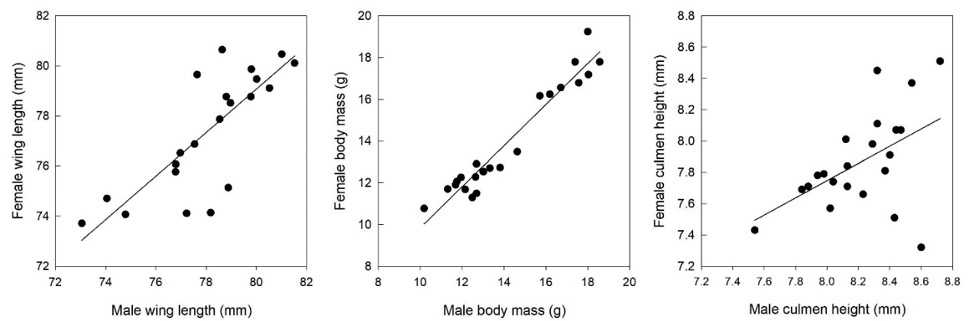
Assortative mating by wing length, body mass and culmen height across breeding pairs of the Grey-capped Greenfinch Chloris sinica from a breeding population at the campus of Longdong University, eastern Gansu, central China.
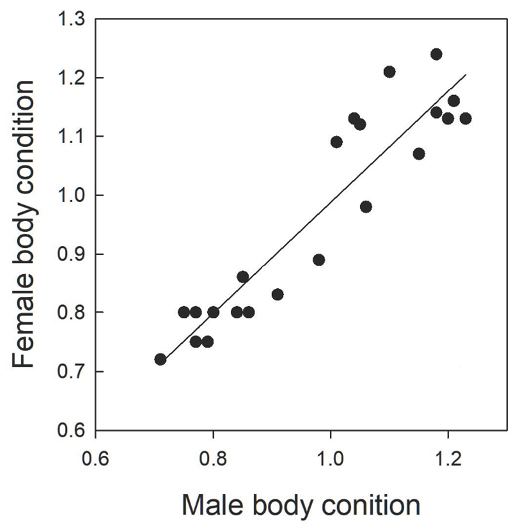
Assortative mating by body condition across breeding pairs of Grey-capped Greenfinch Chloris sinica from a breeding population at the campus of Longdong University, eastern Gansu, central China.
References
- Andersson, M., 1994. Sexual selection. Princeton University Press. Princeton.
- Blanckenhorn, W., 2005. Behavioral causes and consequences of sexual size dimorphism. Ethol, 111: 977–1016. https://doi.org/10.1111/j.1439-0310.2005.01147.x[CrossRef]
- Blomqvist, D., Johansson, O., Unger, U., Larsson, M. and Flodin, L., 1997. Anim. Behav., 54: 1291-1299. https://doi.org/10.1006/anbe.1997.0532[CrossRef]
- Blondel, P., Perret, M. and Anstett, C., 2002. J Evol. Biol., 15: 440–450. https://doi.org/10.1046/j.1420-9101.2002.00397.x[CrossRef]
- Carvalho, C., Macedo, R. and Graves, J., 2007. Braz. J. Biol., 67: 275–281. https://doi.org/10.1590/S1519-69842007000200012[CrossRef]
- Chiba, A., Uchida, H. and Imanishi, S., 2014. Zool. Sci., 31: 741–747. https://doi.org/10.2108/zs140087[CrossRef]
- Clement, P., 2020. Oriental greenfinch (Chloris sinica), version 1.0. In: Birds of the world (J. del Hoyo, A. Elliott, J. Sargatal, D. A. Christie and E. de Juana Editors). Cornell Lab of Ornithology, Ithaca, NY, USA. https://doi.org/10.2173/bow.origre.01[CrossRef]
- Crespi, B., 1989. Anim. Behav., 38: 980–1000. https://doi.org/10.1016/S0003-3472(89)80138-1[CrossRef]
- Darwin, C., 1871. The descent of man and selection in relation to sex. John Murray, London. https://doi.org/10.5962/bhl.title.24784[CrossRef]
- Delestrade, A., 2001. Auk, 118: 553–556. https://doi.org/10.1093/auk/118.2.553[CrossRef]
- Fletcher, K., Hamer, K., 2003. Bird Study, 50: 78–83. https://doi.org/10.1080/00063650309461294[CrossRef]
- Friedman, N. and Remeš, V., 2015. Ecography, 38: 1–9.
- Grant, P.R. and Grant, B.R., 2006. Science, 313: 224–226. https://doi.org/10.1126/science.1128374[CrossRef]
- Haggerty, T., 2006. J. Field Ornithol., 77: 259–265. https://doi.org/10.1111/j.1557-9263.2006.00051.x[CrossRef]
- Halley, M., Holmes, A. and Robinson, W., 2015. J. Field Ornithol., 86: 153–162. https://doi.org/10.1111/jofo.12098[CrossRef]
- Haneda, K. and Nakamura, H., 1970. Tori, 20: 41–59 (in Japanese). https://doi.org/10.3838/jjo1915.20.41[CrossRef]
- Hipkiss, T., 2002. J. Zool., 251: 287– 285. https://doi.org/10.1001/jama.287.3.285[CrossRef]
- Hogle, N. and Burness, G., 2014. J. Ornithol., 155: 91–100. https://doi.org/10.1007/s10336-013-0991-y[CrossRef]
- Hooper, P. and Miller, G., 2008. Adapt. Behav., 16: 53–70. https://doi.org/10.1177/1059712307087283[CrossRef]
- Jiang, Y., Daniel, I. and Bolnick, M., 2013. Am. Nat., 181: 125–138. https://doi.org/10.1086/670160[CrossRef]
- Jones, T., Arnqvist, G., McNamara, K. and Elgar, M., 2012. Behav. Ecol. Sociobiol., 66: 995–1003. https://doi.org/10.1007/s00265-012-1347-y[CrossRef]
- Liu, P. and Sun, Y., 2016. Ardea, 104: 177–182. https://doi.org/10.5253/arde.v104i2.a2[CrossRef]
- Liu, P. and Sun, Y., 2018. Wilson J. Ornithol., 130: 510-515. https://doi.org/10.1676/16-031.1[CrossRef]
- MacDougall, A. and Montgomerier, R., 2003. Naturwissenschaften, 90: 464–467. https://doi.org/10.1007/s00114-003-0459-7[CrossRef]
- Middleton, A., 1993. American goldfinch (Carduelis tristis). In: (eds. A. Poole and R. Gill). The birds of North America, vol 80. Academy of Natural Sciences, Philadelphia. https://doi.org/10.2173/bna.080[CrossRef]
- Moreno, J., 1989. Biol. J. Linn. Soc., 37: 297–310. https://doi.org/10.1111/j.1095-8312.1989.tb01907.x[CrossRef]
- Mueller, H., 1986. Wilson Bull., 98: 387–406. https://doi.org/10.1177/089033448600100422[CrossRef]
- Nakamura, H., 1969. J. Yamashina Inst. Ornithol., 5: 623–639. (in Japanese).
- Nakamura, H., 1979. Tori, 28: 1–27 (in Japanese). https://doi.org/10.3838/jjo1915.28.1[CrossRef]
- Nakamura, H., 1991. J. Yamashina Inst. Ornithol., 22: 9–55 (in Japanese).
- Nakamura, H., 1997. Jap. J. Ornithol., 46: 95–110. https://doi.org/10.3838/jjo.46.95[CrossRef]
- Saitoh, T., Kawakami, K., Red,kin, Y., Nishiumi, I., Kim, C. and Kryukov, A., 2020. Zool. Sci., 37: 280–294. https://doi.org/10.2108/zs190111[CrossRef]
- Sandercock, B., 1998. Auk, 115: 786–791. https://doi.org/10.2307/4089430[CrossRef]
- Shine, R., 1989. Quart. Rev. Biol., 64: 419–461. https://doi.org/10.1086/416458[CrossRef]
- Suzuki, T. and Kobayashi, K., 1990. Jap. J. Ornithol., 39: 66–68 (in Japanese). https://doi.org/10.3838/jjo.39.66[CrossRef]
- Tryjanowski, P. and Šimek, J., 2005. J. Ethol., 23: 161–165. https://doi.org/10.1007/s10164-004-0142-2[CrossRef]
Services
Article usage statistics
Loading…