
Shrimp pond ecosystems are highly dynamic environments in which water quality and biological communities play a critical role in determining culture stability and productivity. This study aimed to evaluate temporal variations in water quality parameters, microbial indicators, and plankton composition in intensive pond-based culture systems of Litopenaeus vannamei across consecutive production phases. Monitoring was conducted in multiple pond units through routine measurements of physicochemical parameters, water transparency, bacterial and Vibrio abundance, and plankton communities throughout the culture period. The results revealed distinct temporal fluctuations in pH, dissolved oxygen, and water clarity, accompanied by corresponding variations in bacterial and Vibrio populations. Plankton community structure shifted over time, reflecting changes in nutrient dynamics and organic matter accumulation within the ponds. These findings demonstrate that ecological conditions in shrimp ponds are not static but evolve in response to culture progression. Continuous ecological monitoring is therefore essential to support adaptive pond management strategies and to maintain environmental stability in intensive Litopenaeus vannamei culture systems.
Special Issue: Innovations in Sustainable Fisheries, Marine Resources, and Food Systems for Food Security and Human Well-being · Volume 42, Issue 2, 22 October 2026 · Open Access
Water Quality and Plankton Dynamics in Litopenaeus vannamei Pond Culture Systems
· · ·
Affiliations & Notes ⌄
- 1Doctoral Program on Environmental Science, School of Postgraduate, Brawijaya University, Malang, Indonesia
- 2Department Fishery Product Technology, Faculty of Fisheries and Marine Science, Brawijaya University, Malang, Indonesia
- 3School of Postgraduate, Brawijaya University, Malang, Indonesia
- 4Departement. Fisheries Agrobusiness, Faculty of Fisheries and Marine Science, Brawijaya University. *Correspondence | Aryani Rahmawati, Doctoral Program on Environmental Science, School of Postgraduate, Brawijaya University, Malang, Indonesia
- 5Email: Aryanirahmawati1983@gmail.com
Article Info ⌄
- Journal:
- Sarhad Journal of Agriculture
- Published:
- 22 October 2026
From the article
- Water quality dynamics in pond-based culture systems of Litopenaeus vannamei exhibited clear temporal fluctuations across the observed production cycle phases, reflecting the highly dynamic nature of shrimp pond ecosystems.
- The monitoring data demonstrated that pond ecosystems used for the culture of Litopenaeus vannamei experienced continuous and interconnected fluctuations in physicochemical and biological parameters throughout the production cycle phases.
- Shifts in plankton composition and periodic increases in Vibrio abundance indicated that ecological instability can emerge even under routine pond management.
- These findings confirm that water quality dynamics are closely linked to biological processes within shrimp ponds and highlight the importance of integrated ecological monitoring to maintain a balanced culture environment.
Selected from the article's own text.
Abstract
Introduction
Shrimp aquaculture has become one of the fastest-growing food production sectors worldwide, with Litopenaeus vannamei dominating global cultivation due to its high adaptability and economic value . Intensive pond systems are widely applied to meet production demands, yet these systems are inherently unstable because water quality is strongly influenced by biological activity, organic loading, and microbial proliferation ; . Fluctuations in physicochemical parameters, particularly pH and dissolved oxygen, are common in shrimp ponds and often linked to the metabolic activity of plankton communities and decomposition of organic matter ; .
Pond ecosystems supporting shrimp culture function as semi-closed environments where nutrient accumulation and microbial processes continuously reshape water conditions ; . These ecological shifts may influence not only water stability but also the abundance of opportunistic pathogens such as Vibrio spp., which are widely recognized as major threats to shrimp health and survival ; . Therefore, understanding the temporal dynamics of water quality and biological indicators is essential for sustainable shrimp farming.
Despite extensive research on shrimp production, many studies primarily focus on growth performance and feeding efficiency rather than the ecological processes occurring within ponds ; . Investigations addressing plankton succession and microbial dynamics often rely on experimental or short-term datasets, which may not fully represent real farming conditions ; . Moreover, routine farm monitoring data, although abundant, are rarely utilized as scientific evidence to describe ecological patterns in operational shrimp ponds ; .
This gap limits the understanding of how water quality and biological communities fluctuate naturally during shrimp culture cycles under commercial management. Continuous pond monitoring provides valuable insight into ecosystem behavior, including plankton dominance shifts, diel pH variation, oxygen depletion, and microbial proliferation ; . Such information is crucial to anticipate environmental instability and disease risk in intensive shrimp culture systems.
This study was conducted to provide a descriptive ecological assessment of pond water quality, plankton dynamics, and microbial indicators in Litopenaeus vannamei culture systems using field-based monitoring data collected during shrimp production cycle phases. The research aims to highlight how physicochemical fluctuations are linked to biological processes within shrimp ponds and to provide practical insights for improving environmental management in pond-based aquaculture.
Despite the widespread application of water quality monitoring in shrimp aquaculture, many studies rely on snapshot measurements that do not adequately capture temporal ecological dynamics throughout the production cycle. In intensive Litopenaeus vannamei pond systems, limited attention has been given to the combined temporal behavior of physicochemical parameters, microbial indicators, and plankton community structure as an integrated ecological unit. As a result, the understanding of how pond ecosystems evolve during culture progression remains incomplete. This study addresses this gap by systematically monitoring temporal changes in water quality, bacterial and Vibrio abundance, and plankton composition across consecutive culture phases. The objective is to provide an ecological perspective that supports adaptive management and environmental stability in intensive shrimp pond systems.
Materials and Methods
This study employed a longitudinal monitoring approach to capture temporal ecological dynamics in intensive Litopenaeus vannamei pond culture systems. Observations were conducted across consecutive production phases in multiple pond units to ensure representativeness of routine farming conditions. Monitoring focused on key physicochemical parameters, microbial indicators, and plankton communities that are widely recognized as indicators of pond ecological status. This approach allows for the identification of temporal patterns and interactions among water quality, microbial load, and plankton dynamics during the culture period.
Study area and pond system
The study was conducted in a commercial-scale pond aquaculture facility culturing Litopenaeus vannamei under semi-intensive management. Earthen ponds were operated using similar preparation and water management protocols throughout consecutive production cycle phases. Pond ecosystems in shrimp farming are recognized as dynamic aquatic agro-systems strongly influenced by organic loading, plankton productivity, and microbial processes ; .
Physicochemical water quality measurements
pH was measured twice daily (morning and afternoon) using a portable digital pH meter to capture diel fluctuations associated with photosynthesis and respiration in shrimp ponds ; . Dissolved oxygen (DO) was measured in the early morning using a calibrated DO meter, as minimum oxygen levels typically occur before sunrise due to plankton and microbial respiration . Water transparency was monitored using a Secchi disk to indicate plankton density and suspended solids .
Microbial (Vibrio) Monitoring
Water samples were collected aseptically and analyzed for total Vibrio abundance using standard microbiological plating techniques on selective media. Vibrio populations are widely used as indicators of microbial imbalance and disease risk in shrimp ponds ; . Elevated Vibrio loads are often associated with high organic matter and unstable environmental conditions ; .
Plankton identification
Water samples were collected from each pond and examined microscopically to identify dominant phytoplankton groups. Plankton composition serves as a biological indicator of nutrient dynamics and ecological condition in shrimp ponds . Shifts between green algae and blue-green algae were recorded to evaluate trophic changes and bloom dynamics .
Data handling and interpretation
Monitoring data were compiled descriptively to evaluate ecological trends across production cycle phases. Observational analysis was applied to interpret fluctuations in physicochemical, microbial, and plankton indicators without experimental manipulation, a method widely used in pond ecosystem studies .
Results and Discussion
The results illustrate that water quality and biological components in shrimp ponds exhibit clear temporal variability rather than remaining stable throughout the culture period. Changes in physicochemical parameters were closely followed by shifts in microbial abundance and plankton composition, indicating strong ecological coupling within the pond system.
Water quality dynamics in pond-based culture systems of Litopenaeus vannamei exhibited clear temporal fluctuations across the observed production cycle phases, reflecting the highly dynamic nature of shrimp pond ecosystems. Variations in physicochemical
parameters such as pH and dissolved oxygen (DO), together with changes in microbial abundance and plankton composition, indicated ongoing ecological shifts throughout the culture period (Table 1). Such variability is typical in semi-intensive and intensive shrimp ponds, where nutrient loading and biological processes continuously alter water conditions ; Edwards, 2015).
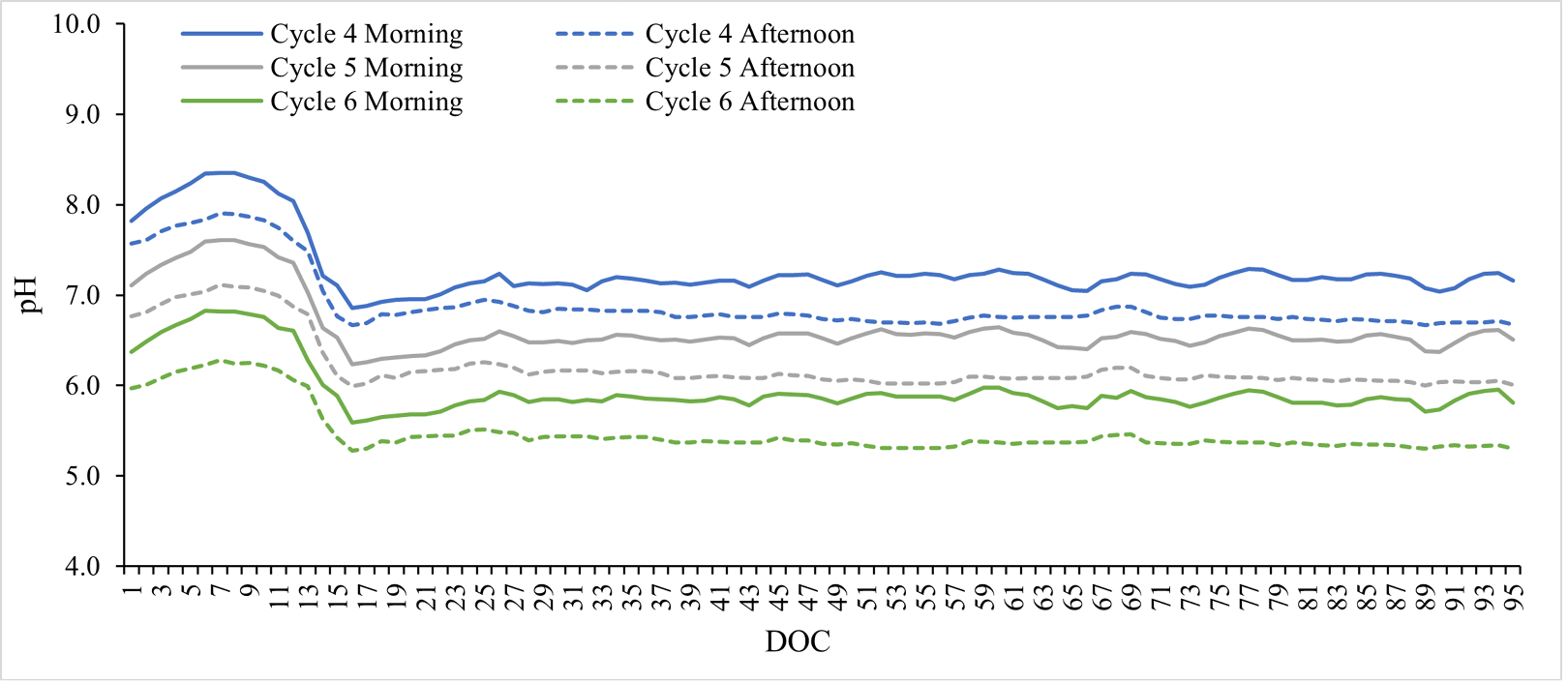
The pH values recorded during the culture period showed daily and cyclical variation between morning and afternoon measurements (Figure 1). This pattern is strongly associated with photosynthetic activity and respiration of phytoplankton communities in the ponds. Higher afternoon pH levels observed in several pond units suggest active phytoplankton photosynthesis, which consumes carbon dioxide and increases alkalinity during daylight hours. Similar pH
Table 1: Summary of physicochemical water quality parameters (pH and DO) in Litopenaeus vannamei ponds
|
DOC |
pH |
DO (mg/L) |
||||||||||
|
Cycle 4 |
Cycle 5 |
Cycle 6 |
Cycle 4 |
Cycle 5 |
Cycle 6 |
|||||||
|
Mor-ning |
After-noon |
Mor-ning |
Afte-rnoon |
Mor-ning |
After-noon |
Mor-ning |
Night |
Morning |
Night |
Morning |
Night |
|
|
70 |
7.2 |
6.8 |
6.6 |
6.1 |
5.9 |
5.4 |
5.4 |
4.8 |
5.0 |
4.8 |
5.8 |
5.4 |
|
71 |
7.2 |
6.7 |
6.5 |
6.1 |
5.8 |
5.4 |
5.3 |
4.9 |
5.1 |
4.6 |
5.8 |
5.4 |
|
72 |
7.1 |
6.7 |
6.5 |
6.1 |
5.8 |
5.4 |
5.3 |
4.8 |
4.9 |
4.7 |
5.7 |
5.3 |
|
73 |
7.1 |
6.7 |
6.4 |
6.1 |
5.8 |
5.4 |
5.2 |
4.8 |
5.0 |
4.8 |
5.7 |
5.2 |
|
74 |
7.1 |
6.8 |
6.5 |
6.1 |
5.8 |
5.4 |
5.2 |
4.8 |
5.0 |
4.7 |
5.6 |
5.2 |
|
75 |
7.2 |
6.8 |
6.5 |
6.1 |
5.9 |
5.4 |
5.3 |
4.9 |
5.1 |
4.6 |
5.5 |
5.2 |
|
76 |
7.2 |
6.8 |
6.6 |
6.1 |
5.9 |
5.4 |
5.3 |
4.8 |
5.1 |
4.5 |
5.6 |
5.2 |
|
77 |
7.3 |
6.8 |
6.6 |
6.1 |
5.9 |
5.4 |
5.3 |
4.7 |
5.0 |
4.6 |
5.7 |
5.2 |
|
78 |
7.3 |
6.8 |
6.6 |
6.1 |
5.9 |
5.4 |
5.2 |
4.7 |
5.0 |
4.6 |
5.7 |
5.2 |
|
79 |
7.2 |
6.7 |
6.6 |
6.1 |
5.9 |
5.3 |
5.1 |
4.7 |
4.9 |
4.6 |
5.7 |
5.2 |
|
80 |
7.2 |
6.8 |
6.5 |
6.1 |
5.8 |
5.4 |
5.3 |
4.7 |
5.0 |
4.5 |
5.7 |
5.1 |
|
81 |
7.2 |
6.7 |
6.5 |
6.1 |
5.8 |
5.4 |
5.0 |
4.7 |
4.9 |
4.5 |
5.5 |
5.0 |
|
82 |
7.2 |
6.7 |
6.5 |
6.1 |
5.8 |
5.3 |
5.0 |
4.7 |
5.0 |
4.5 |
5.5 |
5.0 |
|
83 |
7.2 |
6.7 |
6.5 |
6.0 |
5.8 |
5.3 |
5.2 |
4.6 |
5.1 |
4.5 |
5.5 |
5.1 |
|
84 |
7.2 |
6.7 |
6.5 |
6.1 |
5.8 |
5.4 |
5.1 |
4.6 |
5.1 |
4.4 |
5.7 |
5.1 |
|
85 |
7.2 |
6.7 |
6.6 |
6.1 |
5.8 |
5.3 |
5.0 |
4.6 |
5.0 |
4.6 |
5.8 |
5.2 |
|
86 |
7.2 |
6.7 |
6.6 |
6.1 |
5.9 |
5.3 |
5.0 |
4.6 |
5.0 |
4.8 |
5.8 |
5.1 |
|
87 |
7.2 |
6.7 |
6.5 |
6.1 |
5.8 |
5.3 |
5.1 |
4.6 |
5.2 |
4.7 |
5.7 |
5.1 |
|
88 |
7.2 |
6.7 |
6.5 |
6.0 |
5.8 |
5.3 |
4.9 |
4.5 |
5.1 |
4.8 |
5.7 |
5.0 |
|
89 |
7.1 |
6.7 |
6.4 |
6.0 |
5.7 |
5.3 |
5.0 |
4.7 |
5.2 |
4.9 |
5.6 |
5.1 |
oscillations have been widely reported in shrimp ponds and are considered key indicators of plankton productivity and metabolic balance ; .
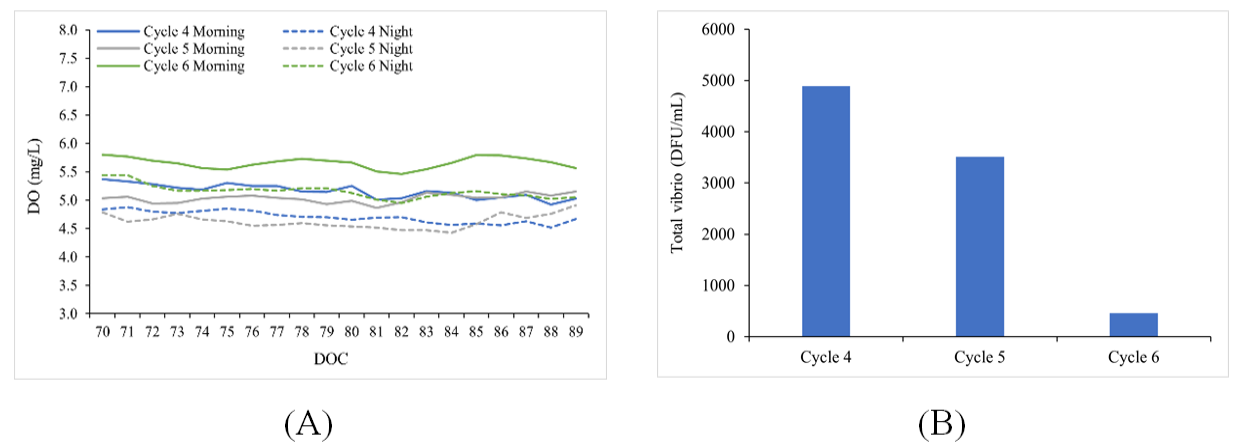
Dissolved oxygen levels also displayed notable fluctuations, particularly between early morning and daytime observations (Figure 2). Morning DO reductions in some sampling periods indicate oxygen depletion caused by nighttime respiratioen of plankton and microbial communities, a common phenomenon in ponds with high organic matter accumulation. Conversely, increased DO during daytime corresponds to phytoplankton photosynthesis, which enhances oxygen availability. These dynamics highlight the strong coupling between biological activity and oxygen balance in shrimp culture ponds .
Microbial monitoring revealed variability in total Vibrio abundance across ponds and production cycle phases (Table 2). Elevated Vibrio counts during certain periods are commonly associated with increased organic matter, feed residues, and unstable
Table 2: Distribution of Vibrio counts observed during shrimp culture cycles.
|
DOC |
Total vibrio (DFU/mL) Cycle 4 |
|||||||||
|
Pond 1 |
Pond 2 |
Pond 3 |
Pond 4 |
Pond 5 |
Pond 6 |
Pond 7 |
Pond 8 |
Pond 9 |
Pond 10 |
|
|
9 |
100 |
125 |
415 |
230 |
|
|
|
|
|
|
|
23 |
4040 |
10300 |
2270 |
9530 |
800 |
8320 |
1520 |
3090 |
2780 |
1670 |
|
35 |
6340 |
2140 |
3850 |
2500 |
2070 |
6700 |
7960 |
3880 |
12590 |
3320 |
|
39 |
2910 |
8870 |
1360 |
1580 |
2280 |
5580 |
4030 |
12350 |
5450 |
3200 |
|
46 |
5070 |
7550 |
7000 |
12930 |
5830 |
4150 |
5070 |
7080 |
3990 |
7590 |
|
54 |
9220 |
5340 |
8600 |
9280 |
10080 |
7820 |
7580 |
1480 |
3940 |
9280 |
|
60 |
6700 |
3480 |
3040 |
400 |
380 |
2560 |
4620 |
2180 |
980 |
2880 |
|
65 |
4850 |
7180 |
2110 |
830 |
1370 |
5480 |
1700 |
1950 |
3460 |
2020 |
|
73 |
10730 |
4050 |
3830 |
4600 |
6190 |
7800 |
3170 |
5350 |
2920 |
3550 |
|
79 |
5590 |
2550 |
3080 |
2590 |
5210 |
3930 |
6250 |
4020 |
4820 |
9400 |
|
87 |
8780 |
7350 |
6700 |
4540 |
2860 |
3500 |
4450 |
9340 |
4990 |
3700 |
|
93 |
6620 |
8530 |
7170 |
5080 |
4910 |
6350 |
3520 |
6300 |
7420 |
8180 |
|
99 |
5460 |
4940 |
6400 |
3230 |
2370 |
4240 |
3730 |
5160 |
5030 |
4710 |
|
DOC |
Total vibrio (DFU/mL) Cycle 5 |
|||||||||
|
Pond 1 |
Pond 2 |
Pond 3 |
Pond 4 |
Pond 5 |
Pond 6 |
Pond 7 |
Pond 8 |
Pond 9 |
Pond 10 |
|
|
17 |
620 |
1495 |
1025 |
1485 |
595 |
1385 |
12 |
|
|
|
|
26 |
1330 |
2010 |
1580 |
670 |
1210 |
200 |
1810 |
1230 |
1310 |
80 |
|
36 |
4460 |
950 |
3360 |
2800 |
1210 |
1760 |
1000 |
780 |
2130 |
910 |
|
45 |
12840 |
13990 |
9880 |
6650 |
5910 |
3940 |
4710 |
8470 |
5030 |
2130 |
|
53 |
9330 |
7590 |
9190 |
9140 |
4810 |
3080 |
6660 |
2390 |
2460 |
690 |
|
66 |
7900 |
7040 |
7620 |
4960 |
0 |
5840 |
10160 |
8860 |
11780 |
5050 |
|
85 |
2580 |
3660 |
2900 |
2620 |
2730 |
1460 |
1340 |
300 |
2250 |
260 |
|
98 |
770 |
3260 |
910 |
620 |
970 |
920 |
2530 |
1010 |
590 |
3350 |
|
DOC |
Total vibrio (DFU/mL) Cycle 6 |
|||||||||
|
Pond 1 |
Pond 2 |
Pond 3 |
Pond 4 |
Pond 5 |
Pond 6 |
Pond 7 |
Pond 8 |
Pond 9 |
Pond 10 |
|
|
15 |
100 |
|
10 |
|
|
|
820 |
660 |
|
10 |
|
27 |
30 |
510 |
790 |
60 |
920 |
1520 |
1290 |
220 |
1560 |
1110 |
|
43 |
690 |
10 |
520 |
840 |
190 |
290 |
50 |
1040 |
50 |
0 |
|
50 |
240 |
120 |
70 |
0 |
10 |
150 |
260 |
100 |
750 |
10 |
|
88 |
800 |
740 |
60 |
30 |
650 |
460 |
350 |
60 |
750 |
470 |
|
111 |
780 |
610 |
380 |
800 |
900 |
600 |
510 |
490 |
100 |
290 |
water quality, which create favorable conditions for opportunistic bacteria. The observed Vibrio dynamics align with previous studies indicating that microbial populations in shrimp ponds are closely linked to environmental parameters and nutrient enrichment ; . These fluctuations emphasize the importance of continuous microbial surveillance in intensive Litopenaeus vannamei farming to prevent disease outbreaks.
Plankton composition varied markedly throughout the culture period, with shifts in dominant phytoplankton groups reflecting changing nutrient conditions and pond trophic status (Table 3). The occurrence of green algae and blue-green algae indicates nutrient-rich environments typical of shrimp ponds receiving regular feed inputs. While moderate phytoplankton presence supports natural food availability and oxygen production, excessive blooms may destabilize water quality and increase bacterial proliferation . Therefore, plankton dynamics serve as both ecological indicators and management signals in pond-based shrimp culture.
Table 3: Distribution of dominant plankton groups observed during shrimp culture cycles.
|
Class |
Percentage |
Type |
Abundance (x10⁴) |
|
Cycle 4 |
|||
|
Green alga |
54% |
Chlorela |
46 |
|
Blue green alga |
25% |
Psudonabaena |
17 |
|
Anabaena |
3 |
||
|
Oscilatoria |
1 |
||
|
Dinoflagelata |
14% |
Gymnodinium |
1 |
|
Lepidodinium |
10 |
||
|
Heterocapsa |
1 |
||
|
Diatome |
6% |
Melosira |
2 |
|
Cyclotela |
3 |
||
|
Etc |
0% |
||
|
Protozoa |
1 |
Euglena |
1 |
|
Density |
85 |
||
|
Cycle 5 |
|||
|
Green alga |
14% |
Chlorela |
5 |
|
Dunalaila |
1 |
||
|
Oocystis |
1 |
||
|
Blue green alga |
65% |
Psudonabaena |
26 |
|
Oscilatoria |
4 |
||
|
Microcystis |
1 |
||
|
Anabaena |
1 |
||
|
Dinoflagelata |
6% |
Gymnodinium |
1 |
|
Peridinium |
1 |
||
|
Hemidinium |
1 |
||
|
Diatome |
10% |
Melosira |
5 |
|
Etc |
0% |
||
|
Protozoa |
2 |
Uronychia |
1 |
|
Ciliata |
1 |
||
|
Density |
49 |
||
|
Cycle 6 |
|||
|
Green alga |
17% |
Chlorela |
7 |
|
Dunalaila |
1 |
||
|
Blue green alga |
30% |
Psudonabaena |
13 |
|
Oscilatoria |
1 |
||
|
Dinoflagelata |
11% |
Gyrodinium |
1 |
|
Gymnodinium Paradoxum |
1 |
||
|
Heterosigma Akhasiwo |
3 |
||
|
Diatome |
24% |
Biddulphia |
11 |
|
Etc |
13% |
Astasia |
3 |
|
Cryptomonas |
3 |
||
|
Protozoa |
2 |
Uronychia |
1 |
|
Vorticela |
1 |
||
|
Density |
46 |
||
Overall, the combined physicochemical, microbial, and plankton data demonstrate that shrimp ponds function as complex and fluctuating agro-aquatic ecosystems. Variability in water quality across production cycle phases is not merely incidental but reflects biological feedback processes inherent to L. vannamei pond farming. These findings reinforce that maintaining pond stability requires continuous monitoring and adaptive management to balance nutrient input, plankton growth, and microbial load ; .
Conclusions and Recommendations
The monitoring data demonstrated that pond ecosystems used for the culture of Litopenaeus vannamei experienced continuous and interconnected fluctuations in physicochemical and biological parameters throughout the production cycle phases. Variations in pH and dissolved oxygen reflected the metabolic activities of plankton communities and the accumulation of organic matter typical of shrimp ponds. Shifts in plankton composition and periodic increases in Vibrio abundance indicated that ecological instability can emerge even under routine pond management. These findings confirm that water quality dynamics are closely linked to biological processes within shrimp ponds and highlight the importance of integrated ecological monitoring to maintain a balanced culture environment. Based on these observations, it is recommended that shrimp pond management incorporate routine assessment of both physicochemical and microbial indicators to anticipate ecological shifts that may compromise pond stability. Early detection of plankton blooms and elevated Vibrio levels should be used as practical warning signals for implementing corrective measures such as aeration adjustment, water exchange, and organic load control. Furthermore, standardized documentation of water quality and biological monitoring across production cycle phases is essential to support adaptive management and improve sustainability in pond-based Litopenaeus vannamei aquaculture systems. These findings emphasize that routine and continuous ecological monitoring is a key requirement for adaptive management in intensive shrimp aquaculture, enabling early detection of unfavorable environmental trends and supporting sustainable production performance.
Acknowledgements
The authors gratefully acknowledge the support provided by the Postgraduate school University of Brawijaya, for facilitating this research.
Novelty Statement
This study provides a temporally integrated ecological assessment of intensive Litopenaeus vannamei pond systems by simultaneously tracking physicochemical dynamics, microbial indicators (including Vibrio abundance), and plankton community shifts across consecutive production phases. Unlike previous studies that often evaluate these components in isolation or at single time points, this research captures their synchronized temporal variability within operational ponds. The findings offer novel insights into how short-term ecological fluctuations reflect underlying nutrient dynamics and organic matter accumulation, strengthening the ecological basis for adaptive water quality management in intensive shrimp aquaculture systems.
Authors’ Contribution
Aryani Rahmawati: Performing the research, formal analysis of the data, wrote the original manuscript draft.
Asep Awaludin Prihanto: Led the conceptualization of the research, contributed to the methodology, reviewing and editing the manuscript,reviewed the final manuscript for publication.
Moh. Khusaini: Academic supervision, assisted in data handling and interpretation.
Anthon Efani: Contributed to the formal analysis of the data, and reviewed the final manuscript.
Generative AI and AI-assisted technology statement
The authors declare that no generative AI and AI assisted technology was used in the creation of this manuscript.
Conflict of interest
The authors have declared no conflict of interest.
Figures
Daily fluctuations of pH (morning and afternoon) in Litopenaeus vannamei ponds during production cycle phases.
Variations in dissolved oxygen (A) and Vibrio abundance (B) in shrimp ponds across production cycle phases.
References
- Anh, P.T., C. Kroeze, S.R. Bush and A.P.J. Mol. 2010. Water pollution by intensive brackish shrimp farming in south-east Vietnam: Causes and options for control. Agric. Water Manag., 97(6): 872-882. https://doi.org/10.1016/j.agwat.2010.01.018[CrossRef]
- Araujo, A.N., C.F. San Andres, K.Q. Nguyen., T.L. Corby, M.A. Rhodes, J.C. Garcia, L.A. Roy, J. Stoeckel and D.A. Davis. 2025. Effects of minimum dissolved oxygen setpoints for aeration in semi-intensive pond production of Pacific white shrimp (Litopenaeus vannamei). Aquaculture, 594: 741376. https://doi.org/10.1016/j.aquaculture.2024.741376[CrossRef]
- Avnimelech, Y. 1999. Carbon/nitrogen ratio as a control element in aquaculture systems. Aquaculture., 176(3-4):227-235. https://doi.org/10.1016/S0044-8486(99)00085-X[CrossRef]
- Boyd, C.E., and C.S. Tucker. 2012. Pond aquaculture water quality management. Springer, New York.
- Burford, M.A., P.J. Thompson, R.P. McIntosh, R.H. Bauman and D.C. Pearson. 2003. Nutrient and microbial dynamics in high-intensity shrimp ponds. Aquac., 219(1-4): 393-411. https://doi.org/10.1016/S0044-8486(02)00575-6[CrossRef]
- Costa-Pierce, B.A., F. Chopin, S. Robinson, R. Neori, A.H. Buschmann and I. Fang. 2019. Sustainability of integrated multi-trophic aquaculture. Rev. Aquac., 11(1): 1-22.
- De Schryver, P. and O. Vadstein. 2014. Ecological theory as a foundation to control pathogenic invasion in aquaculture. ISME J., 8(12): 2360-2368. https://doi.org/10.1038/ismej.2014.84[CrossRef]
- Edwards, P. 2015. Aquaculture environment interactions: Past, present and likely future trends. Aquac., 447: 2-14. https://doi.org/10.1016/j.aquaculture.2015.02.001[CrossRef]
- Emerenciano, M., G. Gaxiola and A. Cuzon. 2017. Biofloc technology (BFT): A review for aquaculture application and animal food industry. Biomass Bioener., 99: 42-52.
- Hasan, M.R. and M.B. New. 2013. On-farm feeding and feed management in aquaculture. FAO Fish. Aquac. Tech. Pap., 583: 1-67.
- Hu, Z., J.W. Lee, K. Chandran, S. Kim and P.L. Sharma. 2015. Influence of microbial communities on shrimp pond stability. Aquac. Res., 46(7): 1722-1734.
- Krummenauer, D., F. Poersch, M. Cavalli and W. Wasielesky. 2014. Superintensive culture of white shrimp in biofloc systems. Aquac. Eng., 59:35-39.
- Lancelot, C., and S. Mathot. 1987. Dynamics of phytoplankton in nutrient-rich waters. Mar. Ecol. Prog. Ser., 40: 197-204.
- Lin, Y.C., and J.C. Chen. 2001. Acute toxicity of ammonia on shrimp in relation to salinity. J. Exp. Mar. Biol. Ecol., 259(1): 109-119. https://doi.org/10.1016/S0022-0981(01)00227-1[CrossRef]
- Liu, K.F., H.C. Chuang and C.S. Chen. 2018. Diurnal variations of dissolved oxygen and pH in shrimp ponds. Aquac. Environ. Interact., 10: 155-164.
- Paez-Osuna, F. 2001. The environmental impact of shrimp aquaculture. Environ. Manag., 28(1): 131-140. https://doi.org/10.1007/s002670010212[CrossRef]
- Nguyen, K.A.T., T.T.H. Nguyen, H.V. Tran and M.C.J. Verdegem. 2022. Production performance and sustainability of shrimp farming systems. Aquac. Rep., 22: 100955.
- Primavera, J.H., M.J.H. Lebata, H.L. Altamirano and J.P. Faye. 2018. Mangroves and aquaculture: A re-examination of blue revolution. Ocean Coast., Manag., 152: 1-7.
- Ray, A.J., K.S. Dillon and J.M. Lotz. 2010. Water quality dynamics in intensive shrimp ponds. Aquac., 300(1-4): 15-21.
- Samocha, T.M., A.L. Lawrence and J.P. Jones. 2004. Sustainable shrimp farming in ponds. Aquac. Res., 35(1): 10-20.
- Tacon, A.G.J., M.R. Hasan and R.P. Subasinghe. 2020. Global overview of shrimp aquaculture. Rev. Fish. Sci. Aquac., 28(3): 290-308.
- Wasielesky, W., D. Atwood, A. Stokes and C.L. Browdy. 2013. Effect of natural productivity on shrimp ponds. Aquac. Res., 44(2): 318-327.
- Xiong, J. 2018. Progress in the gut microbiota in shrimp aquaculture. Aquaculture., 495:368-374.
- Zhang, M., L. Sun, S. Liu and J. Qiu. 2016. Microbial community dynamics in shrimp ponds. Aquac., 455: 9-17.
- Zhang, W., Y. Liu, J. Tian, H. Wang and S. Zhang. 2019. Growth performance and environmental effects of intensive shrimp farming. Aquac. Res., 50(9): 2478-2489.
Services
Article usage statistics
Loading…