
Using a conventional polymerase chain reaction (PCR) approach, this dataset documents the molecular identification and confirmation of chicken DNA in commercial sausage products labelled for sale in Sabah, Malaysia. The objective of this study was to evaluate the yield and quality of genomic DNA extracted from processed chicken sausages, amplify species-specific mitochondrial DNA fragments, and determine the analytical specificity and sensitivity of the PCR assay. The abundant concentration of extracted DNA showed adequate purity and concentration for downstream amplification, and the yield was between 21.82 ± 0.41 and 243.10 ± 1.30 ng/µL. However, statistical analysis revealed significant differences (p < 0.05) among samples utilizing one-way ANOVA and Tukey’s HSD test, which is likely due to variations in processing conditions and formulations between brands of sausages examined. Amplification for chicken DNA was achieved using species-specific primer sets for the 183 bp region of the mitochondrial gene. No cross-reactivity was seen with bovine and porcine DNA, which indicated that the assay had high specificity. Analytical sensitivity testing determined a limit of detection of 0.5 ng/µL; screening results for eleven samples of commercial chicken sausage detected chicken DNA in all tested products. The conventional PCR protocol successfully amplified both pellets with clear and reproducible bands, showing good performance over processed meat matrices. These results confirm the robustness, specificity, and sensitivity of this method for species authentication. The dataset serves as a realistic reference for food authenticity validation and enables the regular configuration of PCR-based methods for food safety monitoring and quality assurance.
Special Issue: Innovations in Sustainable Fisheries, Marine Resources, and Food Systems for Food Security and Human Well-being · Volume 42, Issue 2, 19 October 2026 · Open Access
Molecular Detection and Verification of Chicken DNA in Commercial Processed Sausages from Sabah, Malaysia Using Conventional PCR
· · · · ·
Affiliations & Notes ⌄
- 1Faculty of Food Science and Nutrition, Universiti Malaysia Sabah, Jalan UMS, 88400 Kota Kinabalu, Sabah, Malaysia
- 2Halal Research Group, Faculty of Food Science and Nutrition, Universiti Malaysia Sabah, Jalan UMS, 88400 Kota Kinabalu, Sabah, Malaysia
- 3Halal Service and Research Centre, Faculty of Food Science and Nutrition, Universiti Malaysia Sabah, Jalan UMS, 88400 Kota Kinabalu, Sabah, Malaysia
- 4Borneo Research on Algesia, Inflammation and Neurodegeneration (BRAIN) Group, Faculty of Medicine and Health Sciences, Universiti Malaysia Sabah, Jalan UMS, 88400 Kota Kinabalu, Sabah, Malaysia
- 5Food Security Research Laboratory, Faculty of Food Science and Nutrition, Universiti Malaysia Sabah, Jalan UMS, 88400 Kota Kinabalu, Sabah, Malaysia
- 6Nutrition in Community Engagement (NICE) Living Lab, Faculty of Food Science and Nutrition, Universiti Malaysia Sabah, Jalan UMS, 88400 Kota Kinabalu, Sabah, Malaysia
- 7Fishery Product Technology, Faculty of Fisheries and Marine Science, Universitas Brawijaya, Malang 65145, Indonesia
- 8Coastal and Marine Research Center, Universitas Brawijaya, Malang 65145, Indonesia. , *Correspondence | Abdul Aziz Jaziri, Fishery Product Technology, Faculty of Fisheries and Marine Science, Universitas Brawijaya, Malang 65145, Indonesia
- 9Email: azizjaziri@ub.ac.id
Article Info ⌄
- Journal:
- Sarhad Journal of Agriculture
- Published:
- 19 October 2026
From the article
- This study demonstrated that conventional PCR targeting a 183 bp fragment of the mitochondrial 12S rRNA gene is applicable for the qualitative detection of chicken DNA in commercially processed sausage products marketed in Sabah, Malaysia.
- The extracted DNA was suitable for PCR amplification, and the chicken-specific primers showed good specificity without cross-reactivity with beef or pork DNA under the tested conditions.
- The assay detected chicken DNA down to 0.5 ng/µL and confirmed the presence of chicken DNA in all 11 tested commercial sausage samples, indicating consistency between product labels and molecular detection results.
Selected from the article's own text.
Abstract
Introduction
Species authentication of meat in processed foods is a major issue for food safety, economic integrity, and compliance with religious regulations. Worldwide reports have described fraudulent practices of replacing meat with cheaper species or undeclared cross-contamination, leading to concerns regarding quality control, labelling accuracy, and halal compliance . Processed meat products, including sausages, are especially susceptible to species even after confirmation through comminution, mixing, and the addition of additives that prevent morphological identification . As a result, reliable molecular methods are needed to validate the declared species composition, particularly in multi-ethnic regions like Sabah, Malaysia, which is recognized for dietary practices associated with religious observance.
DNA-based methods, especially polymerase chain reaction (PCR), are well recognized for species identification because of their high specificity and sensitivity among various analytical applications . Compared to protein-based methods, such as ELISA or electrophoresis, DNA markers are generally more stable under thermal processing conditions, making them more applicable for the detection of species in cooked and highly processed meat . PCR-based assays have been shown to detect low levels of adulteration (less than 0.1%) in raw or heat-treated meat matrices . These features render conventional PCR a reliable and economical method for routine food authentication, especially in regulatory and halal compliance applications.
Nonetheless, there are technical issues that may prevent PCR detection in processed products due to processes such as heat treatment, pH alteration, pressure, and other characteristics of the ingredients. Under high temperatures, particularly when coupled with acidic conditions, DNA fragmentation may occur, potentially influencing both the amplification efficiency and detection limits. Nevertheless, prior studies have shown amplification of species-specific DNA following severe heat treatment when suitable extraction and matching primer systems are used ; Yusof et al., 2022; . These results underscore the critical need to validate PCR-based detection under relevant industrial processing conditions to ensure analytical robustness.
Although conventional PCR remains one of the most widely applied approaches for meat species authentication because of its simplicity, specificity, and low operational cost, several advanced molecular techniques have recently been developed to improve their analytical performance. Quantitative real-time PCR (qPCR) offers higher sensitivity, lower detection limits, and the ability to quantify target DNA, making it particularly useful for detecting low-level adulteration and cross-contamination in processed foods. Multiplex PCR further increases analytical efficiency by enabling the simultaneous detection of multiple animal species in a single reaction, thereby reducing both the analysis time and reagent consumption ; . Recently, next-generation sequencing (NGS) and DNA metabarcoding approaches have emerged as powerful tools for comprehensive species identification in complex food matrices, including products containing multiple animal ingredients . However, despite their analytical advantages, these advanced methods often require expensive instrumentation, specialized expertise, and higher operational costs, which may limit their routine implementation in regulatory laboratories and resource-constrained settings. Consequently, conventional PCR remains a practical and accessible method for routine food authenticity verification and halal surveillance programs, particularly in developing regions.
While species-specific chicken DNA detection using conventional PCR has been reported previously, most studies have focused on method development, assay validation, or controlled laboratory experiments involving artificially prepared meat mixtures. In contrast, limited information is available on the application of validated molecular authentication methods to commercially available processed meat products in regional retail markets, particularly in Sabah, Malaysia. To the best of our knowledge, no study has systematically evaluated the authenticity of commercial chicken sausage products marketed in Sabah using molecular verification techniques. Therefore, the novelty of the present study lies not only in the application of a validated conventional PCR assay targeting a short mitochondrial 12S rRNA fragment suitable for processed meat matrices but also in the generation of the first region-specific baseline dataset for chicken sausage authentication in Sabah. These findings provide valuable evidence for food authenticity monitoring, halal verification, regulatory surveillance, and consumer protection initiatives in Southeast Asian markets.
Materials and Methods
Test and control samples
The samples were classified as either test or control. The control samples consisted of raw chicken, beef, and pork. Raw chicken meat was used as a positive control, and raw beef and pork meat were used as negative controls. The test samples consisted of eleven commercial chicken sausage products representing different commercially available products in the surveyed retail market. The samples were purposively selected based on the following criteria: products labelled as chicken sausage, available at the time of sampling, and obtained from local supermarkets around Kota Kinabalu, Sabah, Malaysia, and food premises within Universiti Malaysia Sabah. The actual commercial Brand A names were anonymized and coded as Brand A–H and Brand X–Z to maintain commercial confidentiality and to avoid brand-specific comparison, endorsement, or reputational implication. The samples were kept at −20 °C until DNA extraction to minimize DNA degradation and meat spoilage.
DNA extraction
Genomic DNA was extracted from the samples using the DNeasy Mericon Food Kit (Qiagen, Hilden, Germany). Approximately 200 mg of the equivalent homogenized sample was combined in a 2 mL microcentrifuge tube containing 1 mL lysis buffer for food and 2.5 μL Proteinase K solution. The solution was vortexed and incubated in a water bath at 60 °C while shaking (1000 rpm) for 30 min. After centrifugation at 2500 ×g for 5 min, 500 μL of chloroform was added to a new microcentrifuge tube. The supernatant was transferred to a chloroform tube without disturbing the pellet. Subsequently, after vortexing and centrifugation, the supernatant was transferred to a new tube and mixed (ratio 1:3) with buffer PB and ethanol. The mixture was loaded onto a QIAquick spin column and centrifuged. The flow-through was discarded, and the column was washed with buffer AW2. Following drying, the DNA was eluted with buffer EB and stored at –20 °C prior to polymerase chain reaction (PCR) analysis.
Oligonucleotide primer design
PCR amplification was performed using a chicken-specific primer pair targeting the mitochondrial 12S rRNA gene region, as previously described by Ghovvati et al. (2009). The primer sequences were reviewed and are presented consistently in the 5′–3′ orientation as follows: forward primer 5′-TGA GAA CTA CGA GCA CAA AC-3′ and reverse primer 5′-GGG CTA TTG AGC TCA CTG TT-3′. The expected amplicon size of chicken DNA was 183 bp.
DNA extract analysis
The quantity and quality of DNA were determined with a spectrophotometer (NanoDrop 2000/2000c, Thermo Fisher Scientific, Waltham, MA, USA). The amount of DNA was determined based on the absorbance at A260, and the quantity of measured DNA was reported in ng/μL . In addition, DNA extraction quality was assessed based on the A260/280 and A230/280 ratios using the same instrument. For good quality DNA, the A260/280 and A230/280 ratio readings should be in the range of 1.7–2.0 and 1.95–2.76 , respectively.
DNA amplification
Mitochondrial 12S rRNA gene amplification was performed as described by Bottaro et al. (2014) for a total of 25 μL volume consisting of 2x PCR Master Mix (50 units/mL Taq DNA Polymerase in proprietary reaction buffer pH 8.5, dATP, dGTP, dCTP, and dTTP at 400 μM each and MgCl2 at the final concentration of 3 mM), 5 μL from both forward and reverse primers (10 pmol dilution for each primer), and nuclease-free water (Thermo Fisher Scientific; Loughborough, UK). PCR amplification was performed on a thermal cycler (Applied Biosystems, Thermo Fisher Scientific) using the following PCR cycling program: initial denaturation at 95 °C for 3 min to fully denature the DNA template, followed by 35 cycles of denaturation at 95 °C for 30 s, annealing at 60 °C for 30 s, and extension at 72 °C for 1 min. A final extension step was performed for 7 min at 72 °C, followed by completion cycles to finalize the synthesis of DNA extensions.
Specificity and sensitivity test
Amplified DNA products obtained from control samples (beef, chicken, and pork meat) were used to test the specificity of the primers, with 5 µL of each DNA sample included in the amplification. PCR was performed using chicken-specific primers, and the products were analyzed by gel electrophoresis. To test sensitivity, multiple dilution series (100, 50, 10, 5 ng/µL chicken DNA; 1 ng/µL chicken DNA; 0.5 ng/µL chicken DNA; and 0.1ng/μl chicken DNA) generated from the prepared cDNA were employed in accordance with the study by Kesmen et al. (2013). Dilution series PCR was performed, and the products were analyzed using gel electrophoresis. For the test sample analysis, DNA was extracted from the chicken sausage products and amplified, and gel electrophoresis was used to analyze each PCR product.
Agarose gel electrophoresis method
Analysis of the PCR products was performed by a 2% agarose gel electrophoresis method as described by Jasbeer et al. (2009). The gel was prepared by mixing 0.6 g of agarose powder (Sigma-Aldrich, St. Louis, MO, USA) with 30 mL of 1X TAE buffer (8.0 pH) (Invitrogen, Thermo Fisher Scientific). The mixture was then heated until complete homogeneity and dissolution were achieved. After cooling to ∼55 °C, 6 μL of FloroSafe DNA Stain (1st BASE, Axil Scientific, Singapore) was added and thoroughly mixed until the solution became homogeneous before being poured into a gel mold. A comb was then inserted, and the gel was allowed to harden for ~ 15 min. After comb removal from the solidified gel, 5 μL of a 100 bp DNA Ladder (ExcelBand, SMOBio, Taiwan) was pipetted into the first lane of the gel. Next, each sample with 2 μL of loading dye (Promega, Madison, WI, USA) was added to the following lanes on the gel at 5 μL. Electrophoresis was performed at 85 V for 30 min. The PCR profiles were analyzed using a gel electrophoresis documentation system (Bio-Rad, Hercules, CA, USA).
Statistical analysis
Spectrophotometric measurements of DNA concentration and purity were used to evaluate the suitability of the extracted DNA for downstream PCR amplification. DNA extraction and PCR amplification were not conducted as independent triplicate experiments, and spectrophotometric measurements were not used as independent triplicate data for inferential statistical analysis. Therefore, no one-way ANOVA or Tukey’s HSD test was applied to the DNA concentration and purity data. PCR specificity, sensitivity, and commercial sample screening were qualitatively interpreted based on the presence or absence of the expected 183 bp amplification band after agarose gel electrophoresis.
Table 1: Concentration and purity of extracted DNA obtained from raw meat (control sample) and chicken sausage products (test sample).
|
Sample |
Label |
DNA purity (ng/µL) |
A260/280 |
A260/230 |
|
Raw meats |
Pork |
122.30 ± 0.10 h |
1.92 ± 0.01 abc |
1.95 ± 0.01 c |
|
Chicken |
114.60 ± 0.20 i |
1.94 ± 0.01 a |
1.95 ±0.02 c |
|
|
Beef |
93.60 ± 0.10 j |
1.90 ± 0.01 abcd |
1.96 ±0.01 c |
|
|
Chicken sausage products |
Brand A |
243.10 ± 1.30 a |
1.93 ± 0.04 ab |
2.03 ± 0.03 b |
|
Brand B |
177.54 ± 1.49 d |
1.91 ± 0.02 abc |
1.96 ± 0.01 c |
|
|
Brand C |
186.73 ± 0.30 c |
1.88 ± 0.01 cd |
2.17 ± 0.03 a |
|
|
Brand D |
174.91 ± 0.31 e |
1.90 ± 0.01 abcd |
2.18 ± 0.01 a |
|
|
Brand E |
146.47 ± 0.60 f |
1.90 ± 0.01 abc |
1.88 ± 0.01 d |
|
|
Brand F |
129.04 ± 0.14 g |
1.88 ± 0.01 cd |
2.03 ± 0.03 b |
|
|
Brand G |
127.93 ± 0.42 g |
1.89 ± 0.01 bcd |
1.88 ± 0.01 d |
|
|
Brand H |
59.58 ± 0.67 k |
1.84 ± 0.02 ef |
1.62 ± 0.01 e |
|
|
Brand X |
21.82 ± 0.41 l |
1.80 ± 0.01 f |
1.95 ± 0.01 c |
|
|
Brand Y |
241.85 ± 0.38 a |
1.88 ± 0.01 cd |
2.06 ± 0.01 b |
|
|
Brand Z |
208.13 ± 0.10 b |
1.86 ± 0.01 de |
1.97 ± 0.01 c |
Results and Discussion
DNA yield of chicken sausage
The concentrations and purities of the DNA extracted from raw meat controls and commercial chicken sausage products are shown in Table 1. The DNA concentration of the sausage samples ranged from 21.82 ± 0.41 to 243.10 ± 1.30 ng/µL. Among the commercial sausage samples, Brand A showed the highest DNA concentration, whereas Brand X showed the lowest. The raw meat controls also produced measurable DNA concentrations, with pork, chicken, and beef yielding 122.30 ± 0.10, 114.60 ± 0.20, and 93.60 ± 0.10 ng/µL, respectively. These results indicate that DNA can be successfully extracted from both raw meat and processed sausage products.
The differences in DNA yield among the sausage samples may be related to differences in the formulation and processing conditions. Commercial sausages may contain different proportions of meat, fat, binders, fillers, spices, curing agents, and additives. In addition, heat treatment, grinding, and emulsification during sausage processing may cause DNA fragmentation and reduce the DNA recovery. Therefore, the variation in DNA concentration should not be interpreted only as a difference in chicken content but also as the effect of matrix composition and processing intensity. Similar findings have been reported in previous studies, where processing conditions affected DNA integrity, although short mitochondrial DNA fragments could still be amplified in processed meat products ; .
DNA purity was evaluated using the A260/280 and A260/230 ratios. The A260/280 values ranged from 1.80 ± 0.01 to 1.94 ± 0.01, indicating that the extracted DNA was suitable for PCR amplification. The A260/230 values ranged from 1.62 ± 0.01 to 2.18 ± 0.01. Lower A260/230 values in some samples may indicate the presence of residual salts, lipids, carbohydrates, or other compounds from the sausage ingredients. These substances are commonly found in processed meat products and may influence the DNA purity. However, successful PCR amplification in subsequent analyses showed that the extracted DNA was suitable for molecular detection. Similar observations have been reported in processed meat authentication studies, where minor variations in spectrophotometric purity did not prevent PCR amplification when short mitochondrial targets were used .
The DNA concentration and purity results demonstrated that the extraction method was adequate for commercial chicken sausage samples. These data are useful for confirming that the extracted DNA was of sufficient quality for downstream PCR analysis. However, DNA concentration data were interpreted descriptively and not used to determine the actual proportion of chicken meat in the products. Conventional PCR can confirm the presence or absence of chicken DNA, but it cannot quantify the adulteration levels or meat percentage. Therefore, quantitative methods, such as real-time PCR or other advanced molecular approaches, may be required when precise quantification is needed . Nevertheless, the successful extraction of amplifiable DNA from all sausage samples supports the practical use of conventional PCR as a simple and accessible method for preliminary halal verification and food authenticity assessment.
DNA detection in the selected meat samples
The specificity of the chicken-specific primer was evaluated using chicken DNA as the target species, and beef and pork DNA were used as non-target controls. As shown in Figure 1, a clear amplification band at 183 bp was observed only in the chicken sample, whereas no amplification was detected in the beef and pork samples. This result confirmed that the primer pair specifically amplified chicken mitochondrial DNA without cross-reactivity with the tested non-target species.
The 183 bp amplicon size is suitable for processed meat authentication because DNA in processed products is often fragmented due to heat treatment, grinding, curing, and other processing conditions. Short mitochondrial DNA targets are generally more stable and easier to amplify than longer fragments in degraded samples. Previous studies have also reported that mitochondrial markers are effective for species identification in raw and cooked meat products, even after processing-induced DNA degradation ; . Therefore, the specificity results support the use of this primer for chicken DNA detection in processed meat matrices.
This finding is relevant for halal authentication and food authenticity monitoring because the assay can distinguish chicken DNA from beef and pork DNA under the tested conditions. However, conventional PCR is a qualitative method. It can confirm the presence or absence of target DNA but cannot quantify the proportion of chicken meat, determine adulteration levels, or differentiate trace contamination from intentional substitutions. In highly processed products, DNA degradation and PCR inhibitors, such as fat, salts, spices, preservatives, and additives, may also affect amplification efficiency. Therefore, confirmatory or quantitative methods, such as real-time PCR, digital PCR, sequencing, or validated multiplex PCR, may be required for regulatory cases involving low-level adulteration or quantitative assessment. Nevertheless, conventional PCR remains a practical, accessible, and cost-effective preliminary screening tool for routine halal verification, food quality control, and regulatory monitoring .
Detection limit of the chicken’s DNA
The sensitivity of the conventional PCR assay was evaluated using serial dilutions of chicken DNA (Figure 2). Clear amplification bands with the expected size of 183 bp were observed from 100 ng/µL to 0.5 ng/µL concentrations. The band intensity gradually decreased as the DNA concentration was reduced, indicating that the PCR amplification efficiency was influenced by the template availability. No visible band was observed at 0.1 ng/µL; therefore, the limit of detection (LOD) under the experimental conditions of this study was determined to be 0.5 ng/µL.
The LOD obtained in this study was consistent with the sensitivity range commonly reported for endpoint PCR assays targeting mitochondrial DNA. Mitochondrial markers are suitable for species authentication because they are present in multiple copies and remain detectable even when DNA is partially degraded. Previous studies have reported that PCR-based assays can detect animal DNA in raw and cooked meat products, although processing conditions such as heating, grinding, and curing may reduce DNA integrity and amplification efficiency ; . The successful detection of chicken DNA down to 0.5 ng/µL suggests that the selected 183 bp mitochondrial target is sufficiently short and stable for application in processed sausage matrices.
Although the sensitivity of conventional PCR is lower than that of more advanced methods, such as real-time PCR or isothermal amplification, it remains useful for qualitative screening. For example, recombinase polymerase amplification combined with lateral flow detection has been reported to detect animal DNA at lower concentrations, such as 0.01 ng/µL, depending on the target and the assay design . However, conventional PCR offers a simpler and more accessible approach for routine laboratory use. Its main limitation is that it only confirms the presence or absence of target DNA and does not quantify the adulteration levels. Therefore, for regulatory purposes requiring quantitative detection or confirmation of low-level adulteration, real-time PCR, digital PCR, or other validated molecular methods may be required.
The sensitivity results indicated that the developed conventional PCR assay could reliably detect chicken DNA at concentrations ≥0.5 ng/µL under the tested conditions. This level of sensitivity is adequate for preliminary species authentication and food labelling verification in processed meat products, provided that the extracted DNA has acceptable quality and is not strongly affected by PCR inhibitors.
DNA analysis of the tested chicken sausage
Eleven commercial chicken sausage samples were analyzed using conventional PCR with chicken-specific primers. As shown in Figure 3, all samples produced a clear amplification band at 183 bp, corresponding to the target mitochondrial 12S rRNA gene fragment. The presence of a single, sharp band without non-specific amplification indicates good primer specificity and suitable DNA template quality. The use of a 100 bp DNA ladder further confirmed that the amplified fragments matched the expected size.
All tested sausage samples were positive for chicken DNA, indicating that the species declared on the product labels was consistent with the PCR results. This finding also confirms that the selected mitochondrial marker is suitable for detecting chicken DNA in commercially processed sausage products. Mitochondrial DNA is commonly used for species authentication because of its high copy number and better stability in processed matrices than nuclear DNA. Previous studies have also shown that mitochondrial targets, including cytochrome b and 12S rRNA genes, can remain amplifiable in raw and cooked meat products despite processing-induced DNA degradation ; .
Although no evidence of mislabeling was detected, the results are important because they provide baseline molecular authenticity data for commercial chicken sausage products in Sabah, Malaysia. In food authenticity surveillance, compliant findings are useful because they establish an initial reference for the surveyed market and can support future monitoring programs. These baseline data may help identify potential deviations, contamination events, or species substitutions in broader studies involving larger sample sizes, different product categories, and additional animal species.
The practical significance of this finding is relevant to halal verification and regional food control systems. Sabah represents a multi-ethnic consumer market, where accurate species declaration is important for food safety, consumer confidence, religious compliance, and fair-trade practices. Therefore, the successful detection of chicken DNA in all the sampled products supports the potential use of conventional PCR as a simple, affordable, and accessible screening method for local regulatory laboratories and halal authentication programs. However, because conventional PCR is qualitative, further confirmation using real-time PCR, digital PCR, sequencing, or multiplex PCR may be required when a quantitative assessment or detection of low-level adulteration is needed .
Conclusions and Recommendations
This study demonstrated that conventional PCR targeting a 183 bp fragment of the mitochondrial 12S rRNA gene is applicable for the qualitative detection of chicken DNA in commercially processed sausage products marketed in Sabah, Malaysia. The extracted DNA was suitable for PCR amplification, and the chicken-specific primers showed good specificity without cross-reactivity with beef or pork DNA under the tested conditions. The assay detected chicken DNA down to 0.5 ng/µL and confirmed the presence of chicken DNA in all 11 tested commercial sausage samples, indicating consistency between product labels and molecular detection results. Although no mislabeling or adulteration was detected, these findings provide useful baseline information for regional food authenticity monitoring and halal verification in the future. However, as conventional PCR is qualitative and cannot quantify meat proportion or adulteration level, future studies should include larger sample sizes, broader product categories, additional animal species, and quantitative or multi-species methods, such as real-time PCR, digital PCR, sequencing, or multiplex PCR.
Acknowledgements
The authors would like to express their sincere appreciation to the Faculty of Food Science and Nutrition, Universiti Malaysia Sabah, for providing the resources and facilities that greatly contributed to the success of this study. This research did not receive any specific grants from funding agencies in the public, commercial, or not-for-profit sectors.
Novelty Statement
This study provides the first molecular verification dataset of commercial chicken sausages marketed in Sabah, Malaysia, using a validated conventional PCR assay targeting a short mitochondrial 12S rRNA fragment optimized for processed meat matrixes. This study established region-specific baseline authenticity data and demonstrated the applicability of a cost-effective PCR approach for routine halal and food labeling surveillance in local markets.
Authors’ Contribution
Dg Norlela Ag Aji: Software, Formal analysis, Investigation, Data curation.
Mohd Hazim Mohd Yusop: Conceptualisation, Methodology, Resources, Writing – review & editing, Visualisation, Supervision, Project administration, Funding acquisition.
Mohammad Amil Zulhilmi Benjamin: Formal analysis, Data curation, Writing – original draft.
Mohd Azrie Awang: Validation, Data curation. Abdul Aziz Jaziri: Resources, writing – review & editing, funding acquisition.
Mohamad Norisham Mohamad Rosdi: Investigation, Methodology, Validation, Writing – review & editing.
Generative AI and AI-assisted technology statement
The authors declare that no generative AI and AI assisted technology was used in the creation of this manuscript.
Conflict of interest
The authors have declared no conflict of interest.
Figures
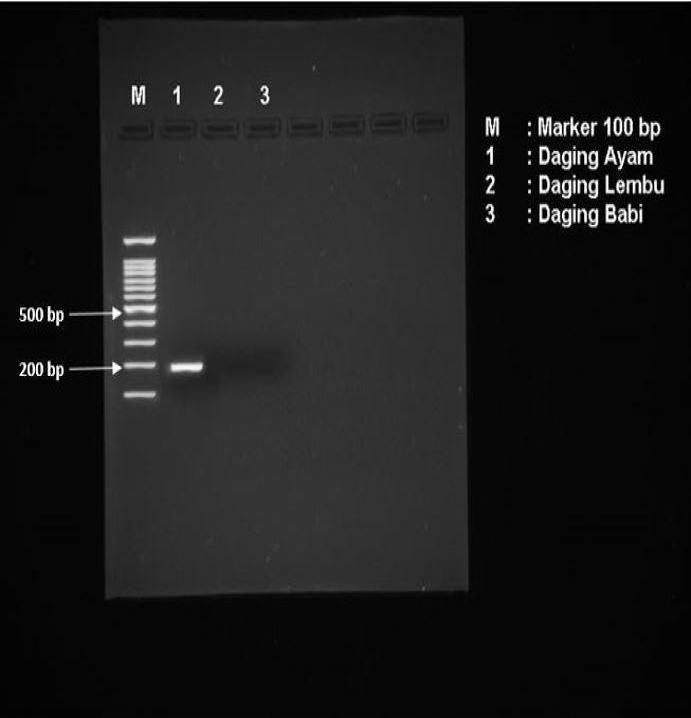
Gel electrophoresis results of the specificity test. M: marker 183 bp;1: chicken meat; 2: beef meat; 3: pork meat.
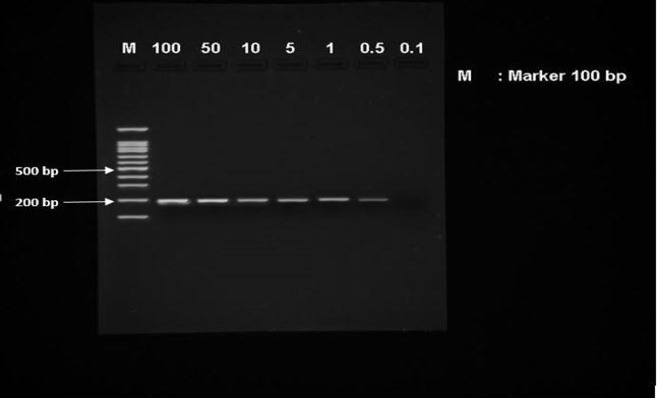
Gel electrophoresis results of sensitivity test. M: marker 183 bp; 100 - 0.1: concentration of chicken’s DNA
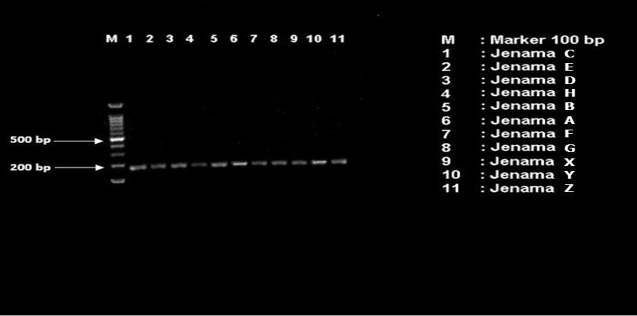
Gel electrophoresis results of test samples. M: marker 183 bp; Lane 1: Brand C; Lane 2: Brand E; Lane 3: Brand D; Lane 4: Brand H; Lane 5: Brand B; Lane 6: Brand A; Lane 7: Brand F; Lane 8: Brand G; Lane 9: Brand X; Lane 10: Brand Y; and Lane 11: Brand Z.
References
- Arun, Ö.Ö., G. Çiftçioğlu, S. Sandıkçı Altunatmaz, S. Atalay, M. Savaşçı, and H.S. Eken. 2014. Effect of processing on PCR detection of animal species in meat products. Kafkas Univ. Vet. Fak. Derg., 20(6): 945-950.
- Bottaro, M., P. Marchetti, A. Mottola, F. Shehu, and Di Pinto, A. 2014. Detection of mislabeling in packaged chicken sausages by PCR. Albanian J. Agric. Sci., 455-460.
- Chiş, L.-M. and D.C. Vodnar. 2019. Detection of the species of origin for pork, chicken and beef in meat food products by real-time PCR. Safe., 5(4): 83. https://doi.org/10.3390/safety5040083[CrossRef]
- Desjardins, P. and D. Conklin. 2010. NanoDrop microvolume quantitation of nucleic acids. J. Vis. Exp., 45: 2565. https://doi.org/10.3791/2565-v[CrossRef]
- Fakhry, S.S., M. Adnan, F.A. Rashid, A.A. Abdulbaqi, L.A. Ismail, S.K. Ismail, and R.J. Kazem. 2021. Authenticity test of the processed meat products. Food Res., 5(4): 210-215. https://doi.org/10.26656/fr.2017.5(4).679[CrossRef]
- Ghovvati, S., M.R. Nassiri, S.Z. Mirhoseini, A.H. Moussavi, and A. Javadmanesh. 2009. Fraud identification in industrial meat products by multiplex PCR assay. Food Cont., 20: 696-699 https://doi.org/10.1016/j.foodcont.2008.09.002.[CrossRef]
- Jasbeer, K., R. Son, F. Mohamad Ghazali, and Y.K. Cheah. 2009. Real-time PCR evaluation of seven DNA extraction methods for the purpose of GMO analysis. Int. Food Res. J., 16: 329-341.
- Kesmen, Z., Y. Celebi, A. Güllüce, and H. Yetim. 2013. Detection of seagull meat in meat mixtures using real-time PCR analysis. Food Cont., 34: 47-49. https://doi.org/10.1016/j.foodcont.2013.04.006[CrossRef]
- Mathieson, W. and G.A. Thomas. 2013. Simultaneously extracting DNA, RNA, and protein using kits: Is sample quantity or quality prejudiced? Anal. Biochem., 433: 10-18. https://doi.org/10.1016/j.ab.2012.10.006[CrossRef]
- Nejad, F.P., F. Tafvizi, M. Tajabadi Ebrahimi, and S.E. Hosseni. 2014. Optimization of multiplex PCR for the identification of animal species using mitochondrial genes in sausages. Eur. Food Res. Technol., 239: 533-541. https://doi.org/10.1007/s00217-014-2249-1[CrossRef]
- Ng, P.C., N.A.S.A. Ruslan, L.X. Chin, M. Ahmad, S. Abu Hanifah, Z. Abdullah, and S.M. Khoo. 2022. Recent advances in halal food authentication: Challenges and strategies. J. Food Sci., 87(1): 8-35. https://doi.org/10.1111/1750-3841.15998[CrossRef]
- Purnomo, N., M. Mansur, A. Nugraha, M.I.A. Dagong, and A. Natsir. 2023. Specific species DNA amplification as a halal authentication method in sausage based on genetic markers. J. Agripet., 23(2): 157-163. https://doi.org/10.17969/agripet.v23i2.26595[CrossRef]
- Safdar, M., M. Ozaslan, and Y. Junejo. 2023. Rapid multiplex PCR for species authentication: Current prospects and challenges. Eurasia Proceed. Health Environ. Life Sci., 59–66. https://doi.org/10.55549/ephels.76[CrossRef]
- Spatola, G., A. Giusti, and A. Armani. 2024. The “dry-lab” side of food authentication: Benchmark of bioinformatic pipelines for the analysis of metabarcoding data. Food., 13(13): 2102 https://doi.org/10.3390/foods13132102.[CrossRef]
- Ulca, P., H. Balta, I. Çağın, and H.Z. Senyuva. 2013. Meat species identification and halal authentication using PCR analysis of raw and cooked traditional Turkish foods. Meat Sci., 94: 280-284. https://doi.org/10.1016/j.meatsci.2013.03.008[CrossRef]
- Yusop, M.H.M., M.F.A. Bakar, K.R. Kamarudin, N.F.K. Mokhtar, M.A.M. Hossain, M.R. Johan, and N.Q.I.M. Noor. 2022. Rapid detection of porcine DNA in meatball using recombinase polymerase amplification coupled with lateral flow immunoassay for halal authentication. Molecul., 27: 8122. https://doi.org/10.3390/molecules27238122[CrossRef]
Services
Article usage statistics
Loading…