
Most of Niviventer’s phylogenetic analyses were performed using several mitochondrial (CYTB, COI) and nuclear genes (RAG1, IRBP) alone or in combination, but yielded inconsistent results. In order to further understand the phylogeny of Niviventer lotipes, we performed a phylogenetic analysis of N. lotipes with a partition model based on 13 mitochondrial protein-coding genes (PCGs) and 2 ribosomal RNA genes. The first complete mitochondrial genome of white-bellied rat (Niviventer lotipes) was determined using conventional PCR. The genome was 16322 bp in length and contained 13 protein-coding genes (PCGs), 2 ribosomal RNA genes (12S rRNA and 16S rRNA), 22 transfer RNA genes (tRNAs), one origin of light-strand replication and one control region. The basic composition of the whole genome includes, A (34.1%), T (28.3%), C (25.1%) G (12.5%) and AT-skew (0.092), GC-skew (-0.335). 13 PCGs encode a total of 3791 amino acids, of which Leu has the highest AARatio (15.59%). Phylogenetic analysis yielded three phylogenetic trees with similar topological, and the results support that genus Niviventer is divided into four groups, in which N. lotipes was clustered within the genus Niviventer and formed a division with N. gladiusmaculus, N. pianmaensis, N. sacer, N. confucianus and N. niviventer. The mitochondrial whole genome sequence of N. lotipes at the molecular level provides an important complement to the phylogenetic relationship of the genus Niviventer.
Research Article · Volume 58, Issue 4, 10 May 2026 · Open Access
The Complete Mitochondrial Genome of the Niviventer lotipes (Rodentia: Muridae) from China and its Phylogenetic Analysis
· · · ·
Affiliations & Notes ⌄
- 1College of Life Science and Technology, Mudanjiang Normal University, Mudanjiang, 157011, Heilongjiang, PR China * Corresponding author: swxlz0@126.com
Article Info ⌄
- Journal:
- Pakistan Journal of Zoology
- Published:
- 10 May 2026

From the article
- The mitochondrial genome structure of N. lotipes is consistent with other murine species and most mammals.
- The results of phylogenetic analysis showed that the genus Niviventer was divided into four groups, in which N. lotipes was clustered within the genus Niviventer and formed a division with N. gladiusmaculus, N. pianmaensis, N. sacer, N. confucianus and N. niviventer.
- The mitochondrial whole genome sequence of N. lotipes at the molecular level provides an important complement to the phylogenetic relationship of the genus Niviventer.
Selected from the article's own text.
Abstract
Introduction
The genus Niviventer (Rodentia: Muridae) dispersing from the Himalayas and China to the Greater Sunda Islands ; . They have diverse and extensive habitats, from moist forests to dry valleys. They also carry a variety of human pathogens . Current research shows, there are 19 recognized Niviventer species with another 64 recognized as synonyms or subspecies ; Wei et al., 2021; .
Niviventer lotipes (Allen, 1926; Type Locality, Nada, Hainan, China) are endemic to China. At present distribution of N. lotipes is mainly found in southern China (Hainan, Guizhou, Hunan), southeastern China (Zhejiang, Fujian) and Xizang . N. lotipes and N. champa (Robinson and Kloss, 1922) were once regarded as synonyms of N. tenaster (Thomas, 1916) . A previous study conducted karyotyping and morphological analysis of three Rat species (Mammalia: Rodentia: Muridae) in Hainan Island, and identified N. lotipes as a valid species for the first time .
As more Niviventer species were sequenced and analyzed, the results of phylogenetic analysis based on one or several mitochondrial and nuclear genes indicated that genus Niviventer should be divided into four groups, not two, among which N. lotipes included in N. confucianus-Division ; ; . In addition, it also supporting that N. lotipes and N. niviventer were sister species . However, the phylogenetic analyses results of N. lotipes are always inconsistent in detail due to the subjective selection of gene sequences and the limited number of gene sequences used. Compared with individual mitochondrial gene sequences, complete mitochondrial genome sequences can provide higher resolution and sensitivity to better reveal evolutionary relationships between closely related species ; ; . Since different evolutionary pressures and time scales result in different gene evolution , so for phylogenetic analysis we use a partition model which allow each gene has its own substitution models and evolutionary rates .
Until now, NCBI has included the mitochondrial genome sequences of most recognized Niviventer species except for N. bukit, N. coninga, N. culturatus. We sequenced and annotated the first mitochondrial whole genome sequence of N. lotipes. The mitochondrial whole genome sequence of N. lotipes at the molecular level provides an important complement to the phylogenetic relationship of the genus Niviventer. On the other hand, the topological differences between genome and gene trees also highlights the importance of the entire mitochondrial genome in rodent phylogenetic analysis.
Materials and Methods
Sample collection and genomic DNA extraction
A muscle sample obtained from a female Niviventer lotipes captured from Tongren regions in Guizhou Province, China (27°69′14″N, 108°84′84″E) was stored at -75 oC in Animal and Plant Herbarium of Mudanjiang Normal University with voucher number HNSS2019004 (Zhu Liu, swxlz0@126.com) after preservation in 95% ethanol. Genomic DNA was extracted from muscle using the EasyPure genomic DNA kit (TransGen Biotech Co., Beijing, China). The 15 pairs of primers used in PCR were designed based on the existing Nivienter mitochondrial genome useing Editseq and Premier 6 , 2021).
PCR amplifcation and sequencing
PCR for fragmented amplification of mitochondrial whole genomes was performed in 20 μl reaction volumes. A 90 μl cocktail prepared by mixing 50.02 μL ultrapure water, 8.2 μL buffer, 6.56 μL dNTP, 4.92 μL MgCl2, 1.64 μL primer, 0.82 μL Taq polymerase (Takara, China), was divided into five equal parts of 18 μL each, and then finally 2 μL DNA templates was added. The PCR cycle conditions were as follows: DNA denaturation temperature 94 oC for 4 min, followed by 39 cycles, DNA denaturation temperature 94 oC for 45 s, annealing temperature 52 oC for 1 min, extension temperature 72 oC for 1.5 min, and a final extension of 7 min at 72 oC. The PCR product was sequenced using the first-generation sequencing technology and the ABI 3730 sequencer (Ruiboxingke Biotechnology Co. Ltd., Beijing, China).
Sequence assembly, annotation and analysis
Referring to the existing Nivienter mitochondrial genome on NCBI (https://blast.ncbi.nlm.nih.gov/Blast.cgi), the mitochondrial gene sequences of N. lotipes obtained by sequencing was assembled with DNASTAR software package to obtain a complete mitochondrial genome. Annotation of the whole mitochondrial genome with the MITOS web server (mitos2.bioinf.uni-leipzig.de/index.py), and the annotations were validated using BLAST (https://blast.ncbi.nlm.nih.gov) . For tRNA genes analysis using tRNAscan-SE Search Server (http://trna.ucsc.edu/tRNAscan-SE/), the parameters are set to default . Composition skew analysis was calculated by the formula : AT skew = (A–T)/(A + T) and GC skew = (G–C)/(G + C). Base composition and relative synonymous codon usage (RSCU) by using software PhyloSuite v 1.2.2 . The circular mitochondrial genome map of N. lotipes was drawn using SnapGene v 6.0.2 (www.snapgene.com).
Phylogenetic analysis
The complete mitochondrial genome used for phylogenetic analysis was downloaded from the GenBank database (https://www.ncbi.nlm.nih.gov/genbank) (Table I). Software PhyloSuite v 1.2.2 was used to extract the desired genes from the downloaded mitochondrial genomes. Multiple sequences were aligned using MAFFT v 7.471 and MACSE v 2.03 with default settings ; . Before using software PhyloSuite v 1.2.2 to concatenate the extracted gene sequences, Gblock was used to cut all gaps generated after the alignment. The best-fit partition model (Table II) for ML analysis and BI analysis were evaluated using Bayesian information criterion in iqtree v 2.2 and -MF+MERGE program. The MERGE strategy starts with the full partition model and subsequentially merges two genes until the model fit does not increase any further . Phylogenetic tree reconstruction using iqtree v 2.2 and Mrbayes v 3.2.7a for ML analysis and BI analysis, respectively. The standard Bootstrap test of ML tree were set to 1000 iterations. The MCMC settings for the BI tree were as follows: 10 million generations as 4 MCMC chains at the same time, sampling every 100 generations, Burnin Fraction is 10%, and number of runs is 2. We used tracer v 1.7.1 and ESS value > 200 to evaluate the credibility of the results. Editing phylogenetic tree results using ITOL web server (https://itol.embl.de/).
Results and discussion
Mitogenome organization
Accurate annotation of the closed-circle complete mitochondrial genome of 16322 bp in length has been
Table I. The complete mitochondrial genome used for this phylogenetic analysis. For sequences without annotation information in GenBank (N. pianmaensis, N. niviventer, N. brahma, N.eha, N.huang, N. gladiusmaculus, N. fengi, N. mekongis), we use the MITOS web server for gene annotation.
| Genus/ Species | Length (bp) | GeneBank No |
| Rattus | ||
| R. andamanensis | 16304 | NC_046686 |
| R. nitidus | 16297 | NC_040919 |
| R. norvegicus | 16313 | NC_001665 |
| R. rattus | 16305 | NC_012374 |
| R. tanezumi | 16306 | NC_011638 |
| Mus | ||
| M. musculus | 16303 | LC644158 |
| Niviventer | ||
| N. andersoni | 16291 | MW030174 |
| N. brahma | 16289 | MW193742 |
| N. confucianus | 16281 | NC_023960 |
| N. cremoriventer | 16323 | KY117573 |
| N. eha | 16301 | MW193732 |
| N. excelsior | 16298 | JQ927552 |
| N. fengi | 16300 | MW193731 |
| N. fulvescens | 16301 | KP455488 |
| N. gladiusmaculus | 16365 | MW193728 |
| N. huang | 16372 | MW193730 |
| N. mekongis | 16304 | MW193741 |
| N. niviventer | 16302 | MW193736 |
| N. pianmaensis | 16303 | MW193740 |
| N. sacer | 16308 | MZ935252 |
| Leopoldamys | ||
| L. edwardsi | 16284 | NC_025670 |
| L. sabanus | 15975 | NC_035819 |
submitted to Genbank with accession number ON652843. The arrangement of the multiple genes is in line with other Muridae species and most mammals ; ; , 2021). The complete mitochondrial genome of N. lotipes includes 13 protein coding genes, 2 rRNA genes, 22 tRNA genes, 1 origin of L strand replication and 1 control region (Fig. 1, Table III). The base composition of the whole genome is as follows: A (34.1%), T (28.3%), C (25.1%) G (12.5%), and A+T (62.4%), C+G (37.6%). In addition, AT-skew (0.092), GC-skew (-0.335) are calculated by formula AT skew = (A–T)/(A + T) and GC skew = (G–C)/ (G + C) which indicating As and Cs were more abundant than Ts and Gs (Table III). Most genes in the mitochondrial genome were encoded by heavy (H) strand except for ND6 and 8 tRNAs (trnaQ, trnaA, trnaN, trnaC, trnaY, trnaS2, trnaE, trnaP) which were encoded by the Light (L) strand. The intergenic spacer (IGS) varing from 1 to 32 bp, with the largest intergenic spacer between trnaN and trnaC. At the same time, overlap between genes varing from 1 to 43 bp, with the largest overlap between ATP8 and ATP6.
Table II. The best-fit partition model for phylogenetic analysis.
| The best-fit partition model for ML analysis (12 PCGs and 2 rRNA) | |
| GTR+F+I+G4 | codon1 (atp6, cox1, cox2, cox3, cytb, nad1, nad3) |
| K3Pu+F+I | codon2 (atp6, cox1, cox2, cox3, cytb, nad1, nad4L) |
| TIM2+F+I+G4 | codon3 (atp6, atp8, cox1, cox2) |
| TIM3+F+I+G4 | codon1 (atp8, nad2, nad4); codon2 (atp8) |
| TIM2+F+I+I+R3 | codon3 (cox3, cytb, nad1, nad2, nad3, nad4L, nad4, nad5) |
| TIM3+F+R2 | codon2 (nad2, nad3, nad4, nad5) |
| TIM2+F+I+G4 | codon1 (nad4L, nad5); 12s rRNA, 16s rRNA |
| The best-fit partition model for ML analysis (13 PCGs and 2 rRNA) | |
| GTR+F+I+G4 | codon1 (atp6, cox1, cox2, cox3, cytb, nad1, nad3) |
| K3Pu+F+I | codon2 (atp6, cox1, cox2, cox3, cytb, nad1, nad4L, nad6) |
| TIM2+F+I+G4 | codon3 (atp6, atp8, cox1, cox2) |
| TIM3+F+I+G4 | codon1 (atp8, nad2, nad4); codon2 (atp8) |
| TIM2+F+I+I+R3 | codon3 (cox3, cytb, nad1, nad2, nad3, nad4L, nad4, nad5) |
| TIM3+F+R2 | codon2 (nad2, nad3, nad4, nad5) |
| TIM2+F+I+G4 | codon1 (nad4L, nad5); 12s rRNA, 16s rRNA |
| TN+F+I+G4 | codon1 (nad6) |
| TN+F+G4 | codon3 (nad6) |
| The best-fit partition model for BI analysis (12 PCGs and 2 rRNA) | |
| GTR+F+I+G4 | codon1 (atp6, cytb, nad1, nad3) |
| HKY+F+I | codon2 (atp6, cox1, cox2, cox3, cytb) |
| GTR+F+I+G4 | codon3 (atp6, atp8, cox1, cox2) |
| GTR+F+I+G4 | codon1 (atp8, nad2, nad4) |
| GTR+F+I+G4 | codon2 (atp8, nad1, nad2, nad3, nad4L, nad4, nad5) |
| SYM+I+G4 | codon2 (cox1, cox2, cox3) |
| GTR+F+I+G4 | codon3 (cox3, cytb, nad1, nad2, nad3, nad4L, nad4, nad5) |
| GTR+F+I+G4 | codon1 (nad4L, nad5); 12s rRNA, 16s rRNA |
Table III. Features of the mitochondrial genome of N. lotipes.
| Gene | Position | Codon | Anticodon | Size (bp) | Intergenic spacer (bp) | Str-and | ||
| From | To | Star | Stop | |||||
| trnF | 1 | 69 | GAA | 69 | 1 | H | ||
| rrnS | 71 | 1026 | 956 | 0 | H | |||
| trnV | 1027 | 1096 | TAC | 70 | 0 | H | ||
| rrnL | 1097 | 2672 | 1576 | -2 | H | |||
| trnaL2 | 2671 | 2745 | TAA | 75 | 0 | H | ||
| nad1 | 2746 | 3700 | ATA | TAG | 955 | 0 | H | |
| trnaI | 3701 | 3769 | GAT | 69 | -3 | H | ||
| trnaQ | 3767 | 3837 | TTG | 71 | 3 | L | ||
| trnaM | 3840 | 3908 | CAT | 69 | 0 | H | ||
| nad2 | 3909 | 4944 | ATC | TAG | 1036 | 0 | H | |
| trnaW | 4945 | 5010 | TCA | 66 | 1 | H | ||
| trnaA | 5012 | 5080 | TGC | 69 | 1 | L | ||
| trnaN | 5082 | 5152 | GTT | 71 | 32 | L | ||
| trnaC | 5184 | 5251 | GCA | 67 | 0 | L | ||
| trnaY | 5252 | 5318 | GTA | 67 | 1 | L | ||
| cox1 | 5320 | 6867 | ATG | TAA | 1548 | -6 | H | |
| trnaS2 | 6862 | 6927 | TGA | 69 | 3 | L | ||
| trnaD | 6931 | 6998 | GTC | 68 | 1 | H | ||
| cox2 | 7000 | 7683 | ATG | TAA | 684 | 3 | H | |
| trnaK | 7687 | 7750 | TTT | 64 | 1 | H | ||
| atp8 | 7752 | 7955 | ATG | TAA | 204 | -43 | H | |
| atp6 | 7913 | 8593 | ATG | TAA | 681 | -1 | H | |
| cox3 | 8593 | 9376 | ATG | TA | 784 | 0 | H | |
| trnaG | 9377 | 9444 | TCC | 68 | 0 | H | ||
| nad3 | 9445 | 9792 | ATC | TAA | 348 | 1 | H | |
| trnaR | 9794 | 9861 | TCG | 68 | 2 | H | ||
| nad4L | 9864 | 10160 | ATG | TAA | 297 | -7 | H | |
| nad4 | 10154 | 11531 | ATG | T | 1378 | 0 | H | |
| trnaH | 11532 | 11599 | GTG | 68 | 0 | H | ||
| trnaS1 | 11600 | 11658 | GCT | 59 | -1 | H | ||
| trnaL1 | 11658 | 11728 | TAG | 71 | 6 | H | ||
| nad5 | 11735 | 13558 | ATA | TAA | 1824 | -23 | H | |
| nad6 | 13536 | 14054 | ATG | TAA | 519 | 0 | L | |
| trnaE | 14055 | 14123 | TTC | 69 | 5 | H | ||
| Cob | 14129 | 15272 | ATG | T | 1144 | 0 | H | |
| trnaT | 15273 | 15339 | TGT | 67 | 0 | H | ||
| trnaP | 15340 | 15407 | TGG | 68 | 0 | L | ||
| D-loop | 15408 | 16322 | 915 | H | ||||
PCGs and codon usage
The complete mitochondrial protein-coding gene is 11402 bp in length and accounts for 69.9% of the entire mitochondrial genome. The AT and GC skews of PCGs were positive (0.031) and negative (-0.364), respectively as observed in the case of whole mitochondrial genome (Table IV). Thirteen PCGs were found in the mitochondrial genome of N. lotipes. Except for NAD1, NAD2 and NAD5, which use ATA, ATC, and ATA as the start codons, respectively, the rest all use ATG as the start codon. CYTB, COX3 and NAD4 use incomplete stop codons (T--), the rest use TAA or TAG as stop codons (Table III).
Table IV. Composition and skewness of N. lotipes mitogenome.
| A | T | C | G | A+T% | AT-skew | GC-skew | Size(bp) | |
| Mitogenome | 34.1% | 28.3% | 25.1% | 12.5% | 62.4% | 0.092 | -0.335 | 16322 |
| PCGs | 31.7% | 29.8% | 26.3% | 12.3% | 61.5% | 0.031 | -0.364 | 11402 |
| nad1 | 30.9% | 28.2% | 29.8% | 11.1% | 59.1% | 0.046 | -0.458 | 955 |
| nad2 | 35.8% | 27.8% | 28.7% | 7.7% | 63.6% | 0.126 | -0.576 | 1036 |
| cox1 | 28.9% | 31.3% | 23.3% | 16.4% | 60.2% | -0.04 | -0.174 | 1548 |
| cox2 | 33.2% | 28.5% | 25.0% | 13.3% | 61.7% | 0.076 | -0.305 | 684 |
| cox3 | 30.0% | 28.8% | 26.7% | 14.5% | 58.8% | 0.020 | -0.294 | 784 |
| atp6 | 32.3% | 28.5% | 28.3% | 10.9% | 60.8% | 0.063 | -0.446 | 681 |
| atp8 | 37.7% | 29.9% | 24.5% | 7.8% | 67.6% | 0.116 | -0.515 | 204 |
| nad3 | 31.3% | 31.0% | 26.1% | 11.5% | 62.3% | 0.005 | -0.389 | 348 |
| nad4 | 33.6% | 28.4% | 27.6% | 10.3% | 62.0% | 0.083 | -0.457 | 1378 |
| nad4l | 31.3% | 33.3% | 25.3% | 10.1% | 64.6% | -0.031 | -0.429 | 297 |
| nad5 | 33.4% | 28.7% | 28.0% | 9.9% | 62.1% | 0.076 | -0.478 | 1824 |
| nad6 | 22.9% | 44.3% | 6.9% | 25.8% | 67.2% | -0.318 | 0.576 | 519 |
| Cob | 30.2% | 28.5% | 29.4% | 12.0% | 58.7% | 0.028 | -0.421 | 1144 |
| tRNSs | 34.8% | 31.0% | 15.8% | 18.4% | 65.8% | 0.057 | 0.076 | 1499 |
| rRNAs | 38.6% | 25.3% | 19.7% | 16.4% | 63.9% | 0.208 | 0.092 | 2532 |
| CR | 35.6% | 29.0% | 24.1% | 11.3% | 64.6% | 0.103 | -0.364 | 915 |
Relative synonymous codon usage (RSCU) shows that serine and leucine are encoded by six synonymous codons, and the remaining amino acids are encoded by two or four synonymous codons, which is consistent with the mitochondrial genome study of N. andersoni . Moreover, the most commonly used codons are Leu-CUA (259), Ile-AUU (191), Ile-AUC (173), Met-AUA (187), and the synonymous codon usage of each amino acid, more favor codons whose third codon position is related to adenine (Fig. 2, Table II).
Ribosomal RNAs, transfer RNAs and CR
The lengths of 12S rRNA and 16S rRNA are 956 bp and 1576 bp, respectively, they are sandwiched by trnaF and trnaL2 and separated by trnaV. The AT-skew value was positive (0.205), and GC-skew value was negative (−0.091) which revealed more adenine and cytosine nucleotide prevalence among rRNAs (Table III, IV). The tRNAs are between 59 and 75 bp in length. The mitochondrial genome of N. lotipes encodes a total of 22 tRNAs, of which14 tRNAs were encoded by heavy (H) strand, 8 tRNAs were encoded by the Light (L) strand. Among the 22 tRNAs encode 20 amino acids, of which Leu and Ser are encoded by two anticodons, TAA, TAG and TGA, GCT, respectively (Table III). Except for trnaS1, which lacks the dihydrouridine arm, the secondary structures of all tRNAs are cloverleaf structures. Loss of the dihydrouridine arm is common in the mitogenomes of many mammal animals . The length of L-strand replication origin (OL) is 31bp, located between trnN and trnaC, and had the potential to fold into a stable stem-loop secondary structure. The control region (CR) is 914 bp in length and is sandwiched by trnP and trnaF. Three domains were defined in N. lotipes mitochondrial genome control region: the extended termination associated sequence (ETAS) domain, the central conserved domain (CD) and the conserved sequence block (CSB) domain .
Phylogenetic analysis
Based on 13 PCGs and 2 rRNAs of 23 species, we performed a phylogenetic analysis using a partition model under the ML method, and obtained a phylogenetic tree (Fig. 3A). Considering that the evolution rates of different codon sites are different , we partitioned not only different genes but also different sites of codons for each PCG in the partition model. A previous study showed that nad6 has high heterogeneity and consistently poor phylogenetic performance . Thus, we constructed a phylogenetic tree based on PCGs excluding nad6 using a partition model under the ML and BI method, respectively (Fig. 3B, C).
The topology of the three phylogenetic trees is the same. The bootstrap value of the phylogenetic tree containing nad6 in the ML analysis (bootstrap value=60 - 100) was lower than the bootstrap value of the phylogenetic tree that did not contain nad6 (bootstrap value=71-100). Both the ML analysis and the BI analysis indicated that the genus Niviventer was divided into four groups, which was consistent with the previous phylogenetic analysis based on one or several mitochondrial and nuclear genes ; ; . Among them N. brahma and N. eha form a division, and N. andersoni and N. excelsior form the other, which is also consistent with previous findings ; . In addition, N. huang is phylogenetically closest to N. fulvescens, and form a division with N. mekongis, N. fengi, and N. cremoriventer. The last division is formed by N. gladiusmaculus, N. lotipes, N. pianmaensis, N. sacer, N. confucianus, N. niviventer, where N. sacer is phylogenetically closest to N. confucianus.
In this study, we obtained the first complete mitochondrial genome of N. lotipes and performed phylogenetic analysis based on 13 PCGs and 2 rRNA genes of N. lotipes. Compared with previous phylogenetic analysis results based on single or several mitochondrial genes, the results of this study provide a different perspective on the phylogenetic positioning of N. lotipes and further explore phylogenetic relationships within the genus Niviventer.
However, it is impractical to fully elucidate the phylogeny of the genus Niviventer based solely on mitochondrial genomic data. In the phylogenetic analysis using nuclear genes and mitochondrial genes respectively, the results are often inconsistent ; ; , which suggests that there may be imperfect taxonomy and inter-specific gene flow within the genus Niviventer ; ; . Therefore, more genetic data of the genus Niviventer, especially complete nuclear genome data, are still needed. Of course, morphological data is essential in species classification, and only when molecular data and morphological data are combined can the phylogenetic analysis of the genus Niviventer be better completed.
Conclusion
We sequenced and annotated the first mitochondrial whole genome sequence of N. lotipes. The mitochondrial genome structure of N. lotipes is consistent with other murine species and most mammals. The results of phylogenetic analysis showed that the genus Niviventer was divided into four groups, in which N. lotipes was clustered within the genus Niviventer and formed a division with N. gladiusmaculus, N. pianmaensis, N. sacer, N. confucianus and N. niviventer. The mitochondrial whole genome sequence of N. lotipes at the molecular level provides an important complement to the phylogenetic relationship of the genus Niviventer.
Declarations
Acknowledgement
We acknowledge the support for the research from the College of Life Science and Technology, Mudanjiang Normal University, and the assistance in data analysis provided by the software PhyloSuite v 1.2.2.
Funding
This research was supported by the Heilongjiang Provincial Department of Education filing project (1451TD002; 1451PT008; 1355JG002); Heilongjiang Provincial Natural Funds (LH2021C095).
IRB approval
The experiment was approved by the Institutional Review Board (IBR number, IACUC-DWZX-2021-401).
Ethics statement
The specimen collection protocol was approved by Laboratory Animal Welfare Ethics Committee of Mudanjiang Normal University and licensed by the local government. The specimens collected were neither non-protected animals nor endangered.
Data availability
Data will be made available on request.
Generative AI and AI-assisted technology statement
The authors have declared that no generative AI or AI-assisted technologies were used to create this manuscript.
Statement of conflict of interest
The authors have declared no conflict of interest.
Figures
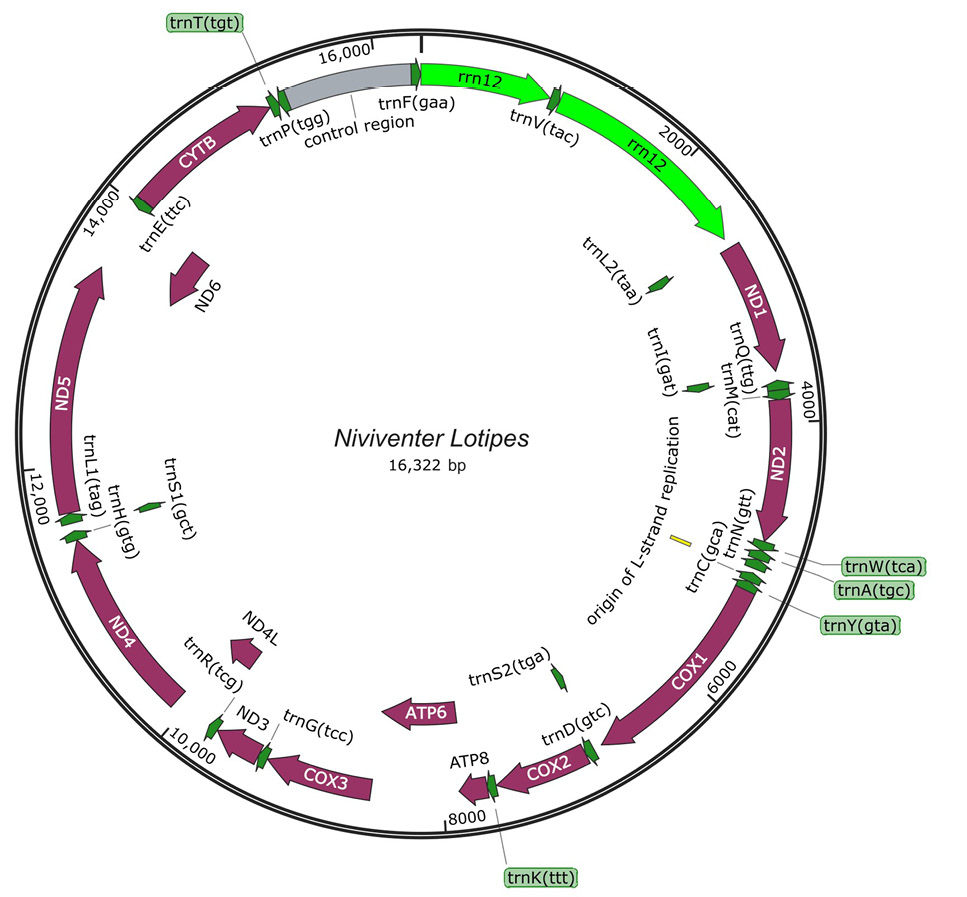
The gene map of N. lotipes mitochondrial genome.
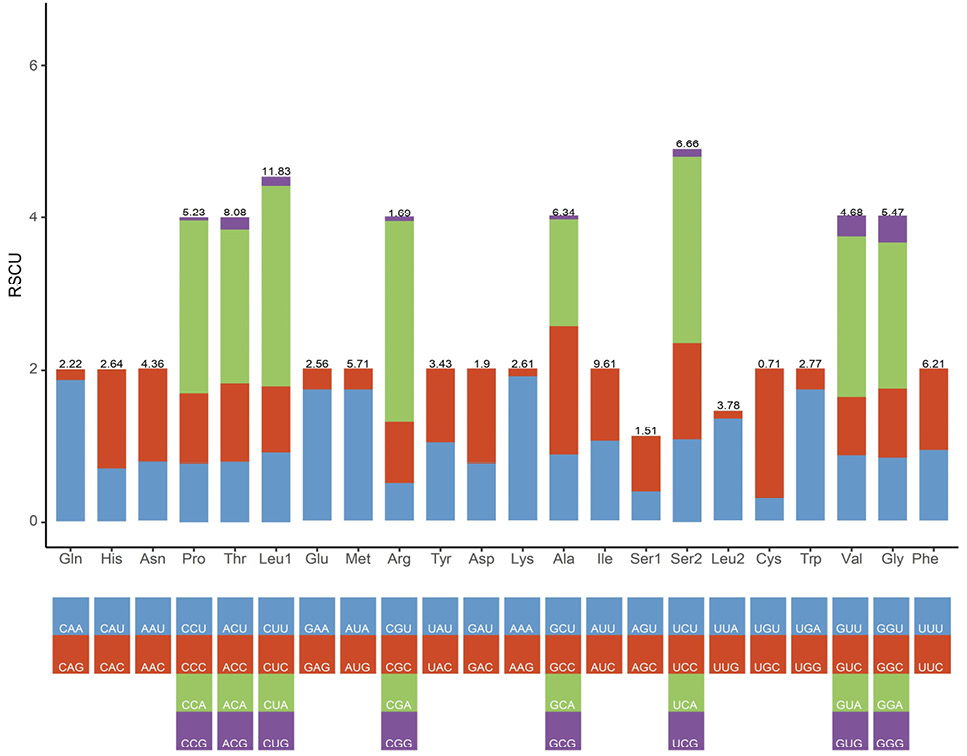
The relative synonymous codon usage (RSCU) in the mitogenome of N. lotipes.
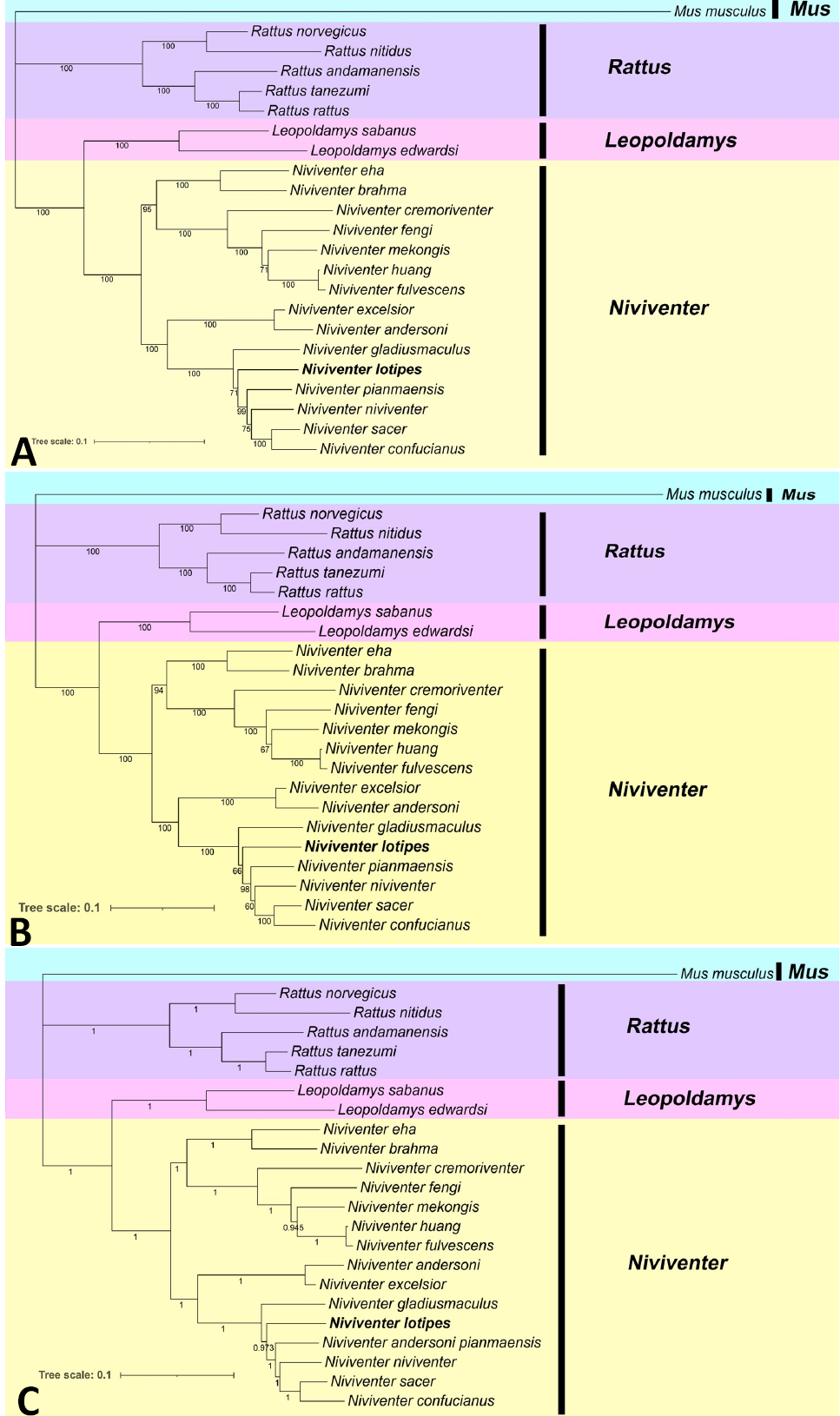
Maximum likelihood analysis was performed based on (A) 12, (B) 13 protein-coding genes and (C) 12 PCGs and 2 rRNAs from 23 species.
References
- Barbosa, S., Pauperio, J., Pavlova, S.V., Alves, P.C. and Searle, J.B., 2018. The microtus voles: Resolving the phylogeny of one of the most speciose mammalian genera using genomics. Mol. Phylogenet. Evol., 125: 85–92. https://doi.org/10.1016/j.ympev.2018.03.017[CrossRef]
- Chernomor, O., Von Haeseler, A. and Minh, B.Q., 2016. Terrace aware data structure for phylogenomic inference from supermatrices. Syst. Biol., 65: 997-1008. https://doi.org/10.1093/sysbio/syw037[CrossRef]
- Choi, J. and Kim, S.H., 2017. A genome tree of life for the fungi kingdom. Proc. natl. Acad. Sci., 114: 9391–9396. https://doi.org/10.1073/pnas.1711939114[CrossRef]
- Ge, D., Feijó, A., Wen, Z., Abramov, A.V., Lu, L., Cheng, J., Pan, S., Ye, S., Xia, L., Jiang, X., Vogler, A.P. and Yang, Q., 2021. Demographic History and genomic response to environmental changes in a rapid radiation of wild rats. Mol. Biol. Evol., 38: 1905-1923. https://doi.org/10.1093/molbev/msaa334[CrossRef]
- Kamalakkannan, R., Bhavana, K., Prabhu, V.R., Sureshgopi, D., Singha, H.S. and Nagarajan, M., 2020. The complete mitochondrial genome of Indian gaur, Bos gaurus and its phylogenetic implications. Sci. Rep., 10: 11936. https://doi.org/10.1038/s41598-020-68724-6[CrossRef]
- Katoh, K. and Standley, D.M., 2013. MAFFT multiple sequence alignment software version 7: improvements in performance and usability. Mol. Biol. Evol., 30: 772-780. https://doi.org/10.1093/molbev/mst010[CrossRef]
- Keesing, F., Belden, L.K., Daszak, P., Dobson, A., Harvell, C.D., Holt, R.D., Hudson, P., Jolles, A., Jones, K.E., Mitchell, C.E., Myers, S.S., Bogich, T. and Ostfeld, R.S., 2010. Impacts of biodiversity on the emergence and transmission of infectious diseases. Nature, 468: 647–652. https://doi.org/10.1038/nature09575[CrossRef]
- Ladoukakis, E.D. and Zouros, E., 2017. Evolution and inheritance of animal mitochondrial DNA: Rules and exceptions. J. Biol. Res. Thessal., 24: 1-7. https://doi.org/10.1186/s40709-017-0060-4[CrossRef]
- Li, Y., Li, Y., Li, H., Wang, J., Rong, X. and Li, Y., 2020. Niviventer confucianus sacer (Rodentia, Muridae) is a distinct species based on molecular, karyotyping, and morphological evidence. Zookeys, 959: 137-159. https://doi.org/10.3897/zookeys.959.53426[CrossRef]
- Li, Y., Wu, Y., Harada, M., Lin, L.K. and Motokawa, M., 2008. Karyotypes of three rat species (Mammalia: Rodentia: Muridae) from Hainan Island, China, and the valid specific status of Niviventer lotipes. Zool. Sci., 25: 686–692. https://doi.org/10.2108/zsj.25.686[CrossRef]
- Liu, S.J., Li, F.L., Zhou, J.H., Lv, J.Z., Tan, Z.Y., Zhang, Y.Z. and Ge, X.Y., 2022. The phylogeny of the Anderson’s white-bellied rat (Niviventer andersoni) based on complete mitochondrial genomes. Ecol. Evol., 12: e8663. https://doi.org/10.1002/ece3.8663[CrossRef]
- Liu, Z., Bai, Y., Sheng, Y., Zhang, Q., Cai, H., Zhang, S., Li, J. and Wang, Z., 2019. Sequencing and analysis of the complete mitochondrial genome of Chodsigoa hoffmanni from China and its phylogenetic analysis. Mitochondrial DNA Part B, 4: 2438-2440. https://doi.org/10.1080/23802359.2019.1637294[CrossRef]
- Liu, Z., Wang, Q., Jiang, X., Jiang, W., Zhao, X., Yao, Q., Zhang, J. and Piao, Z., 2021. Sequencing and analysis of the complete mitochondrial genome of the lesser bandicoot rat (Bandicota bengalensis) from China and its phylogenetic analysis. Mitochondrial DNA Part B, 6: 2063-2065. https://doi.org/10.1080/23802359.2021.1942273[CrossRef]
- Lowe, T.M. and Eddy, S.R., 1997. tRNAscan-SE: A program for improved detection of transfer RNA genes in genomic sequence. Nucl. Acids Res., 25: 955-964. https://doi.org/10.1093/nar/25.5.955[CrossRef]
- Lu, L., Ge, D., Chesters, D., Ho, S.Y., Ma, Y., Li, G., Wen, Z., Wu, Y., Wang, J., Xia, L., Liu, J., Guo, T., Zhang, X., Zhu, C., Yang, Q. and Liu, Q., 2015. Molecular phylogeny and the underestimated species diversity of the endemic white-bellied rat (Rodentia: Muridae: Niviventer) in Southeast Asia and China. Zool. Scripta, 44: 475–494. https://doi.org/10.1111/zsc.12117[CrossRef]
- Miya, M. and Nishida, M., 2000. Use of mitogenomic information in teleostean molecular phylogenetics: A tree-based exploration under the maximum-parsimony optimality criterion. Mol. Phylogenet. Evol., 17: 437–455. https://doi.org/10.1006/mpev.2000.0839[CrossRef]
- Mouchaty, S.K., Gullberg, A., Janke, A. and Arnason, U., 2000. The phylogenetic position of the Talpidae within eutheria based on analysis of complete mitochondrial sequences. Mol. Biol. Evol., 17: 60-67. https://doi.org/10.1093/oxfordjournals.molbev.a026238[CrossRef]
- Musser, G.G., 1981. Notes on systematics of Indo-Malayan murid rodents, and descriptions of new genera and species from Ceylon, Sulawesi, and the Philippines. Bull. Am. Mus. nat. Hist., 168: article 3.
- Musser, G.G. and Carleton, M.D., 1993. Family Muridae. In: Mammals species of the world: A taxonomic and geographic reference (eds. D.E. Wilson and D.M. Reeder). Smithsonian University Press, Washington DC, pp. 1206.
- Nguyen, L.T., Schmidt, H.A., Von Haeseler, A. and Minh, B.Q., 2015. IQ-TREE: A fast and effective stochastic algorithm for estimating maximum-likelihood phylogenies. Mol. Biol. Evol., 32: 268-274. https://doi.org/10.1093/molbev/msu300[CrossRef]
- Nikaido, M., Cao, Y., Harada, M., Okada, N. and Hasegawa, M., 2003. Mitochondrial phylogeny of hedgehogs and monophyly of Eulipotyphla. Mol. Phylogenet. Evol., 28: 276-284. https://doi.org/10.1016/S1055-7903(03)00120-9[CrossRef]
- Perna, N.T. and Kocher, T.D., 1995. Patterns of nucleotide composition at fourfold degenerate sites of animal mitochondrial genomes. J. Mol. Evol., 41: 353–358. https://doi.org/10.1007/BF01215182[CrossRef]
- Rambaut, A., Drummond, A.J., Xie, D., Baele, G. and Suchard, M.A., 2018. Posterior summarization in bayesian phylogenetics using tracer 1.7. Syst. Biol., 67: 901-904. https://doi.org/10.1093/sysbio/syy032[CrossRef]
- Ranwez, V., Douzery, E.J.P., Cambon, C., Chantret, N. and Delsuc, F., 2018. MACSE v2: Toolkit for the alignment of coding sequences accounting for frameshifts and stop codons. Mol. Biol. Evol., 35: 2582-2584. https://doi.org/10.1093/molbev/msy159[CrossRef]
- Robert, L., Brett, C., Simon, Y.W.H. and Stephane, G., 2012. Partition finder: Combined selection of partitioning schemes and substitution models for phylogenetic analyses. Mol. Biol. Evol., 29: 1695–1701. https://doi.org/10.1093/molbev/mss020[CrossRef]
- Rokas, A. and Charlesworth, D., 2001. Molecular evolution and phylogenetics (eds. M. Nei and S. Kumar). Oxford University Press. 2000. ISBN: 0-19-513584-9 (hbk); 0-19-513585-7 (pbk). xiv 333 pages. Price: £65 (hbk); £32.50 (pbk). Genet. Res., 77: 117-120. https://doi.org/10.1017/S0016672301219405[CrossRef]
- Solari, S. and Baker, R, J., 2007. Mammal species of the world: A taxonomic and geographic reference by Wilson, D.E., Reeder DM. J. Mammal., 88: 824–830. https://doi.org/10.1644/06-MAMM-R-422.1[CrossRef]
- Talavera, G. and Castresana, J., 2007. Improvement of phylogenies after removing divergent and ambiguously aligned blocks from protein sequence alignments. Syst. Biol., 56: 564-577. https://doi.org/10.1080/10635150701472164[CrossRef]
- Wei, F., Yang, Q., Wu, Y., Jiang, X., Liu, S., Li, B., Yang, G., Li, M., Zhou, J., Li, S., Hu, Y., Ge, D., Li, S., Yu, W., Chen, B., Zhang, Z., Zhou, C., Wu, S., Zhang, L., Chen, Z., Chen, S., Deng, H., Jiang, T., Zhang, L., Shi, H., Lu, X., Li, Q., Liu, Z., Cui, Y. and Li, Y., 2021. Catalogue of mammals in China (2021). Acta Theriol. Sin., 41: 478-501. https://doi.org/10.1016/j.tca.2021.178993[CrossRef]
- Wei, H., Li, F., Wang, X., Wang, Q., Chen, G., Zong, H. and Chen, S., 2017. The characterization of complete mitochondrial genome and phylogenetic relationship within Rattus genus (Rodentia: Muridae). Biochem. Syst. Ecol., 71: 179–186. https://doi.org/10.1016/j.bse.2017.01.012[CrossRef]
- Wolstenholme, D.R., 1992. Animal mitochondrial DNA: Structure and evolution. Int. Rev. Cytol., 141: 173–216. https://doi.org/10.1016/S0074-7696(08)62066-5[CrossRef]
- Zhang, B., He, K., Wan, T., Chen, P., Sun, G., Liu, S., Nguyen, T.S., Lin, L. and Jiang, X., 2016. Multi-locus phylogeny using topotype specimens sheds light on the systematics of Niviventer (Rodentia, Muridae) in China. BMC Evol. Biol., 16: 1-12. https://doi.org/10.1186/s12862-016-0832-8[CrossRef]
- Zhang, D., Gao, F., Jakovlić, I., Zou, H., Zhang, J., Li, W.X. and Wang, G.T., 2020. PhyloSuite: An integrated and scalable desktop platform for streamlined molecular sequence data management and evolutionary phylogenetics studies. Mol. Ecol. Resour., 20: 348–355. https://doi.org/10.1111/1755-0998.13096[CrossRef]
- Zhang, H.H., Xu, C.Z. and Ma, J.Z., 2009. Structure of the mtDNA control region and phylogeny of the Mustelidae species. Acta Ecol. Sin., 29: 3585–3592.
Services
Article usage statistics
Loading…