
Meso-predators are often greatly interlinked within their food webs. They are often omnivorous, consuming a broader array of prey items than do larger predators. Meso-carnivores can play the role of apex predator by inhibiting competitors and controlling prey populations especially in systems where large-bodied primary consumers are limited. This note presents the first photographic evidence of yellow-throated marten from Nizampur National Park (NNP), Nowshera district Khyber Pkahtunkhwa (KP) Pakistan. The presence of this species indicated that this ecosystem has rich biodiversity, providing plenty of resources for the survival of yellow-throated marten. However, keeping in view the diet ecology of yellow-throated marten we assume that it may have some negative impacts on the ongoing ungulates captive breeding programs with in the park. Therefore, detailed studies are needed to be carried out to investigate the population trend and habitat ranges of this species in the park and adjacent areas.
Short Communication · Volume 55, Issue 6, 31 October 2023 · Open Access
First Photographic Evidence of Yellow-Throated Marten (Martes flavigula) from Nowshera District, Khyber Pakhtunkhwa Pakistan
· · · · ·
Affiliations & Notes ⌄
- 1College of Wildlife and Protected Areas, Northeast Forestry University, Harbin 150040, P.R. China 2Key Laboratory of Conservation Biology, National Forestry and Grassland Administration, Harbin, 150040, P.R. China 3Nowshera Wildlife Division, Nowshera 24110, Khyber Pakhtunkhwa, Pakistan 4Islamabad Wildlife Management Board, Islamabad 44000, Pakistan * Corresponding author: tenglw1975@163.com
Article Info ⌄
- Journal:
- Pakistan Journal of Zoology
- Published:
- 31 October 2023

From the article
- First Photographic Evidence of Yellow-Throated Marten (Martes flavigula) from Nowshera District, Khyber Pakhtunkhwa Pakistan.
- The presence of this species indicated that this ecosystem has rich biodiversity, providing plenty of resources for the survival of yellow-throated marten.
- However, keeping in view the diet ecology of yellow-throated marten we assume that it may have some negative impacts on the ongoing ungulates captive breeding programs with in the park.
- Therefore, based on the evidence reported in the current note we strongly recommend carrying out in depth surveys to assess the population status and habitat ranges of yellow-throated marten in the aforementioned and adjacent areas.
Selected from the article's own text.
Abstract
Field observations
During our field visits (July, 2022) for collecting data on wild boar presence in Nizampur National Park (NNP) (33°45’19” N; 72°0’15” E) Nowshera district, Khyber Pakthunkwa (KP) Province, we opportunistically encountered the yellow-throated marten chasing Indian hare (Lepus nigricollis) (Fig. 1) alongside the cages of captive breeding ungulates. The study area has a prevailing local steppe or semiarid climate. The average annual temperature recorded is 24.4°C with an average rainfall of 532 mm. January is the coldest month with average monthly temperatures lower than 10°C while the warmest month is June with average monthly temperature up to 33.6 °C. The habitat in this park is broad-leaved evergreen scrub forests. The dominant species are Olea ferruginea (Olive, Zaithoon), Acacia modesta (Phulai), Vachellia nilotica (Kikar), Zizyphus mauratiana (Ber), Monotheca buxifolia (Gurgurah) and Dodonaea viscosa (Sanatha, Ghwarahsky).
Although this area falls within the IUCN declared range for yellow-throated marten, yet till date no detailed evidence was reported from this part of KP and the adjacent areas. According to Roberts (1997) the yellow-throated marten exists only along the pines belt in KP province.
Observation importance
In Pakistan yellow-throated marten has been mainly reported from the northern parts ; . We believe that this field note is of great importance in terms of conservation. The presence of yellow-throated marten in these areas indicates that these habitats have rich biodiversity providing plenty of resources in terms of prey species, fruits and seeds. However, simultaneously keeping in view the feeding strategies of yellow-throated marten we believe that it may have the potential to compromise the population of captive breeding ungulates in the area including urial (Ovis vignei), hog deer (Axis porcinus), black buck (Antilope cervicapra), Indian gazelle (Gazella bennettii) and spotted deer (Axis axis) by hunting their fawns . Therefore, based on the evidence reported in the current note we strongly recommend carrying out in depth surveys to assess the population status and habitat ranges of yellow-throated marten in the aforementioned and adjacent areas.
Acknowledgement
Thanks to Wildlife Department Nowshera Division for their tremendous cooperation in our field works. We also thank The Key Laboratory of Conservation Biology, National Forestry and Grassland Administration, P.R. China for supporting open access publishing of this report.
Statement of conflict of interest
The authors have declared no conflict of interest.
Figures
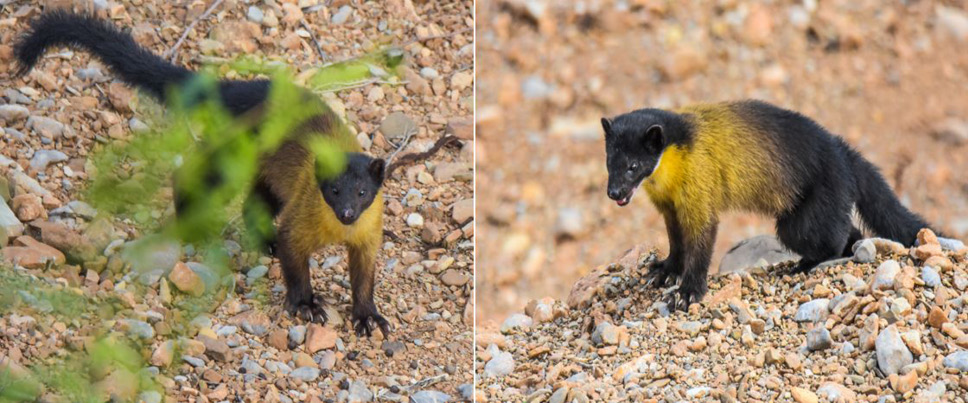
Yellow-throated marten sighted and photographed in NNP, Nowshera KP Pakistan (Photo credit: Abdul Hadi).
References
- Ahmad, S., Hameed, S., Ali, H., Khan, T.U., Mehmood, T., and Nawaz, M. A., 2016. Eur. J. Wildl. Res., 62: 565-576. https://doi.org/10.1007/s10344-016-1029-6[CrossRef]
- Chutipong, W., Duckworth, J.W., Timmins, R.J., Choudhury, A., Abramov, A.V., Roberton, S., Long, B., Rahman, H., Hearn, A., Dinets, V., and Willcox, D.H.A., 2016. Martes flavigula. The IUCN Red List of Threatened Species: e.T41649A45212973.
- Corbet, G.B., Hill, J.E., 1992. The mammals of the Indomalayan region: A systematic review. Oxford University Press, Oxford, U.K.
- Grassman, L.I., Tewes, M.E., and Silvy, N.J., 2005. Wildl. Biol., 11: 49–57. https://doi.org/10.2981/0909-6396(2005)11[49:RHUAAP]2.0.CO;2[CrossRef]
- Parr, J., Duckworth, J., 2007. Small Carnivore Conserv., 36: 27–29.
- Roberts, T.J., 1997. The mammals of Pakistan. Oxford University Press. New York.
- Sheikh, K., and Molur, S., 2005. Status and red list of pakistan’s mammals, based on conservation assessment and management plan for mammals. IUCN, Pakistan, pp. 344.
- Zhou, Y.B., Newman, C., Buesching, C.D., Zalewski, A., Kaneko, Y., Macdonald, D.W., and Xie, Z.Q., 2011. J. Mammal., 92: 611–619. https://doi.org/10.1644/10-MAMM-A-296.1[CrossRef]
Cited by 1 article
In journals published by ResearchersLinks.
Services
Article usage statistics
Loading…