
The number of affected people by asthma is rising to reach up to 339 million worldwide. Asthma defined as chronic airway inflammation. A natural substance called resveratrol, which is present in several plants, red wine, and grapes, has been researched for its potential anti-inflammatory, and antioxidant qualities, and to induce relaxation of airway smooth muscle. The current study investigated whether Resveratrol (RES) could lessen allergic asthma that ovalbumin (OVA) causes in rats. Current results revealed that RES improved significantly (P<0.05) allergic asthma attenuation by decreasing the number of infiltrated mononuclear cells in Bronchoalveolar Lavage Fluid (BALF) and non-significantly (P>0.05) the number of infiltrated mononuclear cells intraperitoneally. RES increased lung integrity by reducing Evans blue extravasation in the lung (P<0.05) and liver (P>0.05). Additionally, in the BALF, RES therapy reduced (P<0.05) inflammatory cytokines including interleukin-17 (IL-17) and interferon-gamma (IFN-γ). RES increases (P<0.05) the expression of Il10 gene in the spleen, which is associated with T-regulatory and anti-inflammatory processes in the immune system. Our findings showed that RES may reduce asthma by activating anti-inflammatory genes, restoring lung barrier integrity, and decreasing proinflammatory cytokines and infiltrating inflammatory cells.
Research Article · Volume 12, Issue 2, 15 April 2024 · Open Access
Ovalbumin-Induced Asthma in Rats is Alleviated by Resveratrol Treatment
·
Affiliations & Notes ⌄
- 1Department of Physiology, Biochemistry and Pharmacology, College of Veterinary Medicine, University of Baghdad, Baghdad, Iraq. *Correspondence | Amira Mohmmed, Department of Physiology, Biochemistry and Pharmacology, College of Veterinary Medicine, University of Baghdad, Baghdad, Iraq
- 2Email: dr.amirakamil@covm.uobaghdad.edu.iq
Article Info ⌄
- Journal:
- Journal of Animal Health and Production
- Published:
- 15 April 2024

From the article
- Although, most of the research on resveratrol’s anti-inflammatory effects has focused on its modulation of inflammatory signaling pathways and immune cell function, rather than its impact on tissue permeability.
- Resveratrol has been administered to lower the production of IFN-gamma, and IL-2 by T cells and NK cells.
- Resveratrol increases Il10 gene expression, which had a significant effect on immune responses by reducing excessive inflammation and promoting immunological tolerance.
- Additionally, resveratrol improved tissue integrity and remodeling of the lung tissue after asthma induction, featured by lowering the number of infiltrating cells as well as extravasated Evans blue stain.
Selected from the article's own text.
Abstract
INTRODUCTION
Traditional classifications of asthma as an atopic disease triggered by allergens, affecting approximately 300 million individuals worldwide, have made it a significant public health concern . Asthma has many signs such as bronchial hyperreactivity, clinical airway inflammation, and reversible airway obstruction. According to studies, asthma patients’ lungs have T-helper-2 cells that play a role in controlling cytokine and immunoglobulin synthesis. Breathing difficulties, chest tightness, and a lingering cough are the clinical symptoms of asthma ; .
In reaction to stress, injury, fungal infection, or UV exposure, phytoalexins are generated in plants (Aggarwal et al., 2004; . Resveratrol, a natural phytoalexin is known to possess multiple biological activities that were linked to human health (Brown et al.,, 2024). Even though resveratrol comes in both trans and cis isomers, it is thought that trans-resveratrol is the biologically active isoform because of its steric stability . Red wine, as well as different foods like grapes, peanuts, mulberries, and legumes, contain phytoalexin resveratrol. When resveratrol was found in red wine and used in traditional Chinese and Japanese medicine, it became clear that it has biological significance . Resveratrol has been shown in many different studies to have positive impacts on cellular systems. The ‘French Paradox’ of France’s high wine consumption shows that it protects against coronary heart disease . Resveratrol is lipid-associated and prevents lipid oxidation (Gimeno-Mallenc et al., 2019; , prevents platelet aggregation and also has antioxidant properties . In the present investigation, the main hypothesis was that resveratrol could inhibit immune cell hyperactivation and proinflammatory cytokines caused by asthma and protect tissue integrity.
Materials and methods
Ethical statement
Before performing experimental procedures, the protocols of experiments were tested by an ethical committee to ensure compliance of the Animal Use Protocol with the guidelines of the University of Baghdad and then approved under reference number 1438/P.G. Animals and treatment.
Sixty adult male Wister albino rats, 8-week-old, weighing 195-200g on average were used in the current investigation. The rats were acclimated in the College of Veterinary Medicine’s animal house at the University of Baghdad in Baghdad, Iraq. All animals were fed a standard pellet during the entire experiment period, provided with unlimited access to water, and housed in plastic cages with good ventilation and at temperature of 20 to 25 degrees Celsius. Throughout the experiment, the rats were subjected to 12-hour alternate periods of light and darkness. Twice a week, the bed was changed. Four equal groups of rats were formed at random. The initial group was regarded as naive (G1), the rats in the 2nd group (G2) were given daily 100 mg of resveratrol supplement orally for 14 days , and the third group (G3) were sensitized with 100µl intraperitoneal injection of 250µg of ovalbumin (OVA) from chicken eggs (Sigma-Aldrich, USA) and aluminium hydroxide 4mg/ml on day 0. The mice that had been sensitized received 50 g of OVA suspended in 50 µl of sterile phosphate buffer saline intranasal on day 7 as described by Alharris et al. (2022). The rats in the fourth group (G4) were given mix treatment as in G2 and induction of asthma as in G3.
BALF collection and infiltrated mononuclear cells count
To obtain broncho alveolar lavage fluid (BALF), the trachea was sutured before the lung and trachea were surgically removed. To aspirate the fluid, sterile, ice-cold phosphate buffer saline was inoculated into the trachea. The gathered BALF was separated in a centrifuge to obtain the cytokine-containing supernatants. Enzyme-linked immunosorbent assay (ELISA) was done using MAXTM standard kits (Biolegend, California, USA) as per the manufacturer’s workflow to identify the cytokines present in BALF . The cells in the tubs after centrifugation were collected and stained count the number of infiltrated mononuclear cells with an autoanalyzer .
Lung vascular leak measurement
Prior to killing the experimental animals, 100 µL of Evans blue stain (Sigma-Aldrich, USA) was administered intravenously two hours beforehand. The whole lung lobes were removed and preserved for 48 hours at 37 degrees Celsius in formamide (Fisher Scientific, USA) as described by Alghetaa et al, (2018).
Real-Time Quantitative PCR
According to Ahmed and Mohammed (2022), Q-PCR was used to ascertain the expression of Il10 in the spleen. To this end, from each group, total RNA was extracted and utilized to create cDNAs using the Real MODTM Green W2 2x qPCR mix . Primer for Il10 used was, Reverse: 5′AGGCTTGGCAACCCAAGTAA 3′ Forward: 5′ TCCGGGGTGACAATAACTGC 3′.
Statistical analysis
All collected data were statistically analyzed by utilizing the GraphPad Prism v8 Software (San Diego, CA, USA). Five mice per group were considered in each experiment, each experiment was repeated at least three times. The multiple comparisons were undertaken using a one-way ANOVA and then Tukey’s post hoc analysis was performed. Statistics were deemed significant at P<0.05 .
RESULTS
Resveratrol attenuated the number of infiltrated mononuclear cells in BALF and intraperitoneal fluid.
As can be seen in Figure-1A, the number of infiltrated mononuclear cells in BALF in G3 group rats significantly (P<0.05) increased in comparison to the G1, G2, and G4 groups. Figure-1B showed no significant differences in the infiltrated mononuclear cells in the intraperitoneal fluid. Although, there is an insignificant elevation of the number of cells in the G3 group relative to other groups.
Resveratrol protects tissue integrity in the lung and liver
As shown in Figure-2A, the concentration of Evan blue extravasation in rat lungs in group G3 was significantly (P<0.05) increased in comparison to the G1, G2, and G4 groups. While in Figure 2B, there was no statistical difference in the level of Evans blue dye in the liver among the groups. However, the concentration of G3 was elevated in contrast to other groups.
Resveratrol decreased proinflammatory cytokines.
Figure-3A indicates that IL-17 level in BALF was significantly (P<0.05) higher in the G3 group than in the G1, G2, and G4 groups. Figure-3B reveals that IFN-γ cytokines dramatically raised (P<0.05) in the G3 group compared to the G1, G2, and G4 groups. In addition, there was a significant increase (P<0.05) in this cytokine in G2 and G4 groups in comparison to G1 group.
Splenic Il10 gene validation
As shown in Figure-4, the Il10 gene expression was significantly (P<0.05) downregulated in the G3 group rats compared to the G4 group. In addition, Il10 gene expression statistically elevated (P<0.05) in the G2 group as compared to the G1, G3, and G4 groups.
DISCUSSION
The specific mechanisms by which resveratrol decreases the number of infiltrated mononuclear cells and reduces inflammation are not fully understood, but several proposed mechanisms have been studied. Resveratrol may exert its anti-inflammatory effects by reducing the quantity and kind of leukocytes in BALF . Additionally, a cytogenetic analysis of resveratrol on healthy human blood lymphocytes showed a significant reduction of the mutagen’s ability to induce mitosis . Previous published research demonstrated that resveratrol may ameliorate asthma by preventing the production of inflammatory mediators, increasing airway remodeling, and suppressing inflammation that is brought on by asthma . However, there is limited scientific evidence available to support the claim that resveratrol directly reduces tissue permeability. In order to evaluate the impact of the inflammatory process on the integrity of the mucosal barrier, alveolar epithelial cells type II were cultured with splenocytes that had been pre-treated with RES (Alghetaa et al., 2021). Although, most of the research on resveratrol’s anti-inflammatory effects has focused on its modulation of inflammatory signaling pathways and immune cell function, rather than its impact on tissue permeability. Resveratrol markedly attenuated the effects of H2O2 on the defect Tunica albuginea, disorganized germ cells, necrosis of spermatogonia, and azoospermia . The physical barrier may be protected by resveratrol, which may be connected to the control of tight junction protein expression and the reduction of oxidative stress . In male rats, hydrogen peroxide-induced kidney damage was lessened by resveratrol . In dogs with T. brucei infection, resveratrol administration reduces oxidative stress and liver damage .
IL-17 is a pro-inflammatory cytokine produced by various immune cells, including T helper 17 (Th17) cells. It plays a role in the recruitment and activation of immune cells during inflammation. Resveratrol has been found to inhibit the production of IL-17 by suppressing the differentiation of Th17 cells and reducing their activity. By reducing IL-17 levels, resveratrol may help attenuate the inflammatory response which was also observed in our study. Contrasted with the control and vaccination groups, the transfer factor recipient lambs’ serum levels of the cytokines IL-17, IFN, and MIF was significantly higher. According to the findings, the generated particular M. bovis-BCG transfer factor was successful in raising the serum level of cytokines in recipient lambs and causing cell-mediated immunity via delayed-type hypersensitivity . IFN-gamma is another pro-inflammatory cytokine that is primarily produced by natural killer (NK) cells and activated T lymphocytes. It has an impact on promoting inflammation and enhancing immune responses. Resveratrol has been administered to lower the production of IFN-gamma, and IL-2 by T cells and NK cells. By reducing IFN-gamma levels, resveratrol may help modulate the immune response and potentially alleviate inflammation . Lung tissue is not just affected by inflammation; exposure to dietary additives, such as monosodium glutamate, can result in a variety of histopathological alterations, such as a significant infiltration of inflammatory cells, emphysema, hemorrhage, hyperplasia, and endothelial cell hypertrophy. In addition, fibroid deposition all over the bronchioles, particularly in pregnant women . In vitro, IL-1, IL-6, and TNF-gamma production were shown to be dose-dependently suppressed by resveratrol, and IL-17 mRNA expression and protein release were reported to be downregulated . Following thoracic surgery, tissue damage, or lung infection all contributed to the infiltration of inflammatory cells. Additionally, the release of cytokines by inflammatory cells within the wounded tissue would draw them to the injury site . The potential cancer treatment properties of resveratrol, which can disrupt erroneous signaling mechanisms in altered colorectal cancer (HRT) cell lines, are thought to be the main causes of this impact . Immune cells, especially regulatory T cells, release the anti-inflammatory cytokine Il10. It has strong anti-inflammatory properties and can stop other immune cells from producing cytokines that cause inflammation. It has been shown that resveratrol increases Il10 production, adding to its anti-inflammatory effects . Also, by reducing ROS and nitric oxide (NO) production, resveratrol can produce anti-inflammatory effects across a variety of illnesses, including long-term inflammation and tumors, oxidative stress brought on by the buildup of ROS contributes to inflammation . Resveratrol is well-defined for its anti-inflammatory and antioxidant properties. In the preclinical trial of significant respiratory disorders including chronic obstructive pulmonary disease (COPD), it has already been shown that resveratrol has a shield-like function in disorders of the respiratory system . The therapeutic effect of RES in reducing inflammation and avoiding lung injury through a variety of possible molecular pathways was demonstrated using a variety of procedures to create acute lung inflammation. Similar research demonstrated that RES therapy enhances lung structural changes, reduces pulmonary edema, enhances lung function, and reduces neutrophil infiltration as well as myeloperoxidase protein production and activity in lung tissue (Cao et al., 2011; . Resveratrol has positive impacts on the body via decreasing superoxide levels, activating potassium channels, and increasing endothelium-dependent vasodilation .
Conclusions
Resveratrol increases Il10 gene expression, which had a significant effect on immune responses by reducing excessive inflammation and promoting immunological tolerance. Additionally, resveratrol improved tissue integrity and remodeling of the lung tissue after asthma induction, featured by lowering the number of infiltrating cells as well as extravasated Evans blue stain.
Acknowledgments
The authors would like to thank the manager of the Animal Facility at the College of Veterinary Medicine, University of Baghdad for their assistance in breeding and providing experimental animals.
Conflicts of Interest
None.
authors declearation
We hereby confirm that all the Figures in the manuscript are ours.
Ethical Clearance
The project was approved by the local ethical committee in the College of Veterinary Medicine at the University of Baghdad and received approval to conduct this scientific investigation in file No. 1438/P.G.
NOVELTY STATEMENT
This study has linked between the anti-inflammatory properties of resveratrol with the outcomes of asthma condition through enhancing the pulmonary-blood barrier integrity.
Authors’ contribution
Amira Mohammed designed all the experiments. Bushra AL-Khaqani performed all experiments, collected the data, and wrote the draft of the manuscript. Amira Mohammed contributed to analyses of the data to finalize the manuscript for journal submission. All authors checked and approved the final version of the manuscript for publishing in the Journal of Animal and Health Production.
Figures

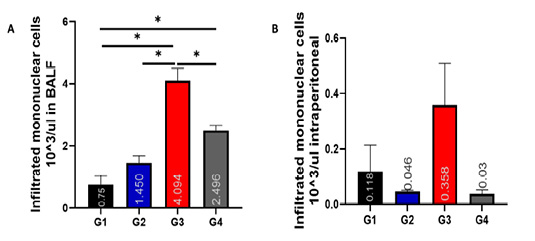
The effect of RES, Ova- induced Asthma, and their combination on the number of infiltrated mononuclear cells in BALF and intraperitoneal fluid in mature male rats. * P<0.05 is the statistical threshold for group differences. A: number of infiltrated mononuclear cells in BALF. B: Number of infiltrated mononuclear cells in intraperitoneal fluid. G1: rats received only drinking water, G2: Rats orally received resveratrol 100 mg/kg, G3: Rats were induced asthma, G4: Rats received both resveratrol and induced asthma.
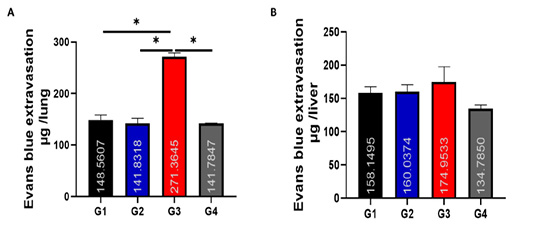
The effect of RES, Ova-induced asthma, and their combination on lung vascular leak by Evans blue dye in adult male rats * P<0.05 is the statistical threshold for group differences. A: Amount of Evans blue stain in the lung. B: Concentration of Evans blue stain in the liver. G1: rats received only drinking water, G2: Rats orally received resveratrol 100 mg/kg, G3: Rats were induced asthma, G4: Rats received both resveratrol and induced asthma.
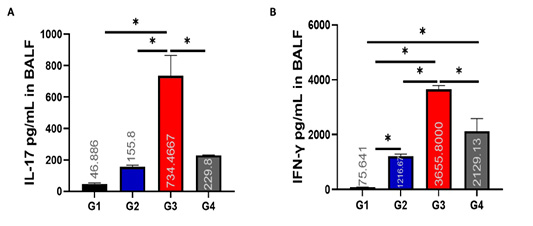
The effect of RES, Ova-induced asthma, and their combination on the concentration of IL-17 and IFN-γ in adult male rats. * P<0.05 is the statistical threshold for group differences. A: Concentration of IL-17 in BALF. B: Concentration IFN-γ in BALF. G1: rats received only drinking water, G2: Rats orally received resveratrol 100 mg/kg, G3: Rats were induced asthma, G4: Rats received both resveratrol and induced asthma.
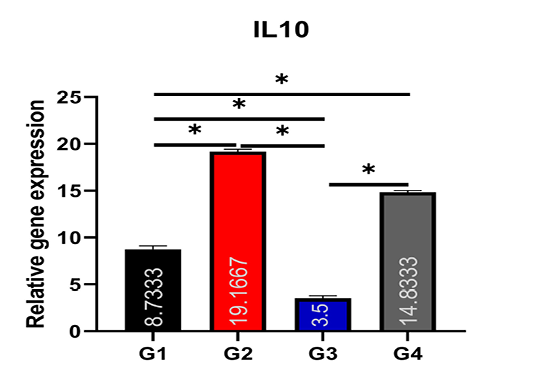
The effect of RES, Ova-induced asthma, and their combination on Il10 gene expression in adult male rats. * P<0.05 is the statistical threshold for group differences. G1: rats received only drinking water, G2: Rats orally received resveratrol 100 mg/kg, G3: Rats were induced asthma, G4: Rats received both resveratrol and induced asthma.
References
- Abdulla JM, Al-Okaily, BN (2022). Histomorphometric and Histopathological Alterations of Rat Testis Following Exposure to Hydrogen Peroxide: Protective Role of Resveratrol Supplement. Iraqi J. Vet. Med.. 46(1): 17-23. https://doi.org/10.30539/ijvm.v46i1.1313[CrossRef]
- Aggarwal BB, Bhardwaj A, Aggarwal RS, Seeram NP, Shishodia S., Takada Y. (2004). Role of resveratrol in prevention and therapy of cancer: preclinical and clinical studies. Antican. Res. 24: 2783–840.
- Ahmed RM, Mohammed AK. (2022). Amelioration of Hepatotoxicity by Sodium Butyrate Administration in Rats. World Vet. J. 12(3): 323-329. https://doi.org/10.54203/scil.2022.wvj41[CrossRef]
- Al-Hyani OH (2023). Histological comparison between histoacryl and suturing to close lung wounds in dogs. Iraqi J. Vet. Sci., 37(3): 751-758. https://doi.org/10.33899/ijvs.2023.136382.2578[CrossRef]
- Alghetaa H, Mohammed A, Singh N, Wilson K, Cai G, Putluri N, Nagarkatti M., Nagarkatti P (2023). Resveratrol attenuates staphylococcal enterotoxin B-activated immune cell metabolism via upregulation of miR-100 and suppression of mTOR signaling pathway. Front. Pharmacol., 24; 1106733. https://doi.org/10.3389/fphar.2023.1106733[CrossRef]
- Alghetaa H, Mohammed A, Sultan M, Busbee P, Murphy A, Chatterjee S, Nagarkatti M., Nagarkatti P (2018). Resveratrol protects mice against SEB-induced acute lung injury and mortality by miR-193a modulation that targets TGF-β signalling. J. Cellul. Molecul. Med. 22(5): 2644-2655. https://doi.org/10.1111/jcmm.13542[CrossRef]
- Alghetaa H, Mohammed A, Zhou J, Singh N, Nagarkatti M. Nagarkatti (2022). beneficial effects of resveratrol supplementation on parasitemia, oxidative stress and serum biochemical parameters in Trypanosoma brucei infected dogs”. Iraqi J. Vet. Sci. 36(3): 753-760. https://doi.org/10.33899/ijvs.2022.131843.2009[CrossRef]
- Alharris E, Mohammed A, Alghetaa H, Zhou J, Nagarkatti M., Nagarkatti P (2022). The Ability of Resveratrol to Attenuate Ovalbumin-Mediated Allergic Asthma Is Associated with Changes in Microbiota Involving the Gut-Lung Axis, Enhanced Barrier Function and Decreased Inflammation in the Lungs. Front Immunol. Feb 21; 13:805770. https://doi.org/10.3389/fimmu.2022.805770[CrossRef]
- Alharris E, Alghetaa H, Seth R. Chatterjee S, Singh NP, Nagarkatti M., Nagarkatti P (2018). Resveratrol Attenuates Allergic Asthma and Associated Inflammation in the Lungs Through Regulation of miRNA-34a That Targets FoxP3 in Mice. Front. Immunol. 9:2992. https://doi.org/10.3389/fimmu.2018.02992[CrossRef]
- Bhat KPL, Kosmeder JW II., Pezzuto JM (2001). Biological effects of resveratrol. Antioxid. Redox. Signal. 3. 1041–64. 10. https://doi.org/10.1089/152308601317203567[CrossRef]
- Brown K., Theofanous D., Britton R. G., Aburido G., Pepper C., Sri Undru S., Howells L. (2024). Resveratrol for the Management of Human Health: How Far Have We Come? A Systematic Review of Resveratrol Clinical Trials to Highlight Gaps and Opportunities. Int. J. Molecul. Sci., 25(2): 747. https://doi.org/10.3390/ijms25020747[CrossRef]
- Buckley A., Turner JR (2018). Cell biology of tight junction barrier regulation and mucosal disease. Cold Spring Harb. Perspect. Biol. 10: a006338. https://doi.org/10.1101/cshperspect.a029314[CrossRef]
- Cao Q., Jing C., Tang X., Yin Y., Han X., Wu W (2011). Protective effect of resveratrol on acute lung injury induced by lipopolysaccharide in mice. Anat. Rec. 294:527–532. https://doi.org/10.1002/ar.21331[CrossRef]
- Chigozie S Ukwueze, Polycarp O Akpa, Rita I Odo, Chinwe J. Aronu, Boniface M Anene (2022). The beneficial effects of resveratrol supplementation on parasitemia, oxidative stress and serum biochemical parameters in Trypanosoma brucei infected dogs. Iraqi J. Vet. Sci. 36(3): 753-760. https://doi.org/10.33899/ijvs.2022.131843.2009[CrossRef]
- Delmas D, Mornagui B., Aouani E et al (2007). Resveratrol a red wine polyphenol attenuates ethanol-induced oxidative stress in liver. Life Sci. 80:1033–9. · https://doi.org/10.1016/j.lfs.2006.11.044[CrossRef]
- Elaf A. Nayyef., Mawlood A. Al-Graibawi (2021). Clinical and immunological study of specific Mycobacterium bovis-BCG transfer factor in lambs. Iraqi J. Vet. Sci. 35(Supplement I-III): 67-72. https://doi.org/10.33899/ijvs.2021.131305.1939[CrossRef]
- Fuggetta M.P., Bordignon V., Cottarelli A., Macchi B., Frezza C., Cordiali-Fei P., Ensoli F., Ciafre S., Marino-Merlo F., Mastino A (2016). Downregulation of proinflammatory cytokines in HTLV-1-infected T cells by Resveratrol. J. Exp. Clin. Cancer Res. 35:118. https://doi.org/10.1186/s13046-016-0398-8[CrossRef]
- Gao X., Xu Y.X., Janakiraman N., Chapman R.A., Gautam SC (2001). Immunomodulatory activity of resveratrol: Suppression of lymphocyte proliferation, development of cell-mediated cytotoxicity, and cytokine production. Biochem. Pharmacol. 62:1299–1308. https://doi.org/10.1016/S0006-2952(01)00775-4[CrossRef]
- Gimeno-Mallench, C Mas-Bargues, M Inglés, G Olaso, C Borras, J Gambini, J Vina (2019). Resveratrol shifts energy metabolism to increase lipid oxidation in healthy old mice, Biomed. Pharmacother., 118: 109130. https://doi.org/10.1016/j.biopha.2019.109130[CrossRef]
- Goh S.S., Woodman O.L., Pepe S., Cao A.H., Qin C., Ritchie R.H. (2007). The red wine antioxidant resveratrol prevents cardiomyocyte injury following ischemia-reperfusion via multiple sites and mechanisms. Antioxid. Redox Signal. 9: 101–113. https://doi.org/10.1089/ars.2007.9.101[CrossRef]
- Hadil B. Al-Sabaawy; Enas S. Mostafa; Asseel M. Rahawi; Mohammad M. Jaber; Entisar K. Al-Hamdany., Soadd M. Al-Hmdany (2022). Histopathological study of sheep lung roaming in dump zones. Iraqi J. Vet. Sci. 36(Supplement I): 151-160. https://doi.org/10.33899/ijvs.2022.135830.2527[CrossRef]
- Holgate ST, Wenzel S, Postma DS, Weiss ST, Renz H, Sly PD. Asthma. Nat. Rev. Dis. Primers. 2015; 10(1): 15025. https://doi.org/10.1038/nrdp.2015.25[CrossRef]
- Ihsan Husain Mohammed Ali; Qasim Hasso Abdullah, Omer AL-Habib (2021). “Bronchodilator activity of ethyl acetate extract of Nigella sativa”. Iraqi J. Vet. Sci. 35(1): 145-149. https://doi.org/10.33899/ijvs.2020.126455.1333[CrossRef]
- Khayoon H. A., F. M. K. Al-Rekabi (2021). Cytotoxic Effect of Resveratrol on Colorectal Cancer Cell Line. Iraqi J. Vet. Med., 44(1): 68-74. https://doi.org/10.30539/ijvm.v44i1.939[CrossRef]
- Khudair NT, Al-Okaily BN (2022). Renal ameliorating effect of resveratrol in hydrogen peroxide induced male rats. Iraqi J. Vet. Sci.; 36(3): 571-577. https://doi.org/10.33899/ijvs.2022.130939.1898[CrossRef]
- Liu X.-J., Bao H.-R., Zeng X.-L., Wei J.-M (2016). Effects of resveratrol and genistein on nuclear factor-κB, tumor necrosis factor-α and matrix metalloproteinase-9 in patients with chronic obstructive pulmonary disease. Mol. Med. Rep. 13: 4266–4272. https://doi.org/10.3892/mmr.2016.5057[CrossRef]
- Lopez R, Dugo P., Mondello L (2007). Determination of transresveratrol in wine by micro-HPLC with fluorescence detection. J. Sep. Sci. 30: 669–727. https://doi.org/10.1002/jssc.200600300[CrossRef]
- Manni ML, Trudeau JB, Scheller EV, Mandalapu S, Elloso MM, Kolls JK, Wenzel SE., Alcorn JF (2014). The complex relationship between inflammation and lung function in severe asthma. Mucosal Immunol. 7(5): 1186-98. https://doi.org/10.1038/mi.2014.8[CrossRef]
- Masoli M, Fabian D, Holt S, Beasley R (2004). Global Initiative for Asthma (GINA) Program. The global burden of asthma: executive summary of the GINA Dissemination Committee report. Allergy. 59(5):469-478. https://doi.org/10.1111/j.1398-9995.2004.00526.x[CrossRef]
- Meng T, Xiao D, Muhammed A, Deng J, Chen L, He J. (2021). Anti-Inflammatory Action and Mechanisms of Resveratrol. Molecules. 26(1):229. https://doi.org/10.3390/molecules26010229[CrossRef]
- Mohammed A, Alghetaa HK, Zhou J, Chatterjee S, Nagarkatti P., Nagarkatti M (2020). Protective effects of Δ9 -tetrahydrocannabinol against enterotoxin-induced acute respiratory distress syndrome are mediated by modulation of microbiota. British J. Pharmacol. 177(22): 5078-5095. https://doi.org/10.1111/bph.15226[CrossRef]
- Mohammed, Zainab Y., Al-Jumaily, Essam F., Yaseen, Nahi Y., Al-Mustansiriya (2011). Cytogenetic study of the pure Resveratrol extracted from grape skin on normal peripheral human blood lymphocytes. J. Biotechnol. Res. Centre.5(2): 17-24. https://doi.org/10.24126/jobrc.2011.5.2.156[CrossRef]
- Sanabel A. Al Thanoon., Ameer M. Taha (2022). Histopathological changes on the pregnant rat’s lung induced by sodium nitrite and monosodium glutamate. Iraqi J. Vet. Sci. 36(2): 419-424 https://doi.org/10.33899/ijvs.2021.130464.1824.[CrossRef]
- Shimuzu M, Weinstein IB (2005). Modulation of signal transduction by tea catechins and related phytochemicals. Mutat. Res. 59:147–9. https://doi.org/10.1016/j.mrfmmm.2005.04.010[CrossRef]
- Soleas GJ, Diamandis EP. Goldberg DM (1997). Resveratrol: a molecule whose time has come? And gone? Clin. Biochem 30:91–113. https://doi.org/10.1016/S0009-9120(96)00155-5[CrossRef]
- Song J, Cheon SY, Jung W, Lee WT., Lee JE (2014). Resveratrol induces the expression of interleukin-10 and brain-derived neurotrophic factor in BV2 microglia under hypoxia. Int. J. Mol. Sci. 15(9): 15512-29. https://doi.org/10.3390/ijms150915512[CrossRef]
- Shimuzu M, Weinstein IB (2005). Modulation of signal transduction by tea catechins and related phytochemicals. Mutat. Res. 59: 147–149. https://doi.org/10.1016/j.mrfmmm.2005.04.010[CrossRef]
- Stef G, Csiszar A, Lerea K, Ungarvari Z., Veress G (2006). Resveratrol inhibits aggregation of platelets from high-risk cardiac patients with aspirin resistance. Cardiovesc. Pharmacol. 48: 1–5. https://doi.org/10.1097/01.fjc.0000238592.67191.ab[CrossRef]
- Sultan M, Alghetaa H, Mohammed A, Abdulla OA, Wisniewski PJ, Singh N, Nagarkatti P., Nagarkatti M (2021). The Endocannabinoid Anandamide Attenuates Acute Respiratory Distress Syndrome by Downregulating miRNA that Target Inflammatory Pathways. Front Pharmacol. 27(12): 644281. https://doi.org/10.3389/fphar.2021.644281[CrossRef]
- Song J, Cheon SY, Jung W, Lee WT., Lee JE (2014). Resveratrol induces the expression of interleukin-10 and brain-derived neurotrophic factor in BV2 microglia under hypoxia. Int. J. Mol. Sci. 15(9): 15512-15529. https://doi.org/10.3390/ijms150915512[CrossRef]
- Terla B., Waterhouse A (1996). Resveratrol: isomeric molar absorptivities and stability. J. Agric. Food Chem. 44: 1253–7 https://doi.org/10.1021/jf9504576·[CrossRef]
- Woodrow J.S., Sheats M.K., Cooper B., Bayless R (2023). Asthma: The Use of Animal Models and Their Translational Utility. Cells. 12: 1091. https://doi.org/10.3390/cells12071091[CrossRef]
- Zhang Z., Chen N., Liu J., Wu J., Zhang J., Zhang Y., Jiang X (2014). Protective effect of resveratrol against acute lung injury induced by lipopolysaccharide via inhibiting the myd88-dependent Toll-like receptor 4 signaling pathway. Molecul. Med. Rep., 10(1): 101-106. https://doi.org/10.3892/mmr.2014.2226[CrossRef]
- Zhang H.X., Duan G.L., Wang C.N., Zhang Y.Q., Zhu X.Y., Liu Y.J (2014). Protective effect of resveratrol against endotoxemia-induced lung injury involves the reduction of oxidative/nitrative stress. Pulm. Pharmacol. 27:150–155. https://doi.org/10.1016/j.pupt.2013.07.007[CrossRef]
Cited by 4 articles
In journals published by ResearchersLinks.
- Resveratrol Attenuates the Endometriosis-Mediated Inflammatory and Oxidative Stress ResponsesJournal of Animal Health and Production · 2026
- Omega-3 Administration Suppresses Changes in the Lungs of D-Galactose-Mediated Aged RatsJournal of Animal Health and Production · 2026
- An Overview of Interplay Between Aging, D-Galactose and Oxidative StressJournal of Animal Health and Production · 2025
- Resveratrol Administration Reverses the Endometriosis-Mediated Outcomes via Tgfβ Signaling in RatsJournal of Animal Health and Production · 2025
Services
Article usage statistics
Loading…