
Molecular and proteomic study was conducted on field evolved resistance of Red Palm Weevil (Rhynchophorus ferruginous) against Parathyroid group of insecticide (Cypermethrin). Cytochrome P450 genes have been associated with insecticides resistance. Field collected population of R. ferruginous from different provinces of Pakistan was investigated for insecticides resistance development against P450 gene. Insect bioassay indicated highly significant level of LC50 values among laboratory reared and field collected population against Cypermethrin. The laboratory reared resistant population, Sindh and South Punjab collected population showed high LC50 values as compared to susceptible, Baluchistan and KPK population. The expression of P450 gene through PCR showed enhanced level of P450 gene in different Instars as well as collected population. The dsRNA specific for CYP450 gene was designed and targeted through dsRNA in thoracic region of R. ferruginous through micro-injection. Gene expression and proteomic study confirmed the down regulation of P450 gene and associated protein in dsRNA treated population. The application of ds RNA specific for CYP450 also reduced insecticide resistance in R. ferruginous. The developmental parameters were highly affected in RPW treated with dsRNA as compared to control samples treated with water or dsGFP. These results support the RNAi application as a suitable tool for the management of insecticide resistance and control of R. ferruginous.
Research Article · Volume 52, Issue 2, 17 January 2020 · Open Access
Molecular Study on Field Evolved Resistance of Red Palm Weevil (Rhynchophorus ferruginous) and its Management through RNAi
· · ·
Affiliations & Notes ⌄
- 1Integrated Genomics, Cellular, Developmental and Biotechnology Laboratory, PARS Campus, Department of Entomology, University of Agriculture, Faisalabad 2Plant Physiology and Molecular Biotechnology Lab, Department of Botany, University of Agriculture, Faisalabad 3Department of Agronomy, University of Agriculture, Faisalabad , * Corresponding author: jam.ahmad@uaf.edu.pk
Article Info ⌄
- Journal:
- Pakistan Journal of Zoology
- Published:
- 17 January 2020

From the article
- In the present study, R. ferrugineus was injected with dsRNA-P450 by micro-injection via ventral micro-inoculation to suppress the Cytochrome P450 gene in RPW.
- The solicitation of dsRNA through micro-injection provided significant results showing shortened life span upon dsRNA in D. citri as compared to control.
- In light of the fact, dsRNA specificity suggested a helpful invention to control the resistance in the R. ferrugineus as demonstrated in both exposed as well as resistant R. ferrugineus population.
- Contrarily, no impact of dsRNA-gfp was detected on mortality as well as Cytochrome P450 gene expression in control treatments.
Selected from the article's own text.
Abstract
INTRODUCTION
The date palm is an important fruit tree but due to severe attack of pests and diseases 30% yield losses were recorded throughout the world . R. ferrugineus is regarded as tissue borer that have the ability to destroy 28 species of palm trees throughout the world. The enormous losses induced annually by this invasive pest in the Middle East are around $US 130 million ; In Pakistan, recently, red palm weevil (R. ferruginous), dusky cotton bug, (Oxycarenus hyalinipennis) and nucleopolyhedrovirus from Armyworm (Spodoptera litura) have been collected, molecularly identified and characterized from Pakistan , b; .
For the past six decades, synthetic pesticides are being implemented as pest control regardless of their negative impacts such as environmental pollution, health hazards, resistance development in insects (Tiwari et al., 2011b) and contamination of foods due to residual effect . The parasites and predators are also killed due to no target specificity of these insecticides. To handle this burning pest, molecularly constructed insecticides specific to insect species may be helpful.
RNA interference is a reliable molecular technique employed in insect pest management and operational gene expression due to the systemic nature of dsRNA ; ; ; ; .Plenty of genes have been isolated and targeted for RNAi in various insects such as chitinase in Tribolium castaneum, Ostrinia nubilalis, Nilaparvata lugens, Mythimna separata, Manduca sexta, Drosophila melanogaster, Chilo suppressalis, Bombyx mori, Anopheles gambiae and many other economically serious pests ; Zhu et al., 2008b; ; Zhang et al., 2011; ; ; ; ; ; .
Cytochrome P450 mono-oxygenase is one of the exceedingly vital groups of enzymes which are important for metabolism in arthropods. Explicit gene silencing has been directed via ingestion or incorporation of dsRNA in Caenorhabditis elegans, tick and flatworms, respectively ; . In the same manner the gene suppression through microinjection in last instar larvae as well as adult of T. castaneum and insects such as Ostrinia nubilalis larvae for dsRNA delivery has been practiced. Catalase and Olfactory Co-Receptor (Rfer Orco) down regulation in Rhynchophorus ferrugineus has been achieved in near past ; .
The purpose of this investigation was to evaluate parathyroid insecticide resistance level in R. ferruginous population in association with expression of P450 gene and to enhance the effectiveness of this pesticide by knocking down the expression of resistance P450 gene. This was achieved via injection of dsRNA to the thorax region of R. ferruginous.
MATERIALS AND METHODS
Collection and rearing of R. ferruginous
Adults, larvae and pupae of R. ferruginous were collected from four provinces of Pakistan, Punjab (31.1704° N, 72.7097°E) Baluchistan (28.49° N, 65.0958° E), Sindh (25.8943°N, 68.52°E) and KPK, 34.95°N, 72.331°E) from field and various palm orchards of the public and private sectors and rearing was done at Integrated Genomics, Cellular, Developmental and Biotechnology Laboratory (IGCDB), Department of Entomology, University of Agriculture, Faisalabad. Collections were made with the help of pheromone traps as well as handpicking and transferred into insect rearing boxes (15cm × 10cm × 5cm) for rearing and bioassays purposes. Laboratory susceptible (SG7-without pesticides exposure) and resistant (RG6-contiuously exposed to pesticides for 6th generations (G6) population of R. ferruginous parathyroid insecticide were developed and maintained under laboratory controlled conditions (25±5 °C, R.H 60±5%) with 12:12 (L: D) periods. Different concentration (10-500 ppm) of tested insecticide (Parathyroid) was applied against R. ferruginous of laboratory and field collected population along with control and mortality data after 24h were recorded regularly.
Gene expression studies
Total RNA isolation from R. ferruginous samples collected from fields as well as laboratory susceptible and resistant population was done by using isolation kit (Promega WI., USA). Picodrop-200 was used to measure the quality and quantity of the RNA. The cDNA synthesis was doneusing kit (iScript synthesis kit, CA, Bio-Rad, USA). Expression of the gene P450, beta actin and gfp was determined according to the protocol of (Ahmad et al., 2013a; 2014). The primers for Beta actin, P450 and gfp (control) genes are shown in Table I. Gel electrophoresis on 1.5% gel stained with ethidium bromide was carried out in 1% TAE buffer. There were five replicates consisting of 10 insects including three technical replications.
Construction of double stranded RNA (dsRNA)
Double stranded RNA specific for P450 gene (mono-oxygenase) was synthesized according to the manufacturer protocol through RNAi-kit (Austin, TX) following the methodology of Al-Ayedh et al. (2016). Using reverse and forward primers with T7 promoters designed for P450 gene were amplified to get339 bp from the cDNA synthesized (Table I). There were 35 cycles consisting of 72 °C for 60 sec, 55 °C for 45 seconds and 94 °C for 30 seconds with 10 minutes elongation steps at 72 °C for the PCR amplifications.. PCR amplified product was sent for purification and sequencing to Macrogen for verification of the desired sequence. P450 ds RNAwas generated and then suspended in the DEPC water and quantified using Nanodrop (Pico-200). Agarose gel electrophoresis (1.5 %) was performed for the verification of amplified genes. . The concentration of tested genes used in RNAi experiment were made up to (1µg/uL in ddH20) and kept at -20 °C. The same protocols and methods were used for constructing of the double stranded RNA for green fluorescent protein (gfp) employed for control.
Induction of RNAi in R. ferruginous
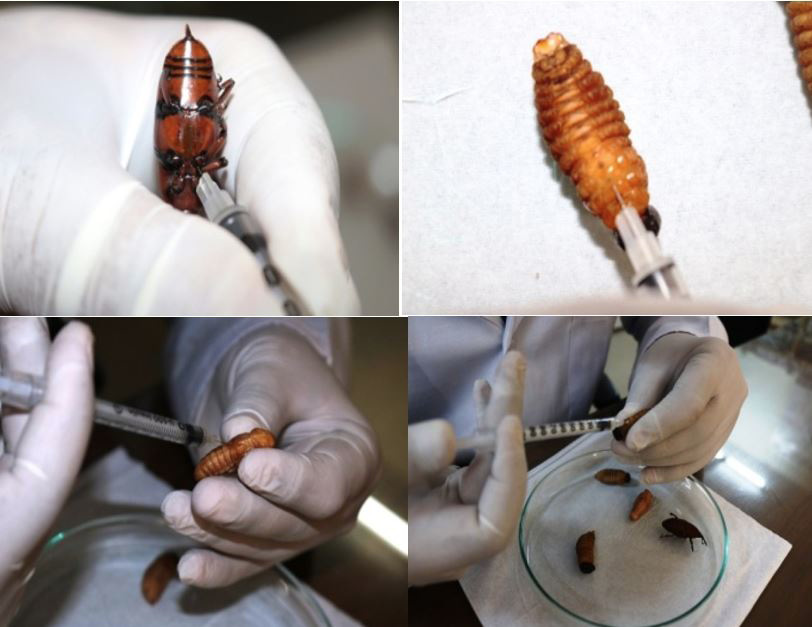
P450-dsRNA was micro-injected at a concentration of 0.5, 1.5, 2 and 3 ug/insect in the thoracic region of 5th, 10th instar larvae and adult of R. ferruginous and observed for a times period of 4h-48h (Fig. 1). For the purpose of negative and positive control, DEPC water and dsGFP were used for the microinjection. These treated insects were then dissected 24-48h after application and forgut, midgut and hindgut were extracted for further study. Three replications were made with ten larvae per replication. Treated and control larval population were placed in the cups and allowed to feed on the artificial diet.
Gene knockdown assessment through qRT-PCR
Knockdown effect for P450 gene was studied through PCR. For each test sample, about 25µl reaction mixture was prepared consisting of RNA free water (8.5 µl), cDNA template (2 µl), and primers (1µl reverse primer and 1µl forward primer) including 12.5µl PCR mix. RT-PCR (real time) was done according to Ahmad et al., 2013, 2014.
Table I. Genes and primers used in gene expression and RNAi study.
| Purpose | Gene name | Primers sequences used |
| dsRNA Synthesis | P450-2 Forward | 5′- TTACTGGGGCGATCTTCACG-3′ |
| P450-2 Reverse | 5′- TGAAGCGTTCCAAGGTCTCC-3′ | |
| β-Actin-2 Forward | 5′-AAAGGTTCCGTTGCCCTGAA-3′ | |
| β-Actin-2 Reverse | 5′-ACCACAAAGCTTCCATACCCA-3′ | |
| P450-T7 Forward | 5′-TAATACGACTCACTATAGGGAG ATTGACCTTGAGGACGGAATC-3′ | |
| P450-T7 Reverse | 5′-TAATACGACTCACTATAGGGAGA TTGACCTTGAGGACGGAATC-3′ | |
| dSGFP-Forward | 5′-TAATACGACTCACTATAGGGAGAAA GGGCGAGGAGCTGTTCACCG-3′ | |
| dSGFP-Reverse | 5′-TAATACGACTCACTATAGGGAGA CAGCAGGACCATGTGATCGCG-3′ |
Table II. The probit analysis showing Resistance Ratios (RR) in Lab R(G6)= laboratory resistant, FP= Field resistant population from Punjab, FK= Field resistant population from KPK, FS= Field resistant population from Sindh and FB= Field resistant population from Baluchistan of RPW through employing 0-, 10-, 50-, 100 plus 500 ppm insecticides concentrations.
| Pop. | n | LC50 | Lower | Slope | Inte-rcept (Log) | SD | SE | R^2 | Chi-test(χ2) | DF | RR |
| Lab S(G7) | 150 | 1.991183423 | 0.85078609 | 0.812 | 0.256 | 1.231 | 0.188 | 0.868 | 0.999 | 12 | - |
| Lab R(G6) | 150 | 355.6143702 | 162.328689 | 0.709 | 1.811 | 1.410 | 0.174 | 0.895 | 0.640 | 12 | 178.5945 |
| FP | 150 | 14.58985924 | 8.39388539 | 1.091 | 1.261 | 0.917 | 0.122 | 0.865 | 0.948 | 12 | 7.32723 |
| FK | 150 | 8.5657616 | 3.3274262 | 0.587 | 0.546 | 1.704 | 0.210 | 0.809 | 0.993 | 12 | 4.301845 |
| FS | 150 | 30.9031022 | 15.8941465 | 0.826 | 1.198 | 1.211 | 0.147 | 0.469 | 0.009 | 12 | 15.51997 |
| FB | 150 | 3.949345446 | 1.63997052 | 0.683 | 0.413 | 1.464 | 0.195 | 0.863 | 0.999 | 12 | 1.983416 |
PCR condition were used as 95°C for 30 seconds followed by the other cycles at 95 °C for 5 seconds and lastly at 60 °C for 30 seconds. Analysis of the melting curve was done by the final elongation step of 10 and 15 minutes at 95°C and 60°C respectively with three replications. Beta actin expression was used as standard to standardize the P450 expression by following the 2-∆∆Ct procedure of Livak and Schmittgen (2001).
Western blot assay
Protein was extracted from dsP450 treated and control R. ferruginous samples according to prescribed procedure (Ahmad et al., 2013b). Transverse electrophoresis was used for the blotting on PVDF (Perkin Elmer) membrane at 4°C at 100V in a glycine buffer (0.192 mM) and Tris base (0.025 mM). At room temperature, immune labeling was implemented. Tween 20 was used for the incubation of PVDF membranes for 1 hour. Membrane washing was done with Tween 20 (0.05%). Membranes were incubated with laboratory prepared polyclonal antibodies (Anti-P450 1/4000) for two hours and then diluted with Tween 20. PBS Tween 20 (0.05%) was used for washing (4x5 min. and 1x15min.). Chemi-luminescent reagent kit (Thermo Fisher) was used to express the labeling in the dark room. Light films (Kodak Biomax) were used to expose the membranes.
Application of pesticides
R. ferruginous were reared and maintained in cages box and fed on artificial diet for a period of two hours and then transferred to other cages. Efficacies of the dsRNA were assessed in the R. ferruginous applied with different concentrations (0, 0.5, 1, 1.5, 2 and 3µg/insect). The plates were soaked in the insecticides solution for 30 seconds in acetone and then air dried about 1h prior to insect placement according to the methods of Killiny et al. (2014). The cypermethrin at dosage rate of the 0.02 ng Al/ml (acetone) were used. The mortality data was recorded after every 24 hours. For P450-dsRNA, ds-RNA-gfp was implemented as control treatment. There were five replications having five insects from RPW tested population. Each population was applied with four treatments such as RNase free water, cypermethrin treated discs, dsRNA-P450 treated RPW and cypermethirn.
Statistical analysis
Collected data were analyzed through ANOVA and DMR (Tukey’s Multiple Range Test) used for mean’s comparison at 5% significance level by SAS18. Means were expressed as standard error (SE). Insecticide resistance and activity of the P450 was examined through Probit analysis. Student-T significant test was used to find the comparisons among the treatments and genes expression at 5% significance level.
RESULTS
Evolution of resistance in R. ferruginous
Comparative resistance development was studied in Laboratory susceptible, laboratory resistant and four field populations (FP, FK, FS and FB) collected from four provinces {Punjab (P), Sindh (S), Baluchistan (B) and KPK (K) the Pakistan (Table II). The observed resistance ratio (RR) for laboratory resistant population of generation (G6) was 178.5945 fold as compared to laboratory susceptible generation (G7). The field populations of Sindh (FS) and Punjab (FP) depicted 15.5 and 7.32 fold more resistance whereas resistance ratio of field population of KPK (FK) and Baluchistan (FB) population was 4.3 and 1.98 fold more as compared to laboratory susceptible ones.
Expression of cytochrome P450 gene in field collected R. ferruginous population
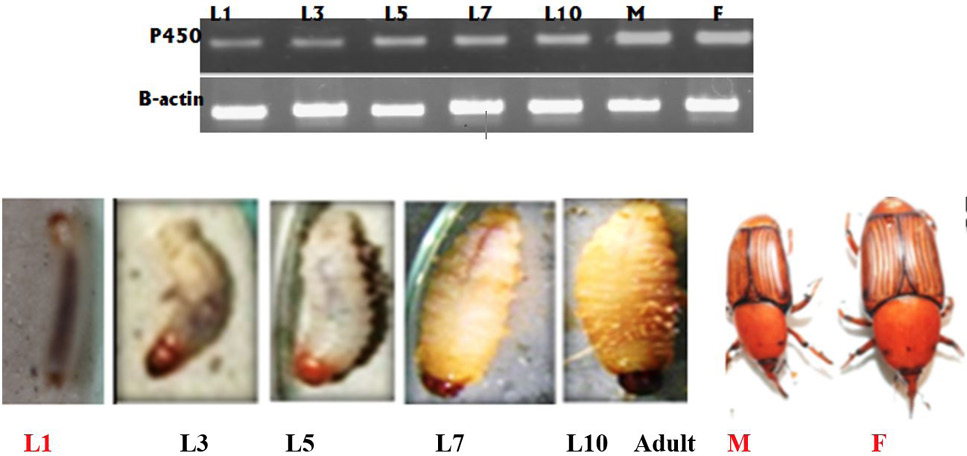
Through RT-PCR, Cytochrome P450 gene expression was studied in larval and adult population collected from different places before the application of dsRNA-P450. Adult male (M), female (F) and Last stages of larval instars showed maximum expression of P450 gene expression as indicated by band intensity. Bands intensity in gel for various larval stages has the expression of P450 gene with increasing trend from L1 to L10. The expression of P450 was highly enhanced in larval stages L7-L10 as compared to L1-L3 as compared to constant expression of B-actin reference gene (Fig. 2).
Gene knockdown by larval injection with dsRNA
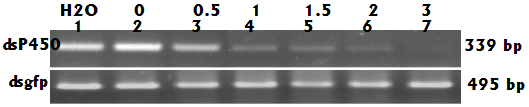
Infusion of larvae (10th instar) with dsRNA-P450 at different concentrations exhibited significant knockdown of P450 gene. After 24-48h of dsRNA-P450 injection, the knockdown effect for P450 was enhanced as dose rate increased from 0-3 µg/insect (Fig. 3). The high intensity of amplified bands was observed in the foregut of L10 with H20 and 0µg / insect (Wells 1-2) while the bands intensities was reduced gradually with increased doses showing down regulated expression of P450 gene in R. ferruginous (Wells 3-7). The 40-50 percent larvae was found dead after 48h and 10 percent larvae was found abnormal with passage of time as shown in Fig. 3)
Expression of P450 gene proteins after dsRNA- P450 treatment
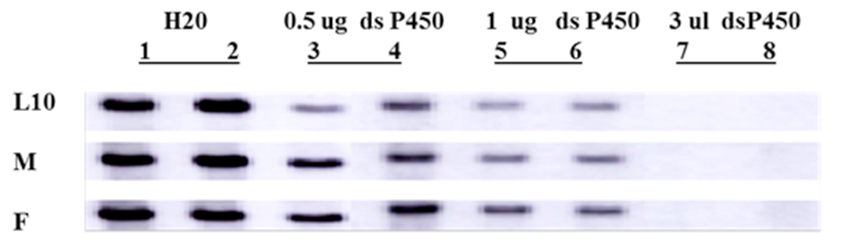
The ds-RNA application in R. ferruginous (male and female) was confirmed by western blot analysis. The controlled palm weevil, R. ferruginous exhibited maximum amplification of P450 expression. When R. ferruginous was treated with different concentrations of dsRNA-P450 (0.5µg, 1µg and 3µg) and constant doses of dsRNA-gfp (control), a decreasing expression of P450 gene was observed. The activity of P450 was decreased tremendously by increasing the concentration of applied dsRNA-P450. The complete cytochrome P450 down-regulation was achieved when 3µg/ insect concentration of dsRNA-P450 was injected to the body of R. ferruginous. Although 0.5 µg/insect concentration of dsRNA-P450 suppresses the P450 gene but no significant results were noted. It was observed that target P450 expression levels and dsRNA treated proteins expressions are directly correlated (Fig. 4).
Down regulation of P450 gene induced by dsRNA-P450 treatment through qRT-PCR
The expression was also studied with qRT-PCR after the application of dsRNA-P450 and dsRNA-gfp. The treatment with ds-RNA-P450 induced reduced expressions of P450 gene at 1-2 ug/individual. Each treatment sample of ds-RNA-P450 indicated positive correlation as down regulation of P450 expression with increased dose rate (1-2 ug/individual). The target gene P450 expression was investigated in ds-GFP treated insect samples used as control treatments. The relative gene expression of P450 in R. ferruginous exhibited significant down regulation (0. 2-0.5 *P<0.05) compared with dsRNA-GFP control treatments (1 *P<0.05). The dsRNA P450 employed with 2µg/larva displayed maximum down regulation (0.03-0.1 ***P<0.005), compared with as treated with 1µg/adult or larvae (0.2-0.3*P<0.05). But the down regulation of P450 was higher in larva (0.03-0.2) as compared to adults (0.3-0.4). The control gene Beta actin demonstrated constant expression level in all dsP450 and dsGFP treated insect (Fig. 6). Statistically no significant differential gene expression was recorded in reference gene Beta-actin. The results proved that the dsRNA-P450 was found target specific and induced maximum mortality.
Down regulation of Cytochrome P450 increased insecticide susceptibility in RPW
The effectiveness of cypermethrin against the different laboratory susceptible, resistant, and Punjab field collected larvae, male and female (SL, SM and SF; FL, FM and FF and RL, RM and RF) population of R. ferruginous were assessed. Its effectiveness was investigated before and after the application of dsRNA-P450 (Fig. 5). R. ferruginous Punjab and laboratory resistant populations exhibited minimum susceptibilities for cypermethrin mixed in artificial diet at LD50 recommended dose rates. RNase-free water treatments were used as control treatments. The pesticide treated SL, SM, SF, RF and RL populations’ showed more significant (P<0.01) relationship and mortality was (Susceptible 84±3, 75±2, 73±6), (Field 63±4, 60±2, 55±5), (Resistant 38±1, 33±1, 32±2) respectively, comparing with H2O treatment pool of RPW (susceptible 11±4, 11±3, 8±2), (field 12±4, 11±2, 13±2), (resistant 6±2, 9±3, 8±1). When these population were treated with dsRNA P450 at least 12h before pesticide treatment, “Susceptible, Field and Resistant population of R. ferruginous showed significant interaction (P<0.005) and mortality was increased (susceptible 98±6, 95±2, 91±4), (field 90±2, 83±6, 81±7), (Rresistant 78±4, 73±4, 72±3), respectively) after the application of dsRNA-P450 (Fig. 7).
DISCUSSION
Various genes that play an important role in the growth and development of R. ferrugineus are diverse in chemical composition and enzymatic properties. In R. ferrugineus, glycoside hydrolase 18 (GH18), playing an important role in the chitin synthesis of mature eggs of R. ferrugineus .
According to Timmons and Fire (1998) feeding or micro-injection are the key methods associated with the novel RNA-interference expertise and its utilization for arthopodal control in the field conditions ; . These techniques have both benefits in addition to limitations. Passionate training is requisite in micro-injection technology comprising injection point, needle size for efficacious dsRNA penetration in test insects and appropriate calibration and optimization is needed for assortment of volume . The dsRNA-P450 delivered through micro-injection reduces adequacy for the induction of RNAi . Potency of the double stranded RNA is diminished inside the gut of insect body due to harsh environmental conditions ; making it difficult for quantifying the amount of dsRNA. In the present study, R. ferrugineus was injected with dsRNA-P450 by micro-injection via ventral micro-inoculation to suppress the Cytochrome P450 gene in RPW.
The current work was supported by the previous work done to suppress a number of genes in insect pests including Blattodea, Hymenoptera, Neuroptera, Dictyoptera, Orthoptera, Diptera, Lepidoptera, Hemiptera and Coleoptera. These orders have been showing amenability to RNAi mediated down regulations of target genes ; ; ; ; . Moreover, the Cytochrome P450 provides gossypol resistance to insects and is also a pesticide detoxifying gene. Turner et al. (2006) observed that the reduction in the mRNA in E. postvittana is induced by highly concentrated (4000 ppm) dsRNA but it doesn’t cause mortality. Insect disease resistance against D. citri is supported by the metabolic mechanism which is enhanced by over-expression of gene (cytochrome P450) and detoxifying enzymes ; Tiwari et al., 2011a, 2011b; , Helicoverpa armigera was subjected to dsRNA down regulation of CYP6AE14 gene and retarded growth was observed , cytochrome P450 monooygenase genes suppression was also noted in Aphis gossypii . Catalase and Olfactory Co-Receptor RferOrco down regulation in R. ferrugineus has been done to control this invasive pest ; .
El-Sheshay et al., (2013) proved that gene (P450) in the D. citri can be down regulated by a small amount of dsRNA (1µg/insect). However, in present work 3µg/insect concentration was sufficient to down regulate the Cytochrome P450 gene. The solicitation of dsRNA through micro-injection provided significant results showing shortened life span upon dsRNA in D. citri as compared to control. In some cases it causes 40-50% mortality of O. nubilalis . Double stranded-RNA target design is likewise pretty supportive in case of non-target arthropods in the fields . In light of the fact, dsRNA specificity suggested a helpful invention to control the resistance in the R. ferrugineus as demonstrated in both exposed as well as resistant R. ferrugineus population. Contrarily, no impact of dsRNA-gfp was detected on mortality as well as Cytochrome P450 gene expression in control treatments. One of the most vital limitations of dsRNA is its difficult and costly for large scale. Moreover, different insect species lack the RNA interference machinery and concerned genes with high transcriptional rate so the impact of RNA interference can be evaded by them . The dsRNA delivery in the H. armigera and D. vergifera introduced through plant mediated RNA interference shows positive correlations ; . The dsRNA could be applied in the absence of interferon regulated innate immunity for maximal effect of RNAi . According to some researchers, the injection of bacteria with dsRNA provides a potential feasible delivery of dsRNA as well as engaging them to plants in foliar form with appropriate transfection reagent therefore, In future, dsRNA efficacy with any other microbial formulations or mixtures will be evaluated for the purpose of dsRNA application in field conditions against R. ferruginous.
Acknowledgements
Authors are highly grateful to Punjab Agriculture Research Board (PARB) under grant (PARB-802) to conduct research, Higher Education Commission of Pakistan (HEC) under grant (No.204535/ NRPU/R&D/HEC/14/159) and Framework of Institutional Cooperation Program (FICP-Pak-Norway Grant) (to Dr. Jam Nazeer Ahmad and Dr. Samina Jam Nazeer Ahmad) for providing funds to establish well equipped Laboratory (IGCDB) at University of Agriculture, Faisalabad, Pakistan.
Statement of conflict of interest
The authors declare no conflict of interest.
Figures
Demonstration of the injection of dsRNA in the 5th, 10th instar larvae and adults of R. ferruginous.
P450 expression through PCR in several R. ferruginous larval instars (L1-1st instar, L3- 3rd instar, L5- 5th instar, L7- 7th instar and L10- 10th instar), male (M) and female (F).
P450 down regulation in 10th larval instars (L10) and its knockdown influence via microinjection of dsRNA Conc. (µg/insect).
Expression of P450 proteins by using ant-P450 antibodies.
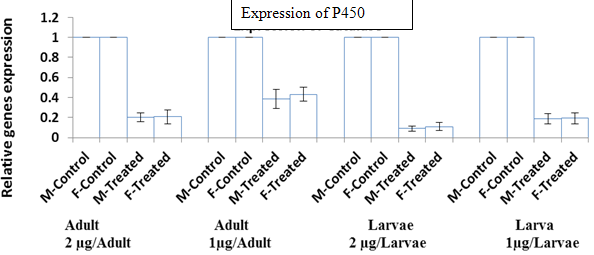
Expression of P450 gene through qRT-PCR in male, female and larva of R. ferrugineus. (*P<0.05, **P<0.01 and ***P<0.005).
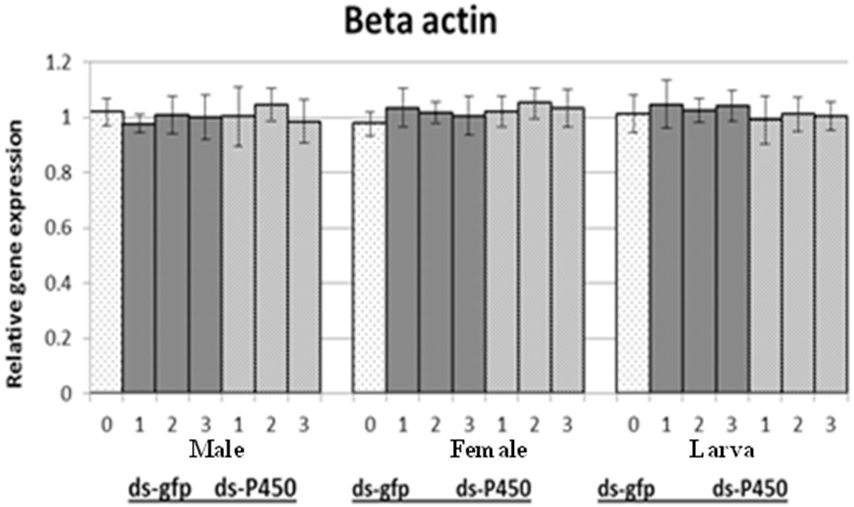
Beta-actin expression in R. ferrugineus larvae (10th instar and Male and Female from left to right) after the application of dsRNA-gfp and dsRNA-P450
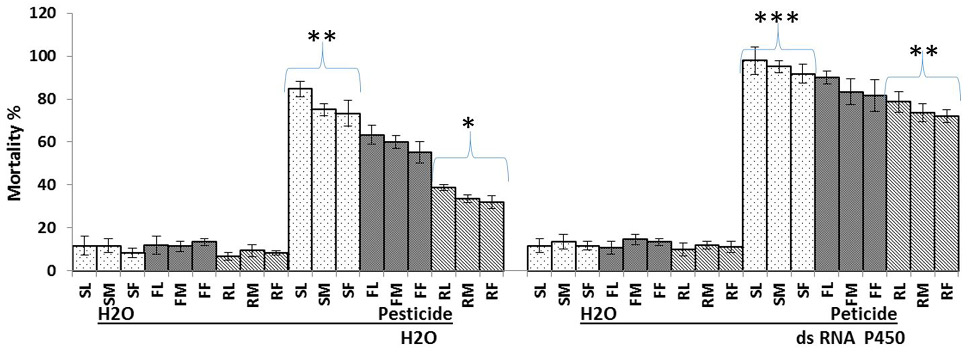
Mortality percentage of R. ferrugineus population in response to Pesticide (Cypermethrin) and ds RNA P450 application. SL= “Susceptible larvae”- SM= “Susceptible male”- SF= “Susceptible female”- RL= “Resistant larvae”, RM= “Resistant Male”- RF= “Resistant Female”-, FL= Field larva, FM=Field Male and FF=Field Female (Field population of Sindh province was used. Mortality was observed after 48h of treatment. (*P<0.05, **P<0.01 and ***P<0.00
References
- Abdel-Banat, B.M., El-Shafie, H.A., Alhudaib, K.A., El-Araby, W.S. and Al-Hajhoj, M.R., 2018. Molecular characterization and tissue expression analysis of five genes for chitinase in the red palm weevil, Rhynchophorus ferrugineus (Coleoptera: Curculionidae). Afri. J. Biotech., 17: 447-457.
- Ahmad J.N., Jafir, M., Javed M. W., Maqsood. S. and Ahmad, S.J.N., 2018a. Molecular identification and Sequence analysis of the dusky cotton bug, Oxycarenus hyalinipennis (Hemiptera:Lygaiedae) infesting cotton in Pakistan. Pakistan J. Zool. 50. https://doi.org/10.17582/journal.pjz/2019.51.2.SC1[Full text][CrossRef]
- Ahmad, J.N., Mushtaq, R., Ahmad, S.J.N., Maqsood, S., Ahuja, A. and Bones, A.M., 2018b. Molecular Identification and Pathological characteristics of native isolated NPV against Spodoptera litura (Fabricius) in Pakistan. Pakistan J. Zool. 50: 2229-2237, 2018. https://doi.org/10.17582/journal.pjz/2018.50.6.2229.2237[Full text][CrossRef]
- Ahmad, J.N., Renaudin, J. and Eveillard, S., 2014. Expression of defence genes in stolbur phytoplasma infected tomatoes, and effect of defence stimulators on disease development. Eur. J. Pl. Pathol. 139 : 39-51. https://doi.org/10.1007/s10658-013-0361-x[CrossRef]
- Ahmad, J.N., Pracros, P., Garcion, C., Teyssier, E., Renaudin, J., Hernould, M., Gallusci, P. and Eveillard, S., 2013a. Effects of stolbur phytoplasma infection on DNA methylation processes in tomato plants. Pl. Pathol., 62: 205-216. https://doi.org/10.1111/j.1365-3059.2012.02605.x[CrossRef]
- Ahmad, J.N., Peyret, L.M., Moreau, P. and Ahmad, R., 2013b. Study of Lipid Protein interaction in the secretory pathway of plant cell by raising and using antilipid antibodies against particular lipids and proteins in Arabidopsis and tobacco plant. Pakistan J. Bot., 459: 509-514
- Al-Ayedh, H., Rizwan-ul-Haq, M., Hussain, A. and Aljabr, A.M., 2016. Insecticidal potency of RNAi-based catalase knockdown in Rhynchophorus ferrugineus (Oliver) (Coleoptera: Curculionidae). Pest Manage. Sci., 72: 2118-2127. https://doi.org/10.1002/ps.4242[CrossRef]
- Baulcombe, D., 2004. RNA silencing in plants. Nature, 431: 356-363. https://doi.org/10.1038/nature02874[CrossRef]
- Baum, J.A., Bogaert, T., Clinton, W., Heck, G.R., Feldmann, P., Ilagan, O., Johnson, S., Plaetinck, G., Munyikwa, T. and Pleau, M., 2007. Control of coleopteran insect pests through RNA interference. Nature Biotech., 25: 1322-1326. https://doi.org/10.1038/nbt1359[CrossRef]
- Bellés, X., 2010. Beyond drosophila: RNAi in vivo and functional genomics in insects. Annu. Rev. Ent., 55: 111-128. https://doi.org/10.1146/annurev-ento-112408-085301[CrossRef]
- Bucher, G., Scholten, J. and Klingler, M., 2002. Parental RNAi in Tribolium castaneum (coleoptera). Curr. Biol., 12: R85-R86. https://doi.org/10.1016/S0960-9822(02)00666-8[CrossRef]
- Cao, B., Bao, W. and Wuriyanghan, H., 2017. Silencing of target chitinase genes via oral delivery of dsRNA caused lethal phenotypic effects in Mythimna separata (Lepidoptera: Noctuidae). Appl. Biochem. Biotechnol., 181:860-866. https://doi.org/10.1007/s12010-016-2254-x[CrossRef]
- Cheng, D., Cao, N., Chen, J., Yu, X. and Shuai, X., 2012. Multifunctional nanocarrier mediated co-delivery of doxorubicin and sirna for synergistic enhancement of glioma apoptosis in rat. Biomaterials, 33: 1170-1179. https://doi.org/10.1016/j.biomaterials.2011.10.057[CrossRef]
- Clemens, M.J. and Elia, A., 1997. The double-stranded RNA-dependent protein kinase pkr: Structure and function. J. Int. Cytol. Res., 17: 503-524. https://doi.org/10.1089/jir.1997.17.503[CrossRef]
- El-Juhany, M. and Loutfy, I., 2010. Degradation of date palm trees and date production in Arab countries: causes and potential rehabilitation. Aust. J. Basic. appl. Sci., 4:3998-4010.
- El-Sabea, A.M.R., Faleiro, J.R. and Abo-El-Saad, M.M., 2009. The threat of red palm weevil Rhynchophorus ferrugineus to date plantations of the Gulf region of the Middle East: An economic perspective. Outlook Pest. Manage. Sci., 20:131-134. https://doi.org/10.1564/20jun11[CrossRef]
- El-Shesheny, I., Hajeri, S., El-Hawary, I., Gowda, S. and Killiny, N., 2013. Silencing abnormal wing disc gene of the asian Citrus psyllid , Diaphorina citri disrupts adult wing development and increases nymph mortality. PLoS One, 8: e65392. https://doi.org/10.1371/journal.pone.0065392[CrossRef]
- Faleiro, J.R., 2006. A review of the issues and management of the red palm weevil Rhynchophorus ferrugineus (Coleoptera: Rhynchophoridae) in coconut and date palm during the last one hundred years. Int. J. trop. Insect Sci., 26:135-154.
- Feyereisen, R., 1999. Insect p450 enzymes. Annu. Rev. Ent., 44: 507-533. https://doi.org/10.1146/annurev.ento.44.1.507[CrossRef]
- Hannon, G.J., 2002. Rna interference. Nature, 418: 244-251. https://doi.org/10.1038/418244a[CrossRef]
- Huang, Q.S., Xie, X.L., Liang, G., Gong, F., Wang, Y., Wei, X.Q., Wang, Q., Ji, Z.L. and Chen, Q.X., 2012. GH18 family of chitinases: Their domain architectures, function and evolutions. Glycobiology, 22:23-34. https://doi.org/10.1093/glycob/cwr092[CrossRef]
- Hunter, C.P., 1999. Genetics: A touch of elegance with RNAi. Curr. Biol., 9: R440-R442. https://doi.org/10.1016/S0960-9822(99)80276-0[CrossRef]
- Huvenne, H. and Smagghe, G., 2010. Mechanisms of dsRNA uptake in insects and potential of RNAi for pest control: A review. J. Insect Physiol., 56: 227-235. https://doi.org/10.1016/j.jinsphys.2009.10.004[CrossRef]
- Izant, J.G. and Weintraub, H., 1984. Inhibition of thymidine kinase gene expression by anti-sense rna: A molecular approach to genetic analysis. Cell, 36: 1007-1015. https://doi.org/10.1016/0092-8674(84)90050-3[CrossRef]
- Johnson, D.V., 2011. Introduction: date palm biotechnology from theory to practice. In: Date palm biotechnology (eds. by S.M. Jain, J.M. Al-Khayri and D.V. Johnson). Springer. Dordrecht. Netherlands. pp. 1–11. https://doi.org/10.1007/978-94-007-1318-5_1[CrossRef]
- Khajuria, C., Buschman, L.L., Chen, M.S., Muthukrishnan, S. and Zhu, K.Y., 2010. A gut-specific chitinase gene essential for regulation of chitin content of peritrophic matrix and growth of Ostrinia nubilalis larvae. Insect Biochem. Mol. Biol., 40: 621-629. https://doi.org/10.1016/j.ibmb.2010.06.003[CrossRef]
- Killiny, N., Hajeri, S., Tiwari, S., Gowda, S. and Stelinski, L.L., 2014. Double-stranded RNA uptake through topical application, mediates silencing of five cyp4 genes and suppresses insecticide resistance in Diaphorina citri. PLoS One, 9: e110536. https://doi.org/10.1371/journal.pone.0110536[CrossRef]
- Levi, P.E. and Hodgson, E., 1985. Oxidation of pesticides by purified cytochrome p-450 isozymes from mouse liver. Toxicol. Lett., 24: 221-228. https://doi.org/10.1016/0378-4274(85)90061-X[CrossRef]
- Livak, K.J. and Schmittgen, T.D., 2001. Analysis of relative gene expression data using real-time quantitative pcr and the 2-δδct method. Methods, 25: 402-408. https://doi.org/10.1006/meth.2001.1262[CrossRef]
- Mann, R.S., Ali, J.G., Hermann, S.L., Tiwari, S., Pelz-Stelinski, K.S., Alborn, H.T. and Stelinski, L.L., 2012. Induced release of a plant-defense volatile ‘deceptively’attracts insect vectors to plants infected with a bacterial pathogen. PLoS Pathog., 8: e1002610. https://doi.org/10.1371/journal.ppat.1002610[CrossRef]
- Manzoor, M., Ahmad, J.N., Giblin-Davis, Arif, M.J. and Rafael, G.R., 2018. Molecular identification and phylogenetic analysis of distinct geographical populations of Rhynchophorus ferrugineus (Olivier) (Coleoptera: Curculionidae) in Pakistan. Int. J. Agric. Biol., 20: 1997-2004.
- Mao, S., Sun, W. and Kissel, T., 2010. Chitosan-based formulations for delivery of DNA and sirna. Advan. Drug Deliv. Rev., 62: 12-27. https://doi.org/10.1016/j.addr.2009.08.004[CrossRef]
- Mao, Y.B., Cai, W.J., Wang, J.W., Hong, G.J., Tao, X.Y., Wang, L.J., Huang, Y.P. and Chen, X.Y., 2007. Silencing a cotton bollworm p450 monooxygenase gene by plant-mediated RNAi impairs larval tolerance of gossypol. Nature Biotech., 25: 1307-1313. https://doi.org/10.1038/nbt1352[CrossRef]
- Newmark, P.A., Reddien, P.W., Cebria, F. and Alvarado, A.S., 2003. Ingestion of bacterially expressed double-stranded rna inhibits gene expression in planarians. Proc. natl. Acad. Sci., 100: 11861-11865. https://doi.org/10.1073/pnas.1834205100[CrossRef]
- Pan, Y., Lü, P., Wang, Y., Yin, L., Ma, H., Ma, G., Chen, K. and Y. He, Y., 2012. In silico identification of novel chitinase-like proteins in the silkworm, Bombyx mori, genome. J. Insect Sci., 120:150. https://doi.org/10.1673/031.012.15001[CrossRef]
- Peng, T., Pan, Y., Yang, C., Gao, X., Xi, J., Wu, Y. and Shang, Q., 2016. Over-expression of CYP6A2 is associated with spirotetramat resistance and cross-resistance in the resistant strain of Aphis gossypii Glover. Pest Biochem. Physiol., 126: 64-69. https://doi.org/10.1016/j.pestbp.2015.07.008[CrossRef]
- Price, D.R. and Gatehouse, J.A., 2008. RNAi-mediated crop protection against insects. Trends Biotechnol., 26: 393-400. https://doi.org/10.1016/j.tibtech.2008.04.004[CrossRef]
- Rahimizadeh, M., Habibi, D., Madani, H., Mohammadi, G.N., Mehraban, A. and Sabet, A.M., 2007. The effect of micronutrients on antioxidant enzymes metabolism in sunflower (Helianthus annuusL.) under drought stress. Hella, 30:167-174. https://doi.org/10.2298/HEL0747167R[CrossRef]
- Rajagopal, R., Sivakumar, S., Agrawal, N., Malhotra, P. and Bhatnagar, R.K., 2002. Silencing of midgut aminopeptidase n of spodoptera litura by double-stranded RNA establishes its role as Bacillus thuringiensis toxin receptor. J. biol. Chem., 277: 46849-46851. https://doi.org/10.1074/jbc.C200523200[CrossRef]
- Rangasamy, M. and Siegfried, B.D., 2012. Validation of RNA interference in western corn rootworm diabrotica virgifera virgifera leconte (coleoptera: Chrysomelidae) adults. Pest Manage. Sci., 68: 587-591. https://doi.org/10.1002/ps.2301[CrossRef]
- Sachs-Ericsson, N., Burns, A.B., Gordon, K.H., Eckel, L.A., Wonderlich, S.A., Crosby, R.D. and Blazer, D.G., 2007. Body mass index and depressive symptoms in older adults: The moderating roles of race, sex, and socioeconomic status. Am. J. Ger. Psych., 15: 815-825. https://doi.org/10.1097/JGP.0b013e3180a725d6[CrossRef]
- Scharf, M.E., Zhou, X. and Schwinghammer, M.A., 2008. Application of RNA interference in functional genomics studies of a social insect. RNAi: Design. Appl., Vol? 205-229. https://doi.org/10.1007/978-1-59745-191-8_15[CrossRef]
- Scott, J.G., 1999. Cytochromes p450 and insecticide resistance. Insect Biochem. Mol. Biol., 29: 757-777. https://doi.org/10.1016/S0965-1748(99)00038-7[CrossRef]
- Shen, Z. and Jacobs-Lorena, M., 1997. Characterization of a novel gutspecific chitinase gene from the human malaria vector Anopheles gambiae. J. biol. Chem., 272: 28895-28900. https://doi.org/10.1074/jbc.272.46.28895[CrossRef]
- Silva, A.X., Jander, G., Samaniego, H., Ramsey, J.S. and C.C. Figueroa, C.C., 2012. Insecticide resistance mechanisms in the green peach aphid Myzus persicae (Hemiptera: Aphididae) I: A transcriptomic survey. PLoS one, 7:e36366. https://doi.org/10.1371/journal.pone.0036366[CrossRef]
- Soares, C., Lima, C., Dolan, M., Piesman, J., Beard, C. and Zeidner, N., 2005. Capillary feeding of specific dsrna induces silencing of the isac gene in nymphal ixodes scapularis ticks. Insect Mol. Biol., 14: 443-452. https://doi.org/10.1111/j.1365-2583.2005.00575.x[CrossRef]
- Soffan, A., Antony, B., Abdelazim, M., Shukla, P., Witjaksono, W., Aldosari, S.A. and Aldawood, A.S., 2016. Silencing the olfactory co-receptor rferorco reduces the response to pheromones in the red palm weevil, Rhynchophorus ferrugineus. PLoS One, 11: e0162203. https://doi.org/10.1371/journal.pone.0162203[CrossRef]
- Su, C., Tu, G., Huang, S., Yang, Q., Shahzad, M.F. and Li, F., 2016. Genome-wide analysis of chitinase genes and their varied functions in larval moult, pupation and eclosion in the rice striped stem borer, Chilo suppressalis. Insect Mol. Biol., 25:401-412. https://doi.org/10.1111/imb.12227[CrossRef]
- Surakasi, V.P., Mohamed, A.A. and Kim, Y., 2011. Rna interference of β1 integrin subunit impairs development and immune responses of the beet armyworm, Spodoptera exigua. J. Insect Physiol., 57: 1537-1544. https://doi.org/10.1016/j.jinsphys.2011.08.006[CrossRef]
- Tetreau, G., Cao, X.L., Chen, Y.R., Muthukrishnan, S., Jiang, H., Blissard, K.M.R. and Wang, P., 2015. Overview of chitin metabolism enzymes in Manduca sexta: identification, domain organization, phylogenetic analysis and gene expression. Insect Biochem. Mol. Biol., 62:114-126. https://doi.org/10.1016/j.ibmb.2015.01.006[CrossRef]
- Timmons, L. and Fire, A., 1998. Specific interference by ingested dsRNA. Nature, 395: 854-854. https://doi.org/10.1038/27579[CrossRef]
- Tiwari, S. and Siddiqi, S.A., 2012. Intracellular trafficking and secretion of vldl. Arterioscl. thromb. Vasc. Biol., 32: 1079-1086. https://doi.org/10.1161/ATVBAHA.111.241471[CrossRef]
- Tiwari, S., Mann, R.S., Rogers, M.E. and Stelinski, L.L., 2011a. Insecticide resistance in field populations of asian Citrus psyllid in florida. Pest Manage. Sci., 67: 1258-1268. https://doi.org/10.1002/ps.2181[CrossRef]
- Tiwari, S., Pelz-Stelinski, K., Mann, R.S. and Stelinski, L.L., 2011b. Glutathione transferase and cytochrome p450 (general oxidase) activity levels in candidatus liberibacter asiaticus-infected and uninfected asian Citrus psyllid (hemiptera: Psyllidae). Annls. entomol. Soc. Am., 104: 297-305. https://doi.org/10.1603/AN10128[CrossRef]
- Tomoyasu, Y., Miller, S.C., Tomita, S., Schoppmeier, M., Grossmann, D. and Bucher, G., 2008. Exploring systemic RNA interference in insects: A genome-wide survey for RNAi genes in tribolium. Genome Biol., 9: R10. https://doi.org/10.1186/gb-2008-9-1-r10[CrossRef]
- Turner, C., Davy, M., MacDiarmid, R., Plummer, K., Birch, N. and Newcomb, R., 2006. RNA interference in the light brown apple moth, Epiphyas postvittana (walker) induced by double stranded RNA feeding. Insect mol. Biol., 15: 383-391. https://doi.org/10.1111/j.1365-2583.2006.00656.x[CrossRef]
- Upadhyay, S.K., Kumar, J., Alok, A. and Tuli, R., 2013. RNA-guided genome editing for target gene mutations in wheat. G3: Genes Genom. Genet., 3: 2233-2238. https://doi.org/10.1534/g3.113.008847[CrossRef]
- Voinnet, O., 2005. Induction and suppression of RNA silencing: Insights from viral infections. Nature Rev. Genet., 6: 206-220. https://doi.org/10.1038/nrg1555[CrossRef]
- Wang, Y., Zhang, H., Li, H. and Miao, X., 2011. Second-generation sequencing supply an effective way to screen RNAi targets in large scale for potential application in pest insect control. PLoS One, 6: e18644. https://doi.org/10.1371/journal.pone.0018644[CrossRef]
- Whangbo, J.S. and Hunter, C.P., 2008. Environmental RNA interference. Trends Genet., 24: 297-305. https://doi.org/10.1016/j.tig.2008.03.007[CrossRef]
- Whitten, M.M.A., Facey, P.D., Sol, R.D., Fernández-Martínez, L.T., Evans, M.C., Mitchell, J.J. and Dyson, P.J., 2016. Symbiont mediated RNA interference in insects. Proc. R. Soc. B: Biol. Sci., pp. 283. https://doi.org/10.1098/rspb.2016.0042[CrossRef]
- Whyard, S., Singh, A.D. and Wong, S., 2009. Ingested double-stranded RNAs can act as species-specific insecticides. Insect Biochem. mol. Biol., 39: 824-832. https://doi.org/10.1016/j.ibmb.2009.09.007[CrossRef]
- Wuriyanghan, H., Rosa, C. and Falk, B.W., 2011. Oral delivery of double-stranded RNAs and siRNAs induces RNAi effects in the potato/tomato psyllid, bactericerca cockerelli. PLoS One, 6: e27736. https://doi.org/10.1371/journal.pone.0027736[CrossRef]
- Xi, Y., Pan, P.L., Ye, Y.X., Yu, B., Xu, H.J. and C.X. Zhang, C.X., 2015. Chitinase-like gene family in the brown planthopper, Nilaparvata lugens. Insect mol. Biol., 24: 29-40. https://doi.org/10.1111/imb.12133[CrossRef]
- Yu, N., Christiaens, O., Liu, J., Niu, J., Cappelle, K., Caccia, S., Huvenne, H. and Smagghe, G., 2013. Delivery of dsRNA for RNAi in insects: An overview and future directions. Insect Sci., 20: 4-14. https://doi.org/10.1111/j.1744-7917.2012.01534.x[CrossRef]
- Zhang, J., Zhang, X., Arakane, Y., Muthukrishnan, S., Kramer, K.J., Ma, E. and Zhu, K.Y., 2011b. Comparative genomic analysis of chitinase and chitinase-like genes in the African malaria mosquito (Anopheles gambiae). PLoS One, 6: e19899. https://doi.org/10.1371/journal.pone.0019899[CrossRef]
- Zhou, Z., Xu, M., Huang, Q., Gates, A.T., Zhang, X.D., Castle, J.C., Stec, E., Ferrer, M., Strulovici B. and Hazuda, D.J., 2008. Genome-scale RNAi screen for host factors required for hiv replication. Cell Host Microbe, 4: 495-504. https://doi.org/10.1016/j.chom.2008.10.004[CrossRef]
- Zhu, Q., Arakane, Y., Beeman, R.W., Kramer, K.J. and Muthukrishnan, S., 2008a. Functional specialization among insect chitinase family genes revealed by RNA interference. Proc. natl. Acad. Sci. USA., 105:6650- 6655. https://doi.org/10.1073/pnas.0800739105[CrossRef]
Services
Article usage statistics
Loading…