
Designing of new antimicrobial drugs is always needed to solve the problem of continue resistance emerging among microorganisms against antibiotics already in use. Microorganisms from unusual environments, such as reported from the surface and inside of rocks are a repository of certain metabolites that might be able to solve the problem of increasing resistance against antibiotics. The present study was designed to isolate endolithic and epilithic bacterial strains from the rapidly weathering rocks collected from Nathiagali, Pakistan to characterize and screen them for antimicrobial activity. The isolates were identified based on 16S rRNA sequence analysis. Antibacterial activity of the isolates was checked against ATCC strains E. coli, Staphylococcus aureus, and Pseudomonas aeruginosa. Seven different types of antibiotic discs were used to check the intrinsic resistance of all the isolates to various antibiotics. Interestingly, most of the isolates were found resistant while only a few were susceptible, however, the isolates Lysinibacillus spp. N40 and Brevundomonas spp. P20 showed no activity at all. Increased levels of resistance to heavy metals such as; iron, arsenic, cadmium, chromium, and nickel were shown by strains like; Alcaligenes spp. N14 and N21, Bordetella spp. N30 and Streptomyces spp. N28. Alcaligenes spp. N27 and Lysinibacillus spp. P17 showed strong activity against all the three ATCC strains. The study concludes that the bacteria isolated from the rocks having substantial resistance to heavy metals are also showing good antibacterial activity as well as, and they are also potential candidates for the applications in pharmaceutical as well as environmental research.
Research Article · Volume 52, Issue 2, 17 January 2020 · Open Access
Antibacterial Activity and Tolerance towards Heavy Metals by Endolithic and Epilithic Bacteria Isolated from Rocks of Nathiagali, Lower Himalaya, Pakistan
· · · · · ·
Affiliations & Notes ⌄
- 1Applied, Environmental and Geomicrobiology Laboratory, Department of Microbiology, Faculty of Biological Sciences, Quaid-i-Azam University, Islamabad-45320, Pakistan 2State Key Laboratory of Cryosphere Science, Northwest Institute of Eco-Environment and Resources, University of Chinese Academy of Sciences, Lanzhou, P.R. China 3Key Laboratory of Petroleum Resources, Gansu Province/Key Laboratory of Petroleum Resources Research, Institute of Geology and Geophysics, Chinese Academy of Sciences, Lan
Article Info ⌄
- Journal:
- Pakistan Journal of Zoology
- Published:
- 17 January 2020

Abstract
Introduction
Microorganisms are considered the most diverse, complex and important organisms in biosphere playing a significant role in various biological activities. Microorganisms are being isolated from almost all habitats around the biosphere ; . The rocks that are under oligotrophic condition are also inhabited by several species of extremophilic bacteria . The study of rock dwellers both endoliths and epiliths have been done in many parts of the world from different habitats ; ; ; ; ; . Endoliths were also reported from cliffs of the Niagara escarpment ; and from streams in the UK . These microbes were also reported from several harsh and unusual habitats like hot and arid desert environments ; ; from travertine in Turkey from Arctic and Antarctic locations ; ; ; ; ; and also from marine littorals ; . Rock-inhabiting microbes have also been isolated from other diverse habitats across the globe such as hydrothermal vents , meteorite impact crater , 2002), tsunami deposits , deep subsurface ; and also from the cultural heritage monuments . Several types of rocks have been studied for microbial diversity such as igneous rocks (both glassy and crystalline) ; ; , sedimentary rocks such as sandstones, salts and limestones ; ; , and metamorphic rocks such as gneisses and granites ; De los .
Extremophilic microorganisms produce molecules adapted to unusual living conditions and have been recognized as an important source of new biological moieties . Accordingly, these microorganisms are an important screening target for a variety of bioactive compounds such as secondary metabolites . Antimicrobial compound production seems to be the general phenomenon for most bacteria. A commendable array of defense, i.e. broad-spectrum antibiotics, lytic agents such as lysozyme and metabolic by products such as organic acids are produced by bacteria. In addition, several other types of bacteriocins and protein exotoxins are also produced which are biologically active peptide moieties with the bactericidal mode of action ; . Secondary metabolites are produced in the response of exhaustion of nutrients, biosynthesis or addition of an inducer and growth rate decrease .
Unwanted microorganism control is essential for life and diseases because microbes must be treated in humans, plants, and animals ; . However, this leads to rapidly emerged and developed antibiotic-resistant microorganisms, mainly due to the misuse of antibiotics ; . The problem of multidrug resistance is now recognized as a global health problem . The current solution for this problem involves the development of a more rational approach to antibiotic discovery and use of new antimicrobial agents . Most of the antimicrobial compounds originally isolated from the microbial source are being used in the past several decades . The present study was aimed to investigate the antibacterial activity of endolithic and epilithic bacteria isolates against ATCC bacterial strains.
Materials and methods
All the chemicals and reagents used in this research were of analytical grade and purchased from Sigma-Aldrich Chemical Co. and Merck.
Sampling procedure
Rock and soil samples were collected aseptically from Nathiagali (34°4’20”N, 73°23’55”E), District Abbottabad, KPK, Pakistan, (elevation 2600 meters), in pre-sterilized polyethylene zipper bags. On return to the laboratory, all the samples were stored at 4°C and preliminary isolation experiments were carried out immediately.
Isolation and purification of endolithic and epilithic bacteria
The outer surface of rocks was swabbed with sterile cotton-tipped swabs in Laminar flow hood. The swab was then immersed and shaken in 1 mL sterile water, the suspensions were then spread on nutrient agar plates for isolation of epilithic bacteria. The rocks were broken down with a hammer under aseptic conditions. Then the inner exposed surface was swabbed with sterile cotton-tipped swab under sterile conditions. The swab was then dipped and shaken in 1 ml sterile water and was then spread on nutrient agar plates for endolithic bacteria. The plates were incubated at 30°C for 3 days. For purification, visible colonies were selected based on morphological differences and cultured on nutrient agar plates separately.
Identification of isolates
All the isolates were identified through biochemical and molecular characterization. For molecular characterization, the bacterial DNA was extracted by CTAB method, and 16S rRNA gene was amplified by using both reverses and forward universal primers 27F’ (5’- AGAGTTTGATCCTGGCTCAG-3’) and 1494R’ (5’- CTACGGCTACCTTGTTACGA-3’) bacterial primers (47). 20 mL of PCR reaction mixture contains 1 mL DNA sample, 2 mL PCR buffer, 2 mL deoxynucleotide triphosphate (dNTP) mix, 2 mL each reverse and forward primers, ex Taq DNA polymerase of 0.5 mL and 10.5 mL distil water. Initially, the reaction mixture was incubated at 96°C for 4 min. Then 35 amplification cycles were run at 94°C for 40 sec, 55°C for 55 sec, and 72°C for 60 sec. Further, incubation of reaction was carried out for 7 min at 72°C. Both positive control (Escherichia coli genomic DNA) and negative control were run in parallel in the PCR. Sequencing products were resolved on an Applied Bio-Systems model 3100 automated DNA sequencing system (Applied BioSystems, USA) at the Macrogen, Inc., Seoul, Korea and the sequences were submitted to public gene bank NCBI and the accession number has been assigned (https://blast.ncbi.nlm.nih.gov/Blast.cgi). The phylogenetic tree was constructed by the Maximum Likelihood method with the robustness of 1000 bootstrapping value in MEGA 6.0 (47).
Test bacterial strains
ATCC bacterial cultures such as E. coli (10536), Staphylococcus aureus (6538) and Pseudomonas aeruginosa (15442) were used as test strains to check the antibacterial activity of endolithic and epilithic bacterial isolates.
Antimicrobial assay
A pure test microbial colony was transferred into test tubes having a normal saline solution and adjusting the turbidity comparing with 0.5 McFarland standard solution prepared by adding 0.5 ml of BaCl2 (1.17% w/v BaCl2.2H2O) into 99.5 ml of H2SO4 (1% w/v) with proper stirring. After adjusting, a sterile cotton swab was dipped into the normal saline suspension having test organisms and swabbed well over the entire surface of the plate containing Mueller Hinton agar (MHA) to ensure uniform distribution of the inoculum. Subsequently, a small portion of each bacterial isolate was point inoculated on plates that contain test microbial colony. These plates were incubated at 30oC for 24 h along with control having an antibiotic disc (ciprofloxacin and rifampicin). After 24 h of incubation, the diameter of the clear zones that showed inhibition of bacterial growth was measured in millimeter (mm). The experiment was done in triplicate and the mean value of zone inhibition was calculated with standard error.
Sensitivity test of isolates against antibiotics
Sensitivity test of isolates was performed to check their resistivity against antibiotics. Seven different types of antibiotic namely Amoxicillin + Clavulanic acid (AMC), Nalidixic Acid (NA), Gentamicin (CN), Piperacillin + Tazobactam (TZP), Cefepime (FEP), Imipenem (IMP), and Fusidic Acid (FD), of 30, 30, 10, 110, 30, 10 and 10 µg/disc, respectively were used for this purpose. A pure bacterial colony was transferred into test tubes having a normal saline solution and adjusted the turbidity comparing it with 0.5 McFarland standard solution. After adjustment, a sterile cotton swab was dipped into the normal saline suspension and swabbed well over the entire surface of the plates containing Mueller Hinton agar (MHA) to ensure uniform distribution of the inoculum. The antibiotic discs were placed on the plate very carefully.
Heavy metal tolerance of isolated strains
To study the metal tolerance of all the strains, 24 h fresh cultures were streaked on nutrient agar plates supplemented with different concentrations (10-1000 ppm) of metal salts. Metal salts used included; ZnCl2, CrCl3, HgCl2, FeCl3 and CdCl2. Cultures were incubated for 24 h at 37°C and cell growth was observed.
Results
Physical characters of the site were recorded during sampling. The pH of the site was 5.0 and the temperature was 20°C. The flora and fauna of the site were recorded. In flora, mostly shrubs and tall trees of pines were present around the sampling site. In fauna, insects, snakes, monkeys and various kinds of birds were seen there. Seventeen different endolithic and epilithic isolates were reported in the present study. Among 17 isolates, eight isolates were epilithic named as P17, P18, P19, P20, P21, P23, P24, and P26 while 9 were endolithic named as N12, N14, N21, N22, N26, N27, N28, N30, and N40. All these different strains were isolated on a morphological basis.
Table I.- Colony morphology and microscopic examination of isolates.
| S. No. | Strain | Colony morphology | Microscopic examination |
| 1 | P17 | Small, circular, cream color, flat, opaque | Gram Negative, long rods |
| 2 | P18 | Small sized, raised colonies, opaque, pin-pointed colonies | Gram +ve, rods |
| 3 | P19 | Off white in color, flat in shape, small size, circular | Gram –ve, short rods |
| 4 | P20 | Grows in net form, off white in color, long threads type | Gram –ve, long rods |
| 5 | P21 | Off white color, flat colonies, small in size | Gram -ve, rods |
| 6 | P23 | Large in size, sticky/jelly type, irregular in shape, cream color, raised colonies, after 4 days the colonies become dried having liquid inside and have irregular margins | Gram –ve, short rods |
| 7 | P24 | Small, circular shape, off white color, flat colonies, opaque | Gram –ve, rods |
| 8 | P26 | Small in size, shiny appearance, opaque, | Gram –ve, rods |
| 9 | N12 | Off white color, small in size, flat colonies | Gram –ve, rods |
| 10 | N14 | Small in size, irregular in shape, cloudy type in appearance, off white in color | Gram +ve, rods |
| 11 | N21 | Small in size, flat colonies, entire margins, off white color | Gram +ve, short rods |
| 12 | N22 | Small in size, raised colonies, yellowish in color, circular in shape | Gram -ve, rods |
| 13 | N26 | Orange color, small in size, flat colonies, irregular in shape | Gram –ve, short rods |
| 14 | N27 | Transparent type, small in size, irregular in shape, off white in color | Gram –ve, rods |
| 15 | N28 | Milky white in color, dry, small in size, circular in shape, raised colonies | Gram +ve, rods |
| 16 | N30 | Large in size, flat colonies, sticky type, off white color | Gram –ve, rod |
| 17 | N40 | Medium size, yellowish, circular in shape, flat colonies, change the medium color | Gram –ve, rods |
Morphological features such as size, shape, color, margins were checked and recorded (Table I). Gram’s staining results show that out of 11 endolithic bacteria two of them were Gram-positive rods while 9 were Gram-negative. While out of 10 epilithic bacteria, 2 were Gram-positive and 9 were Gram-negative.
Identification of isolates
The isolates were identified by BLAST search homology in NCBI. 16S rRNA gene sequences of the isolates were assigned the Accession numbers by the NCBI (Table II). Based on microscopic, morphological and biochemical tests the isolates were identified by comparing these characteristics with Bergey’s Manual of Determinative Bacteriology (9th Edition). Isolates N22, N21, P21, N14, N27 and P24 were identified as Alcaligenes spp., P17 and N40 were identified as Lysinibacillus spp., P20 was identified as Brevundimonas spp., P23 and N30 were identified Bordetella spp., P26 and P19 were identified as Pseudomonas spp., N12 as Pusillimonas spp.
Table II.- Identified strains with their respective accession numbers.
| S. No. | Isolated strains | Homologous species | Accession No. (Assigned) | Query coverage (%) | Identity (%) |
| 1 | P17 | Lysinibacillus spp. | KT004373 | 100 | 99 |
| 2 | N22 | Alcaligenes spp. | KT004374 | 100 | 99 |
| 3 | N30 | Bordetella spp. | KT004375 | 99 | 89 |
| 4 | N21 | Alcaligenes spp. | KT004376 | 99 | 86 |
| 5 | N40 | Lysinibacillus spp. | KT004377 | 98 | 82 |
| 6 | P21 | Alcaligenes spp. | KT004378 | 100 | 99 |
| 7 | P23 | Bordetella spp. | KT004379 | 99 | 90 |
| 8 | P24 | Alcaligenes spp. | KT004380 | 100 | 99 |
| 9 | P26 | Pseudomonas spp. | KT004381 | 100 | 99 |
| 10 | N12 | Pusillimonas spp. | KT004382 | 100 | 97 |
| 11 | N14 | Alcaligenes spp. | KT004383 | 100 | 99 |
| 12 | N26 | Fluviicola spp. | KT004384 | 98 | 93 |
| 13 | N27 | Alcaligenes spp. | KT004385 | 100 | 98 |
| 14 | N28 | Streptomyces spp. | KT004386 | 100 | 100 |
| 15 | P19 | Pseudomonas spp. | KT004387 | 100 | 98 |
| 16 | P20 | Brevundomonas spp. | KT004388 | 100 | 100 |
| 17 | P18 | Parapusillimonas spp. | KT004389 | 100 | 95 |
Table III.- Antibacterial activity of isolates.
| S. No. | Isolates | Activity against ATCC | ||
| Pseudomonas aeruginosa (15442) | Staphylococcus aureus (6538) | Escherichia coli (10536) | ||
| 1 | Pusillimonas spp. N12 | + | - | + |
| 2 | Alcaligenes spp. N14 | ++ | - | ++ |
| 3 | Alcaligenes spp. N21 | ++ | +++ | - |
| 4 | Alcaligenes spp. N22 | + | - | + |
| 5 | Fluviicola spp. N26 | +++ | - | |
| 6 | Alcaligenes spp. N27 | +++ | +++ | +++ |
| 7 | Streptomyces spp. N28 | - | +++ | - |
| 8 | Bordetella spp. N30 | + | - | - |
| 9 | Lysinibacillus spp. N40 | - | - | - |
| 10 | Lysinibacillus spp. P17 | +++ | +++ | +++ |
| 11 | Parapusillimonas spp. P18 | +++ | - | - |
| 12 | Pseudomonas spp. P19 | +++ | - | + |
| 13 | Brevundomonas spp. P20 | - | - | - |
| 14 | Alcaligenes spp. P21 | - | - | ++ |
| 15 | Bordetella spp. P23 | + | - | + |
| 16 | Alcaligenes spp. P24 | - | - | + |
| 17 | Pseudomonas spp. P26 | + | - | ++ |
-, no activity; +, weak activity; ++, moderate activity; +++, strong activity.
N26 as Fluviicola spp., N28 as Streptomyces spp. and isolate P18 identified as Parapusillimonas spp.
Phylogenetic analysis
The phylogenetic tree constructed in MEGA 6.0 revealed that similar bacteria are grouped into the same group. The 1st cluster is of Proteobacteria group. Most of the study isolates belong to this group. This group contains bacteria similar to Advenella sp., Alcaligenes sp., Pseudomonas sp. and Bordetella sp. These all are gram-negative bacteria. The second cluster of gram-positive bacteria Actinobacteria. Isolate N28 is clustered into this group. The 3rd cluster is of gram-positive bacteria Firmicutes and isolate P17 belongs to this group (Fig. 1).
The evolutionary history was inferred by using the Maximum Likelihood method based on the Tamura-Nei model. The tree with the highest log likelihood (-2757.2947) is shown. The percentage of trees in which the associated taxa clustered together is shown next to the branches. Initial tree for the heuristic search was obtained automatically by applying Neighbor-Join and BioNJ algorithms to a matrix of pairwise distances estimated using the maximum composite likelihood (MCL) approach and then selecting the topology with superior log-likelihood value. The tree is drawn to scale, with branch lengths measured in the number of substitutions per site. The analysis involved 50 nucleotide sequences. All positions containing gaps and missing data were eliminated. There were a total of 383 positions in the final dataset. Evolutionary analyses were conducted in MEGA6.
Antimicrobial activity of endolithic and epilithic bacteria
Antimicrobial activity of all 17 isolates was checked against three ATCC strains; Pseudomonas aeruginosa (15442), Staphylococcus aureus (6538) and Escherichia coli (10536). The clear zone around the point inoculation of isolates showed inhibition of test microbes as with control (Table III). Alcaligenes spp. N27 and Lysinibacillus spp. P17 showed strong activity against all the three ATCC cultures while the strains Lysinibacillus spp. N40 and Brevundomonas spp. P20 showed no activity.
The sensitivity of isolates against antibiotics
The sensitivity of all the isolates was checked against seven different broad and narrow spectrum antibiotics and the results were interpreted by measuring zones of inhibition according to Clinical and Laboratory Standards Institute (CLSI) protocol (Table IV). All the isolates were found resistant against Amoxicillin + Clavulanic acid and Cefepime except isolate Bordetella spp. P23, while Alcaligenes spp. N22 was resistant to Amoxicillin + Clavulanic acid and susceptible to Cefepime. Against Piperacillin + Tazobactam (TZP), Lysinibacillus spp. P17 and Alcaligenes spp. P24 were found resistant, whereas, Alcaligenes spp. N14, Pseudomonas spp. P26 and Pusillimonas spp. N12 were susceptible. It was observed that all strains were susceptible to Imipenem and Gentamicin. Majority of the strains were found susceptible to Nalidixic acid except for Lysinibacillus spp. P17, Streptomyces spp. N28, Lysinibacillus spp. N40 and Alcaligenes spp. P24. Against Fusidic acid, the isolates Parapusillimonas spp. P18, Pseudomonas spp P26, Alcaligenes spp. N27, Alcaligenes spp. N22, Lysinibacillus spp. N40, Pseudomonas spp. P19 and Bordetella spp. P23 were found resistant, whereas, the remaining were susceptible.
Table IV.- The sensitivity of endolithic and epilithic bacteria against different antibiotics.
| Strains | Antibiotics used and zone of inhibition (mm) | ||||||
| AMC | FEP | TZP | IMP | NA | CN | FD | |
| Pusillimonas spp. N12 | 0 (R) | 0 (R) | 14 (R) | 28 (S) | 26 (S) | 26 (S) | 18 (S) |
| Alcaligenes spp. N14 | 0 (R) | 0 (R) | 10 (R) | 28 (S) | 26 (S) | 28 (S) | 0 (R) |
| Alcaligenes spp. N21 | 0 (R) | 10 (R) | 13 (R) | 15 (I) | 14 (I) | 20 (S) | 0 (R) |
| Alcaligenes spp. N22 | 0 (R) | 38 (S) | 14 (R) | 28 (S) | 22 (S) | 22 (S) | 0 (R) |
| Fluviicola spp. N26 | 0 (R) | 0 (R) | - | 24 (S) | 24 (S) | 20 (S) | 30 (S) |
| Alcaligenes spp. N27 | 0 (R) | 0 (R) | - | 32 (S) | 18 (I) | 22 (S) | 0 (R) |
| Streptomyces spp. N28 | 14 (I) | 0 (R) | - | 34 (S) | 0 (R) | 42 (S) | 18 (S) |
| Bordetella spp. N30 | 0 (R) | 0 (R) | - | 28 (S) | 26 (S) | 32 (S) | 27 (S) |
| Lysinibacillus spp. N40 | 0 (R) | 0 (R) | - | 30 (S) | 0 (R) | 26 (S) | 0 (R) |
| Lysinibacillus spp. P17 | 0 (R) | 0 (R) | 0 (R) | 34 (S) | 0 (R) | 28 (S) | 12 (R) |
| Parapusillimonas spp. P18 | 0 (R) | 0 (R) | - | 24 (S) | 16 (I) | 20 (S) | 0 (R) |
| Pseudomonas spp. P19 | 16 (I) | 0 (R) | - | 20 (S) | 12 (R) | 18 (S) | 0 (R) |
| Brevundomonas spp. P20 | 17 (I) | 0 (R) | - | 22 (S) | 17 (I) | 15 (S) | 22 (S) |
| Alcaligenes spp. P21 | 0 (R) | 0 (R) | - | 21 (S) | 25 (S) | 28 (S) | 0 (R) |
| Bordetella spp. P23 | 10 (R) | 12 (R) | - | 20 (S) | 12 (R) | 18 (S) | 0 (R) |
| Alcaligenes spp. P24 | 0 (R) | 0 (R) | 0 (R) | 18 (S) | 0 (R) | 26 (S) | 0 (R) |
| Pseudomonas spp. P26 | 0 (R) | 0 (R) | 12 (R) | 24 (S) | 14 (I) | 24 (S) | 0 (R) |
R, no zone produced or resistant; I, intermediate susceptibility; S, susceptible.
Table V.- Tolerance of isolates against different metals.
| S. No. | Strain | Concentration (ppm) of metal salts | |||||
| Cd | Cr | Fe | Hg | Ni | As | ||
| 1 | Lysinibacillus spp. P17 | 800 | 680 | 880 | 10 | 440 | 780 |
| 2 | Parapusillimonas spp. P18 | 180 | 160 | 200 | 5 | 300 | 300 |
| 3 | Pseudomonas spp. P19 | 820 | 280 | 900 | 40 | 120 | 840 |
| 4 | Brevundomonas spp. P20 | 810 | 670 | 920 | 10 | 140 | 80 |
| 5 | Alcaligenes spp. P21 | 770 | 680 | 880 | 35 | 290 | 820 |
| 6 | Bordetella spp. P23 | 800 | 630 | 840 | 50 | 390 | 760 |
| 7 | Alcaligenes spp. P24 | 270 | 600 | 430 | 5 | 360 | 200 |
| 8 | Pseudomonas spp. P26 | 800 | 720 | 820 | 40 | 340 | 760 |
| 9 | Pusillimonas spp. N12 | 790 | 700 | 920 | 50 | 400 | 820 |
| 10 | Alcaligenes spp. N14 | 820 | 220 | 920 | 10 | 420 | 180 |
| 11 | Alcaligenes spp. N21 | 780 | 370 | 340 | 20 | 340 | 840 |
| 12 | Alcaligenes spp. N22 | 810 | 280 | 780 | 10 | 460 | 800 |
| 13 | Fluviicola spp. N26 | 760 | 700 | 820 | 40 | 350 | 800 |
| 14 | Alcaligenes spp. N27 | 800 | 720 | 820 | 40 | 340 | 760 |
| 15 | Streptomyces spp. N28 | 790 | 720 | 800 | 10 | 640 | 780 |
| 16 | Bordetella spp. N30 | 800 | 720 | 790 | 20 | 300 | 740 |
| 17 | Lysinibacillus spp. N40 | 760 | 120 | 900 | 25 | 290 | 780 |
Metal resistance
In the current study, five different metals including; Cd2+, Ar+2, Hg+2, Cr+3, and Fe+3 were examined for all isolates (Table V). The highest level of resistance was recorded by Alcaligenes spp. N14 as 920 ppm to iron, followed by resistance to arsenic by Alcaligenes spp. N21, cadmium again by Alcaligenes spp. N14, chromium by Bordetella spp. N30 and nickel by Streptomyces spp. N28. In the case of mercury, less resistivity was observed, yet Bordetella spp. P23 and Pusillimonas spp. N12 showed maximum resistivity i.e. up to 50 ppm. The level of resistance was recorded as; Fe > Ar > Cd > Cr > Ni > Hg.
Discussion
There is a great deal of variation in the degree of antagonistic activity of different cultures . The antimicrobial chemical compound efficiency has highly affected by its permeability, target site specificity and its effect on the host impact . Antimicrobial compounds inhibition ability depends on the site of secretion of compounds, i.e. compounds are secreted outside the cell or accumulated in the cell . Increasing resistance pattern and the associated side effects of antibiotics have evolved the importance of some alternative source to be used as an antibacterial agent.
One of the options for the solution of this medical problem is the use of microorganisms from unusual habitats. These habitats are beyond the reach of anthropogenic activities, so that can be able to produce some unique types of secondary metabolites that may encounter the pathogenic microbes which is the main issue of the present period. Recently, one such study was conducted from the glacier environment and reported the antimicrobial activity of psychrophilic bacterial isolates (Rafiq et al., 2019). Bacteria may have certain genes responsible for encoding metabolites, but it does not express in normal circumstances . In this study, isolates showed an efficient antibacterial activity against other ATCC test bacterial species. This kind of environments holds nutrient deficient conditions and the microbes compete for nutritional requirements by producing anti-microbial agents against competing organisms. These antimicrobial compounds may demonstrate weak inhibition because some of them yield it in small amounts. Though, in high amount, these compounds may hold new and beneficial properties. Antimicrobial activity of isolates against Pseudomonas aeruginosa, Staphylococcus aureus, and Escherichia coli were checked and some isolates showed good activity against these ATCC bacterial cultures. Antibacterial activity of bacterial isolates from different extreme environments has already been done but the activity of endolithic and epilithic isolates is not reported yet. Endolithic and epilithic bacteria inhabit in the oligotrophic environment and possibly having the potential ability to produce antibiotics. Several studies focused on screening secondary metabolites produced by microorganisms that inhabit such extreme habitats as potential sources of useful compounds: antibiotics, immunosuppressant, and statins , exopolysaccharides , biosurfactants , extremozymes , radiation protective drugs , antitumoral . Activity against these three strains was also checked by Singh et al. (2009), for the screening of antimicrobial activity of bacterial isolates from the soil of stressed ecological niches of eastern Uttar Pradesh, India.
Isolates also showed resistance to several broad and narrow spectrum antibiotics. This property may be adopted due to their survival in harsh conditions where they face unusual conditions by switching on certain genes to face harsh conditions and to encounter the effects of dominant competing microorganism. The sensitivity of isolates was checked against seven different antibiotics, and some isolates were found having resistivity against both broad and narrow spectrum antibiotics. This resistance against the known antibiotics reveals that these isolates can compete for other microorganisms for their nutritional requirements by producing certain secondary metabolites. Resistance against AMC, FD, and FEP was reported by endolithic and epilithic isolates. Similar study was reported by Parvathi et al. (2009), performing biochemical and molecular characterization of Bacillus pumilus isolated from coastal environment in Cochin, India, and Naphade et al. (2012) while performing isolation, characterization and identification of pesticide tolerating bacteria from garden soil in Kalyan, India. The antibiotic resistance of environmental isolates on the other hand also revealed the miss use of the antibiotics that may somehow be transferred from clinical to environmental microflora which is a big alarm for the current medical problems.
Isolates were also found to have resistance against certain metals. This property of these isolates is due to the fact that they are living in the harsh condition inside rocks which is abundant in metal concentration. Tolerance of isolates against six different heavy metals was checked and the results show that most isolates have great potential for metal tolerance. This capability of isolates could be exploited for certain applications such as for the bioremediation of heavy metals affected environments, extraction of metals from low-grade ores and their enzymes are metals tolerated. These isolates from such an unusual environment have several beneficial aspects, which could be exploited for the well-being of mankind.
Conclusions
Based on our study it was concluded that bacterial isolates from the unusual habitat of rocks not only showed resistance to metals and antimicrobial activity against ATCC isolates but also exhibited resistance towards several antibiotics. Moreover, purification and characterization of each bioactive chemical compound may be pharmaceutically more potential and significant. Further study is required to characterize and purify these antimicrobial compounds.
Acknowledgments
We are grateful to Quaid-i-Azam University, Islamabad for providing transport facility for the collection of samples and funds in order to accomplish research successfully on time.
Statement of conflict of interest
The authors declare no conflict of interest.
Figures
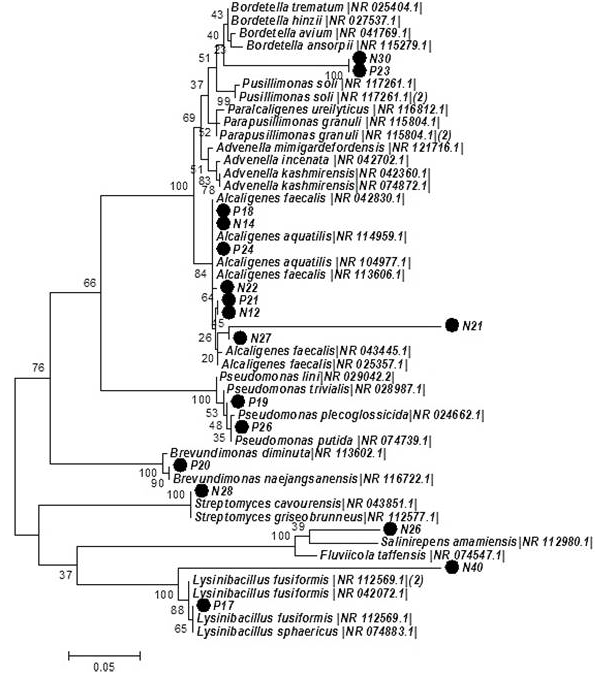
Phylogenetic tree of isolated bacterial strains.
References
- Amy, P., Haldeman, D., Ringelberg, D., Hall, D. and Russell, C., 1992. Comparison of identification systems for classification of bacteria isolated from water and endolithic habitats within the deep subsurface. Appl. environ. Microbiol., 58: 3367-3373.
- Ascaso, C. and Wierzchos, J., 2002. New approaches to the study of Antarctic lithobiontic microorganisms and their inorganic traces, and their application in the detection of life in Martian rocks. Int. Microbiol., 5: 215-222. https://doi.org/10.1007/s10123-002-0088-6[CrossRef]
- Banat, I.M., Franzetti, A., Gandolfi, I., Bestetti, G., Martinotti, M.G., Fracchia, L., Smyth, T.J. and Marchant, R., 2010. Microbial biosurfactants production, applications and future potential. Appl. Microbiol. Biotechnol., 87: 427-444. https://doi.org/10.1007/s00253-010-2589-0[CrossRef]
- Basavaraj, K., Chandrashekhara, S., Shamarez, A.M., Goudanavar, P.S. and Manvi, F.V., 2010. Isolation and morphological characterization of antibiotic producing actinomycetes. Trop. J. Pharm. Res., 9: 231-236. https://doi.org/10.4314/tjpr.v9i3.56282[CrossRef]
- Bell, R.A., 1993. Cryptoendolithic algae of hot semiarid lands and deserts. J. Phycol., 29: 133-139. https://doi.org/10.1111/j.0022-3646.1993.00133.x[CrossRef]
- Bell, R.A., Athey, P.V. and Sommerfeld, M.R., 1986. Cryptoendolithic algal communities of the Colorado Plateau. J. Phycol., 22: 429-435. https://doi.org/10.1111/j.1529-8817.1986.tb02485.x[CrossRef]
- Bhavnani, S.M. and Ballow, C.H., 2000. New agents for Gram-positive bacteria. Curr. Opin. Microbiol., 3: 528-534. https://doi.org/10.1016/S1369-5274(00)00134-X[CrossRef]
- Chang, C.C., Chen, W.C., Ho, T.F., Wu, H.S. and Wei, Y.H., 2011. Development of natural anti-tumor drugs by microorganisms. J. Biosci. Bioeng., 111: 501-511. https://doi.org/10.1016/j.jbiosc.2010.12.026[CrossRef]
- Chiellini, C., Miceli, E., Bacci, G., Fagorzi, C., Coppini, E., Fibbi, D. and Fani, R., 2018. Spatial structuring of bacterial communities in epilithic biofilms in the Acquarossa river (Italy). FEMS Microbiol. Ecol., 94: 181. https://doi.org/10.1093/femsec/fiy181[CrossRef]
- Cockell, C.S., Brack, A., Wynn-Williams, D.D., Baglioni, P., Brandstätter, F., Demets, R., Edwards, H.G., Gronstal, A.L., Kurat, G. and Lee, P., 2007. Interplanetary transfer of photosynthesis: An experimental demonstration of a selective dispersal filter in planetary island biogeography. Astrobiology, 7: 1-9. https://doi.org/10.1089/ast.2006.0038[CrossRef]
- Cockell, C.S., Lee, P., Broady, P., Lim, D.S., Osinski, G.R., Parnell, J., Koeberl, C., Pesonen, L. and Salminen, J., 2005. Effects of asteroid and comet impacts on habitats for lithophytic organisms- A synthesis. Meteorit. Planet. Sci., 40: 1901-1914. https://doi.org/10.1111/j.1945-5100.2005.tb00153.x[CrossRef]
- Cockell, C.S., Lee, P., Osinski, G., Horneck, G. and Broady, P., 2002. Impact-induced microbial endolithic habitats. Meteorit. Planet. Sci., 37: 1287-1298. https://doi.org/10.1111/j.1945-5100.2002.tb01029.x[CrossRef]
- Daughney, C.J., Rioux, J.P., Fortin, D. and Pichler, T., 2004. Laboratory investigation of the role of bacteria in the weathering of basalt near deep sea hydrothermal vents. Geomicrobiology, 21: 21-31. https://doi.org/10.1080/01490450490253437[CrossRef]
- De los Rios, A. and Ascaso, C., 2005. Contributions of in situ microscopy to the current understanding of stone biodeterioration. Int. Microbiol., 8: 181.
- Demain, A.L., 1998. Induction of microbial secondary metabolism. Int. Microbiol., 1: 259-264.
- Friedmann, E., Kappen, L., Meyer, M. and Nienow, J., 1993. Long-term productivity in the cryptoendolithic microbial community of the Ross Desert, Antarctica. Microb. Ecol., 25: 51-69. https://doi.org/10.1007/BF00182129[CrossRef]
- Friedmann, E.I., 1971. Light and scanning electron microscopy of the endolithic desert algal habitat. Phycologia, 10: 411-428. https://doi.org/10.2216/i0031-8884-10-4-411.1[CrossRef]
- Friedmann, E.I., 1982. Endolithic microorganisms in the Antarctic Cold Desert. Science, 215: 1045-1053. https://doi.org/10.1126/science.215.4536.1045[CrossRef]
- Gerrath, J., Gerrath, J., Matthes, U. and Larson, D., 2000. Endolithic algae and cyanobacteria from cliffs of the Niagara Escarpment, Ontario, Canada. Can. J. Bot., 78: 807-815. https://doi.org/10.1139/b00-042[CrossRef]
- Gram, L., Melchiorsen, J. and Bruhn, J.B., 2010. Antibacterial activity of marine culturable bacteria collected from a global sampling of ocean surface waters and surface swabs of marine organisms. Mar. Biotechnol., 12: 439-451. https://doi.org/10.1007/s10126-009-9233-y[CrossRef]
- Hackl, E., Zechmeister-Boltenstern, S., Bodrossy, L. and Sessitsch, A., 2004. Comparison of diversities and compositions of bacterial populations inhabiting natural forest soils. Appl. environ. Microbiol., 70: 5057-5065. https://doi.org/10.1128/AEM.70.9.5057-5065.2004[CrossRef]
- Harvey, A., 2000. Strategies for discovering drugs from previously unexplored natural products. Drug Discov. Today, 5: 294-300. https://doi.org/10.1016/S1359-6446(00)01511-7[CrossRef]
- Herrera, A., Cockell, C.S., Self., S., Blaxter, M., Reitner, J., Thorsteinsson, T., Arp, G., Dröse, W. and Tindle, A.G., 2009. A cryptoendolithic community in volcanic glass. Astrobiology, 9: 369-381. https://doi.org/10.1089/ast.2008.0278[CrossRef]
- Horath, T., Neu, T. and Bachofen, R., 2006. An endolithic microbial community in dolomite rock in central Switzerland: characterization by reflection spectroscopy, pigment analyses, scanning electron microscopy, and laser scanning microscopy. Microb. Ecol., 51: 353-364. https://doi.org/10.1007/s00248-006-9051-y[CrossRef]
- Hughes, K.A. and Lawley, B., 2003. A novel Antarctic microbial endolithic community within gypsum crusts. Environ. Microbiol., 5: 555-565. https://doi.org/10.1046/j.1462-2920.2003.00439.x[CrossRef]
- Jabeen, F., Muneer, B. and Qazi, J.I., 2019. Characterization of thermophilic bacteria Anoxybacillus rupiensis and cultivation in agroindustrial wastes isolated from hot spring in Chakwal, Pakistan. Pakistan J. Zool., 51: 1243-1250.
- Mason, O.U., Stingl, U., Wilhelm, L.J., Moeseneder, M.M., Meo-Savoie, D., Carol, A., Fisk, M.R. and Giovannoni, S.J., 2007. The phylogeny of endolithic microbes associated with marine basalts. Environ. Microbiol., 9: 2539-2550. https://doi.org/10.1111/j.1462-2920.2007.01372.x[CrossRef]
- Matthes, U., Turner, S.J. and Larson, D.W., 2001. Light attenuation by limestone rock and its constraint on the depth distribution of endolithic algae and cyanobacteria. Int. J. Pl. Sci., 162: 263-270. https://doi.org/10.1086/319570[CrossRef]
- Matthes-Sears, U., Gerrath, J. and Larson, D., 1999. Community structure of epilithic and endolithic algae and cyanobacteria on cliffs of the Niagara Escarpment. J. Veg. Sci., 10: 587-598. https://doi.org/10.2307/3237193[CrossRef]
- Muhammad, S.A., Ahmad, S. and Hameed, A., 2009. Antibiotic production by thermophilic bacillus specie sat-4. Pak. J. Pharm. Sci., 22: 339-345.
- Naphade, S.R., Durve, A.A., Bhot, M., Varghese, J. and Chandra, N., 2012. Isolation, characterization and identification of pesticide tolerating bacteria from garden soil. Eur. J. exp. Biol., 2: 1943-1951.
- Nicolaus, B., Kambourova, M. and Oner, E.T., 2010. Exopolysaccharides from extremophiles: From fundamentals to biotechnology. Environ. Technol., 31: 1145-1158. https://doi.org/10.1080/09593330903552094[CrossRef]
- Nofiani, R.N.S. and Sapar, A., 2009. Antimicrobial activities of methanol extract from unidentified sponge associated bacteria in Lemukutan Island, Kalimantan Barat. E-J. Ilmu Teknol. Kelaut Trop., 1: 33-41. https://doi.org/10.28930/jitkt.v1i2.7871[CrossRef]
- Norris, T.B. and Castenholz, R.W., 2006. Endolithic photosynthetic communities within ancient and recent travertine deposits in Yellowstone National Park. FEMS Microbiol. Eecol., 57: 470-483. https://doi.org/10.1111/j.1574-6941.2006.00134.x[CrossRef]
- Pandey, B., Ghimirel, P., Prasad, V., Thomas, M., Chan, Y. and Ozanick, S., 2002. Studies of the antimicrobial activity of the actinomycetes isolated from the Khumby region of Nepal. Department of Bacteriology, University of Wisconsin-Madison, Madison, Wisconsin.
- Parvathi, A., Krishna, K., Jose, J., Joseph, N. and Nair, S., 2009. Biochemical and molecular characterization of Bacillus pumilus isolated from coastal environment in Cochin, India. Braz. J. Microbiol., 40: 269-275. https://doi.org/10.1590/S1517-83822009000200012[CrossRef]
- Pathania, R. and Brown, E.D., 2008. Small and lethal: Searching for new antibacterial compounds with novel modes of action This paper is one of a selection of papers published in this special issue, entitled CSBMCB-systems and chemical biology, and has undergone the journal’s usual peer review process. Biochem. Cell Biol., 86: 111-115. https://doi.org/10.1139/O08-011[CrossRef]
- Pedersen, K., 1997. Microbial life in deep granitic rock. FEMS Microbiol. Rev., 20: 399-414. https://doi.org/10.1111/j.1574-6976.1997.tb00325.x[CrossRef]
- Pentecost, A., 1992. Growth and distribution of endolithic algae in some North Yorkshire streams (UK). Br. Phycol. J., 27: 145-151. https://doi.org/10.1080/00071619200650151[CrossRef]
- Pentecost, A., Bayari, S. and Yesertener, C., 1997. Phototrophic microorganisms of the Pamukkale travertine, Turkey: Their distribution and influence on travertine deposition. Geomicrobiology, 14: 269-283. https://doi.org/10.1080/01490459709378052[CrossRef]
- Rafiq, M., Hayat, M., Zada, S., Sajjad, W., Hassan, N. and Hasan, F., 2018. Geochemistry and bacterial recovery from Hindu Kush Range glacier and their potential for metal resistance and antibiotic production. Geomicrobiol. J., 36: 326-338. https://doi.org/10.1080/01490451.2018.1551947[CrossRef]
- Riley, M.A. and Wertz, J.E., 2002. Bacteriocins: Evolution, ecology, and application. Annu. Rev. Microbiol., 56: 117-137. https://doi.org/10.1146/annurev.micro.56.012302.161024[CrossRef]
- Russell, R.J., Gerike, U., Danson, M.J., Hough, D.W. and Taylor, G.L., 1998. Structural adaptations of the cold-active citrate synthase from an Antarctic bacterium. Structure, 6: 351-361. https://doi.org/10.1016/S0969-2126(98)00037-9[CrossRef]
- Sajjad, W., Bhatti, T.M., Hasan, F. and Shah, A.A., 2015. Characterization of heterotrophic and mixotrophic acidophilic bacteria isolated from black shale and acid mine drainage, Khala Chatta, Haripur, Pakistan. Int. J. Biosci., 6: 62-70. https://doi.org/10.12692/ijb/6.8.62-70[CrossRef]
- Sánchez, L.A., Gómez, F.F. and Delgado, O.D., 2009. Cold-adapted microorganisms as a source of new antimicrobials. Extremophiles, 13: 111-120. https://doi.org/10.1007/s00792-008-0203-5[CrossRef]
- Scheerer, S., Ortega-Morales, O. and Gaylarde, C., 2009. Microbial deterioration of stone monuments-an updated overview. Adv. appl. Microbiol., 66: 97-139. https://doi.org/10.1016/S0065-2164(08)00805-8[CrossRef]
- Singh, G., Bhalla, A. and Ralhan, P.K., 2011. Extremophiles and extremozyrnes: Importance in current biotechnology. Bioflux, 3: 46-54.
- Singh, O. and Gabani, P., 2011. Extremophiles: radiation resistance microbial reserves and therapeutic implications. J. appl. Microbiol., 110: 851-861. https://doi.org/10.1111/j.1365-2672.2011.04971.x[CrossRef]
- Singh, V., Praveen, V., Banga, J. and Tripathi, C., 2009. Antimicrobial activities of microbial strains isolated from soil of stressed ecological niches of Eastern Uttar Pradesh, India. Indian J. exp. Biol., 47: 298-303.
- Thorseth, I., Furnes, H. and Heldal, M., 1992. The importance of microbiological activity in the alteration of natural basaltic glass. Geochim. Cosmochim. Acta, 56: 845-850. https://doi.org/10.1016/0016-7037(92)90104-Q[CrossRef]
- Uzair, B., Ahmeda, N., Mohammadb, F.V., Ahmadb, V.U. and Edwards, D., 2009. Screening of marine bacteria of Pakistan coast for drug discovery potential. Proc. Pakistan Acad. Sci., 46: 137-144.
- Villar, S.E.J., Edwards, H.G. and Benning, L.G., 2006. Raman spectroscopic and scanning electron microscopic analysis of a novel biological colonisation of volcanic rocks. Icarus, 184: 158-169. https://doi.org/10.1016/j.icarus.2006.04.009[CrossRef]
- Walker, J.J. and Pace, N.R., 2007. Endolithic microbial ecosystems. Annu. Rev. Microbiol., 61: 331-347. https://doi.org/10.1146/annurev.micro.61.080706.093302[CrossRef]
- Walker., J.J., Spear, J.R. and Pace, N.R., 2005. Geobiology of a microbial endolithic community in the Yellowstone geothermal environment. Nature, 434: 1011. https://doi.org/10.1038/nature03447[CrossRef]
- Weber, B., Wessels, D. and Büdel, B., 1996. Biology and ecology of cryptoendolithic cyanobacteria of a sandstone outcrop in the Northern Province, South Africa. Arch. Hydrobiol., 117: 565-580. https://doi.org/10.1127/algol_stud/83/1996/565[CrossRef]
- Whitton, B. and Potts, M., 1982. Marine littoral. Biol. Cyanobact., 19: 515-542.
- Wierzchos, J. and Ascaso, C., 2001. Life, decay and fossilisation of endolithic microorganisms from the Ross Desert, Antarctica. Polar Biol., 24: 863-868. https://doi.org/10.1007/s003000100296[CrossRef]
- Wierzchos, J., Ascaso, C. and McKay, C.P., 2006. Endolithic cyanobacteria in halite rocks from the hyperarid core of the Atacama Desert. Astrobiology, 6: 415-422. https://doi.org/10.1089/ast.2006.6.415[CrossRef]
- Yang, S.H., Tandon, K., Lu, C.Y., Wada, N., Shih, C.J., Hsiao, S.S.Y. and Denis, V., 2019. Metagenomic, phylogenetic, and functional characterization of predominant endolithic green sulfur bacteria in the coral Isopora palifera. Microbiome, 7: 3. https://doi.org/10.1186/s40168-018-0616-z[CrossRef]
- Yeaman, M.R. and Yount, N.Y., 2003. Mechanisms of antimicrobial peptide action and resistance. Pharmacol. Rev., 55: 27-55. https://doi.org/10.1124/pr.55.1.2[CrossRef]
Services
Article usage statistics
Loading…