
The identification of dusky cotton bug, Oxycarenus hyalinipennis (Hemiptera:Lygaeidae) is difficult because of its close resemblance to other bugs of genus Oxycarenus. Molecular identification and characterization of dusky cotton bug (DCB), Oxycarenus hyalinipennis (Oxycarenidae: Hemiptera) was done through Polymerase chain reaction and sequencing. In PCR, mitochondrial cytochrome oxidase I (COI) gene based primers were used for identification of this pest collected from various cotton fields in Punjab. Phylogenetic analysis was also complemented to differentiate DCB identified from other countries of the world. The PCR bands obtained in gel electrophoresis amplified PCR fragments from all DCB species at 710 bp. The sequencing results and phylogenetic analysis with sequences submitted at NCBI database revealed that DCB have 99-100% similarity with Oxycarenus hyalinipennis OH1 (JQ342987.1), Oxycarenus hyalinipennis OH2 (JQ342988.1) reported from USA. This is the first report of molecular identification and DNA barcoding of Oxycarenus hyalinipennis infesting cotton from Pakistan. DCB is becoming alarming pest, so, this study will be highly helpful to observe DCB correct identification for management.
Short Communication · Volume 51, Issue 2, 10 March 2019 · Open Access
Molecular Identification and Sequence Analysis of Dusky Cotton Bug, Oxycarenus hyalinipennis (Hemiptera:Lygaiedae) Infesting Cotton Field in Pakistan
· · · ·
Affiliations & Notes ⌄
- 1Integrated Genomics, Cellular, Developmental and Biotechnology Laboratory, PARS, Department of Entomology, University of Agriculture, Faisalabad 2Plant Molecular Biology and Biotechnology Laboratory, PARS, Department of Botany, University of Agriculture, Faisalabad 3Institute of Agricultural sciences, Punjab University, Lahore , * Corresponding authors: jam.ahmad@uaf.edu.pk
- 2samina.tanwir@uaf.edu.pk
Article Info ⌄
- Journal:
- Pakistan Journal of Zoology
- Published:
- 10 March 2019

From the article
- In base pair sequence alignment, homology of DCB spp. was compared with previously reported NCBI database through BLAST option.
- Pairwise alignment of dendrogram tree indicated that our dusky cotton bug Seq (>180220-034-O01-8-DCB-HCO-2198.ab1) or Seq (>180220-034-O01-8-DCB-LCO-1490.ab1) share same cluster with Oxycarenus.
- The pairwise phylolenetic tree (Fig. 2) indicated that all the species belonging to Oxycarenus being clustered together with high query coverage score 97-99.
- As we expected, our entry Oxycarenus hyalinipennis (605bp) was found to be clustered with the same species of members of the genus Oxycarenus showing 99-100% sequence similarity with.
Selected from the article's own text.
Abstract
Materials and methods
Hand picking of dusky cotton bug (DCB) was done during 2017-2018 in cotton at Post Graduate Agriculture Research Centre, Faisalabad, Department of Horticulture, University of Agriculture Faisalabad as well as AARI Faisalabad and CCRI Multan. Adult specimens of were collected from infested opened bolls of cotton. Before proceeding molecular identification, morphological study of the species was carried out under laboratory using light microscope. Some of the collected specimens were preserved in 96% alcohol or either stored at −20 °C in a freezer or prior to analysis.
For molecular study, total genomic DNA from whole body of insect or parts of adult body (legs) of DCB was extracted using CTAB method with slight modifications to increase DNA yield ; 2018). Mitochondrial cytochrome oxidase I (mtCOI) based primers were used for PCR. PCR amplifications were performed in PCR machine (Peqstar, Germany) for primers (LCO-1490 (5´-GGTCAACAAATCATAAAGATATTGG-3´) and H C O - 2 1 9 8 ( 5 ´ -TAAACTTCAGGGTGACCAAAAAATCA-3´) conditions as described by Folmer et al. (1994). Simply, an initial denaturation at 95 °C for 5 min, 40 cycles at 94 °C for 40 sec, 47 °C for 40 sec, extension at 72 °C for 45 min and final extension at 72 °C for 15 min. The amplified PCR products were tested for the confirmation of genomic DNA presence using gel electrophoresis on 2.0% agarose gel. The required size of DNA fragment from fruit fly samples was estimated by comparing with 1 kb DNA ladder markers (GeneMark). The amplified band corresponding to the target PCR product was documented using SYNGENE Gel documentation system under UV light. The amplified PCR products (710 bp) were sequenced directly in both directions using services of M/S Macrogen (Korea) with primers (LCO-1490/HCO-2198) after purification with a QIAquick PCR Purification Kit (QIAGEN, Valencia, CA). The obtained sequences were analyzed using Lasergene v. 7.1 software package (DNASTAR, USA) and were further aligned using CLUSTAL W method of Bio-Edit software. Comparison of obtained sequences with sequences available in GenBank was accomplished using BLAST (Basic Local Alignment Search Tool)service available at http://www.ncbi.nlm.nih.gov:80/BLAST. Pairwise alignment tree for our samples sequence query (dendrogram) was constructed with NCBI data base available. The studies were performed with software BLASTN 2.8.0+ employing a methodology for pairwise alignment for the construction of phylogenetic tree. The evolutionary history was inferred by using the maximum likelihood method based on the Tamura-Nei model . Evolutionary analyses were conducted in MEGA6 .
Results and discussion
The nucleotide sequencing of DNA fragments were analyzed and aligned through BLASTN with sequence data of DCB previously reported in NCBI site (Fig. 1). The reference accession numbers of sequences used for alignment were DCB (HQ908084.1, JQ342988.1), (KM022344.1, KM023038.1, KJ541660.1, HQ105989, KM021657.1, KR918399.1 and KX053389.1. In base pair sequence alignment, homology of DCB spp. was compared with previously reported NCBI database through BLAST option. Pairwise alignment of dendrogram tree indicated that our dusky cotton bug Seq (>180220-034-O01-8-DCB-HCO-2198.ab1) or Seq (>180220-034-O01-8-DCB-LCO-1490.ab1) share same cluster with Oxycarenus
hyalinipennis OH-1 (JQ342987.1), Oxycarenus hyalinipennis OH2 (JQ342988.1) isolates and Oxycarenus laetus (HQ908084.1) while other species (Oxycarenus lavaterae and Oxycarenus modestus, Oxycarenus pallens) of same genus have separate clusters (Figs. 2, 3). In homology sequence study, DCB showed 100% similarity with themselves and 100% and 99% similarity with NCBI GenBank database, Oxycarenus hyalinipennis OH-1 (JQ342987.1), Oxycarenus hyalinipennis OH2 (JQ342988.1), respectively with 97-99 % good query coverage while 99 % similarity was observed for Oxycarenus laetus (HQ908084.1). The pairwise alignment also showed 87 to 94 % homology with other species of same genus (Accession numbers: KM022344.1, KM023038.1, KJ541660.1, HQ105989, KM021657.1) and 86% similarity for other Hemiprerans (KR918399.1, KX053389.1) (Table I).
The pairwise alignment of nucleotides indicated a very high and significant match confirming our sequence to be a part of Cytochrome C Oxidase subunit1 family with good query coverage (Fig. 1). The amplified sequenced segment of COI was closely related to insect species from the Order Hemiptera by using BLAST search (Figs. 2, 3). The pairwise phylolenetic tree (Fig. 2) indicated that all the species belonging to Oxycarenus being clustered together with high query coverage score 97-99. As we expected, our entry Oxycarenus hyalinipennis (605bp) was found to be clustered with the same species of members of the genus Oxycarenus showing 99-100% sequence similarity with
Table I.- Comparison and identity of fragment of the cytochrome oxidase I (COI) gene of Oxycarenus hyalinipennis of major cotton growing districts of Punjab with that of referred gene bank available in NCBI.
| Query | Subject | Max score | Total score | Query cover | E. value | Identity | Accessions |
| >180220-034_E01_3-FF-C_H_C_O_-_2_1_9_8.ab1 | Oxycarenus hyalinipennis OH-1 | 942 | 942 | 97% | 0.0 | 100% | JQ342987.1 |
| Oxycarenus hyalinipennis OH-2 | 937 | 937 | 97% | 0.0 | 99% | JQ342988.1 | |
| Oxycarenus laetus cytochrome oxidas | 1067 | 1067 | 99% | 0.0 | 99% | HQ908084.1 | |
| Oxycarenus lavaterae BFB | 928 | 928 | 100% | 0.0 | 94% | KM023038.1 | |
| Oxycarenus lavaterae BFB | 893 | 893 | 95% | 0.0 | 94% | KM022344.1 | |
| Oxycarenus modestus JSTR00275 | 735 | 735 | 99% | 0.0 | 87% | KJ541660.1 | |
| Neoneides muticus voucher CNC-HEM-0916 | 726 | 726 | 99% | 0.0 | 87% | HQ105989.1 | |
| Oxycarenus pallens BFB_Heteroptera | 717 | 717 | 99% | 0.0 | 87% | KM021657.1 | |
| Harmostes reflexulus BIOUG07896-A02 | 706 | 706 | 96% | 0.0 | 87% | KR918399.1 | |
| Hemiptera sp. sc-02411 | 695 | 695 | 98% | 0.0 | 86% | KX053389.1 |
Oxycarenus hyalinipennis reported from USA . Oxycarenus laetus has been reported and identified from India using (COI) based primers showing 99% similarity . Currently morphological based identification methods for DCB complex are time consuming and technically difficult for closely related species. Further, for most of the adult and immature stages, diagnostic morphological characters are not completely suitable .
Conclusion
Our sequence will serve as an exclusive DNA barcode for this species. This is probably the first report of molecular identification of this insect from Pakistan.
Acknowledgements
Authors are thankful to HEC (Pakistan) and FICP (Norway) for providing funds for this work.
Statement of conflict of interest
Authors have declared no conflict of interest.
Figures
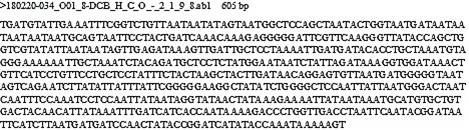
Nucleotide sequence of the PCR amplified mitochondrial cytochrome C oxidase subunit I (COI) of dusky cotton bug
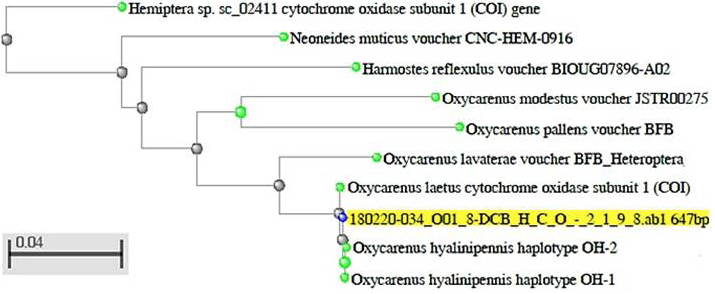
Pairwise alignment of constructed tree based on cytochrome oxidase I (COI) gene sequence of dusky cotton bug (Oxycarenus hyalinipennis) from Pakistan.
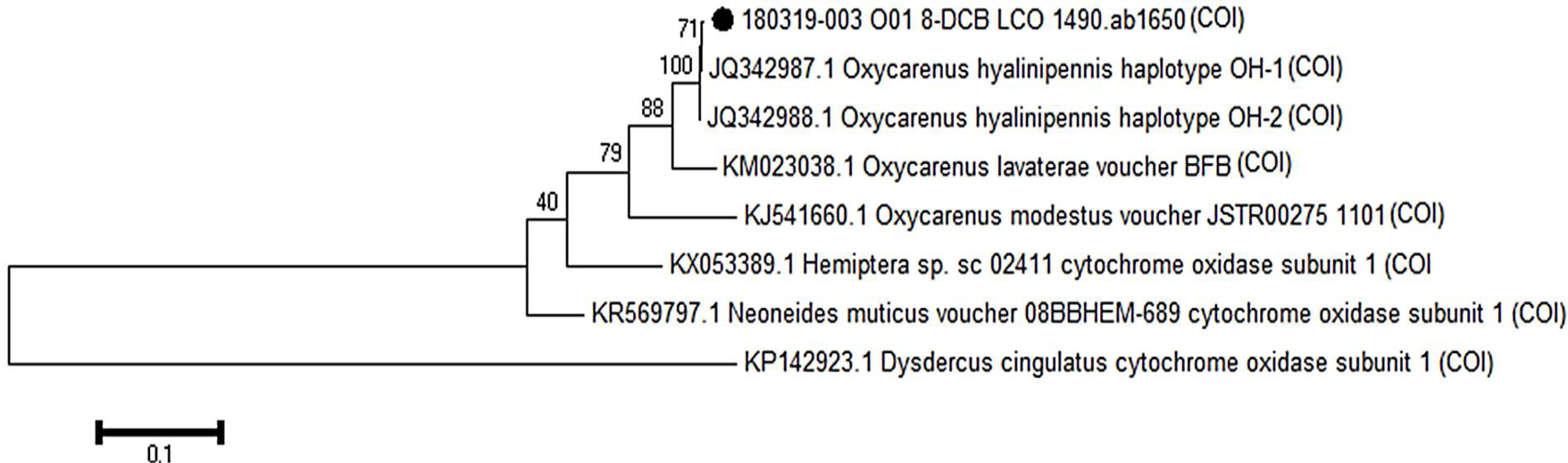
Multiple alignment of constructed tree based on cytochrome oxidase I (COI) gene sequence of dusky cotton bug (Oxycarenus hyalinipennis) collected from Pakistan with high scored NCBI gene bank data available.
References
- Ahmad, J.N., Ahmad, S.J.N., Ahmad, M.A., Contaldo, N., Paltrinieri, S. and Bertaccini, A., 2017. Eur. J. Pl. Pathol., 149: 117-125. https://doi.org/10.1007/s10658-017-1170-4[CrossRef]
- Ahmad, J.N., Mushtaq, R., Ahmad, S.J.N., Maqsood, S., Ahuja, I. and Bones, M.A., 2018. Pakistan J. Zool., 50: 2229-2237
- Awan, A.R., 2013. Top 10 insect pests of cotton in Pakistan. Agriculture Information Bank. http.//agri info bank biog.com/2013/10/top-10-insect-pests-of-cotton-in html
- Felsenstein, J., 1985. Evolution, 39: 783-791. https://doi.org/10.1111/j.1558-5646.1985.tb00420.x[CrossRef]
- Folmer, O., Black, M., Hoeh, W., Lutz, R. and Vrijenhoek, R., 1994. Mol. Mar. Biol. Biotechnol., 3: 294-299.
- Abbas, G., Hassan, N., Farhan, M., Ikramul-Haq and Karar, H., 2016. Am.-Eur. J. Agric. environ. Sci., 15: 170-176.
- Hajibabaei, M., Janzen, D.H., Burns, J.M., Hallwachs, W. and Hebert, P.D.N., 2006. Proc. natl. Acad. Sci., 103: 968-971. https://doi.org/10.1073/pnas.0510466103[CrossRef]
- Habeeb, S.K.M. and Sanjayan, K.P., 2011. Int. J. Pl. Anim. environ. Sci., 1: 85-92.
- Hebert, P.D.N., Penton, E.H., Burns. J.M., Janzen, D.H. and Hallwachs, W., 2004. Proc. natl. Acad. Sci., 101: 14812-14817. https://doi.org/10.1073/pnas.0406166101[CrossRef]
- Hebert, P.D.N. Stoeckle, M.Y. and Zemlak, T.S., 2004a. PLoS Biol., 2: e312. https://doi.org/10.1371/journal.pbio.0020312[CrossRef]
- Hebert, P.D.N. and Gregory, T.R., 2005. System. Biol., 54: 852-859. https://doi.org/10.1080/10635150500354886[CrossRef]
- Nagoshi, R.N., Paraiso, P., Brambila, J. and Kairo, M.T., 2012. Fl. Entomol., 95: 1174-1181. https://doi.org/10.1653/024.095.0448[CrossRef]
- Sewify, G.H. and Semeda, A.M., 1993. Bull. Facul. Agric. Univ. Cairo, 44: 445-452.
- Smith, M.A., Rodriguez, J.J., Whitfield, J.B., Deans, A.R., Janzen, D.H., Hallwachs, W. and Hebert, P.D.N., 2008. Proc. natl. Acad. Sci., 105: 12359-12364. https://doi.org/10.1073/pnas.0805319105[CrossRef]
- Sweet, M.H. II., 2000. In: Heteroptera of economic importance (eds. C.W. Schaefer and A.R. Panizzi). CRC, Boca Raton, pp. 143-264. https://doi.org/10.1201/9781420041859.ch6[CrossRef]
- Shah, Z.U., Amjad, A., Ibrar-ul-Haq and Hafeez, F., 2016. J. Ent. Zool. Stud., 4: 228-233.
- Tamura, K. and Nei, M., 1993. Mol. Biol. Evol., 10:512-526.
- Tamura, K., Stecher, G., Peterson, D., Filipski, A. and Kumar, S., 2013. Mol. Biol. Evol., 30: 2725-2729.
- Tembe, S.S., Gaikwad, S.S., Shouche, Y.S. and Ghate, H.V., 2009. Barcoding true bug species of India. Third International Barcode of Life Conference, Mexico City.
- Vennila, S., Biradar, V.K., Sabesh, M. and Bambawale, O.M., 2007. Stainers (red and dusky cotton bugs), crop protection folder series by central Institute for cotton research. Maharashtra.
- White, I.M. and Elson-Harris, M., 1992. Fruit flies of economic significance: Their identification and bionomics. CAB International, Wallingford, Oxon, UK.
Cited by 2 articles
In journals published by ResearchersLinks.
- Sub-lethal Dose Reponses of Native Polyhydroviruses and Spinosad for Economical and Sustainable Management of Spodoptera litura in PakistanPakistan Journal of Zoology · 2020
- Molecular Study on Field Evolved Resistance of Red Palm Weevil (Rhynchophorus ferruginous) and its Management through RNAiPakistan Journal of Zoology · 2020
Services
Article usage statistics
Loading…